
(Warning: There is absolutely no talk of religion or Mormonism in the post)
I bet you all think that Bishop Bill sits around listening to Mormon themed podcasts and reading Mormon history books all day (besides talking about himself in the third person). I do read other books, and last week I read a book called “Born to Walk” by Mark Sisson. The subtitle pretty well sums up his book: The Broken Promises of the Running Boom, and How to Slow Down and Get Healthy—One Step at a Time.
Sisson’s background is he did a pre-med degree in biology, then instead of going to med school he went into competitive distance running. He ran a 2:19 marathon and was 5th at the World Ironman in Kona Hawaii. That marathon time is world class level, and the Ironman is a 2.4-mile swim, 112-mile bike, and 26.2-mile run, all in under 8 hours to finish in the top. But Sisson realized he was not healthy: his knees and hips hurt, he caught colds frequently, and he was diagnosed with heart problems directly related to his running.
He is now 73 years old, and has not run over a mile in the last 30 years, and says he is in the best health of his life. The major premise of his book is that humans were never meant to run long distances. Through out the history of homo sapiens spanning hundreds of thousands of years, there was never a need for endurance running. We did not evolve to run long distances. We did need to be able to sprint from time to time, to either catch some food, or escape from becoming food. We evolved to walk. Our feet, legs, knees, and hips are built to walk, not run.
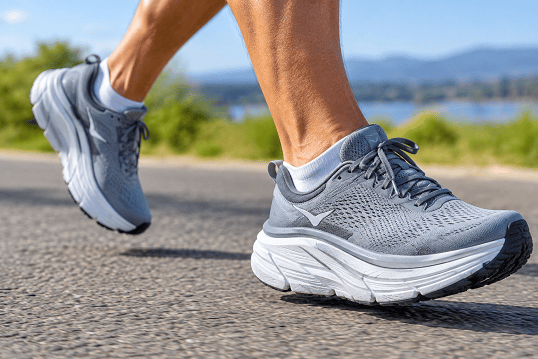
He goes into great detail and is very passionate about how the running shoe industry is actually hurting us with the fat heals and high elevation heal vs the toes. The thick heal promotes running with a heal strike, which we have been doing since the mid 1970’s and the invention of the first shoe specifically build for long distance running (we’re looking at you Nike). Since for most of human history we didn’t wear shoes, or if we did there was little or no cushion in the heal, we had to run with a with a midfoot strike. After I read the book I wend outside barefoot, and ran down the sidewalk. It was intuitive to run with a fore/mid foot strike. He promoted either running barefoot, or with one of the minimalists shoes available. This part I took with a grain of salt as he has his own minimalist shoe company.
Sisson talked about how running causes stress on the body, in the same why that a stressful day of work or a fight with your spouse would. It raises cortisol in the body which leads to inflammation. Why would you do that on purpose? Also with this he recommended to never let your heart rate get out of the fat burning zone and into the glucose/lactate burning zone. The body switches from fat to glucose at about 60-70% of the max heart rate. For example, max heart rate is 220 minus age, so for old Bishop Bill, my rate would be 220-69=151. 60-70% of that is 90-105. I can usually get that with a brisk walk.
Speaking of walking, Sisson’s recommended exercise is walking every day (30-60 min), weight lifting twice a week, and doing sprints once a week. The sprints can be running, bicycling, swimming, or anything similar. He recommends jogging for a few minutes, when sprinting as hard as you can for 20 seconds, then back to jogging until you are fully recovered (5 min or so). This is not High Intensity Interval Training (HIIT), as you take longer to do a full recovery before your next sprint.
So what do you think of this?
What are some of your exercise routines?
Are any of you endurance runners? What is your rebuttal to Sisson’s ideas?


I have run many marathons and in fact ran the St. George Marathon just yesterday. I find running to be very beneficial both physically and mentally. But I won’t bore readers with the details.
But since this is an LDS / x-LDS reader board let me share something that some of you will find humorous about the St. George Marathon. It always takes place the first Sat. in October a.k.a. General Conference Saturday. And when I was a TBM my annual routine was very simple. I would run the marathon in the morning, get back to the hotel as quickly as possible to listen to most of the Sat. AM session, watch college football from 12-2, then watch the afternoon session from 2-4, then more college football, then head over to a local stake center for the priesthood session, then back to the hotel for late night college football. As a TBM and college football fanatic, this was one of the true joyful days of my year (especially if I did well in the marathon). (my wife stayed in SLC to run the kids to soccer games, etc. so the day was mine)
My routine has changed a bit. My wife travels to the race to support me so we spend time eating lunch out, etc. but there’s still plenty of college football but not a whole lot of GC (i.e., none) and of course the priesthood session doesn’t exist. Tuns out that my running has outlived GC in terms of its utility in my life. Who would have guessed?
Ha! I am vindicated! I tried to be a runner. Back in college, I entered a 5k and came in dead last in my age category by several minutes. I finished the race along with people who were as old as I am now. That was the end of my attempt to be a runner.
I have a good friend who runs those 100-mile races and really enjoys them.
As I get older, I’m noticing that people who did a lot of exercising in the 80s and 90s are seeing some negative health effects. Aerobics was big in about that same time period. I’m in an exercise class designed for post-menopausal women (upper body strength training and bone density exercises). It’s all very low impact. One of the women was an enthusiastic aerobics queen in her younger years, and she’s needed multiple surgeries for exercise-related injuries that turned into chronic pain as she got older.
That failed race did my health a favor. I’ve always enjoyed walking and the older I get, the more grateful I am that walking has been my exercise of choice.
Nah. I started running when I was 35 because overweight and high cholesterol. My first race I paid to enter was a marathon that I did in 4:46. I switched to trail and ultra running because the scenery its more enjoyable than road running. I’m now 52 and have run over forty races up to and over marathon length. I’m ideal body weight and bloodwork numbers now and had made many wonderful friends through running. The only overuse injury I’ve had was plantar fasciitis, which my doctor said was more related to walking barefoot on tile than running.
I don’t think my experience will be true for everyone, just like not everyone will find contentment in cycling, weight lifting, swimming, or bowling. Honestly I think as long as you’re moving and connecting with others, you’ll get many of the same benefits as running. Find something that fits your budget and interests and you’ll be fine, but running is *not* inherently bad for humans.
Put this prompt in your favorite AI app:
“What is prevailing evidence that running is good or bad for your body, including knees, heart, feet, hips, and mental state. Is there evidence that moderate running up to marathon distance is healthy?”
I trained for a half-marathon 18 years ago, along with a bit of circuit training and Tae-Bo. I did it mainly for weight loss. Surprisingly, I rarely bothered to weigh myself throughout the process (as newlyweds I don’t think we bought a scale the first two or three years of our marriage), but as someone more conscious of it now, I’d estimate I lost 30 to 40 pounds. I ended up being 13 pounds below the weight I was for most all of high school. At the half-marathon I placed 7th in my age category and 52nd overall.
I’ve been running about three times since then.
My work schedule doesn’t make planned exercise more convenient to do more than once or twice a week (although I average anywhere from 8000-16000 steps at work), but I try to make the most of it. I’ve read walking 50 minutes, 3mph, on a 10 degree incline can burn more fat than a 20 minute hard run, so I do some of that. I do regular walking. I’m a huge fan of a VR exercise program called Supernatural and do a lot of that. Doesn’t even feel like exercise–at least, not until the next morning. It does give you a bit of tennis elbow. I need to start implementing more resistance training. And as far as doing it for weight, I realize my diet is far more impactful. I’ve also realized recently that I’m in need of a lot more protein than I thought I needed.
I’ve also read that man can run better barefoot, but some pushback could be that on an evolutionary timeline, we’ve only been on concrete for a few seconds. I’ve also read that cushioning shoes don’t really soften the impact, just how we feel it. There’s so much conflicting information in this area.
I do think Mosiah 4:27 can be aptly applied to exercise.
It depends on the individual. I think Mark was a bit too competitive and that may have had something to do with his getting injured too often. I ran until I was 80 years old and then had to stick to walking because of knee cartilage problems. But up until 80 jogging was possible and I enjoyed it. You have to walk a lot further to get the same benefit as running, I think. At age 79, my coronary calcium score was zero, which is quite unusual, and I attribute it is a lifetime of running/jogging. A half marathon is the longest race I ever ran, and it was not at a competitive time. Pushing yourself and competing is what brings on injuries, I think. Lots of recreational joggers don’t have many injury problems. But certainly walking will suffice if that is what you enjoy, and I agree with Mark about doing some weight training. I also do Yoga, which is valuable.
And what would Mark Sisson have us do? Sit around eating Irish nachos and drinking German beer while watching hot dog eating contests on television? That is not the way to health.
Humans have always had to run. Whether from a wolf or a bear or a menacing neighbor. Indeed, there would be no humans on this planet if they had not been able to run.
I condemn the laziness and sloth that modern popular culture promotes. Sisson would apparently support this culture and call for a Dairy Queen or 7-Eleven on every corner.
Janey, I’m with you, I can’t run. I remember trying out for cross country in primary school. I tried to convince myself I could do this. I ran my heart out. I finished dead last, face hot and purple, and tasting blood in my mouth and throat. It’s not like I was unfit. We literally walked 12 miles every Sunday for church. I tried jogging as a student, and quickly developed plantar fasciitis, which has been a problem off and on ever since. It seems I am very prone to soft tissue injury. Tore the fascia in my hand playing fortissimo octaves in Joplin (small hands, short thumbs), and the fascia in my foot slipping on wet grass in sandals.
My preferred exercise is cycling, as something I can do sitting down, and leaning on handlebars, but it’s starting to affect my knees, and my hands are finding the break levers a bit of a stretch since the injury.
I’m not surprised that so many readers of W&T are runners, or have found other ways to stay fit. I myself swim/surf, lift and bike, but no running. I think the same mentality that makes us look critically at the world and religion, also lets us examine out health in the same way.
My husband and I are in the age group called “paying for what you did when you were younger.” Old injuries that healed 30 years ago start to give you new problems. My husband just had back surgery for a pinched nerve. He had a few MRI’s and X-rays to determine what all was wrong. So, the discussion with the doctor is like, “the pinched nerve is probably from an old injury, any idea what you did?” And “when did you break L-2?” And, “what about breaking L-4?” He didn’t even know he had fractured bones in his back because he hurts himself and it hurts for a while and then heals. So, we figured out that the pinched nerve is probably playing in the surf with the YM & YW. They called it “chicken” and the YW got piggy back on either a male leader or another YM and then they tried to topple another YW off her “mount”, in the big waves. The broken vertebrae were probably falls flat on his back playing church ball. (See, I am trying this back into Mormonism too) I am starting to have back issues from a scuba diving related accident 30 years ago.
I have never been much of a runner because I have a tendency to plantar fasciitis due to high arches and tendency to walk barefoot all the time on tile floors and cement and so have too frequent plantar fasciitis. My diabetes doctor gets after me for going barefoot at home. But no, I will never give up going barefoot to give me a better chance at running without constant over use injuries.
And Eli is correct that cushioning shoes do not prevent the over use injuries of running on concrete.
And I have family that are addicted to running. ST George marathon was a regular for years for one until she left on a senior mission. Another does that 100 mile over the mountains in sleet and snow. We live (in summer) a mile or so from their finish line at 6,000 feet altitude and the sleet was coming down and it was too freezing to even go see our nephew come in. That nephew and his dad also do a relay race out on the salt flats. One niece does an uphill, that is more vertical than horizontal. Most of them are not overly competitive and winning isn’t worth risking injury
And my brother is a biker who doesn’t know when to quit because he is too competitive and has had several injuries.
I agree with Gebanks that it is being too competitive and pushing beyond your limits that leads to most injuries. We had a friend who had an injury and the doctor told him stay off it for two months. And two weeks later he is running on it, because he is addicted to runner’s high. So, of course it didn’t heal. Even my husband’s church basketball injuries was because he was so competitive.
Good post. Like Anna, I’m at the age where I’m seeing both the blessings and the curses of a lifetime of being active. I’m 60, an had been a runner since the time I was 12 years old. Steve Prefontaine and Frank Shorter were my first sports heroes as a kid, and I wanted to emulate them.
Speaking of the curses, I’ve had to completely give up running; some bodies can handle it just fine, but at 57, I started having intense sciatic pain and the doctors discovered that half of my L-5 vertebra was missing. I asked my doctor what could have caused that and he said “40 years of running on asphalt”. So now, after spinal fusion surgery, I don’t run. It’s been harder than I thought to no longer be able to do so. Truthfully, I was never a fast runner (my only marathon took me 5 hours to run), but averaged 35 miles a week for years, and I loved doing speed work (fartleks, running hills, etc.) I mourn the loss of it, but compared to the physical challenges that other people have, I consider myself quite lucky, so I just try to get on with things. I don’t walk (too boring, sorry), but I do 40 mins. of cardio 6 days a week on the recumbent bike, which is no strain on the back and easier on the knees, and lift heavy weights 6 days a week also. My wife’s PT says that building muscle mass is the number one thing to do to prevent injuries and protect joints as we age. YMMV, but it works for me.
They do say barefoot running is easier on the spine, in part because of how your foot lands and how the natural structure of the foot. I’ve been tempted to try it, but haven’t so far. Best of luck to us all as we try to delay the inevitable.
Is this a running blog now? All my dreams have come true!
I am not familiar with this book or Mark Sisson, so all I know is Bishop Bill’s description here, but a few things that jumped out at me.
First, the claim that humans were never meant to run long distances. Setting aside what it means for a species to be “meant” to do something (who means it?), plenty of experts believe that humans developed as persistence hunters who literally ran their prey to death. The idea is perhaps most well known from it’s inclusion in the very popular book “Born to Run” by Christopher McDougall. It seems hard to believe that Sisson wouldn’t be familiar with this book given it’s popularity when it came out and as the title of his book seems to be a nod to McDougall’s book. But just from a observational standpoint, it’s wild to argue that humans aren’t meant to run long distances when we’re literally one of the best species on earth at it. Humans can outrun horses at very long distances. Wolves and some dogs might outrun us in the cold, but on a warm day it’s really not that hard to outrun most dogs. (I’ve never personally tried running with wolves.) Whether evolution or God is behind it, why are we the best distance runners on the planet if we’re not meant to run?
Conversely, what prey are we able to hunt by sprinting? Maybe some larger aquatic birds that can’t get into the air very quickly? I could probably run down a goose or a duck. Smaller birds are only catchable if I can get within a couple feet; hardly a sprint. Small mammals are nearly all faster than me over sprinting distances. I can’t catch a cat, dog, fox, or even a mouse. Partly, this is because I’m slow, but also because I can’t run worth beans and be close to the ground to grab something that small. Even if I catch up to the raccoon, I’m going to come to a stop trying to grab it, so I’ll only get one shot at it. Bigger prey (deer, sheep, etc.) tend to be both faster than me, and way too much for me to handle even if I could catch it. Lizards, frogs, fish, reptiles, you name it, there aren’t that many mammals that humans can out sprint. And the ones we can (turtles, sloths, koalas) are so slow that I don’t really need to sprint at all.
Continuing on this thread, sprinting away from predators makes even less sense. Even Usain Bolt can’t sprint away from any large cat (lion, tiger, mountain lion, cheetah, leopard, panther) or a bear, wolf, coyote, hyena or wild dog. What animal large enough to take down a human can we run away from? Perhaps crocodiles, which have a good first step, but generally don’t pursue their prey more than one or two dozen yards.
As for minimalist footwear, McDougall beat him to that by 16 years. (Sisson’s book is 21 months old.) I wear minimalist shoes every day, and have for years. I run in zero-drop shoes and have for years. There has never been options for zero-drop, minimalist footwear than there are right now.
As for me, you’ll be shocked to learn that I’m a runner. I try to get about 40 miles per week in. My run club are my best friends. As I get more gray hair, I’m learning the benefit of running more easy miles, and I’ve stayed remarkably injury free for many years. (Knock on wood) Last year I ran the most miles yet. I might beat it this year, it’ll be close. Last week I ran my fastest mile ever, which is mostly a product of not having run a single, fast mile since high school.
I worked with someone who’s husband had recently died at a very young age running a marathon. I realize there are risks to anything, but I’ve never had much lung capacity and that anecdoctal evidence gives me an easy opt out from running.
While I much prefer walking, I thought I might mention Persistence Hunting and the endurance running hypothesis.
Furless humans sweat. Most prey animals do not. Many hunter gatherers keep pursuing until the animal conks out.
Paleoanthropologists who study hominin anatomy propose that evolution of us vs other apes can only be explained by running.
As someone with flat feet, I obviously took a detour from the evolutionary path.
Brother Sky, there are lots of what DaveW called “minimalist footwear”, which are shoes with zero drop from the heal to the toe, and very minimal cushioning on the bottom. You get all the benefits from running barefoot with the dirt or cuts! I have yet to try them, but I live by the beach so can run on sand when I feel the need.
As someone who is truly truly awful at ball sports, I’ve always gravitated towards other recreation and I love running, hiking, walking, bike riding, swimming, weight lifting, kayaking, and practicing yoga. These activities fill a lot of my free time and living in SoCal I can participate year round. But it’s mostly hiking and lifting weights.
And it turns out, other than maybe yoga, if you build bad habits around these activities, or if you become obsessed with them, they can be quite dangerous. My son’s high school hosts the largest XC match in the nation (shout out to the Woodbridge Classic) and as a volunteer, the things those kids do to get a PR at one of the fastest courses is ridiculous. Everyone told me swimming is the best option as it’s low impact but turns out if you have inverted ear drums like I do, too much swimming inevitably leads to all sorts of ear/sinus problems. People showing up in crocs and flip flips and jeans and baggy sweatshirts to deadlift would possibly make RFK Jr cringe. Don’t get me started on HS American football injuries.
2026 humanity makes everything a competition and I quite often have to remind myself on the bike trail and at the gym it’s ok that I’m slow or that I don’t look like everyone else if I’m having a good time and enjoying my time. The journey should be the destination.
Or to quote Elle Woods: “Exercise gives you endorphins. Endorphins make you happy. Happy people just don’t shoot their husbands, they just don’t!”
I took up cycling as a teenager. I do a fair amount of walking and a bit of running, but I like biking a lot more than running. Time has been harder to find in recent years and I find that makes cycling harder to do than walking or running, so I’ve not been doing as much.
I wonder if there’s a middle ground between “born to run” and “born to walk”. I would say nearly every human can do a lot of walking (assuming they meet a basic level of health) and walking is good for us and probably most of us would benefit from doing more than we are. I would say most humans can handle some level of running, but when you get into the realm of training for serious distance running, I just think perhaps it’s just not suited equally to all human bodies. Some will have joints that just start to break down when subjected to enough training. Some will benefit from barefoot style shoes. Some will benefit from the opposite. Maybe we should just stop making generalizations. To make a Mormon angle here, just like it bugs me when leaders generalize their personal experience and thus struggle to understand those who have had a different experience, perhaps authors of books about the “right way” to live a healthy life ought to consider whether they are overgeneralizing their personal experience.