
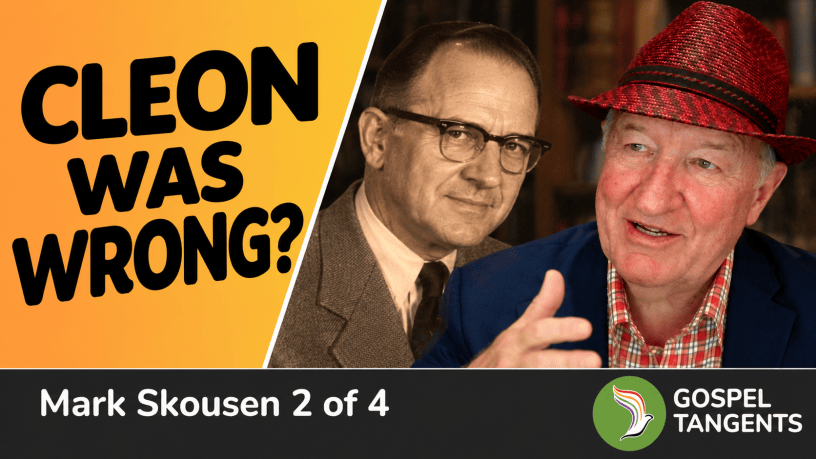
“Are you the famous Skousen?” Economist Mark Skousen says he hears that in nearly every ward he moves into, and the person almost always means his uncle, W. Cleon Skousen, the FBI veteran, former Salt Lake City police chief, and author of The Naked Communist. I had the same reaction when I first saw Mark at the John Whitmer Historical Association meetings. Put glasses on him and the family resemblance is hard to miss.
But Mark is not a copy of his uncle. He is a free-market economist who admires Cleon deeply and still disagrees with him on some big things: the John Birch Society, The Naked Capitalist, and whether Eisenhower was secretly helping the communists. He was also a self-described troublemaker at BYU in the 1960s and early 1970s.
BYU Troublemaker
Mark’s father, Leroy Skousen, lived a life that paralleled Cleon’s: lawyer, FBI man, committed anti-communist, father of a large family. When Leroy died of lung cancer at 46, Cleon stepped in as something like a father to Mark. He gave Mark a father’s blessing, visited the family’s home evenings in Provo, and later chose Mark as the only pallbearer from outside his immediate family. Mark and his wife Jo Ann went on to compile There Were Giants in the Land, built from Cleon’s roughly 150 journals so Cleon tells his own story.
Mark also is consulting on Benjamin Park’s forthcoming biography of Cleon, and Matthew Harris plans to include a surprisingly cordial meeting between Cleon and Hugh B. Brown in his upcoming book on Brown.
Mark arrived at BYU in fall 1965, and shares some of his experiences in the 1960s and 70s as a student. Raised on thrift, limited government and Ludwig von Mises, his first economics class assigned Paul Samuelson’s Keynesian textbook, which treated deficit spending as good recession policy. Mark went on local radio to criticize how economics was taught at “the Lord’s university” and wrote an exposé for the Daily Universe. He still earned the top grade, though his professor admitted that A was hard to give.
I was surprised to hear that Mark calls himself a liberal! He does it in the classical sense and would rather argue issues than sort people into camps. He gave an interesting example: Cleon and Salt Lake mayor J. Bracken Lee agreed on cutting taxes and shrinking government, yet Lee fired Cleon as police chief and they became bitter enemies.
Part 2: Was Adam Smith inspired of God?
This is where Mark parts ways with his uncle. He admires The Naked Communist as a serious warning about communism. He is much cooler on The Naked Capitalist, partly because of how it portrays figures like David Rockefeller. Mark interviewed Rockefeller while working for Forbes. He disagreed with Rockefeller’s support for bigger government, but didn’t see a sinister conspirator.
Mark also never joined the John Birch Society, and he calls founder Robert Welch’s claim that Eisenhower served communist interests outrageous. In Mark’s view, Eisenhower avoided direct confrontation with the Soviets because he believed their system was flawed enough to collapse without a nuclear war. Cleon defended the Birchers in a pamphlet, but Mark says Cleon never officially joined and eventually had a falling-out with the society.
While writing The Making of Modern Economics, Mark followed his mentor Murray Rothbard and drafted a largely negative chapter on economist Adam Smith. He handed it to Uncle Cleon for feedback. Without reading it, Cleon put an arm around him and said Smith’s invisible hand was inspired of God. So Mark read all 1,000 or so pages of The Wealth of Nations himself, decided Cleon was right, rewrote the chapter, restructured the book, and dedicated it to Cleon.
We also revisit the BYU spy ring under Ernest Wilkinson, Wilkinson’s ties to Ezra Taft Benson and the Foundation for Economic Education, and Mark’s own part in it. He says the students were naive and he wouldn’t do it today. He then makes a case for academic freedom, recalling Milton Friedman’s view that free-market economists shouldn’t dominate economics departments.
Part 3: Was Joseph Smith a socialist?
This one started with a poster. BYU economist Val Lamson made a chart of the schools of economic thought, and Mark was irritated to find Joseph Smith listed among the utopian socialists. When I pushed him, his answer got more interesting. He grants that Joseph briefly experimented with something like utopian socialism, but argues he moved toward a system that kept private property and individual stewardship. Drawing on Leonard Arrington, Mark prefers “communitarian” to “socialist.”
Why did the United Order fail? Mark’s answer is incentives. If members gave up all their surplus, why produce more than they needed? He compares it to a 100% marginal tax rate, and adds that most early Saints were poor, so there wasn’t much surplus to share anyway. He also leans on Marion G. Romney’s distinction between the United Order and socialism, which turns on private property and voluntary consecration.
Mark’s most surprising claim: tithing is closer to Adam Smith than to central planning. Members give 10% and keep control of the rest to save, invest, or start a business. The alternative is a bishop judging every family’s income and business decisions, which Mark thinks is unworkable.
He is also no fan of Joseph Smith’s plat for the City of Zion. He finds the uniform grid too rigid and thinks cities need variety and personality. I brought up David Hall’s New Vistas project as a modern attempt at Joseph’s plan. Mark’s favorite Joseph Smith line is the one about teaching correct principles and letting people govern themselves.
Historians and economists will push back on whether incentives alone explain the United Order’s struggles, and I’d love to hear that pushback in the comments.
What do you think?
- Can you admire someone deeply and still reject some of their best-known ideas, the way Mark does with Cleon?
- Was Cleon right that Adam Smith’s invisible hand was inspired of God?
- Was Joseph Smith a socialist, a capitalist, or something our modern labels don’t fit?
- Did the United Order fail because of incentives, or were other factors more important?
- Is tithing a successful adaptation of the law of consecration?
- Should BYU expose students to economic and political views the Church’s more conservative members dislike?


As I understand, Joseph Smith’s United Order and Brigham Young’s United Order were entirely different.
Joseph’s United Order was largely successful. It involved only a few people (Brigham Young never participated), was mostly kept secret, and its primary purpose was buying land for the church. It was akin to a corporation working toward corporate goals.
Brigham’s United Order was entirely different. It operated at the local level (not at the general church level), involved entire communities, and touched every aspect of those communities. It was akin to a communitarian kibbutz.
When speaking of the United Order, I think one needs to take care to specify whose United Order he or she is talking about.