
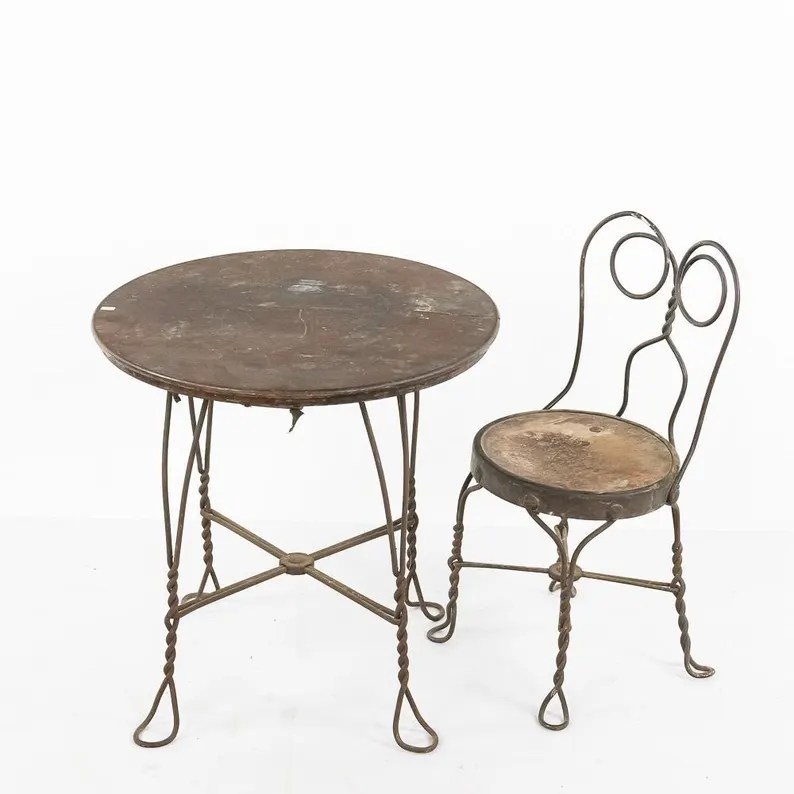
This week I’ve been working on a project to restore an antique child’s table and chair from my grandparents’ restaurant that went out of business during the Great Depression (very similar to the image on this post, with some slight differences–the metal on the back of the chair on mine is in a heart shape). There is a family photo of my mother as a toddler sitting in this chair during the late 1920s wearing a ridiculous snowsuit that makes her look like Ralphie’s little brother in A Christmas Story. This is the first time I’ve taken the lead on restoring a piece of antique furniture, although I helped my dad once or twice on things he was working on. He originally restored this table and chair for my mother in the 1980s after my grandparents died, painting the metalwork white and replacing the ruined tabletop with one he handcrafted. The chair seat is original as is nearly all the hardware. I noticed that the chair had a layer of red paint under the white which is almost certainly lead-based.
The concept of restoration is one that anyone raised in the church has had to think about to a certain extent. We are taught that Christianity had to be “restored” by Joseph Smith, and then we are asked to affirm that we believe this in temple recommend interviews. In every type of restoration, we are not creating something new. We are negotiating a relationship with what has been broken, altered or stripped away. We are preserving elements of the past while rendering them newly relevant or useful.
In the case of my antique table and chair, the process I am taking depends a lot on what I intend to do with the piece. I don’t intend for it to be used by children, for example. It’s mostly a display piece, as it was when I used it as a nightstand throughout my teen years. As a result, preserving the original hardware while eliminating rust is my prime objective. I will also be restoring the framing to a metallic color. But there’s nothing I can do about the tabletop having been ruined and replaced by my dad. Because I remember him making it, it actually holds sentimental value for me. And it’s not a piece I plan to sell. In fact, I’m involving my adult daughter in the restoration process, hoping she will want to keep it when I’m gone. I would love for this piece to be relevant in the story it tells about my parents and my grandparents, as well as the time they lived in history. If my purpose was simply to have a useful table and chair for a child, there would be no need to restore this piece. Something modern with drawers and other useful features, even built in technology, would be the ideal piece of furniture.
There’s a lot of discussion in politics about restoring our country to something from the past, a time some envision as “greater” than it is now. This is a similar mindset to that held by the Puritans who wanted a purer form of Christianity and came to Massachussetts to build a city on a hill that would be an example of what a Christian society run by a Christian government could be (cue ominous “Salem Witch Trials” music).
Additionally, as with religion and with historical artifacts, when we suffer a personal loss, we also have to work through our own restoration. This can be in the wake of trauma, but it’s also a part of the ongoing process of living a life. We incorporate our past to create our future. Whenever one is doing restoration work, there are some common mistakes to avoid:
The myth of a “flawless original.” This is also called the Restoration Paradox. We often try to sand down any flaws or damage until the piece looks brand new, but stripping away the natural wear and tear, color changes, and dents and dings destroys the item’s value by destroying its history. My dad’s replacement tabletop looks modern. It doesn’t look antique.
The danger of over-restoration. Sometimes amateurs (and I’m definitely not a pro) make the mistake of doing too much which strips away the soul of the piece. While I may be doing this by getting rid of the original red paint (which was already covered up), it seemed like a wise move since it lets me get to the original metal and protect it from rust while also getting rid of the lead paint chips that are flaking off. I also have a dining table that was a gift from my husband’s grandparents that has carved wooden legs that are really beautiful, but an amateur trying to restore these might sand away the contrasts and ruin the workmanship.
Hidden structural damage that requires deconstruction. Some pieces are no longer sound or have rot within the joints. Some have been stuck back together in haphazard ways that make the piece unstable. It’s important to deconstruct and fix these types of structural problems.
Integrating scars. A successful restoration will prize resilience over perfection. You need to incorporate scars or replace missing pieces, but this doesn’t mean that the replacement is not visible on inspection. I respect my dad’s choice to replace the flimsy water-damaged tabletop with a sturdy, much thicker resilient modern piece of his own making. He’s not trying to fool anyone. As a result the table will be useful for much longer, although a collector might devalue this change.
Looking at both the Puritans and the early Mormons, they made several of the same types of mistakes in trying to restore Christianity. Both became highly authoritarian and legalistic, creating a rigid zero-tolerance atmosphere for doubt that led to the Salem Witch Trials (Puritans) and blood atonement and Mountain Meadows Massacre (Mormons) during their low points. The only way to survive was to continue to restore, becoming more pluralistic and tolerant, loosening the authoritarian hold, and ceasing to punish dissenters.
Both Puritans and early Mormons failed to realize that human culture, philosophy and adaptation are not corruptions or external threats–they are what allows faith to survive in a complex world.
I’ll keep this post short today, but there’s a lot to think about here.
- Looking at the risks of restoration, how do you think the LDS church has fared? How has the US fared?
- Have you restored a piece of furniture? What did you learn from the process?
- Have you seen these cautions in your own life as you have grown and matured?
Discuss.

