
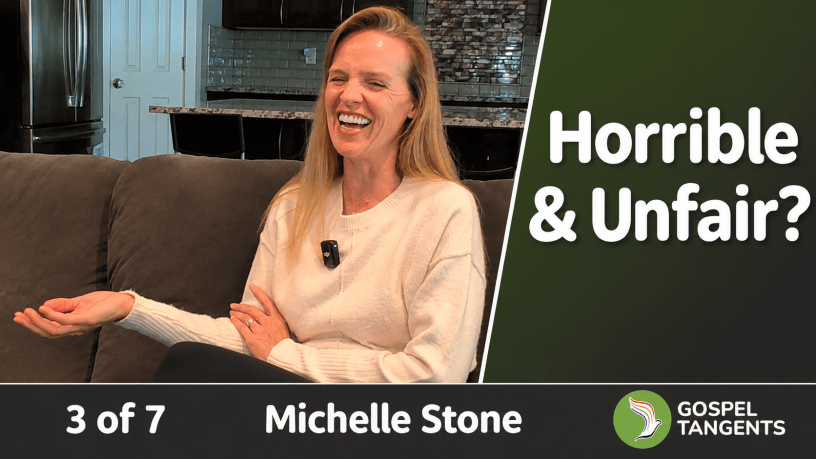
Few people in Mormon studies stir up as much reaction as Michelle Stone. On her 132 Problems channel she argued first that polygamy was never of God, and later that Joseph Smith didn’t practice it at all, a conclusion most historians reject. Saying so has cost her supporters and friends, and has brought death threats and a lot of public criticism. I invited her back to Gospel Tangents because her senior thesis on Helen Mar Kimball, “Constructing Helen,” won Utah Valley University’s Lucille T. Stoddard Senior Thesis Award and was published in the Journal of Mormon Polygamy. You don’t have to agree with her to find her story worth hearing, and I pushed back in places. We started at the beginning: Michelle was raised to believe polygamy was God’s higher law.
Family History of Polygamy
Polygamy runs in Michelle’s family. She says Joseph F. Smith called her great-grandfather to Mexico to take a second wife, and he married her in 1906, well after the 1890 Manifesto. As a young mom selling her mother’s music, Michelle spent time in the homes of fundamentalist families, and women from the Apostolic United Brethren told her the principle and the church were like a separated mother and father who would one day come back together. With her family history, she says, that made perfect sense.
Then she studied the scriptures for herself. Michelle points to Jacob’s condemnation of David and Solomon, King Noah’s “many wives and concubines,” and Riplakish in the Book of Ether, and now calls the Book of Mormon the most anti-polygamy book in the Latter-day Saint canon. She notes that section 132 wasn’t added to the Doctrine and Covenants until 1876. That study became her Facebook group and later her 132 Problems channel. Some fundamentalists now treat her as an enemy, which she finds sad, and she credits their best advocates for sharpening her thinking. We also compared her view with the old RLDS position and with the Ericksons, who read the same scriptures and reached the opposite conclusion.
Emma Smith Changed Her Mind
Michelle planned a single episode on Emma Smith. Months of research later, she concluded that Emma “does not make sense,” and that the only part of Emma’s life that doesn’t fit is polygamy. Everyone who knew Emma praised her honesty, Michelle says, yet once Emma denied that Joseph practiced polygamy, she became “the biggest liar in Mormonism.” Studying Emma, not Joseph, is what changed Michelle’s mind about Joseph Smith.
Personal Cost
Saying that out loud came at a cost. Many former members had supported her channel while she argued polygamy wasn’t of God, and Michelle says that support disappeared when she said she didn’t believe Joseph practiced it. She went through a long stretch of death threats, and a few fundamentalists made sure she knew they still believed in blood atonement. Her connection to Emma is personal too: after losing two children in 2020 and 2021, she remembers standing at the sink thinking, “Emma made it. I can too.” She now plans to write her dissertation on Emma.
Michelle calls section 132 “horrific” and thinks it’s time for it to leave our scriptures, pointing to Spencer W. Kimball ending the priesthood ban as a model for how a church can change course. Most historians, including Todd Compton and Brian Hales, and the Church’s own Gospel Topics essay, conclude that Joseph did practice plural marriage. Michelle’s argument is that the sources behind that conclusion deserve a much closer look than they’ve had.
Back to School, and to Helen
Part 3 covers some of Michelle’s hardest years. After she took her channel down at her stake president’s invitation, she felt she was supposed to go back to school. She left a full presidential scholarship at BYU nearly three decades earlier to start her family. BYU’s options for returning students didn’t work out, so her husband suggested UVU. She called on the last day to enroll, was told there were no appointments for two weeks, and then someone canceled while she was still on the phone. She started class the next day.
Michelle graduated with a 4.0, summa cum laude, and she tells any returning student, “Go to UVU, not BYU.” She is also candid about her own past: as an overwhelmed young mother of a big family, she used to pray for a housekeeper and think, “This is why we need polygamy.” Now she pictures it from the other side, a 20-year-old moving into an older wife’s home to care for her children. “That’s horrible and unfair,” she says, “and that’s what polygamy is.”
Her paper on Helen began almost by accident. Michelle was researching Sarah Ann Whitney’s blessing, written on unusual pink-bordered paper, when she learned the only other known document on that paper is a poem Helen wrote to her mother. That trail led her to Helen’s own patriarchal blessing, recorded by William Clayton and dated May 28, 1843, the month usually given for Helen’s sealing to Joseph Smith. Helen was 14. Michelle believes the blessing shows Helen was not married and had no plans to be, and she asks why it has been so little used. In Part 4, she explains what a historiography is and answers the charge that she has an agenda, and I share some news about where she’s starting her PhD.
Questions for Discussion
Michelle’s views are controversial, and I expect plenty of you will disagree with her. Please keep the conversation about the arguments and the sources, not the person.
- Michelle says Emma “does not make sense” unless she was telling the truth. How do you weigh Emma’s denials against the later affidavits?
- How do you read Helen’s 1843 patriarchal blessing? Does it change anything about the traditional account?
- Should section 132 stay in the Doctrine and Covenants?
- Michelle has changed her mind more than once. Does that make her more credible, or less?
- Do you support her even if you disagree with her?

