
I recently heard somebody say we should turn off the podcast when we read scriptures. What he was getting at is for our whole life, especial those raised in the Church, you have been told what a specific scripture means. If you can clear your mind of all preconceived ideas of what the Church wants you to think, and read the scriptures like it was your first time, you will find new meanings in the words.
Lets take some of the parables, and look at them in a new light.
Parable of the Lost Coin: A woman has ten silver coins and loses one. The woman goes to great lengths to find the coin. When she finds the coin, she calls her friends and neighbors together, saying, “Rejoice with me; I have found my lost coin”. From: the Church’s web site:
Church members are like the woman in the story, and the lost coin is like a member who has become less active in the Church and is lost. Jesus wants Church members to find the lost brother or sister and to care for and bring him or her back.
For some context, Jesus told this story, along with the Parable of the Lost Sheep and the Parable of the Prodigal Son, in response to the Pharisees and religious leaders who criticized Him for welcoming and eating with tax collectors and “sinners”.
Instead of taking the Church’s position that this is about finding a lost member, what if I looked at it this way. The parable of the lost sheep and prodigal son both have that the item lost doing something wrong, either wandering away from the herd, or living a sinfully life style. But the coin in the parable did nothing wrong. It is not the coins fault. It was just lost through no fault of its own, and has the same value whether it is behind the couch or in your purse. It is in a safe space even under your bed. In fact if fault can be laid, it is upon the owner of the coin, not the coin. Could this be though of as a member of your family that no longer associates with the family? They did nothing wrong. They may have purple hair, are gay, or did not go on a mission. The family member is just as valuable as ever, and the parable tells of to bring them back with the others and rejoice. It puts the onus on us to bring them back, not to change the coin.
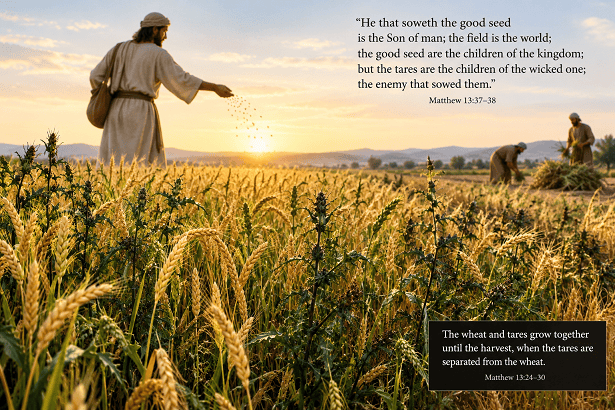
The Parable of the Wheat & Tares (A fan favorite of this blog): A man plants wheat. In the night the enemy comes and plants tares in the field. Tares look like wheat, and it would be hard to pull up the tares without destroying the wheat also. So when they ask if they can get the tares, Jesus says
But he said, Nay; lest while ye gather up the tares, ye root up also the wheat with them. Let both grow together until the harvest: and in the time of harvest I will say to the reapers, Gather ye together first the tares, and bind them in bundles to burn them: but gather the wheat into my barn.
Matthew 13:29-30
The Church says “The Lord used the parable of the wheat and the tares to teach about gathering people into His Church.” Is that really what it says? The wheat are the good members of the Church, and the tares are the bad people of the world. Could the parable be teaching us that we should not judge (weed out) the bad people in our ward, family, neighborhood, or community? Because if we do judge somebody at Church to be a tare, and don’t asociate with them, or call them as a counselor primary, we could mistakenly have misjudged a faithful member (remember, wheat and tares are very hard to to tell apart). We then cause harm to the faithful person (wheat), while thinking we are getting rid of the tare. The parable teaches us not to judge anybody, but let Christ do that at the final judgement (harvest).
Now, don’t take my view of the above parables. Turn off your podcasts and blogs, and read the parables for yourselves without any preconceived notions. What do you find?


Bill, another thing I find interesting about the parable of the wheat and the tares is the binary description of the two categories. Everyone is either a wheat or a tare. The reapers may not be able to tell the difference right now, but the outward similarity between the two doesn’t change the identity of the individual plant. A wheat plant can’t become a tare plant and vice versa. Obedience and repentance seemingly have no place in the parable. If so, while the parable may well be about not judging, it seems just as well suited to supporting the doctrine of predestination. That’s an interpretation the Church certainly would not countenance.
My take on the lost coin. The woman is a leader (as is the shepherd and the father), and these three parables were given to religious leaders who were failing in their leadership. The Lord gave three examples of good leadership. The woman (religious leader), when she realized a valuable coin was missing, took a candle to look in dark places behind furniture and took a broom to clean. In other words, she cleaned her house to find the coin; she made right what was wrong in her administration of her household. These three parables, or these three parables in one, say nothing to you and me as members of the church. The target audience is church leaders, then and today, who have care for souls. We can extend the parable to us in our families. I agree: we should read the parables for ourselves and not depend on someone else to tell us, because this usually means that we do not read and think for ourselves.
Speaking of turning off all the ideas that the church has already taught us, I found the reading a newer translation gave me a totally new perspective on scripture. I found a translation that started with the original language, and got rid of the archaic Middle English . It thus avoided the mistakes of the King James Bible, and often used different words in the very familiar passages. The fresh language alone jutted me out of the old rut that the church carved.
With that reminder that those parables are aimed at church leaders, it made me think how our church leaders are constantly dumping the responsibility onto the members. Some member get offended and the hurt/offended is the guilty party who has to pretend not to have been hurt because being offended is a sin. Meanwhile, the offensive person is not equally told to change their attitude. No matter how hurtful the offense was, the injured party is the one who is supposed to change. We members are taught it is our job to bring the wayward back to the fold.
When Elder Bednar gives a talk that is tone deaf and arrogant, or Elder Whatever writes a terrible book, such that horrible “The Miracle of forgiveness” or undoctrinal Mormon Doctrine, it is not the offensive book or the arrogant talk that is the problem. No, never, it is us members who need to change our attitude and be more humble. The leaders support each other, no matter how wrong, because they can never BE wrong. But when the members see what is actually wrong (bad leaders) it is seen as totally the members fault for even seeing the real mistake or problem. The leaders gaslight members into believing it is their fault they dislike that book, or that talk, or that mission president sexually abusing missionaries. The top leaders can never be seen as fallible.
So, it is no wonder the church leaders teach us that the parable means that we *sheep* need to go find the poor lamb that the shepherd chased away. Well, that is how they teach it. We members should go after the lost member. So, yes, our church leaders teach it that it is the sheep’s responsibility go after each other. Or teach that it is the good brother who has a problem for not welcoming his bad brother home when Dad shows more love to the bad child than the good child ever got. No, the good brother was hurt that Dad loves the brat more than the son who has struggled and sacrificed for dad and stayed with dad and been loyal. The bad son had his inheritance, but good son is being asked to give up his share of the inheritance for the bad brother because dad loves him most. I would have been hurt and angry too.
It has been challenging to learn how to read what the scriptures say, as opposed to what I “knew” they said before I started reading. I have found a few approaches that help me, and would welcome any additional suggestions.
I too have found that reading a modern language translation helps me to read differently. I’m not as likely to skim past phrases and verses so familiar to me that they barely register.
Reading or listening to discussions from other faith traditions can be helpful. Whether I agree or not, learning more about a quite different understanding of a passage of scripture often gives me the incentive to really dig into that passage. The same is often true of the non-mainstream/official LDS discussions.
Sometimes reading something aloud can help. It’s especially likely to be helpful when I see that in my regular reading I’ve been missing words or phrases. I don’t find listening to someone else read scriptures much different than reading them silently myself. It’s still easy to autotune to what I already assume.
A few years ago, I ran into the idea that the common names of the parables set the guidelines for how we understand them, followed by the suggestion to think of other possible names. For example, would my understanding of the prodigal son be different if I thought of it as the parable of the the loving father or the parable of the jealous brother?
Does anyone have other suggestions to offer?
My spouse went church hopping for a while last year, and the biggest thing I got out of that is that while our church teaches that the second you slightly cross over the line of the most harmless Mormon taboo the Holy Ghost leaves in a huff and God is like “Oh well, I’ve got a lot more children where that one came from,” most other churches teach that the further you stay from Him the harder He works to bring you back. That made more sense to me. I know what I’d be doing if it were my child.
It is interesting how similar the parable of Wheat and Tarea is to the old Buddhist parable of the empty boat:
A young farmer was covered in sweat as he paddled his boat up the river to deliver his produce to the village. As he looked ahead, he saw another vessel heading rapidly downstream. He rowed furiously to get out of the way, but it didn’t seem to help. He shouted to the other vessel to change direction, to no avail. The vessel hit his boat with a violent thud. He cried out, “You idiot! How could you manage to hit my boat in the middle of this wide river?” As he glared into the vessel, he realized that night one was there. He had been screaming at an empty vessel that had broken free of its moorings and floated downstream with the current.
Hi Bishop Bill,
I love this. When we “turn off the podcast” (love this phrasing), we are also free to focus on parts of the parable we hadn’t noticed before. What’s the enemy doing planting weeds at night? And what are we to make of that? I mean, if I want to mess with my neighbor’s livelihood, is this really the way to do it? Why? I guess she has to waste resources on something that isn’t going to be of ultimate value. But is that really so bad? It seems more inconvenient than anything. Time (which is money) and aggravation are a bummer. But in terms of dastardly enemy behavior, I’m kind of unimpressed.
On the lost coin: I have to wonder if the woman’s labor was worth it. I have lost things and turned my whole house upside down to find them. And yeah, it feels amazing when I finally find it. But it’s more about pride than anything. I could afford for it to stay lost. I could replace it. The time spent looking for the thing, when I have ten more of them: it kind of looks like foolishness. But that’s part of what’s so endearing about the story. Jesus is recasting my obsessive compulsiveness as a feature, not a bug. Still, Lord, I kinda have to wonder…
IMO like any good analogy parables have their limitations. So we have to be careful not to over interpret them–let alone misinterpret them.
Re: The parable of the wheat and tares: I think it’s meant to be understood within a context of events having to do with the end times. More specifically as the rise of a blog of the same name in the latter-days.
Jack is correct. The parables have limitations.
For example, the parable of the sower of soils. My church lessons focused on shaming the soil, but never focused on the sower for wasting precious seed on bad soil. Talk about blame shifting. It reminds me of something Carol Lynn Pearson said about church leaders throwing marginalized (queer) people in the gutter, then shaming them for getting dirty.
The wedding banquet focuses on blaming the virgins who took the bridegroom at his word and travelled with enough oil to light their lamps for the time and place he promised and didn’t horde or waste oil. And heaven forbid the late bridegroom sent someone out to inform everyone of the delay and that they may as well snuff their lights and take a nap and how long the delay would last. Or where was HIS lamp to see the faces of those whose oil was spent waiting for him? And why were those who wouldn’t share their oil considered wise? And why couldn’t he recognize the voices of the people HE invited to HIS party when he met them in the dark? Dumb and dumber.
I’m not sommelier but does the age of the wine really affect an old bottle’s ability to hold it? Why?
I could do this all day.
And Jack, remember what Elder Price taught us: tomorrow is a latter day.
I find we (along with the rest of Christianity) tend to wrest the parables. We prefer to deploy them over and against others whom we don’t agree with or feel are lost. And then we make ourselves the heros of these stories. I don’t know. I wonder sometimes if we’d actually get more meaning out of these stories by looking at our current situation and asking: “are we the bad guys?”
@Chadwick
The “bottles” in that parable is a mistranslation. Jesus was talking about wineskins, which are evidently one use only.
I’m used to getting downvotes–lots of the them.
But why so many for my little joke?
@Jack
I thought it was funny.
The message is not to judge, lest you discard the wheat. AT THE TIME OF THE HARVEST the wheat will be gathered,,,not everyone who says Lord! Lord will be saved….so the tares may be those who appear to be righteous., who check all the boxes , yea, even those who are judges in Zion.
This what makes the Bible so enduring and universal. It is quite a feat to write something that lasts 2000 years and across multiple cultures. Jesus’s parables are intentionally both familiar and subject to interpretation. Re-reading a parable lets us get a new meaning each time. When reading of the lost coin, where do we put ourselves in the narrative. Do we see ourselves as the woman? The coin? The neighbors? Are we like the 9 coins or the 1 coin? What’s the difference? I like hearing different interpretations and hesitate to say there is “one true meaning” to any parable. The intention is to make us reflect and be open to spiritual promptings to reconsider the message. I like the open-endedness of this approach.
For the wheat and tares I prefer the interpretation that it’s not referring to good people and bad people, it’s referring to good and bad qualities within each individual.
Jesus will take what’s good about us, elevate it, and help us root out the bad. They’re allowed to grow together because what else can an imperfect person in a fallen world do? We also often misjudge what is a good or bad for us so withholding judgment and going off a fruits based approach might help in some cases. For example, I learned from experience that this is good for me, I learned from experience that this is bad for me.
The purpose of religion is to control yourself, not criticize others. In that light I prefer to interpret the wheat and the tares as a process of self discovery.
Thanks, FNS.
Georgis, the parable of the Good Samaritan also is not for the general membership, but an indictment of the leaders. I gave a talk while bishop and replaced the people that passed by as the Stake Pres, and EQP. The Samaritan was replaced my a Muslim, and it was all see on the 101 Freeway here in SOCAL.
Jack, so you are saying that God wrote the Wheat&Tares parable specifically because he knew there would be a blog by the same name! Did that take away our free will when we went to name the blog? It is almost like the causal loop paradox in time travel. Very cool!
Squidlove, I was always taught that Jesus spoke in parables so that those who were not ready to hear the words would not understand them. Also he used everyday examples that the people could relate to. It has been awhile since I planted any wheat, but I have lost money before, so there is that. Maybe we could add modern stories to help us today.
Former Nonbinary Sunbeam: Funny thing is, a whole lot of Mormon parents DO in fact act the way you described which is pretty yikes.
I appreciate the freedom that parables allow. I’m interested in understanding their historical context and how their original audience might have heard them, but I also recognize that interpretation is inevitable. Parables invite us to look for meaning in their characters, details, and imagery, and different readers will inevitably find different things. Some interpretations are illuminating, others less so. Occasionally, we may even find ourselves interpreting a parable through the very assumptions or attitudes it might be challenging.
The parable of the Wheat and the Tares is particularly interesting to me because it captures something that Ernest Becker and others have explored in their anthropological, psychological, and sociological work: much of humanity’s cruelty and violence doesn’t originate in a conscious desire to do evil. It often comes from people who sincerely believe they are doing good.
Becker frequently explored how human beings construct systems of meaning that give them a sense of righteousness, significance, and security. Once we identify ourselves with a cause we believe to be good, those who threaten that cause can become more than people with different beliefs or perspectives. They become obstacles to righteousness, threats that must be eliminated.
Hannah Arendt explored a related problem in her work on the banality of evil, demonstrating how ordinary people can participate in extraordinary cruelty without seeing themselves as particularly malicious. They may simply believe they are fulfilling a duty, following an established system, or doing what is necessary.
There’s an old observation, often attributed to Glen Cook, that captures the sentiment rather well: “More evil gets done in the name of righteousness than any other way.”
I think the parable of the Wheat and the Tares captures something important about this tendency.
What strikes me is that there are actually two threats to the harvest, not just one.
The first is the introduction of the tares by the enemy. The second is the servants’ eagerness to remove them.
There are three things worth considering about the agricultural setting.
The resemblance: Tares, commonly identified as darnel, look remarkably similar to wheat in their early stages of growth. Distinguishing between the two isn’t easy, even for an experienced farmer. What appears to be a tare might actually be wheat.
The entanglement: Their roots can become intertwined as they grow. Pulling up the tares prematurely risks pulling up the wheat with them. The effort to remove the problem can damage the very thing the farmer is trying to protect.
The timing: As the plants mature, the differences become more apparent. The harvest provides an opportunity to separate them without jeopardizing the entire crop.
What I find interesting is that the farmer is dealing with two very different problems. The enemy has introduced something destructive into the field, but the servants’ proposed solution carries its own destructive potential.
The servants are eager to protect the field. Their intentions are good. They see something that doesn’t belong and want to do something about it. Yet their urgency to eliminate what they perceive to be a threat may actually endanger the harvest more than allowing the tares to remain for a season.
The farmer seems to understand something the servants haven’t quite grasped: protecting what is good and eliminating everything perceived to be bad are not necessarily the same thing.
I wonder how often this principle applies beyond the agricultural setting.
Human beings have a remarkable capacity to turn the preservation of something good into an obsession with eliminating everything we perceive as threatening it. We see it in politics, religion, culture, and even our closest relationships. We become so invested in protecting an ideal that we lose sight of the people and relationships that ideal was supposed to serve.
We see it in religious communities, too, including our own.
Consider how easily the desire to preserve doctrinal purity can turn into policing the boundaries of acceptable belief. A person raises an honest question, expresses uncertainty, or arrives at a different interpretation of scripture. Rather than engaging with the substance of the question, we become concerned about the threat it represents. We begin labeling, distancing, correcting, and sometimes excluding. In our eagerness to protect the faith, we can make it increasingly difficult for people to be honest about their experience of it.
Or consider our efforts to preserve moral purity. We want to protect young people, families, and communities from destructive behavior. Those are worthwhile goals. But when the preservation of purity becomes an obsession, we can inadvertently create shame around normal human struggles, discourage vulnerability, and teach people to conceal their difficulties rather than work through them. In trying to protect people from sin, we can sometimes make it harder for them to find compassion, support, and genuine healing.
There is also something worth considering in how we approach those who leave, question, or struggle with the Church. We may become so concerned with protecting others from what we perceive as dangerous ideas that we stop listening to the actual experiences of the people expressing them. We can turn relationships into rescue projects, treating someone’s continued participation or eventual return as the measure of whether we’ve loved them successfully.
In each case, the intention may be preservation. But the consequences can be alienation, shame, dishonesty, and broken relationships.
And perhaps that is the more uncomfortable part of the parable. The servants aren’t necessarily bad people. They aren’t the enemy. They are simply so certain about what needs to be removed that they haven’t considered the damage their own intervention might cause.
Our attempts to eliminate evil can sometimes produce more destruction than the evil we are attempting to eliminate.
This doesn’t mean we should abandon discernment, pretend that harmful things aren’t harmful, or become indifferent to what happens in the field. It means recognizing that our ability to identify and eliminate everything that threatens the good is considerably less reliable than we might like to believe.
Perhaps there is a difference between cultivating what is good and obsessing over eliminating what is bad.
The former requires patience, nurture, and an appreciation for growth. The latter can become an endless exercise in identifying threats, policing boundaries, and pulling things out by the roots.
The farmer seems to understand that distinction. The servants, not quite yet.