
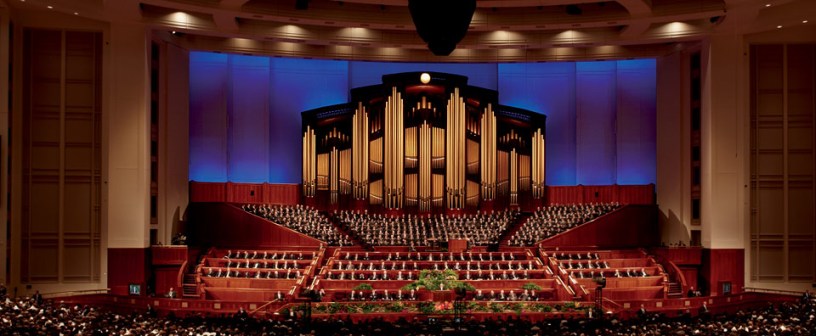
I watched Conference so you don’t have to. Brief summaries for each speaker. My comments are generally in parentheses or, at the end of each session, in italics.
Sunday Morning Session
Pres. Christofferson conducting. Music by the MoTab, joined by some international LDS visitors.
Pres. Eyring of the FP, repeating the words of How Firm a Foundation (just sung by the choir) and emphasizing the blessings promised therein. Bear each others burdens, mourn with those who mourn, etc.
Rosemary K. Chibota, President of the Primary. Jesus saw marginal and needy individuals, and ministered unto them. Like the Good Samaritan, who saw the man in distress when others just passed him by. See them. Start by just learning their name. See them through the Savior’s eyes.
Elder Andersen of the Twelve, on spiritual courage. Being a disciple of Jesus Christ requires courage. Faith lifts your courage.
James O. Fantone, of the Seventy. Names, take upon us the name of Christ, service and the mighty change.
Edward Dube, in the Presidency of the Seventy. Trespassers will be welcomed. Come unto Christ.
Elder Cook of the Twelve, on living a life of integrity and virtue, as expected of disciples of Jesus Christ. He links happiness with virtue, defined broadly. No Latter-day Saint should engage in derogatory and insulting online speech.
Alfred Kyungu, of the Seventy. Be peacemakers. Say nice things. Avoid “corrupt communications” (Paul’s term).
Ciro Schmeil, of the Seventy. Reflections on the sacrament.
Pres. Oaks. Be active members of the Church and stay on the covenant path. We are all a work in progress, so be patient with others. Reconciling science and religion can be a lengthy process. We leaders are concerned with those LDS who have diminishing faith in Jesus Christ. Don’t let secular faith limit your spiritual horizons. He contrasts the scientific method with the “spiritual method” of obtaining truth. No ultimate conflict between scientific and spiritual truths. Learn by both methods. God reaches out to all peoples: Jesus came to the Nephites in America. Book of Mormon promises to all people, including the Lost Tribes, whose accounts of visits by the Savior will come forth.
Sister Chibota’s talk gets honorable mention, but I’ll give Pres. Oaks the Best of Session Award. He looked healthier than usual at the stand and he had a positive message (Be patient, we are all a work in progress). He acknowledged that LDS leaders are concerned with people leaving the Church, then immediately addressed science and religion as an issue. That’s a fairly obvious tell about what the leadership is concerned with (science and learning versus faith). My sense is that it’s the regressive LDS positions on social justice and sexuality/gender, paired with the ongoing Trumpiness of the Church, that are pushing people to the exits. So the leadership might be barking up the wrong tree on this one.
Sunday Afternoon Session
Elder Causse conducting. Music by the MoTab.
Pres. Uchtdorf of the Twelve, on overcoming divisions and achieving unity. We need to unite the great family of God. The sacrament as a collective, unifying ordinance. (Remember, most Christians call it “communion.”)
Andrea Munoz Spannaus, 2C in YW. God will guide you home. Seven suggestions for the young women of the Church.
Moises Villanueva, of the Seventy. Another tithing talk.
Elder Bednar of the Twelve, on ordinances and covenants as credentials to get into heaven. Obedience keeps your credential shiny and valid. Ordinances are only valid if sealed by the Holy Spirit of Promise. (This talk is going to rub a lot of people the wrong way. If Elder Bednar mans the gate into heaven, not many people will get in.)
Thabo Lebethoa, a Seventy. More Jesus.
Paul H. Sinclair, a Seventy. Tells the parable of the misplaced buttons. Be slow to judge and quick to help.
Elder Stevenson of the Twelve, directing his message to the youth and Primary kids. Be like Jesus.
Gabriel W. Reid, 2C in Sunday School. Another NFL graduate. He defends 25-minute lessons in the new Sunday meeting schedule. Teachers, just get to the point quicker.
Elder Gilbert of the Twelve, on standing for truth with love. Avoid contentious settings. Look for common ground. (He did liken those who leave the Church or go inactive to wounded dogs, but it could have been worse.)
Pres. Oaks closes the Conference. Salt Lake Temple doors will open to the public on April 5, 2027. There will be a video series about it called “Dedication” to watch at LDS.org.
And that’s that. I’ll pull a surprise here and give Elder Gilbert the Best of Session Award. It’s a glass half empty and half full kind of talk, depending on how you look at it. I doubt an LDS leader will ever acknowledge that some people have valid reasons for doubting or leaving the Church. At least Elder Gilbert counseled listeners to hold off with that first impulse to throw out judgment, and to throw in a little love as well.


Everytime one of the Q15 brings up a specific topic (rather than sort of vague, run-of-the-mill gospel stuff), I naturally think, ok, that must be “a thing” in the Jello Belt. For example, I can only assume that gambling (particularly sports betting by young men) is becoming a big problem in Utah. So when President Oaks brings up the apparent conflict between science and religion, I’m thinking the COB is being flooded with angry parents who are irate that the theory of evolution is being taught at BYU. That couldn’t be the case… right? Is this really a stumbling block to the general membership? Are we to take “Science” to mean the Academy in general? Are we talking about the latest findings in gender studies and human sexuality? Is that what they are afraid of? Or is he referring to the rising interest in critical biblical scholarship, which tends to undermine (or at least problematize) BofM historicity, the literal Resurrection of Jesus, and a literal Lost Ten Tribes who all went to specific places and were visited by Jesus – all things he brought up. (BTW, the whole additional scriptures from other “lost sheep” coming forth is not a topic I had on my general conference bingo card. That was wild). Anyway, what is it that Pres. Oaks is referring to? This is not the first time he has brought up the conflict between science and religion – if I recall correctly. What is going on? Do Utahns have a beef with science? Will someone please tell me? What is happening with science and the Church and Utah?
I agree that Pres. Oaks gave a good talk, and I also agree that it was odd that he followed comments about members leaving with a science vs religion discussion. It’s a fine discussion, but one that would have been way more effective forty years ago. Maybe he’s been sitting on this one for a while and has been waiting a “respectful” amount of time to voice his opinions on the matter. But to give President of the church the benefit of the doubt, maybe there’s a LDS religion vs science conflict that would have happened in the near future, and he just nipped it in the bud. Perhaps Clark Gilbert was about to become another anti-science fundamentalist; I don’t know. I do think that a follow up discussing church history and history in general would have been more effective than science though. Still, I’m sure it will be referenced for quite some time.
Congrats to Elder Gilbert and his best of session award. I wonder if the anecdotes he shared all came from after his calling to the Q12, and the weight of the calling has actually humbled him to a degree, to where he’s more concerned about building bridges than proving himself correct. It was a good talk to have someone say “I wanted to do X, but instead I did Y”.
I think the science vs. religion issue grew out of the rejection of science and medical information that was such a part of the MAGA movement, especially during and after the pandemic. We’ve seen the rebirth of anti-vaccination and some pretty weird dietary advice with MAHA as well.
It did feel like Gilbert was deliberately trying to rehabilitate his reputation.
I think what members of the Q15 talk about is more a reflection of themselves than the church. I would not be surprised if Oaks had some recent experience where he learned something and accepted as truth something that contradicts what he thought was a gospel truth, and he is trying to reconcile it himself. That may be why he has been more of a “back to basics “ president than Nelson was.
On a side note, I grow increasingly concerned about the direction Bednar will take the church. His dogmatism and puritanical style doesn’t seem to be easing. I also get the sense that he isn’t well liked in the Q12. He is clearly going to rise to the throne, but he hasn’t been asked to be on any presidency yet.
Elder Bednar’s passport analogy was strained to put it generously. I guess he loves being the sorter of men and constructing a heaven in his own image. Whatever. Elder Gilbert’s talk felt a bit like fake humility to me. His one story in there about responding in anger rather than in love fell flat for me because he still had to get in the “but I was still right” remark. And then he proceeded to try and tease apart the first and second great commandments. Even though, as has been pointed out nicely by the Givens, the god speaking in the book of Moses references them in reverse order to the New Testament. But it is only rhetorically useful in the first instance because loving God to church leaders means staying tied to the institution. It is crazy to me in 2026 that we are still doing this nonsense. Is this really the only thing we can come up with to talk about? If God’s first love is people (i.e. us), why is it that ours cannot be the same? God does not need anything from us. He is God. If he is so worried about being loved, then maybe he should show up and help fix the messes he’s allowed to perpetually happen. I guess Gilbert’s reputation started in the toilet when he got this job so I suppose any improvement is welcome.
As for science vs. religion, the church has made this bed along with all of evangelical Christianity and now they’ve got to sleep in it. Of the two “sides” only one will not ever admit it is wrong in the light of new evidences. Only one is so self-assured it thinks it has a line on eternity and its workings. Only one has made some of its theological bed in bad English translation and won’t change it as newer, better translation becomes available. At some point, this isn’t a science vs. religion issue, it’s a religious certainty being its own worst enemy problem. I don’t know. In this modern age, I think religion needs a reimagination. Gone are the “god of the gaps” days and it feels like we are still trying to hold on to that because that was the major reason for religion to exist before. It seems like religion is perfectly positioned to reorient itself towards human thriving, but for some reason it’s not doing that. Instead it has tied itself to the “right belief” and institutional authority wagon, which people are abandoning at record levels.
Thanks for the summaries – it is bad for my mental health (seriously) to listen anymore to stuff I don’t believe in. 2 1/2 years ago when Nelson was talking about Jesus and Moses coming to Ohio in 1836, I had to bail on my family and go on a drive to reset and self-regulate.
I hope you all are right about Clarke’s talk. All I could hear were the ways truth would be used as a weapon against me because of “love.” That in conversations with family where I think I’ve made progress (example, I don’t go to the temple. They don’t have to be mad at me about it. Not being mad does not mean they “condone” it) will be reversed. Nobody can condone sin! He didn’t clarify what he means about love vs. condoning.
Elder Andersen’s witness of the Savior was stunning.
Please. Please! Mormons! Quit using “come unto.” Archaic and cheesy. Like most ritualized Mormon behaviors.
Clark Gilbert gave another attempt at unraveling the stand-off between Truth and Love. But I think the premise is flawed from the beginning, as though the greatest truth of all might somehow be something other than love itself. Although we fellow commenters will probably wander into the familiar weeds of what exactly “Truth” means, I don’t want to go there now. There is a more fundamental problem underneath the whole discussion. When I enter a conversation holding a position that I believe is not merely true, but absolutely certain, and that certainty has become tightly woven into my identity, I will inevitably become defensive. That is human nature. But I don’t think we are really defending our certainty as much as we are defending ourselves from the possibility that we might be wrong. I think one of the hardest things in life is not proving that I am right but admitting that I might be wrong. Once a belief becomes part of who I am, questioning the belief can feel like questioning me. Disagreement becomes a threat to my identity rather than an opportunity to understand another person.
And this is where I wonder if we have misunderstood what it means to tell the truth. Perhaps the most important truth is not the one I think I possess, but the one I am willing to tell. What if the person Elder Gilbert is talking to isn’t declaring some propositional claim about what is objectively true? What if they are bravely telling the truth about their own life, their own experience, what they have encountered, what they feel, and what no longer makes sense to them? That kind of truth requires vulnerability, not certainty. It asks me not to defend my answers, but to have enough love for another person to hear what they are actually saying. Love cannot survive, let alone lead the way, when everything in my system is detecting a threat to my identity. Perhaps the real test isn’t whether I can defend the truth I believe, but whether I can love someone enough to listen when their truth unsettles me.
I’m with Chrisdrobison on Clark Gilbert’s fake humility. He was the hero of nearly all his examples, and when he wasn’t the hero…he was still right. True to form, he managed to mention that he was part of a group of “national academic leaders,” and that later “a university chancellor reached out for counsel in creating a course on character at one of the nation’s most prestigious academic institutions.” Wow. He is So Important. People RESPECT him.
And I’m so tired of the parsing of the first and second commandments, and how love for God permits us to preach God’s laws (or fire people we don’t approve of)—and as long as we do it nicely, that’s manifesting love for our neighbor. Please.
Pres. Oaks wants to have it both ways. He insists that the Scientific Method and the Spiritual Method are two distinct pipelines of knowledge, yet in the same address also asserts that God is the source of all truth, that all knowledge is circumscribed in one great whole, and that science and religion can be reconciled. This is intellectually dishonest, especially when you consider he has been actively promoting anti-science positions for decades (especially concerning gender and sexuality). If God were truly the source of all knowledge, there would be no difference between the two or any reason to distinguish them.
“Never let your secular learning limit your spiritual horizons.” I think you have it backwards, Dallin.
To his credit, he acknowledged that religious teachings can be “sometimes incomplete”. Ultimately though, he offers no concrete examples or viable solutions to any of the problems he lays out.
Jack Hughes – Agreed. I think the problem is that when he distinguishes the Scientific Method from the Spiritual Method but then presents the Spiritual Method as an alternative way of arriving at truth, the distinction eventually collapses into convenience.
There is an important distinction to make here, but I think it is between methods of knowing and kinds of knowledge. The two aren’t simply competing pipelines that can be used interchangeably depending on the question. I would make the simpler distinction between observational knowledge and experiential knowledge. Science can establish that exercise produces certain measurable benefits and make generalizable claims about what happens when people exercise. But science cannot give me the personal knowledge that comes from actually exercising. I have to experience that for myself.
This is where I think we’ve conflated the two methods. When someone says, “I know the Book of Mormon is true because I prayed about it and received a witness from the Holy Ghost,” they are using what Oaks calls the Spiritual Method to answer what is, at least in part, an historical question.
But those aren’t necessarily the same kinds of knowledge.
A person can receive meaningful spiritual or experiential knowledge from a text without that experience establishing the historical claims contained in the text. Literature, whether fact or fiction, can contain profound truths. A fictional story can teach me something genuinely true about human nature. My experience with that story can be real and meaningful. But neither the truth of the lesson nor my spiritual response to it establishes that the events described in the story actually happened.
That’s where I think using the Holy Ghost to “test” historical facts muddies the waters. The spiritual experience may tell me something about what the text means to me, what principles resonate with me, or how living those principles affects my life. But that is different from establishing whether Nephites existed, whether particular events occurred, or whether a particular civilization actually existed.
In other words, the question “Is this spiritually true?” and the question “Did this actually happen?” may require different kinds of evidence. A spiritual experience can be genuine without being evidence for every proposition contained in the text.
Perhaps that’s the distinction Oaks’ two-method framework should make clearer: different methods don’t merely give us different routes to the same kind of knowledge. Sometimes they are answering entirely different questions.
That seems very different from saying, “Science can’t answer this question, therefore ask God.” In fact, that can become exactly the sort of “getting something for nothing” that Christofferson criticized in his comments about gambling. Testing a claim, living it out, observing the consequences, and being willing to revise our conclusions takes time and effort. “Ask God” can become a shortcut that bypasses all of that. And if God really is the source of all truth, as Oaks also insists, then I don’t see why we should be afraid of the knowledge produced by careful observation and inquiry. Secular learning shouldn’t limit our spiritual horizons, but neither should a claimed spiritual method become a way of insulating our beliefs from the ordinary processes by which we determine whether something is actually true.
Todd S your comment is the talk Oaks should have given.
Todd S,
I think President Oaks would agree with you that the methods he speaks of are not typically used interchangeably. In the chapter “Reason and Revelation” in his book “the Lord’s Way” President Oaks talks about reason and revelation being used more sequentially than simultaneously. We start by reasoning out things, utilizing all of our faculties and resources–and then seek confirmation and wisdom as needed. He says (in so many words) that often we don’t need revelation to get the right answer when we’ve done our best to reason through a question or a problem. He says that we should allow reason to have the “first word” — and that often that “word” is sufficient.
But then he goes on to say that while it is important to allow reason to have its day in court (so to speak) it is also important to allow revelation ample room for its expression. He goes on to say that while it is important to allow reason to have the “first word” we must allow revelation to have the “last word.” So while there will be times when reason is sufficient–we must be open to the possibility that revelation will be necessary to take us beyond the limits of what may be known its methodology. Indeed, on rare occasion, we may be challenged by revelation that runs counter to reason’s “first word.” But even so, we must be willing to give revelation complete sovereignty–the “last word” if you will.
That said, I would add that while the process that President Oaks outlines is typically sequential–I think there’s room for a little overlap. For example, we may believe that the quest for knowledge of a literal Jesus is the within province of historians and archaeologists, etc. But because it may be important for some folks to know that Jesus actually walked the earth as a mortal being I believe that such knowledge can be received by revelation–the spirit prophecy. And I think there are many such things can be known by such means–especially when such knowledge strengthens the foundations of the Kingdom.
Jack,
But I think you’re unwittingly making a distinction here that works against you a little bit. No matter how you slice it, they are still two entirely different categories of truth. Revelation is subjective/personal truth. You believe something because of some otherworldly experience that is not falsifiable. It says nothing objectively about the world around us. And I think this is where Oaks and others get tied in knots. Objective truth implies objectivity, some kind of ability to vet. I just don’t think the word “knowledge” in the context revelation and knowledge in the sense of objective truth and reason are the same thing. Using the word “knowledge” in the context of revelation muddies the water quite a bit.