
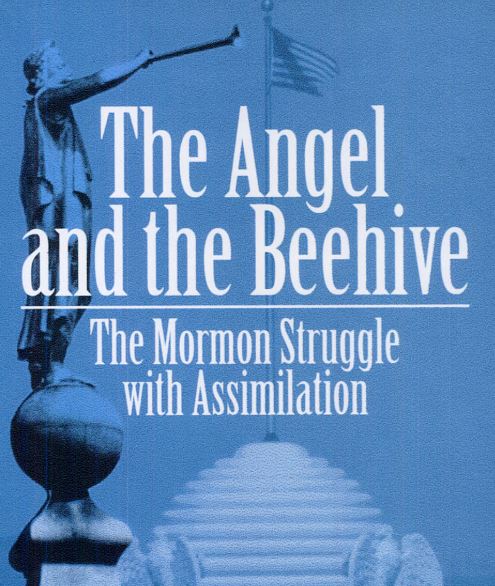
A few decades back, it was common for LDS speakers to refer to the body of the Saints as “a peculiar people.” See, for example, a 1975 talk by Bruce R. McConkie titled, “The Ten Commandments of a Peculiar People.” The phrase comes from 1 Peter 2:9 KJV. It turns out the word “peculiar” meant something different in 1611 than it does today, but that’s beside the point. The point is that it has been a popular phrase emphasizing that Mormons were different, noticeably different, but in a good way. Non-LDS might agree with the different part but maybe think different in a bad or just strange way. But “nice people, just a little strange” was a description Mormons were willing to accept, even trumpet.
So here we are in the year 2026, and maybe we’re not so different anymore? That’s the claim in a recent Atlantic article, “Are Mormons Losing Their Distinctiveness?” The article quotes a lot of people whose names you will recognize and comes to the conclusion, “Yes, a lot of it.” Good Mormon families have three or four kids, not eight or nine. We don’t avoid Coca Cola anymore (Diet Coke being the caffeinated beverage of choice for Mormons) and even coffee seems okay for a good chunk of younger LDS. We still build temples and talk about them a lot (about half the content on LDS.org highlights temples) but those oh-so-dated pageants and road shows have gone away.
The article — which you really must read — highlights certain demographic changes that you have probably heard about lately. Retention rates are down: only about half of those born in the Church remain active, down from roughly 80% two generations back. And, most surprisingly, young women are now more likely to drift away than young men. This mirrors what has happened in many other denominations, but it is still jarring for older members who remember the good ole days when all the kids stayed in the Church and got married in the temple and had six kids of their own.
Now there is a 100.00 percent chance LDS leadership is aware of these shifts and changes. They might say “All is well in Zion! The Church is prospering!” in public statements, but they then march off to another meeting to discuss why we are losing so many of our youth and why they are getting married in their late twenties instead of their early twenties. Run the clock forward another couple of decades and where will we be? The time may come when older LDS parents will be proud to tell their friends that even just one of their three or four kids is still active in the Church.
So let’s talk about it. What’s your experience?
- Are Mormons less distinctive than a generation or two ago? Do you still stand out at work or in the neighborhood as an obviously Mormon person, or can you now fly under the radar if you want to?
- Is the rise of convert baptisms overseas, compared to stagnating growth in North America, driving some of these changes?
- Has the drive to simplify LDS activity (two-hour church, fewer activities, the emphasis on home learning rather than church teaching) just shrunk the Mormon footprint, so even good Mormons just aren’t that Mormon anymore?
- Using the assimilation versus retrenchment model of Armand Mauss (see image at the top of the post), is the Church presently allowing assimilation as argued in the article, pushing retrenchment, or in a confusing way sort of doing both assimilation and retrenchment at the same time?
.


Do the Q15 want us to be different or not? I suspect they want outsiders to think we aren’t but insiders to think we are.
This OP is interesting following on the heels of the last OP–where folks were talking about the changes they would like to see in the church. Just about everything that was mentioned would cause the church to become more amenable to modern sensibilities.
Born in 1966, baptized in 1978, I never experienced a Golden Age when 80% of latter-day saints stuck with it. A range of 40-65% feels more like what I have experienced across my decades. If my experience is representative of anything, and if that 80% figure is also meaningful, then there must have also been other places 40 and 30 years ago with 95% retention, places unfamiliar to me.
When it is “revealed” by the prophet not to even call yourself “Mormon” anymore, how do you expect to be peculiar or unique as a religion?
The amount of money spent on BYU football suggests we want to be like the rest of the world instead of being a peculiar religion.
The way Mormons vote says more about how they want to align with Evangelicals than it does about their own peculiar take on modern revelation and the Gospel of Love.
With hundreds of billions in its investment arm, the Corporation of the Church of Jesus Christ of Latter-day Saints is richer, but hardly peculiar.
Building of hundreds of temples says more about the “large and spacious building” than it does about a humble, peculiar people who believe in a living prophet and the Book of Mormon and its admonitions about getting rid of pride.
I keep thinking about Jack’s comment about “modern sensibilities.” That attitude is such a cliche for political conservatives. But it seems to me that it rests on an easy assumption rather than extensive study and pondering. It assumes that the sensibilities from my childhood are the correct and true sensibilities. There doesn’t seem to be any thought that there’s even a possibility that the assumption might be wrong in any particle.
But what if it is wrong? What if being a peculiar people means looking at our assumptions and testing them in the light of the gospel of Jesus Christ? What if being a peculiar people means that we don’t automatically try to emulate evangelical Christianity? What if God wants us to reject the world’s “conservative” bias and follow Jesus’ commandments about what is required of those who want to build the Kingdom of God?
I’m not interested in belonging to a weird branch of evangelicalism. I want to belong to a church that follows the teachings of Jesus Christ. I find the common and easy dismissal of those who disagree with conservative political positions as being the tares who are separated in the last days or the unfaithful who follow the world into the large and spacious building to be largely superficial and uninformed. In today’s environment, I think one can make a quite solid case that those who follow our Savior’s commandments to “feed my sheep” and to love one another are the peculiar people who reject the philosophies of men. I think it is unfortunate that so many sincere but politically conservative believers quickly and easily dismiss genuine concern for the welfare of others as a rejection of God.
“The time may come when older LDS parents will be proud to tell their friends that even just one of their three or four kids is still active in the Church.” For my parents who had four kids, this was already true for 15 years ago. They’ve grown to accept it as the status quo, but I know they’re still very sad and more than a little embarrassed about it.
As to assimilation versus retrenchment, the Church seems to not be able to make up its mind. Church leaders it seems are not willing to return to being a minority faith with little footprint outside the American inter-mountain West, and yet they are also unwilling to let go of the things that still make them stand out from American Christianity such as exclusive authority, the Word of Wisdom, garments, temples (or at least temples as they now function), the Book of Mormon, and not using the cross (though the latter seems to be softening).
Will any of these unique doctrines/practices continue to be softened and ultimately abandoned over the next 100 years? Only time will tell, but rather than these issues, I suspect the next really big challenge for the Church will be how it navigates the shocks caused by the U.S. gov’t debt crisis wave finally breaking. Does the Church come out of that with something like the wealth it has today? Likely not. Can the Church sustain its activities around the world in 2075 or 2100 when U.S. tithing dollars are closer in value to 2009 Zimbabwe dollar than the 2026 U.S. dollars? I sincerely hope I’m just being alarmist.
Thanks for the comments, everyone.
Josh H, yes the leadership tries to play inside/outside games a lot. That doesn’t work as well with the Internet.
Jack, I suppose that’s true, but only because even the most conservative current members don’t generally want to go back to ankle-length garments, member-built chapels, three-hour church, Relief Society on Wednesday afternoon, local building funds supplied by members, or any of the other features of 20th-century LDSism. There are a few conservative Mormons who argue for a big conservative change — going back to practicing polygamy — but if they publicly advocate for that, they likely get excommunicated from the LDS Church. A bishop who withheld temple recommends for drinking Coke (going back only sixty years or so) would get corrected or, if unwilling to change, would get released. So it’s the Church itself which prevents agitation for “conservative” change.
John Mansfield, good to see you again. Yes, I’m sure there was regional variation, but 80% was apparently an accurate number. Many families had just one kid who left the Church (or just went totally inactive), the black sheep of the family. Now there are whole flocks of black sheep.
Instereo, cancelling “Mormon” in LDS discourse was certainly a strange move, especially in the wake of the remarkably successful “I’m a Mormon” ad campaign. I’d chalk that up to just a pet issue of the guy at the top of the org chart. But the guy at the top almost always has an odd pet issue or two that might or might not make sense in light of other LDS initiatives or changes.
PWS, I’d put your thoughts more bluntly like this: Trumpism, enthusiastically accepted and endorsed by most Mormons, has thoroughly screwed up the moral sense of those who accept it. Mormon Trumpers are largely blind to how much MAGA has warped their morality. Honestly, it is embarrassing to be a Mormon these days.
Not a Cougar, yeah that’s what I was getting at in my last bullet point. LDS leaders can’t quite make up their mind whether they want retrenchment, assimilation, or (somehow) both at the same time. It’s like being a passenger on a cruise ship that zigs this way, then zags that way, back and forth — where does the captain think he is going, anyway? Is anyone steering this ship?
Dave B,
What about the larger issues like marriage, chastity, abortion, and not apologizing for past practices and policies?
How strangely ironic that something like the proclamation on the family should cause the saints to be viewed more and more as a peculiar people as time goes by.
The things you list as making Mormons distinctive are a mix of individual practices and institutional programs. The programs have been slimmed down, probably a necessity in a global church, but I don’t think those have all that much to do with whether Mormons stand out. When I was growing up my neighbors knew we were Mormon in part because of the huge family. They probably wouldn’t have known whether we were participating in road shows or pageants. So in my view it’s individual practices that tend to make Mormons distinctive in the broader culture. Families are smaller, apparently, and people are more relaxed about caffeine, but I think they are still mostly abstaining from alcohol, which will certainly stand out in certain situations.
Church leaders do and say things that push both in the directions of assimilation vs. retrenchment because I don’t think that framing is really a guiding principle for their decision making. And ultimately I’m not sure they have all that much control over it. Oaks’s public handwringing over falling birthrates isn’t going to change anything.
Jack,
Not completely disavowing polygamy and essentially having polygamy in heaven is what makes us look peculiar to others, not the proclamation. The proclamation fits perfectly well into the theologies of almost every other Christian sect in American. In fact, it really is just a codified set of beliefs held by church leadership and American Christianity at large that they all grew up in. In and of itself, it is not peculiar. What makes us peculiar to others is us hiding behind it to excuse bigotry in our doctrine and behaviors. That’s not to say that they aren’t some good things about it, but we’ve typically weaponized it over against groups of vulnerable people rather than engaging in self-transformation because of it.
As for the large issues that you mention, what about them? We aren’t unique in those particular areas.
From a UK perspective there used to be a lot of grumbling about US or Utah specific cultural stuff that was seen as an essential part of the church. For example, why was it that US members could celebrate Thanksgiving, but a traditional UK Harvest Festival (which included a church service) was frowned upon, and couldn’t happen. I’m aware of one ward that now holds an annual traditional harvest supper, at the same time as collecting items for a lo+al food bank. (Traditionally harvest festivals include collected food to be distributed to the poor). Our schools held/hold harvest festival during a school assembly in the autumn and collected food for the needy in the local area. How come some places in Europe got a pass on the no beard mandate (France for one, according to my father) but we didn’t. It often felt like because we spoke the same language (supposedly), and because so many Utah members and leaders had British ancestors, they expected that we would basically be the same ( that’s a big no!).
At the same time, we did observe the British mothers’ day (Mothering Sunday), and Easter. We were aware of Palm Sunday. I remember having specific Palm Sunday activities in Junior Sunday School. We were aware of lent, if mostly because of pancake day on shrove Tuesday, but some members would forgo some luxuries for lent. Good Friday and Easter Monday were and are national holidays. We’d always be really really annoyed (and still are) every time General Conference gets in the way of Easter.
Over here we always considered ourselves Christian, but I am learning that many Utah members think otherwise. That’s disturbing, because it points to considerable miss-selling of the church in Britain and Europe if so,
So part of me hopes that maybe this relaxation could be a response to decades of British and European complaints, but I fear it’s more likely more cosying up to the evangelical Christian nationalism in the US.
Hedgehog,
I think with all the work that’s going to on get a new hymn book, which will now include regional selections is a good sign that the church finally realizing the need to stop trying to replicate Utah everywhere. But, instead, let local cultures be themselves in the best way possible.
Hedgehog, I couldn’t agree more with your annoyance/anger over the inability to celebrate culturally. Every, single, one, of your items are worthy of recognition and would only enhance discipleship of Jesus Christ. I have been very pleased to see Palm Sunday being celebrated in our congregations. We certainly did in ours over the past couple of years.
I think it is extremely short sighted of the Q15 to hold general conference on Easter or Palm Sunday. While it is a huge deal for the church, it really is only so in Utah. It’s a “big” deal for most active Mormons in N America, and not “any” kind of deal for the rest of the world. But, to not be able to be with your local congregation on Easter Sunday is a net loss, and gives the appearance that GA talks are more important than 1/2 of the most holy worship days for any Christian.
Cheers –
The thing that differentiates a people from the crowd are outward observances, with the most common being clothing and Sabbath day observance. By these two things one can observe a difference in culture and allegiance to religion – think of the Amish & Mennonites and of seeing conservative Jews walking to synagogue.
On both fashion and Sabbath day observance, Utah LDS have become less distinguished from the world. Utah LDS culture is much less peculiar than it once was. Does this matter? I think this is a difficult question to resolve. The Old Testament says yes. The Old Testament says the Israelites need to be culturally different than Babylon, and separated from them. The New Testament says there needs to be a separation but the division needs to be spiritual – that one is in the world but not of the world.
What merits pondering is the meaning of “not of the world”. I think the LDS have desired acceptance and approval of the world’s opinion so much that they, as an institution, has lost perspective on this commandment. The LDS leadership very much prides itself on gaining the approval of the world. Personally, I think the message of the prophet Isaiah applies to the modern LDS as much as it applied to the Israelites of his day.
Hedgehog, I agree about we should be allowed to celebrate local Holidays, and not be forced to celebrate Utah Holidays world wide. Even as a descendant of Mormon pioneers with all of my ancestry, it felt really weird for our ward in Germany (even if it was a high percentage of military, Utah Mormons) to celebrate Pioneer Day. It was just off. I think the church should also make the differences in Music and dress acceptable. Africans like drums and so drums should be part of their worship, not a very American suit and white shirt.
Also, I am not sure exactly what you mean by saying that Utah Mormons do not consider themselves “Christian” because I grew up in Utah and we fought to be called “Christian” by all the other denominations of Christians. But, yes, the use of the word “Christian” has changed recently because of MAGA, with a few of us saying if MAGA are Christian’s then *I* don’t want to be. The Christian Nationalists claim that they are the only *real* Christian and even push Catholics out of their definition. They are very loud and nasty about it. So, if *they* are Christian, I really want to not call myself “Christian” because I DONOT want to be confused with those unChristlike jerks. But mostly Mormons have fought tooth and nail to be called Christians by the other denominations that do not recognize us as such. The majority of US citizens would say Mormons are not Christian, so that means we have had to fight to be included. That showed up recently when our dear [end sarcasm] Secretary of defense changed the denominations that would be recognized by the military are had “Christian” religions differentiated from “other” and he had Mormons as “other” and the church loudly objected. So, don’t confuse how most Americans think of Mormons as not Christian from how Utah Mormons consider themselves.
As to the question in the original post, I think the church has tried so desperately to be accepted that they are giving up all the ways we were strange. They first de-emphasize the strange things to outsiders and then start to de-emphasize those things to members. I mean, how long has it been since you heard anything about receiving your own planet when you become a god? They de-emphasized polygamy so much that my son on his mission in Brazil had the bishop of the ward come to him and ask if it was true that the church ever practiced polygamy,. The guy had been a member 20 years and his English finally got good enough to read some stuff about the church that was written in English instead of Portuguese and for the first time read something about polygamy and was horrified. The guy almost left the church.
As to the question of are the leaders trying to assimilate or retrench, they are retrenching by emphasizing temple more, and assimilating by talking a bit more about Jesus and a bit less about WoW. So in some areas that the public doesn’t find too weird, they retrench and in other areas, like giving up coffee, they play those down, so they won’t scare away converts, or the young health minded who learn that coffee in moderation is healthy and their doctor recommends they start drinking green tea.
@A Disciple
I grew up outside the Morridor, so the level of separation the Old Testament promotes was neither feasible nor desirable. There was still a certain amount of separation because Mormon beliefs kept me from asking out my non-member crush, whereas without them I just wouldn’t have done it because of social anxiety.
@Anna
Yeah, I was aware generally that a lot of the people around me officially believed that I and my Catholic friends weren’t Christian and were going to Hell, even if no one ever said that directly to my face. There was definitely the attitude that that didn’t justify being rude or not being my friend about it. On the other hand, I did have a disproportionate number of friends that had nonstandard religions, so there was probably some effect.
As the saying goes, what’s good about Mormonism isn’t unique, and what’s unique about Mormonism isn’t good.
chrisdrobison, I submitted a very long list of hymn suggestions, back when they were asking for submissions. A few of them have been included, though I don’t imagine I was the only one to suggest them.
Anna, I literally had to dress up as a pioneer as a child. My mother made bonnets for my sister and I. It was all part of a fête held on church grounds as a missionary tool. It was part of some kind of church celebration. No idea how it went down with the locals.
At least the relatively recent relaxation on music means there are no longer restricted instruments, so for me that means brass instruments (hooray, and finally).
Of course there were elements of the Christian world in the UK ( evangelical influence) that tried to tell us we weren’t Christian, which we fought against. But my comment was referring to a lot of online discussion of the recent “Christianising” changes where members are protesting the changes, and arguing that we aren’t, as though they literally bought into the evangelical definition. Now I always wanted to ask the evangelical movement, who exactly made them the official arbiter, because frankly any group also arguing that RC was not Christian was simply not to be taken seriously.
@Chadwick
I’ve heard people say that before, but I don’t know that it’s entirely true. I love being a parent, so the idea that I can keep on parenting billions of children in the afterlife is super awesome for me. That’s pretty unique to Mormonism. I know it’s not for everyone, but that’s just a small part of Mormonism’s problem with being a one size fits all religion.
I also like the idea that Christianity has always been around instead of the massive retcon near the end of the Bible that it obviously is in traditional Christianity. It makes so much sense. Too bad there’s no external evidence that it’s true.