
What do a pyramid in southern Utah, a remote temple in Nevada, a forgotten temple in Texas, and an unfinished fortress in Wisconsin have in common? They are all part of the fascinating—and often overlooked—history of temple worship in the Latter Day Saint movement.
Most Latter-day Saints are familiar with the temples of The Church of Jesus Christ of Latter-day Saints. Some also know about the historic Kirtland and Nauvoo Temples or the distinctive spiral-shaped Community of Christ Temple in Independence, Missouri.
But what about the temples built by smaller Restoration denominations? Did you know that some groups continued performing Nauvoo-era endowments long after abandoning plural marriage? Or that some early Mormon groups performed temple ordinances without ever completing a temple?
In this Gospel Tangents interview series, historian John Hamer takes us on a remarkable tour of the Restoration, exploring the many churches that emerged following Joseph Smith’s death and the different ways they understood sacred space, priesthood authority, and temple ordinances.
Hamer is a historian of the Latter Day Saint movement, co-editor of Scattering of the Saints: Schism Within Mormonism, and a Seventy in Community of Christ. His familiarity with these smaller denominations provides a perspective rarely encountered in conventional LDS history.
Pyramid Temples, Fundamentalists, and the Dome of Stars
One of the most surprising episodes explores temples built by Mormon fundamentalist groups.
We begin with the Salt Lake Endowment House, constructed while pioneers waited decades for the completion of the Salt Lake Temple. The discussion then moves beyond the mainstream LDS Church.
The Apostolic United Brethren, the FLDS Church, and several smaller fundamentalist organizations developed their own sacred buildings and temple traditions.
Among the most unusual is the pyramid-shaped temple associated with Christ’s Church, also known as the Righteous Branch, near Modena, Utah.
We also discuss the group’s remote Nevada temple and another temple in Missouri, with elaborate interior features, including a creation room, murals, and a striking dome of stars.
These buildings raise interesting questions about how different fundamentalist denominations understand the relationship between temple architecture, sacred ordinances, and religious authority.
The discussion also touches on the 1978 LDS priesthood revelation and how fundamentalist groups have responded differently to questions of race and priesthood eligibility.
The Cutlerites and Wightites: Forgotten Temple Traditions
Two of the most intriguing Restoration movements were led by men closely associated with Joseph Smith.
Alpheus Cutler helped build the Nauvoo Temple and participated in the Council of Fifty. Following Joseph Smith’s death, Cutler eventually organized a separate church.
Although his followers abandoned plural marriage, they continued practicing a version of the Nauvoo endowment.
Rather than constructing a monumental temple, the Cutlerites used two-story buildings with worship space below and an endowment room above—a pattern reminiscent of Joseph Smith’s Red Brick Store in Nauvoo.
Remarkably, this small denomination preserved a Nauvoo-era endowment tradition outside the churches descended from Brigham Young.
We also explore the history of Lyman Wight, an early apostle who led followers to Texas rather than Utah.
Wight’s movement established a temple tradition of its own, including a building dedicated in 1849. The episode examines what happened to this community, its temple practices, and the surviving historical evidence.
These stories challenge the assumption that early Mormon temple worship developed along only one path.
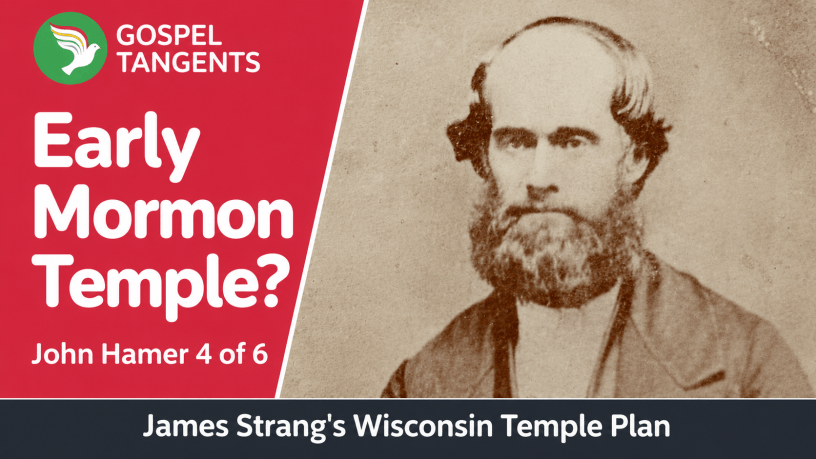
James Strang: A Fortress Temple and a Mormon King
James J. Strang was among Brigham Young’s most formidable early rivals for leadership of the Latter Day Saint movement.
Although a relatively recent convert when Joseph Smith died, Strang attracted followers by claiming prophetic authority, producing new scripture, and identifying a new gathering place at Voree, Wisconsin.
His followers dedicated a temple site and envisioned an ambitious structure with exterior courts, walls, and towers—something resembling a fortress.
But the temple was never completed.
That did not mean temple ordinances disappeared. Hamer describes Strangite baptisms for the dead in the White River, endowment practices, and the continuation of the law of adoption, in which individuals were sealed into religious households.
We also discuss Strang’s extraordinary coronation as king on Beaver Island, Michigan, and the complicated history of plural marriage among his followers.
The Strangite experience raises a fascinating question: What happens to temple ordinances when a religious community never finishes its temple?
The Churches That Rejected Temples—and Those Still Planning Them
Not every denomination descending from Joseph Smith believed that temples were necessary.
The Church of Jesus Christ, often called the Bickertonite Church, developed from the movement associated with Sidney Rigdon and William Bickerton. Unlike the Cutlerites and Strangites, the Bickertonites did not preserve a Nauvoo temple tradition.
Hamer explains how Bickerton’s opposition to plural marriage contributed to the denomination’s separation from Brigham Young’s followers.
We also discover an almost forgotten proposed temple site in Norway, Illinois, where Brigham Young and other apostles set aside land for a temple before the local congregation shifted its allegiance to James Strang.
Finally, we discuss more recent Restoration movements, including groups interested in reviving historic Mormon ordinances or establishing new temple spaces.
The discussion demonstrates that debates about temple worship did not end in the nineteenth century. Questions about authority, ordinances, and sacred buildings continue among Restoration groups today.
What Makes a Mormon Temple a Temple?
Perhaps the most interesting question running through this series is deceptively simple: What actually makes a building a temple?
Is it the architecture? A dedication ceremony? The performance of endowments and sealings? The presence of a baptismal font? Or is a temple defined primarily by the religious authority of the community that uses it?
Different branches of the Restoration have answered those questions in strikingly different ways.
Some built impressive structures. Others used ordinary buildings for sacred ceremonies. Some preserved temple ordinances without temples, while others concluded that temples were unnecessary.
Together, these interviews reveal a much more diverse Restoration movement than most people realize.
Whether you’re interested in LDS temple history, Mormon fundamentalism, Community of Christ, or the lesser-known denominations that emerged after Joseph Smith’s death, this series offers an opportunity to explore a largely forgotten religious landscape.
Community of Christ: New Leadership and Historic Sites
We begin with a look at major changes in Community of Christ.
Following the ordination of Stassi Cramm as the denomination’s first female prophet-president in 2025, the church underwent significant leadership changes, including the calling of six new apostles.
Hamer explains how Community of Christ apostles differ from their LDS counterparts. Rather than functioning primarily as a centralized leadership body, they have responsibilities for geographical regions known as apostolic fields.
We also discuss the denomination’s historic sites, including places associated with Joseph Smith III and the Reorganization in Plano, Illinois, and Lamoni, Iowa.
The conversation offers a useful introduction to Community of Christ before turning to the broader history of Restoration temples.
Questions for you:
- Which lesser-known temple would you most like to visit? The pyramid temple in Utah, the remote Nevada temple, the Cutlerite endowment house, or one of the other historic sites discussed?
- Why do you think so many smaller Mormon denominations have been forgotten? Should their histories receive more attention in mainstream LDS historical discussions?
- Community of Christ and the LDS Church have developed very different understandings of temples. What can each tradition learn from the other?
- Does the diversity of temple practices strengthen or challenge the idea of an ongoing Restoration? Why?
- If Joseph Smith could visit the temples of today’s Restoration denominations, which developments do you think would surprise him most?

