

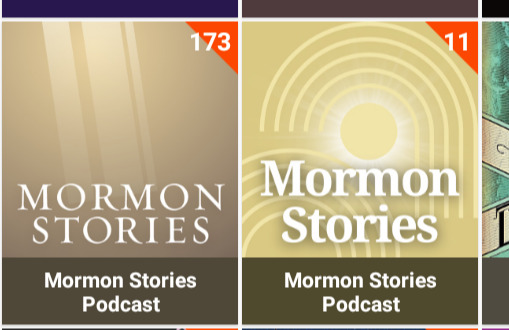
About the screenshot (above) from my podcast subscription screen — a few weeks ago, I decided to search “Mormon” in the podcast player to see what came up. I expected John Dehlin’s Mormon Stories Podcast to show up, but I was surprised to see a new Mormon Stories Podcast! It appears a faithful Church member decided to help out the Church and compete with John Dehlin. The oldest episode in the new Mormon Stories Podcast is from Sept 18, 2026. Dozens of episodes are uploaded at a time. They’re mostly less than eight minutes and sound like sacrament meeting talks that were written during the opening hymn.
Now on to the real topic of this post.
I’m sure you’re all familiar with the Church’s lawsuit against John Dehlin’s Mormon Stories podcast. Twenty years after John Dehlin launched the Mormon Stories Podcast, the Church decided people could get confused about whether Dehlin’s podcast was an official Church product or not. This was, of course, the Church’s own fault. By banning the faithful, obedient members from using the name “Mormon,” the only people left using the word Mormon were the unfaithful and disobedient people.
(There were also some allegations about using copyrighted images, but I’m not getting into those details in this blog post.)
Before filing the lawsuit, the Church and Dehlin tried to mediate. The sticking point was the Church’s insistence that Dehlin give a verbal disclaimer in every single podcast that he wasn’t affiliated with the Church. From the Deseret News explanation of the lawsuit:
What was the final ask the church ultimately wanted? According to the church, it proposed a simple solution: “a brief disclaimer at the beginning of the podcast episodes stating that the content is not affiliated with or endorsed by The Church of Jesus Christ of Latter-day Saints.”
Dehlin argues that the church’s narrative is false because he did add disclaimer language to his podcast descriptions on platforms like Spotify, Apple and YouTube and at the bottom of his website. However, the church has requested a “simple disclaimer at the beginning of podcast episodes, either verbally or in writing, acknowledging that Mormon Stories is not affiliated with the Church.” Dehlin has refused, stating, “We don’t want our primary message to be about what we are NOT.”
Importantly, people don’t often read podcast fine print at the bottom of show notes. They hit play in the car, on a walk, at the gym. A five-second audio disclaimer at the beginning of the episode, “Not affiliated with The Church of Jesus Christ of Latter-day Saints,” actually reaches listeners.
I fully support Dehlin’s decision to refuse to say words he doesn’t want to say on his own podcast that he’s been running for 20 years.
But.
The thought of malicious compliance made me chuckle. You know what malicious compliance is, right? It’s when you do exactly what someone tells you to do. This compliance then causes problems for the person who is being a control freak.
Here’s an example from the malicious compliance reddit: An employee working retail got scolded by a manager for not taking his breaks when they were scheduled. So the employee took his breaks exactly when they were scheduled, even if that meant walking away from helping a customer. When customers complained, the employee successfully pointed out that he was doing exactly what his manager told him to do. His manager’s manager wrote him up for being a control freak, and the policy got changed to give employees some flexibility about when they took a break.
If someone asks you to do something dumb, do exactly what they tell you to do and let the chips fall where they may.
Here are some suggested disclaimers for Mormon Stories:
“We are not affiliated with The Church of Jesus Christ of Latter-day Saints because we tell the truth about the Church’s history.”
“We are not affiliated with The Church of Jesus Christ of Latter-day Saints because we support sexual assault victims rather than protecting the abuser.”
“We are not affiliated with The Church of Jesus Christ of Latter-day Saints because we think people have a right to know what the Church is doing with tithing funds.”
Pick an episode and write a disclaimer! Go forth and comply!
Or feel free to tell your favorite story about malicious compliance. Bonus points if it’s in a Mormon context.


Some years ago when a letter from the FP was read in sacrament asking us to write letters (I forget now for what). I wrote the letter but agreeing with whatever it was that the church was against. In fact I just did not agree with the church’s position, so I wrote the letter saying so. Since I am in Seattle, I would imagine a lot of people did what I did.
This is so funny, and such a great idea! This is totally what Dehlin should do!
“We are not affilated with the Church because we allow everyone, members and non-members alike, to freely express their true thoughts and feelings.”
“We are not affiliated with the Church, and you can tell because most people stay awake listening to one of our 4+ hour long episodes, while most zone out or go to sleep halfway through a 2 hour General Conference session.”
“We are not affliated with the Church because LGBTQ people are allowed to participate here.”
“We are not affliated with the Church: you don’t need to pass a worthiness interview to watch our videos.”
“The Church literally sued us to make sure we told you at the beginning of each episode that we aren’t affliated with the Church, so now you know.”
“The Church excommunicated me, John Dehlin, for merely producing this podcast, so it’s fair to say that the Church really just wishes that Mormon Stories would go away.”
“Would you try to fight a legal case against an organization with $200+ billion and a platoon of lawyers? Neither would we, so we are dutifully informing you that we aren’t affliated with the Church.”
“We aren’t affliated with the Church because we publically talk about the second anointing.”
lpf43, you remind me of the time church leaders wanted British members to petition parliament to change marriage law, so that legal marriages could be conducted in the temple. (There’s an old A Thoughtful Faith podcast episode with a church lawyer in which this push gets a mention). I cannot imagine for one moment that any British member supported the idea. I remember my father mentioned it, and asked if they thought we were daft, and why ever would we want that. We are very happy with our church weddings, to which friends and family could be invited, followed by a temple sealing thank you very much.
I do like the idea of malicious compliance, but it’s the kind of thing that could get tiring after a while, so I can understand why Dehlin didn’t want to go down the verbal disclaimer route. I would think if it became a standard disclaimer regular listeners might just skip the opening couple of minutes. It’s what I do if I’m watching an episode of Poirot from my DVDs, much as I like the aesthetic of the opening, there comes a point where I just want to get into the story.
I suppose it could be made into some kind of celebratory opening along the lines of:
And this is where we take a moment to celebrate that we are in no way endorsed by the LDS church. Cheers folks!
“They’re mostly less than eight minutes and sound like sacrament meeting talks that were written during the opening hymn.” I LOL and woke up my dog =)
The examples of malicious compliance are gold. Love it!
“We are not affiliated with the church because we don’t require voluntary donations to listen to this podcast.”
“We are not affiliated with the church because we believe in apologizing when we make a mistake.”
“We are not affiliated with the church because coffee.”
“We are not affiliated with the church because we don’t require you to stand when we introduce ourselves at the beginning of each episode.”
“We are not affiliated with the church because we don’t want the details of your sex life.”
“We are not affiliated with the church because we don’t believe in gatekeeping heaven with secret handshakes.”
“We are not affiliated with the church because we don’t excommunicate listeners that post negative reviews on our podcast.”
And round and round we go.
Strict obedience rather than malicious compliance…
I always wonder what would happen if I followed the endowment session instruction to repeat a line 3 times, instead of saying it 3 times. (Pedantic, I know, but if you repeat something once, you say it twice.)
Lots of good suggestions here!
The astro-turf version of “Mormon Stories podcast is AI slop, said to be generated by Jaeden Schafer, who taught Advanced Digital Marketing at BYUH. What next?
Why is it so impossible for LDS Corp to be honest?
Lol! These are great!
Chadwick – tell your dog I’m sorry I caused his awakening.
lpf43 – good for you!
Mormon Stories could turn it into a listener-suggestion contest. “Leave a suggested disclaimer in the comments for our next episode!” If he made it snarky enough, I bet people wouldn’t skip it.