

There is what the LDS Church STATES in the Handbook, and then there is what they actually DO when they think no one is watching. I want to use the personal experiences I’ve had all my years living in Rexburg as a student, employee, congregant, and employee spouse to show you this. Consider that the Handbook serves many purposes, and it sends messaging to both outsiders and insiders. SLC can easily distance itself from its past: “Oh, we don’t teach that anymore! Look at our handbook!” and then sometimes act contrary to its stated position when they have the desire and ability to do so without too much blowback.
PROVO vs. REXBURG
As a newlywed in 2001, I started working full-time in BYU-I President Bednar’s Office. After a few years as the receptionist, I realized babies weren’t coming and I went back to school for a bachelor’s degree. (Advanced education for women—an impractical idea based on their role in this life—was now wholly necessary for me! I mean, yes, I’d gotten a 31 on my ACT, but who cares because God made me to only be a Mother in Zion! I digress!) Upon returning to school at BYU-I after my AAS in Office Systems Management from Ricks College, I chose accounting because the history and English classes were asking me to weigh gray moral issues. That made me uncomfy, and as my married ward’s Relief Society President, I felt justified in telling the teacher that The Spirit was telling me I shouldn’t read 1984.
Anyways (as I’ve learned with my newly diagnosed AuDHD, I tend to make my short points long so I will get on with it), I was in Brother Ames’ auditing class that year. He had just come out of an all-faculty meeting where Pres. Bednar reported to them what the CES Board of Trustees had told him when he was down in SLC. Pres. Bednar told all of the gathered BYU-I faculty that the Board of Trustees actually LOVED BYU-Idaho. Rexburg was their favorite campus because they didn’t have the same worldly constraints BYU had in Provo, and “they could basically do what they wanted here.” Provo has rankings and worldly academic expectations and the eyes of the world on it; the more “extreme” desires of SLC just wouldn’t play there. But Rexburg? That was their sandbox. The experience you have in Rexburg is exactly what SLC would prefer to institute everywhere if they could.
I’ve run into lots of folks in online Mormonism, especially folks associated with BYU in Provo, who think Rexburg is full of a bunch of self-righteous nut jobs with a religious superiority complex because we’re so isolated (or insecure, or whatever). Consider that Provo is how they STATE things in the handbook, and Rexburg is how they actually DO things when granted more freedom.
BIRTH CONTROL
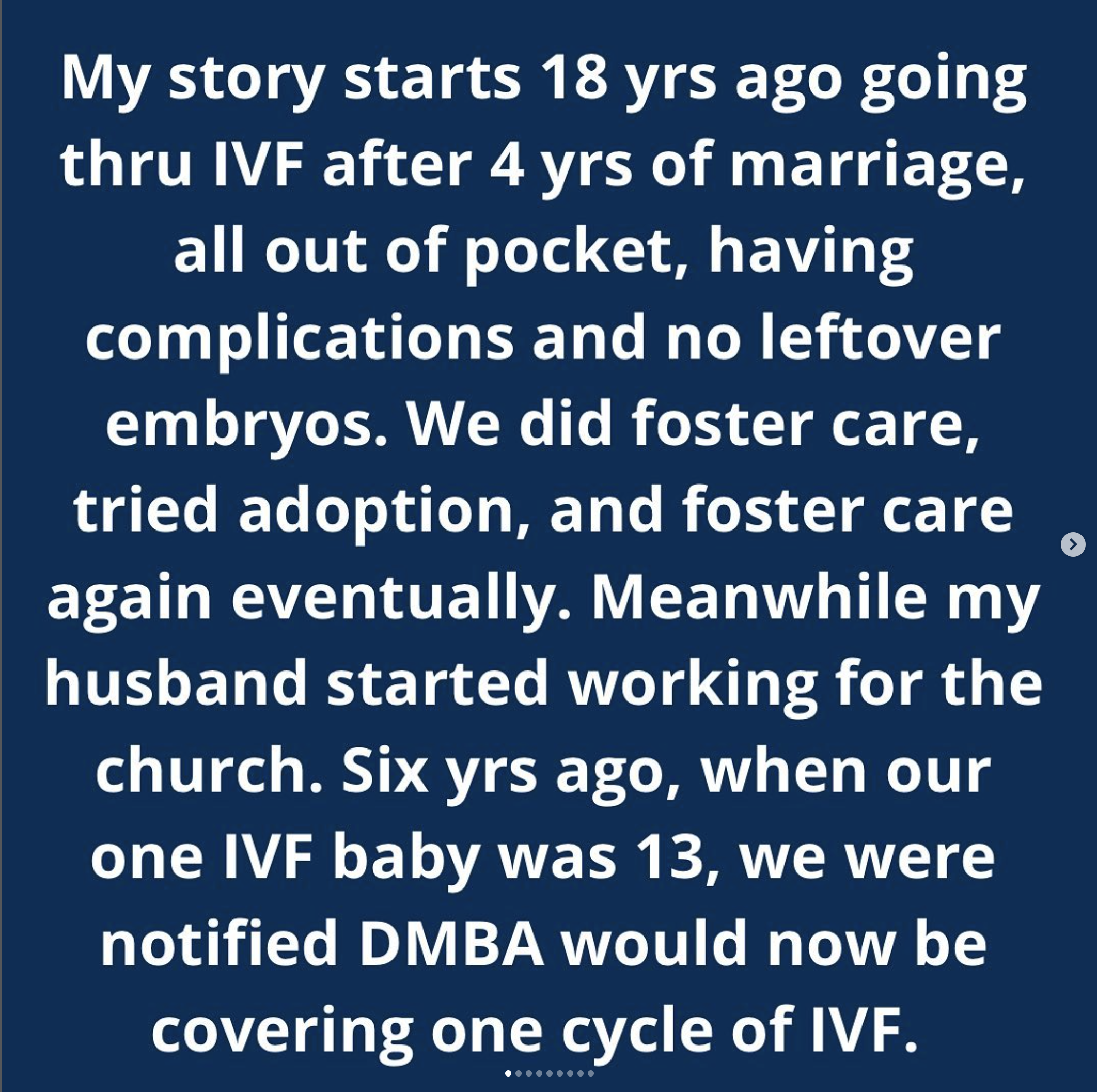
I know my mother’s generation grew up with frequent preaching over the pulpit about the evils of birth control and limiting the numbers of your children. I remember when I got married in 2001, our Ricks College bishop told us that the number of children we have is between us and the Lord. So the handbook STATES it supports its members using their agency in determining the number of children for their family.
But what did the church DO when it had the ability to control its members’ fertility? All we need to do is look at Church insurance policies at DMBA! Until 2023, it wouldn’t cover birth control pills at all, and it only covered permanent sterilization for women if they had already produced 5 children or were over the age of 40. While enjoying a general reputation of being so hands-off for decades, they literally manipulated women’s lives to squeeze out as many offspring as possible until a level that they deemed appropriate. Rexburg OBs were ordering black-market IUDs from Canada because Rexburg didn’t enjoy a Planned Parenthood nearby like BYU employees had in Provo.
So the leaders very much had strong feelings against birth control, and when they had the power to control it in members’ lives without much negative blowback, they absolutely did—until 2023! In fact, I’m not even sure the majority of leaders making the decision are now pro-agency for birth control, or if they just came to face the fact that the public blowback of the DMBA policy was no longer tenable.
My own story of the detrimental effects of the DMBA policy was highlighted on the @dmba_stories Instagram account a few months before the policy was changed. My story includes DMBA twins, degenerative disc disease, a rapid repeat pregnancy 21 months apart, very deep postpartum depression, 8+ years of nervous system burnout, untold financial stressors—mind you, BYU-I has only given us inflation raises over 15 years of employment—and a family that has been far from strengthened by not having full agency over our reproductive choices. (linked here)
WITNESS CHAIRS
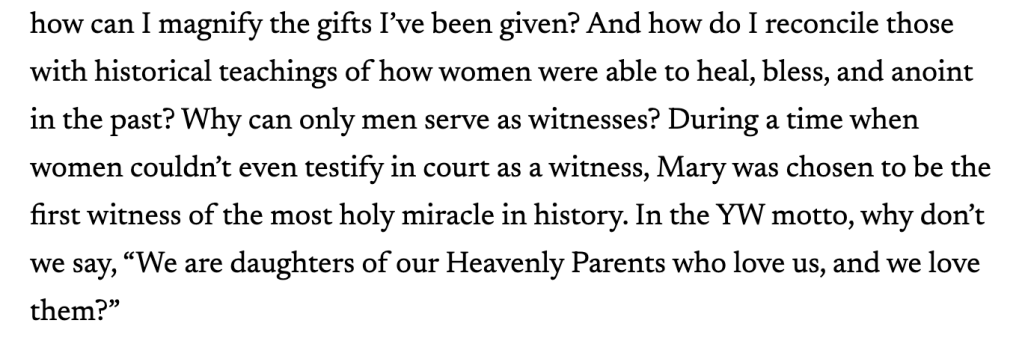
I became a baby Mormon feminist in my 30s in 2013 after moving to Rexburg during the Ordain Women drama and starting to learn what words like “pedestalization” meant. One of my earliest blogs in 2014 (llinked here) explored all of the many issues I had regarding women in the church, and I specifically asked for women to witness. It was important for me that women be given the authority to bear witness. Five years later in 2019, the church changed their handbook to STATE that women (and young children, naturally) could now serve as witnesses.
Before, men would stand or sit to the side in positions of importance with a clear view and understanding of the proper ordinance, and there would be paperwork for them to sign bearing witness that it had been performed correctly. When it came time for me to witness my own children’s baptisms or sealings, I realized they let the woman (or child) stand to the side, and then the bishopric member would come up behind me and peek over my shoulder during the ordinance and then mark it on his paperwork as he walked away. I have never signed any document as a witness. And did you notice they took away the two witness chairs in the sealing room? I was told, “Isn’t it wonderful that the witnesses can now just sit anywhere in the room?!” Consider me impressed (/sarcasm)! I bet women sitting in those two chairs made some men in SLC feel uncomfy inside, and they thought it was the Spirit telling them to change how they DO witnessing.
IDAHO ABORTION
I knew they were willing to micromanage things under the table, so it shouldn’t have been a shock when they pulled the strings on Idaho’s reproductive rights. Yes, I was shocked, but not surprised. I’ve lived in Rexburg since 2013 and grew up in Pocatello; I’ve watched my state legislature veer to the right my whole life (even as our local legislators have been a bit more moderate the last few years, bless).
The Idaho trigger law passed on the Dobbs ruling was written at a time when folks didn’t think Roe v. Wade would ever go away. It was not thoughtful; it was draconian. I have watched OBs flee Idaho and read the stories of women (one with a baby with heartbeats but no brain) have to be life-flighted to Utah or Washington for their abortions. It seemed nearly everyone agreed we needed to moderate the law, except the Idaho Legislature—which, keep in mind, if they had done so, we would have never needed a ballot initiative in the first place.
The ballot initiative process exists for citizens to speak up and say, “The legislature is not instituting the will of the Idaho citizens!” In the past, I am one of the handful of people who knock on doors in Rexburg to gather signatures for ballot initiatives (I did for the Quality Education Act which passed in 2022 and for Open Primaries/Ranked Choice Voting which didn’t pass in 2024). And while I’m not sensitive to knocking on doors and being told no after a 60–90 second pitch for paying teachers more or RCV, I also knew knocking on strangers’ doors for this initiative in Rexburg might not be… as safe. I did cheer them on from the sidelines.
I knew the proposition rolled back laws to what they used to be under Roe v. Wade and that it was a step beyond the exceptions STATED in the handbook. I also knew our handbook’s stated exceptions tended to be seen as fairly open-minded compared to other conservative churches. My first job after was for Agassi Enterprises, and the C-suite were Democrats and they loved to debate current political issues. On the abortion issue, I remember garnering begrudging respect from the CEO after sharing my position: the Church’s stated handbook exceptions. “That’s really open-minded, actually!” Unfortunately, I assumed they would leave well enough alone because while they wouldn’t support the full measure, our leaders had exhibited some understanding of the complexity of the issue by even having exceptions stated and encouraging parents to make decisions with their doctors and faith leaders.
After a lifetime of association with the church with inside knowledge of how the sausage is made, it really shouldn’t have been a punch to the gut to find out what they were willing to DO. When I heard about the leaked letters, I spent all day working to get a copy to reporters so good journalism could be done above what the local Limbaugh wannabes had covered. Over the last week, as my shock has subsided, I realized that not only is what they DO what they really believe, their actions also show the shallowness of their discernment and understanding, and their unwillingness to consider the lives and voices of women.
MY IVF & ABORTION
I remember my own first feelings of confusion when facing the moral complications of IVF. In 2004, we had to mark what we’d like done with any leftover embryos: donate them to other couples, pay to freeze them indefinitely, give them to medical research, or discard them. I had never considered that IVF had a gray area—it was supposed to be about creating life. But it makes sense when you look at how other faiths handle it; the Catholic Church allows IVF only under strict guidelines restricting the number of embryos created. The LDS Church, by contrast, wrote its handbook policy with virtually no restrictions beyond using the DNA of the parents. For a church that historically didn’t even record stillborn children, that logic tracked: they don’t treat embryos and fetuses as fully alive people.
So I researched it, digging into the history of the first test-tube baby. That breakthrough in the 1970s only happened because the UK legalized abortion in 1967. That’s not a coincidence. The obstetrician who helped create the first IVF baby was also one of the few who performed abortions in the UK. You need the legal freedom to make medical decisions about embryos—and conduct research on them—to have IVF at all. It is complex, and I had naively assumed the church was similarly aware and thoughtful in crafting its STATED position.


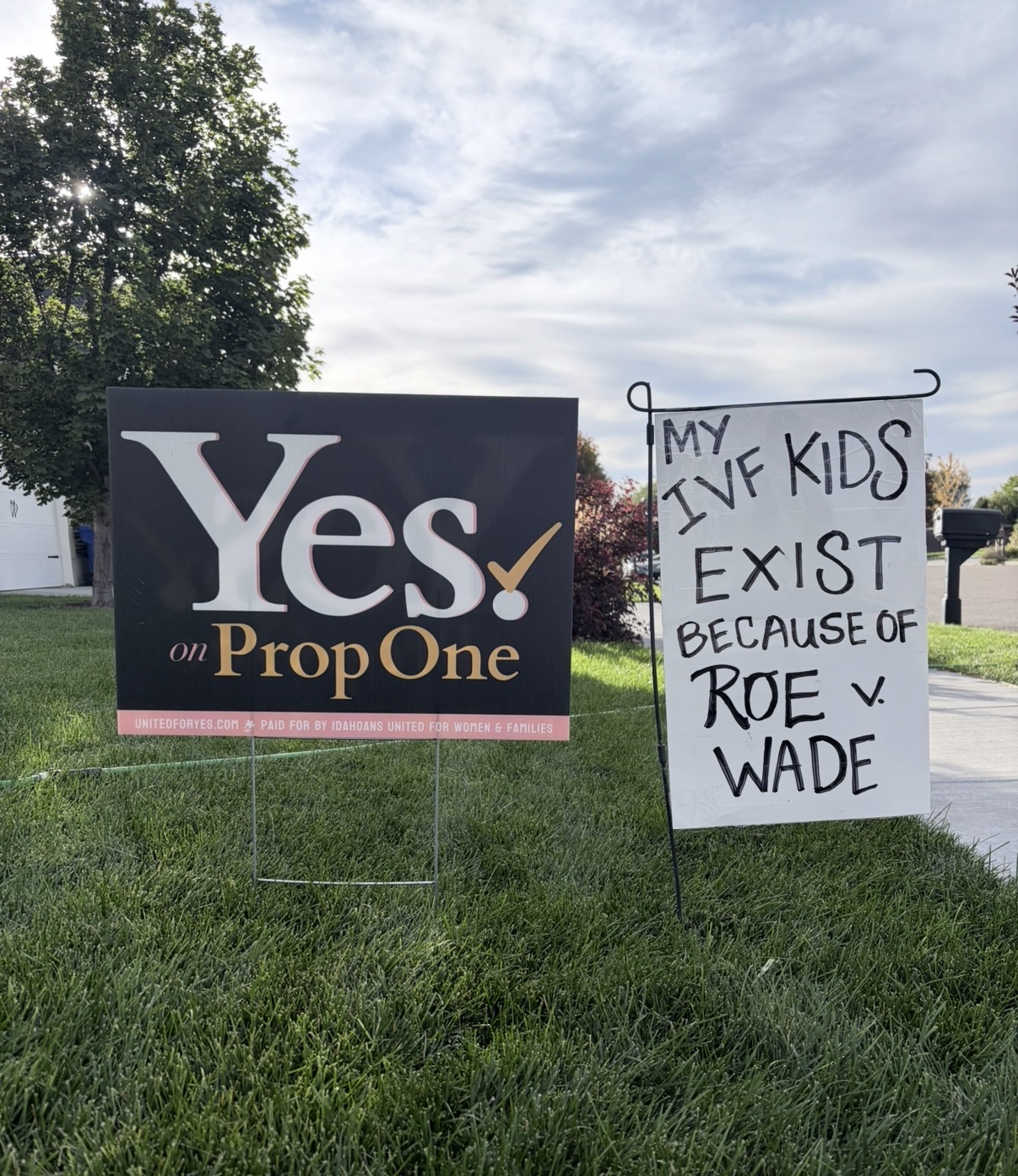
So here I am, probably one of the few (honestly … MANY?) women in the church that has had their reproductive policies AND actions lead to such devastating AND miraculous results in my life. My life has been completely derailed AND I am so in love with those faces my heart aches. These babies are miracles AND I never would have them without legal abortion rights.
I’m just a girl, standing in front of her church, asking their black-and-white MBA brains to see her, to hear her, and to be able to embrace the ANDS of life. And yet they continue to show me that’s just not something they DO.
I remain heartbroken AND furious.


A keeper, for sure. Thank you, Kristine A.
I had a similar reaction (what they say vs. what they do) a couple of weeks ago, listening to Pres. Oaks speak at the Washington National Cathedral in Wash. DC (there’s a post and video at the Newsroom if you’re interested). From his remarks, you would think the LDS Church is a progressive and tolerant church, welcoming in people from all across the racial and sexual and economic spectrums. For the most part, that’s just not how it works in the “what we do” sense. It’s better than it used to be, but a C- isn’t anything to brag about.
Great perspective!
How did BYU’s student insurance differ from the employee insurance? My Nuvaring birth control was covered around the turn of the century; I think the copay was $40/month, about what our weekly grocery budget was. I even had a Paragard IUD placed at the BYU student health center while on the University insurance.
My favorite student ward F&T meeting was when a BYUI transfer told us all we were going to hell for following the loose and sinful BYU honor code regarding curfews, when the BYUI honor code was obviously the true word of God.
Side note: One of the most enjoyable x-Mormon experiences I have is when I hear or read TBMs claim that BYU (in Provo) is too liberal. I hardly know how to respond.
HokieKate, employee policies were completely different. Imagine the blowback theyd have from 40k+ students cycling through their policies every year compared to folks who were locked into their system indefinitely and reliant on the organization for their livelihoods. Both of your examples highlight the exact lines leadership is willing to cross and why and also the resulting culture that literally filtered down from the top.
Kristine, thank you for this post. As a Mormon who has lived outside these geographic and institutional bubbles for over two decades now, it’s easy to overlook the pressures that people within them have experienced. Of course, I am reminded that even when I lived within these bubbles, I often failed to realize what women are routinely commanded to endure for the sake of the institution. Again, thank you for taking to the time to share your experience and insights.
“Until 2023 it would only cover birth control for women if they already had produced 5 children or they were over the age of 40.”
This rule applied (and still applies) to surgical sterilization only. Before 2023 DMBA didn’t cover any of the standard prescription types of birth control — not even for women who were over 40 or had produced 5 children — unless it was a medical necessity and signed off by a doctor.
I got this info from Gemini–just trying to keep the categories straight.
Oh my word, I’m a BYU-Idaho grad too (class of 2007), and even though I was a childless single dude who had zero experience with reproductive healthcare while attending, I could still express all these same sentiments!
Because the big hullabaloo my senior year was when President Kim Clarke realized he had a growing budget problem: namely, most of the married students were opting out of the school-sponsored health-insurance because it had high premiums while providing fewer services. Like the “free-market” conservatives they’d been trained to be, these students were naturally opting for cheaper private plans instead, cause why wouldn’t they? The only married students still choosing to use the school’s plan were the ones having babies while still in college, because the school plan still offered comprehensive gynecology care. This in turn was driving up premiums for the school.
Kim Clarke really had two options here: 1, he could’ve just treated it as money well spent to cover the OBGYN expenses of students choosing to have children while still young themselves. I mean, is that not exactly what Church leaders have been encouraging young people to do for decades now? Would that not be investing wisely in the future of the Church, a way to put their money where there mouth is? Did the Church not have even then a multi-billion dollar hedge-fund that could’ve easily covered those premiums anyways? Seriously, the easiest and most obviously correct choice that Kim Clarke could have made would have been to simply do nothing and keep covering those health insurance premiums as is–that is, *if* the Church was serious about how important it was for students to have children young.
But that’s not what Kim Clarke did. No, he instead went with option #2, which was to mandate that all married students get on to the same student health insurance. He mandated this to bring down premiums for the school you see, not for the individual students. Because it was always the money itself that was most important, not the students; because he thought the students were made to serve the college, not the other way around.
The backlash among married students was as emphatic as it was predictable–which made it all the more hilarious how the college administration was caught flat-footed by the response. A buddy of mine who served in the student senate at the time even tried to warn the higher-ups that this would not go over well, but they ignored him in that sweetly Mormon way that “acknowledges your concerns” while making clear they were still going to do it anyways. My buddy said he got deeply disillusioned with student government after that.
Outsiders need to understand just how much Rexburg students are socialized to treat their college administrators as though they were called-and-set-apart General Authorities speaking on behalf of God Himself to whom we must defer in all things; hence how significant it was that large swaths of the student body lashed out angrily against the administration on this domineering new policy. The student newspaper was soon swarming with letters to the editor about how this mandate was a violation of their sacred free agency (as a side-note, I wonder sometimes if the reason why Bednar has been making those awkward and ham-fisted attempts to redefine “free” agency as “moral” agency lately are his reaction against a lifetime of BYU-I students pointing out, very logically and rationally, that all these attempts to police every aspect of people’s lives is utterly incongruent with a religion that claims to honor “the agency of man” above all things).
I was, again, unmarried at the time (despite my best efforts), so this policy change didn’t impact me in the slightest, yet I still followed the controversy with interest, because it just seemed to crystalize for me everything that was starting to bother me about BYU-Idaho, how it presented itself as the face of a faith that respected the agency of everyone, all while endlessly violating it every chance they got in even the most petty of circumstances. The OP mentions how Bednar once bragged that Church HQ not-so-secretly LOVES Rexburg, because it gives them a quiet testing ground to run a college the way they *actually* want to run one, and I am 100% willing to believe that. The higher-ups clearly think that if they had their druthers, they could ensure that *everyone* who graduates from Church schools would turn out to be reliably little conservative always doing exactly as they’re told, not matter how absurd; so if the Strengthening Membership committee is reading this, consider this:
In 2004, just before I started at BYU-I, I was already a dutiful young Republican, who very matter-of-factly voted for George W. Bush in the first Presidential election I was old enough to vote in. I then attended BYU-Idaho of my own freewill and choice (my parents were really hoping I’d gun for Provo, instead). Four years later, right after graduation, I voted for Barack Obama, and have never voted for another conservative since.
Dave B: even more ironic for them to endorse anti-prop 1 after Oaks’ talk. Little bit of whiplash.
Jack: you’re correct, I went back to edit and clarify. Having lived it I must have PTSD amnesia or something. I remember the nurse laughing at me when I asked for a bc pill perscription bc she knew I was on dmba.
Jacob: I do believe that was SLC and DMBA pulling those strings in SLC? Kim Clark supported it of course, but wasn’t the administrator over those funds. And I would say that everyone in rexburg is socialized to treat BYUI folks and letters from the pulpit as speaking on behalf of God Himself, not much nuanced parsing here based on the dozens of NO ON PROP 1 signs popping up within 48 hours.
You continue to be an example of courage to me. Do what is right; let the consequence follow – if only we could count on our leadership to do likewise. Or more of the membership to push for it instead of making excuses for harmful policies.
I truly fear for a small family very dear to me, living in Rexburg and now expecting #3. Hopefully there will be no complications. 🙏
I love your kids too; watching them is both dazzling and fascinating. Knowing what you went through to bring them here just enhances my sense of wonder.
Witnesses no longer get to sit beside the sealer? How can they witness the correct ordinance if they don’t have access to the text, and the names for crying out loud. What you’re saying is that basically witnesses are no longer required… Didn’t they appreciate having women point out if they were getting stuff wrong?
Or is this just a your temple thing. The last time my husband and I did sealings earlier this year there were witness chairs either side of the sealer.
“These are not serious people.” Logan Roy from Succession
NewIcon: it’s been a long 15 year journey together on this here bloggernacle. Bless all the pregnant women in Idaho right now with a low number of complications (intnojca)
Hedge: I definitely could have been just the temples I’ve attended over the last few years since the policy change. At my daughters sealing in December there were no witness chairs.
Thank you for this. I have 4 kids, 3 of which are daughters. I honestly don’t know that continued participation in the church will last beyond me and my wife and those kids while they live with us. Heck, once they grow and leave, I don’t know that there is any reason to stay myself. Overall, participation is a drain. The truth claims no longer ring true for me and we live in a ward where people mostly like to stay to themselves so the community part is just not there. The institution seems to be in this mode of covering sins and gratifying pride–it just no longer has the power it claims to have by rules they set for themselves about power. It is a husk of what it used to be. It has stripped itself of all meaning out of a desire to be the same everywhere–you can see this in CFM where literally every lesson comes back to the same 3 or 4 points as all the other lessons, it’s just not worth opening the manual anymore. My oldest daughter goes into YW next year and the video the church put out to introduce new youth just made me sick. So now we want to send our YM off on some pointless war and dress up and put our YW into a life of involuntary servitude. I’m so tired of the war motif, the us vs them, Satan, all of this nonsense that just gets in the way. There is just not a whole lot it allows itself to offer women–. And it could–supposedly by our own scripture, the keys have been delegated to man on the earth, but I guess they forgot they could use them or maybe delegate them to women, I don’t know (bring on the “that’s not how keys work” excuses). My two oldest daughters are bored out of their mind. When they ask me why we have to sit in sacrament meeting, I don’t have a good answer for them so we often go late. If my kids leave when they get older, there is honestly nothing worth coming back for right now unless they happen into an area where the ward has built awesome community and really supports one another. But garbage like this abortion letter is such a communal turn-off.
Listening to Inside Out, it seems like they are putting new energy into the missionary program, but the problem is the bucket the missionaries put these people in is so proverbially full of holes, very few opt to remain a part of it. Surely with “living” priesthood and revelation the institution could revamp and reenergize everything to bring new life, institutions do this all the time. But these other institutions do this by ruffling lots of feathers accepting the fact that some people will not like it and leave.
If the church has to keep repeating the same tired tropes to keep people convinced because people aren’t instinctively seeing it on their own without a lot of squinting, they’ve completely lost the plot.
chrisdrobison – I appreciate your thoughtful posts here. I don’t always agree with them, but I sense that you are sincere in your thinking about church, community, politics, etc.
I’ve got to wonder why you and your wife are possibly going to wait until the kids are gone to exit your church participation. If you both are not agreeing with the the way things are being run, find something else to engage your family with the community. If you are in Utah, I understand that the “community” is heavily church oriented. My son and his wife were in Utah working professionally after attending UofU. They decided there was no way they wanted to raise their children in that type of setting and left the state for California.
My point is that you only have a very short period in your life for a couple to raise a family. That time frame is less than 20 years, not considering that your children’s ways are pretty well set by age 16. What influence do you want effecting the rest of their lives? Do you want them to end up having the same faith struggles you and your wife have?
My children were all raised in the church, they are all deep into their 30s now, with varying church participation. None of them are TBM. They think on their own about their spirituality and participation with religion, but they are all active participants with each other and my wife and I. I can’t ask for anything else. I recognize some of the hurt that our church culture placed on them, and I would have inserted a few tweaks, if I had it to do over, but that is not realistic. You are in the middle of it. Apply YOUR parenting now. It is you and your wife’s responsibility now, so make your decisions now.
I offer this advice knowing you didn’t ask for it, so disregard it, use part of it, or tell me to go jump off a cliff. It just seems like you are at a transition stage in your life right now and I thought I’d throw it our there. Good luck!
Cheers
WOW! See Dave B’s “How to Win at Religion!” That is very apropos to what I said above.
Cheers
Google’s AI on the IVF/Abortion paragraph:
The statement contains a mix of historical fact, flawed logical leaps, and a mischaracterization of scientific timelines.
Here is a factual breakdown of the claims made in that paragraph, separating where the speaker is historically accurate from where they are incorrect.
1. “That breakthrough in the 1970s only happened because the UK legalized abortion in 1967. That’s not a coincidence.”
Verdict: Historically Incorrect.
• The Reality: The birth of Louise Brown in 1978 was the result of a decades-long international scientific race that predated the 1967 Abortion Act.
• The Evidence: Robert Edwards (the embryologist who won the Nobel Prize for IVF) successfully fertilized human eggs in a laboratory setting in 1968, but his fundamental research into mammalian reproductive biology started in the 1950s. Furthermore, American researchers (like John Rock and Miriam Menkin) were attempting human in vitro fertilization as early as the 1940s. IVF did not require abortion legalization to begin or succeed.
2. “The obstetrician who helped create the first IVF baby was also one of the few who performed abortions in the UK.”
Verdict: Technically Accurate, but Contextually Misleading.
• The Reality: The obstetrician referenced is Dr. Patrick Steptoe. It is true that Steptoe performed abortions. He was a pioneer in laparoscopy (keyhole surgery), a technique he used both to safely terminate pregnancies and to perform other gynecological procedures.
• The Context: Steptoe was not “one of the few” performing them; after 1967, abortion was integrated into the UK’s National Health Service (NHS), meaning many NHS gynecologists performed them. More importantly, Steptoe’s role in IVF was surgical—using his laparoscopy skills to harvest eggs from women’s ovaries. His willingness to perform abortions was a reflection of his progressive views on women’s healthcare, but it was his surgical mastery of laparoscopy, not his abortion work, that made IVF possible.
3. “You need the legal freedom to make medical decisions about embryos—and conduct research on them—to have IVF at all.”
Verdict: Legally and Historically Inaccurate for that Era.
• The Reality: In the 1960s and 1970s, there was no specific law governing embryo research or medical decisions about embryos in the UK.
• The Legal Vacuum: Edwards and Steptoe operated in a legal gray area. They did not have “legal freedom” granted by the Abortion Act; rather, they operated in the absence of laws prohibiting embryo research. The 1967 Abortion Act dealt exclusively with terminating a pregnancy inside a woman’s body. It said absolutely nothing about embryos in a petri dish. The UK didn’t legally regulate embryo research until the Human Fertilisation and Embryology Act of 1990—twelve years after IVF succeeded.
4. “It is complex, and I had naively assumed the church was similarly aware and thoughtful in crafting its STATED position.”
Verdict: Subjective opinion, but historically ironic.
• The Reality: The Catholic Church (and other religious bodies) actually anticipated the ethical dilemmas of IVF long before the general public did.
• The History: Pope Pius XII explicitly condemned artificial insemination and early concepts of in vitro fertilization as early as 1949 and 1956, decades before a child was born. When Louise Brown was born in 1978, the Vatican’s response was highly coordinated, arguing that IVF separated the unitive and procreative aspects of marriage and resulted in the destruction of spare embryos. Whether one agrees with the Church’s stance or not, history shows their position was not reactive or “unaware”—it was a deeply calculated application of their existing theological framework regarding the sanctity of life from conception.
Summary of the Flaw in Logic
The speaker is committing a correlation proves causation fallacy. They looked at the UK in the late 1960s/1970s, saw two major events involving reproductive medicine (abortion reform and IVF), and falsely assumed one legally paved the way for the other. In truth, IVF was born out of a desire to cure infertility, developed by scientists who fought uphill against a lack of legal frameworks and government funding.
17RRider,
Thanks for the questions. We stay in Utah because of close family relationships that we value greatly and health concerns. And because of the help rendered by close family in relation to those health concerns, leaving Utah comes at a massive cost. We’ve considered leaving, but the support system we have here from family is just too valuable right now.
As for the why we still go to church–we still find some community there. These are literally most of our neighbors in our neighborhood. And if we stopped going, there just wouldn’t be another place for interaction with them. That’s why we still go. It gives our kids interactions with other kids that are positive. That interaction is important even if the institution surrounding it is not that great right now. If those interactions become a net negative for them or us, then we will be done. We are definitely trying to parent in other ways that don’t pass down the same faith struggles. We do that by acknowledging the complexities of life and acknowledging that belief systems are just that beliefs–not answers. They help us engage in life and when they stop being helpful, they are no longer are useful. Additionally, church is something we do, not something we are. Church should be something that helps improve who we are, but right now seems more focused on controlling what we do. Now I realize that sometimes controlling the things we do results in improved outcomes in character–for instance, in children–but that does have a short shelf life of usefulness as children grow into higher levels of reasoning. As parents, we try to teach values as something independent from institutions we participate in. Which essentially means that we should feel free to separate from institutions that don’t align if our values. There is a lot of complexity here that I’m hand waving. At the end of the day, we still get value from church participation, just not the value I feel like it says we should be getting as our belief systems are not in alignment in various areas. And that is frustrating because I feel like as a church that makes the claims it does, it should be a lot better and more big tent. I think there are a lot of people in the church in this camp that are pushing for a bigger tent church, believing that a church should be singularly unique in its purpose–one of welcoming in people from all camps and widening its doors so that all people can find a place.
“They think on their own about their spirituality and participation with religion, but they are all active participants with each other and my wife and I. I can’t ask for anything else.”
1000%. This is exactly what I hope for.
I actually do personally participate in other communities that have the feeling of more alignment. For example, I participate in a choral org that focuses on learning and performing sacred music from across traditions and time. The goal of this org is to share divine light. That’s it. I pay to be part of this group and put in multiple hours a week in rehearsal and practice because I feel like I get more back from it than I put into it. There is lots of effort, but it feels effortless. It feels important, worthwhile and valuable not only to me, but to the people we perform for. It feels way more like church to me than church does. In fact, this group is ‘church’ for the director as he was essentially forced out of the church after coming out as gay some years back. He started this org so that he could still have some place to worship God since the actual church no longer welcomed him as being that place for worship. And that is sad, because they’ve lost someone who could have had such a massive impact on the inside had they set down their dogmas. This is what is so frustrating to me in general about the institutional church and the orthodoxy: it cuts off its nose in spite of its face believing that gatekeeping is what God is all about. Yet, being in this choral group gives me the energy to still engage somewhat in church to hopefully push for change from the inside, because it could be so much better if it gave up so much of the control it tries to exert.
Revised Verdict on the Speaker’s Claim
If the speaker is an LDS member or looking at the LDS Church, their statement that they “naively assumed the church was aware and thoughtful” is historically and doctrinally backward.
The LDS Church was highly aware—they crafted a policy that embraced the life-giving potential of IVF decades ago to support their theology of family and pre-mortal spirits. If the speaker is frustrated by a lack of guidance on what to do with unused frozen embryos, that ambiguity is a deliberate choice by church leadership to leave the ethical weight on individual agency rather than strict dogma.
“[T]hat ambiguity is a deliberate choice by church leadership to leave the ethical weight on individual agency rather than strict dogma.”
Doubtful. This is a church that has rules about earrings. There’s no way the leadership trusts its members to do the right thing for decisions of any import.
The point is that legal/medical freedom surrounding human embryos are legally and logistically bound at the hip. Edwards and Steptoe faced relentless backlash from folks who viewed human embryo experimentation as a moral outrage and a violation of fetal personhood. Which, according to policy, the church also does not believe in fetal personhood, although our actions following a “strict dogma” prove otherwise–Which is exactly my point.
If the UK hadn’t legalized abortion in 1967, Steptoe and Edwards’ research could/would have been legally criminalized and shut down before it ever left the lab. Because of the 1967 abortion act they had a legal stance to defend themselves in what was then a legal gray area. Reproductive freedom creates the legal umbrella that allows assisted reproductive technology to exist./fin
And it doesn’t matter how much you can prompt Chat to disagree with me, lol, THAT is a fact
Since I knew nothing on the history, I just copied your paragraph and had AI analyze it. No weird promptings, and I’m not experienced enough to make it disagree. I didn’t know anyone personally (just online strangers) who was a church member actively going against the apostles and church leadership on the topic until your FB post (I’m a FB friend of your husband – love that guy btw). You and your husband went through the IVF process around the same time as my wife and I. I was also caught off guard on the options with embryos. And I was naïve to looking to the church handbook on much of anything at the time (I think it might have only been available to certain leaders at the time?). So the IVF tie-in and the personal connection hit me in the feelings, and it led me to comment on my AI findings. Peace to you and yours.
Same to you, Jeremy! yes Darik is a v good guy 🙂
And yeah sorry, I’m sensitive to AI responses. Esp because before I published I ran it thru chat one time to verify any errors and it was way too effusive In its praise. (Eye roll) It tends to want to produce a result to please the person using the product. PS Byui/the church etc really leaning into it really grinds my gears.
What the Church says: The BoM was written for our day.
What the BoM says: Infant baptism is evil.
What the BoM doesn’t say: Abortion is evil.
What the Church does: Instruct its members to vote for criminalization of abortion.
What the Church doesn’t do: Instruct its members vote for criminalization of infant baptism.
Well said! I had to have several painful experiences before I was able to accept that the Church wasn’t going to live up to its words. It’s a very painful process of disillusionment. Thank you for setting it out so clearly.
chrisdrobison – I knew you were being thoughtful about your participation and I completely understand your angst and disillusionment for many of the church dogmas and processes. I too am not very fond of “the covenant path.”
Cheers Brother – Hang in there. Nothing wrong with being a “cafeteria mo.”