

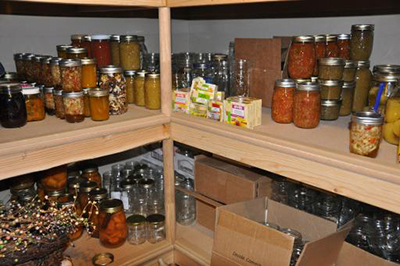
[image from the Church’s website]
The most important question in this post is if you had enough toilet paper and Clorox wipes on hand to get you through the first few months of the pandemic when grocery store shelves emptied out.
I have two vivid memories of food storage. One is the pantry in the basement my dad built, in which we stored two years worth of food. It worked great — we all learned to rotate food. We cooked with food storage. I don’t recall throwing out much, but maybe I’ve forgotten. My other vivid memory is when my parents were downsizing and offered their adult children all their food storage. Wow, they had a lot of unappetizing food.
I was raised when the counsel was to have two years worth of food on hand. Then it got reduced to one year. In the end times, before Christ came, there would be a worldwide drought and so much upheaval that supply chains would all break and we would need to live off our food storage until Christ swept the wicked from off the face of the earth. That was the reason we needed food storage — to prepare for the Second Coming.
The current counsel is to have three months worth of food, though members are encouraged to have more wheat, rice, and beans when possible. This is to help you get through unexpected challenging times, not prepare for the Second Coming anymore. It’s good advice. To the extent someone can store up a bit, rather than living paycheck to paycheck, it’s good advice to have food and other supplies on hand.
Earlier in my adulthood, I tried to have food storage because I was an obedient person. Using food storage is hard, especially if you don’t like canned vegetables. I would buy food storage and then eventually donate cases of nearly-expired canned goods to food drives just to get rid of it. I wasted a lot of money trying to buy food storage before I realized that food storage was not going to be my thing. When the pandemic began, my family had enough toilet paper to survive the first months of the pandemic, and the only thing I remember running out of was yeast (I make homemade bread), but I had enough on hand that we were fine until grocery stores got back to normal.
And gardens!
As my yard is struggling in the heat and drought, I thought with some fondness of the years that I grew a couple vegetables. I was raised by serious gardeners and remember a couple months every fall spent canning peaches and apricots, slicing corn to be frozen, bottling applesauce, and whatever else we grew. Again, the reason was to feed ourselves during the chaos before the Second Coming.
When I finally had a house of my own with enough yard for a garden, we planted tomatoes, zucchini, and crookneck squash. It was awesome! Until harvest time. Then I began to understand why people with gardens are desperate to give away produce before it spoils. It takes a lot of effort to bottle, can, and freeze produce. I bottled applesauce for a few years until some of it went a funny color and I got scared of botulism.
Gardens are no longer a requirement for being a faithful Latter-day Saint. This is what the Church’s website says about gardens: “If it makes sense where you live, consider planting a garden as a supplement to your food storage (learn more about how to start by reading the “Gardening” Gospel Topics page).” It’s optional now.
We talk frequently about how Church teachings change over time. Food storage and gardens are one of the teachings that has gradually been discarded as the Church has expanded beyond the Rocky Mountains and the pioneer farmers are several generations behind us. Some countries ban food hoarding. Lots of people live in apartments where you can’t grow a garden.
I don’t try to grow produce anymore. It takes so much water. Utah is in the midst of a bad drought. My gardening efforts are all about native, waterwise plants. That said, I don’t begrudge my neighbors their emerald green lawns (including the Church; their sprinklers turn on right at 6:00 every day). Utah politicians were gung-ho about building a huge AI data center, with all its water requirements, over the protests of angry Utahns. And there’s a surf pool planned too. A surf pool! To attract Olympic hopefuls! In the Utah desert! What the fudge??!? Anyway, until the politicians and land developers start conserving water, I can totally see why some Utahns refuse to cut back on watering their lawns.
Questions:
- Did you run out of anything during the covid shortages? Or did you have the necessities already on hand?
- Did you grow up with food storage? Do you still maintain food storage?
- Do you grow any of your own food? Where is the most recent full-time farmer in your family tree?
- What are your thoughts about how food storage was tied to the Second Coming? How were you planning to cook when all civilization was wiped out and we had no electricity or running water?
- Do any of your kids store food or grow gardens? Or was this teaching one of those temporary commandments?


1. We did get pretty low on oatmeal during covid, but otherwise fine.
2. Both my husband and I grew up with food storage. We also threw away LOTS of unappealing and clearly no longer healthy food after our parents died. We sort of continue to do food storage, though it’s challenging as we get older because it’s harder to use the food promptly. Mostly we stock up when food that we use is on sale.
3. We have a small garden. It’s “grazing” only. I don’t preserve much. It doesn’t seem to me to be cost effective. I have also read that commercially processed food tends to retain nutrients better because it’s processed at a higher temperature for a shorter period of time.
The most recent full time farmers were my paternal grandparents, though both of us grew up with part time farming. I miss farming communities. I don’t miss farm work.
4. I no longer find the food storage for the end times argument persuasive. Having some food storage to help manage costs or to weather unexpected difficulties seems wise. I do have some food seeds canned for long term storage in my basement, but don’t think I’ll ever actually plant them.
5. All of our children have left the church. They don’t have any food storage as far as I know. We do share with them when we find bargains on food.
Ironic that the closer we get to the second coming, the less we need food storage to prepare for it.
I grew up with a few weeks or months of food on the home made shelves in the basement, which as you said is just good sense if you can afford it. Forgetting to buy a can of beans for a specific meal you want to cook isn’t a problem when you have a stock of them on hand all the time. We also had hundreds of pounds of wheat. I’m not aware of us owning a wheat grinder, and I don’t remember ever using any of that wheat. I have no idea what the plan would have been to survive on wheat alone if the end of the world came.
As the adult myself, I have the same few weeks of food stored on the home made shelves in my basement. We have some cans of wheat, oats, rice and pasta that are probably nearing their expiration date and will never be used. But at least I can say that I’ll only be throwing out 20% as much wheat as my parents did!
We moved from Utah to the midwest 16 years ago and had professional movers that packed up all our stuff and took it out there for us. When they were most of the way done packing, one of them looked at us and said, “You’re Mormons, right? . . . . Where’s all your food?” They had some good stories about old ladies with thousands of pounds of food storage.
I grew up with the same kind of pantry with shelves of food storage. We were NOT as good at rotating; BUT we did have to dip into it more than once during times of economic hardship for our family (job loss). And let me tell you, to this day I HATE POWDERED MILK. Absolutely hate it! (late 80s/early 90s)
Maybe it is because of that lens through which I experienced food storage as a kid, but for me it was never about second-coming upheaval – it was for emergencies in general, whether it be natural disasters, war, or job loss etc.
It certainly does seem that the shift in teaching is more an accommodation of a more diverse membership than anything else. We still try to garden for food, but that is so we know how to do such things in case we needed to in the future – I often joke that I do the garden stuff, and a few other things related to livestock, so that I have some useful skills in a zombie apocalypse.
The challenge on most of us, should there be a general collapse of rule-based order, is how to maintain systems we don’t understand anymore. I could plop in a solar panel system tomorrow that is supposed to work for 25+ years, but if an inverter goes bad, who could troubleshoot and jury-rig that to work again?
Or perhaps I’m one of the crazies that thinks about such things …. whatever the case, my concerns are more of the run-of-the-mill-authoritarian-types-ruin-democracy-in-America flavor than anything regarding the second coming itself.
Ah, such an interesting topic – and particularly pertinent in my present situation: we have decided to move (downsize) after 4.4 decades of accumulating and raising our 5 children. Of course, being in the center of the Mormon Corridor, food storage was a key component of that accumulation – we even dug out and constructed a 12×20 concrete underground room to contain our food storage under cool conditions.
We have given ourselves a year to pack/consolidate/donate/toss our accumulated riches, but in the case of the food storage – our two options are to eat steadily from the storage or eventually lug lots of fragile glass bottles and rusty cans to our new location a hundred+ miles away. And the dry rice! And the dry wheat! And the dry pasta! I started reconstituting wheat and sprinkling it generously on our noon meals, but after a few months of that, I can hardly stand the thought of more wheat at lunchtime. And we have literally several hundred pounds of dry wheat, tinned up and awaiting the move.
About our offspring: interesting that our firstborn took literally the opposite tack. For her, meal preparation involves: a. deciding what to prepare; b. prepare a list of required ingredients; c. hop in the car, drive to grocery store, get required ingredients; d. make meal. For our lastborn, meal preparation involves a daily stop at Trader Joe’s. He recently commented that they literally do not eat out of tin cans at their house; he still owns a can opener just for the memory.
It is good to be prepared. It is wisdom to know the balance between preparedness and fear of starvation. Unfortunately, in our case, the ample food reserve was initially (and still is, in the minds of the TBM sectors of our clan) based on fear of the Second Coming.
Thanks, Janey, for your contributions to the blogosphere.
Tangential comment. DaveW said: Ironic that the closer we get to the second coming, the less we need food storage to prepare for it.
Christians, including apparently the apostle Paul, have believed for 2000 years that the second coming is imminent. Members of The Church of Jesus Christ of Latter-day Saints have believed for 200 years that the second coming is imminent. I was first told when I was in high school that we were the chosen generation saved for the last days. Now it’s my grandchildren’s generation who are told the same thing.
We have been told that wickedness is spreading throughout the earth. We have been told that the world is getting better as the gospel spreads throughout the earth. Some prophets and members are clearly catastrophists. Some prophets and members seem to be optimists.
Meeting my Savior could happen for me at any time. I don’t see how I can be sure of anything else.
Janey, apple sauce will never cause botulism. It has too much acid for that particular germ. It may go dark—still edible but nutrients are lowered. If it spoils, you get fermentation and mold. If processed properly canned fruit is safe and unless it comes unsealed keep well for a few years. Better than tin cans. Green beans, corn, and any meats if not processed properly can cause botulism and there is no visible sign of spoilage or damage. It just invisibly gets poisonous. But boiling before eating kills off the poison, which is why I boil all canned veggies from the grocery store. People have died from stuff from grocery store.
And, when you run low on yeast, put some in sour dough start and keep it fed and you will never run out of yeast. If you run completely out, then set out your sour dough start to collect wild yeast. It takes a bit longer but after a few days of sitting on the counter, it starts to get bubbly. There is always plenty of wild yeast in the air around you to make sour dough. If you do not like the taste of sour dough, add baking soda and that sweetens it by counteracting the acid.
For more tips from an old fashioned grandma, just ask. I know a lot about how to survive any kind of disaster as well as gardening, composting, canning. All that stuff nobody knows any more.
We use the food storage. We have never thrown anything out from going bad, except tin cans of stuff. But then I know signs of spoilage compared to it just passing an expiration date. The tin cans tend to go bad about the expiration date when stored in Southern Utah because we let the house be hot while we are gone. I sued to grind my wheat and make bread, but with two diabetics, it is just too much carbohydrates, so I have stopped. My kids will throw out what I have left when I die because I am only using maybe a 5gallon bucket of it every 5 years or so. I still have my parents stored corn to grind for corn bread, but same thing with the wheat. Although it keeps forever, my kids will throw it out. There are only two of us and we just can’t eat the carbs.
We threw out a lot of my mother in law’s food storage as she had not properly stored some things like dehydrated potato shreds. It had gone dark from air getting in and tasted like crap anyway. My sister in law threw out all her home canned stuff because she throws stuff away if it is two months old, and I said I had enough of my own.
My home canned stuff is starting to get thrown out as it is getting old. But I have stopped canning more, so we are using up or throwing it out. I had a lot because we had fruit trees and a huge garden before moving to Southern Utah and snow birding to Idaho
Grew up gardening and love it. Even when we have lived in apartments I have had window boxes. In West Berlin we grew radishes in the window boxes, but we were poor enough there that we needed everything we could do to save a dollar. My husband teases me about my needing to get my hands in the dirt. After retirement is the first time we haven’t grown some kind of food, because we are snowbirds and that cuts up the growing season. So, I have pet cactuses in pots, lots of them, at my Southern Utah house and flowers in Idaho.
No, we did not lack anything during Covid. I tend to keep extra of stuff like toilet paper, which never goes bad and you are always going to need.
Yes, we have lived mostly off food storage and home grown stuff while my husband was out of work for about six months. We could not live on the tiny salary I got as a social worker and so we paid mortgages, water & electric with my paycheck and lived off the food we had in storage.
We were so TBM that we bought each other a can of wheat for Xmas 46 years ago, and it doesn’t keep forever because the fats in the grain go rancid. Believe me.
We do what the europeans do now which is grow what we can and preserve what we can for a year and make sure we use it in the winter. We get good food but it takes a lot of time and energy and has never been cost effective, but we have time on our hands having retired and it’s more interesting than the gym. We do only grow what we enjoy and is relatively expensive all year. My favourite thing to preserve and eat is ratatouille, always gives me a meal in winter with fish or meat or beans and is a winter treat full of summer’s harvest. About to start on that labour!
I’ve enjoyed reading other peoples’ experiences with food storage and gardening. Thanks for commenting.
It sounds like there’s a consensus (among the commenters) that food storage is not cost effective. Lots of people get rid of food storage because it’s hard to eat. I inherited some 40+ year old wheat when we cleaned out a relative’s food storage. I have a wheat grinder, so I ground it up and made bread. It was hard red wheat and the bread’s texture was not good. There’s now a white winter wheat that makes a whole wheat bread that’s a lot tastier. Maybe if the alternative was starving, but eating long-term food storage is not anyone’s first choice.
Basically, food storage nowadays is just having a bit extra on hand so, as DaveW pointed out, you don’t have to run to the store for just one can of beans. Although it sounds like raymondwinn’s child handles cooking in just that way!
Adam F – I also hate powdered milk. My mom stretched the food budget with powdered milk. One gallon of milk from the store became two gallons at home. She would mix it in the blender so there was a huge cap of foam on the regular/powdered milk blend in the jug. Food fatigue is real! I grew to hate certain foods.
raymondwinn – you’re welcome. 🙂 I really love being part of the blogosphere. Thanks for your contributions too.
Anna – interesting that applesauce can’t have botulism! Thanks for that. I already threw it all out, but thanks for that info anyway. When I ran out of quick yeast, I did still have my bottle of sourdough starter in the fridge. I don’t like sourdough bread as much. As always, thanks for sharing your anecdotes.
wayfarer – cans of wheat for Christmas gifts!! You made me laugh. Yes, that’s a very TBM thing to do. My parents gave all their kids wheat grinders for Christmas one year. They were super cheap and mine broke after two uses. I eventually splurged and got a nice wheat grinder that I haven’t used in years because the only store that used to sell five gallon buckets of wheat stopped selling it and I only ever bought as much as I could use in a year. I learned from previous generations that buying hundreds of pounds of wheat is just a waste. So now I used all my wheat and have nothing left. I could probably post a note on the Church bulletin board and ask if anyone wants to get rid of some wheat. I bet there would be a lot of people trying to get rid of old wheat.
The last farmer in my family was my grandfather, who grew up farming but decided to leave that life behind at the age of 27 to study engineering at the University of Utah during the great depression. My grandparents did all of the bottling. I think those were ingrained habits of their generation long before Spencer Kimball told the church they should all be doing it. My memory of their bottled food was that in their later years they created far more of it than the two of them could ever consume, and they were constantly trying to give some away to their family members. Some of it was legitimately good and nice to have, but in my family it became a joke to refer to some of the bottles as “mystery fruit” because sometimes it had sat on the shelf long enough to have degraded in color and shape a bit and become indistinguishable from other fruits.
My parents were actually very good at living off food storage and it actually was very helpful during some periods of financial stress when I was growing up. I have a large pantry and a decent stock of things I actually use but I wouldn’t want to speculate on how long I’d survive on it if required to. Not terribly long, I’m sure. I do have a flour mill. Baking whole wheat bread and getting it to turn out well is actually a lot harder than with white flour, it turns out, so I mostly bake white bread. I do use the mill for whole wheat pancakes on occasion. Maybe I’ll survive the end of the world a few extra weeks on my limited wheat supply and pancakes. But only if I have enough Costco maple syrup on hand. Not sure I could make it otherwise.