


In past decades, prophets and apostles expected that the members of The Church of Jesus Christ would produce some of the greatest art the world has ever seen. President Spencer W. Kimball quoted President John W. Taylor in prophesying that: “Zion will be far ahead of the outside world in everything pertaining to learning of every kind as we are today in regard to religious matters.
“God expects Zion to become the praise and glory of the whole earth, so that kings hearing of her fame will come and gaze upon her glory. …” (Sermon, September 20, 1857; see The Messenger, July 1953.)”
President Kimball went on to predict and encourage great singers and composers: “With regard to masters, surely there must be many Wagners (Richard Wagner, 1813–83) in the Church, approaching him or yet to come in the tomorrows—young people with a love of art, talent supreme, and eagerness to create. I hope we may produce men greater than this German composer, Wagner, but less eccentric, more spiritual.” While much of President Kimball’s talk is focused on musical art, he also referred to Michelangelo for his sculpture and painting, praised poets and novelists, dramatists like Shakespeare, even scientists and filmmakers.
Kimball believed faithful LDS artists could surpass even these great artists of history. From the same source linked above, he proclaimed, “It has been said that many of the great artists were perverts or moral degenerates. In spite of their immorality they became great and celebrated artists. What could be the result if discovery were made of equal talent in men who were clean and free from the vices, and thus entitled to revelations?”
And yet The Church of Jesus Christ is still working to fulfill its artistic potential. You may have already seen this meme floating around the Internet:
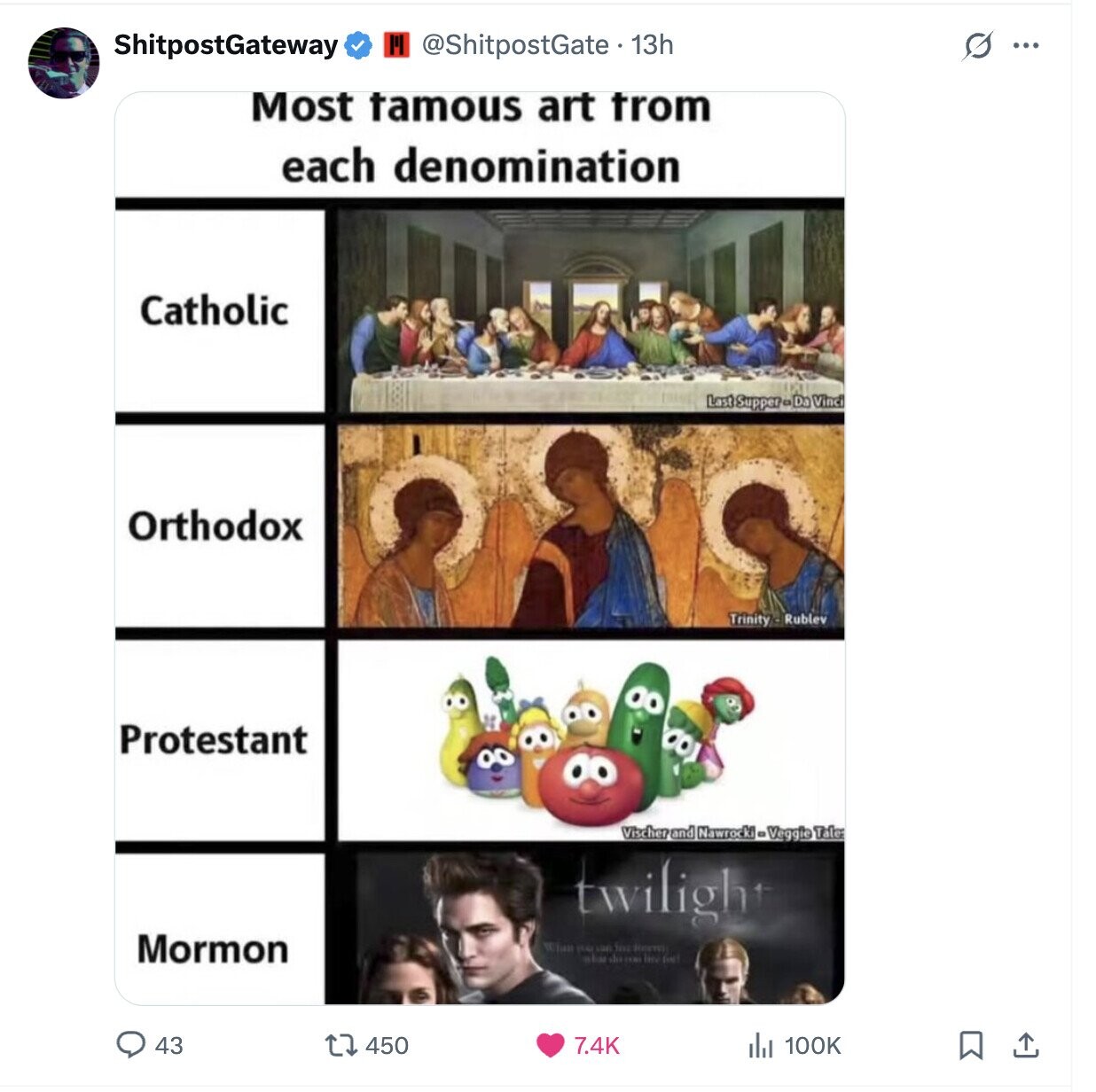
This meme is humorous, but unfair. Twilight, written by LDS author Stephenie Meyer, is not in the same category with the Last Supper, painted by Leonardo da Vinci, the Trinity icon painted by Russian artist Andrei Rublev in the early 15th century, or even Veggie Tales, that Protestant delight. Twilight, the story of vampires, werewolves, and Bella Swan, is not a religious work at all. Meyer happens to be LDS, but Twilight is not created out of a desire to extol great religious beliefs, or even teach religious principles using vegetables (or vampires).
Adding Twilight into this list would be like adding “The Late Show” (now canceled) onto this list because Stephen Colbert is a practicing Catholic.
What is the most famous LDS art that is meant to teach religious principles or express religious belief? I would suggest that temples fill this role in the LDS belief system. President Kimball didn’t talk about architecture at all in his talk about the arts, but in my opinion, temples are the most visible and recognizable symbol of LDS faith. Part of the reason they are so opulent and eye-catching is to interest people to attend open houses or ask questions about why the LDS Church pours so many resources into temple building. Then we can explain work for the dead, the restoration of the priesthood, eternal marriage, and so on. I know that nuanced believers have rolled their eyes a bit about the number of temples that President Nelson announced, but surely one of the reasons for so many temples is the faithful Mormon belief that the honest in heart will be attracted to temples. Building a temple is a missionary tool.
The Church has egg on its face with some of its temples. Fairview, Texas is surely not looking kindly on Mormon beliefs about the dead, for example, because of the Church’s insistence on building a very tall spire. The Church’s lighting preferences for temples has also come under criticism by dark sky advocates, like in Heber, Utah. Nevertheless, I suggest that temples are, for the most part, the most visible aspect of LDS belief and peppering them around the world is a missionary effort as much as it’s an effort to redeem the dead.
But still, if we select an artwork for its connection to LDS belief, and an expression of faith, I would put the Salt Lake City Temple in that fourth panel, not Twilight.
- What artwork produced by an LDS believer would you put in that fourth box? I considered The Work and The Glory books by Gerald Lund, but those aren’t well known outside of the Church. Are there movies made by LDS filmmakers you would suggest for that fourth box?
- Does the LDS Church have any famous composers or singers that you would suggest for that fourth box?
- The Book of Mormon Musical doesn’t qualify.
- David Archuleta left the Church.
- I gave the example of Stephen Colbert as a Catholic who is well-known, but his artistry (comedy and variety shows are a form of art) isn’t intended to preach his beliefs. What other artists are faithful Catholics, Orthodox, or Protestants, and have produced works that aren’t intended to preach beliefs?
- Did you read Twilight? I did. I didn’t see Mormon teachings in it. There was the Mormon quirk of smashing names together to name a child, but other than that, not much. Vampires, the eternally undead, directly contradicts the resurrection.
- If you read Twilight, did you see any LDS beliefs in it?


Twilight was wholly LDS. The whole idea that not having sex until marriage being the only way was very on the nose. That’s more than an LDS teaching, I understand, but it still came across as very LDS. Meyer was really trying to showcase waiting until marriage as an option. The part that was so bonkers to me was the idea that two hormonally charged teenagers could be in a room together for hours and somehow NOT have sex is just silly.
My ex-wife’s family were Methodists. Their church had a large copy of Greg Olsen’s “O Jerusalem” hanging in their lobby. Some of his works might qualify.
Not sure this answers your question Janey, but I’d put Liz Lemon Swindle’s religious paintings up against any other contemporary religious painters based on the quality and expressiveness of her works. As I understand it, she’s described as a popular artist, though I don’t know if all that many people in our out of the Church would recognize her name.
David Archuleta may have left the church, but doesn’t he still count as a Mormon artist? I don’t think any other faith tradition has claimed him yet.
I hope Jorge Cocco Santángelo (from Argentina) and his sacrocubism will be counted one day. https://jorgecocco.com/
I’d have to put down Arnold Friberg’s BoM illustrations or deption of the First Vision, Mac Wilberg and the Tab Choir’s “Come, Come, Ye Saints”, and Rob Gardner’s “Lamb of God” oratario. The only film maker is Richard Dutcher, the film is “God’s Army”.
Read “Twilight.” Lots of panting teens. Nothing inherently LDS, unless abstinence is inherently LDS?
If the question is most famous religious art from a Mormon, I think the answer would be “The Prayer at Valley Forge” by Arnold Friberg. It’s found significant popularity from the religious right in the US, and is well known enough that NPR did a story on it a few months ago.
As much as I dislike it, various works by Jon McNaughton are quite well known. Whether his works are good art is much more debatable. (I vote no.)
And Matt, I know lots of hormonally charged teenagers that spend hours and hours together without having sex. They do it all the time. (By not doing it, if you catch my drift.) Something like 30% of Americans make it through their teen years without ever having sex. Sure, that’s a minority, but I wouldn’t call the idea silly.
It is weird to me that Mormons are so successful in areas that focus on money, imaginary thinking and the immediate trappings of social success — but not so much in the traditional arts.
LDS authors have had great success in science fiction — Brandon Sanderson, Brandon Mull, Charlie Holmberg, Shannon Hale, Orson Scott Card and James Dashner all seem to be holding their own.
In the game industry, Sandy Petersen, Todd Howard and our own blogger Stephen R Marsh have had long term impacts on the industry. Maybe Cthulhu deserves that fourth spot.
It is a reality that Mormons are stronger in Venture Capital and in the Multi-Level Marketing industry than in the classical arts.
My thought is that Mormonism is a very young religious faith and its focus remains on youth, growth and outward displays of success. Prosperity Gospel teachings drive much of the LDS cultural dynamic. The religious culture remains deeply uncomfortable with death, complicated grief, chronic illness and unresolved pain. Those uncomfortable topics and their associated deeply complicated feelings are the roots of what often leads to great art.
Mormonism is not ready to sit in the ashes with those who suffer, listen and learn. Mormons want to sit in a chair by the those who suffer, tell them how to fix their situation and share a favorite faith promoting story.
Nothing about that second approach leads to greatness in anything.
Yes, I read the Twilight series and it is all about waiting until you’re married to have sex. And then it turned the whole thing into “wait porn.” And not in a good way. There’s a reason Fifty Shades of Gray came out of that.
I second the nomination of Mack Wilberg. He does more arranging than composing, perhaps, but his work is well known and respected in the broader world of choral music. Some of his work might have Mormon-specific attributes but most of it is more generally Christian themed.
For the most well-known secular works produced by an artist known to be religious: look no further than the instrumental works of Bach. While he was employed by churches for most of his career, he had one or two brief periods employed by members of the nobility, during which he produced works that are still famous 300 years later.
The best Mormon artist is Minerva Teichert.
But the greatest? As in the one who’s had the biggest influence on the world? I’m sorry to say it’s McNaughton. His visual style has become the basis of an entire genre of hyperreligious right wing kitsch and its progeny—an ocean of AI slop. The president of the United States, when infamously posting pictures of himself as Dr Jesus healing Jon Stewart, was unknowingly stealing straight from McNaughton. His work is tacky and vapid, but its effects on the world will propagate for generations.
DaveW,
Oh man, Jon McNaughton. He’s a special individual. Not only does he paint weird portraits of conservative fever dreams, I discovered years ago that apparently he talks with Jesus on a regular basis in induced vision–who apparently tells him what to paint sometimes. And he records all these visionary experiences “anonymously” online in a blog.
I would second Liz Lemon Swindle. I thought the painting she did for The Chosen was terrific. A couple others to include: Anthony Sweat and Rose Datoc Dall. Anthony is quite talented and I’m really liking that he’s producing work that tries to accurately portray history. Rose is interesting because she focuses a lot on women and children. I think her paintings of Heavenly Father and Mother are really interesting. I don’t know that anyone else is producing art of that. Although I do think we’re going to see more of that as women’s voices inevitably get put on the same level as men’s.
I could see Twilight or Temples as the last panel in the meme. Either one shows how the church has seemed to lose the idea that it’s about Christ. Twilight because it’s a movie that makes references to some kind of higher morality that’s never really defined, and Temples because it’s an outward show of something that is kept secret and people find it hard to make a connection outside of those that attend.
I also Googled LDS and Ex-LDS actors and famous individuals, and I found that the Ex-LDS usually have left a bigger mark in the world, with the LDS being known better in church circles.
Finally, I thought about LDS Art and if it’s made an impact on the world. The LDS music scene has barely made a dent in the Christian music scene, which has barely made a dent in the National music scene. The same could be said about movies, visual arts, or dance. There may be individuals who are LDS or Ex-LDS in the Arts but it’s usually the Ex-LDS or the ones on the fringe who seem to have the most success. For instance, compare Michael McLean or Marvin Payne and how many albums they’ve sold vs. Tyler Glenn of Neon Trees or Dan Reynolds of Imagine Dragons or even Branden Flowers of The Killers. It doesn’t matter if it’s music, movies, art, or whatever; an LDS Scene has not crossed into the wider world yet LDS or Ex-LDS artists have made an impact on varies types of art but not usually for “preaching” the gospel but for either questioning some of the assumptions LDS people have to face or talking about more universal topics like “love” without specific LDS references.
I think for us at Wheat and Tares it boils down to the 13th Article of Faith and finding anything good. I love Marvin Payne and Dan Reynolds. Arnold Friberg I enjoy and appreciate except for the Valley Forge painting, which I think is contrived (they probably all are, but that one in particular because it directly impacts our own history). As for Jon McNaughton, he might paint in the dramatic style of Arnold Friberg, but his topics and interpretations I don’t think represent the church like he thinks maybe they should. Mahonri Young, on the other hand, while doing many LDS and Utah artworks, was also known outside of Utah. I couldn’t find much about his faith journey, but his relationship with the church would have been challenging for many of us, considering just his contracts. LDS Filmmakers like Richard Dutcher seemed to me to be just a little too formulaic to make it outside of Utah, except in DVD sales to LDS members in other states. So I’ve found that the stuff that moves me as “good” is the stuff that makes me think or feel, not the stuff that preaches.
To Kimball’s point, “It has been said that many of the great artists were perverts or moral degenerates. In spite of their immorality they became great and celebrated artists. What could be the result if discovery were made of equal talent in men who were clean and free from the vices, and thus entitled to revelations?”
He unfortunately misunderstands art completely here. Great art is made from empathy, curiosity, and courage. And empathy, curiosity, and courage look like moral degeneracy to those behind the curve on the arc of the moral universe. Jazz was considered demonic by racist pearl-clutchers afraid of African American influence in their music. Van Gogh was dismissed as vulgar and deranged.
Great art is also born of great pain and great pain also manifests as behaviors like substance abuse and infidelity. I’m not defending these vices—I’m just saying that you don’t get Hemingway without the trenches of World War I. And an artist like that, with a profound understanding of the darker side of the human condition, doesn’t easily emerge out of the trenches of war without psychological scars or vices to cope with them. Is it any wonder so many of the greatest musicians, actors, and writers are LGBTQ? Religiously motivated homophobia creates the pain that drives their art. The sexual freedom Kimball calls “perversion” is more healing for many than the burden of the cross.
So Kimball and his successors can sit on their velvet chairs and wish for “morally clean” artists who can make great art and also be poster-children for the church, but what they’ll mostly get is a bunch of very talented exmos whose pain, curiosity, empathy, and courage lead them straight out of the church and into the trenches of unsanitized humanity.
I would be remiss, if I didn’t sit on my recliner and attest that while Europe has the Sistine Chapel and Manneken Pis, the Salt Lake airport had Flight Aspiration by Trevor Southey.
Kirkstall, there is a difference between “greatest” and “most influential”. McNaughton is not great. No way no how. Yes, I totally agree that he is probably most influential in today’s political climate. But then today’s political climate will go down in history as corrupt stupidity and anti science, anti intellectual and anti art. What McNaughton produces is not art, but slop. And I hope when the antichrist finally dies that slop will be recognized as slop and the slop worshippers will be recognized as stupid. So, yes, McNaughton is very popular and has had a huge influence on the lovers of cheap slop.
The greatest as in most famous and recognizable artist is probably Friberg and his painting of George Washington at Valley Forge. I am not much of a fan of his Book of Mormon paintings because, well, I am not into homoerotic art, but he just might be the artist that influenced McNaughton. Personally, I like Greg Olsen and even have some of his prints hanging.
And among singers, nobody mentioned Gladys Knight, Donny and Marie, or Imagine Dragons, all of whom might be more famous than David Archuleta. I can understand that Gladys Knight might be before some of y’all’s time but she was a pretty good singer. But Donny and Marie, some of you guys grew up watching them on TV, and all three of Donny & Marie, Gladys knight, and Imagine Dragons have more number 1 hits than David what’s his name.
And for scientists, maybe not famous because I can’t even remember his name off hand, but the guy who invented TV was pretty great. He was a Mormon farm boy from Idaho.
No, I never read anything from Twilight series. Spare me the torture. McNaughton’s slop is bad enough although it is harder to avoid seeing than Twilight was to avoid reading.
Kirkstall is right that Teichert is the best LDS artist. But either Friberg or McNaughton are the most popular and well known currently in broader culture. Certainly Olsen and Swindle are better than Friberg or McNaughton, but they don’t have the popularity.
In the pop music area, Osmonds vs Archuleta might depend on the generation of the listener. Archuleta’s top spotify track (“Crush”) has 277 million streams. Donny Osmond’s top track (“I’ll Make a Man out of You”) has 458 million, but his second place (“Puppy Love”) has only 11 million. Given that many people probably don’t know that Donny sang I’ll Make a Man out of You, I might give the nod to Archuleta. Oh, and Imagine Dragons has 11 different songs with over 1 billion streams.
And as for Gladys Knight, the height of her fame came before she was LDS. (Midnight Train to Georgia has 400 million streams.)
So, I guess I’m arguing Imagine Dragons >> Archuleta > Donny Osmond with Knight ruled ineligible.
DaveW – I’m not sure I knew that Prayer at Valley Forge was painted by Friberg or not. That painting is definitely know outside of LDS circles, though. Thanks for mentioning it.
Observer – that’s a good example. I’m sure the Methodists would have researched the artist before hanging a painting in their foyer.
Not a Cougar – I really like Liz Lemon Swindle’s art. I don’t know how much recognition she has outside of LDS circles, but her art should be appreciated more widely. She really does have a gift for portraying emotion.
Okay, the mentions of abstinence in Twilight have now reminded me that Twilight started a whole conversation about how it’s creepy for your boyfriend to just watch you sleep.
Littleredhenpecked – That’s a good list of commercially successful LDS authors. You’re right those are well-known writers. However, their works aren’t teaching their religious beliefs, which is the type of art I was focusing on in this post. Thanks for the observation about the age of the Church; I believe that’s a factor. It’s not like Michelangelo painted the Sistine Chapel in 85 A.D.
I was not familiar with McNaughton. Against my better judgement, I searched for some of his work. Among the first results was an image of the last supper with Jesus surrounded by a panoply of chuds, including, of course, djt.
We’re not gonna make it, are we.
The Presbyterian Church I work with for community theater has several Liz Lemon Swindle paintings throughout their buildings.
I did a Google search on McNaughton and paintings just now. I was decidedly not impressed. I feel almost dirty. No, he does not rank with great artists, or even good ones.
My favorite LDS painters are Rose Datoc Dall and Minerva Teichert. They put so much love into their work. It’s a reflection of their faith and it speaks to my soul.
On a more secular note, I’m quite fond of Don Bluth. Anastasia and The Secret of NIMH were some of my favorite movies as a kid, although I didn’t know Don was Mormon until I was in high school.
Great LDS Art = Oxymoron
I suspect that the conformity of thought and actions required by Church teachings and its culture drives many of the most creative and artistic talents out of the Church. Sure, there are some that stay, and we should eventually expect to have some more famous Mormon artists in the future, but I suspect that Mormonism would have produced more great art than it has so far if it hadn’t driven so many independent minded, creative thinkers away. It’s just my own speculation–it would be interesting to see someone try to quantify things.
There is solid evidence that LGBTQ people are overrepresented in artistic occupations, and Church leaders have chosen to drive pretty much all of them out of the Church, so we are missing out on the art produced by our LGBTQ members who leave.
Catholics and Catholic churches were patrons, purchasers, and protectors of art in Leonardo da Vinci’s lifetime — and similar for Orthodox and Rublev.
If we want great LDS art today, maybe the church (and rich Mormons) should become patrons, purchasers, and protectors of art?
Matt Page was selling some fun stuff at Sunstone this weekend.
Wayne Thiebaud
I am not a fan, but consider Orson Scott Card’s work to be very LDS. His Alvin the Maker series is a fantasy-based retelling of Joseph Smith’s life. The Homecoming series is a science fiction retelling of the Book of Mormon. The main character is N’phi!
Brian Kershisnik.
Never cloying.
All speak to the viewer.
“Nativity” is astounding. Simultaneously it humanizes Jesus’s birth. Joseph’s expression…
Her new baby is all Mary sees.
Her friends assisting, washing bloody cloths….
The angels’ transformation after they witness Jesus.
I am a fan of Orson Scott Card. Enders Game is one of the best books in science fiction. Pastwatch is a great time travel novel about Christopher Columbus. Lost Boys is terribly sad and worth reading. I liked the Worthing saga as well. Kind of a Mormon version of the foundation series. His Mormon inspired series already mentioned are terrible though.
Brandon Sanderson is very popular as well and are intricate fantasy novels with complicated magic systems.
Even though I’m not going to say his name, the Worthing Saga struck me as very mormony. It’s alI I remember about it, since it’s been over thirty years since I read it.
I thought Folk of the Fringe was excellent. Short stories set in the post apocalyptic American west. And no, I’m not going to reread it.
I’ll throw J. Kirk Richards into the mix for a talented LDS artist!
I’ve known Kirk since he was a kid and have been privileged to see his artistic talent grow. I’m especially happy to note that Kirk’s religious art is to be found in many churches outside of the LDS Church. He, Brian Kershisnik and Minerva Teichert are the only LDS artists whose work I enjoy.
Brandon Stewart- composer (Milleniall Choir and Orchestra)
Billy Barty- film actor
Leigh Harline- “When you wish upon a star” composer
David Sargent – contemporary classical composer- BYU Professor (his works will continue to gain acclaim)
Emma Lou Thayne – poetry
Carol Lynn Pearson- poetry
Emily Woodmansee- poetry