
I’m not sure it’s possible to “spoil” the Odyssey which was written almost 3000 years ago, but if you haven’t yet seen the Nolan film and have somehow missed the “culture war” controversies led by conservative critics, you might want to skip this post until you’ve seen the film. Is it a good movie? Yes. Is it as good as Homer’s Odyssey? No. Are Nolan’s choices a reflection of thoughtfulness, scholarship, and making ancient themes relevant to a modern audience? It’s a mixed bag. Are conservative critiques of the movie extremely dumb? Yes–mostly they are very, very dumb and also racist. But these are not old arguments, and there is always a tension present in theater and literature between the original context of the work and how a modern audience reacts to it or updates it to make new points.
First, let’s unbox the critiques that the film is “woke.” The evidence for this critique:
- A diverse cast
- Modern psychological themes
- Altered moral framework
- Ideological messaging
Diverse Casting
The most basic outrage has been pointed at the casting of Lupita (who is black) as Helen of Troy. This seems to be saying that the “most beautiful woman in the world” can’t possibly have dark skin. The Odyssey does refer to Helen as “white-armed” meaning she was high born and did not work outdoors. Later poets like Sappho describe her as golden-haired. However, she is a demi-goddess, daughter of Zeus (in the form of a swan) and human Leda. She is not a real person. Likewise, Sinon (portrayed by Elliot Page) is not a historical figure, and he also doesn’t appear in Homer’s Odyssey. He appears in Virgil’s Aeneid and performs the role portrays for him in the Odyssey. The outrage about Page is that he is trans. Nolan likes to work with the same actos over and over, and the multi-award-nominated Page has worked with Nolan before. I haven’t heard any criticism of the fact that one of Matt Damon’s main stunt doubles is a woman, nor the fact that Damon is from Boston and not Greece.
Theater frequently uses a more diverse cast than would have been portrayed in the original context, and this allows an audience to see themselves in the characters, but it also points to the text as standing on its own merit, not needing to be “literal.” Last summer I saw a fantastic portrayal of Julius Caesar at Oregon Shakespeare with an all female and non-binary cast. Some wore togas and Marc Anthony was literally in a track suit. The words of the text were still the focus. And of course, we all know that in Shakespeare’s day only men were allowed to perform on stage, so boys were cast in the female roles. I heard a similar (and unfathomable) critique of Hamilton–that it wasn’t “accurate” to have a diverse cast. If that’s your view, I guess go see 1776, another great musical about the founding fathers. I’ve blogged about diverse casting choices in theater in 2024.
I also coincidentally went to see Hadestown the Musical this weekend, and it would be silly to critique it on the basis that ancient Greeks didn’t go around singing blues music, or that Hermes wasn’t a black man. Actors are acting. They don’t have to be type-cast for the story to be relevant. I consider the critiques about diverse casting to be mostly fueled by racism and ignorance, but if people feel that way, I guess enjoy your limited entertainment choices. I understand Kid Rock concerts are apparently all the rage in some circles.
Modern Psychological Themes
Nolan’s version of the Odyssey shows a main character who is wracked by guilt and trauma and who would agree with Hawkeye Pierce that “war is hell.” That’s not Homer’s Odyssey. Does it add to the character, making him a richer more complex man, or does it flatten him into a modern trope? Personally, I think it’s too convenient to portray him in this way. Homer’s character is much more complex than Nolan’s. Nolan’s Odysseus could be one of the Avengers. I’m fine with modernizing a character to understand themes better, but I’m not as impressed when that modern version is less interesting than the original.
I didn’t hear anyone really making this complaint, but it was one of my own. In Nolan’s Odyssey, the Gods are not literal gods. They are mostly psychological phenomenon–hallucinations born from guilt, puffs of wind, the warmth of sun, etc. Nolan gives us something that feels uniquely modern; a world in which the monsters are real, but the gods are figments of our imagination. Odysseus refers to the gods as being real, but Nolan leaves plenty of room for doubt.
Even the powerful Circe is reduced to a bitter feminist, fighting the patriarchy by literally turning men into the pigs they always were. Homer’s Circe is dangerous, beautiful and powerful, starting as a threat, but eventually deciding to aid Odysseus after a year-long consensual affair and thanks to the intervention of god Hermes. Nolan’s Circe is tricked by his heroic Odysseus who doesn’t need any gods to help him because he’s just that good. Of course, we are supposed to believe that a powerful goddess is going to cave to the demands of a mere mortal just because he’s threatened the sister that she already turned into a raven. Whatever you say, Nolan. (And I do think her “feminist rant” was actually played as a trick to deceive the men into thinking she was not a threat, so it wasn’t straightforward, but she later seems like a beleaguered menopausal woman reduced to bartering with a man).
Changed Moral Framework
Nolan’s Odyssey is also portrayed as faithful to his wife who is also faithful to him. Modern audiences like this trope, and it’s very familiar, but it’s not true to the text. While it’s hinted that he’s in a sexual relationship with Calypso, he’s exonerated by being under the influence of the lotus flowers she’s giving him. In Homer’s text, Calypso is a goddess who has enslaved him for seven years, and they have a sexual relationship. She is livid when Zeus demands she release her boy toy because the male gods are allowed to have sex slaves. The lotus eaters are from a different part of the Odyssey and have nothing to do with his time with Calypso.
We also see another trope that makes me roll my eyes every time, although the Odyssey includes this one as well. I call this the “must love dogs” trope, when we can shortcut whether a character is good or bad based on how they interact with dogs. If dogs don’t like them, we know we should also dislike them. If they treat dogs well, they are trustworthy. In Homer’s Odyssey, Argus remains loyal to Odysseus despite decades apart, but Odysseus must ignore his dying dog and walk past him without saying goodbye to protect his identity. Nolan knows a modern audience would never forgive this, so he makes sure Matt Damon gets to say goodbye to his beloved dog, revealing himself to his son Telemachus. That dog is given more depth and screen time than Helen of Troy.
One of the most disturbing things Odysseus does in Homer’s poem is slaughter the enslaved women who’ve been raped by his wife’s suitors while he’s been on his voyage. In the poem, he does not dither over how willing they were in their “relationships” with the suitors–they must share the fate of the evil suitors who raped them. He instructs his son Telemachus to hack them to death, but Telemachus instead hangs them in the courtyard, a much more ignominious death. Obviously nobody wants to see our beloved Matt Damon and Tom Holland act in such morally compromised ways right at the end of the film. Instead, Nolan nods to this act by having Penelope (giving her more agency) shut out her serving woman who she has discovered has been actively conspiring against them. Melantho, Penelope’s trusted servant, has been conspiring with the main villainous (scene-chewing) Antinous, who kicks Argos the dog, and she is locked in with the suitors who face their death at the hands of Odysseus and Telemachus. We don’t actually see her fate because as the modern audience we are, we know she didn’t really have a lot of great choices here once Antinous set his sights on her. We also don’t see her kicking the dog, so she’s morally gray.
Ideological Messaging
Conservative commentators often complain that Hollywood uses classics as vehicles for contemporary political or social messages. Interestingly, back to Hadestown the Musical, there were some who complained that it’s a direct critique of Trump. They referred to the banger “Why We Build the Wall,” which refers to Hades’ oversight of the dead souls in the underworld that he has enslaved in industrial projects, telling them that they are free, when they are actually his enslaved workers. It’s an anti-capitalist theme, for sure, but the song was written in 2006, before Trump’s political rise, and before his slogan of “Build the Wall” was in the zeitgeist.
Likewise, one can complain about any modern retelling of a classic story if the retelling does these things:
- reinterpreting foundational Western texts
- changing characters to reflect cultural debates
- judging ancient societies through modern moral frameworks
But of course, any retelling of a work of literature or theater is going to be imbued with the interpretation of the contemporary director or actors.
There were a few who complained about not using “ancient-sounding” language, instead including words like “dad,” but this is such a silly one (IMO) that I almost didn’t mention it. Ancient Greek is not the same thing as KJV or Shakespearean English, but for some reason, modern English speakers sometimes conflate the idea that anything ancient should sound like that. Insert eye-roll here.
These arguments are not unique to the Odyssey. I have at times been a member of JASNA (Jane Austen Society of North America), and there are always tradition vs. modernization arguments in that group. Likewise, seeing modern productions of Shakespearean plays often brings up the questionable morality of the past, misogyny, sexual violence, slavery, racism, and other elements that don’t wear well, alienating modern audiences. Homer’s Odyssey was not written to be a black and white hero. He was complicated in his day. In Nolan’s telling, he is less interesting, less complicated, but still entertaining.
A great Homeric scholar, Emily Wilson, had a little fun with this argument, talking about how Nolan’s Odyssey was really a commentary about modern-day LA.
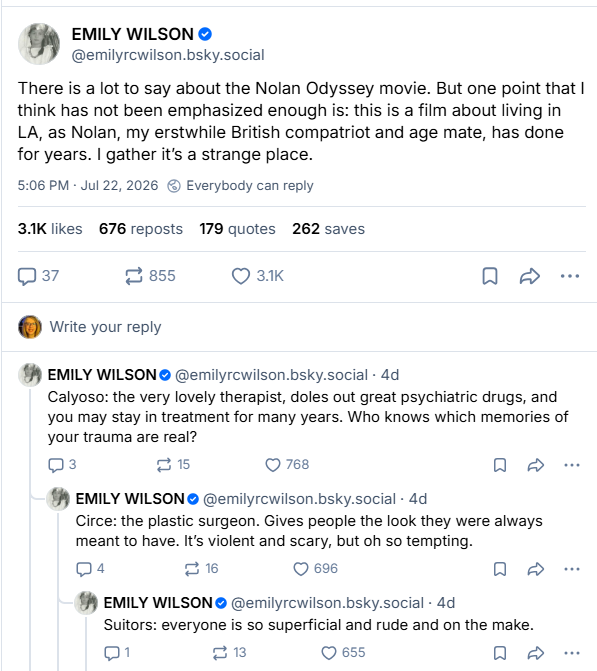
In a more serious vein, Wilson sums up her critique of the film with some very salient points:
It’s a fun action movie….Adaptations can do whatever the creators want with the source material, and in many cases, the more they diverge from or push back against the original, the better. It’s also totally fine to use American actors and a diverse cast. The costumes/ armor/boats are a mess, but who cares? Homer is also a mishmash… It’s less fine to waste your expensive diverse cast by terrible screen-writing, giving them zero convincing characterization or attempt to make us care about the relationships, and tokenism.
Adaptations are often most successful when they make clear, courageous choices about what to leave out – so, for instance, the movie “The Return” seems to me both a much more radical departure from the original source, and also a more successful film. Nolan tries to pack a lot of Incidents and Big Ideas into this film, but they do not seem to me to hang together coherently on the level of his own plot and the movie’s constructed system of values. Instead, it’s foisting a didactic point about Our Times onto the plot without integrating it. The film centers Odysseus’s guilt over his war crimes, but never shows us the POV of his victims, and instead glorifies the perpetrator for feeling bad about himself. I found this unsatisfying ethically and worse, imaginatively, because Damon’s character is given only one mood (Troubled).
Whatever one thinks of the film as a work of art, it’s doing some good in the world, by generating big conversations, bringing new audiences to the cinema, and new readers to ancient literature. I hope it helps save the humanities.
- What do you think of the Odyssey and modern adaptations in general?
- Do you enjoy adaptations that are more traditional or that deviate? What types of deviations do you like?
- Are you irritated by some of these same modern themes applied to classics or do you think they make them more relevant?
- Do you ever read fan fic as a way to explore a beloved classic?
Discuss.


Every adaptation has always adapted the story to be relevant to their own time and situation. I have a friend who wrote their dissertation a few years back on how Spartacus, the gladiator who led a slave revolt, has been reinvented and reimagined over and over by each generation, and reinterpreted to be relevant and useful for that generation. It was a very interesting topic, and Homer is subject to the same waves of interpretation. Consider how, until Wilson’s interpretation, the victimization of enslaved women was concealed by the choice to present them in translation as whores. Each new interpretation always conveys a message.
I should add that, if we were to attempt to present the Odyssey as it would have been experienced and understood by the ancient listeners of that oral epic (as far as we can reconstruct that view) we would likely find the story shockingly amoral. Not that it was amoral, but that it was based on fundamentally different assumptions about what constituted good human conduct. It occupied a culture and moral universe vastly different than our own, and every generation since has kept it relevant by continually reinterpreting it for their generation.
The people accusing it of being woke are not mad that it was reinterpreted. They are mad that it was reinterpreted in a way that did not give their own worldview the patina of ancient legitimacy. But their own preferred interpretation would have also been an adaptation of the story for our generation.
(I will admit, though, that the drive of ancient Greek heroes for personal wealth and glory, no matter who gets hurt or exploited, does seem to suit the MAGA mindset a little better than the world view Nolan occupies. But to be closer to the selfish, preChristian ideal of personal glory, rape and plunder is not a compliment- for all that I find Homer deeply compelling, it’s not because I think the protagonists embody the kind of virtues Christ called us to exemplify. I love Hector’s self sacrifice to protect his family and people, for instance. There is much to admire in them. But when MAGA talks about the legacy of Homer, I feel like they mean something quite different than I do, and something quite incompatible with their professions of Christian values)
Just in case anybody was intrigued by my friend’s work on Spartacus-
https://repository.lsu.edu/gradschool_dissertations/5387/
By the way, I loved Nolan’s Odyssey. Retelling the story in a way that is relevant to our times has always been the way, and I found his version deeply compelling. And I find it hilarious that so many folks got so upset about the casting that they did not seem to anticipate that the story would be told in a manner that was, on a deep and fundamental level, a repudiation of the MAGA world view, that betraying trust and destroying networks of mutual beneficial relationships for personal gain only burns down the system in which it was possible to acquire that personal gain in the first place, resulting in harm to yourself and all you care about.
I still don’t think most MAGA commentators understand how sharp the critique they just paid to watch was. They were too distracted by comparing skin melanin to recognize the story would lay bare the rot at the core of their philosophy.
Did Nolan do anything that Joseph Smith didn’t do in terms of woke? And what I mean by “woke” in this context is to adapt a story to the sensibilities of one’s era. JS tries to solve contemporary issues of his day (child baptism, etc.) by plugging those into his works. JS all but copies word-for-word the KJV of the Bible into the BOM and the apologists tell us it’s because the Lord wanted him to be able to use the language that would make sense to him and to us. I could go on and on with many more examples. But the point is Nolan and JS were both thinking of their audiences when they produced their works. And side note: they did so by adapting someone else’s (Adam Clarke / Ethan Smith / Emanual Swedenburg / The Masons / etc.) work.
Conservatives would keel over and pass away if they didn’t have anything to fear, rage or complain about. Seems like that has become their only reason for living at this moment.
I read Ithaca by Claire North and Pandora’s Jar by Natalie Haynes long before Nolan started making The Odyssey. The former is the first in a trilogy that explores the events of the Odyssey from Penelope’s perspective, the latter explores the stories of various prominent women in the Greek myths. Hayne’s book often criticizes modern adaptations of the Greek myths for re-framing the men as heroes by neglecting to mention all the rape and torture of women in the source material. I imagine she would have a similar critique of Nolan’s Odyssey. Perhaps the only way to faithfully present the source material while staying within our modern sensibilities is to tell the story from the perspective of the women, as Claire North does. I don’t know that there is a way to tell the story faithfully from the perspective of the men without glorifying the gratuitous violence against women in the source material. Imagine the field day the Conservatives would have with that!
I did find myself wondering why we need to stay true to the stories at all, they are not scriptural. Our salvation does not depend on a faithful pursuit of an understanding of Odysseus’ true character. But then, if we want a more sympathetic character, we can make our own characters instead of adapting ancient ones.
I liked the movie. It’s not a new favorite, or even my favorite of Nolan’s films, but it was worth a trip to the theater on an otherwise lazy Sunday afternoon.
In Book 1 of the Odyssey, Homer reveals that the whole reason why Odysseus was finally able to escape from Calypso’s island in the first place is because Poseidon was busy visiting his worshippers in Ethiopia. Africa is very much a present and ongoing concern in the original epic milieu, and had been for centuries. The Aethiopica by Heliodorus is an ancient Greek novel that climaxes in Ethiopia. There is a long, well-documented history of intellectual exchange and trade between Greece and Egypt that stretches clear back from pre-Socratic times to the late-Roman empire. For that matter, Greece is geographically far closer to Africa and the Middle-East than to western Europe; the ancient Greeks were far more closely aligned culturally and economically with the former than the latter. For conservatives to claim that there shouldn’t be any black people in the Odyssey is to prove that they have never actually read the Odyssey, or a history book, or just looked at a basic map. At this point, a conservative calling you “woke” is the highest compliment you can receive.
I’ll start with my bona fides: I read half of ‘The Illiad’ in high school 29 years ago and I didn’t like it. I have watched the first two seasons of ‘Percy Jackson and the Olympians’ but I haven’t read the books or seen the movie(s?). I’ve never read any bit of the Odyssey. I have seen a HS performance of Hadestown. Throughout my life I have consistently shown very little interest in Greek mythology. I have a science degree. I’ve seen the Nolan movie. I am unaware if there even are previous versions I could have watched. Now that you know just how qualified my opinions are . . .
I enjoyed the film. When the rest of my family wanted to see it, one of my central questions going into the film was ‘why do I care?’ Homer’s tales are stories for a Greek audience that tried to convey to the Greeks who they were as a people, and why the world is the way it is. Probably to provide some entertainment, too. I’m not an ancient Greek and don’t plan to become one, so what value does the story have to me? I found Nolan’s adaptation successful in presenting a reason to care about the story as a modern viewer.
I think adaptations often fail for people who are very knowledgeable and/or attached to the original (or even just a previous adaptation). Movies are almost always worse than the book, and doubly so if you read the book before you saw the movie. Plus, movies virtually always have to reduce material because of the format. So I don’t doubt that people who already love The Odyssey have changes and omissions they found lacking in the movie. But coming in with a fairly blank slate, the film exceeded my expectations.
To answer the title, yes, I think the Odyssey is woke. (Inasmuch as ‘woke’ even has a meaning, it mostly just means “conservatives should be scared of this”.) The casting controversies are beyond dumb. But MAGA should be able to find plenty of more substantial things in the film to be upset about, as I think it correctly speaks against values that MAGA prizes.
I thought the movie rocked. As an adaptation, I’m not qualified to evaluate it but as a piece of epic filmmaking, it’s vast, visceral, tactile, thunderous, and poignant. Its use of in-camera special effects is a breath of fresh air in our age of AI and CGI slop. Its message of how we treat strangers and how we honor social contracts and hospitality—that we should treat every beggar like a god in disguise—is extremely timely.
No movie is perfect and I think moviegoers in general could work a little harder at enjoying the marvel of filmmaking even if not every element is landing for you. Costumers and production designers are usually giving their all regardless of the quality of the writing, and truly bad acting is pretty rare these days. Cinematographers, the Odyssey’s Hoyte Van Hoytema in particular, are serving us a a visual feast even when the film fails to convince us to suspend our disbelief.
On a separate note, I interpreted the gods in the film as very real, just mostly out of reach. I think keeping the gods out of frame gives more agency to the protagonists and helps the film feel grounded (which is important to Nolan). And clearly the underworld is real. If the Christian/Mormon God is real today, He spends all his time “out of frame” too so…there’s that.
Very honest question: WTH does MAGA even watch for entertainment?
Every dystopian novel is an indictment of capitalism, government overreach, or scorched early policies run amok. Hence they all hate Terminator, Handmaid’s Tale, The Giver.
Fantasy is the push and pull of good and evil, and the likes of Star Wars, LoTR, Harry Potter, Hunger Games, is all about the corruptibility of power and bagging on those that enjoy CIE (or Conformity, Inequity, and Exclusion, ya know, the opposite of DEI).
They can’t even watch Ted Lasso because he’s too nice and the soccer team isn’t just a bunch of mid white dudes.
Theater’s out, what with Elphaba raging against the man or all those non-white immigrants hogging all the Hamilton lead parts.
Calvin & Hobbes probably goes over their heads.
Truly, what’s left? Maybe this is why they all watch network news more than the rest of us?
I am actually a bit of a Greek mythology geek ever since seeing Hadestown and reading Percy Jackson with my kids. When I was a teenager and twenty something I used to wonder how anyone could believe in and worship the likes of Zeus given the polytheism, meddling in human affairs, and their toxic character traits of selfishness, cruelty and indifference. Fast forward 20 years, I’m not sure Christianity is any better. Notwithstanding fewer Gods who are mostly absent, there are still plenty of toxic character traits in our deity. The stories we tell to make sense of things we don’t understand I suppose.
Yeah, diverse casting makes it kind of woke. Bear in mind that it is unlikely that it would be accepted or found acceptable by many for white people to play the roles of people who were historically black. But more and more it is becoming commonly accepted for non-whites to play the roles of historical whites. I’m just saying this matter-of-factly. Interesting to observe. Conservative commentators will get a lot of views and make a lot of money raging about this. But Hollywood has historically favored whites. So I’m that sense I support an expanded integration of minorities in the casting.
Honestly I’m not terribly interested in watching. Having studied ancient Greek history considerably, I prefer ancient Greece talked about within its proper historical context. Modern adaptations be damned.
Being a closet Buddhist, I flinch whenever I hear the term “woke” used in a disparaging manner. If there is one thing I wish the political right would do, is wake the heck up. Unfortunately, it will likely take something more than meditating under a bodhi tree. The very notion that celebrating cultural elements and aiding immigrants is wrong boggles my partly Christian mind. I hope you all enjoyed the movie.
Any time a movie is adapted from a classic, it’s a balance between turning it into a literal word-for-word translation of the original modern relevance be damned, or modernizing it beyond all recognition. Even the strict translation route offers wiggle room, though, as many words and phrases don’t translate directly to another language.
Because of this balance, arguments over too much adaptation versus an appropriate level is expected and, indeed, desirable. The classics are nothing if not a multimillennial conversation.
Because movies incorporate visuals with music, they evoke emotion and mood. This is the major strength of motion pictures. Therefore, the best adaptations capture the mood of the original. The mood that can be hard for modern readers to feel through arcane language and alien cultural assumptions.
In this I found Nolan’s work a success. Keeping the gods and the magical world view intact was indispensable in recreating a mythical story in a mythical time.
Brad D: Just expanding on your comment, not really arguing with it. “Bear in mind that it is unlikely that it would be accepted or found acceptable by many for white people to play the roles of people who were historically black.” I think there are two justifications for this to go mostly one way: 1) Hollywood has (as you pointed out) a tradition of favoring white people, even casting them in minority roles (Olivier as Othello, Emma Stone as a mixed race / Asian woman in Aloha, many, many white actors as Asian characters over the years, and so forth), and 2) when we are talking about histories, specifically, there’s something about the issue that history is written by the victors. When people have been deliberately marginalized or enslaved, their stories aren’t usually the ones being told in history books. That certainly seems like something we could remedy, but it’s also difficult if their histories were deliberately not written down or hidden to avoid being taught. After all, the victors don’t appreciate having their misdeeds broadcast. Why would they want to platform the voices that they’ve worked so hard to silence?
But, and this is I think an important point that even white people descended from colonizers who want their histories to be the dominant narrative should appreciate–if they want their version of history to be accepted by all, then allowing minorities to participate in the portrayal of those narratives makes them more accessible to those minority groups. I suspect that Hamilton won more hearts and minds than the 1619 project did, and it probably also had a wider reach than 1776, which is a fine enough musical but pretty much as white as they come.
As far as being “woke” I think it is fine to have Helen of Troy be a beautiful black woman. The point was that she was outstandingly beautiful, so she was *different* than most of the Greek women, possibly exotic. Now if we are going to be true to history, Africa is not far from Greece, so there will be Africans. So, then most of the other characters should have been medium to dark skinned and Helen should stand out because she is very different than most of the medium to dark skinned characters. So, do Penelope and Calypso as black women and Odysseus as a black man, with Helen as pale blond.
I tend to like movies as close to the book as possible, and it strikes me as arrogant for movie makers to feel that their version is an improvement on the original. I mean, imagine thinking you know more about Middle earth than Tolkien or more about the Ancient Greek world than Homer and that you can improve on their books. Those books are classic for a reason. And I have never once seen movie material that differed from the book that most people feel is better. The general consensus is that the book is almost always better than the movie. Except for that one movie version of War and Peace that followed the book so perfectly that they had the exact crop planted in the field of the exact path the characters walked on. Yeah, that movie was perfect. So, yes, I guess I am a purest. Adaptations are usually bad and any changes make things worse.
But, then when a director starts with something as ancient and l—-o—-n—-g as the Odyssey, one has to adapt for something movie length or make six separate movies, and in order to make it something modern audiences will even begin to comprehend the director has to adapt some material. How to get around “boring to tears” is also a problem with The Odyssey. So, adapt away, because in my opinion, the movie director could not possibly ruin the Odyssey. No, I didn’t like the book, how did you guess? And yes, I was forced to read it in high school. Even my mother who was an English adjunct professor at the Y and loved Greek mythology could not make me like Homer. She loved it, but then insanity is not hereditary.
Having said that, I won’t be seeing this movie until it comes out on dvd, because I get migraines in movie theaters because they always have the sound up louder by far than I can tolerate. And since they do not DO dvd formats anymore, I guess I just won’t be seeing this movie. But, I am not broken hearted over not getting to see it. Blame it on neurodiversity, but I swore off movie theaters years ago because I just cannot tolerate the blaring sound in theaters.
Anna: Your point about having to make so many cuts to make the Odyssey is why I suggested to my husband that what they really should have done is make a series. One episode can be the Sirens. Another is the Cattle of the Sun. Maybe Circe and Calypso get more than one episode each. There are episodes back at Ithaca showing those stories. My hubbie said the only problem with that idea is budget. You just never quite get the same grandiose special effects in a series, which is true. You end up with a bunch of CGI that doesn’t wear well over time.
And yes, it was loud AF. In general, I am not thrilled with how loud movies are, but in my case, I really prefer to see things in the theater because it’s phone free, so I really can focus and enjoy it for what it is. When I’m at home, the temptation to pay half attention is much too great.
Theater decibel level: Highly recommend “musician grade” earplugs. Great alternative to foam earplugs, which (in my view) just deaden everything. But there’s no shortage of review/comparison sites on “best of” for music festival season etc… the point is, these high-quality earplugs are often what musicians use and they attenuate sound and reduce the decibel level, but don’t muffle things. Lots of options (Hears, Eargasm, Hearos, Loop, etc.)… I use Earasers. But most of these clock in at about 25 to 35 bucks. Highly recommend something like that, for movies and concerts.
I saw the Odyssey and thought it was wonderful. It was loud at times, but I lived with it. I will say that I have a pair of AirPods Pro 2 headphones from Apple, and they work wonders in reducing volume and keeping clarity, but they are also more expensive than even the best earplugs. But they also reduce background noise on airplanes and in restaurants, which makes it so you can hear people at your table, translate languages, and sound awesome if you just listen to music. But enough said about the volume.
The Odyssey was “written” 3000 years ago, but it wasn’t written as a book or even a story; it was an oral tradition that was memorized, performed, and adapted for years. We don’t have a record of the changes in oral tradition. So this movie is a visual representation of a written story that was collected from oral texts. Once things get written, they tend to become more solid than a story with an oral tradition. So I see the big problem with creating a visual representation is how large a work has become and trying to adapt it for modern understanding. So yes, things are going to be given different emphasis. People are also going to bring their modern interpretation and views to it. Some will love it, and others will hate it because it’s woke. The same could be said about any number of other works like Hamlet or The Lord of the Rings, where there is a lot more source material than there is time to tell it.
Finally, who is to say that the modern wokeness is not the same thing the ancients meant? In the church, it’s often said things are the same yesterday, today, and forever. People then subscribe their own beliefs as being the belief that has always been. Beliefs change over time, no matter how hard someone tries to pass them on unchanged. Also, words are invented to describe things like PTSD or BiPolar or other things that have been around since ancient times, and the words they used to describe those things have either been lost or their meanings altered. So I liked how The Odyssey took on the challenge of making old things new and showing new things as old.
Anna
Christopher Nolan movies always get a physical release.
I recommend the always region free 4k discs.(yeah for imports) Get a good 4k TV and decent sound system(where you can make your own adjustment), a 4k player (Black Friday makes it affordable), a comfy recliner and you’re good to go. And if you need a bathroom break, just hit pause.
To answer the questions.
Not sure what the Odyssey is, but I do have novels such as Circe by Madeline Miller. So I suppose I am ok with adaptations if they align with what I think relevant. And if others find other stuff relevant, go for it.
No I have not seen it the movie. When the 4k disc goes on sale I most likely will,. I am not a Christopher Nolan films. (Dark Knight barf) but I did think Inception excellent, so I guess I’ll give it a go.. If only Harryhausen was still making movies.
As to what Maga watches. They don’t. They’re busy on their Youtube hate channels and other social media, railing and campaigning against shows they’ve never seen. So congrats to them for taking down Star Trek and getting other shows to magically disappear.
Homer in general, and The Odyssey in particular, are big gaps in my literary knowledge. Except for watching some scenes from the 1954 Kirk Douglas movie Ulysses in high school English, I’ve never invested the time and effort. When it came time to read long complex works, I started with Victor Hugo’s Les Miserables and quickly gravitated toward Shakespeare, Tolstoy, Byron, and Dickens. Very much enjoyed this primer, Hawkgrrrl! Definitely feel this movie’s commercial success is mostly about people, including Hollywood actors, being obsessed with Christopher Nolan. (Just rewatched The Dark Knight and can’t blame them). Is Nolan to movies what Homer was to poetry?
Lupita Nyong’o playing Helen is definitely motivation for me to see the movie. She’s awesome! Most recently enjoyed her performance as Viola in the PBS Great Performances video production of Twelfth Night. Delightful!
I’m here to second Emily Wilson’s plug of the 2024 indie film The Return, staring Ralph Fiennes (Odysseus) and Juliette Binoche (Penelope). Maybe not the most fun of movies, but full of excellent acting and brutally intimate storytelling. Gets rid of all the supernatural noise and just gives us sweaty, weary humans reckoning with each other. The many liberties I assume The Return took with Homer’s classic are my answer to this post’s questions about adaptation. Take liberties. Make choices. Tell the story of what the classic means to you. It seems Nolan has done that for better and worse, so I’ll get around to watching his epic (when it becomes a reasonably-priced streaming rental).