
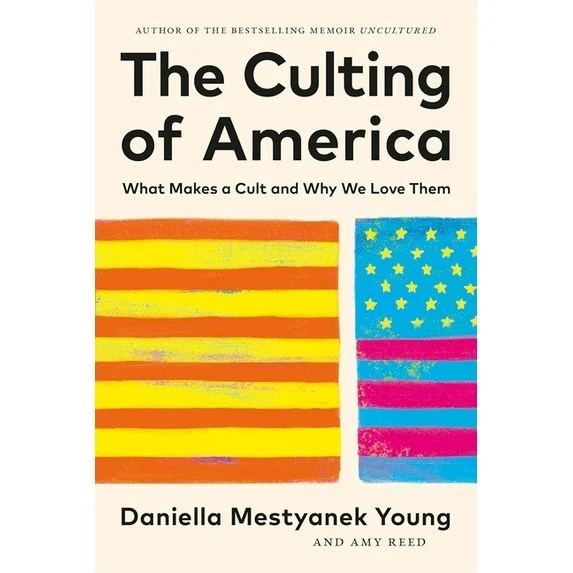
I’ve read about half of The Culting of America: What Makes a Cult and Why We Love Them (2026, Otterpine). The author, Daniella Mestyanek Young, is “a cult survivor, a US Army veteran, [and a] Harvard-trained organizational psychologist ….” So I expected maybe a professional discussion of cults? That’s tough to come by, of course. The LDS Church and its members or former members show up in every chapter, but largely in passing. But so do a lot of organizations, from the Marines to your corporate employer or the start-up you work for. When you are a professional cult analyzer, everything is a cult.
Here is how Chapter 7, “Us-Versus-Them Mentality: We Are the Best, Down with All the Rest!”, starts out:
Every fall, they return. Young, eager, and easily molded. They arrive in droves, drawn by promises of belonging, status, and power. To the outside world, it all seems innocent enough …. But behind the polished surface lies something far older, far darker. (p. 173)
The author continues with, “The initiation is brutal. They are broken down, tested, made to prove their devotion through suffering.” And so forth. No, it’s not the MTC. It’s Greek fraternities and sororities. It doesn’t end with college, of course. She notes that “fraternity men make up … 63 percent of all US presidential cabinet members since 1900” and “85 percent of Fortune 500 executives.” Secret combination? Cult? Cultish? You should read the chapter if your kid is planning on rushing a fraternity or sorority in the fall.
Overall, the book sort of removes the stigma and even the meaning from the label “cult” but it does make you think harder about the organizations you affiliate with or join, every one of them. What do you give up? What do you get? What are you pressured or forced to do as part of the organization? How easy is it to get out?
Here are a few snippets from the chapter. [The whole book is just too much to go through.]
Secrecy further fuels this insularity. Hidden rituals and internal codes elevate members above the rest of campus, promoting the idea that outsiders just wouldn’t understand.
Yeah, churches too.
High-control groups thrive on an all-or-nothing mentality, perfectly captured by the phrase, “You’re either with us or against us.” … This binary worldview is everywhere in today’s America.
So maybe the high-control group characteristics of the LDS Church life are a byproduct of being an American institution more than being a small and marginalized, occasionally persecuted, church that grew up into a corporate behemoth with a hundred billion dollar portfolio?
After noting that “Cults are deeply rooted in American culture,” the author notes
[T]he Pilgrims and Puritans fled religious persecution only to turn around and enforce their own brand of rigid, exclusionary doctrine.
After mentioning a few other religious groups, including the Mormons, the author observes
While not all these groups were destructive, most shared one core trait: a belief that they were the chosen ones, the enlightened, and everyone else was lost, misguided, or actively working against them.
If the shoe fits, wear it. Later, the author discusses “groupthink,” noting eight characteristics, including silencing dissent, internal suppression (“individuals keep quiet about their own doubts”), and false consensus. That whole list sounds more MAGA than Mormon, but not by much. And of course there is a lot of overlap between MAGA and Mormon these days.
So let’s ponderize.
- Does “high-control group” lead to a more informed discussion than “cult”?
- Is your employer, who tells you what you can’t wear to work and maybe should wear to work, what time to show up and when you can leave, and (informally) what you can or can’t say to your boss, a “high-control group”?
- Anyone with military experience? Please weigh in. The military, and even more some elite groups within it, are the very definition of a “high-control group.” But it seems misplaced to call the Army or even the Navy Seals a cult. At least until Pete Hegseth’s “white man’s Christian Army” initiative (my term), the military was highly respected by Americans.
- The MTC is probably the most cultish of Mormon experiences. But a lot of young missionaries have a great experience there. Some don’t. It’s probably better than it used to be, maybe?
- I suspect no discussion, however accurate or fact-laden, can dislodge the utility Evangelicals derive from labeling the LDS Church a cult. But, honestly, the whole Trump and MAGA experience with wholehearted Evangelical support has largely destroyed any Evangelical religious or moral credibility. At this point, who cares what Evangelicals think or say? Does the same critique apply to the Church and its members?


Everything is a cult which makes the cult label not very meaningful.
Consider this conversation
Person complains to a friend: “My Sundays are awful. I spend thousands of dollars each year to waste my day waiting around with people who think like me and then we all go home feeling bad and wishing our lives were better.”
Friend asks, “What church do you go to?”
Person responds: “I’m a season ticket holder to the New York Jets”
The MTC example is illustrative. It is a very controlling environment that demands conformity. I hated my first week at the MTC. Fortunately, I was there 9 weeks and I learned to love the remaining time. But I would not ever want to go back!
Similarly, I never considered military service as I figured I would hate boot camp and the conformity demanded by the military. But maybe it would not have been so bad?
To me, the valid pejorative meaning of “cult” is an environment that coerces harmful and unproductive behaviors and makes exit from that environment very difficult, all while making the person feel justified in staying and supporting the abuse. Cult phenomenon exists in every association. Yet sometimes, what happens is the person in the environment feels it is more difficult to leave than it actually is. I think this is true with the LDS church. Some people have the impression it is very hard to leave the church all while many more people just leave and would say there was no friction at all.
cult example #1: a White House cabinet-level nominee is asked whether or not Biden won the 2020 election and he is unable to answer in the affirmative. It’s fairly likely that those who have no problem with this are hooked up to Fox News.
cult example #2: a Church president warns that some of those who distance from the Church are lazy learners and cautions the membership not to take advice from non-believers. It’s fairly likely that those who have no problem with this refuse to look at “non-approved” materials.
I have family members and friends who are perfectly comfortable with both examples above, so to me they are members of a political and religious cult. Maybe I am too and don’t realize it?
Yes, avoiding the term “cult” leads to more productive discussions. Even in situations where the label is applicable, using it isn’t likely to convince any member of a harmful cult to leave it.
I have long said that the LDS church is not a cult but some of its members belong to one. By that I mean that cult membership is fundamentally about an individual’s relationship to external authority, and that the LDS church, or really any large church, is going to include a broad spectrum of such relationships to authority. Some members have spent their whole lives handing over all critical thinking to church leaders general and local, and others have spent their whole lives resisting that. If a former member feels they were part of a cult, who am I to say otherwise? But likewise, I am the arbiter of my own experience, which I do not feel remotely falls in the category of cult.
I will agree that the mission, and the MTC in particular, is a fairly unique environment. But comparisons to military service are apt. Just like the mission experience, military service, while a highly constrained life, is still in most countries voluntary and temporary, which I think puts it in a slightly different category from standard cult discussions. Even so, it’s clear that some people struggle when fully immersed in the situation they signed up for, having not fully appreciated what it would be like, and in both situations having committed to it at a fairly young age. I think that’s generally OK, as long as we can ensure that missions are a true choice, and that those who are unhappy with the experience and wish to leave it early can do so without stigma. On those points I think we still have work do to as a church.
Lot’s of interesting food for thought in this post.
The connection is made between college fraternity membership and later political success. But what is the active ingredient in this correlation? To me it’s financial. Both frats and political careers require access to money. Fraternities are obvious pay-to-play mechanisms, but this practice extends into political careers, especially for elected positions. On the other hand, churches tend to offer a great deal of access/networking opportunities even if you don’t have much money upfront. This only underscores Dave B’s observation on MTC cultishness, because you don’t get to go to the MTC until you’ve acquired funds. Same with the temple. You may not have to pay at the literal door, but you aren’t going to get inside unless you showed the money (or is paying tithing no longer a requirement?)
Of course, family money comes into play as well. In many cases, wealthy parents underwrite wealthy children’s success, even when the kids themselves are pretty average on a behavioral/intelligence level. One of the few times my middle-class dad flat-out refused to give me discretionary funds during college was when I wanted to join a fraternity. The frat offered me membership. But I couldn’t pay, so I didn’t join.
This also applies to wealthy students succeeding in showbusiness. Though it may be impolite to call them on it in publicity interviews, so many successful performers are folks whose parents not only paid for tuition (and fraternity/sorority membership), but also for that first apartment in New York and L.A. while they were getting started in the business. Money seems more of a catalyst. The cult seems more of an outgrowth.
Honestly, cultish though it may be, that low-key frat at that low-key school would have been a net positive for an introvert like me. But no pay. No play. (Side-note: I completely respect my father’s decision to draw a line there. I needed to learn limits.)
Perhaps this leads to a discussion of exclusivity, and how certain cultish organizations traffic in exclusivity to curate their membership rolls. Worth keeping in mind, especially in the context of American capitalist cult practices. Are cults the drivers, or the outcomes?
Military veteran here. Perhaps it’s my own bias showing, but I agree that calling the U.S. military a cult is misplaced, even in the current political climate. There are certainly cult-like practices that occur in the military, notably during induction and entry-level training, as a means of indoctrination into the disciplined lifestyle the military requires. But boot camp is just a few short weeks/months, and not representative of the remainder of one’s service, just as the MTC experience is not the whole mission (for better or worse).
While the military is transparent about the fact that it’s a demanding lifestyle and not for everyone, they pay their members a decent salary, and additionally provide full medical/dental coverage, generous educational benefits, career training, potential for retirement and lifetime medical benefits, and a raft of family support services and entitlements. I’m not aware of any high-demand religious movement or fraternal organization on earth that provides such material benefits to its rank-and-file members. If you get some kind of permanent or disabling injury during your military service, you are eligible for lifetime medical treatment and/or compensation for that injury. Meanwhile, I’m aware of a great many LDS former missionaries who struggle with the lifelong effects of injuries/illnesses incurred during their missions, and they get absolutely nothing from the Church. The military may ask people to do dangerous things, but they also provide training and safety gear to minimize the risks. While in missionary culture, it’s considered noble to wreck your body for Jesus, and lazy to seek reasonable medical care for legitimate injuries/illnesses, which is far more cult-like IMO. Also, elitism and superiority run deep in the military, but not a persecution complex, as with high-demand religions. Navy SEALs and Green Berets don’t derive their elite statuses from a belief that the rest of the world is out to destroy/dismantle them.
And in the current climate of favored treatment for Christian Nationalism at higher levels, that is largely performative; such is not the case in the rank and file. Individual soldiers are still entitled to their own minds, their own conscience and private belief systems. Most I know are generally non-religious in practice, regardless of what’s on their dog tags.
Commonly heard in post-Mormon spaces, a cult can be defined as “any organization that won’t let you leave with your dignity intact”, which I’m inclined to agree with. I’m very proud of my military service (regardless of how I may feel about the morality of the current military engagements), but not so proud of my LDS heritage/identity, and I recognize that formally leaving comes with high costs that not all disaffected Mormons (myself included) are able to bear.
I think in everyday vocabulary the word “cult” usually implies religion. I would agree that most religions are a cult to some degree. Other groups can definitely be almost like a religion / cult. MAGA, some extreme fitness groups and employers.
I work for an employer that doesn’t allow visible tattoos. It also has strict obedience requirements, including dress code, and there is quite a lot of fawning towards managers, especially high level managers. However I don’t consider it a cult because my boss isn’t telling me that if I get fired then I’m going to hell.
I really like Quentin’s comment. There are clearly people who long, who yearn to be in a cult. I think psychologists would say they have an authoritarian personality. They are deeply concerned with authority, who is in charge of whom. If they’re in power, they want submission of their underlings. If they’re underlings, they want to submit and to prod others around them to submit.
And then there are organizations that are more or less culty/authoritarian. People and the organizations they’re in tend to correlate, but far from perfectly. So like Quentin said, there can be Mormons who would love to be in a cult (e.g., those who love to police their fellow members’ dress or WoW observance, who are always coming up with new commandments to observe because the existing list isn’t extensive enough) even though the Church in general seems only mildly culty. And there can be Mormons who are less authoritarian/culty. But there are probably more authoritarian Mormons than there are authoritarian UUs, for example. (I assume some social scientist has studied this.)
I just finished watching The Handmaid’s Tale and reading The Testaments, where the cult mentality is so hyperbolic, it makes one take a hard look at real life political and religious abuse and hypocrisy. This particular quote seems very applicable to most religions:
“Gilead doesn’t care about Children- Gilead cares about Power! Faithfulness, old-time values, homemade bread. That’s just the means to the end!”
The Handmaid’s Tale,
Margaret Atwood
Also, I agree that receiving a fair wage and benefits for service, as in military or demanding jobs, makes a huge difference. Cults don’t do this.
I also strongly agree that the threat of hell and loss of family, and required obedience to a speaks-for-god authority figure IS a Cult!
Thanks for the comments, everyone.
Jack Hughes and Loudly Sublime, in a later chapter there is the claim, “Cults are always about labor.” The author recounts several examples of organizations that squeeze a lot of free labor from even the children in the organization. Scientology is a good example, as is the JWs with their regular uncompensated proselyting time and, of course, LDS missionaries.
Add up the hours LDS missionaries serve (70 hrs/wk times 100 hours for a two-year mission) and you get 7000 hours. At Utah’s minimum wage of $7.25 per hour, that’s about $50,000 worth of free labor per missionary. At California’s minimum wage of $16.90 per hour, that’s about $118,000 worth of free labor. It’s true that those serving are volunteers. It’s also true that the Church spends fifteen years persuading (manipulating?) young LDS to serve for free, right through Primary, Sunday School, and Seminary. Jack Hughes is right that the US military gives pay and substantial benefits, including essentially very generous workman’s comp for injuries sustained while serving. The Church gives none of this. The general lack of compensation for injuries is the most glaring omission for the Church in how it treats its missionaries.
In some other Mormon discussion of cults someone brought up the idea that in order to survive an organization needs some cult traits, so it is just a matter of where on the spectrum it fits. Yes, Mormonism is on that spectrum. Probably toward the cult like end.
And I agree that I would not call the military very cult like. It does not demand you buy into its culture—-well,at least the Air Force doesn’t. I have no real experience with Marines, except for when my DH worked joint chiefs of staff assignment and worked with some. They are far more cult like with a strong culture, where that A. F. does not have such a strong culture or I force norms near as much.
But any successful religion is going to have some cult like traits, probably in proportion to how successful it is. More cult like, the more successful up to the point it becomes drinking the Koolaid. There is a point that too many cult like traits becomes dangerous and you have the potential for Jonestown. So, it is finding the happy medium between too much control or so little that the organization is strong enough to survive. But if we think of it as a spectrum instead of binary, it can help understanding that every religion has some cult like traits. So, not a question of “is or isn’t” a cult, but how much of a cult.
“Cult” gets thrown around too much, so much that in common parlance, it seems meaningless. But what would we call the Heaven’s Gate Cult if not a cult? What would we call the Westboro Baptist Church? FLDS, Jim Jones’s Temple Cult? I think there are legitimate cults out there and that these can cause a lot of harm to those involved. That said, the mainstream Mormon Church led by Dallin Oaks is not a cult. This would have the ex-Mormon reddit community screaming at me, I know. But the truth is that individuals in the Mormon Church still have a lot of individual freedom and can mostly leave the community without too many repercussions. The most cultish part of Mormonism, as mentioned, is probably the mission environment. There individuals feel they can’t leave and there is little to no room for independent thought.
A Disciple: “Some people have the impression it is very hard to leave the church all while many more people just leave and would say there was no friction at all.”
I know many people who have left the church. None of them—NONE of them—would say there was no friction at all.
There’s plenty of room for discussion as to whether or not that makes the church a cult. But don’t minimize the difficulty of leaving until you’ve done it yourself.
Has anyone attended a mental wellness or parenting or couples’ retreat and felt like they were being invited to join a cult? I’m not even talking about Ruby/Jodi or Chad Daybell. Asking for a friend who first attended one of these in 2014. Maybe it’s just a Utah thing…
Jack Hughes gave a great description as to why the military in not a cult. Having spent 24 years as a USAF pilot I agree with all of his points. In flying squadrons there are definitely traditions that everyone becomes a part of for unit cohesion, but it is not “immersive.” Many members of a squadron minimally participate in the traditions and their careers are minimally effected. Additionally, many people in the military exit as soon as possible when they find it is not for them.
It used to bug me on my mission when people said we were a cult. Quentin nailed it, in my opinion when he said that ” the LDS church is not a cult but some of its members belong to one.” Many members imbed the church in every facet of their life, yet don’t actually live the gospel. As a life traveler with many miles under my belt, I see cultish items in our religion, but as it has been said, all religions have a cultish vein to them.
Cheers All
Interesting post and great discussion! I don’t think the Church is a cult the way Jim Jones ran a cult, for example. Like Anna said, cult characteristics are on a spectrum. Quentin made this good point: “By that I mean that cult membership is fundamentally about an individual’s relationship to external authority.” This is key. An individual who submits entirely to external authority is in a cult. For me, the Church was a cult but that was mainly due to my parents being slavishly faithful and enforcing strict penalties on their kids for putting a toe out of line. Someone with parents who were chill, or only partly active, probably wouldn’t develop all the post-cult-personality problems that I had.
I thought Dot’s correction to Disciple’s comment about leaving was a good one. Though perhaps they were describing different departures. There is a big difference in the amount of friction you’ll feel with members and family if you just go inactive for a while — believing the truth claims but just not going to Church or holding a calling or paying tithing. Declaring that your testimony is gone and the Church isn’t true is a whole different experience. Church members take a whole different approach to someone who is just inactive as compared to someone who has apostatized.
I agree with your comment, Janey, but still want to point out that there is friction regardless of one’s type of departure. It may not be much, but it’s not none at all.
Like Quentin, I’ve been saying for years that even though the Mormon church may not be a cult, a lot of members live like it is. MAGA definitely qualifies as a cult for most who are in it. You have to ask yourself some questions to understand whether or not something has a cult-like hold on you, such as:
– What happens if I choose to leave?
– What happens to me if I don’t adhere the group’s norms?
– What untrue things do I have to claim to believe to be accepted in this group?
– What true things am I not allowed to say to be accepted here?
– What are the limits on criticism of the leader(s)?
In any community, there is a “culture” (including the military), and that same word “cult” is part of the taxonomy for a reason. It’s how human communities hold together. Every group has a cost to leaving, but some of those costs are higher than others. Every group has limits on what you can say, do and believe, but some groups are more controlling than others. The biggest factor in how “cult-like” members are is their own family’s culture–starting with their childhood in their family of origin.
All of Christianity is being criticized quite a lot lately by psychologists (and TikTok influencers talking about their own religious trauma) for raising children to believe that if they don’t toe the line of the family religion, they will go to hell and burn forever. Mormonism is more universalist than this and doesn’t really believe in a physical hell in the same way as other Christian sects, but the pressure to conform with Mormon standards can be just as strong even if the threats are less strong. You still may feel that your family will ostracize you if they make it clear their approval is conditional on your standing in and belief in the church.
A few commenters have mentioned the friction associated with leaving. I would just point out that these very real exit costs are generally associated with one particular type of church experience: lifelong or long-term members with significant portions of their family and social circles also being lifelong members. I would expect that’s an overwhelming majority of the readers of this blog. But let’s not forget the other experiences people have. My recollection from my mission was that quite a few members join and attend for a few weeks or months, lose interest, and disappear, never to be seen in church again. I assume that in most of those situations, leaving was probably a near zero friction event. My point here is merely to remind us all that there are a huge variety of Mormon experiences out there, and it is worth being mindful of that anytime we make generalized statements about the Mormon experience or ex-Mormon experience.
Quentin: Yes, a good friend of mine left the church during the pandemic. Her husband didn’t fully leave, but dialed back a lot. They both served missions and raised their kids in the church, but both were adult converts, and in her case, none of her family of origin was in the church, so exiting was relatively easy. I will also note that the ward we both were in together still invited her to social things for mutual friends (that were at individuals’ homes). Friendships transcended the “breakup” as it were.
The longer you are in the church and TBM, the harder it is to leave, regardless of whether you have family or friends still in. Your own emotional trauma of realizing so much of what you’ve been taught all your life is misinformation and propaganda, and the lies and abuses are still being perpetuated. It is never easy!
I have seen the terms “totalistic” and “high demand” used to describe the LDS church, Jehovah’s Witnesses and Scientology, in the peer reviewed mental health journal articles. These systems can have a negative impact on mental health and family relationships.
“I suspect no discussion, however accurate or fact-laden, can dislodge the utility Evangelicals derive from labeling the LDS Church a cult. But, honestly, the whole Trump and MAGA experience with wholehearted Evangelical support has largely destroyed any Evangelical religious or moral credibility. At this point, who cares what Evangelicals think or say? Does the same critique apply to the Church and its members?”
Interesting question! I was thinking about my “departure” from the church and realized how closely it was related to my distrust of the MAGA movement. I just couldn’t stand to go to church anymore and listen to the MAGAites “preach” their gospel every time they commented in Sunday School, Priesthood, or gave a talk in Sacrament. I’d get PTSD anxiety on Saturday Night / Sunday Morning before I went to Church. When COVID hit, and I didn’t have to be a part of their dialogue, I noticed the anxiety went away as well. There was a huge flood of emotions, starting with anger, hurt, dismay, and sadness, when I saw so many members reject the vaccine/mask statements and began to pick and choose what was a revelation and what was just an opinion.
It was easy for me to reject MAGA. Since my parents were John Birchers as well as LDS, my “enlightenment” came first against the JBS. Someone in a comment above said the longer you’re in, the harder it is to get out; that certainly applied to me when it came to the church. I didn’t see a connection between JBS and LDS, but MAGA brought it all together. When MAGA became LDS in many LDS eyes, that’s when I knew there were problems with the LDS Church. It still saddens me but I can also see how the Christ in the Bible is not the Christ in the Church or the Christ in the MAGA movement. I also learned that I didn’t have to align myself with an organization or movement to have self-worth as an individual.
I think the above analysis and comments have shown that the lines we are trying to draw here are so similar to a previous discussion on who was PIMO or not. The MAGA movement is physically in, but are they really mentally in? The liberal members are certainly not the danger to the stability and spiritual health of the CJCLDS.
You can see great value in the LDS tradition, accept the Book of Mormon as scripture in some way, identify as a Christian, yet find yourself an ideological outsider within an LDS ward. I know devout secommend-holding LDS people who would normally think of themselves as near the center of orthodoxy on any rational 21st century spectrum of LDS belief who now feel alienated. I am one. Are MAGA folks really the core of LDS thought and culture? Is the future of the CoJCLDS really as some sort of ugly stepchild of nationalust evangelical or fundamentalist Christianity?
* Nationalist, not nationalust. Hmmm… on second thought, that actually fits!
I have observed for a while that using the words “it’s a cult” tends to derail constructive action and solving problems no matter who you are talking about. (Even if it can feel privately gratifying or relieving to call another group a cult, ha!) People start arguing over if it is or isn’t a cult (or if a cult exists at all, in some cases) instead of how to fix what’s wrong. Power structure is a great term; compliance sophistication, willingness or capacity to think contextually vs universally or exclusively, criminal intent vs “well we think we are in the right and it’s inconvenient or disempowering to consider we might be wrong so let’s go ahead with XYZ” attitudes, all matter to the intensity of one’s experience within a specific group.