

Today’s post is a metaphor.
I grew up in the President Kimball years when Church members were encouraged to have gardens. So we had a garden. A big garden — the entire backyard of my childhood home was produce. In the fall, we canned all types of fruit, ate corn on the cob for every meal, shelled peas, bottled spaghetti sauce, and made endless amounts of zucchini bread. When I bought a home as an adult, I grew a vegetable garden. Just twice. I didn’t have a work crew to deal with the harvest, and zucchini and tomatoes don’t wait.
No more garden for me.
Then I bought another house. This house is old enough to be my grandfather and it’s probably had a lawn for as long as I’ve been alive. A lawn is not a garden. It’s a crop, an inedible, decorative single crop. My 50-year-old lawn was a good example of what happens when you plant one crop in one place for a really long period of time. There was a dead spot that was just always there, no matter how much I watered and no matter how much I fertilized and reseeded.
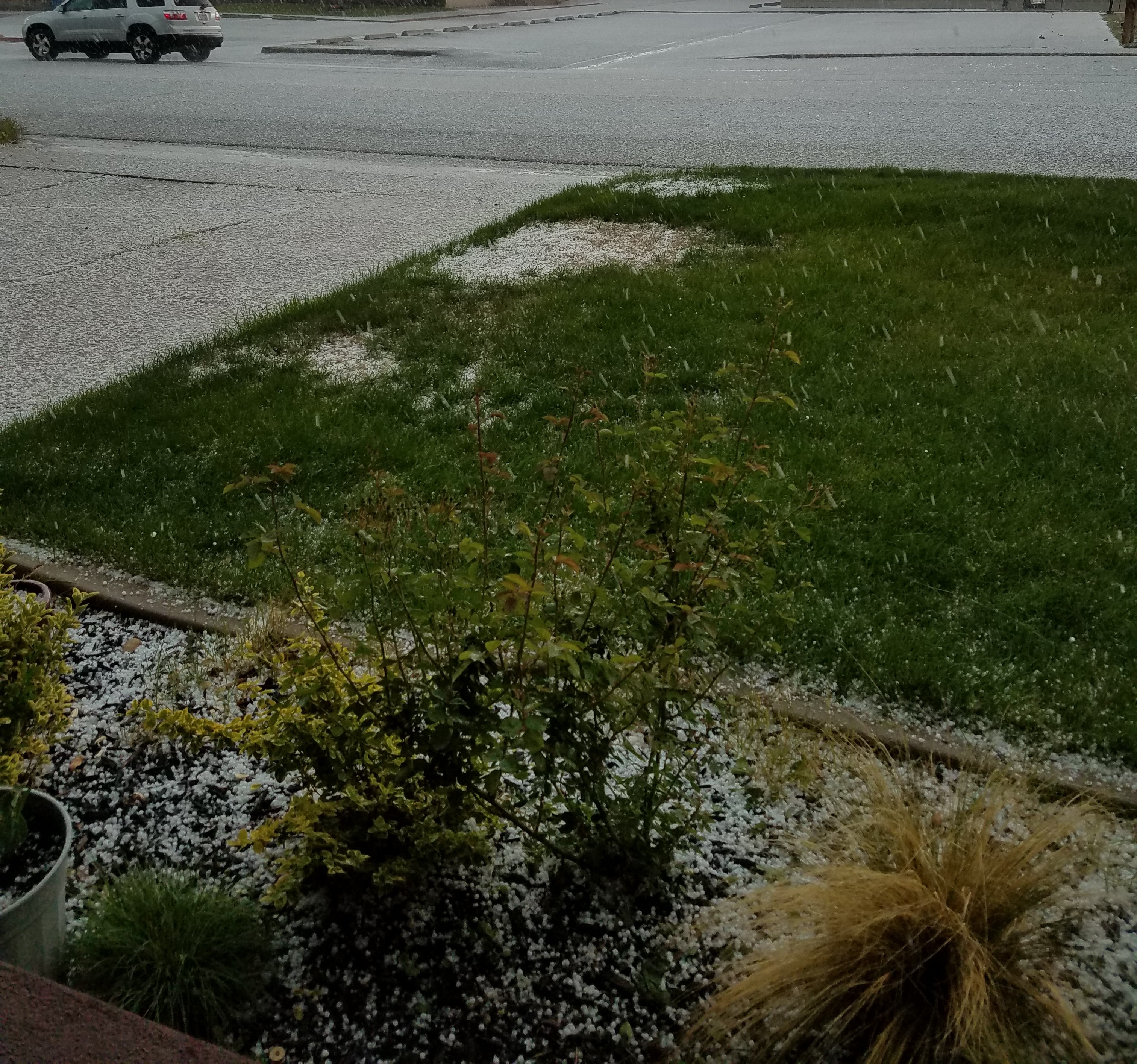
That picture is misleading because I took it in the springtime when it was cool and rainy (during a hailstorm, actually). The picture below is what my yard looked like in July. Even with sprinklers, the heat and drought of the Wasatch Front made my yard’s weaknesses obvious. The lack of diversity had destroyed the soil. I hired a fertilizer, weed control, and pest control company and they poured the chemicals on. Kill the weeds; kill the bugs; feed the grass. And it still wasn’t enough to make my lawn look decent for more than a couple months in the spring time.
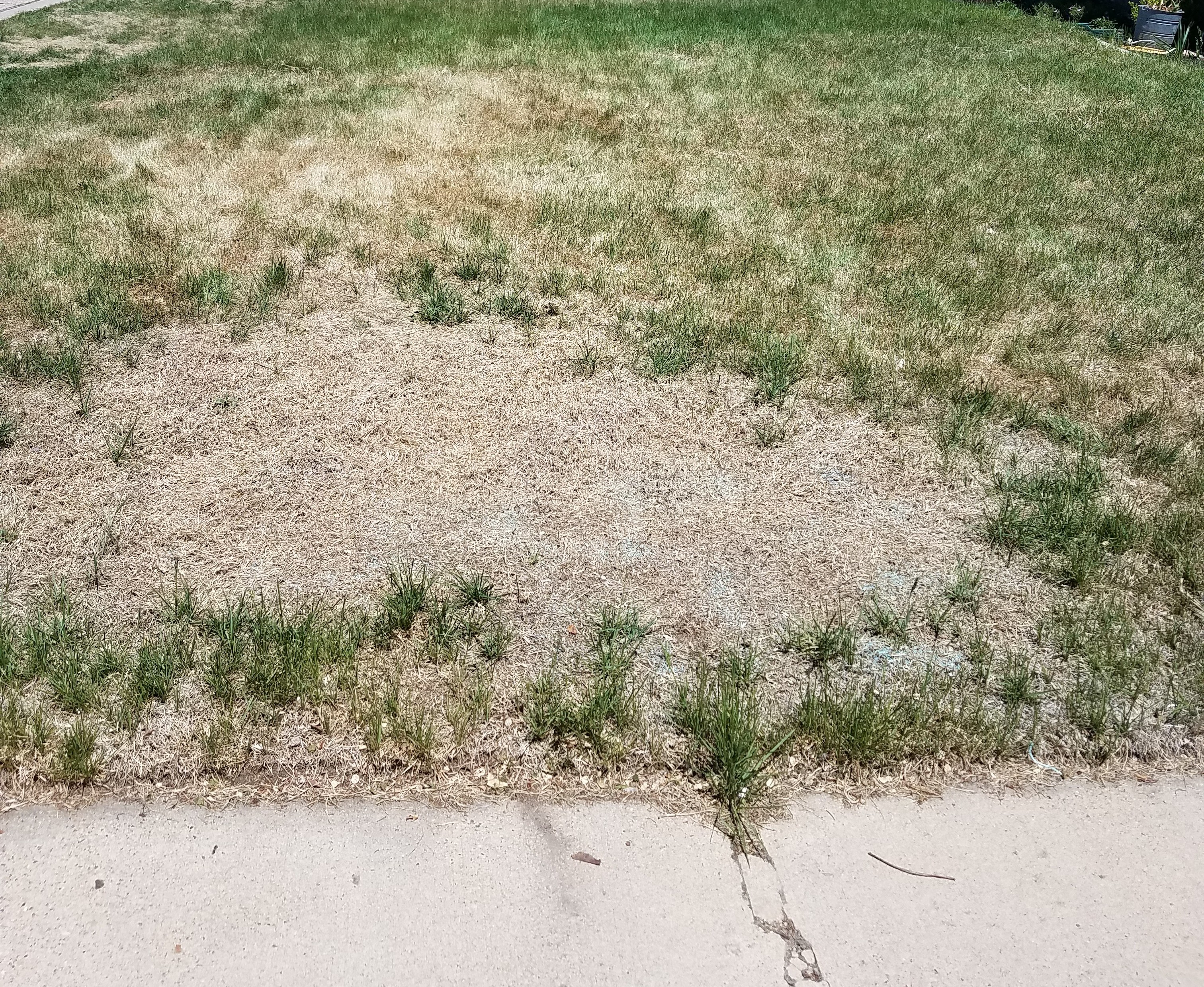
Are we seeing the metaphor? Growing just one crop is not natural and is not sustainable. Wanting a yard full of Just One Thing makes for an unhealthy yard. Perhaps we could point out the parallels to wanting just one type of person in a Church congregation, or in a society. Sometimes we think that uniformity looks lovely. But it isn’t healthy.
I decided to plant a tree. This meant digging a really big hole. Do you know how much thatch builds up over 50 years? All the bugkiller had apparently also killed any microbe that might want to break down dead grass. I couldn’t just use a shovel to dig a hole. We started with a pickaxe to get through the thatch under my ugly lawn. My son and I took two days to dig a hole that was three feet wide and three feet deep. In all that time, I did not see one living thing in the soil. No worms. No beetles. No roly-polys. No ants. No anything. That hole was the most sterile dirt you’ve ever seen, packed as hard as concrete.
The tree died. Yes, I fertilized it and watered it. I don’t know for sure, but I suspect the dead, hardpacked soil had something to do with its short life.
Did you catch that part of the metaphor? I wanted something big and beautiful, but because of my yard’s decades of monoculture, that big, beautiful tree couldn’t grow where it was planted.
My neighbor scooped out their entire lawn and planted a vegetable garden. My yard needed a drastic change too, but the thought of a vegetable garden … I didn’t want a vegetable garden. However, gardens need to produce vegetables. Why else would you have a garden? Hmm, I thought. I don’t want to grow an entire yard of vegetables like President Kimball wanted us to do, and my family taught me to do. But I would love an entire yard of flowers. I apologize for beating you over the head with the metaphor, but perhaps we can change what we want, and what we value.
I read a lot of stuff about how the world’s insect biomass has decreased drastically. I don’t like bugs; I’ve never liked bugs. Icky, nasty things. But I was reading stuff that said bugs are an important part of this planet’s ecosystem. True. It was really funny, but as soon as I acknowledged that bugs are important and I can coexist with them, I stopped being afraid of bugs. Sure, I still don’t want them to crawl on me, but they’re important! And they’re not hurting me. Being ‘scared’ of bugs was just a personal preference on my part, and I could change it. So I changed it. (I wonder if some ‘fears’ people have are personal preferences that could be changed by just acknowledging someone else’s right to exist publicly and visibly?)
I knew I could not pick-axe my way through that lawn. A sod-cutter wasn’t going to work either, because of the mat of Bermuda grass. I hired a guy with a skidsteer frontend loader and he scooped out six inches of thatch.
The first year of trying to rewild my yard was … ugly. I still don’t think my neighbor needed to call the city and report me, but I can acknowledge my yard was ugly.
The second year of trying to rewild my yard was an adventure in learning just how little I knew about growing anything besides a lawn and zucchini. Most of what I planted died shortly after planting. No one called the city on me, though. Progress! The bugs that dominated my yard that year were spiders and grasshoppers. Every so often, I bought nightcrawlers at the local bait shop and dumped them in my yard. I ran a worm rescue that year.
The third year of trying to grow a yard full of flowers, I started to make progress. I learned how to install a drip irrigation system. After filling a compost bin for three years, I had some usable compost (composting is NOT as easy as the articles online say it is). I learned to focus on a smaller area. I kept the weeds mowed and short in other areas of the yard so the neighbors wouldn’t complain, and focused on keeping the plants in just one area alive.
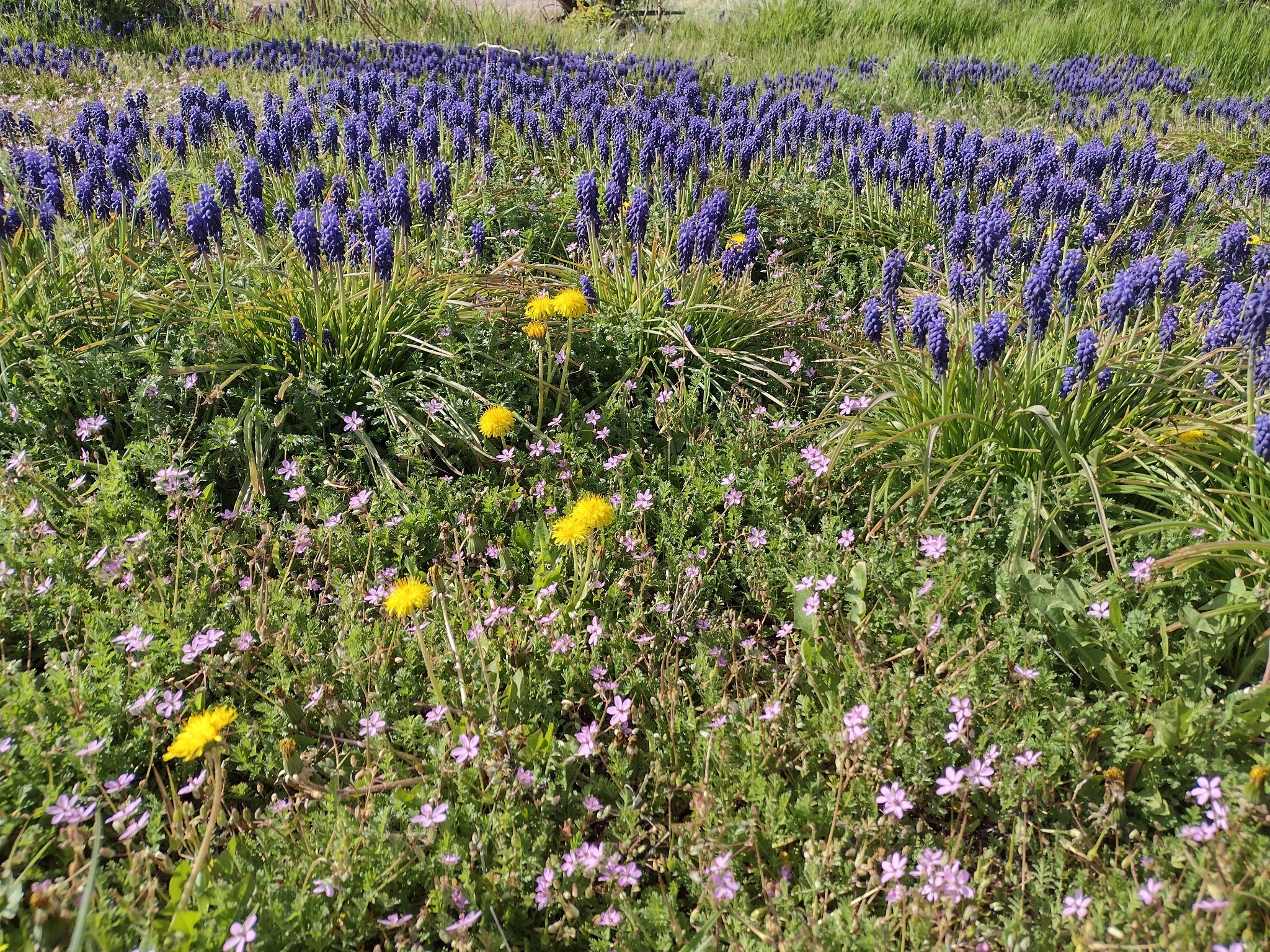
This is my fourth spring without a lawn. The photo at the top of this post was taken this morning. Those bluebells are wild — I didn’t plant those. The tiny purple flowers are a weed. So are the dandelions. BUT ISN’T IT JUST SO BEAUTIFUL!!!! Here it is again:
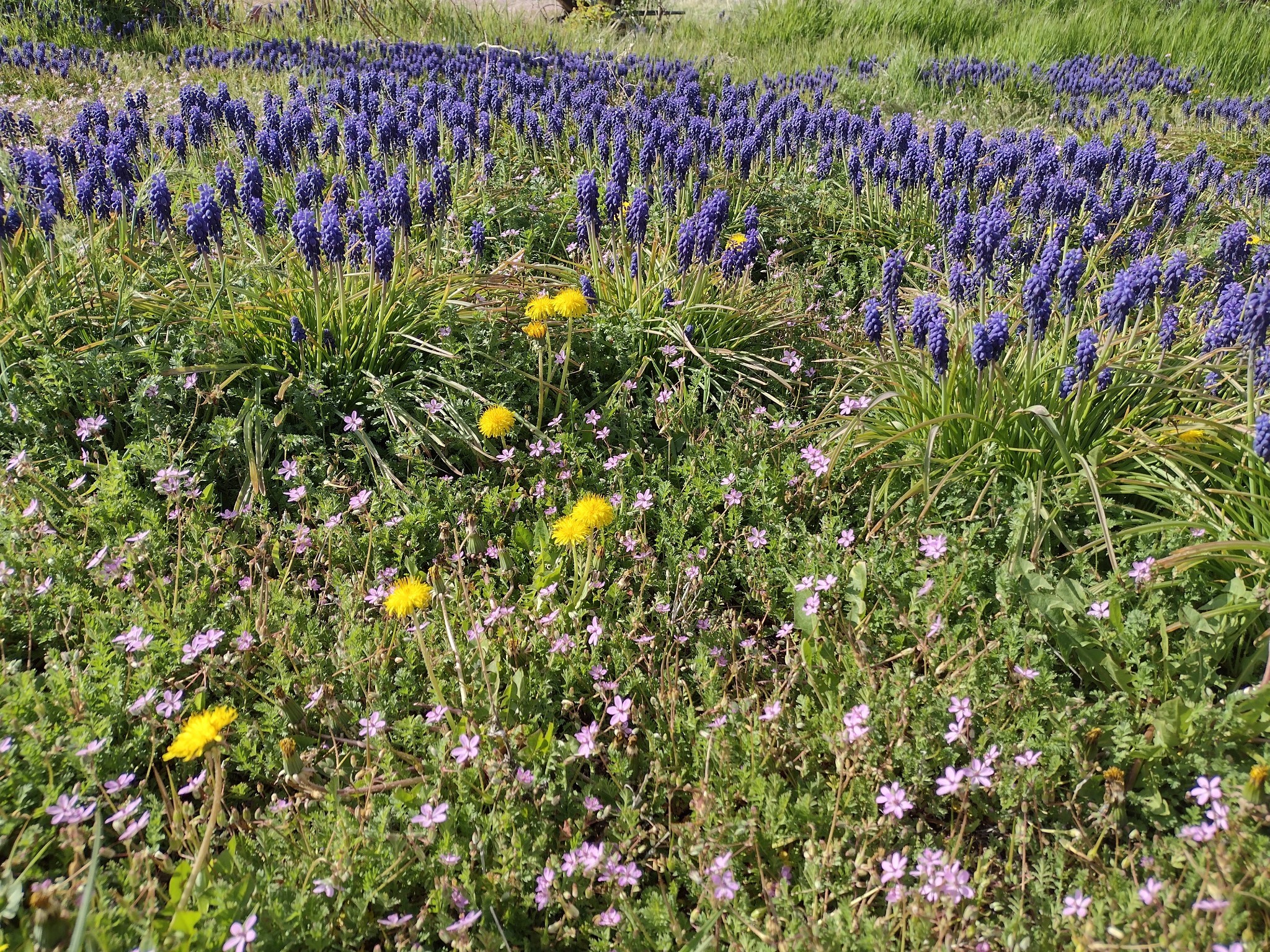
Most of the yard still looks awful in the spring. But when I was cutting back the yarrow plants a couple weeks ago, do you know what I found? An entire colony of ladybugs! Did I screech with joy? Yes. Yes, I did. There are also ants living under a paving stone. Butterflies are already here! And bees! And wasps! (I decided to make friends with wasps too, since they are pollinators.) Plus the spiders and beetles. AND … when I dug a hole last week, there was a WORM!! Some of the worms that I rescued from the bait shop survived! That is the first worm I’ve seen in two years and it made me so happy.
See this ugly photo that i took this morning?
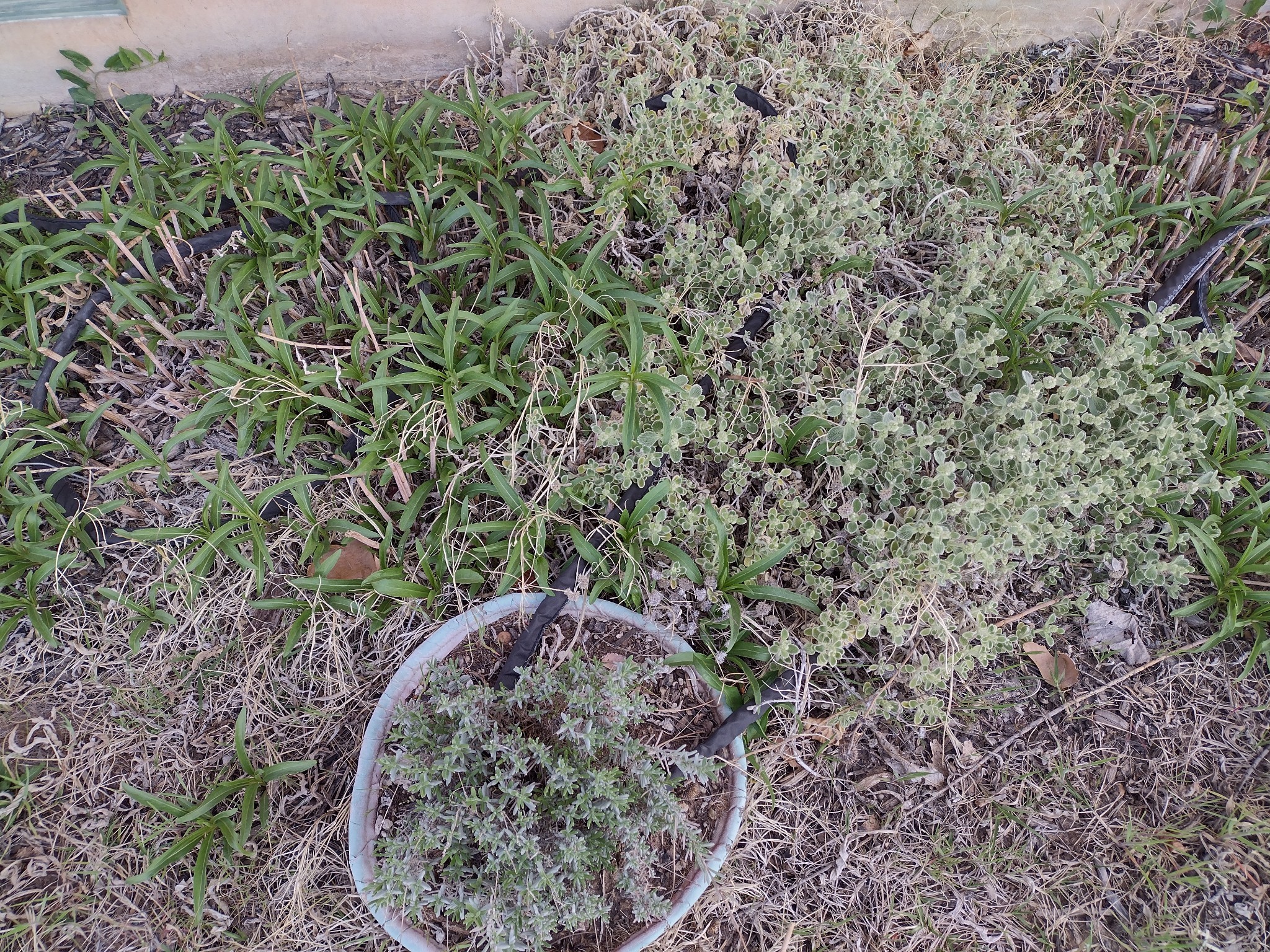
In the fall, that plant on the top left, the little short green things, will be spikes of sunflowers six feet tall.
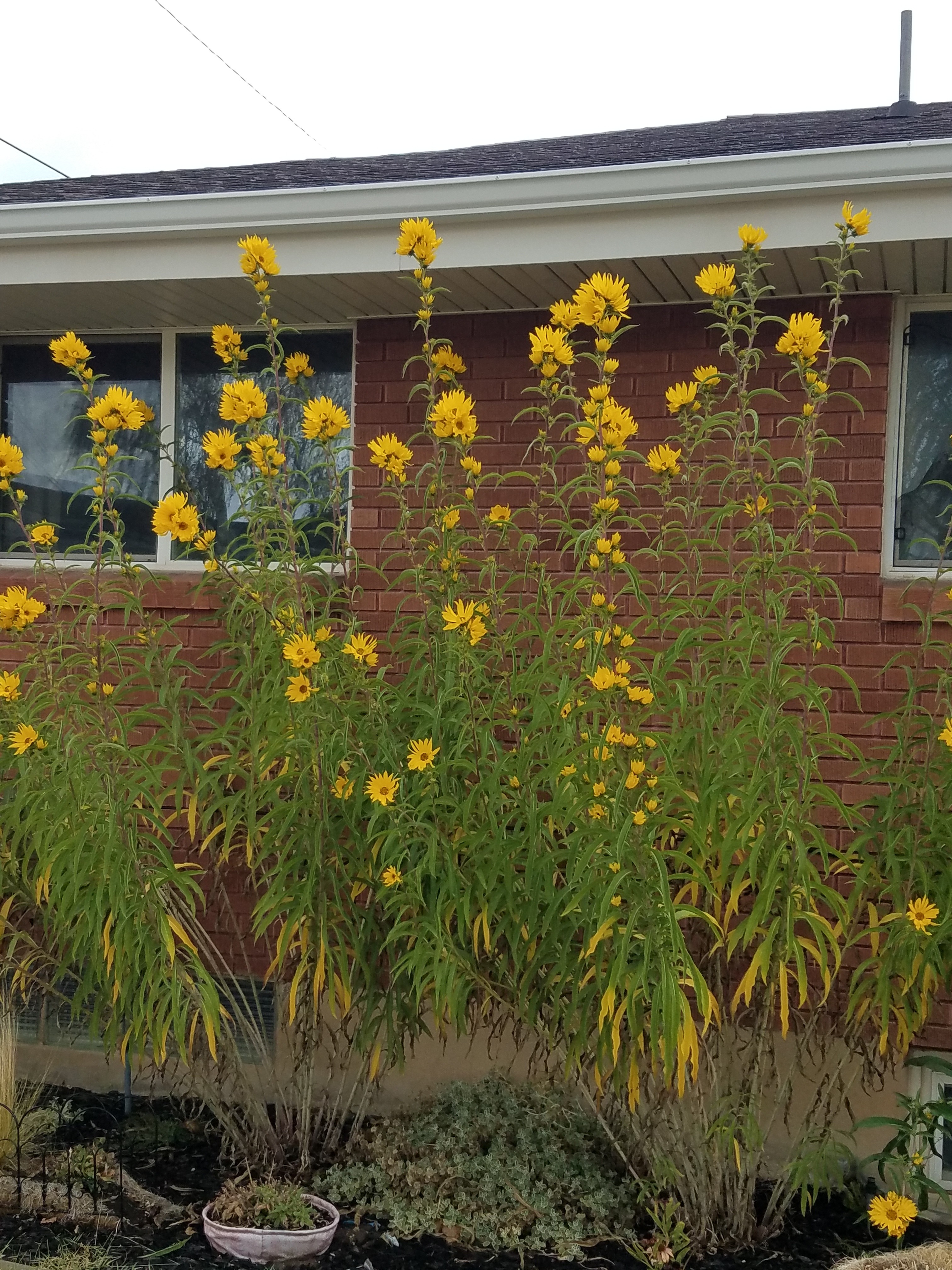
I swear the roots on those sunflower plants grow halfway to China. (Maximilian sunflowers available at High Country Gardens.) If I barely water that sunflower at all, it grows four feet tall. The photo above is from a summer of regular watering, and you can see they’re reaching for the raingutter. The other two plants are a groundcover with gorgeous, pillowy, silver leaves that has white blooms in the spring and attracts bees; and (in the circle) a lavender that I planted a year ago. It struggled a lot last year, but I’m hoping it blooms this year. It has new growth on it already, and I’ve learned that’s a good sign.
Going from a monoculture to diversity has taken a lot of effort, a lot of learning, a lot of setbacks, a lot of determination, a lot of a lot of things that I didn’t know I would need when I undertook this project. My ugly lawn was a lot easier. But I have never once regretted getting rid of it (okay, maybe I did regret it when the City code compliance officer showed up, but that was three years ago now).
Questions:
- What do you think of the metaphor? Like, don’t push it too far. No one is scooping out straight, white, Christians with a frontend loader. And if you’re allergic to bee stings, don’t make friends with bees.
- What sort of dead thatch shows up in a metaphorical monoculture? What are the ideas and attitudes that don’t break down into soil, but turn into a barrier?
- The advantages of diversity are worth the growing pains and struggle. I’m not even framing that point as a question. Diversity is worth it.
- Tell a story about a yard or garden that you work on.


Great analogy.
I’m allergic to ants, so I steer clear of those. We grow rhubarb, which is doing very well this year. Rhubarb and apple crumble is a family dessert. We have an apple tree in a pot grown from seed, so a bit of an experiment. It flowered for the first time last year, but isn’t self-pollinating, so we begged a few blossoms from a friend with a tree that flowers at the same time. We’ll see what happens. We generally see butterflies. There are flowering cherry trees in the public areas of our close, which are gorgeous.
We do have grass, but also get rain. The trick is to keep it aerated, generally by sticking spikes into it all over, to break up any compaction.
Our eldest, who works from home has taken over much of the care of the garden, as relaxation, and is selecting which plants to encourage and which to discourage, and which to control. There’s a small blackberry plant, for example, that can’t be allowed to spread unchecked.
Flowering bushes in front of the house attract bees, and we have wild violets and some sort of woodland iris growing underneath.
We had far more wildlife in our previous garden, which was larger. There was a fuchsia tree hidden in a far corner behind a couple of cypress trees that would be full of bees every summer. We had slow worms, and a toad. And apparently under the cypress trees a fox’s den. An old fox would sit between the trees on summer evenings. And one spring morning I looked out of the window early to see three fox cubs gambolling at the far end of the garden.
Hedgehog, that sounds lovely!
As Oscar Wilde famously stated: “Keep love in your heart. A life without it is like a sunless garden when the flowers are dead”.
When my kids were little we had a hobby farm in Indiana with acres few acres of pasture, a large garden, fruit trees, and at one point a dozen chickens, two cows, two pigs, a dog and a cat. What I learned from that was mostly that I was not very good at hobby farming. My animals were always breaking out of fences and milling about the yard or escaping to eat the neighbors wheat fields. We tried raising pumpkins to sell at the farmers market one year but planted too early and had piles of pumpkins in late August when no one wanted jack o lanterns. So I fed them to the pigs.
Now I travel too much for work, live in the suburbs and am too tired/lazy to try homesteading like that again. One of my kids has taken over the garden and it is more random and weedy than ever. But even then I find snakes, frogs, birds nests, owls, coyotes, and foxes in the back yard. The squirrels and raccoons get a lot of the tomatoes and I gave up getting good sweet corn from our disturbed suburban clay soil.
The metaphor for life that I have been thinking about with my kind of ugly yard is about choosing action instead of apathy. Doing something is always better than just letting the weeds take over.
I do like your analogy. But lawns need proper care and so do people. So, not just diversity, but understanding the needs and proper nurture. The church is failing at the proper nurture, just like that lawn. So, add proper nurture to the list along with diversity.
Janey, your yard lacked air aeration. Proper nurture. Proper aeration breaks up the built up thatch. You can hire people to do it and the best way is not just poking holes, but taking out small plugs. The companies have this big tool that pulls one inch plugs up out of the sod. This allows moisture and air in, but also cuts up that thatch and lets it get rotting. Cutting the thatch is better than just pushing it aside by poking a sharp point into dirt. Think of a thatched roof on your old English cottage. It isn’t letting rain in and it isn’t rotting. But you cut a bunch of holes in it, and it will let water in and start rotting. You want thatch on your roof, not over your lawn. To get the thatch to compost, it needs air, water, and stirring, just like in a compost bin. By bringing plugs up and out, you accomplish all three. You can buy a tool, but lots of work and it only needs doing once a year. Many tools only poke and move thatch aside, not bring dirt up into it by cutting and pulling out plugs.
You can buy worms to help with composting, but they will not go up into thatch. Which is part of why pull out the plugs.
Limit use of insecticide to around your home foundation. To kill aphids on plants, buy some lady bugs in the spring at your local garden shop. There are bad insects, neutral insects, good insects and absolutely essential insects. Our bug phobic culture is killing off too many of the good insects and essential insects. Well, when you kill off the good insects, that leaves the bad insects to take over. When you kill off the essential insects, you are killing off humanity. Our food sources need pollinators.
My son raises honey bees, and every other year or so, some idiot neighbor goes crazy spraying bug poison all over and it kills his whole hive. Bees bring the poison back to the hive, so it kills off more good insects that bad insects when you spray everything. Never spray on flowering plants. You are only killing off the insects that are good for you. Termites, cockroaches, black widows, they will not be on your flowering plants. But honey bees will. If you get wasps, best just remove any hives. You cannot hit them with bug spray, so forget that and find their nests.
My yard is xeriscaped at our southern Utah house, with cactus and other desert plants, plus a few trees. Our summer house in Idaho has deer resistant flowers in this big flower patch. And one lilac that I am protecting from the moose who do eat lilac. In both yards, there are mostly native plants. Sometimes the cultivated variety of the native so it doesn’t look so much like a weed. One ingrowing zone 9 and the other in growing zone 3, so one is almost alpine growing zone and the other is Mojave desert. We are still digging out the non xeriscape stuff from the desert landscape that was put in before we moved there. We are replacing stupid privet bushes with cacti. I will probably keep the wild roses and heat tolerant lilac. Of course, with the heat increasing over just the years we have been in the house, it is beginning to show stress. It doesn’t like 117 that it hit here last summer.
Brigham Young was an idiot to think the Mojave could have Kentucky blue grass lawns. But still most of the houses still try to have lawns and it is still Kentucky blue. Might as well grow alfalfa —-oh, they do that too. And ship it to China and Saudi Arabia.
I read of a study about grasses done at the University of Wisconsin. They sectioned off 30 or 40 plots into large squares and then planted various grasses in the space and just watched what happened. The year they did it, there was an unexpected drought. They didn’t water it and just let it grow or die. What they found at the end of the experiment was that the plots with a single or very few varieties of grass did the worst. The plot with the most varieties did the best. One of the most amazing findings was in the plot that had the most varieties that did so well; some varieties that had died when in plots by themselves or a few other varieties, were thriving in this diverse plot. The plants seemed to work together during the drought crisis. I think it’s why it pains me so to see DEI become such a terrible thing in our politically/religiously charged environment.
Apropos of nothing in particular, at the moment I am sporting a T-shirt with the message “Imagine being scared of diversity but not dictatorship!”
Reminds me of the story of the sacred grove and how they had to change their mindset from wanting it “well groomed” to supporting its “natural state.” From “Lessons from the Sacred Grove” (which was used as an analogy about church history, but still):
“There was a time when those in charge of caring for the Sacred Grove decided that the grove should be well groomed. Service projects were then organized to clear the grove of fallen trees and limbs, undergrowth, stumps, and dead leaves. Under this practice, it wasn’t long before the vitality of the grove began to diminish. Tree growth slowed, fewer new trees sprouted, some species of wildflowers and plants began to disappear, and the numbers of birds and other wildlife decreased.
Later, upon recommendation that the grove be left in as natural a state as possible, fallen trees and limbs were left to decompose and enrich the soil. Leaves were left lying where they fell. Visitors were asked to stay on marked pathways so that the grove would be less disturbed and the soil within the grove less compacted. Within just a few years, the grove began to regenerate and renew itself in a remarkable way. Today it flourishes in a nearly pristine state, with lush vegetation and abundant wildlife.”
Obviously, there are as many takeaways from your story and that of the sacred grove as there are people … but at the least, to further what I assume was your initial line of thinking given your title using DEI, it is yet another anecdote in support of the idea that it is as good to force all people to ACT the same as it is to force a yard or a grove to be all of the same condition. We all grow better, and feed off each other (in a good way!) when we come with our differences, but with a goal to be planted in the same soil.