
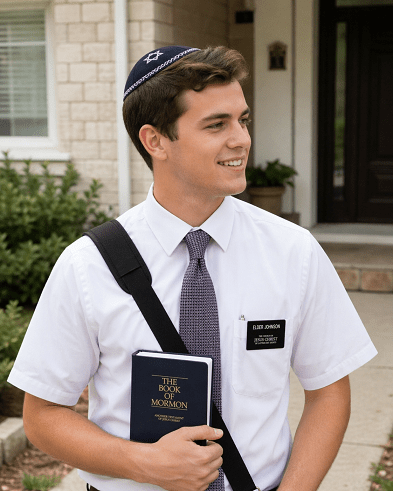
Last week my wife was watching a Jewish dating show on Netflix called Jewish Matchmaking. I was reading a book as is often the case when my wife watches such shows and I’m trying to ignore what is going on, I became intrigued as the “matchmaker” would interview new clients. She self described as a “frum” Jew, a Yiddish word meaning devout, religiously observant Jew. What I found interesting in her interviews was when she asked about their religious observants. The responses was everything from orthodox (frum), to secular, and everything in between.
As the “matchmake” asked the questions, there was no hint of judgment as many of the clients were much less observant than she was. Some did not observe kosher eating, one only observed kosher at home, but not outside the house. Some only went to temple on the High Holy Days, and others went weekly. Some never read the Tora, and others read and studied it every day.
There are five levels of religiosity in the Jewash community.
Orthodox Judaism: Adheres strictly to traditional Jewish law, believing the Torah (both written and oral) is divine and immutable. It includes Hasidic and Modern Orthodox sub-groups.
Conservative Judaism: Seeks to balance traditional Jewish law with modern life, considering Jewish law binding but evolving.
Reform Judaism: Emphasizes the ethical aspects of Judaism over strict adherence to ritual law, viewing Torah as a growing, inspired document rather than literal divine law.
Reconstructionist Judaism: Views Judaism as an “evolving religious civilization” rather than just a religion, focusing on community and cultural tradition.
Secular Jew: A person who identifies with Jewish culture, history, and heritage, often described as “peoplehood”, rather than with its religious beliefs or rituals. They may not believe in God, keep kosher, or attend synagogue, yet they maintain a strong connection to Jewish identity. It is an identity based on ancestry, community, and culture.
Interesting side note, the Jews have the Mormon equivalent to Born in the Covenant (BIC).They say “Frum from birth” (FFB)
The Matchmaker saw each of the clients as Jewish, regardless of their observance. I found that fascinating, and contrasted it with the Mormon faith tradition. I can see a Mormon equivalent to each of the above categories, encompassing everything from the fundamentalist polygamy groups, the mainstream LDS church, and the cultural Mormons. But what I don’t see in the Mormon tradition is the acceptance across the groups of each other like I see in the Jewish community.
Am I trying to compare apples and oranges hear (they are both fruit!)? Because a Jew is an ethnic group and a religion, does that make it different from Mormons? Yet I would argue that Mormons from the Utah/Idaho area (myself included) meet the definition of an ethic group: Ethnicity refers to the cultural expression and identification of people of different geographic regions, including their customs, history, language, and religion.
I am an ethnic Mormon. I was born in Logan Utah, my history includes relatives that marched across the plains, and I pronounce creek different than my California friends (heck ya!).
What is different in Judaism that lets the various sects get along so well? I don’t see the Orthodox Jews trying to convert the reform Jews, they all get along. Is it too much to expect that one day all the various flavors of Mormonism will get along and just be Mormons?
Your thoughts?
How do you pronounce “creek” ?


Bishop Bill insightfully points out that other faith traditions (in this case, Jews… but one could presumably make a similar argument about Catholics) have and make room for different ‘strains’ or subgroups within the faith, and that’s ok.
A recent comment on Hawk’s post about differing degrees of belief and devotion seems relevant; here the OP highlights how some of these different degrees of faith adherence can even be formalized.
(Sorry… meant to link to a specific comment and that clearly didn’t work…)
I think that this idea of using the same categories that Jews use for Mormons and the tolerance it implies have been expressed in progressive circles for many decades (e.g. More than one way to Mormon).
I suspect that a tolerance for differences in approaches to a religious tradition develops when that tradition survives over thousands (or at least many hundreds of years in the case of the Catholic church). In the case of Judaism, that tolerance may also be driven by the shared trauma of being targets of anti-Semitism regardless of one’s approach (I.e. that Jewish is an ethnicity as well as a religion). After all, the Nazis killed both secular Jews and orthodox Jews.
One major difference in Judaism as it survived over the centuries, is it no longer has a central authority that is defining and attempting to enforce orthodoxy. I suspect that if there was no Q15 constantly harping on markers of the covenant path and boundary maintenance including not wearing more than one pair of earrings or using the term Mormon, there would be much greater tolerance for various approaches to being Mormon. And as far as I know, one can’t be ex-communicated (courted with love?) from Judaism.
But it’s also probably not entirely accurate to say that the various approaches in Judaism entirely accept each other as fully Jewish to the extent that your match maker appears to accept them. Even as a teenager reading any of Chaim Potok’s novels, it was obvious to me that members of the most Orthodox traditions saw even reform Jews as sinners and secular Jews were disgusted by the Ultra-Orthodox. And in the the state of Israel, the tensions between Ultra-Orthodox and other approaches are very real.
.
Harvard, at least, considers Mormons (defined differently that “members of the Church of Jesus Christ of Latter-Day Saints”) to be a distinct ethnic group. Not everybody (like Armand Mauss) agrees.
Inserted the wrong link. Sorry. Try this one.
Why are Mormons so unaccepting of our various belief levels? Because we are just SO judgmental. We would rather gossip about how Bro Jones was mowing his lawn without TG tops. Or how Sis Jones has had a boob job and tummy tuck. Or that we saw teen Jones at Starbucks. Judgement R Us.
I think in some ways we have a history that induces judgement. We were forced by the US government to splinter into LDS and FLDS. Then we had to excommunicate the polygamists in the LDS and hunt down and arrest the polygamists in the FLDS. Utah passed a law outlawing the equivalent of Kosher when it passed laws against polygamy.
Then there is how jealously we guard our temple. Under Joseph Smith in Kirkland, anyone could go into a temple. But in Nauvoo, and solidifying under Brigham Young, polygamy was the only reason to be married in the temple and polygamy was hidden and illegal, so Garments were invented to give a signal of who was polygamist and temple attendance became guarded and you had to PROVE orthodoxy to get in. Then polygamy became problematic then disapproved, so they needed a NEW worthiness marker and the pushed the word of wisdom from a nothing suggestion into THE Word of Wisdom, and got really judgy about that.
So, Mormons ended up the most judgy people around with our worthiness interviews and needing your proof of “worthiness” card to get into the temple. So, Mormons got to be some of the snobbiest, judgy, exclusive people imaginable.
So, until we totally get rid of temples, we are going to divide and look down on any Mormon who doesn’t meet the highest standard of “worthiness.”
I’m a cultural Mormon. The culture is deeply ingrained in me whether I like it or not. My life experiences are Mormon to the core. I also raised by parents who were born and raised in rural Utah and grew up saying creek as crick and roof as rooehf (as the oo in good). But I wouldn’t consider myself ethnically Mormon. Ethnicity seems to have more than just a cultural component, but an actual biological component, and one that is typically rooted in genetics spanning hundreds if not a thousand or more years. Jews have long regarded themselves and have long been regarded by surrounding non-Jewish communities as biologically distinct. While I can’t tell that every Jew is biologically Jewish just by looking at them, many Jews undoubtedly have a distinct Jewish look. On that basis, the Jewish community will still regard atheist Jews as Jews, and atheists will still self-identify as Jewish, such as Sam Harris, one of the most outspoken and prolific atheist writers.
An important belief not just in the Jewish religion but the larger Jewish community is that are a group of people who originate from ancient Israel which was scattered throughout Asia, Africa, and Europe by Babylon, Greece, and Rome over centuries. This belief is 100% true. What is fascinating is why Jews retained their identity for so long and in spite of scattering. Phoenicians were diasporic. They settled in Tunisia and Spain, where they were known as Punics. But once Rome defeated them in battle, their community and identity became lost. Chaldeans migrated throughout the Roman Empire, but their communal identity did not last. There are only a few diasporic communities who manage to hold onto a distinct ethnic (cultural + biological + sometimes linguistic) identity. Roma (aka Gypsies) and Armenians come to mind. But mostly assimilation of smaller groups into larger groups takes place and washes away older identities. It is estimated that there are over 1 million Roma in the US. But mostly communal bonds of the Roma have faded away in America and remain strong in Europe.
I think in Utah there is acceptance or variations of Mormonism to some degree. There are cultural Mormons who don’t believe everything and Jack Mormons who don’t abide by the standards. But mostly Mormons see themselves as a community bound by belief, with no biological component, and mostly no cultural component. I had a talk with my bishop, who was new at the time, and told him that I was a cultural Mormon. His response was accepting of me, but noted that in Chicago, where he was from, there were no cultural Mormons. You were either in or you were out. There simply weren’t enough Mormons there. If you went to church it was just assumed that you believed and were willing to fully participate.
I agree with 10ac that much of the reason Mormons aren’t officially accepting of other activity levels is because of the centralized authority. Jews simply don’t have any equivalent to the Q15 who expect everyone to listen to them for 16 hours every six months. As long as the Q15 keep hammering away on testimonies and worthiness, there is only one correct way to be a Mormon.
The official teaching is different from my lived experience. I’m BIC and a lifelong resident of Utah. I quit attending Church 7 years ago, and haven’t held a temple recommend for probably 10 years. I’ve been flying a Pride flag in my yard for a year. My neighbors are great. Every so often I get an invite to a religious function and I politely turn it down. Half my office is TBM. I participate in conversations in the lunchroom about missions and BYU with the TBMs and then go get coffee with the neverMos. I’m sure some people are judgmental towards me but I haven’t really noticed. It would probably be a lot more intense if I still hung around my siblings and niblings though. A lot of the worst judgment comes from family. I don’t have that pressure anymore.
I identify as culturally Mormon, despite making an effort to lose some Mormon ways of speaking. I trained myself to say ‘creek’ to rhyme with ‘weak’ instead of ‘trick,’ for example. But I’ve got pioneer stories and a tendency to take food to anyone who has been in the hospital recently.
My thought about Mormonism as an ethnicity is that it’s developing, but not quite there yet because we’re still so new. As Brad D pointed out, some cultures endure for a while and then dissolve into the surrounding culture. Mormonism’s missionary effort cuts against it becoming its own ethnicity — there is too much effort to bring in new people from many nationalities and traditions. In 300 years, we’ll know more about whether Mormonism is an ethnicity, or just a tight-knit religion that faded eventually. What about the Amish? And the Menonnites? Are they considered distinct ethnicities?
I think the Amish could be considered an ethnic group. They come from split along the Anabaptists (Alpine German areas), speak a distinct language, and have intermarried among themselves since their arrival to America in the 1700s. Mennonites are also similar to the Amish, yet distinct from them. Mennonites are more willing to integrate with outsiders than the Amish, so their ethnic distinctiveness is more diluted. I actually met a group of Mennonites on a cruise a number of years ago. They all wore their traditional garb and had their distinctive haircuts throughout the cruise. Nice folks.
To that, I think some of the polygamist Mormon groups could be said to have an ethnically distinct component, since they’ve been practicing endogamy for generations and do not let outsiders in. But the Oaks-led Mormon Church has been massively committed to expansion for generations. Plus, we have to consider that early Mormonism was very missionary-based, attracting converts from different parts of Europe very early on. My Mormon ancestry comes from Wales, England, and Germany. Denmark was also a source of early converts. So given Mormonism’s early biological diversity, I would say that it was not on its way to ethnic distinctiveness early on, although once it reached Utah, a few generations of endogamy may have set it on a trajectory of ethnic distinctiveness that ended in the post-WWII period.
Our last Sunday at Church was march of 2021. The talk was about how to be “all the way in.” The stake president spoke for a half hour about how you can’t be a cafeteria Mormon, can’t be tepid but have to choose to be hot or cold, can’t be a fence sitter with one foot in the church and one foot in the world. This kind of rhetoric is part of why it is hard to maintain levels of religiosity and orthodoxy in the Mormon church.
The other two reasons I see that make it impossible are temple recommend or worthiness interviews and correlation and central regulation of all teaching materials. It used to be every year but is now every two years we are expected to sit in front of ward and stake leaders and declare that we 100% believe and support the leaders, core doctrines including role of Joseph Smith, Book of Mormon, and affirm that the Church is true. Then in those interviews you are supposed to confirm adherence to Mormon specific lifestyle commandments like word of wisdom, garments, church attendance, tithing and sexual purity. You can lie. Most people do. But if you are honest about deviation from those expectations forget about being a member in good standing.
Teaching materials are expected to follow the correlated manuals. How do you get a nuanced or different interpretation of history or doctrine in 25 minute classes and talks if you follow this explicit instruction manual. I was teaching Sunday school for the youth once and one of the youth asked about polygamy. I showed them the essays about polygamy on the church website and app and walked through the content of those essays with them. A parent must have complained because I was released the next week.
There is no room for a reform or nuanced Mormon. Eventually the church will force you to choose orthodoxy or honesty. You can’t stay and the church doesn’t know what to do with inactive members that don’t believe or follow the rules except urge them to repent and return.
I went to a local reform synagogue last week for a bat mitsvah and loved the cantor, the tradition and worship that was possible alongside the changes to that tradition. The female rabbi and the young woman gave inspiring readings and interpretations of the Torah. I was saddened even while it was inspiring because this path is closed to us as Mormons.
I agree with the other commenters who point out the effects of centralized authority on a culture of boundary policing. But also I think age and maturity of a tradition plays a role. Catholicism has the most centralized authority structure of major Christian denominations, but they seem a little more tolerant of a spectrum of belief and practice than Mormons are, though probably less than in Judaism. Mormonism’s need to police boundaries strikes me as coming from a place of insecurity, the same instincts that gave us a church-owned shopping mall next to church headquarters. A more established religion that has been on the world stage for far longer seems less likely to make decisions based on worries about appearances.
“Creek”? I grew up outside Utah and I say it the way most Americans do, but my dad who grew up in Utah said “crick”.
I wasn’t aware of the “creek-crick” pronunciation as a distinctly Utah thing. I’ve heard “crick” before in non-Utah, non-Mormon settings, and usually associate it with the rural Midwest or Appalachia, or perhaps a historical Scottish origin, but I could be wrong about that. I’m from the west coast myself, and I previously lived in a city that had the word Creek in its name. In my whole life I’ve never heard anyone, Mormon or otherwise, refer to that city’s name with the folksy “crick” pronunciation, and would find it very strange if anyone attempted such.
I relate to Brad D’s comment about the bishop from Chicago, which was similar to the attitude of my non-Utah LDS upbringing. Because of the sparsity of Mormons, you were either all-in or totally out; where Mormons are a small, quirky minority group, there is a social cost for publicly identifying as one, so only the truly devout, orthodox members will publicly claim to be Latter-day Saints around their overwhelmingly non-Mormon neighbors, co-workers, classmates and associates. Among themselves, these LDS communities were very monolithic in their belief, at least outwardly. Very different from Utah, where everyone is just assumed to be Mormon until proven otherwise. The upside of the Utah LDS density is that the culture tends to tolerate more diversity of belief, so you have people like Jack Mormons and others who claim to be Mormon but are more casual in their observance or outside the norm in some way.
Like previous comments mention, I think Mormonism as a religious movement is too new to be tolerant of a broader spectrum of believers and “cultural mormons” to the extent that Judaism and Catholicism are for their respective adherents. But it feels like we are slowly moving in that direction, fortunately. Some of these shifts are organic and grassroots, like the trends of younger Mormons being less rigid about prohibitions on coffee, tattoos and extra piercings, or being less dogmatic about garment wearing. Interestingly, some of the changes are official top-down changes from the institutional Church itself, like sleeveless garments, 2-hour church meetings, reduction in GC sessions, and dropping scouting, all of which would have been considered sacrosant and unchangeable to the Church I grew up in. That, and it seems like Church leaders are privately panicking about how to solve membership retention problems, especially in the developed world, and thus are faced with an existential crisis (on top of their festering public trust crisis and image crisis).
I’m not sure “crick” is a Mormon thing. My grandpa grew up in southeast Arizona (Bisbee) and he pronounced it crick. Might be a US mountain desert area thing.
FYI. My grandpa was not Mormon. He was a navel officer before becoming a Lutheran pastor.
I was in my 30’s (or later) before I realized creek and crick were the same word. Like river and stream but smaller, I thought creek was a bigger crick.
So I pronounced it both ways, depending on size.
I’m a frum. And though I’d like everyone to be a frum I’m open to people being involved in the church for the best reason they can come up with.