

More than forty years ago, Jan Shipps, was an American historian specializing in Mormon history, particularly in the latter half of the 20th century and into the 21st century. Shipps was generally regarded as the foremost non-Mormon scholar of the Latter Day Saint movement.
https://commons.wikimedia.org/wiki/File:Joseph_Smith%27s_First_Vision_in_Stained_Glass_at_the_LDS_Church_History_Museum.jpg
One of her key observations was that the Mormons had become an ethnic group more than two hundred years sooner than was generally thought possible. This gave Mormon individuals a deep sense of identity, community, and social capital. These connections often resulted in improved well-being and practical advantages in various areas of life. [1, 2, 3, 4, 5]. Importantly, being a Mormon was more important to members than race, social status, wealth, education, political identity or other factors.
One of the interesting developments of the last twenty years is that the Mormon ethnic group has ended and seems to have been dissolved by the actions of the leadership.
One result is that issues of race, social status, wealth, educational attainments and political party are now more important than being “Mormon” — a term that has pretty much come to an end, outside of “anti-Mormons” who like to emphasize that use of the word from Joseph Smith to Gordon B. Hinkley, where the church embraced the term, and has now rejected it means that the Church has now admitted that the word is a marker of being satanists. (Something that many might disagree with, and others embrace as treating “Mormon” as giving a victory to Satan).
https://commons.wikimedia.org/wiki/File:Joseph_Smith,_Jr._portrait_owned_by_Joseph_Smith_III.jpg
The loss of “Mormon” as a primary identity has become obvious as vaccine deniers proliferate, Measles outbreaks show up in Utah, and other social trends have become significant. Political party has become more important to many than membership in the Church. Social stratifications seems to proliferate.
The development has raised the question, now that we are not the extended family that comprises an ethnic group, just what are we? Now that membership in the Church is no longer the primary identity of the members, what is the role of the Church and the community in the life of members?
Where does the Church go now that we have faced an end to the Mormons?
(for historical perspective, https://www.churchofjesuschrist.org/media/music/songs/i-am-a-mormon-boy?lang=eng).


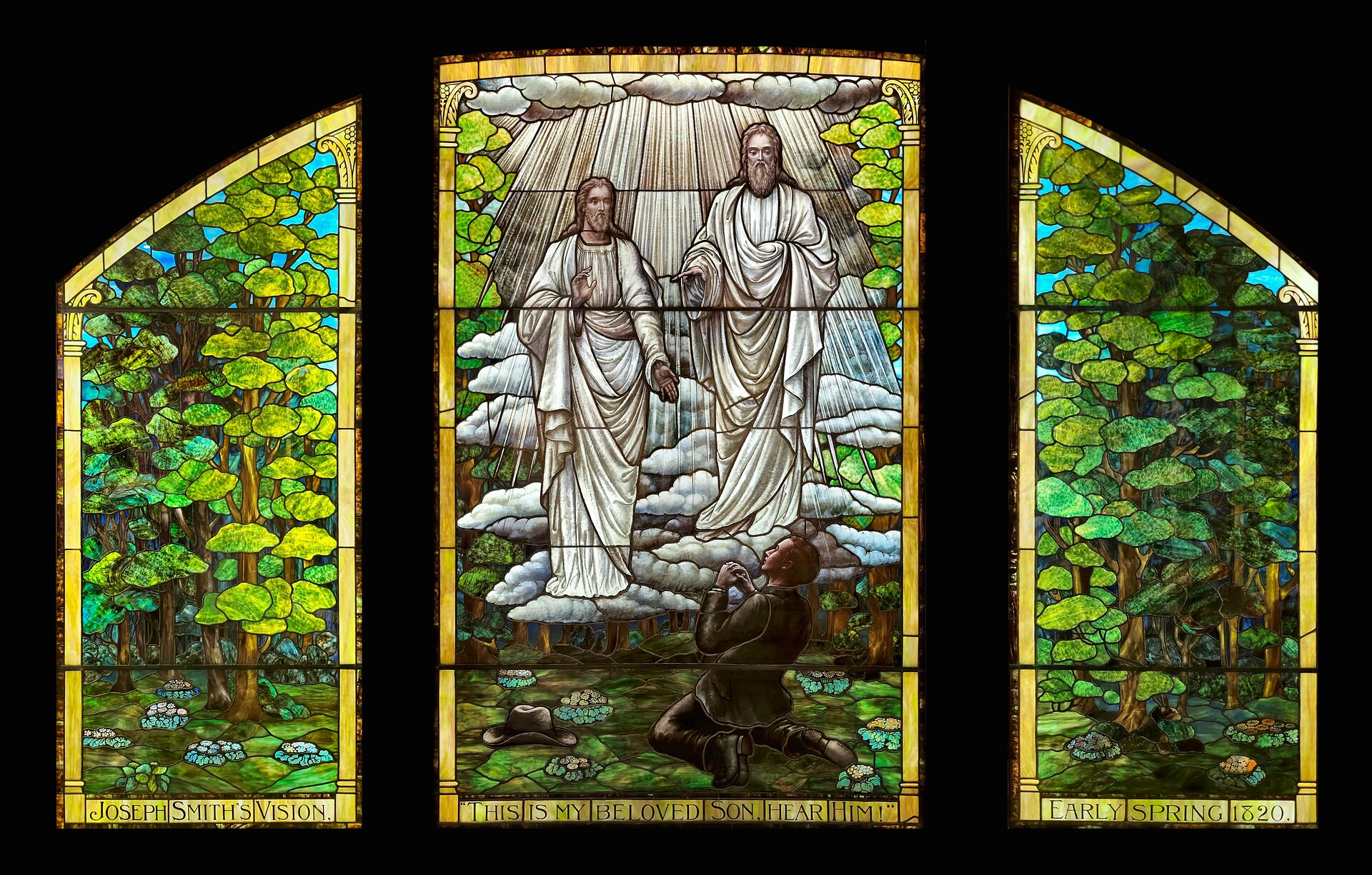
The stained glass artwork at the top of the post was featured on the cover of Richard Bushman’s book Believing History. Any connection to the text of the post?
The idea that erasing the word “Mormon” from LDS discourse is part of erasing or reversing the nascent ethnic identity of “Mormon” is interesting — but it seems a stretch to claim that being an LDS member is just like being a member of any other church. Plus it’s too early to tell if the word “Mormon” will re-enter LDS discourse with the passing of President Nelson.
“Where does the Church go now?” Well, it’s the same place where they’ve been headed for quite some time now (at least since N. Eldon Tanner’s time) – they continue to foster themselves as one of the wealthiest, most lucrative Real Estate Investment Houses in the World. Hey, so what if your doctrine is being proved as nonsensical and baseless; when you have this kind of wealth – who needs Heaven?
I think the major reason for the loss of identity is the gutting of ward activities. It’s hard to feel like a family if you never do anything together.
I’m going to ask a question that some of you will find outrageous: Is LDS leadership (i.e., the Q15) embarrassed to be “Mormon”? I’m not saying they are embarrassed because I have no way of knowing what they actually think. But if we could read their minds and determined that indeed they are embarrassed, they would be acting just like they are acting. That is, moving the Church towards mainstream Christianity, deemphasizing what makes Mormons unique, spinning LDS history, etc.
It’s kind of ironic that the mainstream member of the Church may be less embarrassed to be known as a Mormon than the actual leaders of the organization. Another example of my belief that the members are better than the organization (I totally reject the idea that “the Church is perfect but the members are not”).
josh h, Can you elaborate a little? Can you give an example or two of “moving the Church towards mainstream Christianity” which you find problematic? Can you give an example or two of “deemphasizing what makes Mormons unique” which you find problematic? Can you give an example or two of “spinning LDS history” which you find problematic? I think clarity is important for meaningful dialogue, and I’m not understanding where you’re coming from. I might agree with you, but if you’re a fundamentalist then I probably don’t — but I don’t know because you made general statements with no specifics.
To some degree, I am okay with a little bit of all of these — maybe it depends on the particulars. For example, while some of our “steps towards mainstream Christianity” might appear inartful, I think a general movement towards gospel principles as taught in the New Testament is a good thing. I also think there are some weird teachings in Mormondom that should be deemphasized or even outright disclaimed. But I don’t know what particular matters you are thinking about that are bothering you. That said, I regret what I see as a weakening of our local church communities even while being glad that some aspects of church culture are changing. I also regret a weakening of our Sunday curriculum even while being glad that some things are no longer taught.
Well, the church is for sure losing that sense that we are all one group of people. I think Covid and Trump are part of that loss. When being Republican and loyal to your party above all and meant going against Mormon values, there was a choice. Then the cognitive dissonance of the situation lessens your tie to the one you decide against. So, some Mormons who saw Trump as a corrupt, conman, racist, misogynist, and a whole handful of other bad things, voted against Trump, it reduced their Republican loyalty. The thought being, “I am not so Republican that I abandon my Mormon values. But if they abandoned their Mormon values to stay as a loyal Republican, it reduced their Mormon ties, because they chose being Republican over being Mormon. When there is a choice like this, the one you pick increases in value and the one you decide against decreases in value. Well, we know about 70% of Mormons picked a very dishonest man to be true to being Republican above all else. So, they reduced their Mormon identity.
They might not have realized the choice would reduce their Mormon loyalty but it does.
Then Covid and there was another choice. Follow the prophet and get vaccinated or follow your party and insist on freedom to be an idiot…oops, I mean to choose.
Then back to church after such a nice break, and many didn’t go back. The liberals didn’t go back because they had started feeling like the church didn’t want them because of all the loud Trumpers. And the Trumpers didn’t go back because the prophet supported these crazy things like masks, stopping big meetings like church, and vaccines. The increasing political divide is decreasing feelings of belonging to the group from *both* sides.
When members do not feel like part of the group, that feeling of ethnicity is gone. The Trump led increase in racism has made blacks feel less like part of the group because there are so many Trumpers. The deportations are making Hispanics feel unwanted by the loud and proud Trumpers.
So, there are lots of things going on in the last 10 or so years that have worked to destroy that feeling of being a loved part of a larger group.
Dave—no connection between the Bushman book and the post. Wish I had been that intuitive.
Anna—the way Romney’s position was received was telling. Sad too.
Ji—that was a good question.
Former—the church had abandoned community. It is interesting to watch the results.
ji started me on a very interesting train of thought. I certainly agree that the devil is in the details of what we reject and what we retain. Also, it’s hard to tease out which beliefs are part of mainstream/evangelical Christianity and which are part of general US culture as adopted by many US religions. (A la The American Religion by Harold Bloom.) I don’t know that the Church as an institution is moving toward mainstream Christianity. I think any movement is toward acceptance by evangelical Christianity.
I do not have any interest at all in being a member of an odd branch of evangelical Christianity. I want to be a Mormon Christian. But what does that look like?
I think the recent big push pointing out that temple rites are about Jesus is part of the move toward convincing evangelicals that we really are Christian. I hope that most of us already understood the temple in those terms.
I value very highly our idea of eternal progression. That’s one I would really hate to lose. However, I certainly hope that our current ideas about the Celestial Kingdom are wrong in many big ways–I think they sound more like hell than like heaven. I want to continue learning and growing. I want to become like my heavenly parents. I hate the idea of eternal polygamy and some kind of weird spiritual pregnancy and childbirth. I reject the idea that I should want to have billions of spirit children who will never know me and never have any relationship with me.
I value having prophets, but I wish we (and they, it seems) understood their roles differently.
I like that we are moving closer to mainstream Christianity (as I understand their position, at least) in our understanding of grace and the value that we place on it.
I think our understanding of the Atonement is very much informed by Calvinist theology, at least as I understand it. I wish we would move farther away from mainstream US Christianity in this aspect.
I don’t know if we have learned white Christian nationalism from evangelical Christianity, or if it’s a US cultural belief that many adopted together. Either way, I don’t think it’s actually Christian.
Same with the prosperity gospel–is it US culture or evangelical Christian? Either way, I don’t want any part of it.
And as far as eternal progression…I honestly can’t tell you right now what we officially believe. The messaging is very mixed. Have we played down the idea of achieving godhood in an effort to be accepted by evangelical Christians who reject the possibility as heretical? Are leaders talking about it less clearly because they don’t know what the Celestial Kingdom will look like? Are they not talking about it because they don’t want to deal with the polygamy implications? Something else?
I think the Church is becoming that “great and spacious building” talked about in the Book of Mormon. It’s all about gathering wealth. Of course, it’s the investment portfolio, but it’s also the number of temples, the removal of old chapels in poorer parts of town, and members leaving those parts of town to live in the new, bright developments. It’s how many lawyers there are in the Q15, or how Stake Presidents and Bishops seem to be “well off” in their areas, thus making them natural leaders. Wealth is about rising membership numbers (big numbers are always better), even though they are decreasing in the USA, but exploding in S. America and Africa, where it’s a very different church that doesn’t reflect things in Zion. I worry that it’s easy for the church to look at morality as being LGBTQ but not concerned about war because of the risk to their portfolio. Sure, the church proclaims peace, but did they condemn war like the Pope? If morality affects the bottom line, they dance around it.
Ji: there are so many examples I could provide I hardly know where to start.
1. Focusing on Holy Week. We used to
ignore it because, after all, that’s what Catholics do.
2. Not talking about Jackson County. Not talking about creating our own worlds. So many unique beliefs we seem embarrassed about now.
3. As for spinning LDS history : I truly can’t give this topic the justice it deserves in this small space.
Did we formerly ignore Easter week because that’s what Catholics do? I agree that we ignored it, but maybe for a different reason. Maybe the Brethren have realized that most Saints really don’t worship Christ, except in name only, and we really worship prophets. Maybe the Brethren are trying to move us back to Christ because that is where our focus should have been all along. Instead of “Follow the Prophet,” maybe we are moving, slowly, to something like a safe way to follow Christ is to follow the prophet, or follow the prophet when and to the extent that he follows Christ. Same is true for all local leaders: maybe the members are being encouraged to search out answers for themselves, relying on the Spirit and on the scriptures more and on local leaders less. Maybe.
josh h, not contradicting you but on Easter Sunday, Elder Cook was regaling us with the (tall?) tale of the return visit of Moses, Elias and Elijah to Ohio in 1836.
I keep coming back to this post, because it’s caused a lot of offline reflection on my part. I believe that Bro. Marsh’s comments here are not only provocative, but very very astute.
Among friends, and even on the blogs, this idea of the “changing church” and associated LDS identity has been up for discussion for some time. But I’ll admit that I’ve mostly been thinking about it as a “change in approach” that’s a programmatic thing with other implications. In other words, as the church sort-of retracts or ‘hollows out’ from the more immersive cultural approach of prior generations (e.g. today’s two-hour church, minimal program structure, minimal social elements), many of us have commented or discussed the pros and cons, particularly compared to the youth years many of us experienced (with an overabundance of scout camps, stake farm volunteer work, roadshows, etc etc). Effective arguments have been made against many of these former quirky or anachronistic elements of LDS life (e.g. all the anti-scouting sentiment etc)…. yet many former proponents of a hypothetical dial-back have now realized that “getting what you asked for” has its downsides, as well. We may not play in church basketball leagues any longer, but we’ve also come to recognize the associated diminishment of social cohesion that comes along with the loss of all that stuff (camping, athletics, pageantry) is also a thing. And this plays out across a number of elements of mormonism; for instance, the hypercorrelation of ComeFollowMe and associated surface-level prooftexting and loss of actual baseline scriptural knowledge….. the transformation of the temple endowment away from human experience and narrative (using Adam and Eve’s personal journey) toward something that resembles more of a narrative reading of the church handbook…… the loss of cohesion in the youth due to the stripping away of meaningful program and activity, toward one of singleminded reminders of covenant-pathing….. the “blandification” of general conference and relentless trickle down of rehashing GC addresses in 87% of the few remaining meetings we actually attend together….. All of these things have effect, and second-order effects.
However, I also believe that these changes may be more of a case of the church RESPONDING to changing sociological dynamics of modern life, rather than CAUSING the lack of cohesion. What’s motivating what is actually somewhat unclear, though there’s likely some recursive/circular causation. But I tend to think of my 98-year-old father as another interesting data point and bellweather, since he would be (and is) utterly unaffected by these institutional changes in program emphasis and lived experience. In other words, the only LDS church he knows is the one that existed long before his “assisted living twilight years”, and as such, the church dropping scouting (for instance) or cancelling the Nauvoo Pageant or dropping the “don’t date before 16” rule is completely irrelevant to him. Yet I see in him the exact thing that Bro. Marsh is pointing out here: the backbenching of Mormonism as his primary identity to something else (in his case the Republican political party). As an illustration, he was an ardent Romney supporter during Romney’s run, ostensibly due to the Mormon identity we’re discussing here…. but dropped his enthusiasm for Romney like a hot rock the second Trump repudiated Mitt. So I think this behavior (in which I don’t think my own father is at all an outlier), indicates that larger things are afoot in the movement away from “immersive Mormonism” to something feeling much less like one’s primary identity.
Which is why the OP framing and the Jan Shipps insight is so profound, I think.
The thing that’s changed isn’t “two hour church instead of three hour church.” The thing that’s changed is: folks don’t see themselves primarily as Mormon anymore, they have other primary affiliations, or none. Which is consistent, i suppose, with Robert Putnam’s original observation in 2000 that (sociologically speaking) we aren’t really “joiners” any more. People operate more like free agents.
And as Bro. Marsh points out, one way of thinking about this is almost like a disappearance of a niche/specific cultural identity altogether. Provocative and profound insight.