
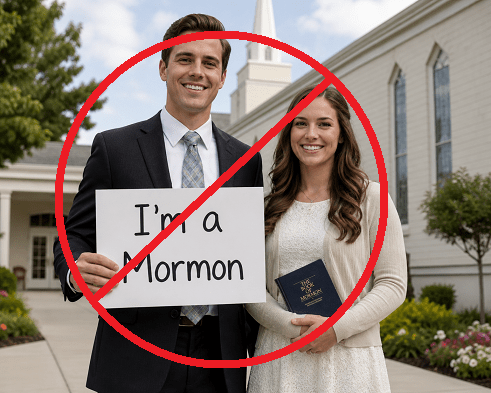
Last week in my post I touched upon being an “ethnic” Mormon. I got some well thought out pushback in the comments saying that because the Mormon Church was expanding outside the intermountain West, and has always sought new members outside the fold, then Mormon really isn’t an ethnic group (at least not yet). Some commenters did say that we could be cultural Mormons, and that made better sense.
It seems an article by Christopher Cunningham in the Meridian Magazine preemptively shot down the idea that I could be an ethnic Mormon, or even a cultural Mormon. Three days before I did my post, he wrote at Meridian:
One of the more confused habits in contemporary Latter-day Saint-adjacent discourse is the insistence that people who reject The Church of Jesus Christ of Latter-day Saints still possess some special claim on “Mormon” identity.
They talk as though “Mormonism” were an ethnicity. As though there were something in the blood. As though having the right grandparents, the right zip code, the right memories of casseroles and church basketball and trek and EFY and green Jell-O and dirty sodas and ward culture means you retain some inherited authority to define what the Church is, what it should preserve, and what it owes the world.
The Church of Jesus Christ is not an aesthetic, it’s not an ethnicity, it’s not a regional brand, it’s not even a culture. It is a church.
It has doctrine, commandments, ordinances, priesthood keys, and covenants. It has admission requirements, and it has boundaries.
For those interested, I recommend you read the whole article at my link above. It is almost like Cunningham read the Wikipedia page for the “No True Scotsman fallacy”, and used that to base his arguments on.
He makes a novel argument about why the Church still cares about the name Mormon when they asked everybody to stop using it. He said that Kentucky Fried Chicken changed its name to KFC, yet you would not be allowed to open a business called Kentucky Fried Chicken. Cunningham goes on to explain why there cannot be cultural Mormons, Why John Dehlin should be sued, and how saying you are a cultural Mormon is a subtle form of racism:
For a church community that is increasingly populated and run by people from Africa, Asia, and Latin America, the idea that people get special say over what happens within the community because of who their grandparents were brings up unfortunate racial problems.
It could appear that the Church PR people asked Cunningham to write an argument for their Dehlin lawsuit. I find it interesting that up until we got a lawyer in the head chair, nobody seemed to care about the word Mormon. Even when the Church was embracing it during the “I’m a Mormon” campaign (2010-2018), John Dehlin was into his second decade of Mormon Stories.
The first comment to the Meridian article was from an LDS raised Cultural Anthropologist, who said the author was wrong, and that she is confident that she (the commenter) has forgotten more about how culture works than this author has ever known.
What do you think is behind this effort to take away my Mormon Culture?


I mean, if we got the Proclamation on the Family mostly because Oaks wanted the LDS church to have standing for him to write an amicus brief in the Hawai’i law on same sex marriage, why wouldn’t Oaks lean on TBM sources like Meridian to write articles that help give them standing to file brief’s supporting the lawsuit against Dehlin.
I guess that would be a more subtle approach than issuing a “Proclamation on the word Mormon” which included statements like:
“We further declare that God has commanded that the sacred name of Mormon is to be employed only by man and woman, lawfully baptized and endowed and with current temple recommends and not by anyone not authorized by the First Presidency such as news organizations or lost sheep…
…We affirm the sanctity of the name Mormon and of its importance in God’s eternal plan…
…Parents have a sacred duty to rear their children to only use the word Mormon for true believers in the Church of Jesus Christ of Latter-Day Saints and not for those who have abandoned their faith to embrace false gods and doctrine, but nevertheless want to acknowledge their cultural past….
…We warn that individuals who violate the appropriate use of Mormon, who abuse the name by adding words like ethnic or cultural will one day stand accountable before God. Further, we warn that the improper use of Mormon will bring upon individuals, communities, and nations the calamities foretold by ancient and modern prophets…
…We call upon responsible citizens and officers of government everywhere to promote those measures that will protect the proper and only the authorized use of the word Mormon.”
To be consistent, the legal minds of Oaks, Christofferson, and Cook should take action against Hulu for “Mormon Wives.”
The author is crazy. If someone has been raised with all Mormon religious and cultural markers, then they absolutely have claim on the description. Even here in the UK being raised Mormon separated me from my English identity, which is still difficult to reconcile, especially since I don’t find the Mormon identity a great fit either.
To insist that someone can’t be Mormon because they don’t tick every LDS church box, and no longer participate, but where they nevertheless feel Mormon because of the way they were raised is downright cruel.
Goodness knows there are enough conference addresses from leaders stating that church should come before any national identity.
What I learned today is that the comments section at Meridian Magazine is not that different from the comment section at Wheat and Tares. Who knew?
Wait, I thought it was a victory for Satan to call yourself a Mormon. Of course there is a distinct Mormon culture among Mormons and being raised in it imbues you with those cultural traits.
Also, the church itself always considers those baptized to be members of its church and is more than happy to count them when it reads its statistics every year.
The church has no special claim to the word Mormon. Its claims against Dehlin are absurd and should fail in court. Their main aim is to legally harass him and make him pay lots of money to defend himself.
The whole thing just feels like a bucket of crabs. Albeit some crabs are huge, medium and small. All of them feel bullied, and all of them will make sure that nobody rises to the top.
By all and any means necessary, pull a little crab back to the bucket that seems to be breaking free. Anyone successfully fleeing makes all the other ones who are left behind poor, helpless victims. Mormonism, Christian Nationalism, White Supremacy to name a quick few.
Well, shocking, shocking, I disagree with Meridian Magazine. [end sarcasm] yeah, I almost always disagree with them. The CoJCoLDS, Brighamite Mormons has always claimed exclusive right to define who and what a Mormon is, at the same time screaming at us not to use that word but the full long tedious name of them, while ALSO claiming the right to define the word Christian to absolutely include them. Why are they the only group of people on earth allowed to define anything? Because they are arrogant, selfish, and think they have a bat phone to God, when they are no smarter or inspired that the rest of us.
Nope, I do not give them the right to dictate how I think. I am a cultural Mormon and they have no more right to tell me I am not whatever kind of Mormon than the born agains have the right to tell them they are not Christian. They do not fit the label “Christian” for about a dozen reasons and yet they want that right by their own personal definition.
We either grant each person/group the right to define themselves, or we do not. If they get to define themselves as Christian because they sort of branched off Christianity, then I still get to call myself Mormon when I have branched off Mormonism. And yet they want to be the arbitrators of all definitions. Nope, and if they are going to go around telling people I am not Mormon, then I get to go around saying they are not Christian.
There are other religions that ALSO have just as much claim to the word “Mormon” as tCoJCoLDS. All of the offshoots of the religion Joseph Smith Started have just as much legal right to the word. How about it really should belong legally to Joseph Smith’s children/grandchildren—and that isn’t the Brighamites. Yes, KFC can still legally claim the Kentucky Fried Chicken brand. But no, the Brighamites have no legal claim to the word Mormon. Joseph Smith forgot to register it as a trademark. It is not and never has been trademarked.
Also, “The Church of Jesus Christ” isn’t even Mormon. It is a registered name of another denomination and yet tCoJCoLDS keeps using that phrase to refer to themselves. Let’s talk about a law suit against tCoJCoLDS for that infringement.
Didn’t this exact same question get litigated a few years ago. Oh, wait until we have a more far right SCoUS. That is just a**hat behavior. Why am I not surprised?
Nationally, the goal of conservative rhetoric is to strengthen boundaries, separate people into clearly defined groups, and then promote hatred and division among the groups. Mormonly, the goal of faithful rhetoric is to widen the gap between the faithful and the lapsed apostates. We, the lapsed apostates, are fine with being called Mormons because it’s a culture and a history, not just a set of beliefs. But the faithful despise us; they’re not like us at all; they would never be so weak. Therefore, we must not be allowed to touch the nickname that they have discarded.
Realistically, what actually happened was Oaks saw that Nelson’s decision to poop on the word Mormon was an utterly stupid decision and he wants to reclaim it. Surely, we all noticed at the last Gen Conf that NOT ONE speaker spoke about The Real Name of the Church? Banning the word Mormon died with Nelson. Oaks knows the word matters, and it matters a lot. This is the way he’s decided to bring the word ‘Mormon’ back into the fold.
Yeah verily, even I say unto you, that the name Mormon shall never depart from this, The Church of Jesus Christ of Latter-day Saints, despite the unforced error made by a prior prophet’s preaching.
I agree that this is nonsense. I remember when the Church still talked about itself in pseudo-racial terms with phrases like “believing blood.” You can’t have it both ways.
I will probably not be clicking into Meridian, so I don’t know if this is addressed at all…but when I personally think of Cultural Mormonism, I am not referring to Utah culture. I am not referring to having generations back of Mormon ancestry. I am not referring to any of that.
My parents were converts, so I don’t have generations of history. I’ve never lived in Utah or Idaho or anywhere in the Mormon belt. I’m “in the mission field.” I am black, so it’s not about race (although…maybe it interacts in an interesting way.)
When i think of Mormon culture, I mean that the religion is a totalizing influence. It is not something that you just do on Sunday for a few hours and then not again the rest of the week. It has its own practices, habits, and vocabulary. And these things stick with you even if you do not believe, or if you stop practicing.
If “The church” as a shortened expression always refers to the Church of Jesus Christ of Latter-day Saints (rather than any number of other churches)…you’re culturally Mormon.
If “deacon” brings to mind a 12-13 year old boy rather than an adult man (or nothing in particular at all)…you’re culturally Mormon.
I was having a discussion with Catholics and protestants on a blog years ago, and they said something that I didn’t get at the time. They said, “You don’t understand what we mean by God”. And I thought, “Just because I’m Mormon doesn’t mean I don’t understand what other denominations think about God.”
…but years later, I realized they were right. Mormonism had shaped my view of what a religion should be, what a church should be, what God should be, that I didn’t realize that other denominations had radically different views of things, and I didn’t view how other denominations or religions did things as “religiously legitimate”. Mormonism has a thoroughgoingly personalist view of deity that cannot really comprehend the classical theism of Catholicism. That is still a legacy of cultural Mormonism. It’s not just how Mormonism views God. It’s how Mormonism entrains people to think that church should be done, how we should relate to ecclesiastic leaders, etc.,
This means that even a Mormon trying not to be Mormon is going to do it in a very Mormon way. Mormons trying to switch to other denominations or religions may need to “unlearn” Mormon ways of thinking and acting. Mormons trying to be secular will need to learn secular culture. There are growing pains to this in the same way that anyone moving into a new culture will have growing pains, but here, it’s a culture within the same country we already live in! (Consider the stereotype/slander of the exmormon who goes overboard with drinking. Consider the stereotype of the exmormon who destabilizes their marriage with swinging/polyamory, etc., I know a lot of believers want to use this as evidence that exmormonism bears bad fruit or whatever, but I think this is evidence that Mormonism produces a type of person who has a certain understanding of morality (that personally, I would say is very brittle and rigid) and when they lose their faith, the load bearing foundation is gone, and the person has to essentially go through a “second teenagerhood” to differentiate themselves. It’s just that there’s a lot more/worse/permanent mistakes one can make at 45 when one has a career, has a family, has obligations, etc., than at 15 when one is in school and is not attached to too many other people)
And here’s the thing…when people leave the church, that doesn’t mean they don’t continue to engage with Mormonism! Obviously, if someone’s family is still engaged, then a person who leaves will need to make a choice every day about “code switching” — do they change their language, their behavior, their mannerisms to flex to each audience? The fact that there *is* such a code switching that can occur tells us there is something *there*. And that something is not dependent on belief or continued practice of the faith. Hence, let’s call it something else…like a culture.
Lots of thoughts on this and appreciative of the comments.
Following the logic of the author from Meridian, Europeans (I know at least one) who became Mormon because of the Osmonds should ask for their money back.
Asking for a friend – can I go to 7-11 and still be Mormon?
I attended church with my mom for her 70th birthday, and all the hymns were instantly familiar. I sat right next to her on Palm Sunday. What surprised me, though, was how much the tone had shifted since the Sunday services of my youth. It was still unmistakably Mormon, but it felt as though church culture is making a deliberate effort to present itself as more traditionally Christian, albeit in a distinctly Mormon way.
The culture and rituals, however, felt deeply familiar. Mormonism is profoundly cultural. If you know what a “munch and mingle” is in a Singles Ward, you’re culturally Mormon. If you understand Ward Ball (basketball), you’re culturally Mormon. If you’ve participated in a Ward Walk-About, you’re culturally Mormon. If you’ve ever responded “Aloha!” from the pulpit to a Polynesian or Samoan speaker in sacrament meeting, you’re culturally Mormon.
You could watch LDS films like Singles Ward, Charly, The Other Side of Heaven, or God’s Army and immediately recognize countless gems of Mormon culture.
With the recent announcement of new names for LDS Young Women groups, there’s also a new wave of Mormon cultural humor online. One TikTok in particular perfectly captures this niche experience.
https://www.instagram.com/reel/DXYc7A6gRtA/?igsh=djB2aHdwdWg2ZGtn
There’s also a Twitter account I follow that jokingly proposed new names for Young Men groups:
Deacons = “Bringers of Bread”
Teachers = “Collectors of Tithing Slips” (though “fast offering slips” would be more accurate)
Priests = “Blessers of Bread”
If you understand why that’s funny, you’re probably culturally Mormon too.
I may not attend church anymore, and I have no plans to return, nor are we raising my son in the church, but I still share aspects of my mission experience with him. We watch The Chosen, I read the Bible to him, and we do what we call “home church”—similar to homeschooling, but for spiritual teaching. I still read him certain scriptures, including passages from the Book of Mormon, and talk with him about the values and lessons they can offer.
I suspect I’ll always be culturally Mormon. After all, I still cheer for BYU over Utah.
There’s a huge difference between Ethnicity and culture. Ethnicity is a social construct to divide us into groups that people can emotionally accept to explain very small differences and justify calling someone else “them.” Culture is also a social construct, but it seems to be able to explain differences better, at least to me, because it’s how a group does something or thinks. The biggest argument against being called an ethnic group is that we are all human. The strongest support for saying something is cultural is the fact that we have differences with other groups.
So are we ethnically Mormon? No, because you can leave the church, and no one would be able to tell. You’d just be labeled with some other ethnic name that’s not really relevant based on the color of your skin, accent, or a host of other things.
Culturally Mormon, you bet. It shows particularly when you are a TMB. But even more telling about Mormon Culture is when you leave the church, you still bring with you mannerisms, attitudes, and beliefs, or can easily slip back into the mold to fit in when you need to socially.
Pres. Nelson tried to take the Mormon out of Mormons, but Mormons are too Mormon to quit being Mormons.
I think when you can say “I was raised [insert high demand religion]” and people then understand better what you mean, then that’s a culture. Call it cultural Mormonism or ethnic Mormonism, whatever. Unlike Andrew S I tend to think of “ethnic” Mormonism as referring to multi-gen Mormons, and yet, it would be wrong if I didn’t refer to my upbringing as completely enmeshed in Mormon culture–is that an ethicity or a strong culture (or as 90% of my non-LDS friends would say, a “cult”)?
If the church didn’t have such a strong culture and such high demands to be an insider in “good standing,” then this argument would not be happening. Personally, I think the lawsuit is specious. They haven’t applied it consistently at all. They are just trying to force John out of business. It’s not a business I would want to be in, but there is a real market for people sorting out their feelings after religion. They just want control total over any dissent–party line over personal experience. Would they be suing him if he said “Ex-Mormon Stories” even though that would not be accurate as many interviewees are still current members?
Over at ByCommonConsent right now, Sam Brunson has an excellent post up about how MMR vaccinations among four-year-olds in Utah have fallen below the herd-immunity threshold of 95%, down to 92%, placing the state in the lowest quartile of vaccine-rates in the USA, which has predictably fueled the state’s current life-threatening measles outbreak. Brunson is rightfully aghast at this development, especially considering that LDS Church leadership has been matter-of-factly pro-vaccine since at least 1932; that getting vaccinated is still a requirement to serve a mission; that getting vaccinated is still official policy in the Church Handbook; and of course everyone here will recall how in 2021, the First Presidency released a statement urging everyone to get the COVID-19 vaccine. Yet in spite of all these official proclamations, it has been precisely in those sections of Utah where Church membership is highest that vaccine skepticism has been most widespread (someone in the comments linked to a Salt Lake Tribune article about how the lowest vaccination rates of all in the state–a staggering 74%–are in the St. George area).
All of which is to say: would Christopher Cunningham of Meridian magazine consider all these LDS anti-vaxxers to still be “Mormon”? He himself states confidently, “[the Church] has doctrine, commandments, ordinances, priesthood keys, and covenants. It has admission requirements, and it has boundaries”, and chief among those all official doctrines, commandments, admissions requirements, and boundaries, is the mandate to sustain and follow the Prophet.” And one of those Prophet-sanctioned mandates is, unmistakably, to get vaccinated. By his own stern logic, these anti-vaxx members have abnegated their rights to still call themselves Mormon.
I suspect that Cunningham would consider such a claim to be a bridge too far, a reductio ad absurdum twisting of his logic. The vast majority of these LDS anti-vaxxers, he might protest, are tithe-payers, temple recommend holders, attend sacrament weekly, active with callings, and etc., and hence he would be loathe to pronounce them non-Mormons. Yet that is precisely the problem: when you state point-blank that all those who have transgressed the boundaries of the Church are now outside of it, then where or why can you stop? How many people do you shove out until there’s no one left? And just to reference the title of this particular website: what makes him so confident that he can tell the wheat from the tares, when the whole point of the original parable is that you *can’t* tell?
@JB
This is a very timely post, and I wanted to comment because I’m a registered nurse living in the St. George area. I was working at Intermountain during COVID, and I remember people in our community protesting vaccines outside the hospital while I was inside caring for patients who were dying. That period of my life was profoundly triggering.
Our decision to no longer participate in the LDS Church came from many factors, but a major one was what felt like the increasing MAGAfication of our ward culture—or perhaps those elements had always been there more than we realized. The growing alignment we saw between LDS culture, Trumpism, white Christian nationalism, and an evangelical-style political identity prompted my wife and me to deeply reconsider what values we wanted our son to passively absorb from that environment.
Ultimately, we decided that while there is undeniable social capital in belonging to a close-knit faith community, it did not outweigh the harmful doctrines and cultural messages surrounding sexuality, purity, LGBTQ individuals, and rigid gender roles.
We had long struggled with many of the more problematic aspects of LDS “Mormon” culture, including pressure to serve missions, purity culture, LGBTQ doctrine, patriarchy, and the lack of full equality between women and men, we often felt that we could be Cafeteria Mormons. But at a certain point we decided that the harms outweighed the good.
One of the more interesting aspects of this experience is that I now find myself teaching my son to have empathy for his active Mormon classmates, even when he perceives them as bigoted or as contributing to harm against marginalized groups. I have to remind him that Jesus said to love everyone, including Mormons and Trump supporters.
“It has doctrine, commandments, ordinances, priesthood keys, and covenants. It has admission requirements, and it has boundaries.”
I think it’s the practice of covenant-making that highlights the church’s boundaries more than anything else. The church teaches that the Lord’s people are a covenant people. And so while the church is happy to have the association of all comers–it must clearly demarcate the boundaries of the covenant.
I understand that those lines can seem really bright at times–but even so, it is imperative that members have clear instructions regarding the terms of the covenant so that the path of repentance is clear as they enter into it and also as they continue to strive to live up to it thereafter.
“If You Are Reading This Blog, You Are Not A Mormon” Take that, Jack =)
“The first comment to the Meridian article was from an LDS raised Cultural Anthropologist, who said the author was wrong, and that she is confident that she (the commenter) has forgotten more about how culture works than this author has ever known.” So many negative visceral reactions to Meridian but this really sums it up nicely while casting just the right amount of shade on the author =)
While I have no desire to maintain any boundaries here, this CAN be an interesting discussion when we move away from binaries. For me, born in the middle of Salt Lake valley in the 80s and 90s, seminary graduate, graduated BYU with a bachelors and masters, eagle scout, served a two year mission, temple married, I will ALWAYS be Mormon and the author can simply pound sand. And. My kids left Mormonism in southern California at the ages of 7, 10, 13, and 16. Will they always identify as Mormon given they weren’t raised in Mormon mecca, didn’t eat green jello each Sunday, didn’t do early morning seminary, etc? One never baptized, two never attended the temple, none ever paid tithing or wore garments. How does it affect them?
To wit, my wife’s siblings left as teenagers. They didn’t do most of these things either. They are still unpacking Mormonism.
Maybe it’s nobody’s business really.
Jack – As a reader of this blog you aren’t Mormon either. The leaders you follow reject the name, and the past. The covenant path is simply obey and pay your tithing. Supposedly the bounds of this covenant are bright and clear but I challenge you to actually define what those are.
If you have to code switch to be understood between inside and outside, it is a culture. When my husband first joined the military and we lived in Air Force culture instead of in Provo Utah, there was an adjustment. In most of Utah, nonmembers know how to code switch to talk to members, but members just assume that everyone knows what a ward is and that “the church” is, well, the church. On this blog, we speak fluent Mormon. When I am with other career military, I speak fluent Air Force. It is a language similar to American English.
Andrew is correct that other religions have very different concepts for God, and a few other words. They also have insider language, and some words mean something quite different than in Mormoneese. In Catholicism, being sick is sin. It is not *committing* sin, but it falls under the umbrella of imperfections that separate us from God, so sin.
I had a weird experience in my social work internship of working for Catholic Family Services. I had to pass as Catholic. Not only did I have to understand the language of Catholicism, but my Mormon upbringing could not show. To be accepted by my clients, I had to pass as one of them. I knew I had succeeded when I was saying goodby to a client and she asked me where I was going that I had to quit. I told her my husband was military and we had been assigned to Utah. She got this horrified look on her face and asked if I knew what it is like living in Utah. She told me some horror stories about Mormons and how they didn’t accept nonMormons. (Ummm, like you are doing just now. By showing prejudice toward someone not like you? But of course I didn’t SAY that.) I had stepped far enough into Catholic culture that even some of my coworkers didn’t know.
You have to experience trying to pass in a different religion to become aware of just how different our culture really is.
So, I know Mormon culture, Catholic culture, Air Force culture, and American culture.
More recently I was having lunch with a bunch of neighborhood (Southern Utah, near St George)women and the new temple in the area had an open house. The ladies were talking about it and asking each other about what goes on in Mormon temples. But they never even looked at me. I was sitting there trying not to laugh, because they did not even realize that I could answer their questions. I am still technically on the rolls of the church and married to an active Mormon. I have known these women 12-15 years and they did not realize I was raised Mormon. Well, most of them share military culture (married to Vietnam Vets) and I know exactly how to step into and out of whichever culture I am dealing with. I code switch. Very effectively it seems.
So, idiots can argue all they want about there only being members (Mormons) and nonMormons. But I know different because I had to learn a whole new culture when I got outside of “Mormon culture”.
Brian:
“Supposedly the bounds of this covenant are bright and clear but I challenge you to actually define what those are.”
I think the most straightforward definition is incapsulated in the sacrament prayers: that we are willing to take upon ourselves the name of the Savior, always remember him, and keep his commandments. For which, if we do, he blesses us with his spirit. That’s the gospel covenant, IMO.
It’s clear than none of us has a clue how important it is to have a seer, revelator, and prophet who can focus on what is really important, bringing the full weight of deep pockets of somewhere around 300 billion dollars to bear on the clear and present danger of John Dehlin. No telling how many he has led astray. Certainly, this shows what Heavenly Father thinks is important. Genocide, war crimes, and capital punishment pale in comparison. Apparently, God doesn’t care about them. But podcasts! And keys.! And shoulders! Well, not shoulders anymore, but podcasts!
@Jack
Those can’t possibly be the boundaries because if I were born eight years ago I wouldn’t be able to be baptized because I was given a nonbinary body.
Sometimes when I read the bloggernacle I think the magafication of the Church (at least along the Morridor) is exaggerated, but this weekend there was an exchange in my aunts-and-uncles’ weekly/monthly family emails that was sobering, and frightening. My uncle, who recently retired from thirty years’ civilian employment with the Air Force, said that my dad shouldn’t describe himself as a “plain vanilla Utah Mormon” because he’s not “a Republican who voted for Trump.” He then wrote a full-throated endorsement of the holy-war theory of the Iran war:
“If you believe President Nelson’s clear statement, “The Lord is hastening His work to gather Israel. That gathering is the most important thing taking place on earth today. Nothing else compares in magnitude, nothing else compares in importance, nothing else compares in majesty”, then you should say your prayers to give thanks that President Trump is the president because his is the only president this century to help facilitate that mission.
Part of gathering Israel involves the missionary and temple work conducted by the church. That is important and the naive pacifist Democratic Mormons can be good tools for that. But some things are too important to be left to the naive pacifist Christians. Jesus himself drove the merchants out of the temple in a very non-pacifist way. Sometimes, the Lord commanded the Israelites to go to war. The part of gathering Israel that is discussed the most in the Old Testament is the literal gathering of the Jews to their ancient homeland. … Iran was on the verge of destroying the gathering of the Jews to their homeland. That was contrary to the Lord’s will and ancient prophecy. Make no mistake that President’s Trump courage in eliminating Iran’s nuclear capability is what was needed for the literal gathering to continue in Israel. … Thank God for Donald Trump.”
So …
According to the extremist Christian right, and to my devout uncle who works in the temple, gives thanks for small miracles and answers to prayers every day, and serves as Gospel Doctrine teacher and ward financial clerk, what God cares about the most today is bombing the shit out of Iran.
That’s it.
That’s the most important thing taking place on Earth today. Nothing else compares in magnitude, nothing else compares in importance, nothing else compares to majesty to … (checks notes) … Operation Epic Fury, aka bombing the shit out of Iran in the most clueless, disorganized, manner possible.
When he spoke in the year 2018 about the Lord hastening his work to gather Israel, President Russell M Nelson wasn’t primarily speaking about the missionary and temple work that “naive pacificist tools” do, he was speaking about … (checks notes) … bombing the shit out of Iran in the year 2026.
My God! Talk about perverting plain and precious truths. I never really liked Elder Nelson as an Apostle when I was a TBM teen and undergrad, and his campaign against the word “Mormon” came right when I was questioning everything in grad school, but I’ll take his talk about gathering Israel in its plain sense about missionary work, temple work, and generally strengthening the Church instead of reading it as a coded message to … (checks notes) … bomb Iran.
Sorry for the threadjack. I just had to get this off my chest somewhere, and a W&T post with this title seemed like as good a place as any. After all, I’m not a “plain vanilla Utah Mormon” by my uncle’s definition of the term.
@Pontius Python: Wow! Literally no words. The level of absurdity that MAGA has taken this current moment to is insanity.
@Jack, those aren’t boundaries they are platitudes. Boundaries imply some rigid, well defined, demarcation. “Keep his commandments” is a constantly moving target.
The common thread between the comments on this post and the previous one are a discussion about what the boundaries are and who defines them. This one is about who is Mormon; the last about who is Christian, and whether Mormon fits in that category.
My problem with this whole line of thinking is that I think religious categories are fundamentally social and cultural, and *not* doctrinal. But it’s a widespread practice, particularly among the most devout adherents of any religious tradition, to impose rigid doctrinal definitions of who they include and exclude from their category. Even then you’ll never be able to get a group of insiders to a tradition to completely agree on the doctrinal boundaries. So I think about how a complete outsider would categorize things. Am I going to get a helpful answer from a Baptist on whether a Mormon is Christian any more than if I ask a Sunni Muslim whether or not Shia are “real” Muslims? If someone is trying to be a Christian “incorrectly” because their church teaches “wrong” ideas about atonement or grace or scripture or authority, what are they? Is the taxonomy of world religion missing categories for “apostate Christian” or “apostate Muslim”? That’s where this kind of thinking leads.
So this all leads me to the following: anyone who would claim a Mormon identity when asked is Mormon. Likewise anyone who claims a Christian identity is Christian. That will include in Christianity a whole lot of people that I personally think are doing a pretty lousy job of following Jesus, but it’s probably for the best that I go no further in trying to get that particular mote out of their eyes.
The success of LDS missionary work in Africa and, to a lesser extent, Asia has forced LDS leaders to think harder about what aspects of LDS life are “Gospel essentials” and which aspects of LDS life are just “Mormon culture” and can be modified or jettisoned. But they haven’t pursued that project with much energy or perseverance.
I think they want to retain a “Mormon culture” envelope around the “Gospel essentials” in Utah and the Mormon Corridor (and elsewhere in CONUS, to a lesser extent) but go with a pared down version of LDS life in foreign countries where the full Mormon package just won’t work.
Of course, the harder you look at LDS life, there’s a lot of culture there and not that much Gospel! If you really cut away all the culture, there won’t be much left.
@jack.
This isn’t primary. The idea that the sacrament prayer defines what it means to be a Mormon is too simple and juvenile. Those vague platitudes are not enough obviously or else the church wouldn’t have all of the correlated manuals and handbooks or hours and hours of meetings with members. Unfortunately I am afraid you represent well the product of those correlated lessons which keeps all critical thinking far from Mormon spiritual life.
Quentin, I disagree with you on accepting the statement of being a Christian as sufficient. Evangelical protestantism is a right wing political movement masquerading as a religion. They bray their identity to the four winds and use that identity to defraud, debase, and destroy our democracy.
How do you tell if someone is Christian? You can tell they by their love…
Brian & Chris,
Let’s not over complicate things. The gospel covenant is straightforward–and it is the means by which we become the Lord’s covenant people. If we have any questions with regard to what the commandments are we can go to our bishop. I’m sure he’d be happy to help us understand what those boundaries are.
That said, we have to remember what Nephi says to those who make the gospel covenant–that we shouldn’t assume that all is done. What follows is the long journey of refinement by which we actually become like the Savior.
Even so, though none of us is yet like the Savior, if we are trying to live up to the gospel covenant we will have a measure of the Lord’s spirit to be with us–as per the sacrament prayer. And herein is how we know that we are generally moving in the right direction.
vajra2, I am going to agree with Quentin, and I respectfully disagree with you on one point: I think that evangelical Christians are Christian. How well they live their Christianity might be a different question, yet we should remember Jesus’ teaching about the mote and the beam. Each of us needs to worry about ourselves before we put labels on, or remove them from, others.
Jack, I would caution anyone from going to his or her bishop for questions with regard to what the commandments are. I think that one would be better served to study it out in one’s own mind, and if inquiring, inquire of many people (see Prov. 15:22, 11:14, and 24:6). My bishop might say that tithing is 10% of gross, but that isn’t the teaching of the church. My bishop might say what I can or cannot do on the Sabbath, but the church doesn’t make lists. My bishop might say that my wife should stay home, but that is no longer the teaching of the church. My bishop might say that I should forgive an abusive spouse and not call the police, but calling the police for a crime is wholly outside of forgiveness. I bishop might tell me what my wife and I must not do when alone, but he isn’t a party to our marriage. Fact is, a bishop might say any number of things, and a bishop in a neighboring ward might say something else. I think it is best to teach correct principles and let the people govern themselves, rather than have bishops dictate the answer to any and every question. If one has questions, let one study, and if one needs advice let one ask many people, and let that person figure it out for himself or herself.
Our current direction is not to use Mormon to refer to the church, or Mormons to refer to its members. We’re supposed to be members of the Church of Jesus Christ of Latter-day Saints. I’m fine with whomever calling themselves Mormons. The FLDS call themselves Mormons, but I don’t see the CoCJoLDS attorneys bringing suit against them. I’m fine with people calling themselves Mormon. In Catholicism, both Jesuits and Dominicans call themselves Catholic, and that’s fine–and in case anyone wondered, they have very different concepts of grace and other matters. There are all kinds of people calling themselves Jews. Muslims come in at least two main varieties who effectively hate each other. I am no lawyer, but I think the Church will lose their current lawsuit on the use of the term Mormon, but they might win on the trademark or copyright issues if it looks like they’re causing confusion. While we’re at it, why don’t we sue whatever producer makes Mormon Housewives? Lots of people see that show and think this is how all members of the CoJCoLDS live.
Could you say I was raised Columbian, raised Thai, or Native American?
I don’t really see it like Mormon.
Jack raises a good point: “What follows [making gospel covenants] is the long journey of refinement by which we actually become like the Savior.” Well, we all know that we won’t become like the Savior in this life, but is that really our purpose in this life. I agree that we should try to become more like the Savior, but that really means doing things that He has taught, such as forgiving others (and He forgives), doing good to others (and He did good and continues to do good), and not judging others (and He came into the world not to condemn the world but that the world through Him could be saved). Is becoming like Jesus in this life the objective? Or is the objective to make His teachings come alive in our individual lives? Maybe those questions are syntactically identical: two ways to say the same thing. But I am not sure, and I’ve haven’t studied it out. How person A makes Christ’s teachings come alive in his or her life might be different from how person B does it, and both might be different from how I do it or how our bishop does it, but are people wrong because they’re making the teachings real in their lives differently? Thanks for the comment, Jack. You’ve given me something to ponder on.
I am curious about why folks think the word Mormon is coming back now that Pres. Nelson is gone? Has it been used anywhere “official?” We are still talking about the using the “correct” name in my neck of the woods.
re: LDS Inc. vs.Joh Dehlin: Lacbes.