
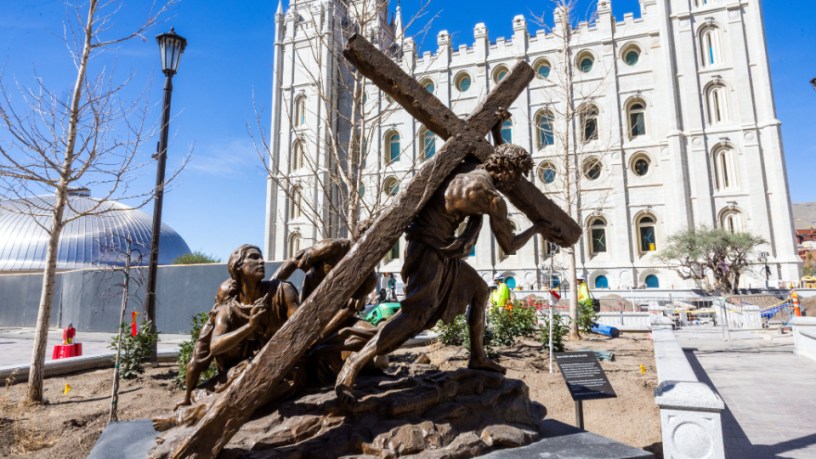
Or, alternatively, is LDS senior leadership pushing the Church more toward traditional Christian doctrine and tradition? Here are a few signs this is happening.
First, the new sculpture placed on Temple Square, as featured in the image at the top of this post. For generations, LDS leaders have disavowed LDS use of the Cross, perhaps the most ubiquitous and powerful symbol in Christianity, in LDS iconography. And now, there it is, a moving sculpture of Jesus and the Cross right here in River City. The rationale for the rejection was a stubborn insistence on situating the key action of the Atonement in the Garden of Gethsemane rather than on the Cross. Yet LDS doctrine also identified the Atonement with the sacrificial act of Jesus, which plainly focuses on the Cross, not the Garden. So perhaps this sculpture indicates a doctrinal movement toward the traditional Christian focus on the cross rather than the LDS focus on the Garden?
Second, and I’m sure you noticed this last month, the LDS calendar has suddenly embraced Palm Sunday. You probably heard a talk on it in church. I gave the “what is Palm Sunday and why are we talking about it in Sacrament Meeting?” talk in my ward. Apart from Easter, the LDS Church has never paid much attention to Holy Week, from Palm Sunday to Good Friday to Easter Sunday. On the LDS calendar, it is overshadowed and sometimes even displaced by General Conference. If they at some point take the bold action of actually moving General Conference back a couple of weeks to not interfere with Easter Sunday, then you’ll know it’s a real thing. Imagine that, putting more priority on the annual religious commemoration of the Crucifixion and Resurrection than on a big meeting. Sounds pretty Christian to me.
A few other changes: Somewhat more collaboration with other churches. Putting Amazing Grace in the LDS hymnal. Taking the first steps away from the King James Version and approving, even encouraging, the use of modern bible translations for personal study.
- So, is the LDS Church moving toward mainstream Christianity?
- Does this also signal a move away from fundamentalist thinking and doctrine?
- Any other changes you have noticed?
- What might the next change or two toward mainstream Christianity or traditional Christian doctrine be?
.


Our ward emailed daily devotional essays out each day for Holy Week. Another actually passed out palms on Palm Sunday. I think there has been a populist movement on the part of members towards adoption or adaptation of some Christian elements.
Yes. I absolutely believe that they are moving towards Mainstream Christianity; at a very rapid pace. (A Note of Interest: Jeff Strong – TORN “Why People We Love are Leaving the LDS Church; and What We Can Learn From Them”. Interesting presentation and Discussion)
Here in the UK, it was my understanding that we’ve always been Christian, if not in the aggressive US evangelical sense (but hey, they don’t think Roman Catholics are Christian either). But who gave them the right to make that determination anyway.
I grew up with Palm Sunday, Good Friday, Easter Sunday. But they are baked into our national calendar. Perhaps a large portion of UK and European members are part of this populist movement Anon is referring to.
I have always been very annoyed when general conference fell on Easter Sunday, but this year especially so after we’d all been encouraged to make it such a big event last year. Having a big event on Palm Sunday instead really didn’t work for me. And it looks so odd to anyone we might be encouraged to invite. I refused to play trumpet fanfares for Easter Sunday hymns on Palm Sunday. My whole soul revolted at the suggestion. Celebrate Palm Sunday on Palm Sunday and the resurrection on Easter Sunday. It’s weird enough to spend so much time on the atonement and sacrifice on Easter Sunday, that’s Good Friday stuff folks, but to try and celebrate everything a week early….
If we aren’t going to follow the local calendar, might we not just select a fixed Sunday in March or April as the LDS Easter festival. Shifting the celebration about to accommodate general conference just feels really disrespectful.
Of course, here in Utah, the most open manifestation of our sudden TradChristian push was the Utah legistative body’s passage of a law making Good Friday a state-sanctioned semi-holiday (employees of the state only get a half-day paid vacation). Proposal of such an obviously orthodox-Christian law would have been unthinkable only a few years ago, but this year it passed with little debate and by a considerable margin (57-9 in the House). A KSL report on the bill stated “Along with making Good Friday a legal holiday, SB193 also asks school districts and higher education institutions to prioritize planning their breaks around Good Friday and a number of other state holy days that were put into law last year .”
Yes, but the Church remains tethered (would some say chained?) to certain doctrines or practices that will keep it from fully embracing mainstream Christianity so long as they remain. Among those are rejection of the Trinity (even if your average Trinitarian Christian struggles to explain it and often confuses it with modalism), the idea that Church is the only true church (and with it the active proselytizing of fellow Christians), the endowment with its adaptation of masonic modes of instruction, and the Book of Mormon (and really any sort continuing canon). There are probably other deal breakers that I’m missing. We’ve taken steps toward mainstream Christianity, but the idea that we’re most of the way there to being a mildly unusual but basically Protestant church is overblown.
My biggest objection to the church and Christianity is that temple and tithing and WoW always seemed to be more important than Jesus. But WoW has at least seemed to drop back from when Donny and Marie were such special youth because they refused to drink or smoke. But it has kind of been replaced by increased importance placed on Covenant Path. But yes, the church is trying to put a bit more emphasis on Jesus. To me, they are not to the first J in Jesus. They are still way, way over emphasizing that you need temple to access the atonement and of course you have to buy your way into the temple.
We are still a “works”based religion. No where in Mormonism is it taught that all you need is the atonement. No, first you need baptism, endowment, marriage ceremonies done by authority. We are worse even than the “horrible” Catholics who say you need baptism to make it back to Gods presence. We think you not only need baptism, but a bunch of other things other *men* do for you. All the ordinances that human males do for us. Second you need to live your covenant path. Third, if you make it that far is that Jesus will step in and cover the sins you couldn’t help but commit. We are really into you are saved by Jesus AFTER all you can do. And you better do it ALL. Not you are save by Jesus in spite of all you think you did. We think we just need a little nudge over the finish line and that we do 99% of the saving of ourselves. After all, Jesus did it all for free and the church needs plenty of cash, so the church needs to be needed. So they have made the “proper authority” into a HUGE deal and added in a few fancy ceremonies that other men have to do for you because Jesus isn’t enough. Bah. We have so far to go before we are really Christian and all we need is Jesus that I do not even wonder why the born agains insist we are not even Christian. We have added in so much that we humans do for ourselves that we hardly even notice Jesus.
But, yes, I welcome the fact that we have made it to J.
Yep. I think it is partly coming from the members (the other member driven change is the change in modesty culture), but also from Church leadership. It’s interesting to see what the Church is pushing in its missionary outreach, and it seems like they are focused on presenting a vaguely non-denominational vibe. IDK how that will not feel like a bait-and-switch when people eventually get to the Mormon specific parts, but that seems to be the Church’s new approach. I guess it will work better than the old approach, I served my mission 15 years ago in the US and nobody cared about the Church’s “special message” (claims of authority, prophet led church, other scriptures, etc.)
Thanks for the comments, everyone.
Hedgehog, that’s the word I was looking for … disrespectful. For all the rah rah Easter posts and comments at LDS.org and at Conference, displacing or replacing Easter with a big meeting is just disrespectful to Easter and to Jesus. It’s another win for Satan.
raymondwinn1941, I hadn’t heard about the Christian holiday push in Utah. Sounds like LDS tagging along with White Christian Nationalism again.
Not a Cougar, those are good examples but I think they show more Christian mainstreaming. LDS temple presentation has recently moved further from its Masonic roots and is now (surprise!) all about Jesus. LDS rhetoric tries to sound Trinitarian, and most LDS can’t tell the difference anyway. And the Book of Mormon is often called by LDS materials as inspired (in the hand-waving general sense) rather than being described as literally translated. Same trajectory as the Book of Abraham.
Anna, Pres. Uchtdorf did a lot to bring the term “grace” into the LDS discourse, which alone has moved LDS thinking from 99% works to maybe 85% works. Baby steps.
Zwingli, I wonder if the US-focused missionary message/curriculum is different from what is presented in South America or in Africa?
I see signs that the church is moving towards mainstream Christianity such as more emphasis on the Savior and less on Joseph Smith, acceptance of the cross, changes in the design of garments which implies a more moderate approach to the purity culture, and giving more space to the concept of grace. If this is in fact the case, why can’t they just tell us what the objective is rather than leave us guessing. Do they think members are not developed enough to process this information? I expect that if they explained what the objective is and asked us to help, the majority of us would help.
Some of us believe that while the Church holds a unique covenant structure with restored priesthood authority, God’s work is primarily with the rest of the human family. We need to recognize that God’s light and inspiration are present among all people and faith traditions. This perspective affirms scriptures like Book of Mormon teachings that “the Spirit of Christ is given to every man” and recognizes that sincere worshippers in other faith traditions are genuinely responding to God according to the light they have. Rather than viewing other churches as deficient, this approach sees the entire human family as participating in God’s ongoing work, with the Restoration providing a covenant structure rather than replacing all prior faith. Such a perspective could contribute to the percieved movement within the Church toward greater openness and respect for traditional Christianity, fostering cooperation and mutual understanding through a shared focus on Jesus Christ. Over the last decade I have heard several LDS theologians teach an LDS version of “Social Trinitarianism” and contextualize elements of what we call “exaltation” to make it comparable to what is taught in Orthodox Christianity. I don’t know if absolute congruency will ever be achieved, but this approach is more honest and loving.
This broader perspective offers significant benefits. It fosters humility. We should recognize the great souls and teachings found in other faith traditions. It reduces ethnocentrism and suspicion. It encourages meaningful cooperation between church members and those of other faiths. It also creates a more welcoming environment for converts and friends of the Church, who can honor their spiritual histories rather than feel they are being asked to reject them. I believe this view aligns closely with Restoration scripture by affirming that God’s light reaches all people; it presents a God who is consistently loving, just, and active throughout history, rather than selectively present. As a result, faith becomes more resilient and intellectually coherent, especially for younger and questioning members, because we can acknowledge goodness and inspiration wherever it appears. Artifical boundaries between people, created by policy or tradition really need to just go away.
In case any non-Mormon Christians come wandering by here and see Anna’s assertion that in Mormonism “you need temple to access the atonement”, please understand that she wrong in that assertion. In Mormonism, you (meaning living people) need the temple to access exaltation, which is an entirely different process.
Admittedly, the Church has done a terrible job of distinguishing between the two. We have Russell Nelson’s teaching that “salvation is an individual matter, but exaltation is a family matter”, but nobody has ever expanded on what that means (probably because it implies a collectivism that most members and GAs are uncomfortable with). Dallin Oaks has also been very clear that salvation (meaning using the atonement to avoid having to suffer for your own sins) is different than exaltation (the stuff about becoming like God). But his formulation still leaves room for what I perceive to be the dominant (and incorrect) line of thinking among the members on the matter; i.e. that the exaltation process is just a more intense version of the individual-focused salvation process.
When it comes to our deceased ancestors, Anna’s assertion is closer to being correct—their access to the atonement is dependent on proxy baptisms that are performed in the temple. But I am not troubled by that, given that the rest of Christianity has made no accommodation for dead ancestors at all.
Of course the fact that the concept of exaltation is part of Mormonism will always set us apart from the rest of Christianity. If the “Christianization” of Mormonism means abandoning exaltation as a doctrine, then the Church will have rendered itself irrelevant. (I haven’t seen any post-pandemic version of the temple ceremony, but what I have read makes me fear that we have started down that path.)
Part of something I wrote in November touching this topic:
Some may recall hearing Pres. Gordon Hinckley describe in 2002 efforts to simplify the functions of the Church:
“[. . .] we know that the administrative load is very heavy on our bishops and stake presidents, as well as some others. An awareness of that fact has led the Presidency and the Twelve to hold a number of meetings, some of them long and interesting, in which, in effect, we have taken the Church apart and then put it together again. Our objective has been to see whether there might be some programs we could do away with. But as we have analyzed these, we have not seen much that could be dropped. To drop one is like giving away one of your children. You haven’t the heart to do it. But I wish to assure you that we are aware of the burdens you carry and the time you spend. In this priesthood meeting I wish to mention a few of the items we have discussed. I think you will note that we have made some progress, although it may be small.”
A future prophet was prepared who lacked Hinckley’s sentimental attachments and sense of collegial collaboration, an iconoclast who could clear out the clutter of laurels, pageants, priesthood meetings, and “Mormonism” (so called). A curious contradiction though was that Pres. Nelson was drawn, and drew the Church with him, to even older traditions of the Catholics. He decided Easter should be a bigger thing among the latter-day saints, and that Holy Week should be a thing too. In 2023, General Conference coincided with Palm Sunday, and the Deseret News reported:
“A record for mentions of Palm Sunday”
[. . .]
“The mentions of Palm Sunday were striking.
In fact, leaders mentioned that day 20 times on Sunday. That’s one more time than that exact term had been said in general conferences in the first 192 years of the gatherings [. . .]”
Last week there was reporting on progress with renovation of the Salt Lake temple, and a photo of the new pavilions north of the temple struck me. The photo left me wondering counterfactuals: If Russell Nelson’s immediate predecesors in the Quorum of the Twelve had all died five years earlier, which was very possible considering the advanced ages he and they reached, would we now find crosses on the interior and exterior of chapels of the Church of Jesus Christ of Latter-day Saints? Such did not happen, so through experience we learn just how much Catholic style the Church of Jesus Christ of Latter-day Saints was supposed to adopt.
The photo mentioned above:
https://www.sltrib.com/religion/2025/10/31/large-crane-is-removed-salt-lake/
There has been a subtle cultural shift underway in the church for a while now. Reversals of past rejections of mainstream Christian ideas such as specific symbols and holidays are just one symptom of this. A few years back I wrote this analysis of use of grace and works-oriented words in general conference over time, including a breakdown by speaker, which I think is relevant to this discussion:
https://qhspencer.github.io/lds-data-analysis/grace/
The specific methodology is outlined in the article. The key trends are (1) a small increase in works-oriented words during the period of about 1985-2015, followed by (2) a significant shift away from it and toward grace-oriented words beginning in 2015, to the point that grace-oriented words now surpass works-oriented words. (The plot is cut off in 2023 when I wrote it, but the trends have persisted and even intensified since then.) It appears this has been heavily influenced by the composition of the apostles, with a handful of works-oriented thinkers being replaced by grace-oriented thinkers resulting in a fairly dramatic shift in the rhetoric in the space of a decade.
What does this mean about crosses and Palm Sundays and such? I think we have a new generation of leaders who are more open to these ideas than the Hinckley/Monson era (which goes exactly back to around 1985 if you include their time in the first presidency running the church on behalf of incapacitated presidents.) I also hear a lot of talk from the grassroots about people wanting this as well. I think we’re in an era when the members want this, and we have leaders willing to go along. I think this is genuine and not just about PR to help the mission program. And yet, I confess even though I like all these changes, it’s still a little jarring after a lifetime of us rejecting them.
Ways in which Mormons are already Christian: They worship white Jesus, they support MAGA, and they simultaneously oppress the marginalized while screaming they are being persecuted and marginalized.
Ways in which Mormons are becoming Christian: Pretending to care about Easter, supporting the cross jewelry industry, and making garments more like underwear.
Ways in which Mormons will never be Christian: Calling Jesus and Satan brothers, works-based theology, and polygamy.
Dan McClellen notes that the more Mormons try to act like “brothers” to
Evangelicals, the harder
Evangelicals work to keep them out. He calls this “boundary maintenance”—the “stepbrother” is trying to join the family, but the
“biological” siblings
(Evangelicals) are constantly checking the locks.
In that conversation, Dan McClellan and Ben Park discuss how the LDS Church is currently navigating a “rebranding” to appear more conventionally Christian
(Jan 2026 discussing the KJV).
The same goes for MAGA Mormons- they will never be accepted by the Mike Johnson Christian Nationalist types!
The leaders are wannabe Christians now. But the members, who still believe crosses are evil last time I checked, haven’t gotten the memo.
I remember not too long ago when Russell Nelson met the Pope himself. The Pope had a wry grin on his face in the picture with Nelson as if to communicate, “am I really making the right decision by meeting with this guy? Not too friendly now.” In his trip, Nelson thought it would be funny to take a picture with a statue of St. Peter appearing as if he were the Hamburglar taking the key in his hand.
The church wants to appear more mainstream Christian-ish, but this is nothing more than a thin veneer beneath which is mostly the same old Mormonism we’ve always known.
As the world has become more open to alternative ways of interpreting the doctrines of the Bible the church has been able to find a place within the ever widening field of acceptable Christian belief systems. It is a step towards coming out of obscurity–so to speak–and who knows but what as the world becomes less believing the church may become the flagship for all who believe in a literal Jesus.
Oh the irony–that for so long the church has been viewed as a community of heretics who believe in a strange God that has no resemblance to the Gods of the Bible–only to become the fiercest defender of who and what the Savior actually says he is in the Bible.
The LDS church fails Christianity in at least two ways:
#1 It teaches that salvation is gained through temple ordinances and this means the LDS corporation ultimately controls who is saved.
#2 It places leaders superior to the members while preventing members from holding leadership accountable. Observe that in the church organized by Joseph Smith the members were given rights and the means to hold leadership accountable. That no longer exists in the LDS church.
The Gospel taught in the LDS church is very Christian and clearly LDS accept Jesus Christ as their Savior. So at a personal level, LDS are Christian. But as a church there are significant departures.
Well, it seems that my earlier comment was not very popular, but in case some of the down votes were meant to punish me for being mean to Anna, I will balance that out by being mean to Disciple for committing the same error.
The Church does NOT teach that salvation is gained through temple ordinances. If you, as a living person, follow the principles and ordinances listed in the 4th Article of Faith, you will be saved (meaning you will not be punished for either your own sins or for Adam’s transgression). That can happen even if you never set foot in a temple. The Church DOES teach that exaltation can only be gained through temple ordinances. I won’t repeat my rant about the difference between the two concepts here.
It is true that dead people can only be saved through temple ordinances. But saying that the corporation controls which dead people get saved is true only in the most technical sense. Anybody, regardless of current recommend status, can submit a name for temple work. And no attempt is made to determine a dead person’s worthiness to receive the ordinance. Sure, the Church can decide to withhold proxy baptisms from certain dead people, but has only done so in the case of Holocaust victims and celebrities—not because they suspected the person didn’t pay tithing.
As for Disciple’s second point, I don’t quite agree with that one either. Joseph Smith insisted that there was a mechanism for holding him accountable and he was, in fact, hauled before councils to answer for his conduct. But the councils always backed down. None of them had the cojones to actually impose discipline on him. So I think the modern Church just decided to do away with the charade.
I disagree with Lastlemming’s assertion that in LDS theology temple access is not access to the power of the Atonement. In LDS theology, the Atonement of Christ is the central saving act that makes ALL ordinances effective. Yet in his response to Anna’s comment that “you need temple to access the atonement”, lastlemming states that persons “need the temple to access exaltation, which is an entirely different process.” Lastlemming seems the believe that salvation requires the atonement, while exaltation and temple ritual does not.
As I understand it, the LDS temple endowment is a ritual that teaches, symbolizes, and helps individuals enter into covenants that rely on Christ’s Atonement for their efficacy and meaning. The endowment ceremony presents a symbolic narrative of human life. At its heart is the idea that humanity cannot return to God without repeated interventiosn of divine help, which comes through Jesus Christ. If the power and efficacy of the Atonement is not part of LDS temple ritual, why is the ultimate goal symbolized in the endowment ceremony entry into God’s presence? Isn’t the goal of salvation and exaltation to be “at-one” with God? This is only possible because Christ bridges the gap caused by human limitations, sin and death. In the endowment narrative, people only gain that access to God through Jesus’ Grace, which exists because of the Atonement. Whether you fully agree with LDS theology or not, the endowment narrative and temple ritual are rooted in L:DS teachings of the Atonement.
We seem to have an emerging debate on two points that put Mormonism outside mainstream Christianity: the role of “extra” temple ordinances in salvation, and the place of human authority figures in the church, brought up by A Disciple.
On the role of temple ordinances for salvation, lastlemming makes a distinction between salvation and exaltation. I would say that as a matter of doctrinal teaching that is technically accurate, but I also think that in the minds of most members of the church, exaltation is the objective and falling short of it feels to them the equivalent of a mainstream Christian feeling they are falling short of salvation. I very much dislike the practice of some Christians drawing boundaries around who gets to call themselves Christian, but personally I’m quite willing to admit that this particular aspect of Mormonism puts us well outside the mainstream, and attempts to split doctrinal hairs over definitions of salvation aren’t going to change their minds.
On A Disciple’s second point about human authority and not holding it accountable, I don’t like it either but I don’t see it as being unusual among Christian churches. Aren’t many other denominations struggling with the same problems? Of course Christ would want us to do better, but I just don’t see our struggles are particularly unusual. I guess I’m seeing “mainstream Christianity” as a social construct here rather than one of doctrine or practice. Our doctrine does put us out at the edges for sure, but our organizational practices don’t as much in my view.
Dave, I guess we will have to agree to disagree on the Book of Mormon. Regardless of whether LDS leaders are backing off the literal translation aspects of the Book of Mormon, the Church absolutely holds it up as canonized scripture comparable to the Bible in importance and holiness that contains at least some literal history of Christ’s dealings in the Americas in it. That is anathema to every Christian denomination not associated with the Restoration. Unless and until the Church begins to distance itself from the Book of Mormon (something that I cannot see happening in the remainder of the 21st century), that alone will keep the Church from truly embracing (and being embraced by) mainstream Christianity.
Lastlemming, YES, I know that technically there is a difference between exaltation and salvation. But in Mormon theology the two get smeared into the same thing because supposedly all of us are trying for exaltation. After 70 some years of Mormonism, I do think I know the official doctrine. And there is way too much emphasis on the temple and covenant path and way too little talk about Grace and how the atonement is really ALL we need to make it all the way back into our Heavenly Father’s presence as Jesus specifically told us. THAT is real Christianity. Not some stupid thing called exaltation that is different than what the atonement bought for us. Mormonism is NOT Christianity when it teaches about exaltation because Jesus said all you need is to take on his name and have faith in him. All you need is the atonement THAT is Christianity. The “need” for the endowment is added on top of Christianity. It is not Christianity.
Maybe this discussion comes down to how we actually talking about “mainline Christianity” or “real Christianity” or are Mormons really Christian if they believe in “exaltation” being a different thing than “salvation.” In Mainline Christianity there is no such thing as Mormon exaltation. There is only salvation as Mormons define salvation. If we are trying to make the discussion to be about “real” Christianity and we believe only Mormons have “real” Chiritianity, then of course Lastlemming is 100% correct.
But I thought we were talking about is the Mormon church moving toward “mainline Christianity.” And under mainline Christianity there IS no distinction between exaltation and salvation so Lastlemming is 100% wrong. He is applying Mormon only jargon to mainline Christianity and of course that is not what they teach. Protestants simply do not believe there is any such thing as “exhalation” where we will happily practice polygamy and the men will become gods and the women will belong to a huge harem. I don’t believe that either because I no longer believe in Mormon specific doctrine. So, until Mormonism gives up Mormon specific doctrine, it will never fit into Mainline Christianity. Yeah, we all know that. And I see them emphasizing the temple stuff MORE, not less.
Quentin,
The debate over what number and types of “sacraments” are required for salvation has been debated within Christian since the Middle Ages. Ask a Catholic and the answer is seven. A Lutheran would respond with “two.” Denominations on the Calvinist end of the spectrum would declare “none,” the sacraments are just reflective of the faith that saves. Orthodox Christians believe that baptism, Chrismation and the Eucharist are foundational to Christian practice. My point is that there is considerable variation within Christianity.
I think a fair comparison can be made between the LDS temple endowment and the Eastern Orthodox Christian description of the sacraments as being a process of theosis (becoming united with God and sharing in God’s holiness). For most Christians, that is very similar to how they view the effects of the Atonement. It is becoming united with God. I think we LDS have stepped way beyond the mark with the explanation that exaltation is separate from salvation and involves becoming a deity independent of the Trinity/Godhead. (We’ve all heard iterations of it, with an exalted man and his wife or wives out on the frontier of the universe populating their own worlds.) Does anyone really believe that they are destined to become a god independent of God? Or is Oneness with the Divine the ultimate destination?
Ok, great. We got some useful comments. Allow me to respond.
First, Anon takes the discussion in a different direction than Anna and Quentin, so I will quickly address his comment first:
Lastlemming seems the believe that salvation requires the atonement, while exaltation and temple ritual does not.
Salvation is a prerequisite for exaltation, so in that sense, the atonement is necessary for exaltation. How the atonement plays into the exaltation of saved people, however, is a different question and I don’t have an answer yet. But it definitely plays into individual salvation without requiring temple access, so I stand by my assertion. Moving on…
From Quentin: but I also think that in the minds of most members of the church, exaltation is the objective and falling short of it feels to them the equivalent of a mainstream Christian feeling they are falling short of salvation.
From Anna: I know that technically there is a difference between exaltation and salvation. But in Mormon theology the two get smeared into the same thing because supposedly all of us are trying for exaltation.
I basically agree with both statements, but I am unwilling to adopt what the members are feeling as a substitute for Church doctrine. Being saved from having to suffer for your own sins is what most Christians want and is a big deal in its own right. The process by which Mormons believe that it is achieved is different from the process that mainstream Christians believe that it is achieved. Those differences are worth highlighting. But the temple is NOT one of those differences. It has no bearing on whether or not we (as living people) will suffer for our own sins. Anna’s correct statement that “Protestants simply do not believe there is any such thing as ‘exhalation'” is itself a good argument for conducting at least part of the analysis on turf we have in common, namely salvation from the consequences of sin.
From Quentin: but personally I’m quite willing to admit that this particular aspect of Mormonism puts us well outside the mainstream, and attempts to split doctrinal hairs over definitions of salvation aren’t going to change their minds.
From Anna: The “need” for the endowment is added on top of Christianity. It is not Christianity.
Again, I agree with both statements and am at a loss as to how my comments (particularly “Of course the fact that the concept of exaltation is part of Mormonism will always set us apart from the rest of Christianity.”) could be interpreted otherwise.
The New Testament talks about a salvation through Christ’s sacrifice at Calvary that leads to us becoming co-heirs with Christ to all that the Father has. It is the adoption of sons, not of slaves or servants. You might call this salvation exaltation, or might say that it is not exaltation. The salvation that people seek is that of becoming a joint heir with Christ, period. The salvation in the telestial kingdom of murderers, liars, and adulterers is not the salvation of being a joint heir with Christ. So please, can we not say that salvation (terrestrial or telestial kingdoms) is wonderful and is what we seek? That’s not the salvation that I seek. Salvation is to be an heir with Christ, a joint heir or a co-heir with Him.
When the Church sells off the Garden of Eden in Missouri, I will be convinced of this Christian pivot.
Friends,
If you haven’t read Stephen Robinson’s book “Believing Christ” you are missing the opportunity to truly see the simple Gospel of Jesus Christ that, in my opinion, we should and can believe. His “Parable of the Bicycle” is a perfect example of the Atonement. This excerpt is an example of Robinson’s take on “Believing Christ” given as a discussion between a sinner and the Savior:
But why would You do this for me?
Because I love you.
But it doesn’t seem fair.
That’s right. It’s not fair at all—it’s merciful.
It is, after all, a gift.
But how can I possibly deserve such a gift?
Don’t be silly. You can’t. You don’t. This gift
is offered because I love you and want to
help you, not because I owe it to you
But how can I ever repay You?
There you go again. Don’t you get it yet?
You can’t repay me, not you or all the billions
like you. Gifts of this magnitude can never
be repaid. For what I’ve done out of love for you,
you can only love me back, and seek to become
what I am—a giver of good gifts.
And that is good news
You can read “Believing Christ” here:
Click to access Believing-Christ-by-Stephen-E-Robinson.pdf
Cheers Friends!
17RRider, that parable of the bicycle is simple Christianity.
Mormonism has tacked a whole bunch of additional things on top of Christianity. There is NOTHING Christian in the Mormon temple. Sorry, no matter how much they claim it is all symbolic of Christ, it really is not. It is added on top of Christianity. Jesus does not require secret hand signals in order to recognize us. He knows his sheep and he employs no servant at the gate. So, just where do Mormons get off saying the endowment is required to attain “all that Christ has”? Or return to the presence of our Heavenly Father.
All the other Christians that I know believe they will be with their family and loved ones. They may not think they will be making babies but they believe and trust that a loving God will not keep them separated from spouses or children. Mormons are the only ones I know of who are afraid their loved ones who are not murdering thieves will be separated from them because of not getting a few words said over them. Most do not even think baptism is so necessary as to keep loved ones from heaven.
Mormons have additional things you have to do in order to become heirs to all that Christ has that are tacked on top of Christianity. And we changed a few definitions. When my born again friends talk about salvation they are talking about being in the top place, with Heavenly Father and having “all that Christ has”. Whether we call “all that Christ has” salvation like most Christians do, or redefine “all that Christ has” to be exaltation, we are still redefining terms and adding things on top of the requirements of Christianity. Not mainline Christianity at all but some other animal. Jesus and the atonement are in addition to all the requirements of Mormonism. Until we get rid of all the additional junk, we are not Biblical Christians. Baptism is the *only* thing that the New Testament says is required.
Some people seem to like that we Mormons have this thing called exaltation that is better than just salvation. Maybe Lastlemming is one of them. At least he has admitted it is not even a concept in mainline Christianity, but he still seems confused why so many Mormons are confused. So, let me explain. Many Mormons are confused because the top leaders purposely obfuscate doctrine that is the opposite of Christian. Like that we changed the definition of salvation and made it less than the Bible says it is.
But the New Testament definition of salvation seems pretty good to me, because I really do not want Mormon defined “exhalation” anyway because being 254375th wife of a god that I have babies for just doesn’t sound too great to me.
Simple Christianity and simple salvation and inheriting all that Jesus has and returning to my Heavenly Mother and Father (or one non gendered God and we all become ungendered.) is all that I want.
All the extra stuff Mormonism tacks on top of Christianity makes that bicycle parable kind of unbelievable.
Is the LDS Church moving toward mainstream Christianity?
I’d have to say no simply because what is mainstream Christianity? The majority of Christians in the world are Catholic, Orthodox (Greek, Russian, etc), or in a Protestant denomination that is a lot like Catholic or Orthodox. When our country was founded, the main Christian religion was Anglican, and the Baptists and other “evangelical” religions at the time were a minority, happy about the separation of church and state. They remembered all too well how they were treated in the “Old World.”
But over the last 250 years, the more traditional versions of Christianity have been giving way to the Evangelical side of Christianity. There has also been the creation of new “American” versions of Christianity, like 7th Day Adventists, Mormons, and Jehovah’s Witnesses. There are also many divisions within the Evangelical movement. We could just look at how many different versions there are of Baptists or look at the Pentecostal churches.
Again, I’d say no because Mormons are not moving towards traditional Christianity like Catholic, Orthodox, or even more established Protestants. It does seem to be moving towards Evangelical Christians, though, which I find very interesting because they will never accept Mormons. I think it goes back to the question Joseph Smith had about which of all the religions was right. He wasn’t looking at the traditional parts of Christianity, but at the fractured, scabbling, Evangelical side of Christianity. That’s where he was rejected but then the same people also rejected Catholics, Jews, and the Church of England (Anglicans).
Finally, I think the average Mormon has no idea about any of this, but the leaders, having tasted the wealth of the masses, are striving to copy what has made Evangelicals so rich. They have also been very successful doing it, but like new money tries to make peace and be accepted by old money, they are working really hard to show how much we all worship the same God. The average Mormon just raises their hand to sustain.
I also want to ask a question: how many of us have Pope envy? Mormons are definitely not moving in that direction in how they choose a prophet or in how a prophet speaks.
“All the other Christians that I know believe they will be with their family and loved ones.”
Anna, I think that’s what a lot of folks intuit–it’s what they want to believe. But I’m not convinced that the prevailing Christian theologies really look like that. They seem to be more like Dante’s Inferno–where virtuous unbelievers are stuck in the top of the bottom or the bottom of the top.
“Simple Christianity and simple salvation and inheriting all that Jesus has and returning to my Heavenly Mother and Father (or one non gendered God and we all become ungendered.) is all that I want.”
Inheriting all that the Savior has is essentially to receive all that the Father has–which is to have power to do all things (within the scope of all that is doable). And in order to receive such power our souls must not only be cleansed by the Savior’s atonement but enlarged as well. And herein is the purpose of the temple ordinances: to prepare us to receive all that is necessary to become like our Savior–for the simple reason that we cannot inherit all that he has without becoming like him.
That said, I understand how certain aspects of the temple can seem strange and even off-putting at times. Even so, as Hugh Nibley said in so many words–we don’t despise the symbols because of their weakness. Rather, we seek to understand the truths that they enshroud. And I can say for my own part that since I’ve begun to see those truths for what they really are I’m so very grateful that a Loving God would condescend to share–or at least open the way to receiving–his knowledge with his children by means that are familiar to us in our weakness.
I struggle to see the theological value in drawing a sharp distinction between “salvation” and “exaltation,” except insofar as it creates a kind of layered system of spiritual outcomes that feels more institutional than scriptural. Once you introduce exaltation as something higher, fuller, or more complete than salvation, it inevitably diminishes salvation itself. It reframes what has historically been understood in Christianity as the central, all-encompassing gift of Christ into something partial—almost provisional.
That shift has real implications. In traditional Christian thought, the Atonement is not a baseline entry point into a tiered afterlife; it is the decisive, sufficient act that reconciles humanity to God. Salvation isn’t merely “being spared” from punishment or granted continued existence—it is union with God, fullness of life, and participation in His promises. When salvation is reduced to something like “having a heartbeat” eternally—existing but not fully inheriting—then the Atonement itself starts to feel diminished, as though it secures only the lowest rung of what God ultimately intends.
By contrast, the New Testament language consistently points toward a present and expansive inheritance. When Jesus speaks in the parable of the prodigal son— “all that I have is yours”—He uses present, not future, language. The relationship itself is the inheritance. Likewise, Paul describes believers as “co-heirs with Christ,” not as candidates for a higher tier contingent on additional ordinances or qualifications. The emphasis is on what has already been given through grace, not what must still be attained through further steps.
The concern, then, is not just semantic—it’s relational. A framework that places the fullness of eternal family, divine likeness, and complete joy behind additional requirements risks introducing a kind of conditionality that feels at odds with the radical generosity of the gospel. It creates a scenario where someone might be “saved” yet still experience a sense of loss or separation—wishing they had done more, attended more, or received the right ordinances—so that relationships formed in love are not ultimately sustained.
That tension raises an important question: if the Atonement is truly sufficient, why should the highest form of eternal life feel gated or stratified? And if God’s nature is perfectly loving and just, would the deepest human bonds really hinge on procedural completion rather than the transforming grace that Christianity has always placed at the center?
What I see in the “Chrisianizing” of Mormonism, is the death of cultural Mormonism. In my youth, Church was a full envelope of friendship and activity. Opportunity was generated, especially for the youth, to bond and become a culture. Each step the Church has recently made is to reduce the opportunity to be acculturated. So, to make up for the lack of cultural bonds, faith bonds have been augmented. Thus the emphasis on faith in Jesus’ love, on his sacrifice for our redemption. Thus emphasis on the “covenant path.”
If we are to become one, across the whole spectrum of humanity, we will likely shed some things along the way, as will others, of our own free choice. More importantly, we will become one through aggregation, by embracing “all things.” In a practical, daily-living sense, this means not convincing others of their errors, nor proving wrong, but discovering in which ways others are right.
Rather than excluding, a true oneness will include differences, even sometimes apparent contradictions.
In the context of this discussion, it can be a good thing when we merge. If we drop something good along the way, we will remember it eventually. Eternal progression renders moot any distinction that our finite minds have placed between glories, salvation or exaltation. (I know that many interpret that there can be no movement between glories, but nothing written requires this. Love and beauty and logic suggest that we will get there).
Anna, and others: The Parable of the Bicycle IS simple Christianity, as is the quote that I mentioned. The entire premise of Robinson’s book is that Mormons regularly “miss the boat,” when it comes to that fact, “CHRISTIANITY IS SIMPLE.” As you have stated Anna, the church has added a bunch of extra, un-needed, in my opinion. I have mentioned in every baptism that I have conducted over the past 5 years that baptism is THE ONLY ordinance that we need to return to the presence of our Heavenly parents, and at that state, we can have eternal learning and progression. The most important thing, after baptism, in my opinion, that we can do while on our blue marble, is renew that discipleship and promise(covenant), by taking the sacrament on a regular basis. That has been my major emphasis for a long time.
Cheers Friends
Thanks for the continuing comments, everyone. Lots of good thoughts.
Dave F: “If this is in fact the case, why can’t they just tell us what the objective is rather than leave us guessing.” They never tell us how the sausage is made, they just dish it out and make us guess the rest. A peek behind the curtain would likely reveal disagreements among the leadership and probably too much humanity and not enough divinity in the discussion and decision.
Anon: “We should recognize the great souls and teachings found in other faith traditions. It reduces ethnocentrism and suspicion. It encourages meaningful cooperation between church members and those of other faiths. It also creates a more welcoming environment for converts and friends of the Church …” Great thoughts. I think the Church is moving in this direction, slowly.
Skipping a bunch of good comments, I get to Todd S: “Once you introduce exaltation as something higher, fuller, or more complete than salvation, it inevitably diminishes salvation itself. It reframes what has historically been understood in Christianity as the central, all-encompassing gift of Christ into something partial—almost provisional.” That, and the entire comment, is very insightful. It captures and spells out, I think, why a lot of people feel uneasy with the LDS salvation/exaltation matrix. The whole comment would make a great post.
On the flip side, the classical Christian view of salvation is so sparse and un-detailed that it hardly provides a solid foundation for the usual critiques of LDS heaven. “We just go to heaven, where everyone is happy and praising God more or less continually.” Well there has to be more to do than just that.
Okay, I’ll be the nitpicker. Speaking as an artsy guy, I don’t think the sculpture in this post’s feature photo marks a meaningful shift. The Church has long had correlated visual depictions of the crucifixion. This, in and of itself, does not match the extensive usage of the cross in mainstream Christianity. This sculpture includes the cross as part of a Bible story depiction, but Jesus remains the core of the composition–more so when you keep in mind this is part of pair of new sculptures. The other depicts Jesus at Gethsemane.
To embrace traditional Christian culture, we would need to see the cross by itself, an independent symbol. You need to see members doing this:
-Wearing crosses (as opposed to CTR rings and concealed Masonic temple markings)
-Mounting crosses on the walls of their homes (as opposed to temple pictures and copies of the Proclamation on the Family)
-Placing crosses (just plain crosses) on temple/church steeples
-Mounting a cross directly behind every pulpit in every sacrament room, with additional crosses hanging in other significant places like Priesthood and Relief Society rooms, and of course the bishop’s office
There is no cross art or jewelry for sale on the Church’s official webstore or through the Deseret Book website. Lots of temple pictures and pictures of Jesus, but no crosses. However, when I go to a mainstream Christian online store, there is a whole submenu of just crosses: crosses to wear, crosses to hang in homes, even Bible covers adorned with crosses.
The LDS Church has no such relationship with the cross, and never has in my lifetime. I think the general shift identified in this post is happening. The ascendency of Palm Sunday is interesting to watch. If there has been a shift, it may be in taking less outward pride in abstaining from cross adoration. If my memory serves, as a kid, Mormons (as we proudly called ourselves) openly expressed our lack of cross use as an indication of our spiritual exceptionalism in being the one true Church. We had, we supposed, risen above such idolatrous things.
Dave B.
I agree with your assessment of Todd S’s comment. The LDS salvational rubric literally points out how salvation is not so special. In an odd way, temples are needed to complete or fix what Jesus did not do or accomplish. I do not look it that way, but a few here and many in the Church do. I really believe (and I believe my perspective is justified by scripture and church leaders’ teachings) that the temple demonstrates the power of Jesus’ infinite atonement. All human beings are somewhere along a continuum of accepting that amazing gift. Yeah, I believe the vast majority of humanity will achieve theosis. Would God create a system that did otherwise? If the person of Jesus desired and needed oneness with the Father, don’t we simple creatures need it even more?
Todd S, thank you for what you said. You say what I was trying to say SO much more elegantly and kindly. I should memorize how you say things so I sound kinder, politer, and much more educated and elegant. Just wanted to say that before arguing nastily with Jack.
Jack, you make the atonement not enough. If I need “enlarging” the atonement will do it because it means literally to become one with God. If I am one with him, then I am just as “enlarged” as he is. There IS no “enlarging” to become bigger than God. If I am one with God, I need NOTHING else. Mormonism tacks a whole bunch of stuff on top of the atonement as “needed” such as your claim of enlargement and that is not Biblical or Christian. It is saying that Jesus’s atonement was not enough and I simply reject that whole idea and there is not one thing in all of Christianity that suggests that more than faith in Jesus is enough. Sure we show our faith in Jesus in a lot of ways. And baptism is one of them. I think that if we refuse baptism, yes that is going to get us into some kind of trouble because it is a way we prove that we trust Jesus and he though that getting dunked was important, really important. But I don’t think it is the dunking, or the words said that are important for salvation/exhaltation because, why? I had a granddaughter die within minutes of birth. She never drew her first breath. According to Catholics she can’t enter heaven because she wasn’t sprinkles with words said over her by “authority”. Male bovine droppings. According to Mormons, it is even worse because we arrogant ass hats won’t even admit she existed. That is worse male bovine droppings. She existed and was born alive and she will be with us in any post existence I am willing to go to.
Let me repeat. She will be with her family in any heaven that I am willing to go to. Her faithful LDS parents agree with me and have taught her siblings that she will be with them in where ever we end up. In not, then God is a jerk. That little girl did nothing to deserve being sent to “never existed in the first place”. Sounds like never existed in the first place is outer darkness. But she is not “good enough” to put on church records? Our theology may officially says “we don’t know” but refusing to admit she was born is saying she never existed. Her lack of baptism is no problem because God is loving and God knows that little girl is loved deeply by her parents who visit her grave on a regular basis. Her death came very close to shattering both her parents testimony of a living God. Then they realized it is human men who don’t get how loving our God is.
Also, under Mormonism I never do get to become truly one with Christ because being female, I never never will have His power because priesthood and Godhood are for men only. Don’t forget you are talking to women here who think Mormonism is sexist. I just do not believe that. Jesus says that all are alike unto God, male and female. And early Christianity seemed to practice that and gave priesthood to women. But then sexist men came along and said, wait a minute. That can’t be right. We men are better than women and surely God knows that. So, no priesthood for the silly women.
And to say that Jesus’s atonement is not enough is blasphemy. That is why Mormons are not really Christian. We tacked junk on top of the atonement and claim God wants us to do it. But that is what you say when you suggest that we need not only “forgiveness”, but “enlargement”. You say that the atonement is not doing everything I need to be with God in his highest glory. What is enlargement anyway and why would the atonement fail to do it? I have enough faith in my Savior to know that I need nothing that my Savior has not given me. I do not need men to say stuff over me, even with authority. Yes, I have to show myself and God that I have faith and trust God. Period. That is Christianity. It is simple. Go read that book that RRider suggested. Believe Christ by Robinson. It is even written by a faithful Mormon and you can order it through Deseret Books.
Dear Anna,
You’re preaching to the choir–I’m a near universalist. Maybe I didn’t word my statement very well–but I really meant to say that our souls need to be both cleansed *and* enlarged by the Savior’s atonement. Sorry for the confusion.
Jack, I can’t argue with what you meant, only what you stated and you said that “our soul not only needs to be cleansed, but enlarged as well. And herein lies the purpose of the temple ceremonies.” So, pretty clear that you are saying we need this enlarging that is the purpose of the temple. As saintly as I am, I can only read your words, not your thoughts. I can tell that you are a loving and thoughtful guy. And a universalist is a pretty good thing to be, although Mormonism is only universalist in the sense that we think almost everyone will be in one of the three degrees of glory. We do not officially believe that everyone will be with Heavenly Father, only those in the highest of the three levels. So, in that sense, if you are universalist in that you think almost everyone will be with our Heavenly Father, you are not orthodox.
Sometimes I suspect our general apostasy here makes you sound more orthodox than you really are. Or am I projecting unorthodox thoughts onto you? No worries if I am. You are brave to stick around here defending a more orthodox viewpoint and I respect that.