
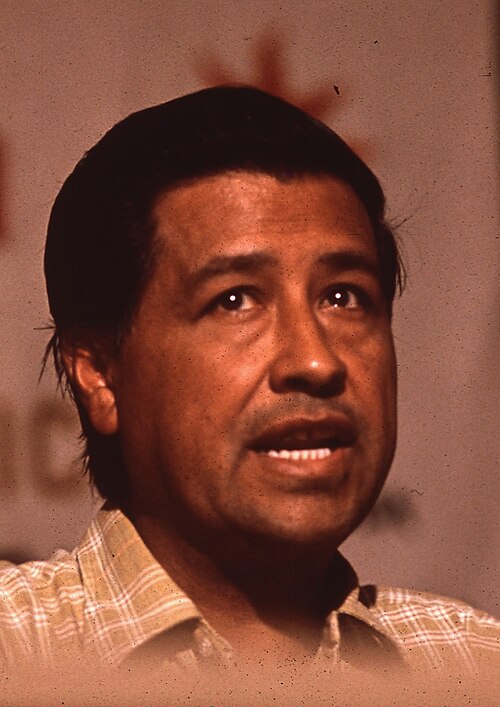
For those of you not in the United States, about a month ago it was reveled that a very famous (now dead) labor organizer named Cesar Chaves was in fact a serial sexual predator. He organized the migrant farm workers in the west, especially California in the 1970s. He got them unionized, which brought them health care and decent wages.
Even his right-hand aide in the in the movement, Dolores Huerta, who is still alive, came out and said she was raped by Chaves, but never reported it, and never spoke of it until last month.
To give you an idea of how big he was, there are over 50 schools in California alone named after him. Also multiple parks, rec centers, and streets. California even has a state holiday named after him.
Recently, comedian and political commentator Bill Maher on his show “Real Time” commented on the Chaves controversy. Maher pointed out that Chavez “undeniably made the lives of millions better.” But he also posed the question: “If you could go back in time and kill him to spare the young girls he assaulted, would you?”
“A purist says yes. I say no,” he continued. “Which is also what Dolores Huerta said. She was Chavez’s right-hand aide in the movement, and also one of his rape victims.” He shared a quote from Huerta explaining why she didn’t come forward after allegedly being assaulted by Chavez.
The formation of a union was the only vehicle to accomplish and secure (farmworkers) rights, and I wasn’t going to let Cesar or anyone else get in the way, the farmworker movement has always been bigger and far more important than any one individual.
Dolores Huerta
While removing Chaves from the farm workers cause would not have stopped the work, it would have been a major impediment, and likely set back the gains made by many years. Chavez’s personal reputation was central to the movement. He wasn’t just an organizer, he was the public face and moral symbol of the struggle. He drew heavily on nonviolence, sacrifice, and religious imagery (inspired in part by figures like Mahatma Gandhi). An early scandal involving a serious crime would have undermined that moral authority. Many supporters, especially religious groups, middle-class allies, and students, might have distanced themselves quickly.
As I found myself being sympathetic with Huerta’s decisions, I wondered if I was hypocritical by not taking the same position with Joseph Smith, Brigham Young, or any other Church member that has done a lot of good, but also hurt people.
Is the Mormon Church “far more important than any one individual”? I think this is the mindset of our current leadership. In a 1987 Ensign article, then Apostle Dallin Oaks said “It’s wrong to criticize leaders of the Church, even if the criticism is true”. The idea being that it may harm the Church, and it is more important to protect the Church, and all the good it can do (bringing salvation to the world) than to hurt the cause by criticizing the leader. Is this on the same level as Huerta’s decision not to report (criticize) Chaves? Or is this different?
Is this the same mindset that the Church takes today in telling Bishops not to report sexual assault on children that was learned in a confession? In reporting to authorities, it could make the local (or national) news, and make the Church look bad, and reduce the likelihood that people will join the Church. Again, is the Church “far more important than any one individual”?
What do you think of Huerta’s decision not to report Chaves? If she did she could have saved other young girls from his assaults, but destroyed all the advances they had made in the farm workers movement. Is her decision any different from the Church trying to protect all the good it has done by keeping sexual assaults by members out of the courts?
Are the inactions by Huerta and the Mormon Church any different from how the MAGA faithful treat Trump? They let him get away with just about anything, because to them it is more important to ignore Trumps sins so as not to take down the great good he is doing.
Your thoughts?


Can I have a screaming fit? Yes, go back in time and kill the SOB. Why when it is women being raped, is it always worth the price of saving the whatever at the cost of that “one individual”. Only it is usually one woman, it is almost always dozens. It is EXACTLY what the church does today by protecting “the good name of the church” and covering up child abuse. Once the pattern is set, it just keeps going. More and more women and children are sacrificed for the good of whatever it is THIS time.
Oh, yes, I understand the decision too G** Da** well. I made it myself as a child being raped by my father. He might go to prison and my helpless mother can’t support the family and we will go hungry. I already had SEEN that the church lets children go hungry. So, nobody is going to help the family and so I will let it go. Only, yeah, I had a little sister that I didn’t think of at that point.
It is undervaluing women and discounting them. It is minimizing the damage of rape. It is rape culture.
OK, I am going to go bang my head on the wall.
We will blacken the name of George Washington because he owned slaves. That of course is worth it. Slavery is bad. But somehow rape isn’t so bad.
This is the same kind of argument used for polygamy—if we went back in time and eliminated it, we’d be giving up all the church leaders we had for the last while. My response would be: so? Getting rid of polygamy might also include me as well. Yes, the church has done some good, but what if something else took its place that was better—something that didn’t lie and take advantage of women? What if someone else, someone better, took Chaves’ place to continue carrying the torch without the rape part? I’m not certain something better would have taken its place, but equally uncertain that something wouldn’t have either.
It feels like Huerta’s stance is one of human sacrifice. We say we don’t believe in that any more to the point where we look backwards and are shocked by what the Aztecs did to people to appease the gods—but we still do this, believe this, and glorify this. We just don’t put knives through hearts today—we replaced that with other methodologies. If we look at almost every convenience we have today, I’m sure it was made possible by human exploitation at some point. That feels icky. Yet, the alternatives feel just as bad in some cases. For example, if I understand the history of Aspirin correctly (and painkillers in general) we have those as a curtesy of Bayer human experimentation on Jews in Nazi Germany. The impact painkillers have had on the world has been tremendous. However, is it really the moral thing to get rid of all painkillers because of that? Yes, someone else could have come along and done it morally, but there is also no guarantee of that. My daughter was in the ER this weekend for potential sepsis. She was in a tremendous amount of pain. Would it really be moral of me, as her father, to tell her she could not take painkillers because they were developed by evil people at the expense of many human lives? Making calls like this is just transferring suffering. And this is where this gets really hard to answer. I get Anna’s point, I really do. But, now we have to decide who gets to suffer instead and the morality of that. I can see why people struggle with these questions—because in the face of tremendous personal suffering, our moral frameworks tend to take a backseat.
It’s just like the church, in the face of losing its tithe payers, it won’t call out Trump and MAGA directly or meaningfully. And to some degree, that makes them complicit in the suffering this administration has caused—though that also doesn’t erase the good it has done.
Your question is a good one Bill. And I find it also makes me question whether there is actually a moral god.
By excusing men who rape women and still do tremendous good in the world, we continue to normalize predation. We continue to make a bargain with the devil. While no one is morally perfect or without hypocrisy, there are loads of moral men who don’t rape women and can do tremendous good in the world.
We have to draw the line somewhere for what behaviors are acceptable, what behaviors are mistakes, and what behaviors are unacceptable. Calling the deliberate violation of women and girls a mistake instead of an intolerable evil reduces women to sub-human collateral damage in a system that already puts their needs and wellbeing last. How will change ever come with this kind of rationalization?
We have to look at the character of people who come into power. If they don’t have a good character, why in the world would we give them more power over others and create situations ripe for exploitation and abuse? If the power they have is corrupting them, people need to call it out.
If rape is ok as long as a man is skilled at business, politics, humanitarian work, etc., rape becomes a luxury “mostly good” men get to indulge in with zero consequence. Meanwhile “mostly bad” men maybe, possibly get some time behind bars, if that. If powerful women were torturing men at the same rate as men torture women, this discussion wouldn’t be a delightful theoretical exercise. Yes, rape is torture.
For historical figures, they can be recognized for the good they’ve accomplished despite the bad things they’ve done. But when we speak about the good they’ve done, we should always acknowledge the harm. Otherwise our silence speaks volumes about how we value men more than women. This is especially true when we teach youth.
I’m sure the Jewish elite in Jesus’s time did some good things for the people under their stewardship, but Jesus called them vipers who grind upon the faces of the poor and who neglect the widowed and the fatherless. Hypocrisy in average individuals is one thing. Hypocrisy in those who exercise power over others requires greater accountability and responsibility.
First, I issue my strongest possible condemnation to those who criticize victims of sexual abuse for not acting in a certain way. There is no single “right” way that a victim should act. Each victim is different, and reactions to abuse may be different.
Second, I condemn the idea that abuse should be excused if committed by someone who happens to help others in some different way. Shoveling snow off the sidewalk of an elderly woman does not in any way excuse sexually abusing her young neighbor.
Abraham Lincoln famously stated “Whenever the vicious portion of the population shall be permitted to gather in bands of hundreds and thousands, and burn churches, ravage and rob provision stores, throw printing presses into rivers, shoot editors, and hang and burn obnoxious persons at pleasure, and with impunity; depend on it, this government cannot last.”
Lincoln was absolutely correct. A culture of excusing bad conduct because it is committed by so-called good deed doers simply leads to more bad conduct. That is irrefutable fact.
This quote by Carol Lynn Pearson seems very relevant here:
“I feel violated, intimidated, held hostage, used, threatened, crazy, confused, angry, terrified, powerless, voiceless, inadequate, insecure in my marriage. I’m seen as property, as eternal chattel, in danger of being destroyed, just like Emma, without dignity, hopeless, of lesser value than a man in God’s eyes, soul sick.
In the words of one woman, bludgeon is the right term. I have felt bludgeoned by polygamy. Soul sick, bludgeoned, assaulted, abused, and the abuser” (Joseph Smith), “a personage given a place of high honor in our church, a personage that I call the ghost of eternal polygamy.
His mission purportedly is to connect the human family in God’s kingdom. To my observation, he divides and destroys. His main
achievement is to break the hearts of women.”
Just to add to the previous comments, it’s not okay that women should be expected to put up with abuse, allow ourselves to be trampled over, for some apparently future greater good. Whose greater good is it? It’s certainly not for the greater good of our daughters who would doubtless be expected to do the same. No, the only benefit is to men.
And thank you to Anna, Loudly Sublime, Mary and all other commenters for making the arguments loud and clear.
From “Benefit of Clergy: Some Notes on Salvador Dali” by George Orwell (which granted, he’s here discussing an artist, not a labor activist, but I think his insights still stand):
“If Shakespeare returned to the earth to-morrow, and if it were found that his favourite recreation was raping little girls in railway carriages, we should not tell him to go ahead with it on the ground that he might write another King Lear. […] One ought to be able to hold in one’s head simultaneously the two facts that Dali is a good draughtsman and a disgusting human being. The one does not invalidate or, in a sense, affect the other. The first thing that we demand of a wall is that it shall stand up. If it stands up, it is a good wall, and the question of what purpose it serves is separable from that. And yet even the best wall in the world deserves to be pulled down if it surrounds a concentration camp.”
People are more important than programs!
As a father of five daughters I have to agree with Anna on this one.
Everyone is replaceable. Could someone else have led the movement? Someone needs to lead but bad leaders need to get out of the way and make room for someone else. I am done with movements that belong to any one man.
I want to think that things would have been different if the rape allegations were known while Cesar Chavez was still alive – might he have been prosecuted and maybe even convicted? I think the state authorities in California would have been happy to prosecute him for something.
I’m going to add to this discussion with some points that I’m sure will be looked down upon.
In 2007, the University of Texas published research about the “237 reasons people had sex.” With the “Me Too” movement that’s been happening the past few years, it seems the list has been differentiated into a better-defined “good vs bad” sex.
I’m pretty sure at the time of Cesar Chavez, rape was still rape, but there were many reasons people had sex that had not been labeled as rape. I agree with LoudlySublime’s quote of Carol Lynn Pearson. But at the time of Cesar Chavez, women had a hard time having their own bank accounts. As a society, we’ve learned a lot about equality in the past 50 years.
At church, we hear how the gospel is the same yesterday, today, and forever, implying that what we believe now is what has always been. Yet, we know that it’s not that way at church, nor is it that way in society. Hopefully, we will change and become better with time from generation to generation. If Cesar Chavez were alive today, his behavior would be intolerable and wrong. Looking back in time, it’s hard to stomach, but it was a different time. I don’t want to give him a pass, but I also don’t want to pile on and condemn him for something that wasn’t on people’s radars as much then, even if it should have been.
My final question, though, is whether this discussion about Cesar Chavez is either trying to deflect discussion about the Epstein files or to divide us and cloud the issues using presentism about sex to denigrate learned lessons, clouding our ideas about the downtrodden, labor, and immigration, which also seems to serve the same people as keeping the Epstein files secret.
I believe there is more than meets the eye. It’s very hard not to be quick to judge when something appears to be so bad. We don’t understand all the motivations of everyone involved, why they didn’t speak up, what’s changed over time, if they’ve changed over time in their views (as we all have), and if we are being manipulated by people using one set of values to hurt another set of values while they themselves clearly lack in both sets of values. I think “ji” brings up a good question about how, at the time, state authorities in California would have been very happy to prosecute him for something. His bad things weren’t on their radar either, while his good things they fought against.
Cesar Chavez did a lot of good. We are better as a nation because California’s farmers are organized and have protections. This part of the outcome is good. Dolores Huerta was raped and did not report it, and did not announce it until very recently. Had she reported it when it happened, might it have stopped other women from being raped? If yes, then should she bear some culpability (criminal or civil) for the rapes and assaults that occurred after her unreported assault? Did her silence hurt other women? She herself thought that the cause for which she and Mr Chavez labored was more important than her rape. She was a woman. Very tough issues, and not many good answers. Mr Chavez’s arrest on sexual assault would certainly have hurt and delayed his movement, and maybe even killed it. His work clearly brought much good to many itinerant farmers, and still brings good. Many powerful forces wanted Chavez to fail. There are difficult questions here. I don’t have an answer. Perhaps Ms Huerta failed women by not reporting, but perhaps she also helped itinerant farmers. These are tough questions.
Insterno, in the recent past, say 100 years ago, rape was a *capital offense.* Much more serious, even if it was a bit harder to convict rich white men than poor black men. Read some literature from the past. It was taken a h*ll of a lot more serious when it was seen more as damaging a man’s property than it is now when it is see as “just a bit of sex that went wrong”. That is one of the problems to come out of women’s lib. Now women are not men’s property, so who cares if they are “damaged goods”? And with birth control, we as a society have become more openly promiscuous, so it is assumed women have sex all the time with men they are not married to, so what is one more guy forcing himself on them? No biggie. But now, it is near impossible to convict rich white men. Rich black men may still get convicted and sent to prison after raping 20+ women (Bill Cosby) but the rich white men still get off with nothing.
Yeah, I have kinda studied rape because I worked as a counselor to raped women. Do you know that when men are asked on an anonymous survey if they have even done things that are legally rape, that some 17% admit they have? 17% of men in our culture are rapists, yet would never consider themselves rapists. That survey was taken with college students, so what would it have been if taken by some group of men who are actually more likely to have raped, say prison inmates? Or politicians? Or republicans?
Georgis, had she reported at the time she probably would not have been believed or shamed into silence. Even if she was not willing to sacrifice herself by reporting and did report, others in the movement Chavez was leading would have gone to her with, first appeals to save the movement and second, threats to shut her up. Others would have seen the movement as more important and her as collateral damage.
It is still very hard on the rape victim to come forward. Trumps and Epstein’s victims are receiving death threats, so do you really think that she would not have gotten death threats. Even is she put saving future women from rape as a top priority, others would have tried to silence her. There were all kinds of rumors that Chavez had mob connections with Mexican cartels and they would have shut her up. No, she was probably smart to keep her mouth shut.
And I am not a bit sorry I kept my mouth shut. Yes, it is that bad to report that if I was in the same situation today, I would still not report.
And, no, I do not think that women who choose not to report are in ANY way responsible for rapes that happen because they guy is not behind bars any more than a jury that fails to convict a guilty man is responsible for his crimes once he is released, or cops who don’t do a good enough job gathering evidence. It is our whole society that makes it so horrible for women reporting rape that is responsible for making women too afraid to report. Why is it that mugging have a 99% report rate while rape is still down at 10%? It isn’t because the victims of a mugging are more afraid for their life or more harmed. It is that mugging victims are not seen as damaged goods, shamed, disbelieved, and accused of lying about it. So,until rape is reported at 90% instead of 10%, no rape victims should not face pressure to report.
Why is rape so under reported? Because men have such mixed and confused feelings about women who are raped. Men don’t divorce their wives for being mugged. I saw divorce happen to a rape victim I counseled. I was at the hospital with a rape victim trying to report, when the police refused to believe her because she had had a drink with the guy. Most of the women who came to me for counseling were 10-50 years after being raped and had never reported. Still having nightmares about the rape 50 years later because she shut it up and never talked about it because she was afraid of being shamed for it. With no other crime do the police doubt it was a crime.
Until MEN get this figured out and start respecting a woman’s right to give consent, holding other men accountable, and believing women, and not seeing them as damaged goods because some other man touched them, this won’t get fixed in our culture. Men gotta fix their attitude.
There are a lot of interesting comments on the Chavez case, but I haven’t seen many address how these situations should apply to the Church. I’d like to take a stab at that. Rather than focus on the specific case of sexual assault, I want to take on the broader question of whether the Church should ever cover up a crime or wrongdoing in order to protect its reputation (and, presumably, its ability to gain converts and do more good).
For the orthodox member, I don’t see how the answer can be anything other than no. Orthodox members believe that Christ is the actual leader of the Church. I have a very hard time imagining a perfect Being ordering members not to report crimes, to pay people off for their silence, or otherwise obstruct justice just to preserve His reputation.
Orthodox members also believe scriptures that teach Christ’s work cannot be hindered by any individual or group. That should include the crimes and ethical lapses of Church leaders and members–the work is supposed to be bigger than any one person’s reputation.
Outsiders and non-believers are rightly disappointed when the Church–or any religion–tries to cover up crimes. It’s a big part of why such cases are newsworthy in the first place: religions come across as hypocrites when they engage in this sort of behavior.
If an apostle or prophet committed the same crime against a female secretary that Chavez committed against Huerta, the complicated questions about whether the “greater good” was served by not reporting should be completely out of bounds. It’s supposed to be Christ’s Church. I don’t believe Christ would want a rape by His prophet or apostle covered up, nor would He allow such an event to hinder His work.
This is precisely why Joseph Smith’s (and other early leaders’) intentional, false smearing of women who turned down his polygamous proposals is so disgusting. When a woman rejected Joseph–especially if she went public–he and his followers chose to destroy her reputation to preserve his and the Church’s image. That was wrong.
The Church–and many other religions–regularly continues to cover up the sins of its leaders and members in order to preserve its image. For an organization that loves to criticize “the World,” it sure behaves like the rest of “the World” much of the time.
Georgis: No, we almost never hold people accountable, not criminally and not civilly, for not reporting crimes. This is so universally acknowledged that we have special, specific laws that delineate those who are mandatory reporters. While it is true that someone reporting a crime may help prevent future potential victims, to suggest that anyone other than the person actually committing the crime bears responsibility. (Yes, there are other clear exceptions, such as when people know ahead of time that someone intends to commit a crime, or when they are aiding in or covering up a crime.)
To add to Anna’s comments, one of the reasons that rape is reported at a much lower rate than mugging (or many other crimes) is that rape victims often know their attacker. It’s a spouse, an ex-BF, a neighbor, a coworker, etc. The list of women who reported rape (or any type of assault) by men that they know who then suffered additional violence *because* they reported is tragically long. Women face real risk of social repercussions, career/economic impacts, and physical violence when they report rape. If someone mugs me at the subway station and I report it, I am far less worried that my life is going to end up worse because I reported.
The question of whether we’d be better or worse off if we had eliminated the predator/slave owner/genocidal maniac requires so much hindsight and so many counterfactuals, the question doesn’t even have an answer. The rule should simply be: wherever (or whenever) one exists, one should call out and attempt to stop the bad behavior.
To help see the pointlessness of counterfactuals here, what if there was in fact an even worse farmworker activist in the making before Cesar Chavez? And then what if the even worse activist got called-out and derailed before he became well known (such that we don’t know today that he was worse), which left the space in history open for Cesar Chavez? Wouldn’t we be glad the even worse guy got removed before Cesar? I think so. And what if there was an even more worse (a worst of the worst) activist two rungs before Cesar Chavez, etc, etc? At each point, the best answer is to simply call out the bad behavior.
Be cautious though when fantasizing about calling out those further back in time. George Washington’s, Brigham Young’s, and Joseph Smith’s bad behaviors may have not have been widely known at the time as bad. So, who could’ve effectively cancelled them? In these cases, one would need to both be a time traveller with today’s morals AND be perfectly clairvoyant.
There are two questions going on here. The big picture question is whether bad people have done things that advance some greater good, and whether there are situations where it is worthwhile overlooking the bad to enable or appreciate the good. I would say in general, yes, that can be true, but one always must weigh the specific nature of the sins against the good accomplished. These complex moral judgments are going to be different for different people, and be influenced by the sensibilities of the time in which we live. That brings us to the second question: the specific case of Chaves and accusations of rape. I would offer a contrast with Martin Luther King. We have two men who did important things for civil rights, but one is now a credibly accused rapist and the other a mere run-of-the-mill adulterer. I feel inclined to be far more forgiving of King; his wife may feel differently, as is her right. Sexual assault is a crime against specific victims, but also in our legal system an offense against the state, which in a democratic system is to say all of us. That seems to put things in a different category for me. When crimes are being committed, I don’t think I care any longer about what greater good an individual is accomplishing; let someone else accomplish it. I question whether anyone in this world is really so special that they are the only person who can lead a particular cause. That’s what narcissists who lead movements (and corporations and governments and a long list of other things) tell themselves.
I pretty much think the same thing in the church today; no crimes are worth overlooking for some notion of the “reputation of the church”. I would note that much of the discussion lately about reporting of serious crimes in the church isn’t focused so much on high ranking leaders, though leaders have been the accused from time to time, but rather on how those leaders handle cases that come to them in the course of their callings. That seems to be a different category of question. The “greater good” often becomes not so much about the church but about the supposed repentance of individual perpetrators in a way that ignores the wellbeing of victims.
The Church could do a lot more to prevent rape. I don’t remember ever being taught anything about it in Church. Not even how to recognize when one occurrs. Certainly nothing that would indicate that it’s actually very damaging and far more serious than the stuff they did warn me about. This seems like a pretty big hole in the curriculum, really.
It just seems so common for important male figures in history to have questionable sexual histories. Consider MLK Jr. According to a new trove of FBI documents released a year ago, MLK Jr. had affairs with up to 40 different women. One document claims that MLK Jr. laughed in the background as a colleague of his raped a woman. Now, at that time, it should be taken into consideration that the FBI was racist and heavily biased against MLK Jr. We can’t verify the most damning claims. Still, there is no doubt as to his rampant infidelity. On that note, I simply don’t know what to say when heroes are found to have committed sexual infidelity at best, and sexual crimes at worst. In the case of Chavez, it tarnishes his legacy pretty badly. It is hard to see him the same. Especially when his sexual impropriety crosses a criminal line. Kind of like Bill Cosby. Long hailed a family man and role model for American blacks, the allegations and evidence against him grew so damning that he is long gone. No one talks of that man now. I can’t even listen to his comedy anymore.
One more thing. We could and probably should just rename everything named after Cesar Chavez to Dolores Huerta. She was similarly an extremely influential figure in the Latino rights movement. If we are to extol heroes, we’re often safer and better off extolling female heroes. They are much less likely to have histories of sexual improprieties. It is virtually unheard of for female leaders and historical figures to turn out to have been rapists and predators.
Georgis, your comment comes off a little victim-blamey.
Brad D, I was in no way blaming the victim. I asked some difficult questions and acknowledged that I had no good answers. Ms Huerta had her reasons for remaining silent–she was committed to the cause–and we respect that. But to Anna’s original point: is the cause or movement worth more women being raped? She says no, and I agree with her. For Ms Huerta, maybe the rapes of other women after her assault was a price that she was willing to have them pay, for the benefit of the movement. I am not at peace with that price.
As has been indicated here by others, the California establishment very much wanted to break Chavez (as I understand the history), and I suspect that they would have vigorously pursued a rape charge had they known. Chavez’s future rapes would likely have been prevented, which is good, but his movement would have been hurt, which is bad. I hope that today that rape victims are more able to speak up quickly, and that justice’s sword can fall before more people are hurt.
Good to know that if all the bad people are done away with only good people will remain. But who would those good people be?
Seriously, how does society judge who a good person is, especially when lies and false allegations are rampant? If I say the name Clarence Thomas, the majority of this forum will side with Anita Hill and declare Thomas should be in jail, let alone never on the Supreme Court. Same with Justice Kavanaugh. How dare he! How dare them both!
How dare they what? Who among YOU is a clairvoyant judge of truth and of circumstances? Who knows the truth of He said / She said allegations? How do you judge the character of a person IN THE PRESENT? No time machine. No retro analysis of the past century. How do you judge a person in the time they lived? By the way, back in the 18th century, publishing slander was as common as it is today. The strategy of using the pen and press as a political weapon is as old as the printed word.
But with historical revisionism, you eliminate George Washington, and Thomas Jefferson, and Brigham Young (and I suppose Joseph Smith has to go also). You have to do away with General Grant – he was an alcoholic and used a military strategy of attrition that elevated casualties and of course General Patton was demonstrably unkind so he must also be cancelled. I dare say that after you eliminate all those who do not live up to modern sensibilities and who cannot PROVE their innocence of misconduct you will be left with NO ONE of talent, of grit or of moral courage.
What is fascinating to me is literature is replete of stories of the moral courage and true grit of the fallen man. Why do you think that is so? What are the great writers trying to teach us?
I don’t know, A Disciple, I haven’t raped anyone. I haven’t exploited people. I haven’t physically abused anyone. I stand up against injustice and I support the weak. I’ve held lead acting roles. I’ve won academic awards for my creative writing. I dare say you’re taking a valid concern and pushing it a bit far. I shudder to imagine such extreme black and white thinking and where it comes from.
Disciple, don’t be purposely obtuse. Some things are illegal. Those things are usually regarded as harmful to another person. Sex outside of marriage may be against religious rules, but it is not illegal. It is victimless. Alcoholism is not illegal, stupid and unhealthy and a lot of other bad stuff, but not illegal. It is kind of purposely stupid of you to lump them all together as if a person has to be perfect to be worth anything at all. On that point, I think you are taking your Mormon training about “worthiness” way too far into perfectionism.
Chavez committed a crime that is extremely harmful to the victim. General Grant drank too much. Those are two wildly different situations and for you to lump them together is just plain stupid. There, I won’t use any big words to soften what I say or confuse you because you don’t get big words.
Personally, Robert E Lee is still one of my heroes. But a person has to really study his life to understand and I won’t get into all that and write an essay. “Why” isn’t as important as just saying people are a mix of good and bad. And that is forgivable if the bad is just weakness or mistakes and not horrible. There is a level of horrible that makes the person a rotten apple, instead of just a forgivable human. So, I would really be a hypocritical to say we have to throw out all the good someone did because of the bad when that bad was legal but not good, understandable, or divided loyalties, or some other imperfection.
There are things like slavery that we can understand as bad, yet say “at the time.” Such as George Washington’s owning slaves. Or Robert E Lee siding with his state of Virginia rather than his nation. Not good, but legal and normal at the time and place. You cannot say that about Joseph Smith’s polygamy or marrying 14 year olds. You cannot say that about Chavez raping women. You cannot say that about Justice Kavanacreep. You cannot say that about the fat pedo pumpkin president. Those were crimes of a serious enough magnitude that we should not just brush them aside. They show something of the character of the person, which is why I am not a bit surprised about accusation of fancy vacations as bribes given to Justice ThomAss.
Once a man has so many accusations or accusations that are substantial, I say we believe the women. Especially with things like sexual harassment, sexual assault, or rape where the victim who is reporting stands to lose more than the man she is accusing. You brought up Anita Hill, well, she lost one hell of a lot more than the swear word who is on the Supreme Court. Why didn’t we believe her? Because our society would rather worship powerful men than protect women. Women are expendable. They are collateral damage. There is a reason women would rather meet a bear in a forest than a man.
Yes, there are a lot of rape accusations that are unfounded. That is a police shorthand for “we didn’t want to believe her.” Only about one in 100 rape accusations are false. And when you consider that 90% of rapes go unreported, that makes it one in one thousand. So, there are NOT a lot of false accusations. What there is are men like Trump who get away with raping children because our culture would rather panic over a trans woman in a restroom than believe women are telling the truth about rape and sexual harassment. Just like you just did in trying to minimize and cast doubt on things
Brian,
You are not going to have any heroes in society if all those ones once deemed worthy of recognition are subsequently toppled because people of a later generation decide those heroes are unworthy of admiration. And without heroes, what culture does a people have? What history does it have?
We may wonder why, in the Book of Mormon, the prophet Mormon made such a big deal about Captain Moroni. I think it is because Mormon was aware of how vulnerable the standing of Captain Moroni was. For Moroni was a man of violence, despite the claim he did not seek for blood. I reason that the prophet Mormon wanted to impress that no matter how uncomfortable we might be with a man of action as was Captain Moroni, what Captain Moroni did was integral to the liberty of the Nephites and such people deserve admiration.
Black & white thinking is the argument that a person must be categorized as a single adjective. But that is unrealistic. People can be complex. A person can perform a life saving act and at the same time be a horrible spouse and negligent of his children. Do we throw away recognition of the life saving act because we don’t like the other things the person has done? Modern society leans this way and to me that is black & white thinking.
This is a fascinating topic, and I am grateful that this site is capable of posting discussion-generating articles. As we can see, this particular question does not have a satisfactory answer, but it does us all good to chew at it from our various starting positions.
BTW, the 1992 Dustin Hoffman movie “Hero” is a fun posit of whether a good person can do bad things and vice versa.
A Disciple, I don’t and won’t ever hero-worship. Go for it if you wish. I praise individual acts. Of course people are nuanced. You seem to be implying we can’t criticize just about anyone or anything. And that everyone of note has done terrible things. That’s crap. Or maybe projection. Either way, not interested in such docile engagement with the world. Many people have done terrible things and those things should be called out.
Brian,
Standing up a statue for General Lee or naming a college for George Washington (or a ravine and public schools for Chavez) in no way denies criticism of the person. I’m not sure where you read that interpretation into my argument. I’m saying that for a culture to have a rich history it needs to have heroes, all the while recognizing that its heroes were flawed persons, as each one of us also is.
I don’t know what to make of a nation and culture that rejects its history. I think people who reject the past put themselves in peril. For it is easy to be a cynic. It is easy to judge the past as being unworthy of one’s attention and historical figures as being unworthy and deserving no gratitude but only contempt. But then so it goes for the next generation as they look back on their mothers and fathers. If a culture has no enduring story than I believe that culture will struggle to provide people a common sense of purpose and aspiration.
A Disciple, I understand the power of narratives very well. You wrote, “I dare say that after you eliminate all those who do not live up to modern sensibilities and who cannot PROVE their innocence of misconduct you will be left with NO ONE of talent.” That’s your point of view, and it’s a black and white stance (and an undereducated one, probably based on being taught, reading history written by white males; people like you; there are lots of people who didn’t amazing things in the world who also didn’t rape, exploit, abuse others, difficult as it seems that is for you to believe. Just because you can rightly disagree with other black and white views doesn’t mean your views aren’t also black and white. I’d suggest you abandon your heroes. Or get better ones. Yes people are complex and no one is perfect. Thank you for enlightening us. You are arguing that everyone of note has terrible, terrible things. That’s a crap argument, and that’s what I’m responding to. The OP and several of the comments acknowledge the difficulty of the issues and the nuance of people. I get that you are deeply triggered by cancel culture, but I’m done responding to your threadjack.
A Disciple, given your concerns about a nation rejecting its history, I am curious how you feel about the current administration’s attempts to strip all references to slavery from displays in national parks. That seems like one of the more egregious examples I’ve seen. Which historical figures do you see as being judged as worthy of only contempt, in your words? I don’t think I’ve seen a lot of this.
Brian,
The reason no one of talent and accomplishment will be left to honor is because it is the nature of radicals to tear down those who are persons of talent and accomplishment. The radical always find a reason. Consider the 44 cancellations proposed by the San Francisco board of education in 2021.
Now you may say that San Francisco board of education members are an anomaly and it is true their 2021 list of cancellations was rescinded after public outrage and mockery. But these board members got their ideas from the public conversation & debate. This list included not only George Washington, Jefferson & Lincoln but also Francis Scott Key, Paul Revere, naturalist John Muir, Spanish priest Junípero Serra, and famous author Robert Louis Stevenson. Why? Because in their rush to judgement the board members were determined to eliminate anyone who was not sufficiently ideologically pure, according to their ideology.
Orwell wrote: “He who controls the past controls the future: He who controls the present controls the past”. The radicals understand this concept very, very well.
“Radicals.” Lol. Come on, stop being lazy. Many of the people your praise were radicals, A Disciple. If you ever care to come back with a nuanced or at least less partisan point of view, I’m here. So much ink for such little substance. Quoting Orwell as an appeal to authority and support of your supposed educated and sound stance. Classic. There is, of course, discussion to be had on the subject. But not with arguments like that. “Radicals.” Can’t get over it. Someone who calls everyone they disagree with a radical is probably a radical themselves. This whole thing just cracks me up. God bless.
So, what do we do with our lives
We leave only a mark
Will our story shine like a light or end in the dark?
Give it all or nothing
We don’t need another hero (hero, hero)
We don’t need to know the way home
All we want is life beyond Thunderdome
All the children say
We don’t need another hero (we don’t need another hero)
We don’t need to know the way home, ooh
All we want is life beyond Thunderdome
Broan / Brian?,
I used the word “radicals” to be charitable to this group of people. They were so extreme in what they proposed there was bipartisan opposition, even in California – Hurrah for bipartisanship! How should one label a group of persons whose ideas are so extreme they are universally criticized and rejected? Please suggest a better adjective.
That progressives have lost their love for Orwell is a funny thing that happened in the 21st century. For Orwell was once a favorite author of the Left – my high school assigned the book 1984 in, well 1984, and my kids read it 30 years later in their high school. But then the political right started using Orwell’s writings to attack Progressive statism and that makes Orwell a problem for the progressive movement.
I don’t know a progressive who doesn’t like Orwell. Another indicator to how out of touch you are. Orwell was a socialist democrat. His work is warning against someone like Trump. It’s just . . . too much.
Quentin,
You made me curious so I looked up the White House memo titled “RESTORING TRUTH AND SANITY TO AMERICAN HISTORY”. What I read is a rather narrow complaint and plan of action. The complaint is that the presentation of American history at government museums and historical sites has been polluted by political ideology. The memo provides several examples of the insertion of political ideology. You may or may not agree the examples are problematic.
My own perception, having visited the Smithsonian museums many times, is that the insertion of political ideology in the exhibits has become a distraction. The issue is not that the history of racial conflict in America should be avoided or papered over. The issue is the insertion of race into American history where such addition and editorializing is an ideological viewpoint. Again read the examples provided in the memo.
An example of this ideological insertion is to compare the Air & Space museum on the National Mall to the Steven F. Udvar-Hazy Center in Virginia. Both tell the history of America’s Aeronautical progress, but they go about it in different ways. The Hazy Center is focused on the history of aviation as it happened. The exhibits show the planes and tell of their pilots and their missions and the inventors of aeronautical technology.
The Air & Space museum dilutes the telling of aviation history because it feels it necessary to add messaging about race and diversity. And this attention to race & diversity is not just one room in the Air & Space museum but rather a context through which many of the exhibits are presented. What the Air & Space museum is today is far different than what it was 20 years ago. Is it better? That depends on what the objective of the museum is.
Which states ban books like The Outsiders and Wicked yet its people flock to Eccles or Jordon Commons when it’s put on as a stage play? That’s right, Utah. Banned The Outsiders for crying out loud. A book about a bunch of boys growing up in Oklahoma. Incoming pearl clutching from the red seats on temple square I suppose.
FWIW, I’d rather live in a world with books and no statues than vice versa. But then I’m a liberal so I read for recreation.
I otherwise agree that no one is replaceable. The question for those of us without infinity stones is whether or not the replacement is an improvement.
When I read the title of this post I honestly thought this would be a discussion of Dexter Morgan.