
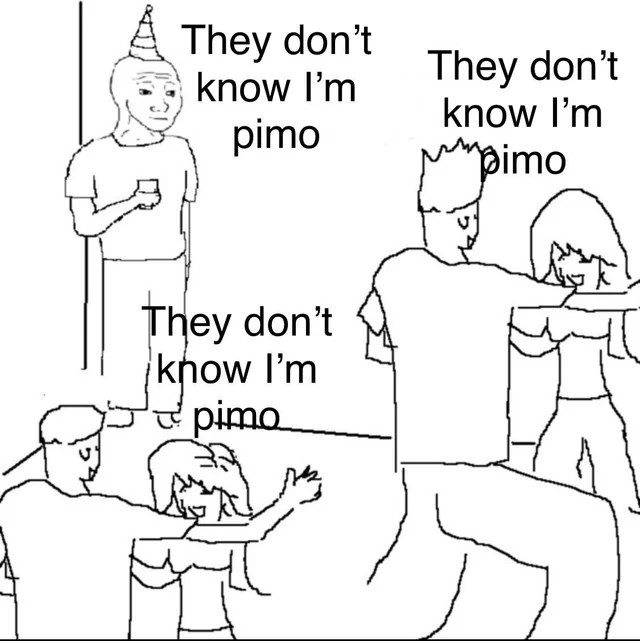
The term PIMO (Physically In, Mentally Out) refers to those who attend church regularly, but don’t believe some or all of the tenets. They attend for other reasons. The term PIMO originated among former and doubting Jehovah’s Witnesses, but it is in common parlance among Mormons and former Mormons as well. It is also used in Ultra-Orthodox Jewish communities. There are some other variants on this concept that are used to describe the relationship of some members within high-demand religions:
PIMI (Physically In, Mentally In): Fully believing, active, orthodox member. In Mormon circles, we would call these TBMs (True Believing Mormons).
PIMQ (Physically In, Mentally Questioning). An active member who has begun to have serious doubts but has not fully rejected the faith. I think we might say Cafeteria Mormons or possibly just nuanced Mormons.
POMO (Physically Out, Mentally Out). Someone who has left both the religious practices and belief system behind. We would probably just say ex-Mormon or post-Mormon. Some believers would say “anti,” but this doesn’t specify that they used to be a member, so it’s imprecise and needless defensive. Not everyone who leaves the church fits the term.
POMI (Physically Out, Mentally In). Someone who no longer attends or practices the faith, but still believes (or fears?) the doctrine is true. I think we’ve traditionally called these Jack Mormons, but I think that term feels a little outdated. I definitely know people who don’t attend and don’t follow things like the Law of Chastity or the Word of Wisdom but who still hold the beliefs.
In essence, being “PIMO” is a type of quiet quitting as described eloquently by fellow blogger Elisa. JWs who coined the term also called it “fading.” Those who leave the Jehovah’s Witness community face extreme social consequences that are much softer in LDS families and congregations. When someone quits the JWs, the elders read their name out in the Kingdom Hall as no longer a member. Members are required to shun them completely: no texting, dining with, or speaking with a family member or other member of the JW congregation–forever. Due to severe pressure in European countries, this has been softened to allow a simple verbal greeting when the ex-JW is encountered. For those who leave the LDS church, there may be social awkwardness, sadness, or distance, but these vary based on the family and ward, and the church often attempts (sometimes to the point of harassment) to reactivate those who have left. There is also some social policing in both JW and LDS congregations, but it is much more severe in the JWs due to the severe penalties. Rather than trying to retain or reactivate questioning members, the JW protocol is to try to actively remove those who don’t believe, and to force the shunning procedures to protect the flock. It can be very difficult for a non-believing JW to fly below the radar. It’s much easier for someone who is LDS.
According to Pew Research, roughly 27% of those who attend church regularly do not believe what that church teaches. Among LDS attendees, research is limited, but estimated slightly lower at around 25% who either believe a partial, nuanced version or who don’t believe it at all but attend for other reasons. So why do people who don’t believe still attend?
Identity. For many, they are born into a religion, and it’s simply a part of their heritage. Even many who have left the LDS church still prefer to socialize with those who were raised in it because of the common identification they hold based on being raised in the same culture. Church attendance shaped their childhood, family relationships, language, holidays, and life milestones.
Family. This is the strongest reason across religions. People attend churches they don’t believe in order to maintain relationships they value: parents, children, spouses, grandchildren, and even friendships. Remaining active allows them to interact with loved ones, to serve them, and to share experiences and social networks with them. Of course, as comedian Todd Glass put it “You wouldn’t let your parents choose your jeans. Why would you let them choose your religion?” But that also doesn’t mean that when Grandma buys you a hideous sweater you don’t suck it up and wear it to Christmas to make her day.
Community. Leaving church makes it difficult to replace things like friendship, mutual aid, meals during illness, childcare, volunteer opportunities, shared rituals, and intergenerational contact. Most people I know who have left the church still like Mormons. In the wake of the violence against the church in Michigan, ex-Mormons felt about the same as TBM Mormons. They identified with the victims as one of them.
Meaning and ritual. People continue to find value in music, prayer, meditation, scripture as literature, seasonal celebrations, weddings, funerals, and communal service. They can participate in these without sharing the beliefs of others in the congregation, interpreting these things on a symbolic level rather than literally.
Moral formation. Even while not believing in God (although many non-believers do believe in God while rejecting a church’s specific teachings), some view religion as cultivating virtues in them and in others, particularly providing a structure for the teaching of children in things like compassion, generosity, forgiveness, self-discipline, or gratitude. They can stay to continue benefitting from these practices.
Hope that belief will return. Some will linger despite non-belief because they hope their doubts will be resolved or that the church’s views will progress, that spiritual experiences will return, or that the faith will see them through an unnamed future crisis. Belonging precedes faith for them.
Institutional loyalty. Some feel grateful for the institution that raised them and will continue to participate while disagreeing with the teachings to engage in things like humanitarian work, educational programs, youth programs, disaster relief, or community service. They would rather volunteer or work alongside familiar friends than try to find these opportunities elsewhere.
Fear of leaving. Despite the penalties for leaving in LDS families being so much lower than they are for JWs, this can vary greatly from family to family, from ward to ward, and from marriage to marriage. Some fear the loss of family relationships, social isolation, reputational harm, employment consequences (I’m sure a study of belief levels among those employed by the church would be very interesting–there’s a reason people say that working for the church is the surest way to lose your testimony), existential fears or loss of meaning, concern about eternal consequences. You may privately disbelieve, but still not have a new set of beliefs to replace the ones you’ve lost.
In short, not everyone defines “belonging” as agreeing to the doctrines. I’ve certainly heard plenty of active Mormons assuming that by belonging you agree with everything, but that’s definitely not how everyone sees things. Anthropologists distinguish between belief and belonging because they do not always move together. You can:
- Believe while not belonging
- Belong while not believing
- Practice without being certain
- Identify culturally yet not participate
For some, being PIMO is a phase on the way to full disengagement, leaving or even resignation. For others, it just means they are getting something out of their attendance that isn’t the same thing the believers are getting from it. Some will cease to participate if they feel that they cannot engage authentically, if they feel they have to be dishonest with others to be accepted, or if they feel that relationships are shallow due to that lack of authenticity.
We often talk about the LDS church being “high-demand,” but just as critically, it’s a high participation church due to our lay clergy. In order to be given a calling, your local leaders have to trust you to do so in the way they think is proper. If you express too many doubts (or disagree with their idiosyncratic views), you will probably not be asked to teach or to give talks. The “belief policing” actually became more of a serious issue when more callings were at least informally tied to having a current temple recommend which was not the case just a few decades ago. This practice forces those who are PIMO to either obfuscate to receive a recommend or refuse to play the game, which probably marginalizes their participation. Most mainline churches don’t have these concerns because sermons are given by trained members of the clergy, not by everyone. Those who are PIMO are not outed. They may feel more welcome as a result.
- Do you think the LDS church should be more tolerant of PIMO members? How would you accomplish that?
- Should non-believers be outed and marginalized in the church?
- Do you know people in all these categories of belief / non-belief as described?
Discuss.


I can’t remember ever using the PIMO label per se and I’m not inclined to start, but my Living on the Inside of the Edge could be viewed as a book length how-to for Mormons in the category.
[Self promotion mode off]
For discussion purposes I’d like to suggest three complicating categories:
>The higher criticism or historical-critical) group, which (I believe) exists within any/every religion that uses a sacred text. Among Mormons I would include those of us who read the Book of Mormon as a nineteenth century work. This is an interesting and complicating group because among historical-critical folks I know many would consider themselves both physically and mentally IN, but recognize that more traditional believers would not agree.
>In Mormonism in particular, the new history group (think Leonard Arrington and later, Dialogue, Mormon History Association, Church History Topics and Gospel Topics Essays, etc.) Similarly interesting and complicating because there is a divergence on what believing and mentally IN means and who qualifies.
>People who attend and participate with varying forms of belief and choose not to go to confession (Catholic) or choose not to sit for a temple recommend interview (Mormon) or otherwise avoid external worthiness or loyalty tests. Here we find divergence on the meaning of “physically in.”
A good essay. My question would be if you see a distinction between “PIMO” and “cafeteria Mormon?” I’m not sure I see a bright boundary between the two, but there does seem to be a difference between someone who believes some but not all of our tenets, and someone who disbelieves so many of the tenets that they consider themselves “mentally out.”
Perhaps it’s just a way of saying that some of these “distinct categories” we sometimes use have a way of describing more of a continuum than boxes.
Nobody knows what other people actually believe unless that person tells you. We honestly have no idea how many fellow members don’t actually believe the truth claims of the COJCOLDS. And even if they believe in the core truth claims, there’s no telling what member X believes about non-core beliefs. For example, does the average active member out there actually believe that the Garden of Eden was in what is now Jackson County, Mo.? Really?
I’m sure some members believe it all as their default position. I’m not sure that is because they are more “faithful” or because they have that kind of internal psychology. I think finding someone who believes it all is like finding someone who always obeys the speed limit.
christiankimball – I gained some great insight, ideas, inspiration and even a few chuckles from your book. It was an enjoyable and great read. I personally think that anyone in a church leadership position would gain some great insight from your words, and it speaks to Hawkgrrrl’s OP – Many Thanks.
Hawkgrrrl – Thanks for this one. I have spoken with many members of our ward who are PIMO, or some variation. I truly think that it behooves Mormon leadership to be paying attention to all attending members of a ward. Notice I said “attending members.” I understand SL wants for everyone to “search for the one,” but my opinion is that the search should only be in the form of “invite” (thanks Dieter!). For those who never, rarely or just occasionally attend, a simple biannual or quarterly friendly invite, email or text is more than enough. Anything else is usually construed as harassment in my experience.
A bishopric/ward council should recognize those “Living Inside the Edge” (thanks Christian), and asks them how they would like to participate, if at all. This would allow all to be more comfortable. I get direction from stake leadership on a regular basis that someone needs to be given a calling. I usually inform them that I am aware of the individual’s needs and that is not in the cards for them at this time. But a Bishop needs to stand up for his ward members in that regard, and that sometimes requires him to tell upper leadership to “back up.” I’ve been told that a member needs to be “temple worthy” to hold a “calling” and I say that is a load of crap. Not every position has been filled with divine inspiration. Sometimes, someone is just the right fit at the time. We have very limited resources out here in California among the membership and restricting members because they are nuanced simply doesn’t fly.
From the point of view of local leadership, what matters is: (1) does he/she attend church (activity)? (2) does he/she pay tithing? (3) does he/she accept a calling? and (4) does he/she say yes to all the TR questions. What they believe in their heart (the “MO” part of PIMO) doesn’t really matter much. Unless they start broadcasting too loudly and disturb the comfortably orthodox in the ward.
For the individual person, there is a lot of variation in how one sees things vis-a-vis the Church and its (exaggerated) truth claims. I haven’t seen the generational angle explored much. What “nuanced” looks like for a teenager, for a young adult, for a married couple with young kids, for empty nesters, and for on-the-last-lap elders is going to be rather different, I think. The Church focuses a lot on the teens and young adults. Not so concerned with adults most of the time.
Who are the PIMO’s? Well, I am for one! While it’s taken me a few years to settle into the role – I’m come to accept it (really) and to recognize that (from a certain perspective) there’s an element of nobility about what I do as a PIMO and why. When my “testimony” and whole belief system became a smoking crater a few years ago – I was faced with one very difficult decision; among many. And, that was ” is my experience REALLY worth blowing up my family, my marriage, most of my professional and personal network of friends, etc.? After some soul searching and private discussions with my wife – I decided that the answer to that question was “No. No, It is not”. Candidly, the happiness of “my girls” and my other kids is much, much more important to me than making myself feel better by vomiting my disgust of a monumental fraud of a religion all over them. Has this process taken some time? Sure. Has it taken some quiet, direct conversations with (so-called) leaders within the Church? Yes. But, here I am (with no callings) supporting my wife and family for a few short hours (each Sunday) by sitting quietly with them, holding their hands and embracing them as the Dad I know I am. No biggie.
Jordan River-Draper-Oquirrh-Saratoga Springs-Timp-Orem-Provo x2-Lehi-West Jordan-Lindon-Payson
I am depressed because the above is a list of temples in SLC/Utah Counties; feels like HQ is going to start asking for more temple workers. OTOH later this year I will decline any appointments to renew my recommend. I need to read Christian’s book again.
I am very much physically in, and I am mentally in a place that I consider “in”, but some might consider “out” if they knew all the things I believe. So I’m reluctant to embrace the label of PIMO, and I appreciate christiankimball’s comments about these various in between categories.
I strongly believe the church needs to be more tolerant of those who are questioning. If someone asked my opinion on how to do that, I’d start with the temple recommend questions. The first half of the interview is mostly unnecessary in my view. There is that famous quote from Joseph Smith about us not having creeds, but several of those questions sound a lot like a formally enforced creed. And for what? As far as I can tell, the only thing those questions are accomplishing are a lot of unnecessary angst for people who might have recently started dealing with deep questions about their faith and are suddenly wondering whether they are still allowed to go to the temple.
grizzerbear55: I think there are a whole lot of people doing just what you are doing, and it’s certainly not limited to the LDS church. Church is a family enterprise, and supporting your wife and daughters is a great way to live a truly Christlike life, particularly if it’s not a big sacrifice that affects your mental health, for example. I wouldn’t expect my trans kid to participate to avoid hurting his grandparents’ feelings, for example. A lot depends on one’s own treatment, and the closeness of the relationship of those who want to be there. I have also seen many stories shared by couples in which one of them finally says “I’m done,” and the other says “I’ve been done for years, just waiting for you to feel the same.”
Beautifully narrated, Hawkgrrrl. My sincere compliments.
Chet: you forgot Taylorsville, Spanish Fork and interestingly, Salt Lake. Granted two of those aren’t operating currently, but neither is West Jordan.
If forced to squeeze myself into a box, I suppose I’m PIMO. I’m there every week and I have two callings, so I’m physically in. As for my mental state, well, Christian’s book lives on my nightstand, if that’s any indication.
I agree with many of the comments that knowing what any member thinks is difficult, and I’m inclined to believe that nearly all members disagree with something that is an official tenant of the church (in as much as we can even define what those are). Ironically, I think Mormonism is more defined by action than by thought, so ‘mental in-ness’ is primarily defined by our outward actions temple attendance, recommend status, garments, tithing, WoW, statements in church, accepting callings, etc.
I wish there was a way for PIMOs to be welcome at church, but I just don’t see how we could ever get there. Doctrinally we don’t accept half-way participation well. The church is built around a belief in being right about everything so there’s no room for skepticism or doubt. Church leadership has no humility about their own status, so they provide no space for anyone else to publicly hold dissenting positions. As long as we teach that obedience is the first law of Heaven, we will never improve in this area. Having never been a part of any other religious community, I’m very curious how other groups deal with these things.
christiankimball’s category of higher criticism/historical-critical resonates with me. I’d describe myself as PIMO for two main reasons:
1. The church’s truth claims are simply too fantastical for me to believe. That includes narratives of heavenly visitors, the gold plates and witnesses, the Book of Mormon, etc. No offense meant to folks who do believe them; I’m only speaking for myself. In terms of the higher criticism idea, I think the B of M is clearly a 19th century work and, frankly, one that cannot be true for a number of reasons. From an anthropological standpoint, peoples don’t behave the way that the book describes, the book is chock full of rampant racism, women essentially don’t exist (except for that one passage about the stripling warriors’ mothers, which gets quoted in every single ward Mother’s Day talk), etc. And if restoring the gospel via the Book of Mormon was so important, I doubt God would use a charismatic con man to bring forth some sort of text from long ago via gold plates, angelic visits, etc. and tell the sketchiest, least believable story about the B of M’s origins on the off chance a few folks might believe in it. If the B of M is a book written for our times, it sure seems to be rooted in 19th century prejudices and social practices.
2. Doctrine/practice/tradition. I find it simply unacceptable on every level that the church excludes women from positions of authority the way it does, marginalizes all of its own adult members who are not married and sealed in the temple, prohibits the sanction of LGBTQ marriages and families, refuses to fully condemn and apologize for the blatant racism in its history and in its foundational text, encourages impoverished members to donate the same percentage of money to the church as its wealthy members in order that they are able to buy their way into the temple, etc. If there is a Jesus, do we really think he’d be fan of any of that?
Also agree with DaveW that, sad as it is, I don’t see any way for PIMOs to be welcome at church. The Mormon Church, as many have pointed out, has a distinct and historical problem with nuance and complexity. In fact, in my view, the main reason the church cannot be more tolerant of nuanced believers has to do with how it uses truth in order to encourage conformity of belief. The church is so attached to its truth claims that any nuance or complexity that folks attempt to inject into, frankly, nuanced and complex doctrinal situations is met with immediate pushback. And when we think about how the church treats the marginalized groups I mentioned in number 2 above, it’s very clear that the church’s attachment to its version of truth is more important than the teachings of Christ, the figure supposedly at the church’s head. Think, for one minute, about testimony meetings. What do we do there (what is expected of us)? We are supposed to state unequivocally (“beyond the shadow of a doubt”) that the church is true. We do this instead of sharing how we tried to enact Christ’s love in the world, which means that the church values conformity and certainty more than it values the teachings of Christ. THAT’s why PIMO members will never really fit; they introduce nuance and complexity that the church feels it cannot abide. That’s really sad, because I believe that true community can only come about when folks feel like they can speak their truths without fear of condemnation or retribution, but this is how the church has chosen to do things.
DaveW: “Having never been a part of any other religious community, I’m very curious how other groups deal with these things.” LDS congregations have a much harder time dealing with non-believers, doubters or skeptics because of having a lay clergy, as well as the focus on hierarchical authority and dogma. Other churches use an “attraction” model. The content in sermons is not insular and dogmatic and avoids jargon so that non-believers can get value from it. There is also community outreach to attract non-members and non-believers into the fold. The LDS church has a lot more “urgency” in teachings and focus on a Mormon lifestyle which is much more onerous than other faiths require, and is such an area of focus that insiders may feel superior and elite and outsiders may feel unwelcome or turned off by the requirements. My parents who were converts were initially turned off when the missionaries told them they had to quit drinking Pepsi (this was in the mid 1950s). They initially felt that the church was too strict, rigid and judgmental to intrude into their lives so much.
I think another comparison is church-run universities. Catholics don’t require adherence to Catholic codes of conduct if you attend their school. Mormon do. Catholics are using an attraction model–if you are surrounded by their people, you may become persuade to join them because the people are a good example to you. This is completely different from how BYU runs. It has always seemed to me that Mormonism is still too insecure as a younger religion, and that if it survives as long as Catholicism, it might have to adjust its methods of retention and proselyting. Catholicism today is obviously nothing like it was even a few hundred years ago.
As a PIMI I say to the PIMOs–I’m happy to have people stay active in the church for the best reason they can come with.
The label that feels right for me is EIRO: emotionally in, rationally out. Mormon truth claims are a square peg to the round hole that is my neocortex, but for me it feels emotionally and mentally healthy to immerse myself in the community and practice of Mormonism (realizing that this certainly isn’t the case for everyone).
This makes for an uneasy tension, but I take some solace in the fact that a significant chunk of Church members are in the same boat to some degree or another. For example, Elder Rasband recently reiterated the doctrine that Pangea was inundated for a time and then rapidly broke up, all during the Bronze Age. He said this at the Church’s accredited university, where, I suspect, few professors buy into such a claim. For many of us, this isn’t a shelf item; it’s a doctrine that we’ll never be able to rationally believe. And for some of us, most of the Church’s doctrines fit in that category.
I naively hope for the day when those of us who are unable to muster a certain level of orthodoxy are allowed to come out of the closet.
Regarding other churches, there are many that use an attraction model, as Hawkgrrrl describes. That’s apparently quite common, maybe even the norm, among mainstream Protestant churches. And recent reports out of the Pew studies suggest a significant shift over my adult years relaxing boundary maintenance by and among Catholics. However, there are also many (? how many) churches that claim to be the “one true” church, and many (? how many) that insist on reading their interpretation of the bible as univocal and inerrant. From general reports and personal stories, nuance and free thinking and personal choice about practice and compliance are not welcome there. Topics of faith crisis and leaving and being disowned or disinherited or shunned sound very similar to complaints in these comments about the LDS community. Also, while I’m certainly not an expert, I think I see a fairly strong correlation between the high boundary churches and teachings about women’s roles and LGBTQ recognition and acceptance, which of course parallel concerns some Mormons have with our church.
Do you think the LDS church should be more tolerant of PIMO members? How would you accomplish that?
Absolutely. To me the biggest impediment is culture vs doctrine; we get so hung up on culture (“we” being those that do boundary policing, whether they’ve been asked/called to or not) that we forget about how to truly try to be Christlike in our own affairs. Seems like the most valuable way to accomplish such tolerance (if that is even the right word!) would be to seek to truly imitate Christ’s actions when he was alive. Sitting with “sinners,” etc etc.
But perhaps I may be missing what the OP’s goal might be in that regard – even with Christ, it’s not like he asked every kind of person to do every kind of thing. He called Matthew as an apostle, despite his job, but he didn’t do the same with other people necessarily. Or perhaps I’m prooftexting. I just don’t recall those being forgiven of serious sins – or even those that simply were in sin and it is not clear if they ever repented – being asked to do things that we would equate to giving talks in church, or certain callings, etc. But to be engaged with every kind of person, setting aside personal fears of “taint” or “infection” (e.g., lepers – not saying “non-belief” is some kind of “infection”!), that has no boundary.
Should non-believers be outed and marginalized in the church?
What a loaded question! The terms used – “outed” and “marginalized” already suggest the answer that is acceptable. We all have different reasons for attending, as the OP notes and as the comments relate. I don’t think that is the issue; to me, the issue is more one of doctrinal/personal protection. At the least, and to use just one crass example, say the church’s express doctrine is no sex outside of marriage, and there is a “non-believer” that comes to church and actively argues/preaches (in a talk, in lessons) that people should have sex outside of marriage for whatever reason. To me, that would be an occasion for boundary policing – which I believe might be characterized as “outed and marginalized” in at least the sense that the person is asked to not give talks or teach anymore. And, potentially, asked to leave if they are not willing to keep their preaching to other venues.
And, FWIW, to me there is absolutely a difference between trying to get to the truth and preaching something to others that I already think is true. So, to me, someone earnestly asking things about why there is a law of chastity is orders of magnitude different than someone doggedly insisting that it is wrong/stupid/whatever. The former is seeking to learn, the latter is seeking to convert to their cause.
Do you know people in all these categories of belief / non-belief as described?
I think we all do! And I think we all are in those categories, as again everyone has observed. I would say that my prior comment – focus on seeking vs. focus on converting – really applies here too. We are, all of us, seeing through a glass darkly in this life. But how we approach that lack of vision/clarity/knowledge can shape so much of what happens to us and those around us.
Maybe I’m PIMI like Jack, but I don’t believe everything that has ever been taught as doctrine in the church environment. I think all of us are cafeteria Mormons, and I think that’s how God wants it. The gospel is a great feast — and I admit that when I go to a feast, I can’t partake equally of everything on offer. So I take what works for me at the time, and you take what works for you, and we all have a good time. However, the feast starts to become unpleasant when one person insists that everyone else MUST partake of (and enjoy!) the _____.
Unfortunately in our church culture, it might be that we have too many people who insist that everyone else MUST partake of (and enjoy!) the _____.
Much of what some people call doctrine is actually folklore, as one member’s doctrine is another member’s folklore. Using an example in this thread, whatever Elder Rasband said about Pangea is likely really folklore — he believes it, and he may call it doctrine, but that doesn’t make it true. I don’t know for sure, but hopefully he is big enough and charitable enough to understand that some good Latter-day Saints won’t agree with him. Like the old quotation, in essentials, unity; in non-essentials, liberty; in all things, charity.. Anyway, and again I don’t know for sure, but I suppose Elder Rasband also doesn’t believe everything that has ever been taught as doctrine in the church environment.
Regarding tolerance, acceptance, and roles we play —
I understand people choosing to be quiet and even masking. That’s human, understandable, happens all over in all kinds of situations. I could debate how healthy that is for the long term, but I certainly understand the choice.
I think there are useful conversations about what kind of person should serve in certain callings and especially how a teacher should behave. I don’t think it’s a simple one-sided conversation. In the times when I had some choice in the matter I did appreciate and sometimes reach out for counselors who were contrarians or had different life experience and different points of view. And I remember with pleasure a conversation with a bishop who wanted me to teach Sunday School not his way but also not all of my way.
I think our culture can be fairly accepting of someone we pigeonhole as an investigator, a searcher. “Let us help you find the truth.”
But the character I assume at church is, I think the most difficult for the acceptance discussion. I’m the been there done that guy who has settled into heterodox views and heteroprax actions—settled meaning I’m not searching and not trying to get better. As noted in print somewhere, I’m the no tie blue shirt backbencher AND I’m not going away. In fact I’ve been welcomed and well treated in a series of wards and by half-a-dozen bishops over the years and I appreciate that. Lucky or blessed or just because I wear a famous last name, personally I have no complaints. But I do think my sort—settled into non-standard practices and beliefs and not looking to change—is one we need to think about when we talk about tolerance and acceptance.
I suspect a big part of the problem of congregational belonging is driven by the church’s commitment to hierarchical authority, and with that (to some extent) the conservatism that goes hand in hand with it. You can have your own opinions, but if you disagree with a local leader who thinks his (and yes, it’s always HIS) viewpoint is The Gospel Truth (TM), then you are going to be barred from any influential callings. And that’s certainly not all, because there are always some of the Q15 who have a really hard time distinguishing between their opinions and truth, their ideas and God’s will, and even if you might roll your eyes at such claptrap, there are individuals sitting next to you in the pews who consider any disagreement with the Q15 (on a matter that they personally agree with that person) to be heresy, worthy of a freak-out. And of course there is the issue that the scriptures refer to “wolves in sheep’s clothing,” a metaphor for those who intentionally erode faith, but it’s very easy for anyone with a fragile faith to imagine that anything that challenges their thinking is a deliberate threat to be snuffed out.
Hawkgrrrl,
Two thoughts on your comment.
1. You’re right in what you wrote.
2. It is sad that you are so right.
I’ve been undergoing a gradual PIMOfication for the last 20ish years. First crack was when I realized the arc story made no sense. Then I became disillusioned with local church leadership. Then I came to accept that evolution is a fact and church space doctrines are just 19th century sci-fi. Then I lost confidence in the general leadership. Then came to realize that I’m actually a liberal and most conservative principles are anti-christ. Then understood that most of the restoration story was made up, either by JST and his posse or by church leadership after him. At which point I made the full switch to PIMO.
So why do I stay PI. It’s complicated.
1) While cracked, my wife’s shelf hasn’t collapsed yet. She knows I’m nuanced. We’ve had some discussions. She probably thinks I’m more in than I really am, but I’m not going to force my views on her. I’m letting her do her own spiritual journey at her own pace.
2) We have moved around a lot for my career. Having a ready built community wherever we move has been a real blessing.
3) With 5 kids, access to church subsidized education has been a lifeline.
4) I believe most members and most church leaders are trying to do the right thing and live good lives, even if not divinely inspired. There are many worse organizations I could associate with.
5) I grew up in a rather fun and nurturing ward. Mormons are my tribe.
What may someday push me into POMO?
1) Our youngest daughter is probably gay. My wife is afraid that she is because of the teachings from the church about being LGBTQ. We agree that if a church leader creates a conflict between our daughter and the church, we will choose our daughter. Of that happens, it may push is out.
2) So far I’ve flown under the radar with low profile callings for a while. If get asked to do a calling that will require me to testify of things I can’t do in good faith, I may be outed and disciplined.
3) Elder Bednar becomes church president.
I lurk in this forum for comfort that there are others out there like me. I am not alone, and there are probably others in the ward in the same boat.
So thank you all. Keep up the good work.
Do you think the LDS church should be more tolerant of PIMO members? Absolutely! How would you accomplish that? Move from strict boundary markers determined by predominantly white/US/heterosexual/ upper class men to a focus on following Jesus. For example, temple recommend questions could be as simple as: “Do you seek to love Jesus?” Do you seek to love others?
Should non-believers be outed and marginalized in the church? No, but they are. If a non-believer chooses to remain active, they usually must sacrifice their authenticity and integrity to belong to the group, which creates a pseudo-community.
Do you know people in all these categories of belief / non-belief as described? Yes. If the church is to survive as a healthy, true community, it needs to embrace nuanced and non-believers with the same respect it affords conformists and faithful followers of the top LDS leadership. However, because the Church has accumulated enough money to sustain itself indefinitely, it feels no need to become more authentic, honest, and inclusive, and will, in my opinion, continue to exclude and marginalize those whom the top leaders fear or reject as unworthy of respect, kindness, and love.
Brother Sky: For me, I personally don’t “give a hoot” whether I’m fully accepted at Church – or not. Frankly, I love my Wife and Family MUCH more than I do anyone else in the building; they each can come and go as they please. I can sit in the pews towards the back, listen to the (sometimes) beautiful music and hold my wife’s hand. To do so for an hour…I’m happy as a Clam. As others then stay for the Bishop’s Counsel…I go home, put on my shorts and T-shirt and have a really great nap. (I suspect – that if I were brutally honest – I could declare that my positioning and decisions “at church” must drive some folks absolutely insane; but, I just no longer care.)
“…I was faced with one very difficult decision; among many. And, that was ” is my experience REALLY worth blowing up my family, my marriage, most of my professional and personal network of friends, etc.? ”
Imagine a system where choosing to no longer associate doesn’t blow up anything. Just imagine.
To wit, when I switched political parties, nobody cared. When I switched jobs, nobody cared.
What gives the church and it’s members the right to blow up anything simply because somebody chooses something different? To quote Alexis Rose, “ew.”
PIMO here. I attend and participate, but only with boundaries. I don’t give talks or lessons and refuse most callings. I don’t attend tithing settlement. I don’t seek a temple recommend.
The boundaries get a little hard to maintain sometimes. I worry that by accepting a calling or making comments at church that other church-goers will see me as one of them and start asking me to do more and to appear more as them. I can’t do that.
The believers, my wife included, seem to hold and endless hope that I’ll come back. The downside to that is that never want to talk about why I no longer believe or express acceptance of that transition in belief.
As some others have mentioned, I think that even the most zealous PIMIs are cafeteria Mormons. One simply cannot eat everything at the table. No individual person can be all things to all people in all places at all times and in all circumstances. We all pick and choose. I know some good people who have no time for family history: that is for other people, and maybe for them when they are old and decrepit. Some people respond to every call to help others move; some otherwise very faithful never respond. We also do not all have to believe the same things. Some things are necessary, but they are few. I, for example, do not believe that there was only one way that God could have impregnated Mary, and I believe that she remained a virgin until after Jesus was born. I do not believe in all of the reasons that leaders (apostles) taught about why Black people could not have priesthood and temple blessings before 1976. I do not believe what Brigham Young taught about Adam-God, nor do I believe John Taylor that we could know the church was in apostasy when the president of the church banned plural marriage. When someone says in testimony meeting that their friend’s electric bill was $149.72 and he couldn’t pay tithing and electric bill, so he paid his tithing on Sunday and in Monday’s mail got a check for $149.72 from an aunt, I take the story with a grain (or several grains) of salt. I know nothing about mothers in heaven, and about the same amount about fathers in heaven. And this is as it should be: each of us decides that he or she will believe (and not believe), and each of us decides what she or he will do (or not do). Everyone is at a different place, and lives in differing circumstances, and we shouldn’t be judging our neighbors on how faithful or obedient or spiritual they are. Whatever we do believe, individually, that we should live, individually, without throwing stones at others who are living differently. Latter-day Saints, by and large, can be very judgmental people, and I wonder if that, more than doctrinal differences, chases more people away.
One of my internal paradigms is that disclosure is earned. Just because some dude is my bishop or EQP doesn’t give me any obligation to disclose anything to them unless I want to. The bishops that think otherwise (I.e. I am called as your bishop, thus you must answer my questions) are amusing. Between individuals living that notion to varying degrees, and the overt sense (even among the most faithful) of going through the motions and languidly checking the boxes, I think there are many who meet at least some attributes of a PIMO member, even if they identify as a TBM. Because most aspects of the church have become extremely boring.
It’s like Greg Prince says on the Inside Out podcast frequently – participation in today’s LDS church is christ-centered boredom 😂
Chadwick: Good comments, my Friend. For me (somewhat unfortunately) another outcome of my faith collapse and the “grind of life” itself – is that I’ve become brutally (coldly) pragmatic in most aspects of how I interact with the World; meaning I simply deal with things as they are – not as I wish them to be. Do I believe that “the Church” will someday change for the better? No. Are there some good people contained therein? Yes. Do I desire some of them as friends and colleagues? Yes. Do I believe that “the Doctrine” will change to become more inclusive of everyone? No. (Eh, maybe after it is simply too late and everyone has left.) Will “the Church” ever fill the void which is simply part of Human existence? No. So, I’ve simply decided to life as positively as I can, love those for whom I care about, create the best environment I can within my small sphere of influence; and then recognize that everything else is simply out of my control. So be it.
As the Preacher reminds us,
What has been is what will be,
and what has been done is what will be done,
and there is nothing new under the sun.
Eccl. 1:9 (ESV)
People don’t change.
In New Testament times, they had the PIMO discussion (although they didn’t use that terminology) – part of it was centered on abstaining from meat purchased from the pagan temples (the only place to buy meat in old world cities) – the self-righteous Saints said don’t do it and wanted to excommunicate those who did, but the apostle Paul taught otherwise, saying two things: (1) let every person make up his or her own mind on the matter (but he was okay with eating the meat); and (2) don’t put a stumbling block in front of your [weaker] neighbor. In our modern church culture, maybe some have forgotten Paul’s teachings (and some of Jesus’, too)?
I think this would be an excellent choice for someone’s general conference talk, or that failing, for some U.S. stake conference talks.
Appreciate the response grizzerbear55.
It seems you understood where I was coming from based on your response but to be clear, my comment is fully directed at the institution that cannot hold nuance, and not at all at you making personal decisions on how to navigate the situation in a way that helps you have the best quality of life possible. Because all those relationships do matter.
Your choice is probably common based on the findings in Strong’s “Torn.”
ji,
But if we stopped putting stumbling blocks in front of our neighbors, then people like Ward Radio and Jacob Hansen would have to actually get out and find real jobs.
ji: I think the problem with that is that Paul also says that you should basically over-comply with dumb stuff just so that you don’t cause another to stumble. Avoid the very appearance of evil. Why would you have to avoid the appearance of evil (while actually not doing something wrong) unless it’s because people are being judgmental? Now, there’s certainly room to debate what he actually wrote and what he didn’t, although scholars are often aligned on a different side of that debate than the church (the church seems to take it all at face value as being written by Paul, even when it’s obvious to scholars that it wasn’t).
chrisdrobison, I don’t know those people, but I generally am in favor of people having real jobs. But busybodies put stumbling blocks in front of others in Paul’s day, and like the Preacher predicted, they still do.
Hawkgrrrl, I don’t know who actually wrote the epistles we commonly attribute to Paul, but someone wrote that it was okay to eat the meat, or not, and that it was okay to keep the observance, or not, as the individual decides, and that each person should be persuaded in his or her own mind while neither judging others nor putting stumbling blocks in front of others. I think that’s a wonderful message with a solid scriptural provenance, and a very fitting message for our church culture today.
It’s a continuum. If someone is still physically in, then there’s something, perhaps just a sliver of hope, on which they’re mentally in. I also suspect there are very few who are 100% mentally in on absolutely every current or historic LDS doctrine or practice. But they don’t wear it on their sleeve. They don’t comment about it on blogs. They just see the.overall scales tilt towards staying physically in.
I was PIMO for years until I realized that not only did in not fit, I wasn’t really wanted. When I finally quit going, no one came looking for me, even though I had been in the ward over 40 years, served in three bishoprics, and raised my family there. After I got divorced, there was little use for a single man, and I felt it.
JLM: “1) While cracked, my wife’s shelf hasn’t collapsed yet. She knows I’m nuanced. We’ve had some discussions. She probably thinks I’m more in than I really am, but I’m not going to force my views on her. I’m letting her do her own spiritual journey at her own pace.”
This is such a hard thing. I did not want my wife to go through the pain I went through in having questions long ago. I tried the best I could to not crack her faith, even when she pushed me to talk about where I was regarding testimony. She knew I wasn’t fully into all the Sunday School stories, she just didn’t know where I was, or why. Explaining the “where” part would require explaining the “why” part, and I didn’t want to do that to her. Now, with most of our adult kids not interested in the Church, we’re face to face with a new situation that of necessity involves hard questions. She has been altering her views for awhile, and I am not trying to push her in any particular direction, although I’d guess before long she’ll start skipping second hour with me. But now I regret not having more seriously thought through my reluctance to discuss with her about my belief situation (which is of the “Lord, I believe; help thou mine unbelief” variety). I’m long past believing there’s anything noble about supposedly being “intellectually honest” above all else; learning to be kind is more important. But avoiding those conversations seems like it was patronizing in some way, not just respectful and protective, and maybe there was a better balance to be struck. It’s really hard.