

Socialism has an economic meaning and a pop culture meaning. Officially, socialism is an economic system in which the means of production are owned collectively rather than privately. More colloquially, socialism is “whenever the government tries to make life easier.” I’m using the colloquial definition for this post.
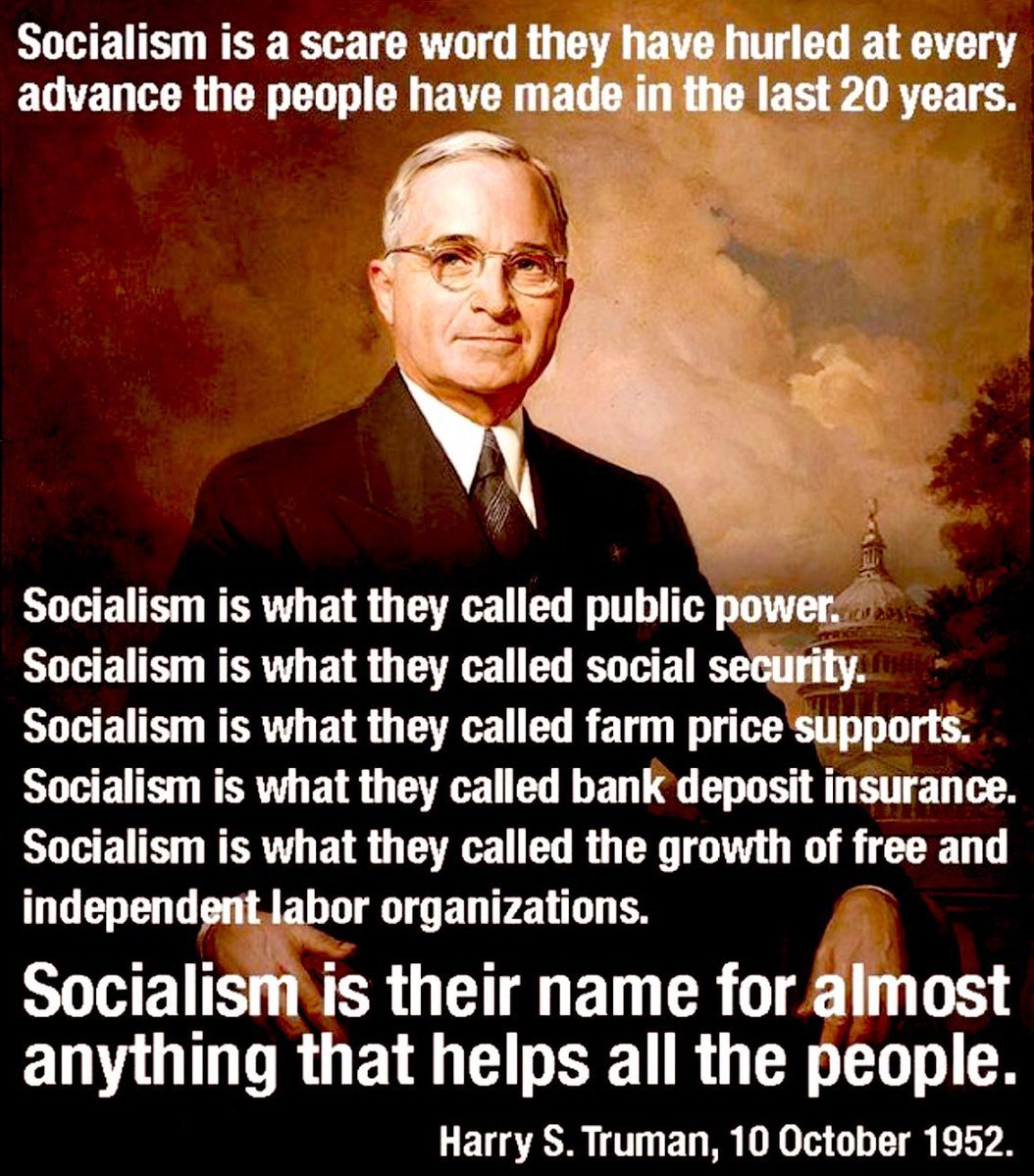
Conservatives dislike socialism because they believe it rots an individual’s moral character if the government smooths away a few obstacles in life. Going into huge amounts of debt for things like healthcare, education, and a home is character-building. This is a stupid belief, yet it persists.
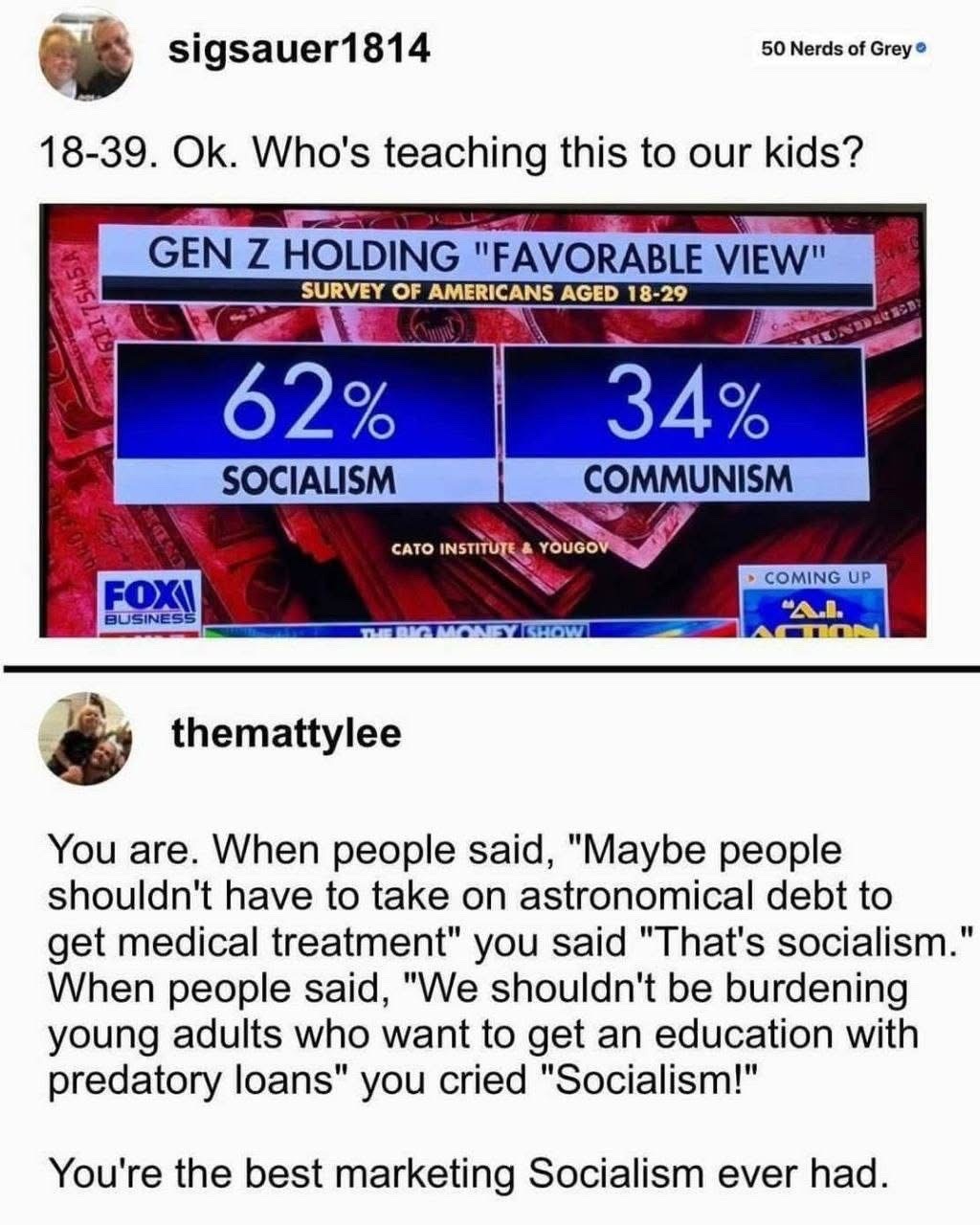
In this meme I found on the Internet and made zero effort to check for accuracy, Fox News is reporting that the younger generation is beginning to approve of socialism.
The anti-socialism propaganda is so intense that people believe that we, the U.S. of A., the most economically powerful country in the world, cannot afford socialism. Plus, it wouldn’t work because as soon as you remove profit motives, everything sucks. All the time. Really bad.
And yet.
The U.S. Military as Socialism
If you join the U.S. military, you join a large, well-funded, mostly effective, well-organized socialist organization.
Education and Job Training
The military will pay for your education, whether through ROTC scholarships or the GI Bill. After you’re done with college, they’ll provide on-the-job training. Private companies will only hire someone with ten years of experience right out of college. In contrast, the military invests in education and training.
And let’s be real, most of the people in the military are just doing a regular job, but in uniform. I work with a veteran. She went to boot camp, did the Army crawl through the mud, learned to field strip a rifle, and then specialized in HR and spent all her deployments in a cubicle in front of a computer doing HR stuff. Once she retired from the military, she got a civilian job doing HR. Another veteran I know was a mechanic. He shipped out to another country on military assignment to be a mechanic and fix tanks and other big military vehicles.
The point is that the majority of people in the military are not putting their lives on the line by engaging in gun battles with the bad guys. They’re just doing a job that isn’t too much different than a civilian job. The military is a fabulous jobs training program, funded by taxpayers.
Healthcare
The military pays all your healthcare. ALL your healthcare — there are no deductibles or co-pays. Not just for you, but for your dependents. Military healthcare is socialized healthcare. The military employs and pays the doctors. The military builds hospitals where it needs them. The military will pay for medical school, nursing school, medical assisting school for recruits. The military is not only single-payer healthcare, it is single-employer healthcare.
Housing
The military makes sure its soldiers and officers have somewhere to live. The military builds a bunch of housing, or it provides a housing allowance if someone wants to live off-base.
Why the Military Works
This post should be a book. Obviously I’m skipping a lot of detail. The ideas on why the military functions as effectively as it does deserve at least a hundred pages of analysis but I’m going to keep it to a couple of paragraphs. When I say the military functions effectively, what I mean is the military takes care of its own. It doesn’t really win wars anymore, and it’s never turned a profit [fn 1]. As a jobs training program that provides healthcare and housing, the military does a good job.
No Profit Motive
The military is not run to make the people in the military rich. The socialized healthcare works because the military isn’t turning shareholders into multi-millionaires by overcharging for premiums and then denying care. American healthcare is crazy expensive because the premiums we all pay don’t just pay for medical care, they also pay to turn healthcare executives into multi-millionaires.
Salaries in the military are rigidly regulated. I looked up the basic pay tables. An officer with 18+ years of service earns four times what a brand new enlisted soldier earns. So (making up numbers) if the newest newbie earns $65,000 then the most experienced person in charge earns $260,000. That’s very different from private companies. For example, this health insurance CEO is making over $20,000,000 annually, which is 278 times the amount that an average employee at his company earns.
Idealism and Respect
Reasonable salaries attract a certain sort of person — an idealist who wants a job in order to make the world a better place. The military (and federal employment in general) is full of people who believe that what they do is important. Not everyone wants to grind out their days making a rich guy richer in the hopes that someday they will also become a multi-millionaire by exploiting others. Pay someone enough to live comfortably and competent idealists will apply for jobs that are designed to help people.
Who would run socialism programs designed to spread healthcare to everyone? And education and training and housing? We could start by hiring the military personnel who did these jobs for the military. Don’t hire rich people whose only real skill is getting richer. Hire former military and let them find others with an idealistic spark.
Respect the people in the system. Propaganda has encouraged a lot of hatred towards anyone that needs help. If a soldier becomes disabled and is medically discharged, the government doesn’t cut him off entirely. Some benefits remain. Everyone deserves respect and everyone, at some point in their lives, is going to need help [fn 2].
The Religious Connection
Clearly, government-led socialism functions well enough to meet peoples’ needs; it doesn’t rot your moral character; and even conservatives are happy to have their tax dollars support military socialism.
Why doesn’t religious communalism last? Why didn’t the United Order work? Why didn’t all the hippie communes (not religious) that sprang up in the 60s last? The earliest Christians tried a communal lifestyle (Acts 4:32-37) and it didn’t last.
Frankly, I don’t know; that isn’t a topic I’ve studied. The lack of structure is a huge factor, I would guess. Socialism requires strong guidelines and guaranteed rights. You can’t just rely on “everyone should help everyone else” because it’s the right thing to do. The military has strict rules and procedures; socialism needs those. A government can make socialism work but a religion cannot make communalism work.
Another factor is that too much power cannot be vested in one individual. The Peoples’ Temple practiced communalism, but then Jim Jones made everyone drink Kool-aid. I read Raven: The Untold Story of the Rev. Jim Jones and His People. He was a dictator who could not be questioned and that really messes people up. Religion is too prone to trusting one individual too much and so the whole system collapses when one person collapses.
Conclusion
America wants its military to be trained, educated, healthy and housed. Therefore, we taxpayers invest in these areas. The thing is, all of society is stronger if these benefits are available to all people. One of America’s strengths is a highly educated and trained workforce. A healthy population works harder and for more years. Housing for everyone keeps the crime rate down and makes cities safer and more pleasant. There is simply no downside to providing these basics to the entire population.
As for the cost, well, Americans already pay enough in healthcare premiums, student loan debt, and outrageous housing costs to pay for these goods twice over. The free market economy doesn’t work well for things that are life necessities because demand isn’t flexible. Opportunists and exploiters are wringing unfair profits out of ordinary Americans. Leave capitalism intact for goods that really do respond to market pressures and remove the profit motive from housing, healthcare, and education.
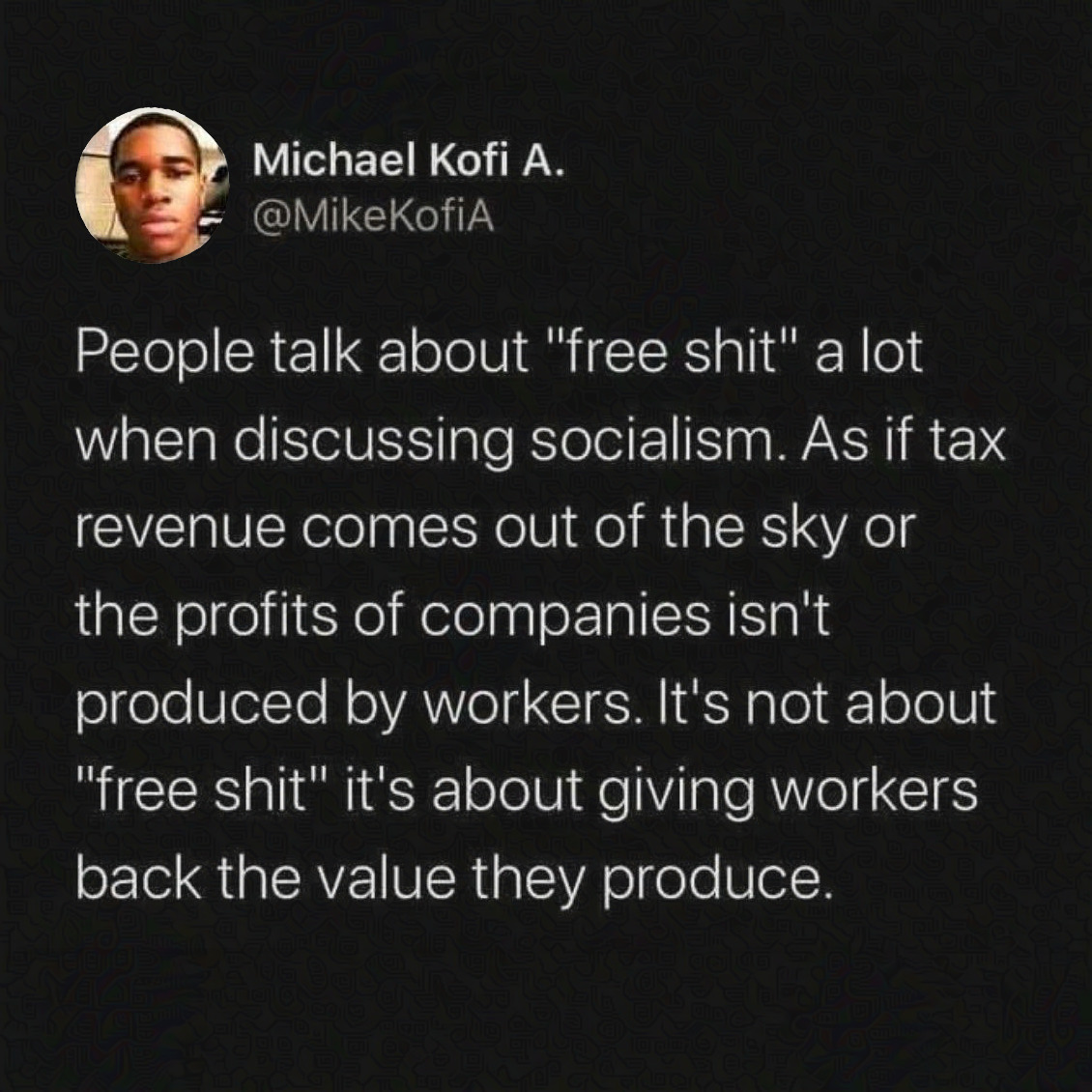
Freeloaders? The fear of poor freeloaders is vastly overblown. The real freeloaders on America’s economy are the health insurance executives who are being paid $15,000,000 to deny claims and increase premiums. The real freeloaders on America’s economy are the private investors who buy single-family homes and drive up prices. The real freeloaders on America’s economy are the mega-rich.
[fn 1] Why do conservatives get upset the post office doesn’t cover its own costs on what it charges? The military doesn’t cover its own costs either.
[fn 2] I’ve posted occasionally about my son who has some special needs. He’s unlikely to ever work 40 hours per week because he doesn’t have the emotional and mental stamina. He’s also unlikely to ever qualify for Medicaid or disability payments under Utah’s rules. I don’t need my tax bill cut; I need to know that my son will be able to go to the doctor after I die, even if he isn’t working full-time.
Questions:
- Okay, yeah, the religious connection is pretty weak in this post. Jesus was very concerned with healing sick people. Despite being a carpenter, he never did a miracle to build a house. He also never did a miracle to get someone a job. Why do you think Jesus didn’t spend much time dealing with people’s physical needs? Sure, he fed everyone at least twice, but he also criticized people for following him just for bread and fish.
- Do you believe that making healthcare, education, and housing easier will really rot someone’s moral character? If a government spreads around resources so these basic needs are met, are they really “doing everything” for people? What other challenges do people still face even if they have healthcare, housing, and education?
- Should religions try to meet these basic economic needs? Why or why not? Is it dangerous to require people to believe and do a certain thing before they can access healthcare, housing, and education? The military requires obedience. Is that as dangerous as religions that require obedience? Why or why not?


“A government can make socialism work but a religion cannot make communalism work.”
That, and paired with your observation that “you can’t just rely on “everyone should help everyone else” because it’s the right thing to do” seem to be fundamentally why. (1) socialism by the government works because of the big sticks it has – economic, and yes, force; (2) religion really SHOULD be focused on the “because it’s the right thing to do” angle, otherwise we’re in the “I’m going to make you do what’s right if you like it or not” territory that we LDS love to talk about regarding why Lucifer fell. And we are really lousy as human beings in choosing something consistently because it’s the right thing to do, which I assume is largely why we are here on earth to begin with (to learn by practice how to get marginally better at making those kinds of choices).
OK, my first reaction as I started reading this, was something along the lines of, “Not our experience with the military.” As with other countries who have socialized medicine, housing, and education, it is not always as promised. There was a continual housing shortage. Every single base has a huge housing shortage. In our 20 years with my husband active duty AF, we lived in government housing, maybe 2 years of that and 10% of your population housed is not a good housing record. The wait list was just too long to even get in when the AF has you moving around 20 times in 20 years. There were doctor shortages where we had to go off base for medical care and had to pay for insurance and then pay a copay. When you could go on base there was zero choice of who you saw. If you happened to be stationed away from a base (3 years out of 20) there is insurance you can pay for and a copay to see the doctor. And heaven forbid you have an emergency away from home because off base care has to be authorized in advance so you have the insurance. Cheaper to hire a medical helicopter to take you home.
So, socialism has issues. England and Germany both have issues with long waits for medical care…..but then my husband is currently w….a….i….t….i……n….g to get care because the doc is book six months out. Just sitting around is such pain that life is totally suspended because he has to wait.
But, you know with all the problems with our military medical care, it is still 100% better than what y’all have outside of the military. We are SO thankful we made the decision to stay in for the 20 year retirement.
Of course, my husband still has nightmares about military stuff. And he never saw combat because his field of work was electronics behind the lines. My son in law had combat injuries that caused terrible pain years later and essentially killed him years later. So, like any socialist dictatorship, the military has HIGH obedience costs.
But with Democratic Socialism the government stays elected and if the checks and balances are kept in place, then you get the best of both.
With capitalism you get an oligarchy eventually. And currently in the US, the very rich are buying the candidates with “campaign contributions” which have become bribes by another name.
As JCS says, Abraham Lincoln once said, “Democracy is a bad form of government, but all the others are so much worse.” And yeah, I am pretty sure that it wasn’t Abraham Lincoln who said that.
But let me modify it. Socialism is a bad economic system, but all the others are so much worse.
The military puts people out on the street whe they decide they don’t contribute. Get overweight? discharged. Can’t work with others? Passed over for promotion and must leave. They take care of those they choose to take of. US Army, honorably discharged, Afghanistan. If you don’t carry your weight, you are out.
Maybe there is a church connection after all. When Social Security was being proposed and debated, perhaps its most ardent opponent was the president of the church and the Lord’s prophet, Heber J. Grant.
Janey,
Any comparison to the U.S. military has to take into account a few things. First, large as it is, the military is still a very small slice of the American public with approximately 1.3M active duty. There are another 770k Guard and Reserve members who generally do not receive the same benefits that those on active duty receive (unless called to active duty).
Second, a majority of military members serve one enlistment, with many of those being separated in the first year of service. On pure numbers basis, the number who go on to serve 20 years and retire is fairly small at around 20% (higher for officers and lower for enlisted). Part of that is the “up or out” scheme for advancement. If you fail to get promoted, eventually you are forced out of the service, often before you are retirement eligible.
Next, service members are compensated because they give up a significant amount of control over their lives. They have to wear uniforms, conform with very conservative appearance and grooming standards and have to regularly pass physical fitness tests. They also do not control where they live or what their job will be (outside of maybe selecting there general career field). They are required They certainly have legally-enforceable curbs on their ability to express political opinions. They also are subject to being deployed to not so nice places on short notice, regardless of whether they will be working in an air conditioned office when they get there (and even “fobbits” and “POGs” are in harm’s way in a combat zone – just ask those who were in Kuwait and Qatar during Epic Fury). And undergirding this system is a legal framework that can punish them for failure to comply with all these requirements.
So yes, while the government does provide pay and benefits to military members, it is very much in exchange for compliance with a very strict and rigorous set of requirements that are absent from most every socialist government arrangement that I can think of. Thus I’d recommend that any analogy of socialism to the military is not really that helpful to your argument.
Adam F – yes, well-stated. A government has authority that a religion does not.
Anna, I loved this line: ” Socialism is a bad economic system, but all the others are so much worse.” Yes! Everything is going to have gaps and challenges. Also, I am wondering how long ago you were in the military? I understand that military healthcare used to really suck. Then they fixed a lot of it. I was married to the military 20 years ago and had my babies in non-military hospitals and they cost $0 out of pocket. Our baby needed a surgery that was also $0 out of pocket, and done at a non-military hospital. I also have a close family member who, 20 years ago, was diagnosed with cancer. He was the military person in the family, not a dependent. His cancer treatment cost them $0 out of pocket. The military put him on special assignment so he could take the time off that he needed. His wife, a SAHM, did not have to go back to work to find a job with health insurance or a paycheck. He spent months doing surgery and chemo, all on the military’s dime. It worked; he passed his physical and remained in the military until he wanted to retire.
And about housing — even if you can’t live on base, the military pays a housing stipend that gets bigger if you have more dependents.
Georgis – my military XH failed his physical and they put him on a remedial physical training regimen and he passed it the next time. I mean, they don’t pitch you out on a moment’s notice. He did eventually get passed over for promotion and asked to leave, but that was at his 20 year mark. He took with him his education, his experience, twenty years of consistent medical and dental care (no student loan debt and no medical debt; none; and that’s huge in today’s world), and a really great experience for his resume. Sure, the military can fire underperformers, but it isn’t an ‘at-will’ employment thing like you get in private employment.
Not – your comment is correct, but misses my point. My point is that the US government can and does pay for education and healthcare for loads of people and could scale that up to society in general. That ability, willingness, and all the benefits it creates can be carried into other contexts, like the civilian world. I’ve got a co-worker whose son joined the military because it would pay for medical school. The military rules for him are VERY relaxed (I hear that medical officer basic training is somewhat of a joke) and yet there is still a mutual benefit for the military and the med student to team up. I understand conservatives hate the idea of the government improving peoples’ lives, and the only way they can stomach the socialism that the government provides for the military is to look at all the freedoms they give up. This attitude needs to change. It’s okay for the government to support and help non-military people too.
Capitalism needs poor people who work for barely survival wages. Little more than slaves earning their masters mega bucks. Like the old coal miners in that folk song. “ You load 16 ton, what’d ya get? Another day older and deeper in debt.” Because they could only shop at the company store, which had jack up prices, but they could buy on credit, and the system was designed to keep them in debt and having to work for the poor wages offered. Capitalism is a system that is designed so the rich get richer and the poor get poorer. The rich have money to invest and that money earns them more money, off the backs of the working poor. It is barely better than feudalism where the rich own the land and pay high rent while they do all the work of farming that land.
The unions tried to fix that, but the unions have been limited by mostly Republicans. So, our system stays broken
The military socialized medical system works because of the tight control and ownership of the people and they do not allow in anyone with medical issues to start with, and the military life just doesn’t work with anyone with special needs. We had friends who got out because they had two kids with congenital heart problems. While the expensive surgeries were covered, his wife could not move with him because of the babies and their multiple surgeries. He got a good job for the military industrial complex. Another family in our ward got out because they had autistic children who just couldn’t handle the moving. If you are obese, diabetic, or have any other long term medical condition you do not make it in to start with or get discharged as unfit. So, the system kind of screens out the worst of the medical care, which a system for everyone cannot do.
But then under capitalism our insurance also screens out the unhealthy by restricting prior conditions. Which leaves the disabled stuck on Medicaid. I had social work clients who were able to work full time, but still could not get off Medicaid because of pre-existing conditions, so they HAD to stay poor by only working part time.
Janey, we have been out since the early 90s. We got out just before they “fixed” the medical for active duty by taking it away from the retired military. See, when we were in, we were *promised* we would be covered free for life with the retirement. But by the time we retired, we are paying a monthly for insurance that is still cheaper than paying full price insurance, and that covers pretty much everything. So, probably we were still active duty for the worst of when it got shitty and the promise of it being for life was broken. Now at over 65 with Medicare, that insurance covers things Medicare will not cover and we get cheap but not free medications. So, what we pay out for medical insurance is better than any private insurance and sure as heck better than my children have and actually covers stuff instead of denying anything possible. My insurance is still better than any of my friends have on top of their Medicare, and we do not have to pay to supplement Medicare and prescriptions are about the same for those with insurance or Medicare supplements.
So, the way Congress “fixed” the military medical by taking it away from half the people on it and putting them paying for insurance……well, that is another place your comparison breaks down.
So, I am not complaining. Compared to anyone else, it is great. But the promise of it being completely covered was broken repeatedly and now we pay a monthly for insurance.
But we didn’t exactly recommend that life for our children. Although our oldest seems to be fatally attracted to military members, but she divorces them over it, so there’s that.
Our system is broken and Trump is proving just how broken it can be when the oligarchs elect someone to lower their taxes while running up the deficit faster than anyone else ever dreamed. My 2nd daughter is having to declare bankruptcy because of her wife’s medical debt and the whole time they were married she had insurance. Our system is broken when my doctor brother retires early because as an emergency room doc the hospital reduces his pay to earn more for shareholders. Most doctors want socialized medicine because they see how broken the system is.
So, yeah, I’m a Democratic Socialist
Socialism has a strict definition and many loose definitions. The strict definition is communal / government ownership of property and the means of production. By the strict definition, most of what Truman labels as Socialism is not. Truman himself was not a Socialist so it appears he is responding to political critics and voicing support for public works..
The USA as a general rule is not a Socialist country for the simple reason that private ownership of property is the norm. So while the government, via the will of the people, imposes taxes, what is taxed is profits / earnings and property owners are free to use their labor and property as they choose. That said, some local, state and even Federal government programs are built on Socialist ideas and in certain situations we see open Socialists advance Socialist programs.
Publicly funded programs are not by definition Socialism. A library is a public program usually supported by taxes. The program provides a common good. However, people are not forced to use the library or restricted to only obtaining books and media from the library. The library coexists with private firms who offer much greater choice and services than does the public library.
The military / defense department is unique in that it claims monopoly power to legally kill and destroy the property of other nations. In World War II, the the US military effort had a very large footprint in the country with great numbers of citizens and manufacturers enlisted to support the war cause. Yet even then the effort was not Socialism – for while the government directed large amounts of economic activity to the private sector, it did not claim ownership of property. Interestingly, one of Truman’s unpopular mistakes was his attempt in 1952 to have the government seize steel production.
There are many social and economic positives associated with the US military program. Defense spending is in fact a great subsidy to the upper middle class as it is through this spending that many engineers, mathematicians, scientists, etc are employed. The military provides opportunity to many people who otherwise be stuck in poverty. However, military spending is expensive. Very expensive. The USA has been able to support its military spending mainly because the rest of the world has been willing to lend the USA money!
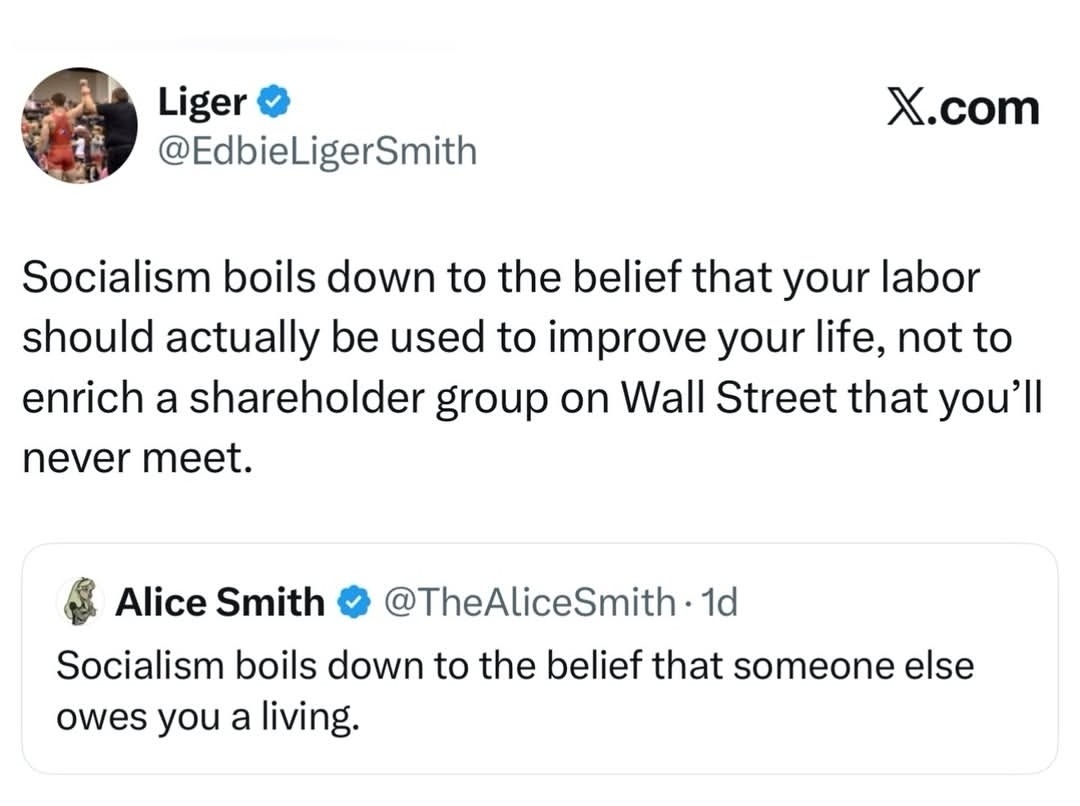
In any case, what I see in Janey’s article is a conflation of what Socialism is in order to argue that Socialism is good. Observe that Janey and those advocating Socialism don’t use examples of actual Socialism – for positive examples of Socialism working are rare or contrived. The X quote by “Liger” perfectly captures this duplicity. Liger says that “Socialism is the belief that a person’s labor should improve their life.”
Great quote! Except this is not Socialism. In Socialism the state owns your labor and production. What Liger argues is for free-market enterprise. Liger argues the Declaration of Independence that we each are free to pursue Life, Liberty and Happiness. Being opposed to corporatism IS NOT SOCIALISM. In fact, Corporatism is a pathway to Socialism as the more one has of both, the less freedom the individual has to enjoy the fruits of his labor.
Janey,
My point (sorry for my username not being complete in the previous post) stands that the military is a small slice of the public and the government struggles to provide needed care even then (as Anna points out). Suggesting that that is proof the government can, let alone should, provide healthcare, housing, and direct control over wide swathes of the U.S. economy to a public of some 400 million people is a stretch (and just a point of rebuttal, ask your co-worker’s son what would happen if he decided he wanted to grow a beard just for the hell of if or refused to deploy because his wife was having a baby – yes, medical corps initial training is notoriously easy, but they still have to put up with all the crap that everyone else does – docs and nurses can and do get court-martialed).
As another point of rebuttal, the NHS in the UK is struggling mightily to deliver care despite having a near monopoly on healthcare in the kingdom. In fact, according to several reports, many British healthcare providers are relocating to the U.S. citing better pay and working conditions. The UK has slashed its defense spending in recent decades (it was over 7% of GDP in 1960, 4.1% in 1991, and is just above 2% today) and redirected much of its spending to social programs with NHS being the prime beneficiary. Even after the Thatcher reform law passed in 1990, NHS still accounts for 40% of all gov’t spending, and yet Britons are getting worse healthcare. And you want that here in the United States?
A Disciple — I think your narrow definitional point is correct, but it doesn’t do the work you want it to.
You’re right that “socialism,” strictly defined, is collective/state ownership of the means of production, and that most of what Janey describes isn’t that. You’re right the Liger quote isn’t a definition of socialism, and that opposing corporatism isn’t socialism either. Granted.
Two things. First, this isn’t a hidden bait-and-switch — Janey said up front she’s using the colloquial meaning, “whenever the government tries to make life easier.” That’s exactly Truman’s usage in the meme the post is built around: he called “socialism” the scare-word aimed at public power, Social Security, farm supports, and deposit insurance. That’s been the ordinary political meaning for 70+ years.
Second: winning the definition doesn’t win the argument. The real question isn’t “is military healthcare technically socialism?” It’s “does collectively provisioning certain goods produce better outcomes than the market does?” That’s empirical, and the label just distracts from it. And the flagship example cuts against the strict framing. Denmark’s own PM told Harvard his country is “far from a socialist planned economy” — it’s a market economy with a big welfare state. So the thing Americans actually fight about isn’t capitalism vs. socialism; it’s how large the welfare state should be inside a market economy. Janey says as much: leave capitalism for market goods, decommodify healthcare/housing/education. That’s social democracy, not state ownership of production — so the strict definition is a red herring in both directions.
On the “we can’t afford it” worry: the U.S. already spends ~17-18% of GDP on healthcare, about $14,800 per person—nearly double the average of our peers— and still posts the lowest life expectancy of any wealthy country. We’re paying the most for some of the worst results. So I’d flip your closing line: it’s not that Janey conflates socialism to make it look good. It’s that “socialism” has become such an elastic scare-word that anyone can define it to win. The honest debate is about which goods markets handle well and which they don’t—and that’s settled by evidence, not vocabulary.
The problem, A Disciple is that just about everyone here is responding to the practical, current use of the word “socialism” as used by . . . Republicans. So, there’s also that. Conservatives mislabel socialism more than those on the left if for no other reason than they use it more (to connect all sorts of things they don’t like to ‘socialism’). They use it to generate fear for things that are not socialism. In the long run, it will hurt them, because the left will then say, “Okay, if the right call [x] socialism, and the public wants/supports [x], then let’s show how ‘socialism’ isn’t really that bad.” And then people who might not otherwise support socialism can end up supporting it.
Socialism has long been a dirty word in American politics, which is why it is used as a political criticism. Going back to FDR and his New Deal, the Socialist label became short hand for excessive government regulation and control. There was merit in this criticism. A government that claims the power to dictate who can grow crops and how much and at what price is a Socialist government for all intents and purposes – it walks like a duck and quacks like a duck.
When I google the question “Was FDR Socialist” the response is: “Franklin D. Roosevelt was not a socialist; he was a capitalist who explicitly rejected the socialist label. While his New Deal policies introduced expansive social welfare programs and government regulation, their primary goal was to rescue and stabilize the capitalist system during the Great Depression, not to replace it.”
Focus on that phrase “rescue and stabilize the capitalist system.” In 2008, as the Great Financial crisis took hold, President Bush justified a bail out of Wall Street banks with the phrase “I’ve abandoned free-market principles to save the free-market system.” A system that abandons free-market principles when the bill comes due is not a free-market system! A cynical yet accurate statement of American Capitalism is a system where gains are privatized and losses are socialized. The pattern is repeated over and over. Too big too fail is financial Socialism.
The economist Joseph Schumpeter predicted that Capitalism would be replaced by Socialism. Why? Schumpeter explained that the prosperity produced by Capitalism would create large, bureaucratic corporations who oppose economic competition. Prosperity would also make people comfortable and build political consensus for making those comforts durable. Observe that today we have Trump pushing universal investment in the Stock Market (and that the market will always go up) and Elon Musk promoting “Universal High Income” as a way of distributing economic wealth. Trump and Musk are Socialists! They will deny it. But if it walks like a duck and quacks like a duck …
Since Americans of all political persuasions and economic classes actually like Socialism, why is Socialism such a dirty word? I think it is because Socialism is fundamentally a lie. People only want the good parts of Socialism. They want the safety and security Socialism promises. But they don’t want the controls and oversight and uniformity and they don’t want to pay the cost for it. Socialism is desirable as long as what one receives is greater than what one puts in. Invariably, the costs catch up and thus begins the contest of deciding who pays the bill.
Janey: out of all of the articles you have written over the years (and true, I’m sure that I’ve missed some) this is – most likely – the one I consider to be most filled with absolute bunk: and is nothing more that a brazen attempt to defend the indefensible – all with the most “beautiful and compassionate words”.
Personally, I think the “battle lines” are becoming ever more clearly drawn between the Democratic Socialists and those who truly love freedom and personal accountability.
I’ve already chosen which side I will be on: and will most gladly fight against this cancerous rhetoric which represents nothing more that Societal Suicide.
No, I will not wish you well on this one.
Part of the difficulty in these discussions is, of course, terminology. Democratic Socialist countries like those in Scandinavia are doing well and better than the US on most measures. Conservatives like to point to places like Venezuela. Trolls like grizzerbear are deep into capitalist propaganda about ‘freedom’ and ‘societal suicide’ and ‘personal accountability’, which is clearly ‘bunk’ (his words) put forth by the forces that capitalism favors: hierarchies built on power and money by the elite (which somehow, people like him think is really for the ‘little guy;’ how gullible to believe the morale of selifishness permits the powerful and wealthy to allow room for little room other than to maintain the illusion). Capitalism tends towards greater inequality between classes. Clearly he has little more than vapid, vacuous comments, as always to contribute.
A Disciple, on the other hand, of course, continues to carry his air of sophistication and argument, but also fails to offer more than slightly more educated takes–always without much consideration or education of the other side. What you write, A Disciple, is the learning of socialism provided by capitalist overlords. In fact, socialist democracies resemble nothing like you suggest. Of course, you want to argue about pure socialism, as if that is the discussion. Nordic countries have a system where the people have decided that they would prefer to pay higher taxes in exchange for societal, collective benefits and to avoid the problems of inequality, unregulated markets, and uncertainty. That you don’t like it, fine. But to call it a lie, is stupid. We can all write trash like: ‘Capitalism’ is a dirty word for those on the left because capitalism is a lie. It takes away choice from the masses and enslaves them. Stupid and simplistic, ike what you wrote.
To add to the discussion from this point forward, instead of addressing the trolls: one thing to address is the frequent conservative argument that people receiving things for ‘free’ leads them to be lazy and ungrateful and whatever else. To the believer: is that how you treat the atonement? And to them and everyone else: is that really how you behave? When someone provides you with something you don’t earn, do you get upset at them or attempt to take advantage of them? Perhaps your argument is projection about your own selfishness.
To counter: 1) when I lived in Ireland, I paid high taxes there. When my son was born, we were on their national system, which meant everything (pre and post natal visits, even at home) were paid for by the system. Result? I still feel 20 years later a great deal of loyalty and gratitude for the people there who established a system that takes care of everyone, even imperfectly.
While living in England this past year, my wife and children were also part and benefited from their national health system. Two emergency room visits in four months. And the phrase I kept hearing from the English (who are having their own economic troubles right now, with the consensus being because they left the EU because of the lies of the conservative capitalists about freedom, etc) is that though they don’t like their health system, they would never give it up.
TLDR: real discussion can happen, but not with hardcore capitalists, apparently. There’s a reason for that.
A Disciple,
So, I’m not clear on what you think socialism is then. In your first comment, you defined it strictly as the gov’t/collective owning the means of production. But now you’re saying “walks like a duck and quacks like a duck” which is now closer to what Janey is saying. The New Deal, 2008 bailout–that is not state owned production and therefore not socialism by your strict definition. Instead, that is the “government tries to make life easier” approach which is colloquially called socialism–what Janey is describing. I agree with you, bailing out the rich when capitalism fails is a crappy form the colloquial socialism. But “wanting benefits without paying” is not unique to socialism, that describes all democratic fiscal politics. Here in Lehi, not a day goes by without a conservative decrying some fiscal city policy while also saying there should be some accounting voodoo that makes it so we the tax payers don’t have to bear the burden of something we obviously want but don’t want to pay for.
The other thing that muddies the water when talking about socialism is that absence of talk about the central planning methodologies. I think when conservatives talk about socialism, they are almost always talking about authoritarian socialism. But there lots of other options for central planning were it could be effective. I personally think adhering to a single ideology as the “only true and living” ™ methodology for economic and governmental success has generally led to disaster. I mean sure, capitalism worked well for a bit in this country, but we are way past that now such that wealth is now consolidated in the top 10%. I think the capitalist US has more to worry about in “the bill coming due” than other countries like Denmark, Sweden and Norway which run some very success and large welfare based programs.
grizzerbear55, do you actually see “personal accountability” evident in the contemporary expression of conventional capitalism in which the 1% consistently squeeze out the middle class and substitute oligarchy for democracy?
Two thoughts:
It’s extremely bizarre to me that grizzerbear55 insinuates that the Venn diagram of people with freedom and people with socialist programs like universal healthcare is zero when it is in fact far from zero. Well over 100 other countries enjoy freedom, and many of them also enjoy universal healthcare. And Mormons supposedly love freedom and also seemingly love free healthcare. Source? Bishops of BYU student wards encouraging college students with no jobs and no insurance to start families under Medicaid/CHIP and voila, babies with no copay. Who pays for that I wonder? It might be you, grizzerbear55, funding healthcare at the direction of church leadership. How’s that for freedom?
Regarding comments about UK doctors fleeing for higher wages in the US, source? My understanding is that Brexit made it difficult for doctors from the EU to continue practicing medicine in the UK so some of them went home to their EU country and probably some of them came to the USA. So Brexit, that idea that the UK couldn’t possibly share resources with the rest of Europe, has caused their healthcare resource shortage. The US had the opportunity to learn in real time the consequence of being bad neighbors, but it seems we decided that FAFO would be more fun.
YMMV.
chrisdrobison,
Appreciate that I am not trying to define for others what Socialism is, but rather I am trying to make sense of the political conversation. The thoughts you share in your latest comment are consistent with my views.
Brian,
State ownership of capital AND profits has always failed to deliver prosperity. The great lie is to claim that Socialism just hasn’t been tried the right way. Nope. No nation will prosper if it denies its people the freedom to enjoy the fruits of their labors.
All,
It is obvious why Republicans throw the Socialist label at Democrats. What is interesting is the ebb and flow of Democrats accepting or denying the label. Lately, a faction of Democrats is embracing the label and this makes one wonder: If in the view of Democrats, the ideal nations are the Nordic countries, and if the Nordic countries are not Socialist, than why are American Democrats saying the USA should be Socialist like the Nordic countries?
The accurate political argument is that the USA should increase its taxation in order to support an increase in social services. The problem is that the American people as a whole continually vote against this idea. So the simple answer as to why the USA cannot be like the Nordic countries is that Americans don’t want to support the level of taxation required to have public services at the level offered in the Nordic countries.
The more complete answer is that the Nordic countries are very small, culturally homogenous populations that have a tradition of paying a high level of taxes to support a high level of public services. The USA as a nation does not have this culture or tradition. However, some states and cities do offer a higher level of services in exchange for higher taxes and American are free to choose where they live.
chrisdrobison – thank you for your well-stated contributions to the discussion. Your replies to Disciple were spot on, and better worded than I would have said them.
Yes, I’m using the word “socialism” to describe any time the government makes life easier for ordinary people, including low income people. No, I don’t consider socialism to be a dirty word. That said, I’m not actually a socialist. My preference is for a capitalist system for things that are optional (sports, entertainment, the diet industry, cosmetics, computer games, fancy cars, vacations, etc.), with a big welfare state that removes the profit motive from life’s necessities like healthcare, housing, food, and basic education. The key is removing the profit motive. The government doesn’t even have to provide the benefits directly. Just pass a law that says all healthcare and health insurance has to be non-profit and CEOs can’t make more than four times more than the lowest paid employee. Leave it in private hands, but remove the profit motive. Same with housing. Same with vocational training and community college. Remove, or cap, the profit motive.
Not many have talked about education in the comments. The government provides a free K-12 education because the benefits of an educated population are so great. The job market now typically demands greater skills. Expanding the free education and training would benefit all of America generally, as well as the individuals who receive the education and training. Having the government make education cheaper and more accessible benefits everyone. Even if you don’t personally go on to take the education directly, you’re benefitted by having so many educated people around. After all, we want educated and trained people caring for seniors, rather than just sending around a robot with a pile of pills around the rest home.
I don’t watch or listen to conservative propaganda, and I think that’s why I am so absolutely confused about why conservatives think it’s somehow bad for the government to make life easier, better, smoother. Like, the government’s purpose should be to make life harder? That’s what these past couple of years have been. Government has made life harder for women, gays, the disabled, veterans, federal employees, immigrants, recent graduates, retirees, the working poor, the working middle class, people of color. Yay! The conservatives got what they wanted! That makes no sense to me at all. Government is of the people, by the people, and for the people. The government should be a collection of people (us) who are motivated to spend their life in public service to help make the economy function smoothly, protect the vulnerable, build infrastructure, provide clean water and clean air, educate, research, improve. Government is supposed to DO GOOD. And conservatives call that ‘socialism’ like it’s a dirty word.
If there’s evidence capitalism promotes personal accountability I’ve never seen it. As far as I can tell it punishes people for being poor regardless of the reason they’re poor and rewards people for being rich regardless of the reason they’re rich. That’s not accountability.
What capitalism does teach in practice is that rich people should not be held accountable for the harm they do other people. For example, no doubt if a group of poor people decided to kill more than 1000 people, grizzerbear55 would be calling for their blood. But instead a group of rich people decided to cause the totally preventable deaths of over 1000 people and you can see him in the comments of a post just this week laughing at the distress of the victims.
Literally cooking a continent to death sounds like Societal Suicide to me, but it seems like in his mind the profit motive makes it ok.
I don’t know how we get from where we are today, where capitalism is apparently an unchecked sacred cow to half the population even while it’s not working for them, to a better place. One thing I’ve long believed we should do as a country, though, is have a compulsory military service for everyone as they come into adulthood. 18 months is enough. It would compete with Mormon missions, and hopefully they would not get deferments. Nothing would increase our ability to work together with other citizens that this shared experience, and it would improve the skills of those who need a leg up and provide opportunities. I’m talking everyone, not just young men. There are jobs that can be trained and done regardless who they are within a system of discipline and service. Other countries do this. It has always made more sense to me than not doing it.
Hawkgrrrl,
I think I could get behind that if the military could become something way beyond this idiotic org that Hegseth has turned it into. We funnel so much money into the military. It would be awesome if instead of just training for pointless jobs (note: not all of them are this way) that have no equivalence in the real world or learning to fight, how about we put all that man power into, say, figuring out how to get manufacturing back into the US or food production or so many other things we need? Produce goods and services in some form for the country. And yes, this would disrupt the private contractor businesses that rake in billions from gov’t contracts because the military would be intelligent enough to do it itself and not have to pay obscene prices. That would certainly provide value beyond just sending people to be pointlessly killed. I would hope we eventually come to a place in this world where military posturing and action become less and less needful.
chrisdrobison: Absolutely! Yes, I’m thinking train them in things like engineering, programming, accounting, and other things–certainly not in toxic masculinity, misogyny and racism which seem to be the new DEI. Train them in how to fix roads. There could be some jobs in the education system even. There are so many projects that this country needs to bolster infrastructure. Also, fighting is mostly done by computer with drones now, and those skills are valuable and transferable. My dad served in the Navy in WW2, extending after the war ended to complete two years, then got his engineering degree on the GI bill after. He did no fighting at all in the war as he was on a very small supply ship. As he put it, he mostly “drank beer and swam,” but when he elaborated, there was some work involving logistics that gave him skills that were applicable in regular life.
Chrisdrobison – I am going to give you a “still, small” bit of latitude. You didn’t really just say that the US military is an “idiotic org?” I spent 24 years in it and I will tell you that whoever the SECDEF was did not amount to jack squat as to how the organization ran. A general officer in the US military does not get there without considerable time and sacrifice. There are still some really crappy General/Admirals in the US military that make it to that stage, but their sphere of influence is usually short and without lasting influence. But, I will say, denigrating the entire organization to idiocy because one “civilian” SECDEF (who is an idiot), shows your lack of understanding of the US military and how it is run.
Hawkgrrl – Again, I don’t always agree with your stances, I appreciate them all. I completely agree that every US citizen should have to do some military service. Nothing brings a country boy/girl together with an inner city boy/girl and helps them realize that they really aren’t all that different than a military organization.
A Disciple – You stated “The military / defense department is unique in that it claims monopoly power to legally kill and destroy the property of other nations.” That power does not rest with the military, it rests completely with the elected civilian representatives of the people. The military going to kinetic means, is a part of diplomacy that rests solely with civilian leadership in the USA.
17RRider
Before I respond to your points, some context, because “idiotic org” made me sound like someone sniping at the military from the cheap seats, and that’s not where I sit. I grew up in Colorado Springs, where the Army, Air Force, and Space Force all have a major footprint and Fort Carson and the Academy were basically part of the scenery. Most of the wards I grew up in had a few military families, I served part of my mission in a heavily military ward in South Dakota, and my brother-in-law served. A lot of people I care about have worn the uniform.
That closeness is exactly why I don’t see the military as one undifferentiated thing. The experiences the people I knew shared ran the whole range — some impressed me, and a few genuinely shocked me. It’s an enormous institution that’s run superbly in some corners and poorly in others. Naming the parts that don’t work isn’t a shot at the institution or the people in it — it’s the opposite. It’s taking them seriously enough to be honest about both.
So first: thank you for the 24 years. And you were right to call me on “idiotic org.” That was sloppy and unfair, and it swept in exactly the people who don’t deserve it. What I was reaching for was aimed at the leadership coming out of the top right now — not the competence of the men and women who actually run the thing. Point taken.
Where I’d hold my ground is the idea that a SecDef “doesn’t amount to jack squat” in how the institution runs. The office was created in 1947 precisely to make civilian direction stick, and history is full of Secretaries whose tone reshaped the force for a generation. Laird ended the draft and gave us the all-volunteer force. Rumsfeld pushed “transformation” and overrode Gen. Shinseki’s warning that Iraq would need far more troops — a call we lived with for years, and one that triggered the “revolt of the generals.” Gates fired a service secretary and a chief of staff over nuclear-handling lapses to set a standard. Leaders set the tone, and tone compounds — through promotions, firings, budgets, and what gets rewarded.
And that’s exactly why Hegseth worries me — not as an insult to the ranks, but because his actions are the tone. He’s renamed the department to the “Department of War,” pushed out a string of experienced senior uniformed leaders including the Army Chief of Staff, and personally intervened in a one-star promotion list to block—something rare for a SecDef. He even moved to recall a sitting U.S. senator to active duty for court-martial over political speech, and censured him with no right of appeal. My worry isn’t that soldiers are idiots — it’s the opposite. When you strip out the experienced leaders and reward loyalty over judgment, you don’t get a sharper force, you get a politicized one: a military that starts answering to a person instead of the Constitution. That’s the road that ends somewhere none of us want, and it’s bad for the country and bad for everyone in uniform.
Here’s the thing, though: I don’t think we actually disagree. You’re describing the organize-train-equip machine — the career corps that gives the institution its competence and continuity. I’m describing the steering wheel. The SecDef steers the ship and sets the weather; he doesn’t row. A bad one can damage priorities, promotions, and morale without making a single soldier an idiot.