
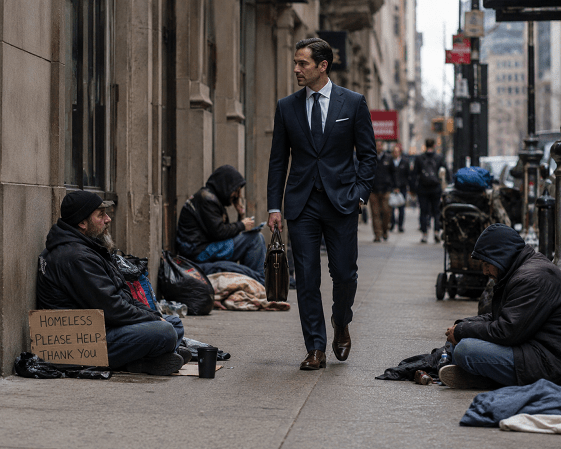
I just recently learned that the Church hires Behavioral/Cognitive Scientists in the correlation department. While this is not surprising in the least, I wonder how apologists would square this with a Prophet Seer and Revelator that can get answers directly from God. Putting on my apologist hat, I would say that the Prophet should study it out in his mind (use science as needed), then take those recommendations to God for his confirmation.
Back in 1967 two faithful Behavioral Scientists (Kendal Price and Kent Lloyd) held a very interesting training class for Stake Presidents in the Los Angeles area. You can read the full story in a 1967 volume of “Dialogue, A Journal of Mormon Thought” Even the name of the article was interesting; “New Approaches to Church Executive Leadership: Behavioral Science Perspectives“
There were some really interesting things that stood out about the class, and would never happen in todays correlated Church. The seminar was held on consecutive Saturdays spread over 6 weeks, for a total of 48 hours. The cost was $175 ($1700 in 2026 dollars), and ” had to come from personal funds, or very limited local Church resources”. So right away is was limited to very successful Stake Presidents. I really can’t imagine any current stake presidents forking over $1700 to spend six Saturdays in a classroom.
Price and Lloyd said that as the Church becomes more sophisticated, it will need trained leaders. They said that most Bishops and Stake Presidents are already successful in their business or profession, but needed further training in a rapidly evolving culture. They said: “to meet the expanding needs of a dynamic Church organization most leadership positions will continue to require people with both demonstrated commitment to Latter-day Saint values and an increasingly high level of technical skills. Thus the focus of the seminar reported here is on improving organizational effectiveness through executive leadership development involving behavioral science approaches to L.D.S. Church administration”
The objective of the seminar was:
(1) to obtain knowledge about administrative behavior and procedures and the applications of behavioral science to management problems facing Church executives;
(2) to acquire greater skills in interpersonal relations, creative use of executive time, reading, learning techniques, and scientific research;
(3) to build better Church and personal relationships with other L.D.S. stake officials, community leaders, and behavioral scientists;
(4) to participate in developing and authoring part of a seminar report analyzing administrative problems facing local Church executives.
The part that really blew me away was the below
Midway through the seminar a special field exercise called “Operation Empathy” was conducted to allow the participants to gain new insights into how others feel by acting out another’s role. This field exercise began about 4:30 P.M. on Saturday afternoon, when members of the seminar visited the “Skid Row” area of Los Angeles, where they purchased $3.50 worth of used clothing from local merchants. After returning to the University of Southern California’s Civic Center Campus, they changed their clothes and took on the appearance of lower class residents.
On this occasion, a special guest, Father Llewellyn Williams, a Negro Episcopalian minister from the Watts-Compton district, reviewed the history of the Negro poverty area before the 1965 riot in Los Angeles. During the discussion that followed, Father Williams complimented the Church on its activities, criticized its stand on the Negro question, and challenged its members to demonstrate community leadership by getting involved in two of the most critical social issues of our time—poverty and race relations. A number of participants took issue with his stimulating comments and observations in the exciting interchange which followed.
After the presentation by Father William the participants returned to the Skid Row area to mingle with people on the street for a short time and to visit one of the “Rescue Missions” in the area, where they participated in a religious service—singing gospel songs and listening to a fiery sermon. After the service participants joined about two hundred others in the simple meal that was offered. In discussions following this experience, many of the participants agreed that “Operation Empathy” had challenged their beliefs about the poor and the culture of crime and poverty.
Can you imagine any current SP doing the above? The conversation with the “Negro Episcopalian minister”, this being pre 1978 Blacks and the Priesthood revelation, must have been a something to be seen. I don’t think the comment that “a number of the participants (SPs) took issue with his stimulating comments” does justification on what really happened.
At six months after the seminar, in a follow up survey, one of the participants listed the following steps he had made to better manage his stake
(1) he has successfully completed the Evelyn Wood’s Reading Dynamics Program and now reads over one thousand words per minute with high comprehension;
(2) he has appointed a special committee of women to study L.D.S. girls and their marriages to non-members in the area, using certain techniques of survey research;
(3) he has appointed a behavioral scientist as his special assistant for executive training of stake high councilmen and ward executives; and
(4) he has sponsored and financed an overnight two-day executive leadership seminar for all six ward bishops and Melchizedek Priesthood leaders at an educational conference center. Subject matter dealt with behavioral science management techniques and methods of improving performance in Church correlation programs and activities at the ward and stake level.
Wow! It looks like the seminar may have worked for some of the participants. A special committee in the stake to study “girls” that marry non-members? Calling a behavioral scientist as a special assistant for training stake high councilmen and ward Bishoprics? Its too bad this could not happen today. They all sound like positive steps in making the Stake President a better leader, more sympathetic to the needs of his members.
What are your thoughts on the Church using behavioral scientist in the development of the curriculum of the Church, like the Come Follow Me manual?
What do you think of the seminar that was conducted for these Stake leaders almost 60 years ago? Should we bring back training like this for our leaders?


Train bishops and stake presidents. What a novel idea.
My husband was called to be a YSA bishop. He was handed keys, both physically to his office and spiritually by being set apart, and immediately after, the hall outside his office was lined with members who needed to talk to him. He missed supper that night and many Sundays thereafter. Finally, his executive secretary told people who had supper time appointments to bring him something to eat!
He spent up to 20 hours a week counseling with members on everything from how to balance a checkbook, to how to handle their sexuality, to who to marry. He is a wise man tuned to the spirit, but so much of his work as bishop was seat-of-the-pants decision making.
IMO bishops need training, and they need to be taught that there are limits to what they know, and when to refer/defer members to professionals.
This article raises an important question. Why is there such discrimination in the selection of bishops and stake presidents?
As the article points out, most bishops and stake presidents these days are selected because they have professional success. Doctors, lawyers, and such fill the ranks, with almost no plumbers or sheep herders.
If all it took to be a good stake president was business acumen, then Jon Bon Jovi should be next in line. He would beat them all under this theory.
Who did Jesus actually select as his leaders? Fisherman. Those He chose who had any business skills were outcasts and not winners of popularity contests like today’s bishops.
And, as pointed out by the first comment, bishops and stake presidents receive very little practical training. Being a good businessman does not automatically mean that one is a good provider of mental health services.
The system is unsustainable. Is it any wonder that today’s members would rather watch a hit dog eating contest on television than meet with their bishop? As Abraham Lincoln famously stated: “Hardly”.
A mission president gave a nephew advice during the concluding interview of that nephew’s mission: “Get an education in accounting, law, business or finance. Work hard and be successful. Then you’ll be much more likely to be called into a leadership position in the Lord’s Church.” Nary a word of consolation to the future teachers, nurses, scientists, artists, social workers, etc. They apparently don’t help build the kingdom and have the leadership skills that the business and legal professions offer,
Anon, that anecdote is as unsurprising as it is positively bananas! I mean, did this presumably orthodox, believing mission president forget that Joseph Smith was a poor, uneducated farmer?! Did he seriously assume Smith would have been a more effective Prophet of the Restoration if he’d had a JD or an MBA? For that matter, does be not remember that the Lord Jesus Christ whom he claimed to serve was a carpenter, his top Apostles fishermen, and that the only finance guy of the original 12 (he “had the bag”) was Judas Iscariot? Talk about losing the plot!
But of course what’s especially infuriating is that, given who generally gets called to church leadership positions, this mission president is not an outlier at all! These executive and finance types are clearly the ones preferred by Church HQ, that mission president wasn’t blind. Imagine if the GAs were overwhelmingly populated by, say, social workers, inner-city school teachers, EMTs, Doctors Without Borders, Peace Corp volunteers, assault-survivor advocates, car mechanics, carpenters, fishermen, farmers—or, if you have to have lawyers, Public Defenders associated with the Innocence Project? How much more effectively would the Church’s programs be designed and administered then, if they were by people who actually understand the folks most impacted by them?
But no, our church leadership is overwhelmed the same dull, bland brand of corporate finance types as the rest of the “world” they claim to abhor. We frankly deserve our current retention rates.
After reading the AI definition of a behavioral scientist, it sounds like they are meant to be using their expertise to protect and promote the LDS Corp, not helping those lay members who attend.
The lovely examples of some things that happened in the past, are in the past it seems! The current retrenchment is unmistakable. Did Oaks consult a behavioral scientist when he recently reiterated the “one and only true church upon the face of the whole earth” dogma?
I add to my previous comment about my husband’s time as a bishop. He was 33 when he joined the church so did not come to his calling with a lot of Mormon tradition and baggage. He could base his decisions on his own life experience and not on years of Mormon culture. I thought it made him a much better bishop.
See the 2019 book “Scan Artist: How Evelyn Wood Convinced the World that Speed-Reading Worked”. It’s on my bookshelf along with a book about Alex Haley and the artistic licenses he took, along with a printed version of the CES Letter.
This is a bit off topic, but I think this article/social experiment might be the origin story for the urban legend I heard at BYU in the 90s and a handful of times since then. The story goes something like this: a religion professor gets some people to cosplay people living on the streets or with signs asking for help. They are to be in strategic places his students would pass on their way to take their final exam. The pretend-homeless people were to approach students asking for help but, as the story goes, the student(s) at the center of the narrative are concerned with being on time for the exam and they rush by. The students who come to the exam on time immediately fail the exam because the professor said they should have stopped to help. Those who arrived late passed the exam because they had stopped. I have approximately 37.4 million problems with this story, but I will not rehearse those here. I’m just relieved to know that what I will now assume to be the original story was based in helping leaders gain empathy and not a lesson in objectifying others.
Athena: The origin of the story you have heard is likely a study conducted by John Darley and Daniel Batson in 1970 which was published in 1973. Seminarians were asked to give a short talk about either The Good Samaritan or another topic and then sent to another building on campus with varying amounts of time pressure (“you’re late” vs “they’re not expecting you for a few minutes”). Researchers observed how they interacted with an actor in distress, and compared their behavior to pre-event personality tests and post-event questioning. Among the results they found that the topic on the students minds did not matter, but the time pressure did. The test has probably been replicated over the years. The published paper can be found at the following link:
Click to access darley_batson_1973_-_from_jerusalem_to_jericho.pdf
Thanks, Dave W!