
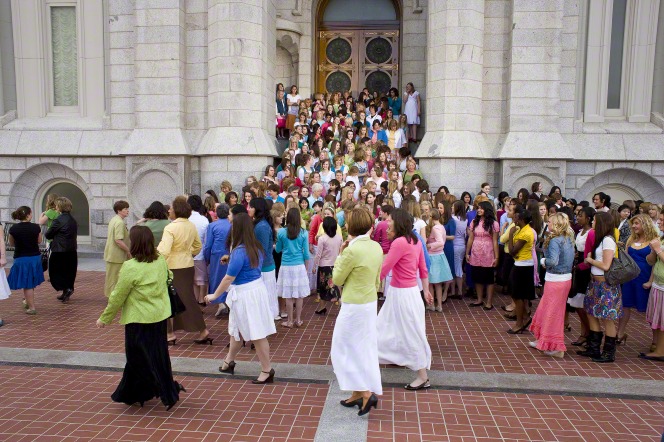
A post by Jana Riess over at Religion News Service is getting a lot of attention: “Why are so many young women leaving Mormonism?” Her discussion is based on a recent BYU Studies publication, which reports a lot of statistical successes for the Church in terms of church activity and engagement. The surprising data about significant declines in the retention rates of LDS young women shows up around page 28 of the BYU publication and isn’t exactly highlighted in the study.
Let’s start with the RNS article. First paragraph:
A recent article in BYU Studies called attention to two clear trends in the Church of Jesus Christ of Latter-day Saints in the United States. The first is that Mormons are succeeding in many ways — we pray more, attend church more and report being happier than most other Americans.
That’s the good news, if you measure success by these statistics. One could propose alternative measures of success for a church (truthfulness, candor, transparency, inclusiveness, being the One True Church, etc.) but that’s a different discussion.
Second paragraph:
The other trend the article noted is that markedly fewer people are staying in the church. We’re keeping about half, which is a big drop from what it used to be. We kept about 8 in 10 childhood members back in the 1980s.
That’s part of the bad news, but the same thing is happening in most other denominations. People just aren’t that into religion anymore. There is broad distrust for institutions, including religions. All the fiddling with missionary eligibility age is likely a response by LDS leadership to internal data showing this drop in retention rates.
Third paragraph, the biggie:
And the biggest bombshell? Women are now more likely to leave than men, especially if they’re younger.
Now that’s a real surprise, given the standard claim (which seems to be generally true) that women are more religious than men and are more likely to attend their respective churches, including the LDS Church. But the data reported in the BYU Studies publication are fairly clear: women have now have lower retention rates than men, especially younger LDS women. And there is a huge gap between older LDS women (much more likely to stay) than younger ones (much more likely to leave). What gives?
That’s the real question. If you accept the data as reported and analyzed (and five BYU PhDs are not likely to report this data if it was questionable) what is going on?
With reference to her own work on the topic, Riess offers some possibilities. “I have some ideas. Let’s boil them down to “three Ps”: young women are reacting against politics, purity culture and powerlessness.“
You can read the details in the RNS article — I won’t rehash them here, and those seem like reasonable suggestions. The trick, of course, is to find explanations not just that lead young LDS women to go inactive or even formally exit the Church, but to find causes that affect young LDS women dramatically more than they affect young LDS men.
I’ll invite readers to weigh in with their own experience and their own observations of family or friends. I’m at something of a disadvantage here, not being a woman myself. But here is one observation: a lot of young LDS women now serve missions, and the feedback I get is that almost all of them have a very positive experience. That ought to lead to more, not less, retention of young LDS women. Perhaps that effect is swamped by stronger effects in the other direction.
If you are really motivated, go peruse the BYU Studies publication as well as the RNS article. You can download the booklet for free.
So here is the question for readers. Put yourself in the position of a 12- or 14- or 16- or 18-year-old LDS young woman. What would lead you to lose faith in the Church or lose interest in continuing to attend as you become an independent young adult? And what changes would and could the Church in general or individual wards make to keep more LDS young women active and attending?
.


If you connect the dots there is one conclusion you can make. One dot is that a lot of women are leaving. The other dot is that those who are staying are more active. The conclusion is obvious. The less active ones are those that are leaving and had they stayed they would have dragged down the average. The Church isn’t doing better. It’s simply getting rid of those that make it look bad.
The article linked has some reallllly different confidence intervals for =50 yo women (55.9 – 74.0). The male confidence intervals line up, though.
So it’s probably safe to say that the survey can support a difference between women 50, but the magnitude of the difference is still pretty questionable.
As usual, there are lies, damn lies and statistics.
I am an old PIMO member and I stay for the community. If I were young, I would not join nor stay for the 3 P reasons. I tell missionaries that I will not encourage women to join. I agree that it looks like the church, rather than address our issues, is just willing to let us go. I think that when there is finally not a critical mass of women to do the work, the church will collapse.
The core issue is that the church doctrine and church culture make explicit that gender defines belonging in the church community. The functional reality that something that is generally untested (mainly the biological component of your identity) but is assumed as known (based on parental statements, personal statements, general appearance, and paperwork) defines what you can do at church, who your role model is, who gets to tell you what to do. There is a large cognitive dissonance scenario for women. On the one hand, we are represented as “helpmeets to men (and to the priesthood)” while being more aware of the chances for domestic violence, more aware of the need for dual breadwinners (and more women being the sole breadwinner – in case of death, handicap, disability, choice, career opportunities among men), and more aware of the kin-work and executive functioning under the “nurturing” umbrella. I don’t want my girls at church because the world isn’t built where being the sole nurturer is a safe bet for their professional life or personal identity.
I have four daughters, and my wife has two daughters (six total kids, step and otherwise) who have all left the church. The common thread was that these girls had dreams about education and careers. As they were raised in the church, their female leaders tried to shame them for these dreams and replace them with being an ideal wife and mother. It wasn’t that they didn’t want to be married or have children, but they wanted to have a career as well. By the end of high school or the beginning of college, they were done. They didn’t want to be in a place where they constantly felt put down for wanting to better themselves. They started asking a lot of questions, found answers, and quit going. Some even asked to have their names removed from the church records. Basically, they led the exodus from the church for many others as well because they found success, got married, had families, and most importantly, are happy.
Your article asked what the church can do to keep teen girls? Give them equality. Have them doing ALL the things the boys are doing. Have a youth program….not a young men and young women program.
As a +1 to the OP and the Reiss Trib article (and BYU Studies article), this Ryan Burge entry should be of interest as well. If you aren’t familiar with Dr. Burge’s work, it’s fascinating, and HE is fascinating (an academic but also involved in pastoral work in a Christian denomination). While he mostly writes on religious trends and not LDS specific insights, this entry should grab everyone’s attention:
https://www.graphsaboutreligion.com/p/the-first-wave-left-with-conviction
In particular, Burge (via the Pew data) shows that LDS retention from childhood to adulthood is generally lower than ANY OTHER RELIGIOUS GROUP. Which I think is a seismic finding. Specifically, he says: “Jews lead the way here. About three-quarters of people who were raised in a Jewish household still claim Judaism as their present religion. The non-religious are statistically in the same spot: three-quarters of Americans who were raised with no faith tradition are still nones into adulthood. Couple that with the data from earlier indicating that 60% of current nones are Christian defectors, and you can quickly ascertain why the non-religious have exploded in size over the last three decades. But the Latter-day Saints had the lowest retention of any group—just over half—which should send alarm bells through church headquarters in Salt Lake City.” Wow.
Even more strikingly, when you split out “defection” rates by generation/decade of birth, you can see another interesting split within the LDS population: 70% of LDS folks born into the church in the 1940s-1950s stay in as adults. But it drops to close to just over a coin toss (50/50) for folks born in the 60s/70s/80s. And most strikingly of all, for younger LDS people (born in 1990s or 2000s), retention drops BELOW 50%. Less than half the number of genZ LDS kids stay in the church. Less than half! It’s the only retention number by sect in the entire population studied that is below 50% retention. (The “Religious Retention by Birth Generation” chart is jawdropping.) Trust me, you should go to this analysis and read through the entire thing.
Add to that the gender split that’s being highlighted by Riess and in this OP, to layer the genZ gender divide on top of all this.
Basically: anyone who has an intuition that “the young people” in the church are in trouble or experiencing a major attrition crisis is correct, according to the statistics. You’re not imagining things.
This is why it makes my eye twitch sometimes when observe the church bending over backwards to project an image of robust growth or strength (e.g. all the temple building, or the recent focus on the record convert baptism numbers, etc). I mean I’m all for that stuff. But sometimes I wonder if a) the brethren truly don’t have a good/accurate sense of this generational attrition problem, or b) they DO know, but their calculation is that it’s nevertheless still better to project a vibe of growth/strength/“stay in the boat”/carry-on etc, for some reason.
The data certainly suggest that whatever we’re doing isn’t working, even relative to other faiths, but I’m unclear how HQ thinks about all this.
It’s easy (as many commenters do) to assume: Oh Gee, the Brethren Don’t Care about women/liberals/thinkers/etc… and that *may* be true. It just seems so obvious when you look at the data that this kind of head-in-sand approach would/will be self-defeating, which is why I wonder if an “inside the bubble” obliviousness explanation is more likely to be true. Not sure.
Scratching,
I think the latter of your two scenarios is most likely. Yes, leaders are looking at the problem. But there is an obvious reluctance or refusal to admit that past practices and teachings are failing. Moves towards retrenchment do not work. New programs and meeting schedules, swung out in succession during the Nelson administration did not stem the flow. For example, the combination of the HP groups into the Elders’ quorums resulted in the loss of more younger elders in my area. It takes a long time for conservative leaders to finally conclude that radical change is needed. I don’t think we are there yet.
I too wonder about the bubble. Since there is no meaningful mechanism for information to flow ‘up’, I wonder if the Brethren really know what’s going on and what our concerns are. Certainly any letters I have written have been ignored, or at least I never receive replies nor acknowledgment. There are so many gatekeepers in the flow of information ‘up’ that I doubt it ever gets to the top.
I have thought in many cases, that they are told only what they want to hear. On the other hand the numbers are beginning to be hard to ignore and from what I hear, the new schedule change (which I think will be a disaster) is about the youth (not sure how it will help and maybe I’m wrong). Also, the changes to have bishop spend more time with youth (and consequently dump even more on the RS president) seem to have been about trying to retain youth (young men only!)
I feel like the politics answer is particularly compelling. With women becoming more liberal while men are moving more toward conservatism and patriarchy, there’s a great disconnect than before between what women see and experience and expect of the world and the disappointment of the Church, where GAs cling to patriarchy and refuse to give any but the most half-hearted condemnations as American Mormons have turned to Trump worship.
Also, on ScratchingHeadOverThis’s point about generational declines in retention, it’s particularly striking that the youngest generations have fallen to such low retention rates in so few years of adulthood. I wrote a little post at ZD where I calculated what the yearly exit rates would be to produce the observed retention rates for each age cohort. For the oldest cohorts, it’s less than 1%. For those born in the 80s, it’s over 3%, and for those born in the 1990s or later, it’s over 7%! That’s just not a sustainable number.
If you’re interested, here’s the post, but you’ve already heard the bottom line:
https://zelophehadsdaughters.com/2026/08/10/the-churchs-retention-problem-increasing-with-younger-members/
At this site way back in the summer of 2017, Bishop Bill wrote about “The LDS Dating Crisis,” the crisis being not enough eligible latter-day saint men for all the single latter-day saint women who want to marry one. Is the crisis over?
As the daughter of 3 teenage/young adult daughters, I see a few big reasons why they’d leave.
1. They have friends who are gay, friend’s parents who are gay, they might be gay, and surprise! These folks are not destroying the family. They are not evil. They are not destroying anything. It’s hard to square lived reality with “doctrine” from church.
2. For me, there is a huge disconnect between a woman’s life outside church vs. life in church. At work I never feel like my gender holds me back. At church? I do. The church gives lip service to hearing women’s voices but they don’t have to if they don’t want to. So when they experience what’s it’s like to be treated as equals with men, it’s really hard to go back.
3. At least one of my kids does not buy the whole get married young and have kids young thing. She doesn’t feel like she’s a fully developed person and doesn’t like the church pushing her into it. She doesn’t like how her dad is pushing it in her. If they keep pushing they will push her right out.
4. There seems to be retrenchment about family roles etc and if people are forced to see everything as black and white, then they will leave when they can’t reconcile ideas.
I think the church is trying, but it’s too little too late. The mission thing has caused a huge surge in the number of women in missions and who knows what effects that will have. Historically they are more likely to stay, so maybe they will. I don’t know how long it will take for us to see that in the data though.
They changed the language in the temple. I honestly did not know what I was going to tell my kids when they went through, so I guess that’s better? Except I think it’s worse because the new words actually mean the same thing they are just obscured and I’m not stupid. But my girls don’t know what it said beside so maybe they won’t notice?
Expanding women’s roles with callings and new “jobs” in the temple. But in my opinion those don’t change anything either. They leave the structural inequality intact.
Any changes the church has made are all about keeping the status quo and trying to convince people that it’s progress. I was having lunch about 13 years ago with a fellow Mormon feminist. She assured me that the church would just *have to* address women’s concerns if there were enough of us who felt that the church’s view of women is second class citizens with head pats and gender roles that don’t fit, plus the promise of eternal polygamy that sounds like actual hell. I said that sadly, no, I didn’t believe for one second that the church cared if every single feminist left–in fact, some of them hope that happens (see the first comment on this post if you disagree). I hate to say it, but I’m pretty sure I was right, and that eventually nearly all girls are feminists, at least by the standards of 90 year old conservative white men who keep making political bedfellows with Evangelicals and Catholics, possibly the only two groups who can outdo the church’s retrogressive views of women.
Then there’s Trump and the MAGAfication of the church. The DN was pinning the departure of women on them being “liberal,” which is probably somewhat true. Jesus was also liberal. This is a values issue, and when the church is not morally good, it’s hard to want to stay.
I was thinking this morning about the time we had just moved into a new home with gorgeous orange trees in the backyard. Anticipating delicious fresh squeezed orange juice, we started cutting them open and juicing them. After about 20 oranges, we had maybe a fourth of a cup of juice, which turned out to be bitter and we spit it out. These trees were actually “ornamental” orange trees, designed to look good, but the fruit is not really edible. Sounds familiar.
Hawkgrrrl
My first thought was marmalade. Then marinade. Then I switched to perfume and soap, before settling on rootstock.
What a orchard full of tasty fruit need is good rootstock. There must be a metaphor about young women leaving the church in there somewhere.
Perhaps the parable of the olive tree should switch to the parable of the orange grove. Or maybe there’s a cooking metaphor. And yeah, lemons.
But seriously, who plants bitter oranges in their backyard?
I wrote a blog post about this topic on Exponent II. It is helpful to understand Jana Reiss’ excellent research along with that of Josh Coates and Stephen Cranney. We are losing our young men and women in droves and top LDS leaders are doubling down on orthodoxy, LGBTQ exclusion, and patriarchal oppression of women. I wrote about this here:
https://exponentii.org/blog/the-journey-away-from-religion-why-people-are-leaving-religi/
Clark Gilbert’s choice as an apostle is very concerning for those who value scholarship, respect for the marginalized, and kindness. He dessimated the Deseret News, which has now become a MAGA rag, and he has now created a culture of fear among honest scholars at BYU. I wrote about this here:
https://exponentii.org/blog/the-journey-away-from-religion-why-people-are-leaving-religi/
I’m just continually surprised that there’s not more movement toward keeping people IN the faith, given the largescale hemorrhaging of people from ALL faiths. It’s a weird time to be retrenching on old Skousen-era values and norms. And it seems so obvious to me that there’s so much that could be done that isn’t difficult: put the RS Prez on the stand. Have the YW builders/guardians/gatherers help pass the sacrament. Put YM presidencies back into existence, so it’s structurally possible for bishops to spend equal time with YM and YW. Etc etc etc.
As Hawk points out, maybe all this is just window dressing and wouldn’t help, for many. (I fully respect the women commenters, for instance, who observe that even modern professional workplaces–with Weinstein problems and all–are, on average, less retrograde than our church structure.) Yet there are many “liminals” who would like to stay and fight the good fight, and it would take such little effort to simply signal that progressives/women/questioners/etc are seen, and wanted. Or even short of that: just signalling that we aren’t weirdos who would be ok with a Darth Vader bishop, SMH. Like, why all the “own goals” that make it so hard for self-respecting folks to endure? That’s the mystery to me. The church doesn’t have to 180 its doctrinal positions, but they could at least dial down the crazy. There’s a lot of ways to extend more autonomy and inclusion to women that doesn’t go full priesthood ordination. We don’t have to solemnize gay weddings in the temple, but gee whiz could we be less homophobic in rhetoric and policy? Etc.
I do think that the “obliviousness” issue is the prime culprit here, but I think that issue also decomposes into at least two facets:
1) As many have observed ad nauseum, there’s no mechanism for communication up the chain. Relatedly, 70s on up (maybe even Area leaders on up) are increasingly removed from actual lived religious life for the average member. So they’re genuinely removed from on-the-ground reality.
2) There’s a selection bias in which those at those ranks on up are typically “all in” and strident on orthodoxy, so there may be a lot of wishful thinking, viewing the world through that lens, and therefore a lack of desire to even be open to learning about statistical reality or any view that threatens the “stay in the boat” approach.
I think it is very telling that the church adjacent responses quite unanimously condemn liberal philosophies corrupting women, but are completely silent about conservative philosophies corrupting men.
PWS: you got that right.
Here’s the problem: bigots don’t believe they are bigots. Sexists don’t believe they are sexists. Racists don’t agree they are racist. Everyone blames others, not themselves. Old people literally never believe their ideas are outdated, and they don’t think that what worked for them just might not still work today for other people.
That is such a fantastic point, PWS. While the church wrings its hands about young women leaning more liberal, the young men are idolizing incels who think women are subhuman and shouldn’t have the right to vote. Which philosophy is more evil? Acceptance of those the church considers sinful (LGBTQ) or dehumanizing half of God’s children? It’s really astounding.
Instead of reaching out to young women with humility and curiosity, the church is content to dismiss them as moronic females easily deceived by the Adversary and modern culture. Because the church refuses to engage with good faith about its flaws and thorny doctrines, they will never reach the young people who are leaving. Young people even more now expect transparency, honesty, and integrity. Since the church cannot do that, I guess it will continue to shrink or pour its efforts into developing countries where women are still 2nd class citizens.
Another forever problem is all the women who uphold and support the patriarchal system and men who
represent it. TBM forever- I see it online in the comments and among creators.
Women advocates for patriarchy are found everywhere- Erica Kirk is one very vocal example of preaching gender roles and trad wife traditions, while she enjoys her power and MAGA political career.
All the lds women in General category leadership would not have a semi-leadership position if they didn’t support male dominance and authority.
PWS brought up an important point. The Church wants to encourage women to stay and get married, but it never talks to the unmarried men about treating women as equals. Conservative dialog encourages men to feel entitled to a gorgeous wife who does all the housework and has lots of babies. Conservative dogma doesn’t really encourage equality in marriage. It may sound petty, but the fact that my XH would not help with the housework was a big factor in my decision to give up on the marriage. It was his attitude towards me — I was the servant. Being second class in a marriage is a terrible way to live. The regressive views of conservative men would be very hard to tolerate in a husband. The Church does not speak to the young men about these attitudes.
PWS: And LDS young men wonder why the single women in the ward ignore them.
Janey: “The Church does not speak to the young men about these attitudes.” And what it does say about these attitudes is often the wrong thing.
The male church leadership frames everything as if they are not allowed to make changes to fundamental things without explicit revelation giving them permission to do so. I would really love them to lean into the whole “of Latter-day Saints” part and start making some big changes to make women equal with men. We have the “keys” supposedly–use them to give women the priesthood or call female apostles. Bednar talks about acting vs being acted upon–for crying out loud, sitting and waiting to be commanded in large things is the very definition of being acted upon. Speak truth to power. I don’t blame women for leaving. They’ve spent years hearing from men “do what is right let the consequence follow”–and so many other trite sayings–but when it comes time for those very men to live up to those things and call out the evils of Trump and other conservative doctrines in this present moment, they instead remain silent. I think the church will be stripped a bit bare before anything really changes and based on the data, I don’t know that it can recover from that as everyone will have moved on and no longer care that is has changed.
Just praying that Gen X and Millenial Mormon parents can show grace, love, and support to daughters who carve their own path and leave the Church. In my own life, the judgments from ward members to my daughter (now age 29) were like a stone cut without hands that led me to reevaluate all of my own beliefs.
If I were considering what changes to make to make young women feel like there’s a future for them in the church, it’s probably a lot of small things. Turn the graduation into the next age group class into the same sort of rite of passage that it is for young men. Announce names in sacrament meeting. Give them some sort of formalized blessing even if it’s not ordination. Show them that women have influence as decision makers in their wards by having women sit on the stand as had been practiced in California before it was shut down by a visiting GA. Elevate the status of the stake council so that it’s the primary deliberative body in the stake and the high council is reduced to more of a formality. Formalize a process in which women are consulted in the same way men are when it’s time to call new stake presidents and bishops. This won’t necessarily be visible to the young women except for the fact that I believe it reduces the likelihood of certain problematic men sitting in the interviewer’s chair.
These are all things that either have been done or could be done within existing church doctrine, without even considering the question of female ordination. My last point still feels a bit radical, but it’s been discussed elsewhere (including on this blog, I think), and the reasoning for why it fits within our existing interpretation of the D&C has been clearly laid out: young women should be included in passing the sacrament.
This isn’t going to fix everything. It’s not going to make women true equals in the church. It’s not going to deal with apparently diverging expectations of gen Z men and women about marriage. But it’s a start and I do think it would make a meaningful positive difference for some young women.
I realize now, that more leadership positions will never be enough for women to have equality. As long as women don’t have equal priesthood, every position they hold is under the supremacy of male leaders, benevolent or otherwise.
Women have been reminded of this fact forever! Quintin’s suggestions could be helpful, but will never really solve the problem of inequality. A few crumbs under the table, is all women will ever get. The only way it works, is that enough women are okay with it.
As much as Quentin’s suggestions would be an improvement, I think LoudlySublime is correct that for most of the women leaving the church less inequality is not going to be sufficient. We’ve been doing less inequality for a while now. Missionary ages went from 19/21 to 18/19 to 18/18. We have some missionary leadership positions for women. Women can serve as temple workers with teenagers at home. Women can be Sunday School President. Women can witness baptisms and sealings. Temple wording is generally better. Women are included in stake speaking assignments along with the HC. YW have the same program (no program) as YM (weird, but equal, I guess). Hard to measure, but I think women are given significantly more voice in ward council meetings than they once were. (With plenty of room still to improve.) Far less shame for women with jobs. These are just the things that came to mind immediately.
We’ve already done a lot of things to be less unequal, and they don’t seem to be working. Many women have looked around and realized that less unequal is still unequal, and that will always be the case until women are ordained and called to positions at equal rates as men. A generation or two ago, women faced a very unequal society nearly everywhere they went. The church wasn’t particularly unique. Today, church is the only place where women are routinely told they are less than because of their gender. (I mean, there are still plenty of sexist workplaces and other such problems, but at least the majority of people recognize that is wrong and places can’t get away with just having blatantly sexist policies in writing.) Rather than the church being one more place in a sexist world, the church is now the single most sexist experience that young LDS women have, and it’s an optional experience. (I’m a guy, so please ladies, tell me if I’m wrong!)
I suppose that throughout this thread, we’re talking about American women and girls. To wit., from the last comment, “Rather than the church being one more place in a sexist world, the church is now the single most sexist experience that young [American] LDS women have, and it’s an optional experience.” I agree with that thought for American women, but not for women worldwide.
If so, I understand. Young people in my extended family have left church activity, but it is more emphatic for the women that have left.
But as one who has spent a lot of time outside the U.S., I think I can attest that the U.S. is among the best places in the world for women. Generally speaking, women in the U.S. have more economic, political, and social opportunities and freedoms than women in Asia, Africa, and Latin America. As someone mentioned above, things seem to improve with each generation. And the church seems to be okay with that — indeed, all (or certainly most) of the women in the general presidencies are career women, meaning they ignored President Benson’s admonitions in the early 1990s. Indeed, I think church leaders are hopeful that American attitudes will positively affect the membership in Asia, Africa, and Latin America.
So while I think economic, political, and social opportunities freedoms for women are moving in the right direction in the U.S. (and eventually for the world), I also sense that right now we are losing more young people (especially women) in the U.S. than in the past. I agree that retrenchment is not the right answer, and am hopeful that someone can bring new ways of thinking to those living in the center place where conservatism and retrenchment are seen as gospel principles.
DaveW: You are absolutely right that women who expect to be treated as equal people will not tolerate less inequality which is so far the best the church has to offer, but I’ve also noticed that treatment is a gateway to exploring the church’s truth claims, and it doesn’t take long for that shelf to fall after that. To quote Trump to Zelensky, the church doesn’t have the cards. Now Trump was mostly wrong IMO about Ukraine, but the church is writing checks with its bluster that its actual history can’t cash.
ji,
Just a little quibble: It looks like most women in the general presidencies have not pursued full time careers–at least judging by their bios.
Jack, just so we’re clear and you’re on record. 4 of the 9 disobeyed ‘prophetic counsel’ and had careers. You’re cool with that as long as it isn’t 5 of the 9?
Yeah, there was a scheduled change less than two weeks ago, and that might have changed the balance. But isn’t the point still valid, that now-prominent LDS women changed with the culture (and contrary to a prophet’s counsel), and are still welcome within church circles? Change is happening.
It seems to me that what the Church has offered young women has always come down to this: “Do as we say or you’ll make Heaven sad for your mom.”
I’m an elder millennial. I’m Mom now. And Mom doesn’t care.
That’s why our daughters can go.
Brian,
It looks to me like there’s only one other sister who may have had a full time career–at least for a time–and she has only one child. So her situation could have been unique to begin with. There are lots of unknowns.
I guess the reason I’m chiming in on this is because I reject the notion that women leaders are typically coming out of full times careers to serve in the church. What I do see–and as a father of five daughters I love this–is that most of the women have college educations. And so regardless of what type of work they may or may not have done outside of the home they are typically well informed–I love that.
For the 9 women in general presidencies:
1 biography says the woman stayed home with her children.
2 work for the church.
1 had a career as a lawyer.
2 were teachers, though the biographies don’t say how much they worked outside their home.
1 lists 20 years on a board of directors, but doesn’t list other employment.
The other 2 don’t mention anything at all about either education or employment.
During the five years (2013-2018) my husband served as a YSA branch president (and I was called to “go with him”):
He called a female as his executive secretary – not to make a point per se but because she was the best for the job. He said if they don’t like it they can fire me. The concession from the stake president was to make it a special assignment. DH told me he didn’t want to sign her mission papers because he couldn’t replace her and her contributions to the branch running well.
We had no branch mission leader, even though we had a number of returned sister missionaries with incredible leadership, training and organizational skills (one is currently the chief of staff for the VP of a national media company, another clerked for a chief justice on our/Canada’s Supreme Court when she finished law school, to give some context). Yet another one said to me “I would be a great branch mission leader. Apparently there is no one to fill the calling but I am literally sitting right here.”
On a very snowy Sunday morning we had a handful of sisters show up, but until the elders arrived, we didn’t have enough priesthood holders to administer the sacrament. One sister, still in her teens, looked around and said “So we’re all here, but it doesn’t even matter. Unless there are guys, we can’t have Sacrament Meeting. That’s just STUPID.”
I escorted another through the temple, only to have her say in the most disappointed voice as we were walking out, “I thought for sure a Heavenly Mother would be there. If She’s not in the temple, where else would She be?!?”
I held one while she sobbed in the doorway of the sealing room on our way out of a session, because her absolute soulmate in every way wasn’t a member of the Church. She had tried breaking it off and holding out for a temple marriage with… who??? and was utterly miserable. Best thing she ever did was decide to marry her non-Mormon soulmate.
How many times did I have to say to LGBTQ YSAs and the YSAs who have LGBTQ loved ones (ie ALL of them) I love you. I am SO sorry we (meaning the institutional Church) can’t do better by you. By your friends. By your family member. No, I don’t know why. I don’t know when.
There was a lot of faith in the concept of continuing revelation and that changes, really big changes, are possible. They had great hopes. They got the November 2015 policy of exclusion.
Anyone care to guess how many of the sisters in our YSA family, our best and brightest in every way, are still active? Honestly, I am more surprised that any, at all, still stay, than by how many leave.
Let’s go a step deeper. The Church features male gods (no official divine feminine, and don’t you dare go down that path) with male-only priesthood, priesthood ordination required for the positions of authority so women are automatically excluded. Scriptures are written and passed down by men, interpreted by men. Church practices and policies favor men. But, hey, we need to hear from our women. But not strident women! Then men make all final decisions, anyway. This seeps down to every level. Many young women (and some of us older women) see no place for them in the church’s theology and practices – only as afterthoughts or appendages to men. Other world religions don’t offer much for women, either, but this Church claims to be a living church with the fullness of the gospel. Except we haven’t gotten around to the women yet. So, yes, we see women, especially young women, leaving organized religion, then being told they are lazy learners, casual disciples, or want to follow in the path of sin.
Youth and young women are the canaries in the coal mine. When they lose focus, purpose, and a sense of possibility, it’s a warning sign for the church as a whole. The gospel is no longer being lived as much as it is being maintained. It is withering at the edges. We are becoming threadbare as we move through yet another century of the mind-and spiritually-numbing “maintenance phase” of Mormonism. Unlike the early revelatory period, or the migratory period, we are hungry for revelation, new illumination, the inspired, the transformative. Yet, we have no grand collective purpose, no millennial zeal. Why wouldn’t they get bored and leave?
David Steindl-Rast describes the pattern of churches throughout history with the metaphor of a volcano. They start with spirituality and a spark of fire that fades into religion, like magma into igneous rock. Spiritual experience begins as living fire, mystical insight, dazzling displays of love and miracles. Over time it fades and the fire becomes rigid doctrine. Ritual becomes an empty form.
We are dealing with cooling, hardening rock rather than the fire of the volcano. Young women learn the do’s and don’ts. They follow, to the millimeter, expectations about sleeve and shorts length and the performative/cultural things to belong in the hive. But they are not necessarily being invited to grapple with sacrifice, revelation, courage, or the profound experiences that have historically defined Mormonism- the core of the fire.
Henry Belafonte said it beautifully:
We come from the fire
Living in the fire
Go back to the fire
Turn the world around
And then:
Do you know who I am?
Do I know who you are?
See we one another clearly
Do we know who we are?
And finally:
We are of the spirit
Truly of the spirit
Only can the spirit
Turn the world around.
We all belong back in the fire, not in the cooling, solidifying, rigid, performative echoes of the spirit. Our spirits crave the fire we sing about on page 2 of the green hymnal.
Consider Mary Elizabeth Rollins. In the 1830s, when she was only 15 years old, she used inspiration and courage to save the Book of Commandments (the early D&C). She was a modern-day Nephi, about the same age, preserving the record by risking her life, just as Nephi did.
But do we give 15-year-old young women any credit for being able to be heroic “Nephis”, or Josephs in the grove? To be the Emily Woodmansees calling down miracles from heaven to cross the plains? Absolutely not. We don’t even trust them to teach, “minister” (I loathe that word), make consequential decisions, go on “long” trips away from their mothers, or handle difficult problems. Absolutely not. We infantilize them or set them on the female pedestal. We treat them as vessels to be filled with our dogma rather than fires to be lit. We constantly lecture them about chastity rather than supporting them as compatriots anxiously engaged in the marvelous work and wonder.
Frankly, I don’t even know what to say about today’s YW. I wonder whether they have been so helicopter-parented that they have been protected right out of their spunk. Even the way they dress seems strangely childish. The prairie dress may be somewhat in fashion, but LDS YW seem to take Fascinating Womanhood’s advice to heart, imitating toddler fashion from the dumpy long dresses (that look like they were homemade on a polygamous compound) right down to the bobby socks and Mary Janes, paired with long stringy hair, and little or no makeup. Sheesh. These kids don’t have the oomph to pop a collar. The 1980’s teen in me rolls my eyes and I wonder where the American teen girl in them went- where their internal “Debbie Gibson” or “Jennifer Gray” pizzaz might have gone. I worry that too much sheltering and too little opportunity to grow up has left young women without the agency, confidence, and self-possession to figure out who they are and consequently- how they interact with something as big as mormonism.
Then again- in order to have a fire, we have to have a purpose and we don’t have millennial zeal. We don’t have plains to cross, records to save, or zion to build with our bare hands. We don’t feel we have any role in stopping international wars, or rescuing refugees, or working for the amnesty of political prisoners, or solving hunger or illness. We just teach them to pray about their privileged lives and be performative while conforming to the world’s definition of “success” so we can boast that mormonism “works” to our detractors. No wonder we feel no fire. As said in proverbs, “where there is no vision, the people perish”.
A few things I’ve heard that our local YW think that haven’t already been mentioned:
* The Church is very smug and condescending without a lot of evidence to back it up. The “one true church” doctrine doesn’t lead to psychologically healthy attitudes.
* The focus on blind obedience. That leads to atrocities. The Church should persuade members to be good, not command them.
” The Church is still stuck at 80’s levels of disability accommodations while the secular world has really upped its game. Shouldn’t the Church be at the forefront of taking care of “the least of these”?
I think what all three of these have in common is that this generation is more emotionally intelligent and expects that out of institutions.
One thing that I have been pondering over is how “Gender” supercedes “Christian” or “Christlike” in terms of identity starting at the YM/YW split. We say “We are daughters of our Heavenly [Father/Parents – depending on era]” in YW and “As women…” while in RS. By itself, this phrasing is demographically meant to be inclusive and make that population subset feel connected and loved. Gender seems to provide external limitations on following Jesus Christ through “proclaiming the gospel, perfecting the saints, redeeming the dead, and serving others (Thomas S. Monson’s 4th mission of the church members).” And honestly, the gender-based limitation is heavily priesthood imposed “redeeming the dead”.
Having discovered that I’m trans-femme in the last couple of years, I initially had a lot of grief that I now I couldn’t:
– Perform saving ordinances
– Give priesthood blessings
– Bless/pass the sacrament
– Stand in the circle at baby blessings
Turns out I have the same restrictions that any faithful women in the church have. I get a few extra restrictions if I dress femme (can’t use restrooms without a chaperone, can’t teach youth or children), but the majority of the restrictions are the same. I find that very ironic and telling of how women are treated in the church.
@Sylvie
Just another example of the principle that you can they think of you as a woman because they treat you like a woman even if they claim they think of you as a man.
* can tell they
Sylvie: Something I always thought was super sus was that the trans policy back in the 70s when I first became aware of it was all geared toward FtM transitioning, and it was pretty clearly outlining how women couldn’t just get an operation to get access to those sweet, sweet priesthood benefits and privileges. Like, they were lowkey admitting that the only reason they could imagine anyone would transition was to get the things they don’t want women to get: authority and power. First, it’s crazy that they really think that anyone is going to transition for the privileges, and second, it’s revealing that they couldn’t really fathom why anyone would want to transition away from male privilege.
Admitting that FtM transitioners exist was kind of progressive in the 70’s, which shows the Church can be progressive as long as misogyny is involved.
It’s weird to me how cis people come up with wacky, elaborate, nefarious reasons why people transition instead of, you know, asking them. I kind of understand because I can’t relate to wanting to stay the gender you’re assigned at birth, but I still don’t invent reasons why cis people stay.
On the other hand, “I can’t think of a reason someone would want to be a man other than privilege” is the kind of thing that trans women that haven’t realized they’re trans tend to think. Just an observation, just like “one generation of gay marriage would completely depopulate the country” is something no straight person would ever think.
I am curious about that BYU transitioning policy you’re referring to. I’ve never heard anything about it. The only policy I knew about as a kid was the one against bottom surgery, which didn’t bother me because I had no interest in it.
Amy, what President Monson added as the fourth mission of the church is to care for the poor and needy. If you are hearing it stated as a simple command to serve others generally, that actually says a lot about the person/people you heard it from.
James, I forgot the exact wording and went for the “close enough” wording of serving others – it’s been a bit since I had seen the exact wording. I also didn’t go looking for the exact wording because the point I was making did not change because of one’s gender. If the 4th mission of the church is still active and is to still care for the poor and the needy, it is a member-first obligation not a gendered obligation (even though culturally and maybe doctrinally – the caring for the poor and needy that happens in the “nurturing” umbrella is doing the heavy-lifting). About 5 year ago, my father (in his 60’s) reported that a man of a similar age that he ministered to has a wife who was undergoing surgery and the man would be left to fend for himself food-wise. My father was the primary cook in our family growing up, so he planned accordingly to bring the brother he ministered to some meals. My father did all the work – the shopping, the meal, the drop-off (my mom may have come along to drop it off, not sure). He dutifully reported that month that he had ministered to this brother (and his family) by making and bringing food to this brother (and men asked him whether he did it or his wife did) – and he got a lot of shocked expressions and weird looks and it was a social weird space for him because my father did all the gender-coded “nurturing” work here (even though it was re-branded as “ministering” and was in fact, ministering). My dad shrugged it off socially (if you knew my father as a Commander Data double – this makes sense). But if we were a culture that truly was comfortable with men ministering to men, this wouldn’t have been a socially unexpected situation.
“What would lead you to lose faith in the Church or lose interest in continuing to attend as you become an independent young adult?”
For young women it is the notion that there is greater fulfillment to be found in forging a career than in being a mom.
@Jack
Today’s young women don’t understand why you would frame forging a career and being a mother as being in conflict.
“For young women it is the notion that there is greater fulfillment to be found in forging a career than in being a mom.”
For young men, isn’t greater fulfillment found in forging a career than in being a dad? At least, while they are adolescents and younger men? And even for older men, doesn’t the job come first?
Former Nonbinary Sunbeam:
“Today’s young women don’t understand why you would frame forging a career and being a mother as being in conflict.”
I agree that many young women today don’t see a conflict between building a career and being a mother. The church, however, prioritizes motherhood over career–and even though it doesn’t teach that women should never pursue a career it’s priorities are still felt by the young women. And so, I think what we have is a conflict of worldviews that young women are wrestling with like never before–and the sad thing is: I don’t think one has to reject her faith in order to find clear path forward.
ji:
“For young men, isn’t greater fulfillment found in forging a career than in being a dad? At least, while they are adolescents and younger men? And even for older men, doesn’t the job come first?”
Oh yes–but they have to be careful as time goes by because for the vast majority of people careerism isn’t all that it’s cracked up to be. Prioritizing family is the number one determining factor for bringing about happiness for both men and women in the U. S.
On this I will say, they see what the church thinks of women. It’s there in the stories they choose to prioritise in the curriculum materials, the way in which the stories are framed, and the way in which demanded female subservience is never called out. They see the news, they see the rise of Christian nationalism and the attitudes towards women in that movement. They see that the church more often seems to be in alignment with that movement than speaking against it. They see the rise in misogyny and male sense of entitlement to women, that the church does nothing to speak against, but rather seems to favour, albeit expressed in more benevolent terms. In short, they aren’t stupid.
I was recently in conversation with our Sunday school teacher. Why, I wondered, amongst other things, do curriculum materials not cover the story of Vashti, rather than simply dismissing her part as having been disobedient. Surely her refusal to display herself at the king’s command for the titillation of his visitors was a good thing. Might it be because they don’t actually want to discuss a woman disobeying her husband whatever the provocation, don’t want to teach women they can stand up for themselves. And goodness knows it’s very relevant, given recent news reports about men basically drugging and selling their wives, the Pelicot case in France, and then several later cases in the UK. It’s horrific.
To add, because the thing is this, at the same time they are not teaching the girls women it’s okay to stand up for themselves, that they are not calling out the wrongdoing in the story, they are teaching the boys and men that women are in fact their property, that those attitudes are not in fact a problem.
Hedgehog,
Things are ten times better than they used to be–that is, relative to men having control over the destiny of women in the West.
I think the real problem is that motherhood has been devalued to the point that a lot of young women aren’t sure why they should prioritize it. It’s not a problem with the church–it’s a problem caused by the Great and Abominable Church doing an excellent job at promoting its counterfeit plan of happiness.
Jack, they might be better than they used to be in the west, but they seem to have reached a peak, and are clearly moving in the wrong direction. You think the young women can’t see that?
The west has certainly abandoned the women of Afghanistan.
Perhaps when the church teaches men to prioritise fatherhood and equal treatment of their wives, women might feel safe to prioritise motherhood. From all I have read Utah laws do nothing to support parents and families.
I’ll also add the constant banging of the have more children drum makes no logical sense. The earth is not running short of people. The habitats of other living creatures are put under stress by the constant incursion of human populations. Here in the UK and Europe we’re experiencing the hottest driest summer on record, it’s relentless. There are wild fires, water stress, and poor harvests. There were already housing shortages pushing up prices. In Eastern Europe they’re having to stop operating nuclear power stations because the rivers providing the necessary cooling no longer carry enough water.
Tell me why any woman would actually want to be pregnant in these conditions. I’m not pregnant but I have certainly been experiencing heat stress over the last week when temperatures reached over 38C (100F).
I’ve said before, but will again. I understand the whole spirit children waiting for bodies theology. What I don’t understand is the frantic drive that this has to be as fast as possible, faster than possible even, to the detriment of the physical and mental well-being of both women and children. Surely it makes more sense to achieve it in a slower, more sustainable way.
Thanks for the comments, everyone.
Hedgehog, it would really help current Latter-day Saints if LDS leaders would get some clarifying revelation about the spirits waiting for bodies model. Specifically, I want to know how many are still waiting. I want a number, because it is certainly not an infinite number. Put up a counter at LDS.org that counts down on a real-time basis, like one of those countdown clocks you see sometimes. When it starts getting close to zero, they can put out an urgent plea for people to quit having babies — lest we get into a situation where bodies are born without spirits. Zombie children (zombies being living bodies without spirits) is not what the world needs.
I was told yesterday by an area seventy that a number of the kids in my stake will be alive for the second coming. So, I guess there’s your deadline for babies to be born.
I’m unclear theologically if we don’t have babies at the right rate if some of those people miss out on mortality and exaltation and all of that because we used too much birth control down here, or if we have too many babies if the whole world will go infertile because God just ran out of kids to send down. Or will the second coming happen whenever the last baby gets born? If we all have a lot of babies, can we speed up the second coming?
Jack,
Please give examples/details of this counterfeit plan of happiness. If it includes fly fishing, I’m toast.
DaveW,
I was told the same exact thing in the 1970s. I don’t think even that was the first rodeo for that idea.
The path to increasing the birth rate is pretty clear. Conservatives just don’t want to do it, instead literally doing everything possible to counteract what young couples need (economically), blame women in a vacuum (or the so-called “Great and Abominable Snowman, er Church” that Jack is hasty to identify as the cause), and eliminate the rights of women to say no, to miscarry without police scrutiny, and to abort a pregnancy they either physically or emotionally can’t handle. We see you. We see what you are saying about women.
Young couples need financial security, affordable housing, real healthcare coverage, and the ability to support a family. Men need to quit expecting their wives to be their mothers and start acting like grownups who perform parenting equally when they decide to have a child. It’s really not that hard. It’s just that nobody seems to have the political will to actually do any of these things. Instead we can just let the corrupt politicians and corporations pick our pockets, the health insurance companies go unchecked in terms of their rampant profiteering, and then we can blame women for not wanting to be mothers.
Jack, your “plan of happiness” is one in which only men are that they might have joy, at the expense of women.
“Jack, your “plan of happiness” is one in which only men are that they might have joy, at the expense of women.”
Not if parenting is exalted above all other pursuits. There is nothing more important — in both time and eternity — than the proper care and nurture of children. There is also nothing more fulfilling than happiness in the home.
So true Jack! If only so many men would stop pursuing worldly degrees and careers that take them out of the home.
@Jack,
You seem to be promoting the Ezra Benson view of gender roles/family:
1. Men get to pursue a career they enjoy and find fulfilling while *at the same time* prioritizing family over all else.
2. Women have zero choice. All women should forgo a career and be stay-at-home mothers.
Do you see why some women, who wish to have a career *and* have a great family life–as Benson allows men to do–might not like this? Do you see why Camille Johnson chose to ignore this and apparently managed to have a great career *and* prioritize her children? Do you see how Benson and many of his contemporaries and predecessors erred in teaching that no women should pursue careers? How do I know all those prophets, seers, and revelators taught this false doctrine? Because the Q15 hasn’t repeated this teaching in the last 20 years, and they gave Johnson the top female job in the Church. The Family Proclamation still comes up to clobber our LGBTQ brothers and sisters and to come up with creative redefinitions of how “preside” doesn’t really mean preside, but the Q15 has been awfully silent about women pursuing careers for a very long time.
You appear to be out of alignment with the teachings of the collective Q15. I thought you believed the Q15, as a collective body, cannot err.
I’m not speaking to how married couples should govern their homelife–only that their priorities should be doing what’s best for the proper care and nurture of children.
Re: President Benson: I think it’s important to remember that he asked mothers to come home at a time when the American family was literally being shredded. Divorce rates had reached 50%–which was absolutely shocking at the time–and children needed more stability at home.
That said, while I agree that careerism can bring a certain degree of fulfillment the vast majority of folks aren’t working because they love their jobs. If they came into some money the vast majority of them would walk away from their careers and never look back–not so with their families. Good family life is the highest predictor of happiness for both men and women alike.
Jack,
If my memory serves, the largest employer of married women in Utah at the time of Benson’s address was the LDS Church. Some of these church employees approached Gordon B. Hinckley and asked them if they should quit. This shook GBH, because institutionally the Church would grind to a halt without a large number of such employees. GBH asked them to remain employed with the church.
Also, divorce rates peaked around 1980 and then began declining, which is particularly interesting because women’s employment continued to rise. Remember, correlation is not causation. No disrespect to SAHMs, but studies have shown that personal, marital, and family situations differ so much that one should not impose a predetermined recipe for employment upon married women.
@Jack
You do realize those divorces were because those relationships had serious issues, right? Teaching families the skills and attitudes needed for a successful marriage would have been much better than telling the women to just grin and take it.
@Jack,
Independently wealthy people do, indeed, have the luxury of choosing to do what they want to do with their time. It may shock you to learn that a number of thoughtful independently wealthy women who place their children as their #1 priority don’t choose to be full time stay-at-home mothers. They find their lives are most meaningful when they carefully balance their family life with other activities. Sure, some women will find their life is most meaningful as stay-at-home moms, but there are many for genuinely don’t find that to be the case. For them, the most meaningful life is being a mom *and* pursuing a career. This is also true for women who aren’t independently wealthy: they find more happiness and meaning when they find the right balance between a career and spending time with their children.
Just turn things around and look at how absurd things sound when we talk about independently wealthy fathers. Pretty much no one will say to them, “Congratulations on selling your company for $20 million. Now I guess you’ll be a full-time stay-at-home dad for the next 18 years.” No one bats an eye when men in this position choose to balance time with their children with other activities that they find meaningful.
If, as you say, women are leaving the Church because, “the Great and Abominable Church is doing an excellent job at promoting its counterfeit plan of happiness” by “devaluing motherhood”, then why aren’t men leaving the Church for this very same reason? Men apparently don’t feel pressure to choose between a career and fatherhood. No, Church leaders teach that fathers are to find the right balance between career and family. Why aren’t women afforded the same opportunities as men when it comes to balancing family life and career? Can you see the inequality here? Can you see why women who desire to be good mothers *and* pursue a career might be frustrated?
“Re: President Benson: I think it’s important to remember that he asked mothers to come home at a time when the American family was literally being shredded. Divorce rates had reached 50%–which was absolutely shocking at the time–and children needed more stability at home.”
I think you missed the points in my Tragically Heterosexual post. You are doing the same thing I keep pointing out: making women responsible for whether the marriage succeeds or fails. You are literally agreeing with Benson that women bear the responsibility for “shredding the American family” by divorcing, and that the solution is for women to completely exit public life and financial independence and rely 100% on a “provider” husband who can then mistreat them and/or replace them with a younger more attractive life whenever he chooses because we live in a capitalist society. The one with the money makes the decisions. The one without any money has to do what the ones with money dictate. This is an intolerably vulnerable position for women and also unfair to men. It’s not good for anyone, and this one-size-fits-all approach is always going to fail in a free society. But by all means, keep preaching it well past its expiration date. We’ll keep watching that downward trend.
I’m just going to point out that calling women who have found a reasonable work/life balance the counterfeit plan of happiness of the Great and Abominable Church is the kind of snugness without much evidence backing it that my young informant was complaining about.
Should the church try to open a mission in Afghanistan? Maybe their family life situation is ideal for church growth?
Somehow, I think God is generally pleased with progress in what we call the West. Sure, there is some sin in the West, but I have to think there is some sin in Afghanistan, too. Looking at the human condition holistically and from the beginning, as God is surely able to do, makes me think that God is probably pleased with human and social progress. Okay, statistics show age of first marriage is a little higher than in the past (or than in Afghanistan), and the number of children per woman is a little lower than in the past (or than in Afghanistan), but I think God is okay with that. It seems to me that God works with individuals, not with societies, and I think God is still able to accomplish his work in the West (indeed, even more so than in Afghanistan).
mountainclimber479 et al,
The “counterfeit” is not a career per se–it’s that the world touts it as the best path to finding meaning and happiness. That’s the great lie. Getting an education and finding good work are important–but good family life is the highest predictor of happiness in the West–not a meaningful good job. And not only is good family life important because that’s where we find the highest degree of happiness–it’s also the most important work that can be done in shaping the future of society.
Sorry for repeating myself so much–but I don’t think I was making myself clear in my earlier comments.
And so what we have is a situation where are young people are being sold a bill of goods–in that they are being led to believe that worldly pursuits can replace the kind of meaning that that can be found in living the gospel and building strong families. And lest we believe that the church is closing the door on women finding any kind of meaning outside of the home let’s remember that they’ve been encouraging young men and young women alike to get as much as they can–and to develop their talents and to be a force for good in the world and so forth.
@Jack,
Believe it or not, I think your “Great and Abominable Church” (which I think just means modern society) generally understands that family is important. Sure, there are extremists on any issue, but I think there is overwhelming agreement in general society today that parents are very important. At the same time, there is also the general understanding that women have just as much of a right and just as much of a desire to be a parent *and* do other things outside the home as men do. You paint society as the problem, and sure, there are elements there that are problematic, but I argue that it is the Church, and its outdated positions on gender roles, that is the much bigger problem–and it’s causing young women to step away.
“And lest we believe that the church is closing the door on women finding any kind of meaning outside of the home let’s remember that they’ve been encouraging young men and young women alike to get as much [education?] as they can–and to develop their talents and to be a force for good in the world and so forth.”
Oh boy, this is absolutely not true. Yes, the Church has encouraged young women to get an education, but they’ve been told to use that education to be a force for good in the world in only one way: as a stay-at-home mom. Church leaders explicitly taught that women were *not* to find meaning outside the home. This is changing slowly–it takes a long time for members to forget the messages of past prophets when the Church simply stops teaching those messages instead of correcting them–but this is absolutely what was taught when I was growing up, and my daughters were still taught this in very recent years by many of their Church teachers and leaders. It’s not changing fast enough for many young women in the Church, so they leave.
Do you think they’d leave if they truly understood that building a happy family is the greatest good that can be done? I don’t. Sure some of them may still want to pursue a career–but they wouldn’t up and leave. You see, there is something out there challenging that fundamental precept. The world tells them that this is it; that they’ve gotta get it done now–in this life–because this is all there is. That’s the doctrine of Korihor. Young folks are taught to seek the best path towards acquiring self-aggrandizement rather than building the Kingdom. And sadly, what the Kingdom needs more than anything else right now is solid homes and families.
Gone are the days when children were considered jewels in the crown of their mother. Instead the jewels are now how much education she has and whether or not she works as some kind of professional. Truly things have been turned upside down–where we value worldly accomplishment more than nurturing our little ones.
Sorry–I’m angry.
Thanks for the comments, everyone.
Jack, I don’t think I have ever met a woman who fits the stereotypes you are repeating. Married women work because dual incomes are needed by most couples to pay the rent and other bills. Married women who work love their kids as much as stay at home mothers.
This discussion having run its course … I think I’ll close comments now.