
What case helped end polygamy in the LDS Church? What do a 19th-century Mormon polygamist, reality TV star Kody Brown, and the Native American religious use of peyote all have in common?
How Did LDS Church end polygamy?
In this fascinating episode of Gospel Tangents, host Rick Bennett sits down with Nathan Oman, law professor and author of Law and the Restoration, to unpack one of the most consequential Supreme Court cases in American history: the 1879 Reynolds v. United States decision. Oman is the author of 2 volumes of Law and the Restoration Volume 1 and Volume 2, from Greg Kofford Books.
We explore how this landmark ruling was the “big bang” that launched the federal government’s legal crusade against the Latter-day Saints, systematically crushing their legal options and ultimately forcing the 1890 Manifesto that ended plural marriage. But the impact of Reynolds didn’t stop in Utah!
Discover the shocking history of how the Reynolds decision was later used during the Spanish-American War to legally justify American imperialism, denying full constitutional rights to “conquered” peoples in the Philippines and Puerto Rico by comparing them to “barbaric” polygamist Mormons.
We also jump forward in time to discuss Sister Wives star Kody Brown’s famous lawsuit. Find out why his lower-court victory decriminalizing polygamy was thrown out by the 10th Circuit Court, and why modern prosecutors deliberately avoid bringing pure polygamy charges today just to keep the Supreme Court from having to officially answer if polygamy is actually unconstitutional. Finally, we dive into the unexpected crossover between Mormon polygamy and the Native American Church’s sacramental use of peyote.
In this video, we cover:
- The 1879 Reynolds v. United States test case and its impact on the First Amendment.
- How the federal legal crusade forced the LDS Church to issue the 1890 Manifesto.
- How Mormon polygamy was used to justify denying constitutional rights in Puerto Rico and the Philippines.
- Why Kody Brown’s legal victory to decriminalize polygamy was vacated.
- Why the modern Supreme Court secretly avoids ruling on the constitutionality of polygamy.
- The surprising link between the Reynolds decision and the 1990 peyote Supreme Court case written by Justice Antonin Scalia
Oman is the author of 2 volumes of Law and the Restoration Volume 1 and Volume 2, from Greg Kofford Books.
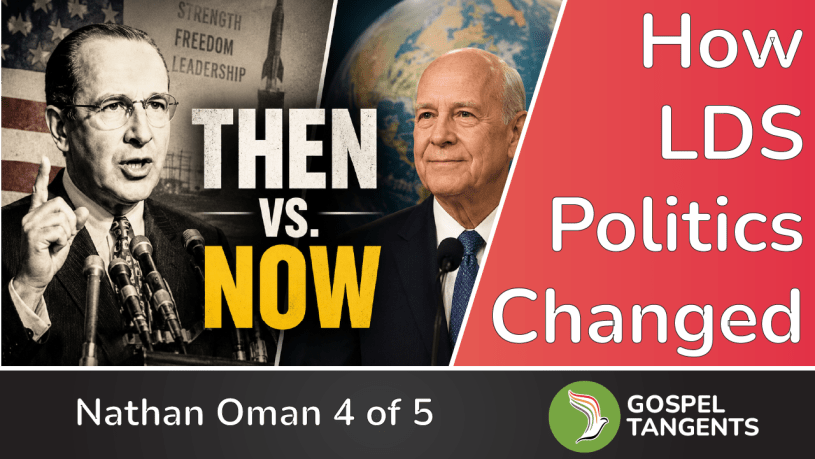
In this episode of Gospel Tangents, I sat down with Nathan Oman, law professor and author of Law and the Restoration, to explore the fascinating evolution of Mormon political theology and the realities of modern Church discipline.
We dive into the Church’s shift toward “quietism”—a strategy of withdrawing from global political conflict to focus on personal righteousness and international missionary work. Discover why praise for the U.S. Constitution has largely vanished from General Conference, replaced by an emphasis on the 12th Article of Faith and being an unthreatening, law-abiding citizen in international environments.
Personal Conscience
The conversation also tackles the complex tension between personal conscience and institutional authority. Oman explains the “epistemic advantage” of church doctrine and shares practical, ethical advice on how faithful members can navigate deep personal disagreements with the Church without undermining its global mission.
Finally, we pull back the curtain on LDS Church discipline. While liberal intellectuals and internet critics dominate the media headlines, Oman reveals a surprising historical truth: the modern concept of apostasy was primarily developed for, and is overwhelmingly used against, polygamist fundamentalists.
In this video, we cover:
The legacy of Ezra Taft Benson’s Cold War apocalypticism.
Why the Church avoids taking stances on hot-button political issues like immigration.
The “epistemic advantage” of obedience and trusting Church doctrine.
How to ethically handle personal disagreements with Church leaders without being insubordinate.
The truth about who actually gets excommunicated for apostasy.
What do you do when your personal conscience clashes with official LDS Church positions? Why did the LDS Church transition from the fiery, anti-communist speeches of Ezra Taft Benson in the 1960s to the strict political neutrality we see today? What do you make of the Kody Brown polygamy lawsuit?


Excellent interview and great questions!
The pre 21st century church leadership was much more willing to take divisive positions, and not just Ezra Taft Benson. Spencer Kimball not only took a strong stand against nuclear missile proliferation but his June 1976 message “The False Gods We Worship” is a poignant attack against American attitudes about war and money.
I agree with the opinion that the church leadership chose to be less politically divisive not only to accommodate the views of more American members but to also lessen the attachment of the church to American political debate, which allows the church to be more relevant to global membership. Another factor is political conversation in the US and Europe has become more polarizing and tribal. This means that the voicing of a strong opinion today invites an energetic social reaction that, in the case of the church, is not helpful to its desire to be attractive to the broader population.*
As it concerns the collision of church doctrine with personal conscience, my observation and experience is the church is very tolerant of personal conscience but very sensitive to the public challenge of church authority. And polygamy will always be a hot-button issue given how close to the heart the matter is to the church and its doctrine and authority claims.
* The church’s pandemic response is a perfect illustration of the leadership punting. The initial global response was uniform and the church followed along. But then there was a divergence as different countries, states and localities adopted different pandemic approaches. There was no way for the church to stand on a uniform pandemic response as there was no uniform pandemic response! So the church turned to the encouragement to follow “local guidance”. The one consistent messaging of the church was support for establishment opinion. To me, this was the most telling aspect of the the current attitude of the church leadership – it wants to be seen as non-controversial and supportive of consensus. Why? Because there is great risk to the church and its standing in different countries if it is identified as a threat to the status-quo.