
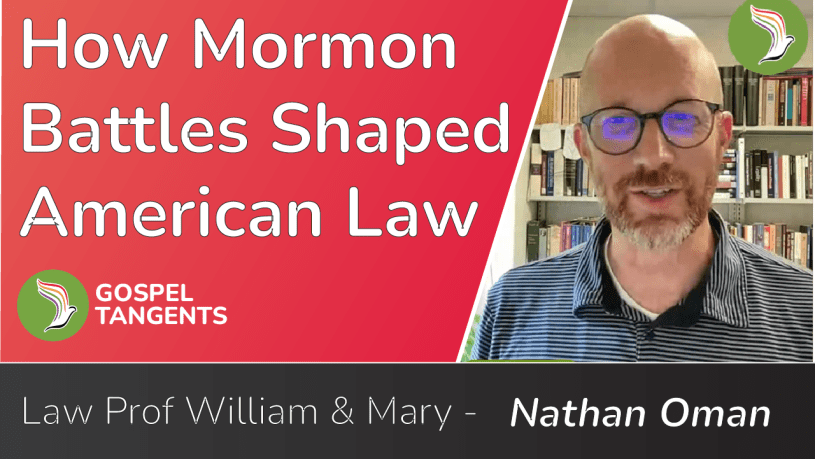
Some call new LDS Prophet Dallin Oaks a prophet, seer, and litigator. We’ll see what Nathan Oman thinks of Dallin Oaks. Nathan is a legal historian at William and Mary University. He discusses how law has affected Latter-day Saints over the past 2 centuries. We’ll discuss Dallin Oaks perspectives on Joseph Smith’s martyrdom and polygamy up to modern polygamy cases, politics, and LGBT issues. Oman is the author of 2 volumes of Law and the Restoration Volume 1 and Volume 2, from Greg Kofford Books.
Did Joseph Smith Really Violate the First Amendment? A Fresh Look at the Nauvoo Expositor
Few events in Latter-day Saint history generate more debate than the destruction of the Nauvoo Expositor. For many people, the issue seems straightforward: Joseph Smith ordered a newspaper destroyed, so he must have violated freedom of the press.
But what if that assumption reflects modern constitutional law rather than the legal world of 1844?
In my latest interview with legal historian Nathan Oman, we explore why one of President Dallin H. Oaks’s earliest scholarly works continues to shape discussions of Mormon legal history more than fifty years later.
As a young legal scholar, Oaks argued that many modern critics unintentionally commit an anachronism when they evaluate Joseph Smith’s actions. The First Amendment, as we understand it today, had not yet been applied to state and local governments. That means the constitutional framework Americans take for granted simply wasn’t the legal landscape in Illinois during the 1840s.
Whether you ultimately agree with Oaks’s conclusions or not, his work forces us to ask an important historical question:
Should historical figures be judged by today’s constitutional standards—or by the laws that existed in their own time?
Our conversation doesn’t stop there.
Nathan Oman traces what he calls three generations of Latter-day Saint legal scholarship. Early historians primarily used court records and legal documents to reconstruct historical events. Later scholars often wrote in response to critics, producing works with an apologetic focus. More recently, legal historians have begun asking a different question altogether: What can the Latter-day Saint experience teach us about American law itself?
That shift has influenced an entire generation of scholarship.
Naturally, the discussion turns to President Dallin H. Oaks. Long before becoming a member of the First Presidency, Oaks helped reshape how historians approached the legal aftermath of Joseph Smith’s death, particularly through his groundbreaking work on the Carthage conspiracy. Today, his legal background continues to influence the Church’s emphasis on defending religious liberty around the world.
We also asked Nathan Oman a fun—but surprisingly difficult—question:
Who are the three most influential lawyers in Latter-day Saint history?
Most readers can probably guess one or two names. But one of Oman’s choices is a largely forgotten figure whose courtroom battles during the federal anti-polygamy campaigns helped shape the Church’s legal future.
His answer may surprise you.
Join the Conversation
I’d love to hear your thoughts.
- Was the destruction of the Nauvoo Expositor primarily a constitutional issue, a question of municipal authority, or both?
- Is it fair to evaluate nineteenth-century events using modern constitutional doctrine?
- Who would make your list of the three most influential lawyers in Latter-day Saint history?
Share your thoughts in the comments.
Did Early Latter-day Saints Hope to Build Their Own Nation?
Modern readers often assume that bishops have always served strictly religious roles. But in nineteenth-century Nauvoo, the line between church and civil government looked very different.
In Part 2 of my conversation with legal scholar Nathan Oman, we explore a forgotten chapter of Latter-day Saint legal history that raises fascinating questions about law, religion, and the American frontier.
One of the biggest surprises? Early Mormon bishops didn’t simply settle ecclesiastical disagreements. They frequently acted as civil judges, hearing disputes over contracts, debts, and other financial matters. Rather than relying exclusively on secular courts, many Church members voluntarily brought their disagreements before bishops in hopes of reaching outcomes that reflected both legal principles and Christian ideals.
Those courts reveal a distinctive vision of justice. Members who could afford to honor their financial obligations were generally expected to do so. At the same time, bishops often sought creative ways to help struggling families resolve debts without leaving them destitute. The goal wasn’t merely enforcing contracts—it was preserving the community while pursuing fairness.
Our discussion also revisits the aftermath of the Kirtland Safety Society’s collapse. How did Joseph Smith and Brigham Young respond to creditors after the financial crisis? What obligations did they believe they still owed, even after bankruptcy?
From there, the conversation turns to one of the most intriguing organizations in Latter-day Saint history: the Council of Fifty.
Popular imagination often portrays the Council as a secret government plotting to overthrow the United States. The historical record is more complicated. Nathan Oman explains that the Council wrestled with a practical question many persecuted religious minorities have faced throughout history: Could the Saints establish a place where they could govern themselves without continual conflict?
That discussion even included drafting a proposed constitution for what members envisioned as the Kingdom of God. Prepared by leaders including John Taylor, Parley P. Pratt, and Willard Richards, the document was ultimately set aside because it lacked the practical legal detail needed to function as an actual constitution.
As persecution intensified in Illinois, some leaders also explored whether the Saints might relocate beyond the boundaries of the United States—an idea influenced by recent events like Texas’s successful independence. These conversations reveal how uncertain the future appeared in the final months before Joseph Smith’s death.
The episode concludes by examining the political climate of 1844 and the publication of the Nauvoo Expositor. Why did opponents portray Joseph Smith as a dangerous political figure rather than simply a controversial religious leader? Nathan Oman explains how long-standing Protestant fears about prophetic authority, communal religion, and plural marriage combined to shape public perceptions of Joseph Smith in ways that ultimately heightened tensions throughout Illinois.
Join the Conversation
What surprised you most about early Latter-day Saint legal history?
- Should bishops have served as civil judges, or was that arrangement destined to create conflicts?
- Was the Council of Fifty primarily preparing for self-government, or did it represent something more ambitious?
- How much did misunderstandings about Mormon political ambitions contribute to the events leading to Joseph Smith’s death?
I’d love to hear your perspective in the comments.


In 2008, during the recession, my bishop paid a large outstanding dental bill we could not pay. Around 2006 he resolved a financial dispute between my family and another member of the ward. This ward member was a contractor and had agreed to build us a free standing garage. My husband paid him the money for it, and then the contractor was in a car wreck which damaged his back. He developed a pain pill addiction as well. He kept trying to build that garage. He had dug the foundation, but he never got past that point. It was a dangerous hole in our backyard for a long time and we paid someone to fill it back in. In the end he was paid a settlement from the other driver’s auto insurance and he gave us part of that settlement, under the direction of the bishop. I wouldn’t be surprised if similar things happen in wards today. We still regard bishops as judges in Zion. We still have a small society with it’s own judicial system of sorts within the church. This is why sexual abuse isn’t reported reliably to the civil authorities. To Latter-day Saints, the bishop is the proper authority to resolve disputes in our communities, to this very day.
Whether or not Joseph Smith violated the constitution in destroying that printing press, it’s still clearly a case of him trying to cover his tracks and control the flow of information about his shameful polygamy.
And according to D&C 121, “when we undertake to cover our sins…the heavens withdraw themselves; the Spirit of the Lord is grieved; and when it is withdrawn, Amen to the priesthood or the authority of that man.”
In other words, the legality of the action aside, the episode disqualifies Joseph from priesthood authority according to revelation he himself produced.
The first ammendment says that the *government* cannot control the press, not that individuals cannot try to shut them up. So, not being the federal government freedom of the press isn’t the issue of JosephSmith trying to destroy the newspaper.
Destruction of private property however is also against the law and was clear back in Joseph Smith’s day. No, the law Joseph Smith broke was breaking and entering and destruction of private property.
So, this really isn’t a matter of “freedom of the press” being different back then. This is a matter of yes, Joseph Smith really did break the law and deserved to be in jail over it.
Very interesting lws329. I’ve never heard a story like that before.
It seems Kirkstall & Anna are making moral arguments, not legal ones. Not wrong, just interesting. It’s also interesting to put the Expositor Press in the context of destruction of printing presses between 1820 and 1850.
Historians have catalogued over 100 mob attacks on printing presses in the United States between 1820 and 1850. This was the era of the “Penny Press” and explosive newspaper growth, but it was also a period of extreme political and social turbulence.The vast majority of these press destructions were politically or ideologically motivated. Here is a breakdown of the specific groups targeted:
Abolitionist Presses: Anti-slavery and abolitionist newspapers were the most frequent targets, with over 100 mob attacks recorded against them. Pro-slavery mobs regularly wrecked or threw these presses into rivers.
Elijah Lovejoy: The most infamous victim was abolitionist editor Elijah Lovejoy. His presses were destroyed three times in Missouri before he relocated to Alton, Illinois. On November 7, 1837, a pro-slavery mob stormed his warehouse, destroyed his fourth press, and murdered him in a shootout.
Religious/Mormon Presses: Mob violence also hit religious factions, most famously the destruction of the Nauvoo Expositor press in Illinois on June 7, 1844. Nauvoo’s city council ordered the press destroyed as a public nuisance, sparking a chain of events that led to the murder of Mormon founder Joseph Smith.
Labor and Political Presses: During times of economic unrest or heated local elections, rival political factions and striking workers occasionally resorted to destroying opposing print shops.
I’m not trying to minimize anything. Clearly it led to the death of Joseph. I’m just saying it’s interesting to look at this incident in the context of larger American history. As I mentioned in the video, Michael Quinn said it was Joseph’s concern about issue #2 about politics that Joseph was worried about, not polygamy. He’s the first candidate for POTUS assassinated. (The 2nd was RJK.) I think far too many of us discount the politics in favor of the polygamy, but this was a political assassination more than a polygamist assassination. I think we need to pay more attention to that issue. Joseph did.
Anna: wasn’t Joseph Smith a political person? Wasn’t he mayor or Nauvoo and head of the Nauvoo legion? This was not the action of a purely private citizen
The First Amendment does not say that government cannot interfere with freedom of the press, or that political people cannot interfere with freedom of the press, it says that the US Congress cannot interfere with freedom of the press. Until after the 14th Amendment passed, and largely not until the 20th century, the provisions of the Bill of Rights did not affect the States. Then the US Supreme Court began a slow process of incorporating various Bill of Rights provisions under the 14th Amendment, such that most of them now apply to the States.
This is not to say that destroying the press was a good idea. It is to say that it did not violate the First Amendment to the US Constitution. That doesn’t necessarily mean much, because back then people turned to state constitutions for their rights, because the federal government is supposed to only have power to do specifically enumerated things, with all other powers belonging to the states. Which is why the original US Constitution didn’t even have the Bill of Rights; the Federalists did not think it necessary since they did not think the federal government would have much power to abuse people. What does your constitution say about freedom of the press?