
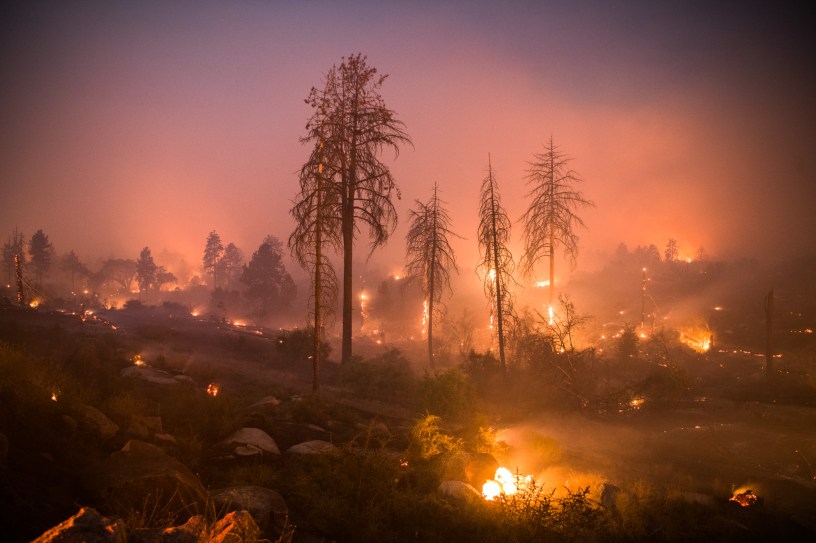
Here’s your weather report for 2026: Floods, fires, and earthquakes. The second half of 2026 (which starts tomorrow) is bringing not just an El Nino but … Super El Nino! So everything weather-related will get more extreme in coming months. Weather across the globe will be affected: hotter and dryer in Australia, weakened monsoons in India and beyond, and in the US California will get wetter (–> floods) while across the mountains Utah, Wyoming, Colorado, and Montana will get more heat (–> drought).
First, let’s get some on the ground reporting. Has anyone been threatened or displaced from their home this year? I’ve been under evacuation warnings twice in my life and it’s a little unnerving, but that’s just what happens out West. Any wildfires in your backyard? There are a few fires burning in Utah. A big earthquake just hit Venezuela, 7.5 on the Richter scale. And Glacier National Park is a big watery mess of flooding. It’s always hard to compare against prior years or decades, but this seems like it is going to be a tough year weather-wise.
Second, what about climate change? Somehow this credible and evidence-based scientific theory got caught up in politics. It is important, of course, to differentiate between climate and weather, but the Internet tells me: “Climate change amplifies the impacts of El Niño by supercharging the weather extremes associated with the phenomenon, leading to more intense heatwaves, droughts, and flooding.” So yeah, climate change makes the weather worse. We all owe our grandkids a big apology for screwing up the planet’s weather.
Third, what’s God got to do with it? It is common to hear prayers for rain over LDS pulpits during times of drought. In 2001, the First Presidency even sent out a letter to all congregations asking them to pray for rain. [In fairness, the letter also encouraged water conservation practices.] All of this is predicated, of course, on the conviction that God can and will intervene and change the weather to give more rain. How you feel about praying for rain depends on your personal theology, of course. If you are atheist, the whole idea is just silly. If you are something like a Latter-day Epicurean, you think God created the Universe and set it in motion but does not intervene in the natural order of things, so such prayers are misguided. If you are an orthodox Latter-day Saint, you apparently believe that if you and your fellow Saints pray hard enough, God will make it rain. The corollary belief is that there’s a drought because people weren’t praying or were otherwise insufficiently righteous or worshipful.
Fourth, there’s another Church-wide fast coming up. Yup, this coming weekend. From the LDS Newsroom: “First Presidency Invites US Saints to Participate in United Fast of Gratitude for Religious Liberty.” The post notes that the fast is scheduled for Sunday, July 5. I doubt one in a thousand Saints, even the devout ones, are going to skip the Fourth of July barbeque, pie, and leftovers in order to fast for religious liberty, so this is sort of a mini-fast. And I seriously doubt God is going to be impressed with a half-fast fast, so don’t expect legislation next month providing even more protection for religious liberty. But the obvious question some Saints may be asking on Sunday is: Maybe we should be praying for rain this month, not religious liberty? Because we already have a lot of religious liberty but are falling rather short of rain. Listen carefully in church next week to see if a plea for rain slips into church prayers for religious liberty.
May you have a happy Fourth. Let’s hope the prayed-for rain comes *after* your family barbeque is over.
.


Those two Church-wide fasts in 2020 didn’t seem to do the trick. Does anyone ever look back and account for results? Maybe it’s because the LDS population is only 2/1000 of the world’s population so even if every single Mormon participated, there’s still 998 who aren’t. Snarky comments over.
When I heard about the religious liberty fast, I’ll be honest, I was baffled at how tone deaf it is along with the feeling that it is just epic virtue signaling. Seriously, the religion has all the power in this country yet it seems the conservative line is that it is under attack–even though Texas just mandated Bible reading. What a stupid display of fragility. It’s things like this where I feel religion needs a good forest fire to clean it out and rebuild on things that actually matter. Bleh. I get that other countries are expressly atheist and actively suppress religion, but that is most definitely not us. And yet, people are leaving religion now more than ever in the US. Seems like our efforts would be better off praying for rain (as you say) and working towards relieving suffering instead fighting for stupid pointless steeple heights.
The other thing I’ve thought of based on years of second coming/end times lessons in the church is: what if these droughts, floods, earthquakes are God’s judgements on the people of Utah or elsewhere? Have the orthodox considered that? Seems like the scriptures always seem to describe a chosen people completely blind to God’s judgements on them until they get really sore and then they finally wake up and look at themselves instead of others. I’m not saying I believe that, but it would track with orthodox teachings. And if the question is what is God judging us for, I’d say: God’s people voting for fascist leaders that harm and kill, eliminating USAID (grinding the faces of the poor), lying to hide wealth, lying to/threatening others to build God’s temples, Rameumptom-style global fasting, prophets that say nothing, the list goes on.
Pray in gratitude that before tRump we had religious liberty? Or are we supposed to pray we get it back? Me, I will pray that religious liberty be restored to Texas where the Bible will be taught to children in school and I will be praying that freedom of religion be restored for our US military members who are having evangelical speeches forced on them by our dear secretary of alcoholism, Christian Nationalism, white male supremacy, and defense. Both of those are kind of close to my heart, having lived in Texas twice and I am still kind of a Texan, and we spent 20 moving around with the US AF.
I want real religious liberty, not Oaks version of “we bigots reserve the religious liberty to discriminate against whoever we feel like.” I want all religions and people respected, not select religions respected and others not so much. If you use your religious liberty to cram a huge towering steeple on a small town that has height restrictions, then you are not respecting the people of that town. Religious freedom means respect for not cramming your religious desires onto others. If a town has height restrictions, go build your big tall beautiful temple somewhere else. Do not cram your religion or religious buildings on others. Sure a religion should be allowed a building where ever they want, but they should obey established rules where they are building. Wouldn’t hurt the Mormon temple goers a bit to have no tall steeple. And since when do Mormon temples *need* a supper tall steeple? Oh, ever since they decided the temples have to *stand out* and be supper visible so people notice them and wonder about the beautiful building. But is that worth making people hate you? That is NOT good advertising. Oaks needs to realize that freedom of religion also means we respect atheists beliefs. It also means freedom *from* religion. It does not mean that religions get to trample on other people’s rights. It doesn’t mean religions get privileged above other rights. It doesn’t mean that a religion gets to change any law it finds inconvenient, or build anywhere and any way it wants, just because it is a religion. Oaks doesn’t want religious freedom; he wants religious privilege.
Seems Chrisdrobisin and I are thinking along the exact same lines. I was writing at the same time and we both even brought up that stupid steeple.
Haven’t heard a thing about a religious liberty fast on this side of the Atlantic. Is it another US thing, perhaps linked to your constitutional 5th Sunday?
On climate, just last week Europe experienced a severe heatwave, sweltering under a heat dome. It was bad enough here, with temperatures in the mid-30s (that’s Celsius)and high humidity, but worse for France, Spain and Germany where temperatures were mid-40s in some places. Very few homes in the UK have air conditioning, and houses are built to retain heat. And the schools haven’t finished for the summer yet. In fact last week a lot of them had to close at midday because it was going to be too hot in the afternoons. Yes, there’s no air conditioning in schools, and kids were still sitting public exams.
At home we covered all east and south facing windows with white blackout fabric. I was waking at 4am to open all the windows and get cooler air flowing through before closing them as temperatures started to rise. This time of year we have long days and short nights, being so far north, so not much time for cooling down. In fact the last few days under the heat dome night time temperatures didn’t get below 20C, so were classed as tropical nights. We’ve broken the record for highest June temperature over and over on three consecutive days.
Let’s say British summers are considered good when temperatures reach mid-20s and dry days. That’s tolerable. It’s where we are this week. But by the weekend we’ll be climbing back up to 30C for the following week.
My understanding is we won’t see the hit of the super El Niño until next summer, so you can be sure I am not looking forward to it.
Hedgehog, Europe is still suffering; the heat dome that was over western Europe has moved to eastern Europe.
https://www.ukrinform.net/amp/rubric-society/4138792-heat-wave-hits-historical-records-in-ukraine-highest-temperatures-recorded-in-west-and-south.html
I am okay with individuals or communities praying for rain or relief – and I am okay with individuals or communities giving thanks when rain or relief arrives – I have done both – but I also believe God lets natural things follow their natural courses.
I’m still trying to understand the arithmetic of fasting. How many people does it take to convince God that we’re serious about a request? Does one person’s fast matter? Twenty-five? Fifty? Five thousand? Is fasting a way of “manifesting” our desires—an attempt to influence reality or persuade God to act? If so, what is the mechanism? Why would the number of people fasting make a difference? Or is fasting something altogether different? Perhaps it’s less about changing God’s mind and more about changing ours—an act of solidarity, humility, and commitment to live in a godly way regardless of the outcome.
I still struggle to reconcile religious practices with the idea of bargaining with reality. If fasting is understood as a transaction—our sacrifice in exchange for God’s intervention—it seems to distort both God and the purpose of the practice. But if fasting is a way of aligning ourselves with goodness, compassion, and faithfulness even when our desires go unmet, then it points in a very different direction.
Steeple heights and now suing John Dehlin for “copyright” infringement. It’s laughable when he has been using these images for 20 years with no problems, and now the Oaks is in power, the Mormon name Nelson said was “a victory for Satan” has now become grounds for litigating a pain in their ass.
I am not in the U.S. now so the church fast across the U.S. doesn’t affect me, and July 5th is the first Sunday of the month so it is already a normal fast Sunday, but even so, wouldn’t that be an excellent day for a ward lunch or linger-longer?
Anyway, I really don’t understand all the church’s talk about religious liberty and religious freedom in the U.S. I simply don’t see religious liberty to be at risk in the U.S. — although I have heard some or all of what President Oaks has publicly said lately, I still don’t understand what it is that he wants remedied or changed. If he is going to persuade me, he needs to explain better, because I don’t get it.
We were evacuated twice in the last week from our home because of the Iron and Cherry fires in Utah. I’m also on the city council of our little town. It was unsettling since we were at a family reunion in Virginia when the fire started. We got back to Utah and had to wait a couple of days to get to our home for 5 minutes to get medicine. We were lucky because our daughter took us in with plenty of room, so we weren’t all over each other. It was great to spend some time with our grandchildren. We were let back into the community, but didn’t go the first night because of how much we had traveled so much that day, we were just to tired. When we got back, two hours later, the sky turned dark, and we were asked to leave again. We still had a place to go, but some of our friends didn’t. It was heartbreaking as we all scrambled to make sure our neighbors were taken care of.
What was interesting to me was that while I saw the great work the mayor did, other members of the council were very critical, wondering why he didn’t call the National Guard out. I thought that was interesting because he had been in the NG and should know it’s the Governor that calls them out, not a mayor. Another council member was critical of our emergency plan because there was not enough communication. Again, I was amazed because we got regular texts, emails, Facebook updates, and FireWatch updates as conditions changed. The mayor stayed in town in the city offices and answered phones himself and coordinated services from 12 other local fire agencies, even though they took control of the operations.
Finally, I was amazed at how negatively people reacted when the Governor asked people not to use fireworks in the state, saying it was their right.
All this showed me how people can’t see what is right before their eyes. Things like climate change are a much more abstract concept, which makes it that much more difficult to recognize and see.
Finally, I’m sure “fasting and prayer” for religious liberty will do about as much good as “thoughts and prayers” to reduce gun violence in schools. If it included freedom from religion as a component of freedom to religion, I’d be more inclined to pray.
ji,
“I really don’t understand all the church’s talk about religious liberty and religious freedom in the U.S. I simply don’t see religious liberty to be at risk in the U.S.”
I live here and I don’t get it either. It’s not at risk–not even remotely. To me it is 100% virtue signaling to the orthodox tithing payers.
Here is how I look at it… The Williamsburg Charter is a 1988 public statement about religious liberty. Its central message is that religious liberty depends on protecting BOTH freedom of religion and freedom FROM government establishment of religion. Rather than favoring either secularism or religious dominance, it argues that the First Amendment protects a “golden mean.”
The church representative who signed the Charter on behalf of the Church was Elder Dallin Oaks. Maybe (fingers crossed) President Oaks is a touch more moderate than many believe. IF Oaks made the request for the day of fasting, perhaps he is laying groundwork to steer the church away from the Christian Nationalism nonsense?
What Todd S. said.
Whether it’s fasting or temple service, the church has made it easy to feel like you did something helpful. And when I was active, I truly believed these things were helpful.
But what if they aren’t helpful? Imagine if all these people took their fasting or temple energy and directed it towards volunteering in a soup kitchen or taking in a foster child or cleaning their hiking trails or forgoing fireworks for a year or holding corporations accountable that don’t care about anything other than shareholder returns. Imagine all the people…
“If you are an orthodox Latter-day Saint, you apparently believe that if you and your fellow Saints pray hard enough, God will make it rain.”
I do–that is, if it’s a righteous request.
Anon:
Thanks for bringing up Christian Nationalism. As I understand CN, it’s using the term Christian to justify authoritarianism, which is cloaked as nationalism, which, to many people, equates to “patriotism.” If Pres. Oaks is laying the groundwork to get the church back to being a church rather than a MAGA support organization; then I’m all for it.
One thing I’d like to bring up in relation to this is that we are going to celebrate our 250th anniversary of our country’s founding in a couple of days. I have found that time after time, the celebration starts with images/movies/references to war; either the revolutionary, civil, or some other war. Granted, we are a country that started with conflict, and we have continued to “defend” our liberty with war. Still, it seems in the last 50-80 years, maybe even longer, we have used war as a justification for our greatness as a nation or an excuse to get something we want in the name of liberty.
We became a superpower after WWII because of our efforts to rebuild Europe and Japan, along with setting up organizations and campaigns to use soft power to spread technology and justice. The last few wars in Iraq, Afghanistan, and Iran, along with other military endeavors in Granada or Panama, have been things justified to protect the US, but in reality have been proven not exactly true. Meanwhile, China and some European Countries have used soft power to develop areas in Africa or other developing areas of the world without war. Sure, they are working to expand their influence, but it hasn’t been by using a war to justify Christian National goals like protecting Israel.
So what does God have to do with Fasting and Prayer when Christian Nationals are perfectly fine with bringing about the last days, Armageddon, or the final battle, whatever you want to call it, instead of working together, recognizing the obvious like climate change or income inequality, building a millennium without the war.
Jack
Jesus’ teaching seems to point in a different direction.
“Your Father knows what you need before you ask him.” (Matthew 6:8)
Immediately afterward, Jesus gives the Lord’s Prayer. Notice that it is not structured as a transaction designed to persuade God to act, but as a prayer that reshapes the person praying: “Your kingdom come. Your will be done.” It is fundamentally transformative rather than manipulative. Earlier, Jesus had already said that the Father “causes his sun to rise on the evil and the good and sends rain on the righteous and the unrighteous” (Matthew 5:45). If that is true, how could we ever know whether rain came because a group of sufficiently righteous people prayed, or because God already gives rain to both the righteous and the wicked?
The problem is that attributing an answered prayer to righteousness is not a testable claim. Every outcome can be interpreted to fit the belief: if rain comes, the prayers worked; if it doesn’t, perhaps there wasn’t enough faith, enough righteousness, or it simply wasn’t God’s will. The explanation becomes unfalsifiable. More fundamentally, why would prayer function as a mechanism for informing or persuading an omniscient God? Jesus explicitly says the Father already knows our needs before we ask. That suggests prayer is not about changing God’s mind but about changing ours—aligning our hearts with God’s will rather than convincing God to fulfill ours.
Otherwise, God’s omnipotence begins to look arbitrary: blessings become contingent on whether enough worthy people ask in the right way, despite God already knowing both the need and the best possible response. That seems difficult to reconcile with Jesus’ own teaching about both God’s knowledge and God’s impartial generosity.
I realize my understanding is unlikely to change how millions of people have come to experience and think about God. But after wrestling with Jesus’ teachings on prayer, I simply don’t believe that fasting and praying determine whether it rains. That isn’t because I think prayer is meaningless. Quite the opposite. I think prayer changes the one who prays. It cultivates humility, dependence, gratitude, compassion, and a willingness to align ourselves with God’s will. Fasting likewise can deepen our awareness of our dependence on God and strengthen our commitment to act with mercy and justice. Others will see it differently, and I respect that. But I no longer find the idea persuasive that collective fasting and prayer alter meteorological events or that God’s willingness to send rain depends on the number or righteousness of those who ask.
Everyone, Everyone……”Clutch your Pearls, Wring your Hands, Oh Dear Oh Dear…..the End is Near”. What blathering nonsense.
Dr. Ray Stantz: “Fire and brimstone coming down from the skies! Rivers and seas boiling!”
Dr. Egon Spengler: “Forty years of darkness! Earthquakes, volcanoes…”
Winston Zeddemore: “The dead rising from the grave!”
Dr. Peter Venkman: “Human sacrifice, dogs and cats living together… MASS HYSTERIA!”
God Bless the USA on it’s 250 Anniversary.
Jack,
I don’t think there is anything wrong with believing that. I think the problem being highlighted here is that, that is the only thing being done. We are praying or fasting in hopes that we don’t actually have to be inconvenienced with change to our personal behaviors and beliefs.
I asked Google AI to compare Faith vs Superstition. The response greatly impressed me. I quote:
“Faith is the confident trust in a higher power or guiding principle, grounded in relationship, love, and meaning, whereas superstition is the irrational belief that specific actions or objects can mechanically manipulate luck or fate. While both involve the unseen, faith brings freedom and trust, while superstition often stems from fear and a desire for control.”
AI adds that superstition involves:
“Dependence on a mechanical action or “magical” talisman (e.g., crossing fingers, carrying a rabbit’s foot).”
and
“Tries to control the uncontrollable to avoid bad luck or guarantee a specific result.”
And about Faith & Prayer AI explains:
“While philosophically distinct, the line between the two can sometimes blur in practice. For example, if someone uses prayer as a mechanical tool strictly to force a specific outcome (like demanding a job promotion), their faith risks slipping into a superstitious mindset. The difference ultimately lies in whether the belief pushes an individual toward a trusting, relational posture or traps them in a cycle of fear and rigid ritual.”
From a Faith perspective, I believe in miracles. I also believe that relying on miracles invites spiritual and mental lethargy. Our choices can bring more good luck into our lives or chase it away. We greatly err when we expect “magic” to make up for our poor preparation.
God has blessed us with intelligence and we need to use it. That may mean we develop and use technology to tame our environment. It may mean recognizing that some environments are not conducive or safe for civilization. Using our intelligence especially means being rational – we need to test and square our efforts with the outcomes produced. The failure to do this invites disaster.
I think the practice of prayer/fasting becomes less problematic when we expressed gratitude outward to God but make our requests inwardly. In other words we ask only for things we have the power to do ourselves with God’s help. e.g. “Please help me find the strength to… Please bless me with more patience…” etc.
That way we can get up off our knees and go to work rather than get up off our knees in a state of wishful thinking for someone else to take action.
So-called religious liberty has long been and continues to be a fake predicament. The only areas where I see threats to religious liberty are too much Evangelical Christian intervention into the public sphere and impingement upon the freedoms of Muslims to practice their religion.
To me there are many fundamental problems with praying and fasting with the expectation that God will control the state of the world to match individual people or groups desires.
You all have laid out many of the problems, but I want to mention another. If you got what you prayed for would that take something from others (like maybe their free will)? Why would God give you what you ask while the very action deprives another person who is also a beloved child of God and may also be praying? Like two basketball teams both praying they win, or a church fasting for rain, if you get the rain does that cause a drought elsewhere?
While I often offer my desires to the heavens, I genuinely have no expectations of control or influence, except over myself. Why should my desires control anything beyond myself? For that matter if God wants it the way it is (and clearly They do, because They made it to be this way), why would I want God to change Their plans just because I want something different than They planned? While it never hurts to ask, I do think it hurts to expect to get your own way, regardless of the needs of others, or God’s plans.
I agree with Todd S. The point of prayer is to become submissive to God’s will, or to put it in a more mentally healthy way, to accept what IS instead of constantly imagining what we think should be. Acceptance of reality, allows us to see what is and take action to change things if need be, instead of just fasting and praying. In other words, work to support a pluralistic society where many religions and people can flourish. The mental energy to support this, put into prayer is a way to unify our people for this work. If indeed we could reverse and prevent authoritarianism, and increase our pluralism, I am all for it.
There’s this interesting little verse from Jacob 4:
6 Wherefore, we search the prophets, and we have many revelations and the spirit of prophecy; and having all these witnesses we obtain a hope, and our faith becometh unshaken, insomuch that we truly can command in the name of Jesus and the very trees obey us, or the mountains, or the waves of the sea.
None of the miracles that Jacob speaks of can be brought about without calling upon God with a pure heart–and that includes our willingness to take “no” for answer. Strong faith can cause great differences in outcomes–as when Nephi (son of Helaman) prayed for a famine in order to stop the people from killing each other with the sword. Yes, many people died from the famine–but the rest humbled themselves and returned to the Lord.
But what’s really at the heart of that little episode with Nephi is that the Lord had given him the sealing powers because–and this is the clincher–he knew that Nephi would not ask that which is contrary to his will. That said, it’s my understanding that whenever we are called upon to join in prayer and fasting (or both) by our leaders to bring about specific blessings it is with a sense that our request is righteous–and by “righteous” I mean in accordance with the Lord’s will.
Oops! I accidentally prayed for the Constitutionality of banning conversation therapy and teaching LGBTQ hate, even under the guise of religion. Hope that doesn’t mess anything up.
In These What I Believe To Be The Short Rows, So To Speak, I Think That God Having A Whole World, and Not Just My, Or Anyone Else’s Life To Work With, Weather Saved , Or In Need Of a Chance To Choose Salvation. Then It Is God’s Will That IS Absolutely Most Important For Us To Be Praying For. Rescue Prayers Aside Of Course:
Matthew 6:33 But seek ye first the kingdom of God, and his righteousness; and all these things shall be added unto you.
For Me That Kingdom of God, AND His Righteousness Is, As The Bible Teaches In Many Areas, None Other Than JESUS. ( In Other Words Only He Is Righteous Enough To Usher It In) Luke 11:20 But if I with the finger of God cast out devils, no doubt the kingdom of God is come upon you.
A Verse I keep Close To My Heart, (To Try To Remember When I Pray Though Too Often Forget That It Isn’t All About Me Is)
Romans 8:28
For Everything To Work In Gods Plan, Who Has Everyone’s Life In His Hands , At Least Up Until Making That Eternal
Whoops!
Romans 8:28
28 And we know that all things work together for good to them that love God, to them who are the called according to his purpose.
Not Just The Good Things We Perceive That Are Happening To Us At The Tine, But AL THINGS Have To Work Together For His Children In There Time and God’s Plan- Even Bad Things Sometimes Especially When It Comes To A None Believer Getting Ears To Here And Becoming Child Of God. He’s Really Working On Me Lately To Be More Like Job:
Job 42:10 And the LORD turned the captivity of Job, when he prayed for his friends: also the LORD gave Job twice as much as he had before.
And The One That’s Really Tough Is – And I’m Sure Job Found It Hard To Distinguish Friend From Foe Those Days is-
Matthew 5:44 But I say unto you, Love your enemies, bless them that curse you, do good to them that hate you, and pray for them which despitefully use you, and persecute you;
Yeah- That’s The Tough One – Thank You For Letting Me Join In On The Topic.