
I attended the Mormon History Association meetings a couple of weeks ago in Las Vegas. Rick B did a post last week with a few summaries and comments about the conference. Here are a few of my own quick thoughts, followed by a deeper dive into the topic I found most interesting.
Quick Thoughts. There are three reasons to go to MHA or similar conferences: (1) to meet people and visit/network with the ones you know, like W&T contributors past and present who were at the conference (Rick B, Mary Ann, Kristine, and Cheryl B.); (2) to buy books from the many booksellers who run a table with their books on display, generally offering a significant discount; and (3) to hear selected presentations. So it’s a lot more than just hearing speakers present their papers.
Settler Colonialism. This is a newish topic in American History, or at least a new title for a perspective that has been around for awhile but is getting more attention recently. Here’s a quick paragraph (courtesty of Google AI) defining it.
Settler Colonialism is a foundational concept in American history that seeks to explain how European powers established permanent societies rather than just temporary trading posts. It shifts the focus from an “event” (like a specific war) to an “ongoing structure” of indigenous displacement, land theft, and racialized hierarchies.
Of course the concept applies to more than just US history. So Canada, Mexico, Central and South America, South Africa, and Australia are all open to have their histories viewed through the settler colonialism lens. The approach is productive and enlightening because the stories of the indigenous inhabitants who were invariably displaced and marginalized (whether they welcomed the new settlers or resisted them) tend to be written out of the subsequent histories.
Think of the way US history is often taught in school, where the Pilgrims landed and their descendants expanded into the wilderness, farming as they went. And how the West was settled and tamed. It’s as if the continent were empty, just waiting to be filled up with hardy immigrants from across the ocean. One can read entire chapters without encountering a Native American. This was certainly not the lived experience of those early explorers, immigrants, and settlers, for whom contact, trade, treaties, and conflict with Native Americans was a constant concern. The settler colonialism perspective seeks to put that interaction and relationship as a central theme of our US history.
I know that you find this topic fascinating, so before I look at the Mormon angle, here is another definition of settler colonialism, from Ned Blackhawk’s book The Rediscovery of America: Native Peoples and the Unmaking of U.S. History (Yale Univ. Press, 2023).
In the early twenty-first century, a new paradigm, “settler colonialism,” became popularized by Commonwealth scholars dissatisfied with historical frameworks that naturalize the process of Anglophone global expansion. Committed to assessing colonialism as an ongoing process, these scholars launched new methods, concepts, and historical approaches that centered upon Indigenous peoples. They called into question the founding narratives of nation-states, exposing how mythologies like the Puritan “errand into the wilderness” or the democratic nature of “frontier” settlements do more than erase Indigenous peoples — they turn history itself into nature and excise the violence of colonialism. (p. 4-5)
Mormon Settler Colonialism. Yes, Mormons are part of the story, having settled not just Utah but north, south, and west of Utah as well. And unique Mormon views (mythologies?) about Native Americans aka “Lamanites” means the Mormon Settler Colonialism story is unique and ongoing.
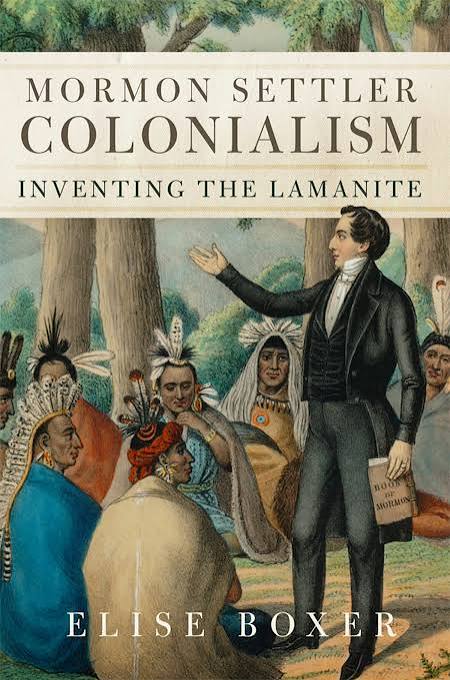
Which brings us to the MHA plenary presentation at the Friday luncheon by Elise Boxer. It covered material from her recent book, Mormon Settler Colonialism: Inventing the Lamanite (Univ. of Oklahoma Press, 2025). At least I think that was what she talked about, having missed the presentation myself (Dave kicks self). So I’ll have to buy the book or talk my local library into purchasing a copy. Here is a short excerpt from the publisher’s page:
In the nineteenth century, Joseph Smith, the first prophet of the Church of Jesus Christ of Latter-day Saints, and his followers believed Indigenous peoples to be Lamanite descendants, living in a degraded state because they no longer followed God’s commandments. In Mormon Settler Colonialism, Elise Boxer investigates the racializing ideologies perpetuated about Indigenous peoples as a result of their categorization by Mormon doctrine as Lamanites.
So if you want to read about how LDS ideas about Native Americans are, in fact, “racializing ideologies perpetuated about Indigenous peoples as a result of their categorization by Mormon doctrine as Lamanites,” find a copy of the book. With a little luck, I’ll read the book myself before too long and post a review here.
So does any of this ring a bell for you?
- Did you grow up singing “Book of Mormon Stories” in Primary, complete with a variety of gestures? Do you cringe when you hear the song now?
- Regarding “Lamanites,” do you believe that “long ago their fathers came from far across the sea”? How about the suggestion (in the song) that the “Lamanites” weren’t righteous, so the land was taken from them and given to invading European settlers?
- Does your family have any experience, positive or negative, with the LDS Indian Placement Program? It ran from 1954 to about 1996, peaking in the 1960s and 1970s.
- There was, and still is, missionary outreach directed at Native Americans, from the very first years of the Church clear through today. Did anyone here serve a mission to a Native American tribe or nation?
- Regarding “Lamanite” identity, is there any clear LDS definition or statement about who is or is not a “Lamanite” today? How do LDS Native Americans in the US feel about the label? How do Central American and South American Latter-day Saints feel about the label? How do LDS Pacific Islanders feel about the label? Is it accepted or rejected?


From 3rd grade till graduating high school, I lived in Oklahoma. There were several Native American members for whom having “Lamanite heritage” was a big part of their testimony. (I will say I also heard some Pacific Islanders also have relationships to Lamanite heritage in their testimony. I am being facetious with this next bit, but it felt like anyone darker than caucasian but lighter than black could claim Lamanite heritage…) Granted, this was several years ago, so I don’t know if things have changed since then, but it was common enough that I didn’t think it was unusual to hear it in fast & testimony meeting.
For the most part – this is nothing more than a rehashing of issues which have been discussed, debated and reviewed ad nauseum. While I’m sure it satisfies the need in some to maximize their need to virtue signal and to publicly wring their hands at the injustice of it all. (Think “Mental Masturbation”)
Ultimately, it doesn’t change a thing – and the World rolls on. Even Nature herself is extraordinarily cruel. We’re each better off to simply carve out the best life we can; in the circumstances wherein we find ourselves
When I was is 6th grade a Navajo student joined my elementary school class. He was well liked by everyone. He returned each year until the middle of 11th grade. There were several other Navajo students in other grades during those years.
I clearly remember hearing several “pulpit pounding” talks in our ward’s sacrament meeting noting how the skin of these Lamanite students had become “lighter and lighter” as they were living closer to the gospel.
As a 7th and 8th grader I actually thought about it bit. Could their change in skin color be the receding summer suntan acquired tending sheep in Arizona just as the summer tans I and my friends had acquired playing outdoors all summer long receded during the winter months?
I concluded it probably was to less sunshine, but I never raised the question to anyone but my mother, as I had long learned not to ask those kinds questions at church.
Grizzerbears comments always virtue signal to fellow brainless conservatives that he has it right and I’m frankly tired of his pornographic self masturbation in front of us all. It does nothing but prove his degenerate nature that lacks empathy and is full of empty gestures in a world that is quickly passing him by.
Growing up, I had an aunt and uncle who hosted two young people through the Indian Placement Program. We lived far enough away that we usually saw this aunt and uncle only once every year or two, at our large summer family reunions. They are very orthodox Church members, and also two of the kindest, most patient people you’ll ever meet. They also had years of experience living among Native Americans in the Four Corners area. The details are fuzzy to me, but I believe my aunt served her mission there, much of it on reservations, and that after they married the two of them lived in that area for a time, where my uncle worked for CES–again, much of it with Native Americans on reservations.
They eventually moved to a rural community in northern Utah and raised eight kids of their own, and that’s where the two Placement Program kids stayed with them. I was young, so I’m hazy on specifics, but my impression is that it was only for a year or two. I remember seeing them at our reunions back then–and, more to the point for this topic, they have continued to be invited to, and to attend, our 4-5 day family reunions every few years, now with their own families (they’re in their 50s or 60s now). I don’t know them well personally, but the simple fact that they keep coming, and the way they interact with my aunt and uncle, tells me there are a lot of good feelings there.
I understand that others had much worse experiences, and the whole program seems strange in hindsight, but in this one instance it seems to have gone pretty well. I’d genuinely like to know more, so I’ll have to ask one of my cousins about their family’s experience with this strange Church program the next time I see them.
I grew up singing Book of Mormon Stories while thumping on my scriptures like all kids in primary did in the 80s and 90s. I’ve been in primary for the the last 2+ years and I don’t think we’ve sung it a single time. I’m not sure the kids know it. I’ve done other stints in primary over the last 15 years and I don’t recall singing it then either.
The lyrics don’t make a lot of sense to me. “Book of Mormon stories that my teacher tells to me are about the Lamanites in ancient history.” The vast majority of stories in the Book of Mormon are about the Nephites. No one calls it “the story of the Lamanites and the guy who cut off arms for them”. “Long ago their fathers came from far across the sea, giv’n the land if they lived righteously”. This is accurate enough, taking the BoM at its word. The second verse is where I get confused. “Lamanites met others who were seeking liberty.” Are we talking about Mulekites? The Mulekites existed independent of the Nephites and Lamanites for a few centuries, then merged with the Nephites and eventually the Lamanites got around to lots of fighting with them. The phrasing also seems to imply that the Lamanites were also seeking liberty, which is not a way we typically describe them. “And the land soon welcomed all who wanted to be free”. If we’ve already covered the Lehites and Mulekites, then who is this line about? The BoM doesn’t mention any other groups being welcomed to the land. Did we fast forward to European colonization? Or was this song decades ahead of the rest of the church in acknowledging that there were all sorts of people in the Americas of non-Israelite heritage? “Book of Mormon stories say that we must brothers be.” Did Yoda write this line? I agree that the scriptures do say that we should treat all people like family, but the actual stories in the Book of Mormon are mostly about how the Nephites and Lamanites killed each other a lot.
Anyway, that song is a mess, and I think it only mentions Lamanites because of the meter of the song. If Nephites had 3 syllables, it wouldn’t mention Lamanites at all.
My daughter married a part Native American. She most certainly did not consider herself a Lamanite, although she was born and raised in the church. She didn’t look Native American enough that any primary teacher would tell her she must be Lamanite, so teachings on the subject would come from parents and general stuff at church. Don’t know what her parents thought because I didn’t meet them until just before DIL died, as they cut off contact because they couldn’t stand the fact that *she* married my *daughter*. They were probably sorry for that as they missed 15 years of their daughter’s life when she died a year ago. But that gives readers here an idea of how orthodox the parents are and they didn’t seem to have even taught the “Lamanite” idea. The siblings, have mostly fled the church and the one we are still close to also thinks the idea ludicrous
My “Indian placement” friend in high school also considered the idea stupid. At the height of the IPP in late 60s. We were getting stuff in Seminary a lot about the “Lamanite becoming white” crap and videos about how the Indian Placement Program was going to improve conditions back on the reservation, apparently by teaching the children white culture and curing them of pagan religious ideas and even then I thought it racist as H.
My IPP friend’s feelings on the program were mixed. I picked up anger she didn’t specifically voice, but it was pretty strong, about it taking her away from family. She liked her “white family” but hated the transition from one culture to the other back and forth as it left her feeling like she didn’t belong anywhere. She joked about “home when Arizona is hot as Hades and in Provo when everything is frozen.” As if she wished it was the other way around.
One close friend in my childhood ward was confused because neither her Native American parent nor her patriarchal blessings said House of Manasseh, which would be “Lamanite” but her younger brother’s did. She asked me why wasn’t her mother’s linage listed as house of Manasseh when she was full blood, but her brother’s was and shouldn’t her and her brother be in the same house of Israel, inherited from the father, and really this linage stuff makes no sense. My only answer was that she is correct, it makes no logical sense. I did not share what I think, which would be Well, because the brother was actually darker skinned than his mother?? Apparently “linage” in patriarchal blessings kinda racist? It seemed judged much more on skin color than actual amount of how much they came from that linage. The mother did not really look Native American but her son, whose father was white, did. And my friend with her medium brown hair looked even less Native American. The PB followed the way the individual *looked,* not real life genealogy. But I’m not going to say that part out loud in the 1960s to a faithful Mormon.
My close family member’s adopted (because no relative or tribe member would take them) daughters do not consider themselves Lamanite. They believe tribal legends of their origin, as in “lived in area 15k years ago, left, then returned” (Hopi)
That small sample comes from three different tribes. And is all that I got close enough to in order to hear honest opinion.
I never heard anyone in church meetings who was NA say they were Lamanite, but then mostly I lived in lily white wards. But I did from Hawaiians. The closest to that was my confused friend wondering why she wasn’t Lamanite when her brother was. But she didn’t consider herself Lamanite anymore because her new PB declared she was House of Ephraim.
I had a Hawaiian friend and she proudly bragged that her people claim to come from “where the sweet potato grows wild” which is in South America. So, she thought she was Lamanite. There is new genetic evidence to back up that there is an itty bitty smidgen of South American DNA, but certainly not that the Islanders as a group came from the west Coast of Chili. There is only enough DNA to indicate that there might have been trade or minimal contact.
All of these opinions formed before there was solid genetic evidence that Native Americans were of Asian origin.
Since that time, I have met only Native Americans who scoff at the idea, and in even more recent years have not been at church to hear an opinion.
DaveW, yes the “others who wanted to be free” was supposed to be white people. Specifically pilgrims who settled Plymouth in 1620. The Thanksgiving mythology stuff. We did a primary program with instructions to have the kids wear paper feathers or paper pilgrim hats, for the song Book of Mormon Stories, and I believe the instructions were straight out of SLC. I lived in Florida where the white people would have been Spanish, but that doesn’t fit US mythology.
“the stories of the indigenous inhabitants who were invariably displaced and marginalized … tend to be written out of the subsequent histories.”
This is very true. What I find fascinating is how both the political Right and the political Left cooperate to make this happen. The political Right dismisses the “losers” as a footnote in the history of the victors. Meanwhile, the political Left complains if the “victors” incorporate historical and cultural elements of the “losers”. The consequence being that the “victors” drop any mentions of the “losers” except as victims oppressed by the “victors” – and that makes the history depressing and further diminishes the willingness of people to tell the story.
America has a rich and informative history of natives and settlers. Year by year, the telling of this history is weakened as demands are made on who can tell it and how it can be told. The end result will be that the history will be forgotten as people will lose interest in taking the risk to tell it.
This has already happened in the American northeast. The Cleveland baseball team is no longer the Indians as the name and history of the name were deemed culturally insensitive. The consequence being that tens of millions of modern Americans have lost the reminder that into the early 18th and early 19th century, the Ohio region was very populated by natives. The “victors” have eliminated this cultural reminder and this happened due to the efforts of the political Left!
Likewise, the Washington DC football team removed all attachments to native imagery. Some people said the name and imagery was racist and demeaning. Yet the consequence of removal is no memory at all! The cultural reminder that natives once populated the land has been removed due to the actions of the political Left! And the consequence will be that the memory of the natives will be lost and the history forgotten.
In the Spanish ward, one of the former counselors in the bishopric, who was a white person who spoke Spanish and was married to a Latina, would speak of ward as evidence of the gospel spreading among the Lamanites, since most Latinos have Native American ancestry. However, never have I heard Latinos see themselves as having Lamanite ancestry.
One of my good friends is half Navajo and a member of the church. He didn’t see Navajos as Lamanites, particularly because the Navajos migrated from Canada to Arizona and spoke a language not related to Uto-Aztecan languages. He strongly objected to the church’s program of white families “adopting” Native American kids.
Growing up in Provo, I remember my community would always call Native Americans Lamanites. Even in my school, teachers and aids would call them Lamanites.
I grew up selling concessions at Indian powwows for most of my childhood. This was mostly in Fort Duchesne, Fort Hall, Crow Fair in Montana, and the 4 Corners Powwow. We were often the only white vendors who sold food and beverages, and we gladly paid a premium to be admitted entry. This revenue was a godsend for our family. I learned a lot and committed a lot of cultural faux pas when I brought my childhood LDS teachings careening into Native culture. I often would see LDS missionaries proselytizing and attending the powwow, especially in Fort Duchesne. They would come up to our shaved ice stand and talk to us, assuming we were LDS—we were—and asking us if we knew of anyone they could teach.
Another story that is shared by my wife is when her family, living in Highland, had a Mexican girl come as an exchange student for a period of time. Before this young girl arrived, her parents sat my wife and her siblings down and said, “Now, we want to let you know that a Lamanite is going to be living with us.” As my wife tells it, looks of terror and panic crossed the siblings’ faces as they imagined a very dangerous person would be sharing a home with them! You have to imagine how traumatizing this was; they had been taught that Lamanites were the people who wiped out the Nephites. The way my wife tells the story, they were quite literally worried about being murdered in their sleep.
This is family lore now, and all the siblings look back aghast at how utterly crazy that was. But it was a very good example of Mormon settler colonialism.
A Disciple, you are doing the very thing you are complaining about. By whining about the removal of a racist baseball team name by the overly sensitive “victors” (white people), you are erasing decades of action and activism by actual Native American people protesting the use of the name and mascot.
From an actual Native American artist and activist, Charlene Teters: “That this image honors neither Indian or non-Indian people, and that I think anyone who looks at this can recognize it as a blatant racist caricature, tells you, really, again, our place in the society.”
And that’s the whole problem with the concept of Lamanites (which, from what I understand, is the thesis of Elise Boxer’s book): Most white people know nothing about Native Americans and we would rather make up our own stories about them so we can continue to turn a blind eye to the broken treaties and stolen land we continue to benefit from.
Nephites and Lamanites never existed. Church leaders don’t want this to matter anymore but it matters very much. There never were such peoples. Joseph Smith invented them based on the racist dogma of manifest destiny and a desire to incorporate Native Americans into his own self-aggrandizing narrative.
Where I live in Southern California is the ancestral land of the Chumash and Tongva peoples—not Lamanites—real people who still have governments, foundations, stories, and sovereignty. Learn about the people whose land you’re on. Find out where you can donate, volunteer, or spread more accurate information. With even just a few seconds of googling, you’ll learn more about the place you live than a racist baseball team name could ever teach you.
Here in the UK, it is unusual to encounter a Native American member. Consequently the primary song was performed complete with the imported actions until embarrassingly recently. Back in the 1970s my local ward would hold an annual garden fête in the large field included in the church land. One year there was a Native American missionary who dressed in traditional dress, complete with the feathered headdress, who performed a rain dance for the entertainment of everyone attending. Not sure why a rain dance is appropriate for a garden fête which depends on good weather, but that’s as close as I got.
Nieces and nephews marriages have introduced possible “lamanite” (Mexican, Māori, Navajo) links to the family, but since they’re on different continents I haven’t been in a situation to have a conversation on the subject.
Kirkstall,
“Indians” is a racist label?
As you write, “activists” cry foul and force the majority to cede to their wishes. This happens even when a majority of the so called “victimized group” is not offended. Why must the feelings of the activists matter more than the feelings of others?
And what is the result of this process? The cultural awareness that natives aka “Indians” populated the Ohio and played a significant role in the history of the area is lost. The activists have their wish granted and consequence is the heritage and culture of their people will be forgotten.
And you say I am whining. No. I am observing that American culture is lessened by the erasure of the memory of a people that played such a dominant role in the history of the country.
Anna,
The mythical Pilgrim story is a simplification of a richer and deeper story. When the Pilgrims first arrived they settled on land that readily available to them because it was not suitable for farming. The poor quality of land and the lack of economic incentive resulted in inadequate harvests, starvation and nearly the demise of the Pilgrim settlement.
The Pilgrims survived and eventually prospered because they received help from the indigenous people and they switched from a communal system of property sharing to one of private property and personal incentives and reward. For decades the relationship between the Whites and Natives was cooperative and constructive. Eventually, divisions and conflict arose, not just between the Whites and Natives but between the various Native tribes and their cooperation with the Whites.
However, even into the 18th century, the idea existed that the White people and the Natives could coexist and the Natives engaged in commerce, diplomacy and treaties with the European settlers. Following the French-Indian war, where Indians allied with the English, the English violated their agreement. This began the process that continued over the next century where the White settlers systematically claimed the lands held by the Natives.
Point is that for over a century the White people and Native people coexisted and mostly cooperated. The English did not show up on the shores of America determined to drive off the existing population. In fact, across North America, the Europeans and Natives were very enterprising in their trade and this was seen as beneficial to all involved.
Eventually the growth of the White population and its demand for land and political control put them in conflict with the Natives. And this raises a key observation and a difficult question: When should a native population be concerned about the arrival of “foreign” people? For once the demands of the “foreign” people are too much, it may be too late for the native population to change the trajectory of their eventual demise.
A Disciple
Jeez Louise, the Patuxet had been farming at Plymouth for generations. The Pilgrims landed at land that had been cleared and farmed, and was now empty. Diseases spread from Europe, decimated native New England populations. The Pilgrims and Puritans gave thanks for God preparing the way.
Here’s the Thanksgiving story I learned(simplified). When the pilgrims landed and set up living there, they were greeted in arch 1621 by Samoset, speaking english he had learned from fishing and fur companies. Next day he brought Tisquantum (Squanto) who now has a disney movie based on him. He spoke better english cuz he’d been abducted and sold in Europe in 1614. Eventually lived in England for several years and when he finally made it back home to his village, everyone was dead. He taught te pilgrams about the 3 sisters(crops that actually grew) and the fur trade with Europeans. Blah, blah, blah, As a reward for his service, he died from a fever. I have no idea if that was God’s will or not.
Oh yes, the fur trade. Epidemics lead to significant population loss, and power vacuums. The fur trade led to competition and conflict for scarce resources. Does that count as private property and personal incentives? And so it went. Again and again.
As to whether it was beneficial to all involved, let’s ask the Pequot.
As to “foreign people”. what say ye to the Bell Beaker culture?
Right as the Pilgrims arrived they made a defense pact with the Wampanoag against the Narragansett. They exchanged their muskets in exchange for land and help farming and finding food. Upon arrival the seeds of conflict were being laid. Friendships were built in the context of conflict. Even Roger Williams, founder of Rhode Island, took refuge among the Narragansett in escape from persecution of the Puritan community in Massachusetts Bay, who has placed him under arrest for spreading “dangerous ideas.” Yes, Williams has a great relationship with the Narragansett, even learning their language. But it didn’t take long before inland movement widened disputes. The Pequot War broke out after only 16 years of the Pilgrims arrival. It ravaged Connecticut natives.
In Virginia, conflict broke out between colonists and Native American groups in 1609, just two years after their arrival. By 1646, Native American groups in the region were brought to the brink of destruction. Romanticization of Pocahontas glosses over the devastation that would come not long after.
I object to these rose-colored Thanksgiving narratives that white-wash a lot of hard realities of the past. Of course there were periods and episodes of peace and collaboration. But outweighing that has been decades of English greed, power, and violence. Colonists made dozens of treaties with native groups. They were all broken. Since independence, the US has made close to 400 treaties with Native American groups, and has violated, ignored, and unfairly altered the overwhelming majority of those.
Bear in mind that upon independence, the US had no intention of including Native Americans as citizens. And it wasn’t until as late as 1924 that they could become citizens. By contrast, Mexico achieved independence with Native Americans. Miguel Hidalgo y Costilla, the Catholic priest who launched the Mexican war of Independence in 1810, gave a speech calling for racial equality and calling for the redistribution of Native American lands. He rallied together thousands of Native Americans in opposition to Spanish colonialism.
A Disciple, you did not comprehend my previous comment at all.
The “activists” ARE largely Native Americans. YOU are erasing them by imagining them all as white liberals.
“Indians” as a term is not the problem. Many Native Americans self identify as Indians and many of them don’t like that term. Since there are so many tribes, nations, languages, and cultures, they’re incredibly diverse. But by far most of them DO NOT like being used as mascots of sports teams owned by white folks.
If your understanding of Ohio history hinges on being able to name a sports team after people who don’t like that, you have a serious problem with information in general. Go read some books.
In our attempts to correct the historical narrative let’s not forget that half the pilgrims died too. Things were bad all around.
“It was/is bad all around, so we can’t criticize it” is a terrible argument. And it’s the same dumb one people use for the awfulness that is patriarchy. Amazing that people can’t see how awful that argument is. There are arguments and conservations to be had on a host of issues, but that argument is one of the worst.