
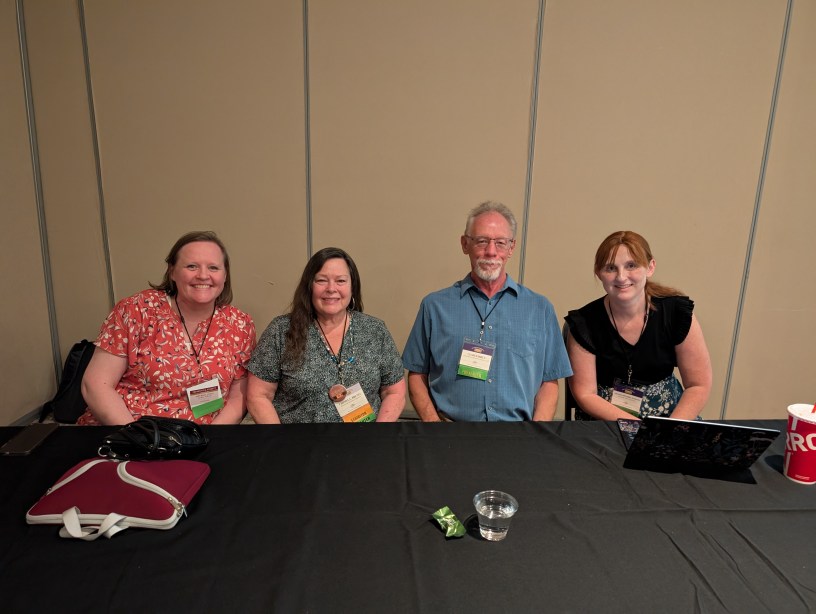
I did a livestream recap of the Mormon History Association (MHA highlights) conference, broadcast straight from my hotel room in lovely Las Vegas. Guided by some slightly out-of-order, AI-generated slides, this recap covers the most fascinating historical deep dives, unexpected gems, and award winners from the weekend.
Unexpected MHA Highlights & Gems: Pro Wrestling and Gnosticism
One of the absolute standout presentations explored “The Mormon Giant,” Don Leo Jonathan, a 6’6″ pro wrestler active from the 1930s to the 1960s. Early in his career, he played up a “weird” and radical polygamist trope—complete with an unkempt beard and a live snake he claimed was from the Garden of Eden. However, to aid the Church’s PR shift toward mainstream assimilation in the 1950s and 60s, he transitioned to a clean-shaven, patriotic hero. Surprisingly, President David O. McKay, who was apparently a wrestling fan, actually authorized this PR gimmick to help mainstream the Church. Suprprisingly, Leo’s career ended via injury when he spun 7 foot tall Andre the Giant and injured his back in 1980.
Another surprise gem of the conference was a presentation by Mike Lemon on the “Temple of the Pearl,” a modern-day fringe group blending Mormon priesthood and eternal marriage with Gnosticism, chakras, yoga, and an androgynous double godhead. Mike LeCheminant, a dentist from Houston, TX gave an amazing presentation and I hope to get him on the podcast soon to talk more about this free love polygamist group.
Politics, Welfare, and the New Deal MHA Highlights
Several scholars provided a deep dive into the Church’s 1930s resistance to FDR’s New Deal, noting how leaders created their own welfare system driven by theological self-sufficiency to “supplant the dole” and discredit Roosevelt. Historian Matt Harris highlighted Hugh B. Brown, a vocal Democrat and trusted confidant of Heber J. Grant, who supported FDR’s programs. Brown faced severe backlash for taking the chairmanship of the state liquor commission after Prohibition’s repeal, a controversial move that delayed his call to the Quorum of the Twelve Apostles by decades.
We also learned about Senator Elbert Thomas, who defeated Apostle Reed Smoot in an election and applied his faith to international humanitarianism. Driven by the historical memory of 19th-century Latter-day Saint persecution, Thomas partnered with Jewish activists to force FDR to create a board that ultimately saved 200,000 Jewish lives. Finally, MHA President Ben Park delivered an address on Cleon Skousen’s massive political influence, explaining how Skousen tied Mormon agency to free-market capitalism and popularized works like The Naked Communist among conservative evangelicals through careful “code-switching.”
Reevaluating Settler Colonialism & Science MHA Highlights
Elise Boxer gave a powerful presentation challenging traditional “manifest destiny” pioneer narratives. She urged an indigenous lens to view Mormonism as a vehicle for US colonial expansion, pointing to the “This is the Place” monument as a visual example of reducing Native Americans to a marginalized backdrop.
In the realm of 20th-century history, Steven Peck discussed BYU biologist Duane Jeffery’s 1970s push for evolutionary biology. Jeffery faced severe backlash and potential termination from Ezra Taft Benson in the 1980s, but was defended by current President Dallin H. Oaks, who decreed that the university must not censor truth or assume faith is too fragile for scientific reality.
Polygamy Economics and Early Records MHA Highlights
Our own Mary Ann Clements presented fascinating research examining the economic factors behind early plural marriage using Nauvoo tax records. She highlighted how leaders like Brigham Young may have strategically pursued women from wealthier families, such as Martha Brotherton, who famously refused a marriage proposal from Young at age 17 and was locked in a room at the Red Brick Store. Additionally, Cheryl Bruno announced the thrilling discovery of an 1854 list of Joseph Smith’s plural wives. This crucial document pushes the timeline of documented lists to just a decade after his death, earlier than the famous Thomas Bullock list.
Award/MHA Highlights
The conference also celebrated major contributions to the field of Mormon history. Posthumous honors went to Ardis Parshall, who received the Public History Award for her work championing the unheralded stories of everyday members. George D. Smith received the Arrington Award for fostering independent research as the co-founder of Signature Books, and Elise Boxer took home the Indigenous Studies Award for her book on Mormon settler colonialism.
Next year, John Turner will lead the conference as new MHA president in Provo, Utah. (Las Vegas to Provo is definitely a 180 in environment. I was surprised when a conference attendee was propositioned by a woman offering to make his night memorable. Clearly she didn’t care that most MHA attendees frown on such things. I don’t expect that to happen in Provo!)
From deep dives into 20th-century political clashes to the surprising intersections of theology and wrestling, this MHA conference proved that Mormon history is vibrant, complex, and full of ongoing discoveries.
Did you go? What are your thoughts?
.


Thanks for the recap, Rick. Here are a few observations of my own:
— Offering 8 concurrent rooms with 3 speakers each during the breakout sessions means you miss a lot of good presentations. It’s good that more people get to present but bad that attendees necessarily miss a lot of good presentations. I might be sending out several “hey I missed your talk could you send me your transcript” emails.
— I never knew Ben Park was so funny.
— Indigenous studies and settler colonialism are definitely hot topics in Mormon studies all of a sudden (or maybe I just missed the emergence of the subdiscipline). There are half a dozen good books on this topic that one should read.
— Those who know tell me that when the MHA Conference is in Utah, attendance like doubles. So expect a lot of people in Provo next year. Maybe W&T should plan its own session.
Well Done, Rick! This is a fascinating read and podcast.