
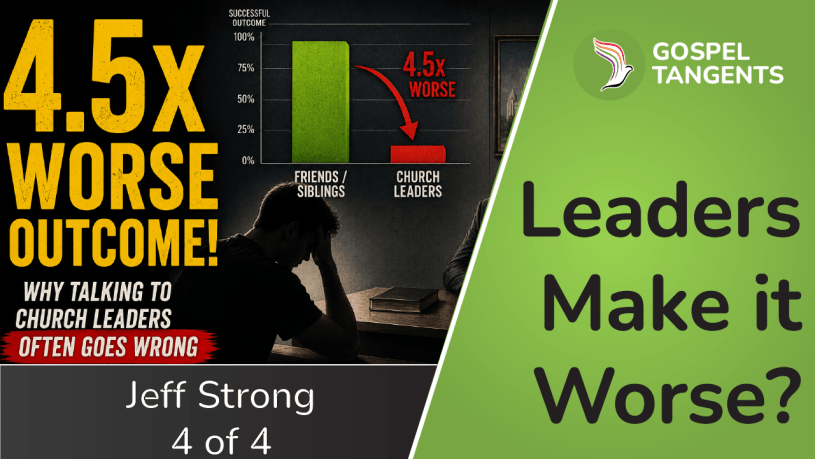
Author Jeff Strong details the “tectonic plate shifting moment” when his son, while serving in the Missionary Training Center (MTC), suddenly wrote him about leaving the faith: both his mission and the LDS Church. At the time, Strong was serving as a Bishop. He admits that he and his wife initially handled the situation poorly by assuming their son had committed a serious sin. This personal crisis spurred Strong to conduct extensive research into disaffiliation, including qualitative work in 40 cities across 20 countries to understand the real reasons people step away from faith.
Leaving the Faith
Strong challenges the “lazy learner” stereotype, revealing that faith transitions are often deeply serious, intentional, and painful processes. Research cited by Strong shows that 49% of individuals experiencing a faith transition spend more hours than they can count over five or more years researching their decision, often likening the experience to the “death of a loved one.” Strong describes his family’s initial communication as “cavemen grunting at each other” because they were “talking under the influence” of intense fear, anger, and anxiety.
To help other families avoid these “unwise mistakes,” Strong provides several key insights:
- Examine Your Motives: Parents often feel anger not because of the child’s choices, but because those choices threaten the parent’s own need for social validation and the “perfect family” image.
- Avoid “Talking Under the Influence”: High-stakes conversations should not happen when the amygdala is firing; parents must step back to ensure they are motivated by love rather than a desire to control.
- Understand the Data: While conversations with siblings and friends typically go well, talking to Church leaders is four and a half times more likely to go badly, and talking to devout parents is twice as likely to result in a negative outcome.
Strong concludes that by being informed and rejecting false stereotypes, families can move toward “healthy trust-building conversations” and maintain strong relationships even when religious paths diverge.
Why do conversations with Church leaders go wrong so often?
Former mission president Jeff Strong says talking to leaders and parents is one of the least helpful things to do in a faith crisis. It’s 4.5 times worse than talking with siblings. Why do some family members quit speaking to those who leave? Should Church leaders better model Christian disagreement? Can a bottom up movement like this succeed in a top-down organization? Check out our conversation…
Staggering Cost of “Correction”
Strong shares a provocative statistic from his research: while 83% of those in a faith transition reach out to someone, the outcome varies wildly depending on who they talk to. Interactions with siblings and friends generally go well, but conversations with devout church leaders are four and a half times more likely to “go badly,” meaning the relationship suffers and the individual feels more inclined to withdraw from the community. Strong attributes this to a default mode of trying to “correct or contain” the person rather than building trust.
Agency vs. Stewardship
A major theme of this discussion is the “goofy cultural idea” of practicing “enforced agency.” Strong argues that when parents or leaders attempt to manipulate outcomes—such as withholding an inheritance or cutting off family members to maintain a temple recommend—they are actually infringing on the foundational doctrine of agency. He reminds listeners that stewardship does not equal control, citing Joseph Smith’s experience with the lost 116 pages as a lesson that God’s work is not dependent on our ability to control others.
Bottom-Up Revolution
Addressing the concern that change in the Church is strictly “top-down,” Strong offers a empowering alternative: bottom-up culture change. While he avoids criticizing the institution or “steadying the ark” by telling Salt Lake what to do, he insists that individuals have the power to shape the culture within their own hearts, marriages, and wards. He notes that even one “Christ-centered” Bishop can completely transform a ward’s atmosphere in a short time.
The Path Forward: Love Over Fear
Strong concludes by urging members to stop “thinking through the amygdala”. When we act out of fear—the “circle the wagons” behavior—it shuts down spiritual growth. By choosing “perfect love” over fear, families can maintain strong relationships even when religious paths diverge. His ultimate goal is not to “recruit” people back, but to help the Church become a place where different types of people can stay, feel they belong, and remain rooted in the Gospel of Jesus Christ.


In my case the church leader immediately switched to “church discipline” mode and started going through the temple recommend questions. And the ward members turned a cold shoulder. For church members, when someone transitions, they treat them as if they have a communicable disease. Not to mention to stress that it generates in a marriage relationship. However, I suppose this is a natural reaction by those who belong to an “exclusivist” religion – one that maintains that it is the “only true church” and that the fulness of God’s truth can only be found therein.
What church members view as a “rejection” of the church, the transitioner can view as a “graduation” to the next chapter of their faith life. In other words, the transitioner doesn’t reject the church at all, but rather can view it as bringing him/her to the next stage of their spiritual development/growth.
So the bottom line seems to be: The biggest problem is bishops. Why are bishops the problem? Not because they are necessarily bad people. It’s because the Church trains them to be harsh and judgmental toward anyone who steps back from the Church. They get no pastoral or counseling training. They are told they are “judges in Israel,” not compassionate shepherds. The Church provides bishops with no paradigm for faith crisis or faith change other than sin or laziness. So it’s a failure of Church leadership, who do a poor job of training or developing bishops, as well as local bishops themselves. [Yes, there are good bishops, but not because the system developed them to be good bishops.]
Strong himself is Exhibit A for the claim that bishops are the problem. While serving as a bishop, he couldn’t even show compassion or support TO HIS OWN SON when the son took the extremely difficult decision of exiting the MTC and terminating his mission. What is wrong with these people?
By the way, you went the whole post and didn’t mention his book, which I haven’t read yet but it’s on my list.
“For church members, when someone transitions, they treat them as if they have a communicable disease.”
They start getting pissy about maintaining their religious freedom and point to gas stations still being allowed to operate as an excuse to circumvent society’s efforts to keep the disease from spreading?
I kid… but treating a faith transition like we treated COVID and treating communicable diseases like we currently treat a faith transition would be an improvement, which is sad commentary.
I also hope for the possibility that the Church might become “a place where different types of people can stay, feel they belong, and remain rooted in the Gospel of Jesus Christ.”
I was surprised to realize that my ward members don’t seem able to understand that the Church is not this. They do think they are welcoming, loving, supporting. They seem to genuinely have no understanding what I mean when I say that if you asked them if I personally was welcome at church, they would say of course yes; but at the same time, I also know that people like me are not wanted or welcome. They sincerely do not recognize that we are driving people away.
For those who have talked to leaders about their faith journey, what’s one thing that made the conversation go well?
I’m sorry but not surprised to hear your experience aurelius. What I found interesting was the Jeff said that the people who are more strictly orthodox are not the majority of membership, but are the majority of leadership. It makes it really tough.
“treating a faith transition like we treated COVID and treating communicable diseases like we currently treat a faith transition would be an improvement.” I know you said “I kid” but that’s a strange joke. I’m not following you.
I found myself in two really strange conversations yesterday, the first with a former bishop, complaining about the tyranny of a former stake president, who didn’t actually counsel with the high council. The offense? SP wanted the bishop to enforce mask wearing during COVID. “That’s against free agency”
Then later that evening, I attended a baptism for a new convert in a ward some 35 min south of me. The person was converted by some Heartlanders, so of course I expected talk of that. What I didn’t expect was talking to an attendee who mentioned he worked at Intel, but retired. Why? Intel forced him to wear a mask during COVID.
I don’t understand how both of these unrelated conversations turned into mask wearing. I smiled politely, but inside I was wondering how I got into both of these conversations. It’s strange to me that these 2 people announced their craziness with pride.
My father-in-law once told me: I never judge a bishop. And I think one of the reasons he said that is because he’s a former bishop–and he knows what it’s like to be misunderstood as a judge in Israel.
I am at the end of a 5 year stint as a Bishop. My primary goal has been to try to help people understand the simplicity of His gospel, L O V E. On numerous occasions, in conversations with our wonderful SP, I have had to remind him to “back up”, because his first question is always “are they endowed.” I then have to remind him that when I work with people who have made errors or are struggling, it is between me and them and the Lord. I have several times not interjected “church removal of blessings” when an error has happened. My thought is always, why would I, who as the Bishop is trying to help this person feel the Healing Love of the Savior, throw a heap of “church discipline” on the already possible dumpster fire? The SP will state that I need to do a disciplinary council because an errant member is endowed. I remind him that the handbook grants a great deal of latitude to the Bishop in most cases. All of that to agree with Rick B. that much of church authorities are orthodox when it comes to providing a “sanctuary” for all who come.
I will not “withhold blessings” from someone who is struggling, that seems antithetical to His gospel to me. I encourage people to partake of the sacrament when they feel like they need to apply the atonement of Jesus Christ in their life and renew their resolve to strive to be a better disciple. It is always met with “what about the Saviors’ direction in 3 Nephi about partaking unworthily? My thought is that if they are talking to me about errors, they are already in the repentance process and actually have a “need” of the renewal of the sacrament.
My two pennies, for what their worth…….
Cheers All
Rick B alluded to this, but I’ll expand. The OP says outcomes are 4.5 times worse when people raise faith issues with Church leaders, versus 2 times worse with parents (compared to siblings and friends). 2x is bad; 4.5x is a lot worse.
At first glance I’d have expected the opposite. A leader is emotionally removed in a way a parent isn’t–this isn’t their own child going “off the rails.” I’d also expect that hearing people’s struggles week in and week out would build empathy and a tendency to love rather than correct. Someone bruised by a bad conversation with a parent might reasonably hope to find safety with a leader.
What I’d love to see is how leaders handle this with their own children. Do current and former bishops and stake presidents do better, the same, or worse than they do with everyone else?
My guess is just as poorly, if not worse–and for the reason Rick B raised. Leaders skew more orthodox (as Jeff notes, the strictly orthodox aren’t the majority of members but are the majority of leadership), and orthodox Mormonism paints a bleak future for those who leave. Watching your own child consign themselves to that can produce a more visceral reaction than watching a member at large do it. Local leaders also tend to care more about appearances, and a child leaving the Church is a terrible look. When I run through the bishops I’ve had, a minority would handle this badly–with members, and probably even worse with their own kids. But most would handle it well in both cases. So I wonder whether a relatively small number of orthodox local leaders is dragging the average down.
The opposite is at least possible: some bishops may feel obligated to “lay down the law” as a Judge in Israel with members while feeling no such role at home, and so do better with their own children. I’m sure that describes some individuals. But on average I’d bet leaders treat doubting children as badly as, or worse than, the membership at large.
One more thing worth keeping in mind: when orthodox parents and leaders push back hard, they’re behaving rationally on their own premises. Mormonism is explicit–leaving after a “full knowledge,” which these parents/bishops are certain they provided, means an eternity apart from family in a lesser kingdom. From inside that framework, it’s a choice the child/member will regret forever. It’s closer to pulling a toddler from a pool or confronting a kid using hard drugs: a parent/bishop who doesn’t intervene forcefully is failing. For an orthodox Mormon, leaving is worse than the drowning, so it’s hard to call the intervention itself wrong. Shaming and criticism may be counterproductive–kindness probably keeps more people in–but in the moment, these parents/leaders aren’t being irrational. They’re acting exactly as their beliefs demand.
Ffrom the movie The Two Popes:
Cardinal: We have spent these last years disciplining anyone who disagrees with our line on divorce, on birth control, on being gay. While our planet was being destroyed, while inequality grew like a cancer. We worried whether it was alright to speak the Mass in Latin, whether girls should be allowed to be altar servers. We built walls around us, and all the time, all the time, the real danger was inside. Inside with us.
Pope: You talk about walls as if they are bad things. A house is built of walls. Strong walls.
Cardinal: Ah… Did Jesus build walls? His face is a face of mercy. The bigger the sinner, the warmer the welcome. Mercy is the dynamite that blows down walls.
@Jack, I get the sentiment, and there’s something real in it. Bishops hold confidences they can’t disclose, and members working without the full picture sometimes judge unfairly. Fair enough.
But notice the move your father-in-law’s rule makes. “I never judge a bishop” quietly treats the bishop’s perspective as the one we’d all share if only we understood it. That’s the soft form of infallibility woven through our culture–the assumption that the priesthood leader is essentially right, and any conflict is really a failure of our understanding. But bishops get it wrong constantly. Sometimes the gap isn’t that we’ve misunderstood them; it’s that they made a mistake.
The OP gives us evidence for exactly that. If these conversations go 4.5 times worse with leaders than with siblings and friends, that’s not a story about chronic misunderstanding–it’s a pattern. And the OP names the mechanism: leaders default to “correct or contain” rather than build trust. 17RRider describes having to talk his SP back from “are they endowed?” as the opening question. That isn’t a good shepherd being misunderstood as a judge in Israel–it’s the “judge in Israel” framing itself doing the damage.
So yes, we should judge that fruit. Not to condemn individual bishops, most of whom are sincere, but because you can’t fix what you won’t name. Most of these bishops need training the Church simply doesn’t give them. Shorter term, it would help to call more leaders like 17RRider clearly is–Rick’s observation that the orthodox are a minority of the membership but a majority of the leadership cuts right to this. The long-term fix is making orthodoxy itself more loving toward people losing their faith, which will take time, and only if the Q15 actually want it.
I know that this is counter-intuitive for many, but from my own observations, the more strictly conservative or rigidly orthodox a parent or leader is, the more likely a person experiencing a faith crisis is to leave if they reach out to these individuals. Jeff’s research seems to confirm this. Fear drives much of our orthodox/conservative thinking. Fear is our real enemy here, not anti-LDS podcasts, not history, not secularism…. it is what is in our own hearts.
““treating a faith transition like we treated COVID and treating communicable diseases like we currently treat a faith transition would be an improvement.” I know you said “I kid” but that’s a strange joke. I’m not following you.”
During COVID I saw many members willing to go to bat to keep church going, so much so that they fought against restrictions meant to protect people.
I’d like to see our church community go to bat for people that have experienced a faith transition, so much so that correlated beliefs (meant to protect testimonies) don’t serve as a deterrent.
It shows that we actually are willing to buck against authority. It just has to align with other tightly held beliefs/opinions.
The flip side of that is we hold people that have experienced a faith crisis at arm’s length, even when there’s no one breathing down our necks to do so. “There’s a pandemic” should have been enough for members to worry about the community as a whole but precautions were met with some resistance.
We took a nonchalant or selfish view when it came to public health but when it comes to public beliefs suddenly all the policing is okay.
My brain has many dots. They don’t always connect. Hope that helps.
I was not a lazy learner. Like Strong mentions, I spend considerable time and effort researching the Mormon Church against its claims, on a variety of plains: history, doctrine, LGBTQ rights, culture, moral philosophy, etc. I get tired of the notion pushed by leaders and apologists that studying the church and its claims extra hard will turn you into a believer. If that were the case then why doesn’t the church just lay it all out there and have its members dig deep into Joseph Smith’s plural marriages and a variety of other topics and shouldn’t that then make them believe even more strongly?
It should be noted that most apologists have a sort of reputation to protect. That’s what motivates them to defend the church the way they do. They have a lot to lose if they write something the church leaders don’t like. They start writing about the church when they’re young and naive. As they rise up the ladder, they realize that they’ve already entered the fray, and the sunk-cost fallacy traps them in. They continue to double down realizing that their lives are better if that just do so. Many of them are employed by BYU, have families that are members and would ostracize them if they left the church, and gave deeply rooted friendships with other believing scholars that would stand to lose if they said or wrote something contrary to the church. Their intellectual honesty is severely compromised by the pressure system created by the church leadership, the church culture, and their families.
Strong’s book is powerful because it confronts doubt, faith, and personal integrity with compassion and honesty—issues that remain urgent for many who struggle with their Mormon identity. It is deeply disturbing when orthodox bishops and stake presidents use ecclesiastical authority to punish sincere questioning and suppress honest doubt.
I served as a bishop for five years, seven months, and twelve days (who’s counting?), including two and a half years under an intensely orthodox stake president. He remains a well-known Mormon apologist and firmly embraces the “lazy learner” label for those in faith crisis. His instinct was to excommunicate first and ignore the damage left behind—fractured families, strained relationships, and lives thrown into turmoil. He took perverse satisfaction in that disruption.
Rigid orthodox leadership does more than reinforce the perception that there is little room for diverse viewpoints in the Mormon community; it confirms that perception for many members. Those who value intellectual honesty, personal autonomy, or a more nuanced faith often conclude that they are no longer welcome. In such cases, leaving is not simply a reaction to particular doctrines; it is a response to being dismissed, silenced, or treated as a threat for taking their own experiences seriously.
Torn should be required reading for Mormon leaders because it names the isolation, grief, and loss that too many members are forced to carry alone. For many disaffected Mormons, questioning faith does not merely create discomfort; it can rupture relationships, destabilize identity, and cast the future into uncertainty.
De Novo not De Nvov. Apologies – caught up in righteous indignation.
De Nvov,
Great comment.
Brad D. I will quibble with you a bit about the motives of apologists. Your argument is in the same vein as the calling those who leave “lazy learners.” To argue that most apologosts are in it only due to sunk-cost fallacy makes it easy to discredit any real faith they may actually have. It is a way to feel superior to them for knowing better than they do. It is the same for those who claim to be superior to those “lazy learners.”
It could be possible that people actually believe in the Gospel as taught by the church. Just because you do not, does not mean others can’t do so honestly. You came to your conclusions, they came to theirs. They don’t have to be the same. To belittle those who leave as lazy or those who stay and promote the faith as deceptive, both sides lose.
Somewhere up above there’s a question what makes it go better when you talk with the bishop? One answer, from my experience, is having someone else go first. Someone else who isn’t cowed by the authority structure but has a real adult-to-adult conversation with the bishop. Of course not always and everybody’s different, and there aren’t enough adult-to-adult conversations to go around, but I have found being second or third in line is a good thing.
I was particularly impressed when he said that parents need to evaluate their own motives and feelings. Are they failing to be compassionate because they see their loved one as taking something from them–bragging rights about their own parenting skills within the church community? Being “better” than everyone else by the yardstick the church provides? Indeed.
Gilgamesh, apologists are smart people, and I do think that they really believe for the most part. But their defense narratives of the church’s traditional teachings come off as either just plain ignorant or disingenuous. If makes me wonder how can otherwise intellectual individuals make arguments that appear so bad faith? All Mormon apologetics carry an air of denialism. And it’s a heck of a drug. The just comes a point not just socially, but also psychologically, that acknowledging what is obvious is simply too painful. So you hunker down and never relent.
We speak of local church leaders, such as bishops and stake presidents, but I wonder if “leader” is the right word to use. Are they called to (a) serve and minister to members, or (b) lead or manage members like a store or regional manager might do in achieving results and outcomes? I prefer (a) as the better answer, but I know others may feel differently. I think it is regrettable that the American business model is so deeply ingrained in our church culture, as I feel it doesn’t really belong there.
What PWS said. And since most members cannot acknowledge how un-welcoming they are, the problem is unfixable at this time.
I was talking at swim team with another Mormon dad how hard it can be when you kids choose a path you didn’t see coming. In my instance, it’s having a rainbow baby; for him, it’s having a child no longer interested in church affiliation. When these kids were born, we probably envisioned their future: missions, BYU, temple marriage, grandkids, etc. When a child chooses a different path, which is absolutely their right to do, I found it important to privately mourn my lost expectations, even if it wasn’t fair to have imposed them in the first place. Once I did that, it was easier to think about the wonderment that awaits their new paths.
This dad later told me he sat with my comment and found it really helpful. Once you do the hard work to close that door, you are able to see all the other amazing doors that you had ignored.
Like other commenters, I’ve also had a negative experience with a past bishop who treated faith crisis or disaffection with a knee-jerk reaction to go straight to disciplinary action. In his mind, the only possible explanation for someone losing their faith or desiring to leave is due to an unresolved grievous sin. The idea of someone becoming disaffected due to honest inquiry, cognitive dissonance or broken institutional trust just didn’t compute for him. He followed the rules with exactness his whole life, and never questioned it, and the system rewarded him, so he couldn’t understand why it didn’t for everyone else. In most respects, he was a decent person trying to do his best in a demanding unpaid job he never asked for, and definitely unqualified and untrained to handle. But he was absolutely loyal to the institutional Church, while having a fundamental lack of empathy, lack of curiosity, and a general unwillingness to consider the validity of anyone’s life experience but his own. Whether intentionally or not, these are the kinds of men that often get called as bishops and stake presidents. Others who have different perspectives and life experiences (and women by default) are screened out. It’s a systemic failure more than the failure of any individual leader.
But I know, not all bishops. My current bishop is a really nice, respectful guy who as far as I can tell, tries to err on the side of kindness and inclusion. He is an adult convert, previously divorced and now raising a blended family, all of which likely would have disqualified him from being called as a bishop maybe a decade or so earlier. My most recent former bishop was a dullard who lacked insight and executive function. He fumbled some important things in my life, but that was largely due to his own ignorance rather than being needlessly harsh like the former bishop I mentioned earlier. Over my lifetime thus far, it’s been quite a mixed bag. I guess you get what you pay for.
Brad D, Gilgamesh,
My biggest problem with apologists is the utter lack of empathy and the excessive use of self-justification. The Interpreter Foundation published a hit piece on Jeff Strong and Torn. The author even managed to work in the word “Marxist” as a label for the stuff people leaving are being influenced by. I can’t imagine what that author is thinking at all. Does he seriously think someone reading his garbage, who is struggling, is going to be convinced stay after that nonsense? No! If an apologists could muster even the slightest “I can see how you see it that way,” things would change. But, no, they aren’t really there doing their thing to defend or pursue truth, but to prop up their own dogmas. And sure, those dogmas may work for some people.
Jack,
The fact that the first description you use for bishop is “judge” is probably the whole problem. I imagine if we polled people to descriptively label Jesus, I’m guessing the two most common results would be “savior” and “shepherd”. We’d probably do well to re-orient bishop towards those Jesus principles instead.
chrisdrobison,
It was the Savior who placed cherubim and a flaming sword to guard the way of the tree of life. We don’t automatically ascend because we imagine ourselves to be justified by some arbitrary system of thought that feels right to us personally. We must conform our lives–ourselves–to the requirements that have been set forth by the Lord’s servants for entrance into the Kingdom. There never has been and there never will be any other means of entrance–and in today’s world our bishop’s and stake presidents serve as the first line of “cherubim” that we must pass in order to gain entrance.
That said, of course section 121 ought to be the standard by which all people in positions of authority are to conduct themselves. Even so, we should remember that there are times when the Lord’s servants must reprove those over whom they have stewardship. And sadly, what we tend to hear about in these sorts of conversations are all the times when leaders were unfeeling or unconcerned–and nothing about the many, many times when they’ve loving and encouraging. As one who has been chastised many times by church leaders I can honestly say that their general demeaner (towards me at least) has been kind and sympathetic.
Jack,
When using Jesus as our guide, how about we stick with his life as our example and not esoteric temple rituals JS created from masonry that don’t remotely reflect any lived reality. Is that really so hard? Why are you so interested in setting up yet more obstacles and “requirements” and to setup mortals as intermediaries between everyone and God?
So much of scripture is man putting words and requirements in the mouth of God to buttress their own power and institutions. Isn’t it exhausting yet? We’ve tried leading with the “judge” for 200 years and unsurprisingly we are losing people faster than ever now. No one wants that kind of heaven Jack where God is a judge first and foremost. Do we have to be hollowed out to the point before we learn the hard lesson that God wasn’t really kidding about the love first part?
Ji, I think most people will prefer bishops minister to members, but the church puts managers on place.
I like to think of it in terms of being a parent. What should our attitude be towards our children? Well we should love them to pieces–but that doesn’t mean that we don’t expect them to behave themselves. In similar terms we members of the church need to humble ourselves and remember that we are like little children–in need of counsel and guidance. Afterall, this is our first foray into mortality–and we need all the help we can get in navigating this alien territory.
“We’ve tried leading with the “judge” for 200 years and unsurprisingly we are losing people faster than ever now.”
As I mentioned in my precious comment, leaders need to use the counsel given in Section 121 as their guide–and that means that they should lead with love unfeigned. Even so, righteous judgment is a necessary part of proper leadership in the kingdom. And those who are set apart as judges in Israel not only call people to repentance–but they also judge people to be worthy of receiving greater privileges. That’s where the real beauty of the system is: it’s in leading people into greater degrees of light and truth–not shutting them out. If someone has been judged by the proper leadership to be unprepared for baptism or a temple recommend–we don’t send them off into the sunset. We keep working with them; nurturing them and helping them along until they are prepared. And then we rejoice with them as they move forward in their lives receiving blessing upon blessing.
“When using Jesus as our guide, how about we stick with his life as our example and not esoteric temple rituals JS created from masonry that don’t remotely reflect any lived reality.”
I certainly agree with the general idea of following the Savior’s example in all we do–he is our eternal exemplar. And one of the reasons I love the temple so much is because that’s where we receive the keys and powers that enable us to actually become like him. It doesn’t happen over night; it’s typically a lifelong process–but it’s real. Even so, we cannot receive those blessings without a certain degree of preparation–otherwise they can be too heavy to bear. Thus the need for careful preparation and judgment prior to becoming an initiate.
Sorry, my last comment was a response to chrisdrobison.
Jack, your illustration of a bishop as a father is exactly the reason why talking to Bishop is 4.5x worse. Did you learn nothing from the conversation?
And when a member is older and wiser than the bishop, it seems inappropriately paternalistic, don’t you think?
For heavens sake, the bloggernacle is full of older bishops exed by newer, paternalistic bishops who were once the wise father’s of the ward and now cast out as heretics. They regressed to being rebellious teenagers as they aged? Come on.
Your theory is nice. It just doesn’t hold up to reality.
I appreciate Jack’s sincerity, but I think I am uncomfortable with his thought, if I am interpreting correctly, that bishops and stake presidents are infallible. A couple of adjustments would work better for me–
…We must conform our lives–ourselves–to the requirements that have been set forth by [the Lord] for entrance into the Kingdom…
and
…in today’s world our bishop’s and stake presidents [are fellow sojourners and exiles, and with us must also work out their own salvation with fear and trembling] in order to gain entrance…
I am very sympathetic to chrisdrobison’s concern that church leaders must not bind heavy burdens and grievous to be borne, and lay them on member’s shoulders. One might reasonably hope that following Jesus’ example of leadership would result more in incidents of mercy and patience than of judgment and enforcement.
Pendulums swing, and I think it would be sometimes okay for our leadership pendulum to swing a little more towards mercy and patience. The stories shared here of local leaders who immediately jumped to church discipline when a member’s faith was weakening are concerning to me, and my own church experience sadly suggests that some of these stories may be true.
I appreciate that this forum allows for honest adult conversations.
I know and accept that others will see things differently than me.
Dieter Uchtdorf, October 2013 General Conference, while he was in the First Presidency: “And, to be perfectly frank, there have been times when members or leaders in the Church have simply made mistakes. There may have been things said or done that were not in harmony with our values, principles, or doctrine.”
Yes, leaders make mistakes. Too many members cannot accept this, or if they say they agree with it, they essentially lie. We deny the word “infallibility” but wholeheartedly embrace the essence of it. Leaders (general and local) have made mistakes, and will make mistakes in the future, and leaders (general and local) have said and done things that were not in harmony with our values, principles, and doctrine.
Whether, or how, members should judge specific leaders is a valid discussion, but to teach that leaders do not err is to teach error. People should know that our local and general leaders can err.
Journal of Discourses 9:150; “What a pity it would be if we were led by one man to utter destruction! Are you afraid of this? I am more afraid that this people have so much confidence in their leaders that they will not inquire for themselves of God whether they are led by Him. I am fearful they settle down in a state of blind self-security, trusting their eternal destiny in the hands of their leaders with a reckless confidence that in itself would thwart the purposes of God in their salvation…” – Brigham Young, Salt Lake City, January 12, 1862.
President Uchtdorf again, at a CES conference: “The invitation to trust the Lord does not relieve us from the responsibility to know [truth] for ourselves. This is more than an opportunity; it is an obligation – and it is one of the reasons we were sent to this earth. Latter-day Saints are not asked to blindly accept everything they hear [from church leaders]. We are encouraged to think and discover truth for ourselves. We are expected to ponder, to search, to evaluate, and thereby to come to a personal knowledge of the truth. Brigham Young said: ‘I am… afraid that this people have so much confidence in their leaders that they will not inquire for themselves of God whether they are led by him. I am fearful they settle down in a state of blind self-security. … Let every man and woman know, by the whispering of the Spirit of God to themselves, whether their leaders are walking in the path the Lord dictates.’“ (Salt Lake City, Utah January 14, 2013
Georgis,
Your quotes are great, but all of this goes back to culture of infallibility the church has constructed and cornered itself into. There are way more quotes about any truth you come to will always align with teachings of the brethren–if it doesn’t, then it isn’t true, which, for obvious reasons isn’t really “invitation” as Utchdorf puts it, but manipulation.
Jack,
In Jesus’ supposed recorded life, he made it really simple for people: judge not. That’s it. He didn’t ordain anyone as judges in Israel. He didn’t do a lot of things we’ve piled on. In fact, it seems a lot of this “judge” stuff you keep bring up is really just human gatekeeping dressed up as if it were God requiring this–kind of a “it’s our heaven, stay out–unless you conform yourself to look, act and think like us”. And this church is not unique in installing this kind of nonsense. Conservative Christians of all walks are obsessed with being the afterlife sorters which is entirely contradictory to the whole point of the gospel. There is no such thing as “someone has been judged by the proper leadership”. What defines “proper”? The whole thing is entirely subjective with absolutely no oversight. The bad examples are extremely bad and the “good” we *might* get out of it is just not worth it.
“Afterall, this is our first foray into mortality–and we need all the help we can get in navigating this alien territory.”
Even though that first part is pure conjecture, why would a judge be remotely helpful? In addition, isn’t constantly viewing ourselves as children kind of the issue? I get that it is supposed to bring some sense of humility, but we’ve let it go way too far in that we just won’t grow up and learn to set appropriate boundaries for ourselves.
Jack,
Your interpretation of the Genesis story is understandable, but it isn’t supported by the text itself. This is a common example of proof-texting—reading a later theological conclusion back into a passage rather than allowing the passage to speak on its own terms.
Genesis 3:24 states:
“So he drove out the man; and he placed at the east of the garden of Eden Cherubim, and a flaming sword which turned every way, to keep the way of the tree of life.”
A few observations:
1. The text says God placed the cherubim and the flaming sword. It does not say Jesus placed them. An LDS reader may infer that the God of the Old Testament is the premortal Christ, but that is a later theological interpretation, not something stated in Genesis.
2. The cherubim are presented as heavenly beings. Nothing in the text suggests they symbolize bishops, stake presidents, or any other ecclesiastical office.
3. The purpose of the cherubim and flaming sword is explicitly given: “to keep the way of the tree of life.” The text never associates them with worthiness interviews, priesthood keys, temple recommends, or institutional gatekeeping.
4. While the imagery of cherubim and a flaming sword is undoubtedly rich with symbolic meaning, the symbolism must be grounded in the text itself and its broader context. There is simply no textual basis for concluding that Genesis was alluding to modern LDS leadership positions.
More importantly, the question raised by the text is quite different from the one you are asking. Why does God guard the tree of life in the first place? Genesis itself answers the question:
“Behold, the man has become like one of us, knowing good and evil; and now, lest he put forth his hand, and take also of the tree of life, and eat, and live forever…” (Genesis 3:22)
The concern in the story is not ecclesiastical authority or worthiness interviews. The concern is humanity’s new condition and God’s decision to prevent access to the tree of life. That raises profound questions about knowledge, mortality, divine boundaries, and what it means for humans to become “like” the gods. Those tensions are already present in the text itself.
Likewise, the traditional LDS reading tends to flatten the story into a simple morality tale about obedience, Satan, and transgression. Yet Satan is nowhere to be found in Genesis 2–3. The character is a serpent. The later identification of the serpent with Satan comes from subsequent theological developments, not from the Genesis narrative itself.
You are certainly free to draw an analogy between cherubim and ecclesiastical gatekeepers, but that is an application of the story, not an interpretation of the story. Genesis itself gives us no reason to think that bishops and stake presidents are what the author had in mind.
Rick B,
I was trying to convey the idea that even though the Lord’s love for us is unconditional that’s not to say that he doesn’t chasten us from time to time. And that it’s only natural that the same kind of love and concern for us should be reflected in his Kingdom through inspired leadership.
chrisdrobison,
I think we have to include the restoration scriptures to get a better sense of how the Lord expects his Kingdom to be run. Even so, if we confine ourselves to the New Testament what we have is the apostles establishing the church after the Lord’s resurrection–and they have a lot to say by way of both edification and judgment. The first few chapters of John the Revelator’s book set forth an array of problems that are typically not corrected without experiencing some measure of divine chagrin.
“There is no such thing as “someone has been judged by the proper leadership”. What defines “proper”?”
Those who have been set apart as presiding high priests by presiding authorities in the church. The stake president is the presiding high priest over the stake and the bishop is the presiding high priest over the ward. And there is never more than one man appointed to serve in those respective positions. As per Alma 13 they are called to stand in the place of the Savior and provide all things necessary for the salvation of their congregations–which requires calling them to repentance from time to time.
Todd S,
I suppose we can quibble over interpretations–but I see some of what mortal authorities do in the church as a reflection of what heavenly beings do in higher realms. There’s the whole idea of the earthly temple being a reflection of the heavenly temple–and not just anyone can have access to those sacred precincts whether on earth or in heaven.
That said, inasmuch as all of us are fallen we–all of us–are blocked from the tree of life. But even so, I think it’s worth noting that the cherubim guard *the way* of the tree of life. And it is in the temple that we learn more about “the way” and how to return to the tree. And so, even though our bishops and stake presidents may not be the very same “cherubim” that were placed there in the first instance they certainly function in similar ways. Because even though there is disagreement on what the functions of presiding high priests should be–we have to meet with their approval before we can enter the temple. It’s a clear pattern, IMO.
Jack, rather than seeing bishops and stake presidents wielding swords that destroy and cut asunder, I would rather see them as physicians, or maybe more like lepers in a leper colony, lepers with a little skill and balm who can help other lepers. There may be a place for discipline, but I think the role is overplayed and overvalued. They should be ministers before administrators, and healers before hurters. As with the woman taken in adultery, where Jesus was slow to judge, so should our leaders seek to teach before we cast stones. I do not our leaders like angels with swords.
Great post and lots to think about. My Dad, who has seen many of his children leave the church, is reading the book Torn, which is great progress for him!
In addition to the points above, I think one reason that discussions with church leaders go poorly is that the person leaving is often renegotiating their relationship to the church and to church leaders. So standing up to a church leader is often part of the journey out (like quitting a job, when does that conversation with the boss ever go well?). I know for me, part of my deconstruction process was that I needed to reject the authority that bishops and other church leaders claimed over me. That meant viewing interacting with my bishop as my neighbor instead of as someone with spiritual authority over me. It was part of my healing journey to have a talk with my bishop that I viewed as a conversation where we each got to express our ideas and “agree to disagree.” That was confusing for my bishop, who was reaching into his bishop toolkit and trying to decide if this was a “teaching,” “counseling,” or “correcting” discussion. In my case, although my bishop tried to convince me to “choose to believe” and keep studying, etc., he did not attempt to use undue pressure or manipulation.
It was also important to me to claim my own power and let go of anything that he or the church controlled, such as temple recommends, ability to engage in certain priesthood rites, church participation, etc. Where it gets especially tricky is where someone leaves but a spouse or other family members remain believing, because the church leaders in that case have a great deal of influence and potential to interfere in family relationships.
Georgis,
I think the story of the woman taken in adultery is a great example of how leadership is to be done according to Section 121. Presiding high priests should lead with love unfeigned–and they never seek to condemn their congregation because of their transgressions. However, as circumstances may require, they must also never fail to advise their congregation to “go and sin no more” when it is vital to their wellbeing.
Agree, Jack. The counsel to go and sin no more comes from a place of healing and inclusion, and not from a place of judgment and discipline. Jesus had no problem associating with prostitutes, publicans, and other “unclean” people. Jesus was much more minister than administrator. He also wasn’t big on presiding. That wasn’t the role that He emphasized during His mortal ministry. I know that we live in a different time, but I wonder if lessons cannot be learned. We seem focused on separating the unclean from among us, instead of strengthening each other together. Maybe we let the wheat and tares grow together, so that we don’t damage the wheat while ripping out the tares. Maybe this is easy to say, harder to do.
@Jack, you held up the woman taken in adultery as a model of leadership under Section 121. Let’s test that. Here’s a bishop, in a video on the Church’s own website, handling a young woman who confesses sexual sin–and let’s compare how he treats her to how Jesus treated the woman caught in adultery: https://www.churchofjesuschrist.org/media/video/2012-06-2350-godly-sorrow-leads-to-repentance?lang=eng
In the video, the bishop:
1. Insists on knowing the details. “I need to know how serious the problem was, if I’m going to help resolve it.”
2. Treats her having stopped the sin as not good enough. She’s no longer involved with the man she sinned with–“I’m not involved with that guy anymore. It’s not a problem now”–and says her relationship with her fiance is different: “It’s different between Matt and me.” None of that satisfies him.
3. Tells her she hasn’t resolved the sin with the proper priesthood authority. “Is there anything in your life that hasn’t been resolved with the proper priesthood authority?” Where did that requirement come from again?
4. Tells her that true repentance is more than turning away from sin. “True repentance is not merely the stopping of something we know is wrong. It’s much more involved.” So it’s a lot more involved than “Go and sin no more”? Huh. Where’d that come from again?
5. Forces her into a repentance process on a defined timeline that requires postponing the marriage, because “It would be a grave mistake to go to the temple without resolving this problem.” Why wasn’t her own process, between herself and God, good enough?
6. Tells her she only had worldly sorrow, and that this process will produce godly sorrow instead. It’s never explained how he determined her sorrow was the wrong kind.
7. Holds the wedding hostage to his timeline, coaching her to tell her fiance and parents only that “You and I and the Lord need a little more time to work this out.” Why isn’t it, “You and the Lord can work this out. I’ll be here to help if you feel you need it”?
Now run the same scene with Jesus and the woman caught in adultery:
Does Jesus ask whether she’s resolved her sin with the proper priesthood authority?
Does Jesus tell her repentance is “more involved” than “Go and sin no more”?
Does Jesus tell her she’ll need to meet with Him weekly for the next six months, and that forgiveness is off the table if she won’t agree to the process?
Does Jesus mock her for crying to have her life spared instead of crying over her diminished standing before God?
Does Jesus demand a detailed accounting of her sin before telling her to “Go and sin no more”?
I realize the two stories aren’t identical, but I don’t think the way the bishop handled this is right, scriptural, or Christlike. And the Church doesn’t release videos like this without heavy vetting–so the Church evidently thinks he did a fantastic job.
That’s the problem. The Church has made repentance far more complicated than it needs to be. It has layered on arbitrary rules and timelines that would make Christ shake His head in dismay. It insists that certain sins can only be repented of through priesthood leaders, when Christ said no such thing. If anyone needs to repent here, it’s the Church–of how complicated and difficult it has made repentance.
mountainclimber, I haven’t seen the video and I am afraid to watch it, but your description is why I wrote my comment above where I recalled our Savior’s call that church leaders must not bind heavy burdens and grievous to be borne, and lay them on member’s shoulders.
Jack, the idea of bishops and stake presidents acting as angels with flaming swords, commissioned directly by God and with a righteous duty to destroy, is very scary to me. I cannot embrace it. I self-identify as a faithful Latter-day Saint and I read the same handbooks and scriptures, but my interpretations differ. Local church leaders are our neighbors, called from among us to preside for a season while they serve us. It seems the handbooks and lived experience teach (and maybe even overemphasize) the “preside” part while the scriptures seemingly unsuccessfully teach the “serve” part. Anyway, to whatever degree there is any movement towards bishops and stake presidents acting as though they hold flaming swords, commissioned directly by God and with a holy duty to protect while destroying, well, that is a regrettable movement. I realize some will think differently, and will cheer that movement.
ji,
The flaming sword and the cherubim are two separate elements: cherubim *and* a flaming sword are placed to guard the way of the tree of life. IMO–the sword is a representation of the word of God and the cherubim are his servants. And what his servants do is allow admittance into “the way” based upon adherence to the laws of God. It is a system that is as old as dirt. It began with Adam and Eve and continues to this day.
mountainclimber479,
I think we have to be careful in how we relate the general to the specific and vice versa. You’ve already pointed out that the two stories aren’t identical–and I think if we add the element of zooming in to a more intimate understanding of individual situations we’ll discover an even larger world of difference between what one soul needs to do in order to move forward–as compared to another soul, that is.
In response to both of you,
I think the way that Alma frames the purpose of calling high priests is telling. He says, in so many words, that they were called in a manner that thereby the people might know how to look forward to the Son of God for redemption. And so it is in our day–presiding high priests stand as types of the Savior in their respective positions seeking to draw as many as will come into the presence of the Lord. You see, their primary objective is to help people prepare to receive greater light and knowledge–not to shut them out–and to do so in a Christlike manner, with love unfeigned.
FWIW, I’ve never placed cherubim and a flaming sword outside my kid’s bedroom door. When I was in a bishopric, I never placed cherubim and a flaming sword next to the sacrament table. YMMV.
It’s possible though that flaming swords are only used to protect fruit trees and to compel people to marry women who already have a spouse. I dunno.
I sympathize for folks that think the bishop deserved any sort of explanation of their faith crisis. I was fortunate that I was able to talk to my spouse. Neighbors and family noticed something was different but when I started sharing the why their uncomfortableness was so palpable I clammed up before anything of substance was said. But for me talking to a bishop about this is akin to playing stupid games and winning stupid prizes.
This topic is clearly one that invites many to respond, and it should! I’ve reasoned myself and had others opine that one should never share personal information with an LDS leader.
Why?
Because there is a good chance that personal information and / or confession will be used against you.
It says a lot about the crappy state of church management that so many members can tell horror stories about their interactions with LDS leadership. And, of course, the message from the Presidency is that members should tough it out and give leadership the benefit of the doubt. It is really quite bizarre – perhaps the thing above all other things – that makes me question the legitimacy of the church.
We have made repentance too complicated. To repent is to change one’s ways, period. Other concepts exist independently and are not subsets or elements of repentance. Restitution stands alone. Sometimes restitution is possible, sometimes it is not possible, but one can change one’s ways without restitution. Godly sorry is not necessary to repent (godly sorrow precedes repentance), because one can repent because one recognizes truth or error, and sometimes repentance results in godly sorry (repentance precedes godly sorrow). Confession is also a separate and distinct concept. Few sins need confession to a church leader, although all should confess to God privately. One can repent without confession, because changing one’s ways isn’t dependent on first confessing. One can repent when one hears the good word, for example. Repentance can happen immediately, and need not require a long process. I am not saying that restitution, godly sorrow, and confession don’t have a role to play, but they are not wholly and only elements of repentance. One can repent without restitution, godly sorry, or confession. A murderer or rapist cannot make restitution, and an adult is not required to find the convenience store to pay for the 25 cent candy bar from when he was 12 years old. I think that godly sorrow can follow repentance, and need not come first. Confession is a private matter between penitent and God, although sometimes a priest is necessary. These are all independent, and often related, concepts, but I am not sure that repentance has as many parts and steps and requirements and conditions that some people say. He he abandons his wicked ways does a good thing.
Jack,
You reference restoration scripture as if it settles quibbles.
1. Quibbling over interpretation is all that we will ever have
2. Scripture has to be renegotiated with in order to remain useful. In our short 200 years as a church, church leaders have repeatedly reinterpreted the text to get members to obey in certain way. The whole covenant path is the most recent scripture reneg.
3. Restoration scripture changes over time just like the Bible does. The BoM started with monogamy, the D&C moves us to polygamy as an example. Another is God, then a Godhead of 2, then a Godhead of 3. Tons of examples.
4. Scripture has no inherent authority, only that which we choose to give it. The Bible very much supports slavery, as an example. Neither God nor a prophet said to stop, the people decided it was not a good thing and then stopped.
All that being said, I think completely delegating one’s moral framework and “what God wants” to scripture is fundamentally contrary to the purpose of scripture. Scriptures should invite us into conversation, they don’t end the conversation—despite what past church leaders have said about that. Just because some previous author believed heaven is gatekeeped by mystical beings doesn’t mean it actually is. And when we employ those symbols for identity politics and boundary maintenance to keep the “undesirables” out, I think we are wresting scripture for personal gain.