
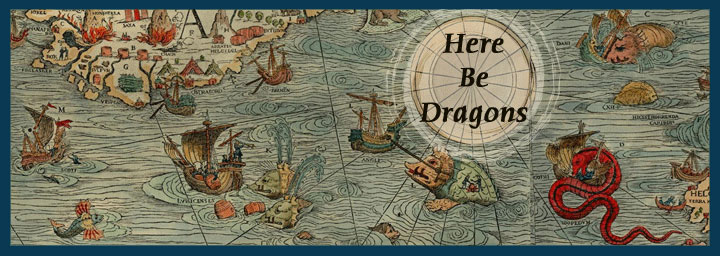
Why do horror movies hold such appeal when they include threats that we would normally avoid? Have you ever watched one and yelled out “Don’t go down those stairs into that dark basement!” from the edge of your seat? Have you ever felt compelled to look more closely at something just because it is dangerous or scary? This is something called “predator inspection.” Some species will deliberately approach a potential predator to gather information. The risk is immediate, but the long-term benefit is better threat assessment. Animals that never encounter predators often become less capable of recognizing danger which is a liability in the survival game. If you’ve ever seen medieval artwork that shows predators the artist never encountered, it’s pretty obvious: lions, whales, sharks and other real animals end up looking more like invented animals (e.g. dragons). Or in one case, we saw a lion pedestal below a baptistry, and the lion faces looked like my second grade teacher, Mr. Walker.
Do you think that people from sheltered environments are more vulnerable to threats due to lack a predator inspection in their community and their personal experience? There are some ways that these environments can increase vulnerability. If a child grows up in an environment where:
- authority figures are consistently trusted
- conflict is minimized
- deception is either rare or hidden
- dissent is discouraged
- difficult topics are avoided
they will have fewer opportunities to develop skills such as:
- detecting manipulation
- evaluating conflicting claims
- recognizing dishonesty
- setting boundaries
- tolerating uncertainty
When they encounter skilled manipulators, they may lack the skills and experience needed to recognize the warning signs and avoid the threat. People who have been scammed once are less likely to be scammed again in the same way. People who see trusted people make and admit mistakes are more likely to evaluate limitations honestly. People who encounter conflicting viewpoints are more able to question assertions made to them by those who seem authoritative or confident. They develop something called epistemic vigilance, the ability to evaluate whether sources and information are reliable.
There is a species on Star Trek that was introduced in the Discovery series. First officer Saru is a Kelpien. He is from a planet called Kaminar which has two sentient species: one that is a predator of the other. His species was preyed upon by the dominant, aggressive Ba’ul species. As a result, the Kelpiens developed a “threat ganglia” in their brain that was hypersensitive to any danger, emitting an intense, involuntary biological sense of danger whenever a threat was near. The more advance Ba’ul species deliberately cultivated this sense of fear in the Kelpiens, creating a religion in which young Kelpiens were protected until maturity, then preyed upon by the Ba’ul. As we learn through Saru’s journey, this religion was created by the Ba’ul because they were originally the prey species. By culling the Kelpiens before they reached full maturity, they could dominate their former predators. Saru alters his destiny by undergoing the vahar’ai process that turns him from fearful and hesitant to a more aggressive and dominant individual, shedding his threat ganglia.
Because of Saru’s evolution, he was a particularly humble and empathetic leader, using courage to protect others, not to freeze up in fear. He became brave and decisive. Before shedding his threat ganglia, he was also effective at warning others of dangers they couldn’t yet detect. He was measured and diplomatic in approaching conflict, but capable of being analytical and tactically competent. This made him an effective captain.
Too much predator inspection is not always a good thing, as you can likely imagine. When staying at my parents’ house, I saw a binder my mother apparently created in 2004 full of scary cartoons from the newspaper about hurricanes and the impact they had on creating panic in the community. There were also cartoons about terrorism and anthrax specifically. She’s no longer around to explain what the purpose of this binder was, but it seemed like an obsession of sorts. It’s not uncommon for the elderly to find their circumstances frightening and bewildering. Perhaps that was preying on her mind at that time. I have heard similar fears from other people as they age: fear of crime, violence (especially sexual violence), loss of property, threats to loved ones, etc. And these fears have some basis in reality, of course.
I recently started watching The Testaments, the series based on the follow up book to Margaret Atwood’s The Handmaid’s Tale. This part of the story shows events that occur several years later as June’s daughter who was kidnapped and is being raised in a commander’s family in Gilead comes of age along with her same-age peers. Dissent is not only discouraged but considered a capital crime, and the girls are frequently taken on field trips to see the corpses of “dissidents,” and to witness brutal corporal punishment of individuals who didn’t follow “God’s laws” as enforced by the community. Agnes (June’s daughter Hannah with her new Gilead name) is beginning to see, for the first time, that the beautiful and safe community she lives in where the only identified threats are outsiders who hate God is actually not all it’s cracked up to be. She thinks she is the one who is tough and prepared for her future adult life, but she is starting to realize that the men who are in authority hold the only power, and use it to control and exploit the women. She is starting to realize that the leaders she thought kept her community safe were actually using their power to demean and brutalize anyone who opposed them, and claiming that they were the victims of terrorism from outsiders while they are the ones perpetrating violence on others. It’s a bleak but compelling show.
From an evolutionary perspective, humans ideally need a balance between trust and suspicion. When there is too much trust, cooperation is high–but exploitation is much more likely. When there is too much suspicion, exploitation is less likely, but relationships and cooperation suffer. Healthy development means learning:
- whom to trust
- when and how to verify
- how to change your mind
- how to tolerate ambiguity
Without ever encoutering challenge, disagreement, or deception, it’s very hard to develop those skills.
Someone raised in a sheltered religious or political environment may be highly skeptical of outsiders yet far too trusting of insiders. That seems to be one of the main themes of The Testaments.
- Do you think Mormons are better at sniffing out deception or worse?
- How have you determined whom to trust and when to be skeptical?
- How have you fostered these skills in your children?
Discuss.


And thus we see why Mormons are such suckers for conspiracy theories, scams, and multi-level marketing pseudo-scams. And conniving politicians, who must privately think Mormons are the most gullible demographic in town.
We are far too trusting of our fellow congregants. The fact that the Church doesn’t invest in background checks for those who work with children and youth and cameras in buildings is increasingly baffling to me. Those things have been standard in many other Christian churches for decades now if for no other reason than that they are scared to death of liability (then again, they don’t have the deep pockets we do).
I remember being asked to teach a 5th Sunday lesson about sexual assault several years ago (I’m a former prosecutor), and it was clear that that the vast majority of the ward hadn’t really given much thought to the idea that there are predators among us. I went so far as to say that a temple recommend is not a background check and sensed that I hit a nerve there. I also tried to make that clear by putting up pictures of now former Mormon leaders and members (including a guy I prosecuted years before) who had been prosecuted for sexual assault or otherwise excommunicated for gross sexual impropriety, and I could tell that it was eye opening for many. It’s still probably the hardest yet most important lesson I ever gave, and I hope it made some sort of difference.
Mormons are vulnerable to deception in large part due to the emphasis placed on trusting religious authority. Such blind trust goes back to the founders. One episode stands out as an example of how deference to authority contributes to the concealment of wrongdoing. I recently visited the Mountain Meadows Massacre site. It is sobering to contemplate the level of cruelty that took place there. At least 120 men, women, and children slaughtered over a five day period.
Even if you have doubts that Brigham Young ordered the attack, he certainly created the atmosphere of hate and covered it up for twenty years. The perpetrators were simply following orders. Church leaders obscured responsibility for the killings and delayed full accountability. It is a tragic example of how religious bigotry, combined with political conflict and fear, can contribute to mass violence. A lesson for our troubled time.
A line of thought that is a little sideways from the major point of this post.
The OP touches briefly on the fact that it is common for people to become more fearful as we age. That’s not entirely irrational. The world genuinely is somewhat more dangerous for me than it was 50 years ago. My strength, balance, immune system, reflexes, senses are all less than they were. More than that, this is not the world I grew up in. The habits and reflexes I learned over the decades of my life are often counterproductive in this world. I think I’m doing well in this world, but there’s no question that in many ways it’s harder than it used to be.
That has led me to wonder how this reality affects the issues and challenges our church culture is facing now. Much of senior church leadership is considerably older than I am. How does the probably inevitable struggle with increasing age-related anxieties affect how we see these issues and challenges? The world may not be more dangerous than it was in an objective sense. However, if it is realistically more dangerous for me and our senior leadership, how will that affect our view of the world and the decisions we make?
Yes, Mormons are much too trusting of fellow Mormons. We virtue signal our in-group status in lots of ways. Our politicians have to signal their “Mormon credentials” in some way. So, they advertise with pictures of them and their 5 sweet children. I have know people who flash temple recommends to try to talk their way out of traffic tickets. And Utah is known as the fraud capital of the US (well at least before Trump, now it is where ever he is) people use in-group status as a way of gaining trust in order to con people.
We are way too trusting of in-group.
And we are too distrustful of “outsiders”.
I want to depart from the religious angle of this and talk about it on a family level, then expand back to the church. Abusive families teach the abused children not to trust anyone outside the family. This cuts off the child’s ability to get help outside of the family. The child needs protection from the family, but has been taught that as bad as the abusive parents are, anyone outside of the family is so much worse. And the child is told that if only they were a better child, then parent wouldn’t get so angry and beat you. Abusive spouses the first thing they do is isolate the victims from anyone they could talk to. They start undermining all relationships she/he has with anyone else. By the time he starts hitting her, or she starts getting violent, the abuser has the victim in a position of no one to tell and feeling like it is all their fault. The abuser uses shame as a control mechanism.
So, the church uses the same tactics. It promotes a distrust of other religions and any outsider. We are told not to use outside material in lessons. We are told not to trust things we find on line. Teens are encouraged to talk to religious leaders about any problem, not school counselors or the police. Adults are told to discuss marital issues with the bishop rather than go to a professional marriage counselor. If you have doubts about the church, talk to your church leaders, not some friend or neighbor. But as the book Torn just demonstrated, it goes 4 times worse and you are more likely to leave the church is you talk to your church leader. Kind of like the abused kid really needs to talk to someone outside the family.
The church also uses self blame. Everyone in the church knows that if you hate the temple, it is because *you* just don’t understand. If a kid comes home from a mission early, he must have screwed up. If you question church authorities, you must be looking at porn. If you don’t think the Book of Mormon is True, it is because *you* haven prayed about it. If you think you have inspiration that disagrees with church leaders, *your* inspiration is wrong. Any problem with the church is *your* fault, automatically. And the church uses shame as a control mechanism. It is all your own fault.
There is a reason that church young women’s program never discuss things all young women need to know, such as sexual consent, rape awareness, dating violence and other predator risk lessons. Same with adult RS. We never got lessons that mention spouse abuse, or what to do if your husband molests the neighbor kids, or what exactly is “unrighteous dominion” and is there any such thing as “righteous dominion”. We are never taught any information about abusers or predators and how to protect ourselves. It is like the church doesn’t really want us to know what predatory behavior is because then we might object to how the church treats us.
The church purposely sets up this system of in-group trust and suspicion of outsiders, and it uses guilt, shame and self blame as control mechanisms. This system is abusive.
One thing that occurred to me as I was writing this, and also finishing up season one of The Testaments is that there’s a real risk in over-trusting outsiders when you realize the insiders are not trustworthy. It seems that during that Fowler Stage 4 of the faith crisis, when the former believer is now rejecting the system they are leaving, they sometimes over-correct and become too distrusting of the group they are leaving and far too trusting of the outside group they formerly did not trust. Their trust and discernment is a bit wobbly before it stabilizes. The final episode of season one of the Testaments was a particularly good look into the need to be skeptical and inspect threats from everywhere, not blindly trust those we previously rejected as outsiders. It was an interesting shift to watch as characters’ assumptions began to fall apart. I really recommend the series, even for those who didn’t watch Handmaid’s Tale. It stands alone just fine.
De Novo, point of order re: Mountain Meadows: To say “even if you have doubts that Brigham Young ordered the attack” is to imply that believing Brigham ordered the attack should be the default position.
Historians in and out of the Church agree with you that Brigham fostered a culture of violence that made the Massacre more likely, but they also universally reject the idea that he explicitly ordered it. The letter he sent prior to the massacre saying that the wagon train should be allowed to pass through Utah territory unharmed is pretty strong evidence to that effect.
That is not to say that Brigham was blameless by any means. The cover-up and profoundly shameful attempt to pin the whole thing on Native Americans was all Brigham’s doing. But claiming he ordered it is a historically sloppy conspiracy theory.
To the original post, the fact that roughly 3/4 of American Mormons who claim some special spirit of discernment voted for the most dishonest and morally repugnant human being on the planet very much suggests that discernment isn’t a real thing – or if it is, Mormons are really, really bad at it.
When obedience to Church leaders is the first law of the LDS Church and when the Church refuses to implement best practices to protect vulnerable members from abuse, LDS members will continue to be highly suspectible to experience abuse.
Your summary is so important: “If a child grows up in an environment where:
authority figures are consistently trusted
conflict is minimized
deception is either rare or hidden
dissent is discouraged
difficult topics are avoided
they will have fewer opportunities to develop skills such as:
detecting manipulation
evaluating conflicting claims
recognizing dishonesty
setting boundaries”
Thank you for this outstanding article.
I haven’t seen the Testaments, one of these years. However–
Saru becoming a ambassador is a win for the Federation.
When it comes to creating interesting characters, you can still be interesting and a decent sentient being. (and have you seen the Short Trek The Brightest Star?)
Saru stands tall (bad joke)