
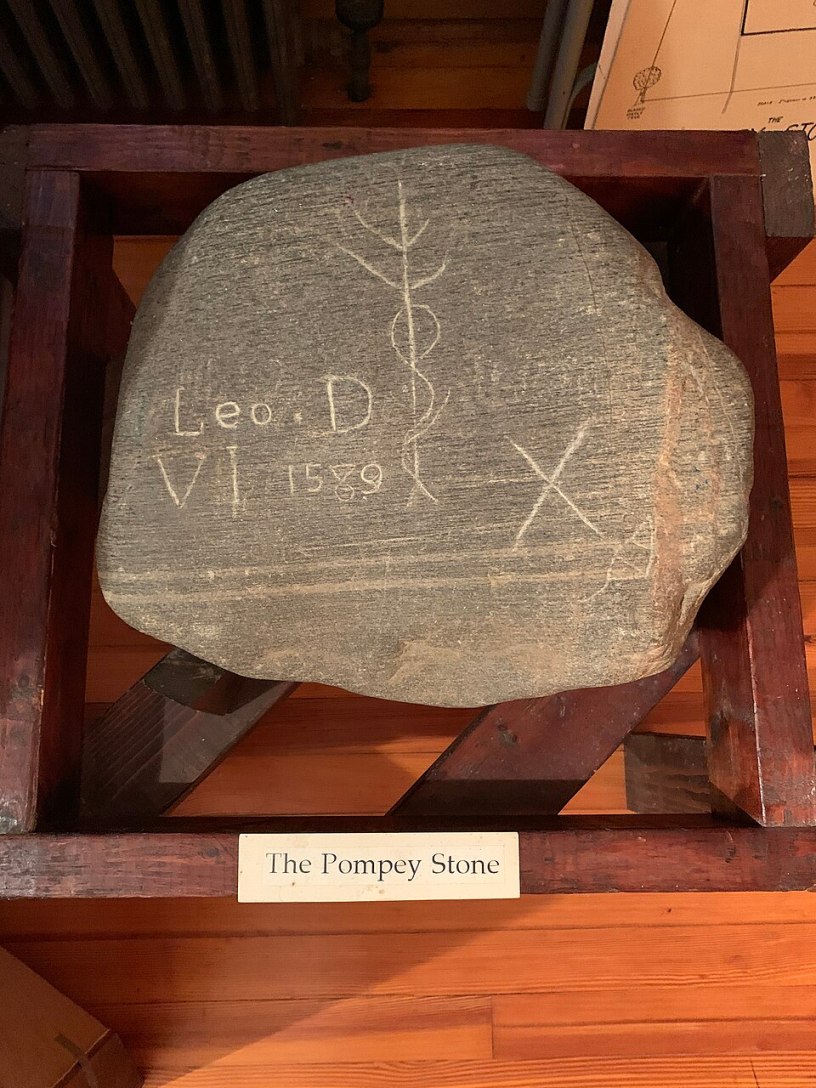
In 1820, on a farm in Pompey, New York (a town between Sharon, VT and Palmyra, NY), a farmer named Philo Cleveland found a sandstone rock featuring a carved inscription in Latin while he was clearing a field. The stone’s inscription included the date 1520, which would have made it the earliest known European artifact in North America.
Philo brought the stone to the local blacksmith in the town of Watervale who displayed it to customers as a curiosity. The blacksmith allowed visitors to the shop to further dig out the inscription using nails from the shop which made the inscription more prominent and newer in appearance. About six months later, the stone was moved to the town of Manilus where several scientists inspected it. After a year in Manilus, it was put on display in the State Museum of the Albany Institute.
By 1872, it had been moved to the New York State Museum of Natural History where it could be inspected by more authorities. By 1880, it was displayed in that same museum.
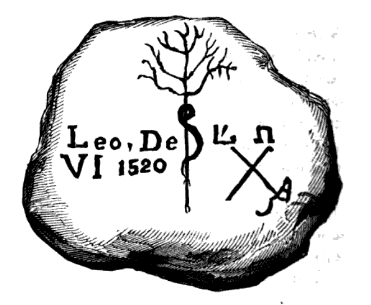
The stone was analyzed in an article in The Literary Chronicle in 1823, concluding that the inscription might be a reference to Pope Leo X’s reign with the symbol in the middle representing the fall of man and the letters L. S. standing for loco sigilli (place of seal). The cross emphasized the Christian connection. This story was seemingly built upon by future researchers:
- 1842. Barber and Howe theorized in Historical Collections of the State of New York that the stone might have maked the resting place of a Spaniard who died after traveling north from Florida in search of gold.
- 1847. Henry Schoolcraft attributed the stone to a member of Juan Ponce de Leon’s expedition searching for the fountain of youth which he published in his book Notes on the Iroqouis. He posited that “Leo” was a shortened form of “Ponce de Leon.” (Ponce de Leon landed in Florida in 1512).
- 1849. Joshua V. H. Clark wrote that the stone marked the grave of a Spanish explorer in his book Onondaga, or Reminiscences.
- 1851. E. G. Squier published Antiquities of the State of New York, endorsing the stone’s authenticity.
- 1863. Buckingham Smith, an author and researcher submitted an article to the American Antiquarian Society suggesting the stone was a memorial to a dead Spanish missionary, and that the inscription referred to Pope Leo X.
- 1860s. LDS leader and scientist John F. Boynton endorsed a connection between the Pompey Stone and the Cardiff Giant [1], another artifact later proven to be a hoax.
- 1879. Henry Homes gave a lecture to the Oneida Historical Society that was the most full-throated defense of the stone’s authenticity to date, claiming that it had been thoroughly authenticated. He added to the story that it was a Spaniard named Leo who was captured and adopted by a Native American tribe. The stone was, he suggested, made by a companion from this Native American tribe upon his death.
- 1884. Historian Berthold Fernow (seriously where do some of these names come from?) cited Homes in Narrative and Critical History of America.
But, alas, after such a long run, this is where the story takes a turn.
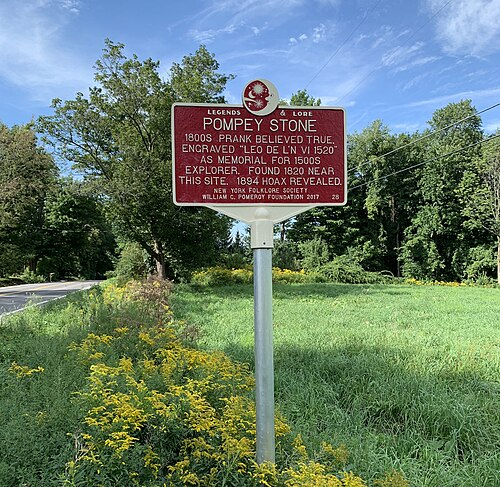
1894. Reverend William Martin Beauchamp, a shrewd Onondaga antiquarian, noted that the ground where the stone was found was completely unsuitable for burial. He also became skeptical of the origins when he discovered that the authenticity had never been seriously questioned. He inspected the stone and concluded that the tools used had been two different types of cold chisels, a hammer or mallet and a punch. He also noted that the L and numbers were written in a modern style, not how they were written in the 16th century, and that there had been no natives living near that area in the 16th century. He wrote an article explaining why it was likely a 19th century creation. As a result, a man named John Edson Sweet wrote that his uncle Cyrus had confessed to him in 1867 that he created the hoax, more or less as a joke.
Despite this new information, at least two Catholic priests later cited the stone as authentic evidence that Catholics had populated the area as early as 1520.
I only just heard about the Pompey Stone hoax last month on an episode of Stuff You Missed in History Class, but there are obvious reasons for someone raised LDS to find this story interesting. There were a lot of these types of “ancient” artifacts popping up in this part of the country at this time. The cultural milieu in which this was pretty unique:
- intense religious revivalism
- treasure digging
- fascination with prophecy
- folk magic
- speculation about “lost races”
One of the main reasons is that white settlers had a really hard time believing that Native Americans built the ancient earthworks they found across North America. It’s similar to the more recent thinking that the pyramids must have been built by aliens because there’s no way such backwards non-white people could possibly . . . yada yada yada. Not believing that the native people were capable of such sophisticated building projects was psychologically necessary to justify taking their land by force. Tale as old as time. This created a culture in which white settlers produced theories to explain away the achievements of the people they stole from, including:
- lost Israelites
- Atlanteans
- Vikings
- Egyptians
- rogue Europeans (as with the Pompey Stone)
- vanished “civilized” races
The Book of Mormon came forward amid this same time of speculation and justification, fitting very well into the prevalent thinking of the day. One key difference is that the Book of Mormon did not leave an artifact to be investigated and proven or disproven (one problem with the Kinderhook plates and the Book of Abraham). If there is no artifact, the claims are not based on a physical or scientific examination of the plates, but instead can be based on the text itself and spiritual witnesses of believers. To put it another way, if the glove does not fit, you must acquit, but if there’s no glove at all then you can believe whatever you want.
Ultimately this points to the question: what types of evidence should count for religious claims? When we look closer at various artifacts (and hoaxes), there is a consistent pattern of religious leaders and followers being vulnerable to hoaxes if the hoax appears to confirm a belief they already hold (such as the Cardiff Giant). But that’s certainly not to say that others are not susceptible to be fooled by hoaxes. Any human viewing an artifact that confirms a pre-existing belief they hold is likely to want to believe. This is true when a fake relic:
- confirms an existing belief
- satisfies an emotional need
- strengthens identity
- resolves uncertainty
I’ve said many times that if you cobbled together all the wood that supposedly was part of the crown of thorns in all the reliquaries across the world, you could build a briar patch that would stump even Brer Rabbit. And yet, if you want to see those relics, get ready to stand in a long line and probably pay a donation. Given that most Christian relics were gathered after Emperor Constantine converted to Christianity 300 years after Christ’s crucifixion, there’s good reason to be suspicious about their authenticity, but they are very meaningful to worshippers. And who know? Some of them might be accurate. Seems like a stretch, but IDK.
- Have you been interested in things like biblical archaeology (or BOM archeology) or are you skeptical of these efforts to “prove” scripture?
- Do you think it’s valid to overlook things like anachronisms or mistakes, prioritizing the meaning derived from scripture?
- Are people today equally prone to falling for hoaxes as they were before?
- Had you heard of the Pompey Stone and the Cardiff Giant? What other fake relics that have been debunked have you heard of?
- Do you find the cultural origins of the BOM to be significant or irrelevant in how you view the book?
Discuss.
[1] Unearthed in 1869 in Cardiff, NY, this was a statue of a 10-foot tall “petrified man.” It turned out to be a hoax perpetrated by George Hull, a cigar-maker and atheist from Binghamton, NY. He had been in a heated debate with a Methodist minister over the biblical passage in Genesis that said “There were giants in the earth in those days,” and he set out to prove how easily the public could be fooled by literal interpretations of religious texts. He quarried a massive block of gypsum in Iowa (gypsum is basically plaster–easy to carve). He hired sculptors in Chicago to carve the figure, using acid and stains to give it a weathered look and needles to create fake pores so the “skin” looked realistic. He then secretly buried it on the farm of his cousin in upstate NY and waited for the hilarity to ensue. In 1869, the status was discovered by workers. Scientists and paleontologists quickly dismissed the hoax, but many clergymen and members of the public lined up to pay 50 cents to see it and declared it a miracle that proved the Bible was true.


I had never heard of the Pompey Stone. Very interesting.
I love Biblical archaeology. New discoveries that confirm the historical and cultural authenticity of the Bible keep showing up. I’m not talking about anything that shows the historicity of a worldwide flood or the parting of the Red Sea, clearly exaggerated faces with no root in reality. But the existence of the ancient Israelite community in the Levant and its connections with outsiders. Just a couple of years ago, seven letters were deciphered on fragments of a clay jar dating back to the 10th century BC. They were found to be of South Arabian origin. The letters appeared to listing labdanum, one of the ingredients used in temple incense. This stands as evidence that Southern Arabians had a trade connection with the Israelites in Solomon’s time and that it is likely that the Queen of Sheba could have very well visited him as noted in the Book of Kings.
There is nothing even close to this in relation to the Book of Mormon. I find it curious that the bulk of studies focus on the Near East, when the Book of Mormon story barely takes place there. Studies connecting the Book of Mormon to Mesoamerica are really peculiar considering the fact that it’s over 2,000 miles away from where the Golden Plates are said to have been found. And to this no evidence has emerged of trade or cultural connections between ancient Mesoamerica and Upstate New York. The Book of Mormon described two huge battles involving the Jaredites and the Nephites at Hill Cumorah. In 1990 the First Presidency affirmed that that hill was the very same one described in the Book of Mormon. So why don’t archaeological studies focus their efforts there? Could it be because there aren’t a whole lot of historical artifacts there? Let alone skeletons of ancient humans and weaponry that would serve as evidence of ancient large-scale battles?
Are people today equally prone to falling for hoaxes as they were before?
Seriously? If there is anything that both the left and right agree on it is that the other half of the population is highly prone to believe and/or perpetrate hoaxes.
“Are people today equally prone to falling for hoaxes as they were before?”
I’ve heard of this $500 gold phone that mysteriously has failed to appear…
I issue my strongest possible condemnation to the so-called Pompey Stone. Its legacy continues to wreak havoc in the Great Lakes region to this very day.
“Do you find the cultural origins of the BOM to be significant or irrelevant in how you view the book?”
Oh man. I think I can recall the exact moment my shelf shattered. It was when I read an excerpt from the First Book of Napoleon (1809). It reads more like the Book of Mormon than the Bible does. As of that moment, I understood very clearly that the BoM was a 19th century creation. And the more I looked into it, the more obvious it became.
The BoM is:
– Full of Calvinist—specifically Arminian—theology (so it’s a post-Biblical work)
– Prone to copying the KJV verbatim, including parts the Nephites wouldn’t have had
– Full of anti catholic rhetoric (so the author was Protestant)
– Horribly racist and specifically colorist (so the author was too)
– A champion of American exceptionalism and manifest destiny (written by a proud American patriot)
– Conspicuously lacking in named female characters (written by an individual man who doesn’t think much of women’s agency)
– Full of terrible grammar and spelling (so the author/scribes’ education was limited)
– Full of stories that Lucy Mack Smith said (admittedly quite late in her life) that young Joseph Jr would tell by the fire as a youth or that Joseph Sr dreamed up himself
– Full of anachronisms, of course, but specifically anachronisms you would expect from a 19th American who read the Bible a lot
Joseph Smith meets all those criteria to the letter. The BoM makes no sense as an ancient document. It makes perfect sense as a 19th century document. Its content and its provenance are one.
Many years ago my parents subscribed me to Biblical Archaeology Magazine which seems to be a mix of legitimate archaeology / study and some shall-we-say sensationalist stuff, particularly in the ads. One of the hoaxes that seems popular among some Christians is related to the hoax I mentioned above (Cardiff Man) that apparently a prominent Mormon leader fell for in the 1800s. These ads purport to have found giant human skeletons buried in the middle east. I checked it out, and anything like that has been fake 100% of the time. I am pretty sure that magazine was the first time I saw an ad for that hoax. I didn’t actually read that magazine as it wasn’t my jam, although I have occasionally enjoyed those Ancient Aliens type shows (and the Biblical versions of the same showing how the ten plagues of Egypt were real, etc.). The thing is, when you go to these actual sites, you quickly discover that these sensationalist “findings” are really not what you heard.
“Full of Calvinist—specifically Arminian—theology…” Is Arminianism a subset of Calvinism? Both may be Protestant, but so are Lutheranism and Anglicanism, neither of which are Calvinist. Methodists are usually considered Arminian, while Presbyterians are usually considered Calvinist.
Is Arminianism a subset of Calvinism?
Those who study these things say Calvinism has five major points (as expressed by TULIP), but the Armenian Remonstrance disagrees with all five points. Other than both being categorized as protestant within Christianity, I see little commonality between them.
One thing I appreciate about the Book of Mormon is that it is not a theological treatise such as Calvin or Arminius or another educated person might have produced. Rather, it is a story. Hasn’t God always preferred stories over theological treatises? I think that if we understand the stories in the scriptures, then over time and with experience and with a little help from the Holy Ghost, we will come to better understand God and better understand things as they really are. Theology (and doctrine and legalism) messes up all of that. Maybe that’s why I find myself opposing labels and manner of -isms, both within our Latter-day Saint framework and within broader Christianity — maybe that’s why Come Follow Me and many general conference addresses don’t fully work for me, because they want to declare or affirm doctrine rather than reading and discussing the stories of the scriptures and letting the doctrine distill upon our individual souls over time and with experience. Even though I differ with other Latter-day Saints in this regard, I appreciate that those called to produce Come Follow Me and to give general conference addresses generally try to act in good faith.
And maybe that’s why I still read Wheat and Tares, because I see value and learning in the conversations. God works with individuals more through stories and conversations, one at a time, over time and with experience, than through theological or doctrinal declarations or treatises.
…the Arminian Remonstrance…
Kirkstall:
“The BoM makes no sense as an ancient document.”
There are many latter-day saint scholars — with training in fields that are relevant to the Book of Mormon’s claims — who will tell you that the BoM makes the best sense when it is treated and understood as an ancient document.
Thank you, Georgis and Ji, for giving me an opportunity to correct my understanding of Calvinism and Arminianism. Per an article from Dialogue vol 38 no 4 by Clyde D Ford:
“Thus, Book of Mormon theology has been classified as ‘wholeheartedly and completely Arminian,’ as containing ‘elements of Calvinism and Arminianism,’ as ‘a volume of Disciple [of Christ] theology . . . beyond any reasonable question,’ or as emphasizing both ‘Methodist [Arminian] and Disciples’ theology.”
Clearly there’s a bit of nuance here as opposed to my hipshot overgeneralization. My point stands that the theology in the BoM is made of the same water Joseph Smith was swimming in and supports a New England Protestant origin.
Jack, any Latter-day Saint scholar who can dismiss the many evidences of the BoM’s 1800s origin in favor of flimsy and wishful arguments of ancient origin are unfortunately succumbing to motivated reasoning. Like Upton Sinclair said, “It is difficult to get a man to understand something when his salary depends upon his not understanding it.”
@Jack,
You said, “There are many latter-day saint scholars–with training in fields that are relevant to the Book of Mormon’s claims–who will tell you that the BoM makes the best sense when it is treated and understood as an ancient document.”
Where will these LDS scholars tell you this? LDS publications, LDS websites, firesides, and conversations with other believers.
Where won’t they tell you this? Peer-reviewed publications where all scholars, LDS and otherwise, participate in the review process.
Show me a peer-reviewed article in a respected non-LDS journal demonstrating that archaeological evidence supports the BoM’s claims. Same for genetics, linguistics, textual analysis, Near Eastern studies, metallurgy, history, or geology. Show me an article in Nature or Science using genetics to support the BoM as ancient. Show me one in the Journal of Field Archaeology or Ancient Mesoamerica. Same for Language, the International Journal of American Linguistics, the Journal of Near Eastern Studies, etc. Nothing.
All you can point to are the likes of Interpreter, the FARMS Review, the Journal of Book of Mormon Studies, and BYU Studies Quarterly. These are echo chambers for LDS believers. No one outside of Mormonism pays any attention to them, because when this work is submitted to journals with non-LDS reviewers, those reviewers poke holes in it until there is nothing left.
Look, I’ll grant that it would be difficult–at first–to get non-LDS scholars to accept findings that support the BoM. But it’s been nearly 200 years. The number of non-LDS scholars who have been persuaded by any of this work remains essentially zero. At some point, that’s not bias. That’s just the honest consensus scholarly opinion given the current evidence. If you follow the data, as true scholars do, the data currently available absolutely does *not* point to the BoM as an ancient document.
“Jack, any Latter-day Saint scholar who can dismiss the many evidences of the BoM’s 1800s origin in favor of flimsy and wishful arguments of ancient origin are unfortunately succumbing to motivated reasoning.”
LOL–Kirkstall. That’s a bit cynical for my tastes. Here we have the Book of Mormon: it fills one little slot on a book shelf. And then we have a veritable library of topnotch scholarly work that has been done on the book from just about every conceivable field of study. How does that happen? Only a book that has a lot to give — religiously, socially, politically, historically, scientifically, etc. — can produce that much commentary.
That said, if we were to read that entire library’s worth of material we may not come away absolutely convinced of the BoM’s divine provenance–but I’m confident that we’d have to admit that there’s a lot more to it than what a backwoodsy young man could conjure up–even if he were educated!
mountainclimber479,
The problem is that Latter-day Saint scholars are the experts on the Book of Mormon–and I mean from a scholarly perspective. And so who else out there even has the credentials to review the work they do on the BoM? There’s no one. And so while I agree that it’s a sort of “in house” kind of work–that’s the way it has to be for now–that is, until they can gain enough traction in the larger scholarly world to make some inroads.
But that’s not to say that their work isn’t topnotch–it is. Even so, it’s difficult to defend a work that claims to have a divine provenance–including angels and gold plates. It’s not the sort of thing that typically attracts a lot of scholarly attention in the world of academia–though some latter-day saint scholars have published good work through “outside” channels.
That said, you might be interested to know that organizations like Interpreter do have a peer review process–but of course it is comprised of experts in the field of Latter-day Saint studies. And so naturally the majority–if not all–involved in the process are going be members of the church. And that’s the best we can do right now–considering the fact that’s where the experts are found.
@Jack,
I’m going to accuse you of moving the goalposts again. Your initial comment emphasized that “latter-day saint scholars–with training in fields that are relevant to the Book of Mormon’s claims” maintain that the BoM is ancient. The criterion you offered was training in relevant fields. When I pointed out that essentially all non-LDS scholars in those same fields–archaeology, genetics, linguistics, geology–find no evidence that the BoM is ancient, you shifted to arguing that these experts aren’t qualified because they lack expertise in the BoM itself.
But deep knowledge of the BoM isn’t required to evaluate its empirical claims. One does not need to be a BoM expert to conclude that the archaeological record doesn’t support a migration from Israel to the New World at the dates the BoM requires–expertise in New World and ancient Near Eastern archaeology is sufficient. One does not need to be a BoM expert to determine from genetic data that no such migration occurred–being an expert geneticist is sufficient. One does not need to be a BoM expert to establish that there is no relationship between New World languages and Hebrew or Egyptian–expertise in those language families is sufficient. One does not need to be a BoM expert to evaluate whether the catastrophic geological events described at Christ’s coming actually occurred–expertise in New World geology is sufficient. I could go on.
You said LDS scholars will bear the load “until they can gain enough traction in the larger scholarly world to make some inroads.” Without significant new data, that’s never going to happen. The data we have overwhelmingly points away from an ancient origin. Frankly, I suspect many (not all) of the LDS scholars you’re referring to would concede this. They start from a position of faith that the current evidence simply doesn’t support, and they publish accordingly. To borrow a biblical analogy: their foundation is built on sand. Until that foundation can be moved onto rock–rock that, given the current data, does not exist–the larger scholarly world is not going to pay attention.
“But that’s not to say that their work isn’t topnotch–it is.” Actually, a lot of it is pretty bad. Even setting aside the sandy foundation, the bar for publication in LDS apologetic journals is far lower than in mainstream scholarship. Daniel Peterson’s work in Interpreter does not come close to matching the quality and review rigor of research published in Nature or the Journal of Near Eastern Studies. These are not in the same league, however much the LDS journals would like to claim otherwise.
“Some latter-day saint scholars have published good work through ‘outside’ channels.” Let’s not move the goalposts here either. Yes, LDS scholars publish good work in outside channels on non-LDS topics, and even on Mormonism as a subject. But the question is whether the BoM is ancient. Show me a list of articles in respected, peer-reviewed, non-LDS journals presenting evidence that the BoM is an ancient document. Good luck.
As for whether reading “that entire library’s worth of material” would convince us there’s more to the BoM than a young man could conjure up: that’s subjective, but for me the answer is a firm no. A great deal has been published arguing the earth is flat; volume of commentary establishes nothing about correctness. And reading Joseph’s history, it’s clear he was a highly intelligent person. It’s not hard for me to imagine he conjured it up.
“Only a book that has a lot to give… can produce that much commentary.” No. Mormonism is a high-demand religion, and the BoM presents a large surface area for believing experts in many fields to attempt to authenticate. It should surprise no one that LDS scholars who have committed their lives to Mormonism want to use their academic tools to vindicate it. Some find things that build their faith. Others look at the data and step away, or lose their faith. So far, essentially no one outside Mormonism accepts any of this research as evidence of antiquity.
“Studies connecting the Book of Mormon to Mesoamerica are really peculiar considering the fact that it’s over 2,000 miles away from where the Golden Plates are said to have been found.”
John Sorenson addressed this and other issues in his book ‘Mormon’s Codex’. Excellent book that lays out the evidences found in Mesoamerica that support the plausibility of the Book of Mormon. The parallels are numerous and detailed.
https://a.co/d/0cH0dMo7
Sorenson is considered the titan of Mesoamerican anthropology–but only within Mormon circles. Outside of Mormonism, his work was never considered very important, largely because he spent so much of his career trying to prove Mormon claims, which non-Mormon scholars regard as fringe at best. He simply is not an important figure in archaeology or anthropology outside of Mormonism.
As a counterexample, I was fortunate enough to take an archaeology class from Ray Matheny while I was a student at BYU. He even took us on a fantastic field trip in a few BYU vans down to the Mesa Verde area, where we toured a number of archaeological sites. In contrast to Sorenson, Matheny made genuinely significant contributions to Mesoamerican archaeology that are recognized outside the Church. Many Mormons have heard of Sorenson, but most probably haven’t heard of Matheny. That’s because Matheny, unlike Sorenson, chose to “let the dirt tell its own story”, and did important work in archaeology instead of spending his life trying to provide the BoM as an ancient document. In contrast to Mormons, if you as Mesoamerican archaeologists about Matheny and Sorenson, I strongly suspect everyone will know who Matheny is and what he did, but not as many will know about Sorenson. As far as I know Matheny was a devout member, but he drew a very firm line between his faith and his profession.
I clearly remember one lecture on Mesoamerican archaeology when a student asked a fairly innocent question trying to connect the material to the BoM. The reason I remember it so well is how Matheny handled it. He was normally a relaxed, funny guy–very competent, but a bit of a bumbling-professor type. When he heard the question, he stopped the class and his tone changed completely. He proceeded to give a very serious ten-minute lecture on how there was zero archaeological evidence for the BoM in Mesoamerica. He walked through the claims people commonly make, explained why none of them line up with the Book of Mormon and the archaeological record, and stated very firmly: NO ARCHAEOLOGICAL EVIDENCE FOR THE BOM IN MESOAMERICA. I can’t tell you how grateful I’ve been over the years for his candor. It didn’t break my faith at all–quite the opposite. I was already skeptical of the Mesoamerican evidence claims, so it was a relief to know that a true expert didn’t buy into any of it, either. I have always been very grateful that a BYU professor, a highly respected expert on Mesoamerica, was willing to state openly in class where he thought the data led on this issue.
Two BYU archaeology/anthropology professors–two very different approaches. Before we tout all the publications by LDS scholars supporting the ancient origin of the BoM, let’s not forget all the LDS scholars who don’t reach that conclusion. They are not small in number, nor are they typically very vocal–and if we’re comparing numbers, we should also count the many who ultimately chose to step away from the Church.
mountainclimber479
I tool a field trip to Mesa Verde in, Um, 1979. Great trip.
I also took Archaeology and the Scriptures. Sorenson’s then unpublished book was one of the textbooks. From what I can remember, from the narrative my biased brain produces, is most everyone keeping their mouths shut. Privately students in quiet voices would acknowledge,– there was no archaeological evidence for the ancient origins of the Book of Mormon.
Now 45+ years later, what I wonder is if we were to poll everyone(including the FARMS people) who went through the BYU archaeology program, what they would say about ancient origins? My data free guess is it mostly matches nonmormon archaeologists. Please, somebody do a study.
mountainclimber479:
“I’m going to accuse you of moving the goalposts again.”
I thought I was clear in defining what the problem was–and that involves getting the “goalposts” in the right position. We can’t judge the quality of work that’s being done by latter-day saint scholars (on the Book of Mormon) by how it fares in the larger academic world. There’s simply no place for it–and remember they–the latter-day saint scholars–are the experts on the subject.
“But deep knowledge of the BoM isn’t required to evaluate its empirical claims.”
I’ll have to disagree with you, brother. I know you’re talking about the hard sciences here–but still, shouldn’t a researcher dig as deep as they possible can into the thing they’re researching? How can they possibly know what they’re looking for if they haven’t familiarized themselves with every pertinent detail in the text? Latter-day saint scholars of done the hard work of becoming experts in the BoM as well as their own fields–and, IMO, they have some good answers to the more “overt” claims of the BoM.
That said, you have to include the work that’s been done in the “softer” fields–which is far greater in sheer number of pages than the archaeological/anthropological work that’s been done. The papers and books that have been published in fields related to language, culture, history, etc., is monumental.
I said: “Only a book that has a lot to give… can produce that much commentary.”
Your answer: “No. Mormonism is a high-demand religion, and the BoM presents a large surface area for believing experts in many fields to attempt to authenticate.”
How ever true that may be–if it were the Late War instead of the Book of Mormon that was canonized there wouldn’t be nearly enough rich content from which to build a sizable library of meaningful commentary.
I’m going to shift the goalposts again: it isn’t only an attempt to authenticate the BoM that causes so much to be written about it. There’s also the devotional aspect of the work–the setting forth of the theological and philosophical elements of the book in new and interesting ways in an effort to promote faith. While that kind of work is usually not in the business of proving the BoM’s claims it does demonstrate that it is a well that never stops giving with regard to living the gospel.
@suzanne, that’s not the right time period for me, but yeah, the Mesa Verde field trip was a blast!
@Jack, “I thought I was clear in defining what the problem was–and that involves getting the ‘goalposts’ in the right position.” Nope. You originally claimed that expertise in a relevant field was sufficient. When I pointed out that virtually all non-LDS experts in those fields reject an ancient BoM, you added the constraint that only LDS BoM experts count. I disagree with that requirement regardless. I’ll concede that plenty of questions about the BoM require significant BoM expertise. But many flat out don’t. I gave you 4-5 examples and could produce a few dozen more in minutes. You don’t need to be a BoM expert to study whether Mesoamerican languages are related to Hebrew or Egyptian. You don’t need to be a BoM expert to study New World metallurgy. On questions like these, non-LDS scholars provide valuable insights with zero BoM expertise required.
“If it were the Late War instead of the Book of Mormon that was canonized there wouldn’t be nearly enough rich content from which to build a sizable library of meaningful commentary.” Wrong. If the Late War were the keystone of Mormonism, LDS scholars would study it as extensively as they study the BoM. You may not find its content rich now, but if it had been canonized instead, I suggest you’d find ways to derive deep meaning from it–and LDS scholars would produce the same sorts of “evidences” and theories for its ancient authenticity that they’ve produced for the BoM.
“I’m going to shift the goalposts again.” Yep, that’s exactly what you’re doing. My best guess is that this is also how Professor Matheny dealt with the BoM. He was an LDS scholar who knew the BoM well and was a world-renowned expert in ancient Mesoamerica. He found zero evidence for the BoM in Mesoamerican archaeology, yet he apparently still found value in Mormonism and living the gospel. I don’t dispute for a second that many members choose to look past the lack of evidence for BoM historicity and find functional value in Mormonism. But that’s a completely different question, and it’s in no way proof that the BoM is an ancient document.
Let’s remember that what we’re really talking about is expertise in the study of the *Book of Mormon*. Yes–in responding to Kirkstall I pointed out how scholars from a wide verity of disciplines believe that the BoM makes the best sense as an ancient document–but that’s not to say that they have no expertise in the BoM itself. And when I responded to you I tried to establish *who* the experts are (in said study) so that there wouldn’t be any confusion about how the smaller world of Book of Mormon scholarship fails to fit neatly into the larger world of academia.
I gotta disagree with you on your second paragraph. Imagine culling only the sermons from the BoM and putting them all together in a book called something like “Sermons from the Book of Mormon.” You couldn’t get anything like that from the Late War–at least not nearly as profound or substantial. The BoM has real meat in it–stuff that can get the reader thinking and feeling on the most profound levels of human understanding and experience. Yes, I agree that its canonization causes members to look to it with a greater eye of faith than they probably would otherwise–a good thing. But even so, it is the cornerstone of our religion because of its content regardless of how we got it–and in saying that I’m sure you already know that I believe in the BoM’s divine provenance.
“And then we have a veritable library of topnotch scholarly work that has been done on the book from just about every conceivable field”
None of which is recognized as informative, true, or even scholarly by virtually all non-Mormon and ex-Mormon scholars. None of this so-called “scholarship” is peer-reviewed in the real sense. The rigged peer-review process that it goes through is not real since it is reviewed only by other believing Mormon scholars and not by a larger body of scholars who are not Mormon.
“Let’s remember that what we’re really talking about is expertise in the study of the *Book of Mormon*”
Apologists and believing Mormon scholars always appeal to this reasoning as a poor excuse as to why their “scholarship” can’t be challenged (except by non-morning scholars who are experts on the Book of Mormon, which wouldn’t happen since there is no money and structure for non-Mormon scholars to become experts). They are the only “experts” on the Book of Mormon, therefore we should defer to them. Look, when it comes to literature and how the Book of Mormon has been used or evolved throughout modern history, fine. I’ll defer to them as experts. But once you try to make the case that the Book of Mormon is historical, you’re crossing over to ancient Near Eastern and ancient American history and bear the onus of convincing a wider range of scholars that the Book of Mormon is legitimate evidence that Jews and Christians inhabited the pre-Columbian Americas.
Apologists have been at some seven decades. They’ve made virtually no inroads in convincing a non-believing scholarly audience that the Book of Mormon is in any way historical. Just look at everything that has been discovered about the ancient Americas in the last seven decades. If anything these findings have made a historical Book of Mormon even less plausible.
@Jack, let’s stay on topic. The question at hand is whether the BoM is an ancient record. You’ve shifted to arguing that because the book has “real meat”–content you find profound–it must have divine provenance. Even granting that, profundity is evidence of neither antiquity nor divine origin; plenty of profound texts are neither. What you’re describing is essentially catalyst theory: God inspired Joseph with the content, and whether he translated an actual ancient record becomes beside the point. That’s the door the Church has already opened with the Book of Abraham in its Gospel Topics essay, and I strongly suspect it’s where the Book of Mormon ends up as the evidence against ancient origins continues to pile up.
mountainclimber479,
LOL–we sure have a way of talking past each other. I’m saying that the content of the BoM is really what makes it worth writing about–not merely the fact that it’s canonized.
Brad D,
I think we have to acknowledge that there’s a natural barrier between serious BoM scholarship and the larger academic world. If, for example–and bear with me–the geographic coordinates found in First Nephi were discovered in the Dead Sea Scrolls they would probably be accepted as legitimate. But what happens vis-a-vis Joseph Smith is that folks assume that he must’ve had a map–or that even though there is a convergence of several lines of evidence we have to remember that even a broken clock is correct twice a day.
In saying that I don’t wish to blame anyone for not being as inquisitive as they otherwise might be. But even so, I think we have to acknowledge that because such a barrier exists it is inevitable that latter-day saint scholars are going to be the experts on the BoM. Otherwise we run into situations where experts miss such obvious correlations as peccaries=pigs.
I wasn’t aware of the Pompey Stone or the Cardiff Giant before this post. After reading it, thinking about it, and following the discussion in the comments I think the main distinction between the Pompey Stone and the Book of Mormon is that the Pompey Stone was available for people to come back to and study, over and over. New methods of analysis provide greater insight, new scientific techniques reveal what the naked eye can’t see. Any attempt at studying the origin of the Book of Mormon eventually devolves into arguments between “You can’t prove the plates existed, because you can’t show them to me” and “You can’t prove the plates are fake because God took them back.”
In my profession in Information Sciences, I help researchers find sources of information. Out of curiosity, I used one of the many academic research databases (in this case Academic Search Complete) to search for “Book of Mormon”. I was curious to see which peer-reviewed publications had articles on the subject. Of the three I found, two were based at BYU and the third was an “independent” LDS-based publication. And the purpose of each publication was geared toward a more literary analysis of the writing within the book, rather than a study of its origin. Basically writing study guides or theology essays. And, as the publications were very LDS based, all the articles I saw (I didn’t read them because there were too many, I was at work, and I have no interest in reading them), based on their brief descriptions, were written from the basepoint of assuming the content of the Book of Mormon was truth.
Janey wrote an excellent post on the theology of the Book of Mormon. That is, I believe, the appropriate direction for any study of the Book of Mormon: theological and/or literary analysis. Without empirical evidence, you cannot prove the existence of the Nephite/Lamanite cultures in the Americas. Any research based in science follows the data/evidence. There may exist a hypothesis beforehand, but the hypothesis is either proved or disproved with the evidence discovered and studied. If the empirical evidence to support the hypothesis doesn’t exist, than the hypothesis is proven false.
“If, for example–and bear with me–the geographic coordinates found in First Nephi were discovered in the Dead Sea Scrolls they would probably be accepted as legitimate.”
“peccaries=pigs.”
The whole focus of apologetics is ‘how could have Joseph Smith possibly known about this.’ Never do apologists ask, ‘how could have ancient Americans known about this?’ The latter question outweighs the former question overwhelmingly. Ancient Americans couldn’t have possibly known about Jesus (especially before his birth, not even the Old Testament mentions Jesus Christ’s actual name), let alone about doctrines taught in the first century Near East.
Also if you can’t establish that ancient Americans actually practiced Christianity and Judaism, then all this stuff about peccaries and NHM and other couldn’t-have-known-about-isms are completely irrelevant. By contrast, it is established beyond any reasonable doubt that ancient peoples in the Levant practiced Judaism and wrote about it. Even the most atheist or atheists acknowledge that fact.
Sorry to drag this out–
Brad D, we have to figure the added weight of folks feeling pressured into accepting the Book of Mormon’s claims about its own provenance–that is, if there emerged undeniable evidence of the BoM’s religious elements in ancient America. Whereas with the ancient findings of practiced Judaism in the East there’s no requirement to accept any kind of supernatural element in order to justify those facts–it’s a purely cultural phenomenon. And I’m sorry to say that I believe that dichotomy creates the kind of bias that causes smart people take the BoM’s claims less seriously than they might otherwise. Not to say that I’m one of those smart people–but I’m pretty sure that if I didn’t have a spiritual knowledge of the BoM’s truthfulness I’d probably lump it into the “flat earth” category. But it’s precisely because I do have that knowledge that I’m more open to theories about where it might’ve taken place than I would be otherwise–you see? And because of that openness I’ve been able to study John Sorenson’s theories without rejecting them before giving them their just due. And I gotta say that (IMO) he has generated a geographical map that conforms to the BoM’s text with almost pinpoint accuracy in every detail. He and others have also pinpointed many cultural, social, geological, and–yes–even religious correspondences. And the list of correspondences keeps growing; it’s productive–which is good sign.
All of that said, I don’t want to convey the notion that I’m 100% certain that Mesoamerica is where the BoM took place. As I’ve said elsewhere–we might learn one day that it all happened on Mars–and the BoM would still be true. But what I want to stress is the idea that enough good work has been done on the BoM’s ancient qualities that it deserves our collective benefit of the doubt vis-a-vis what hasn’t been discovered yet. Just the work that’s been done on the text itself–which is enormous–ought to be enough to keep us from throwing the baby out with the bathwater.
“Are people today equally prone to falling for hoaxes as they were before?“
The story of Mark Hoffman and the Salamander Letter comes to mind. His forgery was so good that experts passed it off as legitimate and church leaders, while skeptical, were certainly dismayed by it. Elder Oaks even tried his hand at harmonizing it with the more traditional accounts of Joseph’s visions (apologetics at work!). If Hoffman hadn’t committed those murders, I wonder how long that salamander story would have stuck around in Mormon thought.
That was in the 80s. I think we were on a good trajectory around then towards more scientific literacy and critical thinking…before Mark Zuckerberg’s big idea to rate the hotness of college girls somehow morphed into an array of online platforms that have become an integral part of our daily lives, sucking us into echo chambers, feeding us fake slop, and amplifying the reach of the bullsh****er in chief. And now we have AI chat bots on which we can offload all our cognitive function. God help us.
@Jack,
“What I want to stress is the idea that enough good work has been done on the BoM’s ancient qualities that it deserves our collective benefit of the doubt vis-a-vis what hasn’t been discovered yet.”
Adherents of every major religion on the planet make this exact claim. The facts and evidences always turn out to support their own supernatural claims.
“Just the work that’s been done on the text itself–which is enormous–ought to be enough to keep us from throwing the baby out with the bathwater.”
You keep returning to this, so let me push back directly. First, every major religion has produced an enormous body of textual analysis “confirming” its scriptures–Islam, Christianity, Judaism, Buddhism. Since you consider yourself open-minded, here’s a sincere question: based on the textual scholarship available today, what is your view of the truthfulness of the Quran? Muslim scholars find it miraculous in ways no 7th-century merchant could have produced. If their textual evidence doesn’t move you, why should yours move me?
Second, textual analysis is squishy. It’s not hard to “prove” a great many things with it, and everyone insists their analysis is the rigorous kind. Third, you talk as if textual scholarship points only one way. It doesn’t. There is a large body of careful textual work pointing toward a 19th-century origin: the Sermon on the Mount in 3 Nephi reproduces KJV readings that aren’t in the earliest Greek manuscripts. Janey recently posted about Alma 42, where Coriantum takes the standard 1820s Universalist position and Alma provides the standard 1820s anti-Universalist rebuttal. Add the long ending of Mark echoed in Mormon 9, Paul’s language on the lips of pre-Christian Nephites, and the thoroughly Protestant revivalist theology saturating the book, and on and on and on.
Meanwhile, the BoM presents a large surface area of testable empirical claims, and it fails them badly: horses, cattle, wheat, steel, and chariots in a pre-Columbian America that had none of them, advanced metallurgy that left no trace, and no Hebrew or Egyptian script found anywhere in the New World. The apologetic responses may offer a glimmer of possibility to a member who needs one, but they convince essentially no one outside the faith. Why should anyone privilege squishy textual correspondences when the book’s concrete, checkable claims have so many strikes against them?
And there is no slam-dunk on the other side–no “Joseph couldn’t possibly have known that” discovery that compels outsiders. Worse, many LDS experts in the relevant fields don’t buy the apologetics either. I’ve already mentioned Ray Matheny. I don’t want to put words in his mouth, but given what he told us in his archaeology class, it would appear that he didn’t think much of John Sorensen’s conclusions. Plenty of believing scholars maintain their faith precisely by drawing a hard line between it and their professional conclusions, because their expertise points away from an ancient BoM. And more than a few members report that it was reading the apologetics–and seeing how strained it is–that broke their faith.
Notice, too, how much apologetic work has been quietly abandoned over the decades because it was disproven or too tenuous to defend. The most effective apologists today have walked away from large portions of the corpus you’re praising. A growing pile of correspondences isn’t the same as a convincing one–the literature supporting a flat earth grows every year too. If the historicity evidence were as strong as you suggest, the Brethren would feature it in every General Conference. Instead, the institutional church increasingly emphasizes the BoM’s spiritual value over historicity arguments. That’s the same trajectory the Book of Abraham already traveled out of necessity: inspired, but not a translation. I suspect the BoM ends up in the same place, and I wouldn’t be surprised if, 50 years from now, openly doubting its antiquity in Sunday School raises no eyebrows at all.
The sheer amount of criticism on Shakespeare or Joyce (who is even more recent than the Book of Mormon) dwarf that of the Book of Mormon. How much time have you spent reading those texts, Jack, seeing as the quantity alone of criticism “ought to be enough to keep us from throwing the baby out with the bathwater.”
I mean, your arguments are all crap, and, as you note, you won’t accept anything that challenges your spiritual experience and thus any appeal to logic on you is already lost. So stop pretending you can defend the historicity some other way; you can’t. Your arguments for defending it logically or engaging with such discussion aren’t “with full intent.” Nothing would convince you.
Tedious, weak, childish, repetitive–that’s what you have. You don’t want a grown up conversation. It’s beyond time to leave. Frankly, you have a lot of learning to do before you can contribute anything to this conversation. And you refuse to do it. Revel in your ignorance all you want. Feel like it makes your position any stronger. You’ll only proving the point of this OP: you can’t look critically at the situation and are reaching for straw after to straw to make it look like you have something solid in your hands. You don’t. You have the argument about feeling and your heart, etc. But the conversation you’re engaging it is about actual, verifiable evidence. Now you can argue it isn’t needed or important or whatever, but your efforts then becoming trolling. If there were a conversation about feelings or heart of the benefits of the BoM despite the lack of physical evidence or some policy or anything, you’d be fine. But for this discussion, you simply have nothing else to add.
mountainclimber479:
“Since you consider yourself open-minded, here’s a sincere question: based on the textual scholarship available today, what is your view of the truthfulness of the Quran?”
First off, let me clarify: I consider myself open to the BoM being an ancient text because of the grace of God–not because I’m naturally open-minded. And secondly, remember that I’m talking about being *open* to evidence–with the understanding that evidence doesn’t always lead to objective verification. That said, with what little reading I’ve done about Islam and the Quran I have a favorable view of both. I think Muhammad probably had some degree of inspiration–at least at certain times of his life.
“There is a large body of careful textual work pointing toward a 19th-century origin.”
OK–but I don’t think it’s nearly as careful or voluminous as the work done on the BoM as an ancient text. Of course, that in and of itself doesn’t prove anything–but my hope is that it’s enough to keep us open to the BoM’s claims about itself.
“Meanwhile, the BoM presents a large surface area of testable empirical claims, and it fails them badly: horses, cattle, wheat, steel, and chariots in a pre-Columbian America that had none of them, advanced metallurgy that left no trace, and no Hebrew or Egyptian script found anywhere in the New World.”
Yes, but we have to remember how many elements had not been identified when the book was first published–a lot of progress has been made since those days. So let’s not batten down the hatches because there are still certain claims that remain to be discovered. And to add a little fuel to the fire–there are latter-day saint experts in the relevant fields who will tell you that some of those “failures” are not as cut and dried as they may seem at first blush. You mentioned that textual analysis is “squishy” — and I would add that archaeology is messy. And so when we put those two together we’ve got something that is very inexact.
“And there is no slam-dunk on the other side–no “Joseph couldn’t possibly have known that” discovery that compels outsiders.”
Maybe not–but I think there’s enough evidence to strengthen the faith of “insiders.” Fair warning: I’m going to wax spiritual here: I give it to you as my opinion that the Lord doesn’t want to compel outsiders to believe–not yet at any rate. Though I do believe that there will come a time when Joseph Smith will be completely vindicated on earth as well as in heaven.
That said, my primary interest is in keeping the door open to accepting to Book of Mormon on its own terms–and that doesn’t mean that it must’ve taken place in Mesoamerica. But it does say some pretty specific things about itself–and what I don’t like to see is folks fearing that Joseph Smith must’ve been a liar (and I’m not suggesting that you’re heading in the direction) because some of the BoM’s claims have yet to be objectively verified.
Dear Brian,
I agree. I’m no scholar–and I’ve got a lot to learn. But even so, I’ve read the Book of Mormon fairly consistently over the last (almost) five decades. And I’ve read quite a bit of scholarly material on the BoM over the years as well. And so while it’s true that I’m not easily shaken with regard to my spiritual conviction of the BoM–that’s not to say that my studies haven’t yielded good fruit vis-a-vis what I consider to be secondary concerns e.g., ancient elements and so forth–I think But even though I categorize such concerns as “secondary” it’s when they’re used as evidence against the BoM’s authenticity that they become a primary concern for me.
Oops. I meant to say: I think they have.
mountainclimber479,
This is kind of a side issue–but I think Robert Millet has some really interesting things to say about protestant theology in the Book of Mormon:
Jack
And on and on it goes;
Regarding BofM theology, here’s my question.
Suppose someone claims to have discovered a manuscript from the renaissance. It features a protagonist named Renesmee and their pet bonobo named Arwen. The manuscript talks about weyl fermions in tantalum arsenide, and an an atomic clock that ticks both forwards and backwards. The protagonist studies about things like dark matter, and negative time while listening to “Oh, ho, ho, it’s magic, you know”. So (finally) when do you think this manuscript was written?
If you want to say there’s a lot we don’t about the renaissance, go ahead. Cuz yeah, there’s much we don’t know about the renaissance. But… it doesn’t fit what we do know.
I would guess it’s it’s a recently written science fiction novel
“Oh, ho, ho, it’s magic, you know.”
Oh, no–that’s a piece by Lassus (or was it Palestrina?) that has the words “O magnum mysterium” sung repeatedly. So the “oh it’s magic bit” is just a scribal error.
“It goes on. It goes on, Judah. The race is not over.”
“That said, with what little reading I’ve done about Islam and the Quran I have a favorable view of both. I think Muhammad probably had some degree of inspiration–at least at certain times of his life.”
I’ve had this discussion dozens of times with believers. “What about Islam, confirm, other religions?” Without fail, they say, “oh, they have some truth, they were inspired…” Argumentatively, you have to ask them about religions closer to home. What do you think about Warren Jeffs or James Strang and the Book of the Law of the Lord. My experience is when you ask them that you get radio silence or “oh, I don’t know who they are.” Ok, take two seconds to Google who they are and answer the question.