
I recently finished Rupert Graves’ twin novels about the Roman Empire during the 1st century I, Claudius and Claudius the God. The story is told from the perspective of Claudius who is mostly dismissed by his family as a babbling idiot (due to a stutter), but eventually becomes Emperor. He is very committed to the Republic and its ideals of shared power, but ultimately finds it nearly impossible to rule without becoming despotic. In modern parlance, we might say that Rome was suffering from “democratic backsliding” as power consolidated under an all-powerful Emperor. Rome still had
- a Senate
- magistrates
- elections
- laws
- constitional traditions and protections
Yet the real power increasingly resided in the emperor and his inner circle, a group of manipulative, back-stabbing (although poisoning seems to be their weapon of choice) schemers. The institutions exist, including the formal structures of power, but they are eroded due to the unchecked power of the emperor. Instead of the law and institutions being the center, these things were:
- imperial personalities
- court intrigue
- loyalty to individuals
- family networks
Instead of asking “What should the law be?” people instead focused on “Whose side are you on?,” trying hard to pick the right winner and curry favor to gain power. If they chose poorly, they might end up banished or dead, or at least out of power. Roman leaders often used pseudo-nostalgia to bolster their own claims to power and to rally the populace behind them, even when they had no actual intention of making things better for others. They spoke about the earlier days of Rome when things were more virtuous, more disciplined, and more honorable.
According to Graves’ novels, Rome didn’t lose its Republican ideals because of changes in structure or laws but instead due to a shifting of norms. Enough people gradually stopped acting as though Republican constraints mattered. When leaders and citizens quit letting the “norms” constrain them, they slid into despotism.
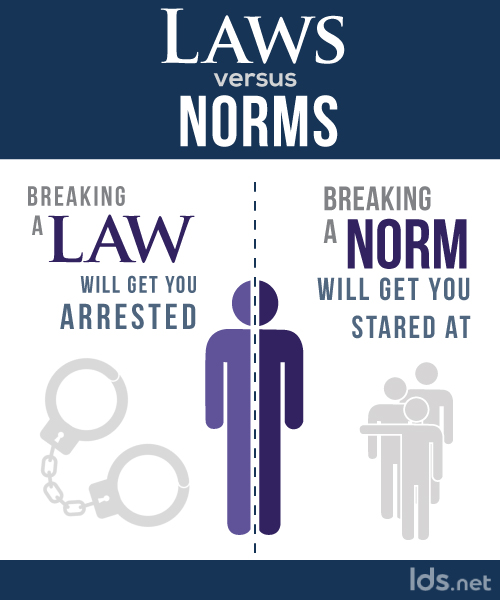
The tension between formal rules and informal norms is one of the most important dynamics in any community or organization, political group, nation, or religion. We tend to think of things that are written down as binding or more important because they can be referred to and understood across people: laws, policies, theology, constitutions, and rules, but the informal norms are actually more important at preserving the community:
- Norms > laws
- Culture > policies
- Practice > theology
- Traditions > constitutions or creeds
- Expectations > rules
Religions usually have a distinction between official doctrine and actual practice. Consider the following examples:
- The building may say “Visitors welcome,” but everyone inside knows that some visitors are more welcome than others.
- Church leaders may teach forgiveness and repentance, allowing for ordinary members to be judged or criticized, but not allowing for any critique of leaders.
- A leader may preach that we seek after truth, but in reality, dissent is socially punished by marginalization in the community.
- We can say our leaders are not considered infallible, but disallow any criticism harsher than a minor tiny mistake.
These types of things occur across all religions. They also occur in business.
“The customer is always right,” but come on, let’s get real. No they aren’t.
“My door is always open” a leader might say, but in reality, if you pester them too much or say what they don’t want to hear, you might find your career stalled or worse.
A company can claim that “safety is #1,” but through what is rewarded, they may show that productivity is more important than avoiding accidents.
To find the norms (that may contradict the “laws”) look at:
- who gets promoted
- who gets praised
- who gets ignored
- who gets forgiven
- who survives mistakes
- who got rewards
Norms are much more important than stated policies. This is particularly true during a crisis, when the stated policies are tested. The true norms will prevail. Consider this scenario:
- A church teaches compassion.
- A controversial member goes public about something harmful.
Does compassion prevail? Or does reputation management? Rules tell you what the organization wants you to think it values. Norms tell you what it actually values.
As I thought about this, I couldn’t help but think of Boyd Packer’s talk about the Unwritten Order of Things (1966). He was not criticizing the unwritten norms in the church, but rather he argued that they were necessary to make the church function smoothly. He gave a few examples:
- Not bypassing local leaders to write to General Authorities.
- Revelation operating within assigned stewardship.
- Members should accept callings as assigned by authority rather than self-selecting or self-releasing.
- Bishops should control funerals and mission farewells, not allow the families to control them.
- Presiding officers should sit on the stand to be recognized and preside over the meeting.
An irony of this talk is that it actually calls attention to the difference between written policies and the norms that exist in the church which begs the question whether the norm is valid and must be upheld, or whether it should be questioned.
- Have you seen the difference between a stated value and the actual value in the Church, your place of work or in government?
- Do you think Packer’s talk made more people question by calling into account something that was unstated?
- What norms have you seen change during your lifetime? What caused that shift?
- Have you seen a norm change in response to a written policy? Have you seen the reverse happen?
Discuss.


I can definitely recommend the BBC radio drama adaptation of the books, available as a BBC audiobook under the title I Claudius.
Packers talk always irritated me. However, I can see norms serve a purpose. Changing culture, globalisation and so forth result in legislation where cultural norms had formerly sufficed. Sometimes those changes are for the better, for example greater autonomy for women and so forth. Other times, older generations can mourn the loss of collective understanding of appropriate behaviour and actions.
This study looks at the particular case of Japan:
https://www.researchgate.net/publication/392328189_Introduction_Japanese_Perspectives_on_Law_and_Culture
To often norms can become a law within an organization, and it is good when such laws are repealed. For example, in 19th century white America cremation was outside the norm, and it effectively became against the law of the church, with our handbook stating so. Cremation now no longer violates the law of the church and our handbook has been relaxed. The church did not need to regulate in this area, but they did. In the 1980s and before the government dole was to be avoided at all costs and members in need were to go to church leaders for assistance. Now we tell members in need to go to the government first. An organization must have rules and policies, and those rules sometimes change as circumstances change. Some will be based on doctrine, but many organizational rules reflect culture, not God’s revealed word. And that is ok.
A problem arises when church leaders or members defend a policy on doctrinal grounds, and make more doctrine from heaven to support the organizational policy, and then the policy changes, but we say that no doctrine has changed. We had doctrine supporting no cremation and no government dole, and now we don’t. We would reduce disconnects for members if we could acknowledge that the church is an organization, and some rules come from God and will never change, unless God’s will changes, and other rules are purely organizational. Both sets of rules are mandatory for those who voluntarily choose membership. Fortunately, I have not heard anyone say that cooking in a church building or using candles is contrary to revelation, but previous prophets have doctrinally taught against playing cards and women wearing makeup.
Not that I think the OP is arguing otherwise, but I just want to point out that the establishment of norms is practically unavoidable for any human group or society, and that norms are not inherently bad. Norms represent our values, and those values are how we define groups that we belong to, groups that are very important for our societal structure. But to answer the questions . . . .
Just last night I was socializing with two other couples in my ward. The conversation turned to talking about a budding romance between the kid of one of the couples (just turned 15) and someone else in the ward (16). None of us there (ages 34 through 44) said anything about not dating before 16, even though I’m 100% certain that we all heard that so many times when we were kids. (And the reason we didn’t say anything is because none of us care one bit about that rule anymore.) I was thinking this morning about how quickly and completely that norm has changed, and I can’t even figure out when, how or why the change started.
A week ago I had to drop by FSY to give something to my daughter and noticed the significant shift in dress code (no more knee length shorts). 20 years ago I was part of the dress code police at the youth dance at BYU education week, mostly (but not exclusively) policing girls hemlines. The changes to For the Strength of Youth are undoubtedly the largest driver on this change.
I’d argue that the church has a policy of “do what is right, let the consequence follow” but often falls short of that policy in practice. I recognize that others would strongly disagree with me and that much of the difference would be in our definition of what is “right”.
This is a very interesting OP, really enjoyed it.
Dave Butler recently referenced the story of Samuel searching for Israel’s next king. One by one, the obvious candidates—strong, accomplished, impressive sons—are passed over in favor of little David. The message is beautiful: God sees differently than we do. Even when others don’t notice, God does.
But I sometimes wonder how much that ideal actually describes our practice. In the Church, we often tell ourselves that callings come through revelation, that the Lord sees hidden gifts and unlikely candidates. Yet, in my experience, we frequently choose the people who make the most sense. The highly successful, reliable, orthodox, independently secure members tend to have a much higher probability of being called to the more visible and influential positions.
Having sat through many bishopric meetings discussing the pressing needs of the ward, I know there are sincere people trying to do their best. But I also know that practical considerations and unspoken assumptions exert tremendous influence. We naturally gravitate toward the known quantities, the safe choices, the people who fit the mold.
So while we rightly celebrate the story of little David, I wonder whether, in practice, we mostly anoint Eliab. We profess openness to God’s surprising choices, but our spoken theology often coexists with unspoken norms that reward competence, conformity, and predictability. The aspiration is noble. The reality, more often than not, is much safer.
Whenever I drive from SLC to St. George (which is often) I am thankful for the 80 MPH speed limits, some of the fastest in the country. I don’t think they started increasing these limits (2008) in Utah because they wanted to let us drive faster. I think they did so because the reality was we were already driving 80+ MPH. In other words, the law caught up with the norm. Kind of reminds me of sleeveless garments.
There is not one word doctrinally about girls passing the sacrament. There is not one word said doctrinally about women being ordained. That is all just the norm, tradition going back to the very sexist Roman Empire, because before the church became Roman, women apparently did have priesthood. Of course, the Romans invented “doctrine” to cover their norm. They said that Jesus didn’t call women to be apostles, but apparently, they had rejected scripture that said claimed that he did. Because their norm was such that they just couldn’t imagine that Jesus wasn’t as sexist as they were, so any writings that said Mary Magdalene was an apostle could not be true.
Back in the 1970s ward council was a new concept. Before that time, the ward was run by just the priesthood, in priesthood executive meeting. So, the norm was that women did not get any say in ward council, let alone decisions about running the ward. Well, I was primary president. It was a small, but very active student ward in Wyoming. The bishop was a good guy and was *trying* to do ward council as it was designed to be. But the RSP, PP, YWP, and junior Sunday school president were not used to this idea that we should be part of “running” the ward, so we didn’t usually speak until spoken to. But even when the bishop asked us a specific question, when we spoke, we got a glare from some man. The norm was such that the men resented us speaking even when we were asked a question. If we spoke before we were specifically addressed, every man in the room flinched and we usually got a glare or two. It was awkward.
Another norm is the children be baptized, boy be ordained, or go on missions be done as soon as possible. If a child isn’t baptized the month in which they have their birthday, the relatives start to panic that the parents are leaving the church. If a young man doesn’t leave for his mission before he turns 19, people start wondering if he is unworthy.
When the age was first lowered for missions, people said that it will give them the choice of getting a bit of college in if he feels like he isn’t ready to go. But very soon that “choice” was gone because the norm is that the YM is anxious to get out on that mission and leaves as soon as allowed to go.
When the “age of baptism” was first established it was an age limit, that was the youngest it was allowed. If people wanted to wait, it wasn’t a problem. But after a few years, it became the mandatory age for baptism, and if a child of record was not baptized at 8, they were kicked off church records. Then missionaries were then in charge of getting them “converted” because if they were not baptized before 9, obviously they had not been properly taught and needed missionary lessons.
Same with ordination. At first it was a minimum age. The first while in Utah, most deacons were adult. The duties of all priesthood levels as described in scripture are adult type duties. But recently, when the decided to promote the whole class at the same time rather than having deacons come from primary to priesthood at odd times after their birthday, they skipped the age limit of at least 12 and now ordain 11 year olds. The norm of 12 had become so important that we can’t make the boy wait a few months after he is 12.
Missionary age started with no age limits. Married men went, old men went, women went, married couples went together. But they discovered other men were swiping their wives while they were gone. (it wasn’t just Joseph Smith) Married women would get pregnant while out on a mission. So, they restricted things to unmarried men. Then they decided that the men needed to be married and making babies by 25 (Brigham said) so they restricted to under 25.
Now, I don’t know the reason or timing on these changes, so, don’t argue with me that something was changed at a different time or reason. The pattern is there.
What started as an option, became a norm, then became mandatory.
Norms are nirmal – that’s why they are called norms. Norms serve a useful purpose. In a church community, it is problematic when members and leaders mistake norms for laws or doctrine. Norms can change as time passes. Laws or doctrine also change, but the method of change is different.
The most obvious norm evolution that I have seen during my lifetime is the standardization of white shirts as an expectation for male church attire. Being from Gen X, I have childhood memories (confirmed in old photos) of my dad wearing colored shirts to church during the era before about 1985. As for the cause of this shift, there are two possible factors I can think of but can’t prove their relevance. The white shirt was the uniform of missionaries going back much further than the 1980s, but only in the 1970s did missionary service become a universalized expectation under Spencer Kimball, so by the 1980s more younger men would have been missionaries and worn white shirts regularly. Secondly, the 1980s was an era when white shirts became much more common as business attire after a much more colorful 1970s. By the 1990s I started hearing leaders impose religious symbolism on the color of men’s shirts, and that’s when you started seeing local wards turn this evolving new norm into rules for young men to participate in the sacrament. I think this norm is finally starting to soften a bit, thankfully.
Quentin,
I understand what you are say and one thought to add is the tie! My goodness you had to be wearing a tie! Bishops would have an assortment of ties for the Deacons to wear in case they came to church without one.
The norm was very strong in the latter 20th century. It is less now.
I miss the norm.
In fact, I care more about the norm that those who officiate and directly assist the Sacrament demonstrate wear clothing that demonstrates respect for the ordinance and their duty than I care if it is a boy or girl doing it. The Catholic Priest may overdo it with his robes and ceremony. But at least in my ward, the carelessness with which the Sacrament is administered is very disappointing.
The LDS church is very conflicted these days on the question of dress. It wants members to wear their “Sunday best” but it doesn’t want to be perceived to be pushy and judgmental about it. So they say “let members choose for themselves” all while leaders wear their “Sunday best”. The consequence being that we have young men performing a priesthood duty wearing a hoodie and looking like they caught the wrong bus and accidently showed up at church.
Remember, all outward ordinances exist for the symbolism they represent. What does the ordinance represent if it is administered by those who show little regard for the ordinance?
Now, I write this not to argue those who administer the Sacrament need to wear a white shirt & tie. But I strongly believe they should dress in a manner that reflects they personally honor the duty they are performing. If they fail to do this, then what are those observing the ordinance suppose to think? The “uniform” of a white shirt & tie worked. There could be other “uniforms” – just have it reflect reverence for the ordinance being performed.
Quentin and Disciple, you both must be young.
So, to put some perspective on the white shirt and tie uniform, Let’s go back to the 1950s when even the poorest guys wore nothing but their best white shirt to church. It was a matter of pride that you had a white shirt even if it was thread bare. That shirt was saved only for Sunday or funerals. Colored shirts were just not reverent and proper. Colored shirts were for WORKING in. A kid would be terribly shamed for showing up in anything but a white shirt. The norm didn’t need rules because the WWII generation was great at following unwritten rules. They were very rule bound stick in the muds. We boomers know because those rules were crammed down our throats.
Ties were mandatory, maybe not by written rules, but by the strongest norm you ever batted your head against. You didn’t need written rules for norms that strong. Younger generations have no clue as to the powerful norms that ruled in the 1950s.
Then in the late 1960s and early 70s there was this “thing” the boomers did called “revolting.” We got sick to death of rules with no purpose except to obey the rules. The hippies decided rules were for those losers over 30. Society followed, except for the church that had an apoplectic fit. And by 1975 even (younger) Mormons were wearing colored shirts to church. At least a few. It was NEVER accepted by that stuffy older generation. The old guys still frowned on it and there were still the jerks who refused to let a YM pass sacrament unless he was in a white shirt and tie. Even in those most liberal 1970s. It was never the norm to wear a colored shirt, although probably in the 70s & 80s over half did. A norm doesn’t mean a generational difference. Even when you have baby boomers doing it and we were the largest number wise of any generation, so yeah we might have been over half in a ward (and I noticed the boomer generation has twice the number of years of more recent “generations” where the span is 10-12 years.)
So, even when your father was in that colored shirt, some 12 year old got shamed for daring to wear a light blue shirt and was not allowed to pass sacrament. And they had ties stashed so that if a deacon showed up with no tie, they could make him wear one. Sure, some bishops were more lenient—probably the ones who were hippy sympathizers back when boomers were telling the stuffed shirts to stuff it.
But the boomers found that the stuffed shirt generation would not give them jobs with their long hair and unstructured dress code, so most of them just got in line with the frumps rules because they had to have a job to eat. So, many of them started following and enforcing norms. Yeah, traitors. So, NOW it will be the boomers who are the stuffy old shirts, along with younger guys who just think norms are best, enforcing an old norm by turning it into a hard and fast rule.
It was those stuffed shirts who were over 30 when the hippies did that rebellion thing that insisted we go *back* to the old norm and enforce it with stronger rules. Nelson, Oaks, they that stuffy old generation, and Oaks is our prophet. He is still older than the boomers. So, those stuffy old guys who hated the boomers as young rebellious whipper snappers are just barely going out of power in the church. And they never changed their rule bound ways.
So, I would hardly say that norm has gotten stricter. No, there are colored shirts sitting in the congregation so, that norm is much less enforced that it was in the more distant past. We just had a short rebellion against the norm, not any evolution. You just have to go back before the rebellion.