
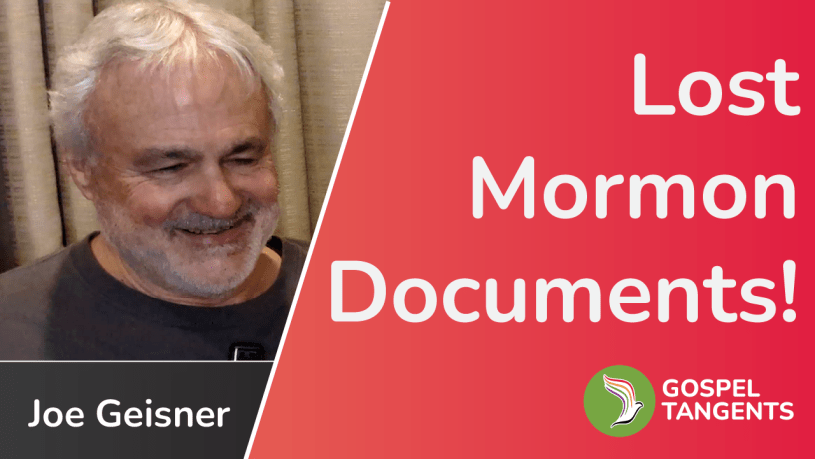
Joe Geisner gave a presentation at Sunstone in August about lost Mormon documents. Does he include the Lost Spalding Manuscript in his list of lost documents? We’ll focus on lost documents and consored General Conferences addresses. Check out our conversation…
Sunstone Presentation and Lost Manuscripts
Joe Geisner is a Mormon history researcher and editor of “Writing Mormon History.” The book is a compilation of authors like Greg Prince, Todd Compton, Polly Aird, and other authors describing their experiences writing books on Mormon history. He recently gave a presentation at Sunstone on lost Mormon documents.
Spalding Theory
The first document lost is the well-known Lost 116 pages. I asked Joe if he felt the missing manuscript from the Spalding Theory held any water. Joe said he had to have evidence that a document existed, and there is no evidence of a lost Spalding manuscript. Joe shares his skepticism about the Spaulding manuscript theory and felt it denies the implications for Joseph Smith’s creativity. The Spalding theory was first promoted by Eber D Howe and Doctor Philastus Hurlbut. Joe discusses the inconsistencies in the theory, such as Rigdon’s supposed visit to Palmyra which never happened. Joe felt that “View of the Hebrews” had more evidence than the Spalding Theory, but it was not a hill he was prepared to die on. Joe shares his admiration for Roberts’ defense of the Book of Mormon.
Censored General Conference Addresses
Joe shares his investigation into censored conference addresses, including Boyd K Packer’s talk. They discuss the rumors of Packer’s talk being edited along with Elder Ronald Poelman’s edited talk from 1984. Joe mentions there are other censored talks, and he researched those at the Church History Library.
George Q & Martha Cannon Lost Journals
Joe discusses the George Q Cannon journals and their significance. Joe shares his fascination with the George Q Cannon journals and their potential revelations. The journals are lost, and Joe expresses hope that the journals might one day surface. Joe talks about the Martha Hughes Cannon letters. He mentions the request to burn the journals and papers after George’s death. Joe shares a conversation with Cannon’s great-grandson, Blaine, about the journals’ destruction. They discuss the intimate content of the letters and the family’s decision to destroy them.
Abraham Cannon Diaries
Joe discusses the missing entries in Abraham Cannon’s diaries and their personal nature. He mentions the excision of pages related to Abraham’s courtship and marriage to Lillian Hamlin. Joe explains the family’s motivation for removing the pages, including the controversy surrounding Abraham’s marriage. He discusses on the impact of the Reed Smoot hearings on the missing portions of Abraham’s diaries. Joe lists other lost manuscripts, including the Joseph Knight history and the Oliver Cowdery history.
Pratt’s Missing Letters and Documents
Joe mentions the current collection of 480 letters from Parley Pratt out of 1817 known letters, with many missing. Steve Pratt, a descendant of Parley Pratt, is working on compiling a comprehensive collection of Pratt’s letters. Joe recounts a statement by Solomon Kimball about the destruction of Orson Pratt’s records by his first wife, Sarah Pratt. The complex relationship between Orson Pratt and Sarah Pratt is discussed, including Joseph’s Smith’s proposal to Orson’s wife, and Orson wanting to commit suicide over the issue.
John D. Lee’s Missing Journals and the Fancher Party
Joe shifts the conversation to John D. Lee’s missing journals and the significance of September 1857. Joe discusses the disappearance of journals of other individuals like Isaac Haight and John Higbee during the same time period. As you probably know, the Fancher party journeyed from Arkansas to Mountain Meadows, noting the tensions and animosity they faced. The reasons for the destruction of these journals, including the desire to cover up incriminating evidence, are explored.
Eleanor McLean’s Story and the Parley Pratt Murders
Because Parley Pratt had plurally married Eleanor McLean, her legal husband Hector wanted to kill Pratt. Joe details the tragic story of Eleanor McLean. In the 1800s, courts typically gratned men control of the children. Eleanor kidnapped the children, leading to the pursuit by Hector McLean. The gruesome details of Pratt’s murder and the aftermath are discussed.
Polygamy and Missing Journals of Church Leaders
Joseph F. Smith’s Journals and Other Missing Documents
Joe mentions the missing journals of Joseph F. Smith, including those up to 1884 and in 1916, and the reasons for their existence at one point. The story of John W. Taylor’s journals, including their destruction in a fire and the subsequent damage from water, is discussed. The story of Melvin J. Ballard’s diaries and their disappearance after being loaned to Bryant S. Hinckley for a biography is recounted. The story of Bryant S. Hinckley’s demand for payment for writing the Ballard biography and the subsequent disappearance of the diaries is recounted. The involvement of Gordon B. Hinckley and the family’s inability to locate the diaries is discussed.
Juanita Brooks’ Diary and Historical Record
Joe introduces the topic of Juanita Brooks’ diary and the broader discussion on historian hypocrisy regarding personal journals. Juanita Brooks’ diary discusses her early life, her attempts to conceal her pain, and her decision to burn her diary. Juanita Brooks’ diary entries reveal her struggle with shame and the need to hide her intimate thoughts. The conversation highlights the irony of historians who value others’ journals but are hesitant to share their own.
Personal Journal Keeping and Hypocrisy
Rick asks Joe if historians who are reluctant to share their own diaries but want the diaries of past historical figures are hypocrites. Joe and Rick share personal anecdotes about journal keeping, including their own limited journaling habits and his reluctance to read past journals. Rick recounts his own experiences with journaling, including a humorous example from his teenage years and younger. The discussion touches on the challenges of maintaining a journal that accurately reflects one’s life without skewing perceptions.
Mike Quinn’s Journals and Redaction
Joe reads from Mike Quinn’s memoirs, detailing his decision to remove references to his homosexuality from his journals. Mike Quinn’s wife, Jan, assisted him in editing the journals, and they decided to conceal certain entries to create a faith-promoting record. Mike Quinn later regretted destroying his original journals, recognizing the historical value of his early writings. The conversation emphasizes the importance of preserving personal records for future historians.
Historical Figures and Missing Records
Joe discusses various historical figures whose records have been lost or destroyed, including Judson Tolman and Heber J. Grant. The conversation highlights the challenges of uncovering the truth about historical events when records are incomplete or missing. Joe mentions the work of scholars like Brian Hales and Cristina Rosetti in uncovering lost records and providing new insights.
Leonard Arrington’s Diary and New Plural Marriages
Joe reads from Leonard Arrington’s diary, detailing a request about a marriage record and the possibility of new plural marriages after the Manifesto. The discussion includes a fascinating account from Leonard Arrington’s diary about a lost marriage record involving Mathoni Wood Pratt. The conversation explores the implications of these new plural marriages and the challenges of verifying historical accounts. Arrington didn’t believe the plural marriages happened until Michael Quinn showed him convincing evidence.
Writing Mormon History Volume 2
Joe introduces the second volume of “Writing Mormon History,” highlighting the contributions of various authors. The conversation includes a personal reflection on the impact of recent losses in the Mormon history community. Joe shares his experiences with mentors like Mike Quinn, Curt Bench, and Will Bagley, who played significant roles in his historical education. Joe emphasizes the importance of sharing personal experiences and the challenges of writing honest historical accounts.
Diversity and Inclusivity in Historical Writing
Joe discusses the efforts to include diverse perspectives in the second volume of “Writing Mormon History.” The conversation highlights the contributions of authors like Elisa Pulido, Alice Faulkner Birch, and C. Jane Hafen, who provide insights into the experiences of people of color and LGBTQ+ individuals in Mormon history. Joe emphasizes the importance of including diverse voices in historical writing to provide a more comprehensive understanding of Mormon history. The discussion includes a reflection on the challenges of writing inclusive historical accounts and the importance of recognizing diverse experiences.
Writing Mormon History Volume 2 came out this week. Have you read Volume 1 yet? Will we ever know the truth of history as it continues to evolve over time? Who are your favorite historians? What lost Mormon documents do you wish we had?


Joe Geisner is a treasure to the Mormon history community.
I’ve been able to listen to part of this interview and look forward to listening to more —thank you!