
We don’t always have to talk about Mormon things, so now for something completely different [1]
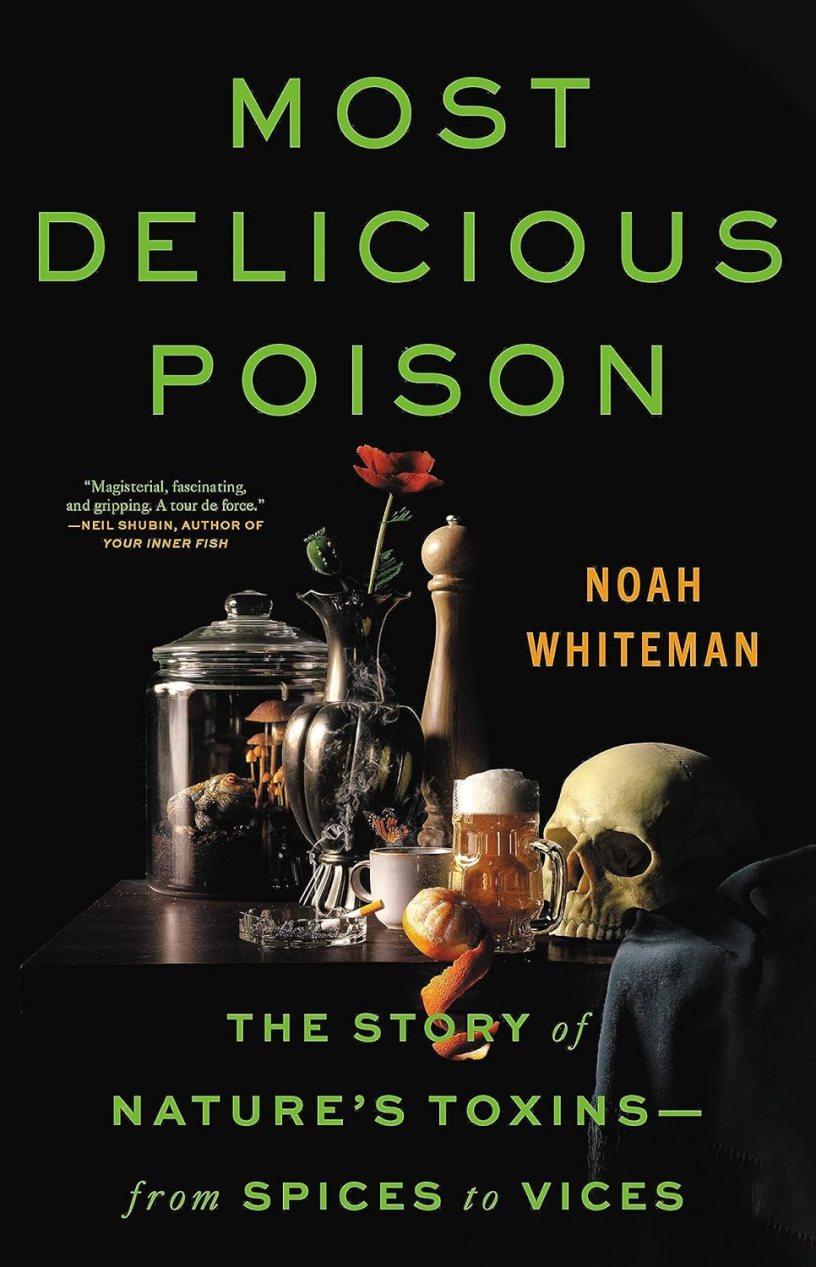
My grandchild is at UC Berkeley doing a dual degree in Statistics and Biology. They are taking a biology class, and the book they are using is called Most Delicious Poison, by Noah Whiteman, who happens to also be the instructor of the class. They recommended the book to me, and I just finished reading it. It is not a normal textbook, more a book for the general public, but it can get dry when he starts talking about the chemical makeup of the toxins. I still have nightmares about my organic chemistry class taken 45 years ago!
In the book Whiteman talks about nature’s toxins, why the plants have them, and how we as humans have co-opted them for our on use. There was lots of fascinating facts in the book, of which I’ll share a few.
- In one Neanderthal skull dating to 50,000 years ago, they found evidence via DNA of a dental abscess that was infected, causing a diarrheal disease. This probably killed the guy. But they also found in the tartar buildup behind his front teeth (he was not brushing well!) the DNA sequence from poplar trees, and the fungus Penicillium. Poplar trees are a common source of salicylic acid, which we use today to make aspirin. The Penicillium species are molds that produce the antibiotic penicillin. Nether poplar trees nor the mold provide any nutrition, so the conclusion is that this man from 50,000 years ago was medicating with aspirin and penicillin for his dental infection.
- There is a plant that give off a toxin called pirene when an insect is eating the leaves. This suppresses the feeding rates of the insect. More importantly, there is a wasp that when it smells the pirene, it flies to the plant knowing there will be food there, and eats the insect that is chewing on the leaves. It is a win-win for this cross species arrangement. The plant get a break from the insect eating it, and the wasp gets a meal. As an aside, pirene is the active ingredient in the sleep medication Ambien.
- Over 50% of the drugs we use today originated from nature. All your spices in the kitchen are toxins that plants use as poison to ward off herbivores.
- Citrus juice can cause third degree chemical skin burns when placed on the skin and exposed to UVA light. There is a toxin in the juice that is activated by the light and makes its way into the skin cells to bind with the DNA, which cause the cells to die. A 30 year old man was badly burned when he was squeezing limes for margaritas, then exposed himself to the sun.
- The monarch butterfly has a toxin in its body from the milkweed leaves it eats as a caterpillar that causes birds to vomit if eaten. The birds learn their lesson, and avoid the distinctly colored butterfly.
- People who drink 2.5 to 4.5 cups of coffee a day in one study were 29% less likely to die during the study. This held true even if the coffee was decaffeinated, leading researchers to believe it was the antioxidants that were helping, not the caffeine. But caffeine helps with depression. Drinking 2-3 cups of caffeinated coffee per day is associated with reducing depression 25-50% in large studies involving hundreds of thousands of people. Also drinking 2-3 cups of caffeinated coffee is associated with a staggering 45% reduced risk of suicide compared to those that don’t drink coffee. (you can take this as your Mormon connection)
All these toxins, from cinnamon and nutmeg to opium, were in the plants to help ward off enemies. They usually taste bitter, and drive away the insects. But humans and our predecessors (and other animals) have been using them for medicinal and recreational purposes for tens of thousands of years.
[1] Extra points if you got the Monty Python reference


How anyone can find reading about the chemical composition of a toxin as dry is beyond me. That is the most exciting part! When I come across the name of a chemical I am not familiar with, the first thing I do is Google to see its structure to help me make sense of its properties. So many aromatics have such interesting (and to my eye beautiful) structures. What a fun book to read.
Folgers: it’s good to the last drop
I always find it ironic that the patriarchal Christians were so afraid of matriarchal pagans and witches, which were the same thing, that the burned all the old medicine women at the stake in every culture they ran into and lost most of the knowledge of these plants and herbs because…witches brew.(said with a spooky voice) thank the Christian for setting back western medicine some 4 thousand years.
To bring the discussion back to Mormonism, my daughter got sick of the sexism in patriarchal Christianity and Mormonism specifically that she went looking for a religion that treated women as worth something. She found Wicca and joined, then to become a priestess/medicine woman, she took classes at her university on edible plants, poisonous plants and their medicinal uses. Then she tried to convert me because I have an obsession with plants, wild flowers, poisons plants, and such. Now her religion of choice worships Loki (among other gods, but her favorite) which I find way too appropriate) But it was hikes through the woods, with me asking “what’s this plant? edible or poisonous? Is it good for anything?” Which eventually caused her to loose her faith in Mormonism. I have never heard a weirder Mormon exit story.
No, Gary, coffee is the nasties stuff ever invented by human. But it helps my ADD, so I choke it down
I’ll see your Monty Python and raise you a Princess Bride. When Westley beats the little guy (can’t remember his name) in the battle of wits he says he’s become immune to poison. In real life this would be rare and dangerous. But we’re talking about the dread pirate Roberts, not any average guy.
The other day I accidentally found out why snake anti venom is so expensive – apparently it takes years of raising snakes and building up immunity within horses before you can extract the anti venom. Here in AZ people are almost as afraid of paying for rattlesnake anti venom as they are getting bit by a snake.
So, could you please share the actual study on the coffee? Where did they get these hundreds of thousands of people that don’t drink coffee? Which groups were they comparing them to that drink coffee? Who did the study and how did they determine who drank coffee or who didn’t? If they had committed suicide I am imagining it wasn’t self report. Did they interview families?
If they are comparing the Mormon community with other populations that drink coffee there could be other confounding factors that contribute to suicide, for instance our culture and teachings about LGBTQ people.
I am taking a graduate level assessments course and it’s important to consider the Standard Error Measurement of the study. What is the correlation coefficient? Correlation is not causation.
There are many other factors to consider when examining a study for veracity. Just because I love the flavor and smell of coffee and enjoy the fulfillment of my confirmation bias when I read the purported findings does not make the information accurate.
And hey, while we are at it, I would love to hear more about Heber J Grant’s decision to define “hot drinks” as coffee and tea. I would like to hear more about the historical forces around that decision, for instance the Kellogg movement. Any one up for writing that post?
Sounds like a fascinating book.
There was that time I accidentally poisoned family with too much nutmeg in the meatloaf… it was strong, and I’d put in more than I meant.. eldest child apparently no ill effect, myself a horrendously dry mouth, husband who has low blood pressure anyway suffered the worst.. we all recovered.. but the family like to remind me not to overdo the nutmeg.. I do like the flavour of nutmeg.
I’m recovering from pneumonia at the moment, and also the powerful antibiotics I was on. Four days on an IV pump, and then a week on two different massive oral antibiotic tablets. They all seem to be different kinds of moulds or some such. Anyway in addition to destroying my natural microbiome by the last day taking the tablets I quite literally felt like I was losing my mind. It was a relief to finish. Recovery from the antibiotics involved consuming pre- and probiotics, and also eye drops for an eye infection that immediately developed in the absence of any friendly bacteria..
Hedgehog, the book specifically talks about the toxicity of nutmeg. Malcolm X had it smuggled from the kitchen in prison, and used it to get “high”. He said it had the kick of three or four reefers. Just google “Malcolm X tea”
Coincidentally, Dan McClellan has a new post about anti-venin. (Tied into debunking a claim that lamb’s blood is a literal anti-venin. I thought it interesting.
Love this post! I always really enjoy going through Poison Gardens in our travels. Nature is fascinating, and humans have known these things for millenia.
I’ve heard that coffee consumption is associated with certain benefits—for some people. Other people that suffer from gastroesophageal reflux (heartburn) should avoid caffeinated products.
My Utah born grandmother (who died before I was born more than 60 yrs ago) suffered from migraines had a Dr. who suggested she drink coffee as a potential treatment.
Also—
Recently when my granddaughter and I were doing some research on opossums—we found out that they are immune to snake venom. Scientists are trying to develop a better anti venom using opossums.
(Note:opossums—that are often called “possums”. living here in North America are not the same as possums that live in Australia).
I will drink coffee on occasion to help me get through the day when I’ve had late nights and very early mornings. A friend picked out a coffee for me that has more of a dark chocolate flavor. A splash of milk and artificial sweetener make it very palatable.
Lois:
My own grandmother also suffered from migraines and her Dr. suggested she drink coffee as a treatment. Coffee really does help with migraines. For some reason, she found that caffeine in various medications did not help in her case. She was a temple worker and informed her Bishop that she consumed a cup of coffee when she felt a migraine coming on and he told her she couldn’t do that. She suffered for several years until he was released, then got permission from the next Bishop to utilize this very effective treatment. I think of her every time I smell coffee brewing.
I have family members with migraines that find coffee effective as well. However, it’s probably because of the caffeine, for them at least. Excedrin works for them as well.
Regular use of caffeine can also cause headaches when you stop using it. Many people avoid it for that reason.
My mother had some kind of kidney issue and our family could not afford the prescription medicine, so her Mormon Doctor told her that coffee would do the same thing, because of its diuretic effects. Well, her bishops would absolutely not allow that. And so I grew up with the idea of how hypocritical it is that opium drugs are fine if your doctor prescribes them, but a cup of coffee your doctor prescribes is a sin. So, God must really have a lack of common sense.
It proved to me that the WoW is not a health code at all, but strictly about obedience, blind unquestioning absolute obedience. And that when the church says it does not require blind obedience and that we are allowed to pray for ourselves and find if we are an exception to the general rule, they lie. And bishops think their “inspiration” gives them more knowledge than the doctor’s years of med school
Link:
https://www.hopkinsmedicine.org/health/wellness-and-prevention/9-reasons-why-the-right-amount-of-coffee-is-good-for-you
and…. We ignore this part of the WoW:
Yea, aflesh also of bbeasts and of the fowls of the air, I, the Lord, have ordained for the use of man with thanksgiving; nevertheless they are to be used csparingly;
13 And it is pleasing unto me that they should not be aused, only in times of winter, or of cold, or bfamine.”
That looks like a way cool book.
I remember when taking a plant class, getting a real good chuckle over Mormon tea. I should go brew some and get to work on my backyard jungle. Maybe set up a irrigation system. Or as my English ancestors might say, blooming ditch.
The bit on Monarch Butterflies leads me to recommend another cool book, “Secret Weapons: Defenses of Insects, Spiders, Scorpions, and Other Many-legged Creatures”. ( “For Love of Insects” is fun too.) The mimic Viceroy butterfly has evolved to look like the Monarch. I don’t what moral to draw other than–Looking bad may be more advantageous than being bad.
So, can anyone tell me if decaffeinated still has some of those advantages?
Just last night after dinner it came up with my son, a chemist who started work in food safety at the FDA last year, that there is a current toxicology fad. The toxicologists he works with are mystified that their little world has become popular, and they wonder what TV show triggered this. A dozen years back the CSI-type crime shows created a forensics fad that led to high schools offering classes in forensics. Apparently high school classes in toxicology are now the current offering of that sort. So it is fun to read today something in that vein that I had no idea before last night is part of the current culture.
Iws329, the decaff coffee had the heart benefits, but not the depression benefits.
John Mansfield: Additionally, the popular Outlander series (first books, then TV series) feature a main character who is a time traveling doctor but uses her knowledge of plants in the past to treat patients. Oh, and has steamy sex scenes with a Scotsman. So, it’s basically got everything.
This comment is not about toxins so I apologize for being off topic.
But I did have a question about some of the comments.
Old Man wrote about his grandmother who suffered from migraines and found that caffiene in coffee helped with the pain but caffine in different medications did not.
She, a Temple worker, told her Bishop that she had taken a cup of coffee for her medical needs and was told to stop by the Bishop.
So she did.
When this Bishop was released she got permission from the newly called Bishop to drink the coffee, and she did.
Anna shared with us that her mother suffered from kidney problems and was told by her doctor that coffee could be used to treat this condition just as well as prescription medications, which she could not afford.
Sadly using the inexpensive option of coffee to treat her symptons was not allowed by her Bishops.
I am astonished that these poor women felt obligated to allow a Bishop to interfere with decisions as to their own health.
I am saddened by the idea that these women would allow their health to be compromised by any one.
I would never ever even think to ask any of my past Bishops permission to do anything much less something that is so very important and personal as health decisions.
My current Bishop is a real goober, I avoid him as much as possible.
Being a convert this information as to how these poor, sick women were condemned to pain is just gobsmacking!
Is this a common thing among women of a certain generation in the Mormon church, this is an honest question.
What kind of human being would ( a bishop) would insist that some one not use an occasional, inexpensive treatment for the blinding pain of migraine.
I suffered from those for quite a while before an effective treatment was found and just can not believe any one would be so cruel.
This behavior by those Bishops broke ( completely smashed ) The Second Greatest Commandment.
Those poor poor women.
Chloe,
Yes. Unfortunately women in the church are usually raised in such a way that they/we completely submit our personal authority to our bishop. In general, the idea is that if you’re a good woman you will submit to whatever the bishop asks. Only a bad woman would rebel or resist in any way.
I would like to hope that I am an anomalous example of this, but unfortunately, as far I can tell, I actually was raised with more of a sense of my personal spiritual authority than many/most? women in the church.
Still, one time I know the Spirit told me not to enter the bishop’s office, and I did anyway, just because it was so engrained in me to obey. I deeply regret that. The interaction we then had was bad for everyone involved, and I could have prevented it by following my own convictions.
I agree with you that this is the most concerning aspect of this story. Yes, it is sad a bishop would act with out flexibility or compassion. It is even more sad and concerning that women of the church hold themselves to a such an inflexible standard of obedience to an external authority.
Well, after about six months, my mother went inactive. That essentially lasted eight years, until six months before I got married. She wanted to be to my wedding enough that she quit the coffee and went on the medication. But when she went to get her temple recommend, the bishop gave her a hard time because he felt she had reactivated, then quit coffee just to get a temple recommend. Then at the stake president, the SP gave her hell. She was in with him for TWO HOURS. She came out, and had obviously been crying. She *doesnot* cry in front of people, ever. she refused to say anything when she came out, but we had been waiting because normally it takes a few minutes. It took her ten years before she would tell me what happened, and essentially the stake pres kept pushing and needling her, asking her over and over if she had *really repented*. When she finally broke down in tears, he got this real satisfied look, and signed the recommend. His whole point was cruelty, not worthiness.
So, what is it about these women? My mother would not lie. It was a supper strong principle with her. She told the truth and suffered the consequences. Even when she swore off church forever, she never stopped wearing her garments. She figured that she promised she would wear them, so she did.
I think she tried to get a recommend when my older brothers left for missions and was told no unless she stopped drinking coffee. So, for my wedding she stopped the coffee. She must have done the same some 10 years later when my oldest brother was married in the temple because she was there, and I don’t know if anyone gave her crap for quitting just to get the recommend. No other sibling married in the temple, and I don’t think she ever got another temple recommend.
and being a convert, you may not realize that for most Mormons, obedience is the first law of Heaven, not love. Love is down there about commandment 26.
lws329 posted while I was writing and I just have to say there is truth to what she says. The church tries to get everyone to obey without question, but I think it is ingrained more in women.
Maybe especially women over about 40 who went through the temple before changes were made and were not raised with feminism in the culture at all. So, boomers and genX. But Mormon women were impacted more than other religions because of the religion, the temple, and the fight about ERA. Women who promised to be subject to husbands in the temple felt even less able to pray to God for their own answers and defy priesthood. They were more submissive because the culture taught them to be more submissive than culture teaches women today. For example, I grew up with the idea that not only was I supposed to obey my husband and priesthood leaders, but that I was to totally mold my identity and my life around my husband and his career. I should not even develop an identity till I was married because there was too much chance that then I couldn’t mold everything I was around him. It was pretty sick by today’s standards, but after WWII, there was this huge movement toward women being a housewife and nothing but a housewife. My grandmother had more “women’s lib” ideas because she was raised before then, and my mother was raised during the depression and WWII, but experienced this huge push to get women out of the workforce so men could have jobs and the glorification of women as nothing but wife and mother.
Unfortunately, over-reaching Bishops and women who’ve been raised to tell them everything still exists.
About seven years ago I lived in a ward with a Bishop who was by far the worst I’ve ever had. I think he tried to do his best, but his extremely rigid, B&W view of the world left little room for compassion. (Hoo boy, I have stories!)
A family moved in and I became friends with the wife. She went in for her temple recommend and mentioned that her previous Bishop, who was also her doctor, had prescribed her green tea for her severe anxiety after the more typical medications gave her horrible side effects. Drinking green tea was hugely beneficial for her mental health.
She genuinely believed our Bishop would be fine with this, considering her previous Bishop had recommended she try it. Except he didn’t. Nothing she said could dissuade him. He felt that if she was obedient she’d be willing to accept the side effects of a more conventional prescription.
In the end, after some serious internal wrestling and long discussions with her husband, she chose to continue drinking green tea and not be honest with the Bishop to get her temple recommend.
you know, it is the most believing, honest, and obedient that get hit the hardest by the absolute obedience crap, because they are more trusting of “priesthood inspiration” and much more honest and unwilling to just lie and tell the leaders what they want to hear. So, the teen boys who are normal have normal sexuality are the ones shamed for the horrible M sin[sarcasm off] and it is the teen girls who confess to that vague sin of petting(whatever the H that is) who are shamed, and it is the girls trying hardest about modesty who are hurt most by having a female body that even an oversized gunny sack can’t hide.
Maybe the young men learn better how to lie to bishops because of their earlier experience with the horrible M sin that is almost as bad as murder and yet normal and perfectly harmless unless terribly shamed. Maybe that has something to do with why adult women never learned to never tell bishops anything except what they want to hear.
Talk about poison. The church has worse built in poison than any innocent plant Goddess ever created. The teaching of absolute obedience and if your inspiration conflicts with 15 old white men, then you are too sinful to know what’s best for you, that is fatal even in small doses.
I know nobody is still reading this post, but it has sure triggered a bunch of crap from my life.
I suggest you check out Lovereality.org for another perspective altogether.
Anna, vent away. We can’t fix it, but we can listen!
Thank you Iws329, Anna, Margot and the other posters here who have tried to help me understand the behavior of these women who have put up with “abuse” and the suffering of physical and mental health problems because a Bishop has an opinion as to their needed treatments which damage them.
I understand it a bit better now, but it still baffles me.
It seems as if the younger women in the Mormon church are better at deciding they are going to be in charge of their own lives than many of the older ones.
Thanks again everyone!
Your comments were excellent, clearly expressed and easily understandable and I think I am beginning to comprehend the situation better, but it still astonishes me.
Anna,
I am still reading. You are right. My oldest son at the of 14 told the truth that he didn’t really believe. He enjoyed the temple trips and church. But he wasn’t going to lie.
He completed seminary and got his Eagle. He is a good respectful honest kind person. But instead of evaluating our actions for worthiness, we evaluate for testimony, which for many of us means deceiving ourselves or others. It just isn’t a good set up for mental health.
I am very committed to following Christ. I don’t think that means I have to know, or pretend I know anything.
“It seems as if the younger women in the Mormon church are better at deciding they are going to be in charge of their own lives than many of the older ones.”
I think that (at least in the US), there has a been an explicit social and governmental shift to encourage, authorize, and/or not punish women as a population for women being in charge of their own lives – that included women in the church. We have more accounts of women self-presiding and presiding over others in a variety of professional fields – including government. We have decades of legal understanding (at least on paper) that women should not be discriminated against in the workforce. This period of time was arguably the 1960’s/1970’s and on.
Ironically enough, Mormon women raised money, ran businesses, sponsored a magazine, and educated themselves to become social workers as part of being members of the Relief Society from the organization’s inception in Nauvoo. It is in the 1970’s that those resources that those women gathered together and managed were assimilated into the church as a whole as part of the correlation process. So all that R.S. autonomy (and it was legal, cultural, and social autonomy) was diminished so that the Relief Society program could be “presided over” more thoroughly.
Whether women in all generations would have decided that they could be in charge of themselves, and seen themselves as empowered to “self-preside” and “authorized to lead” had they had the same level of access, authorization, and empowerment to do so – I like to think so. We won’t know, because most of the power that women have held throughout generations was “influence/indirect power” and “soft power” – so it’s impact didn’t necessarily accurately make it to the written narratives, and those narratives didn’t necessarily make it to mainstream understanding.