
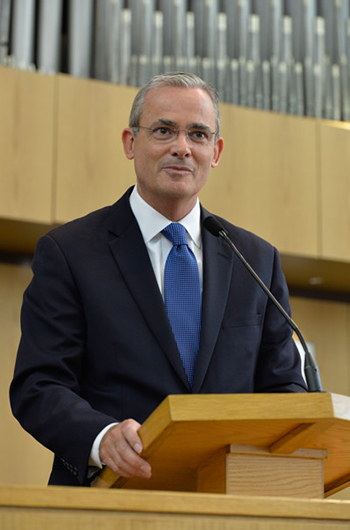
I was out of the country for ten days, enjoying a visit to another ridiculously expensive European country. While I was away a new apostle was called: Elder Patrick Kearon, previously one of the seven presidents of the Seventy (or maybe the chief president of the seven presidents of the Seventy). There’s a short article over at the Newsroom with details, and a longer story at the Deseret News. It’s kind of a surprise. I was expecting another Bednar, and we got another Uchtdorf. Let’s talk about it.
Inflection Points
First let’s talk about what you might call the flow of history and inflection points. Most of the time in the world, this year is a lot like last year and next year will be much the same. It takes something big to turn the ship. But looking backwards, historically, we can spot decisive events or inventions or changes that do dramatically change the direction of things. That holds for civilizations, for individual countries, and for institutions. A book I read on the plane back from Europe identified Gutenberg’s invention of the printing press with movable type in the mid-15th century as the biggest such event of the last thousand years. Certainly 1789 was a turning point, driving the final stake into the ancien regime and ushering in the modern world as we know it, with politics and revolution and the levee en masse.
I think the most recent global inflection point is 1914, which unleashed a European war that marshalled the full force of industrialized war and pushed Europe as a whole from global ascendancy toward a gradual decline in favor of the eventual superpowers USA, Russia, and China. We are still living in the wreckage of the First World War and the later conflicts it spawned: the Second World War, the Cold War and Korea, Vietnam, and now the Ukraine War, which could easily turn into the Third World War. Things are not looking good at the moment, folks. It’s a tough environment to navigate if you are trying to run a global church.
Institutional Inflection Points
On a smaller scale, you can play the same game with institutions, and let’s jump right to the institution we generally talk about here at W&T, the LDS Church. Dates that spring to mind as institutional inflection points are 1844, 1890, and 1978. They happen every two or three generations, it seems, but it’s always much clearer looking backwards what those significant dates are. It’s trickier to get a sense of changes right when they are occurring, when you are in the middle of them, so to speak. It’s the fog of history, which only clears after a few decades or even a century or two.
Here’s where I am going with this. I was ready to write a post making the argument that 2018 is the latest inflection point for the LDS Church. That’s when President Nelson assumed office. After the 1978 changes that ended the priesthood and temple ban, the Church really opened up. The dramatic expansion of missionary work and institutional growth in Africa is only the most visible institutional change toward openness that resulted. You can name others, no doubt. The PR-friendly tenure of President Hinckley and then ten years of staying the course with President Monson (2008-2018) continued that trend.
But President Nelson’s tenure, starting in 2018, seemed to signal a distinct change. The 2015 policy definitively rejecting any accommodation with gay marriage was an earlier sign of the impending retrenchment. The resumption of high-profile excommunications — they stopped for a couple of decades after the September Six debacle in 1993 — was another earlier sign that the wind was shifting. But 2018, with the elevation of both Russell Nelson and Dallin Oaks to the First Presidency, was the big lurch. The Church is now firmly headed from conservative to more conservative to wildly conservative, both doctrinally and politically. With Dallin Oaks and Elder Bednar waiting in the wings as probable successors, there’s no turning back.
At least that’s how I have been thinking about it the last few months and years. It may still turn out to be the case. Then, less than a week ago, we get Apostle Kearon. This doesn’t follow my hard-turn-to-the-right script.
Meet Your New Apostle
I don’t know much about our new apostle, and we’ll all have a better idea in April 2024 when the next General Conference rolls around and he gives his first apostolic Conference talk. But looking at his previous Conference talks since he was called as a GA in 2010, it seems like he is more or less on the liberal-thinking end of the LDS leadership spectrum. He doesn’t even use a middle initial — how radical is that for an LDS leader? To me, this is an unexpected call. Of course, the liberal end of the LDS leadership spectrum is still well to the right of any other spectrum. He’s not going to get up in April and give a talk about how maybe we ought to start thinking about extending the LDS priesthood to women. But here are his previous talks; judge for yourself.
April 2022: “He Is Risen with Healing in His Wings,” a message of hope and encouragement to survivors of abuse. It was 180 degrees opposite of the “blame the victim” culture that pervades the Church. It was the best talk of that Conference and one of the very few delivered on this topic by an LDS leader.
April 2016: “Refuge from the Storm,” arguing for compassionate treatment of refugees. There was this memorable line: “The Savior knows how it feels to be a refugee—He was one. As a young child, Jesus and His family fled to Egypt …”
October 2010: “Come unto Me with Full Purpose of Heart, and I Shall Heal You.” Here’s the first line: “Tonight I would like to share a message of comfort and healing with any of you who feels alone or forsaken, has lost peace of mind or heart, or feels that you have thrown away your last chance.“
That doesn’t sound like the guy that I would have expected to be called by the Nelson-Oaks team. The general direction of his thinking seems out of step with the conservative direction of the Church at the moment. What’s going on? That’s the topic for discussion in the comments. This is an unexpected call. Now maybe that’s just the name God whispered in the President’s ear as he pondered prayed over who to call as the next apostle. That is always a possibility. But there is generally more to the story.
Here’s one possibility. Perhaps senior LDS leaders look with some dismay at the obvious shift in the political thinking (and words and actions) of the majority of US LDS members who have followed and are still following ex-President Donald Trump and his political cronies in their march toward authoritarianism and away from rule of law. Now the fact of the matter is that LDS leaders have spent decades setting members up for this kind of development, with the ghost of Ezra Taft Benson pointing the way, but maybe they have realized they went too far and they need to reel it in. So instead of calling another Bednar they called another Uchtdorf. It’s not as straightforward, but you might be able to make a similar argument for the two most recent callings before this one, Elder Gong and Elder Soares. It takes ten or fifteen years for new apostles to slowly ascend the apostolic seniority ladder and be in a position to actually contribute to LDS decision-making. But at least we get three talks every Conference from these three newest apostles.
In any case, the recent apostle callings, in particular Elder Kearon, suggest that my proposed 2018 inflection point toward retrenchment is exaggerated. Maybe it’s just a minor swerve and the post-1978 move toward openness, so visible under President Hinckley, is still operative. If so, it will be more evident in ten or fifteen years, when this youngest cohort of apostles starts to exercise more influence on LDS policy.
Maybe you have a different theory about this apparent mismatch. But honestly, I can’t connect the dots between the definite and unmistakable shift to the right in terms of LDS policy and doctrine since 2018, when President Nelson took office, and my sense of the liberal-leaning mindset or thinking or personal theology of the three most recent apostles, and especially the newest apostle, Elder Kearon.
What do you think? What’s going on?


David B. is absolutely correct. This apostolic move is designed to prod members into using their own brains to think and learn. At least that is the hope.
David is wise to use the comparison of 1914 to today. World War One was started by Kaiser Wilhelm II, one of the most dangerous lunatics to ever walk on this planet. His subjects obeyed his every command without exercising any independent thought. This led to the destruction of an entire continent.
The Church leaders of today must see that we are in similar times. Far too many croc-wearing members have given up their independent decision making and turned it over to politicians and celebrities. The true lazy learners are those who seek to absolve themselves of responsibility by simply doing what they are told by a modern day Kaiser.
The irony is that Joseph Smith was a strong adherent of his grandfather Asael’s belief that every human being must exercise his or her own thought. Yes, it is wise to listen to those who are wise, but one must still think for oneself and accept responsibility for doing so.
Elder Kearon is clearly in the mold of Asael Smith. He will teach compassion, but will hope that members will be compassionate because they have used their own barons and hearts and have concluded that it is the right thing to do. Mindless automatons are no more good to the Church than to any other organization.
I like your analysis, Dave, and share your pleased puzzlement. One possibility that has come to me is that the ideological differences among GAs that are so evident to those of us on the fringe or outside just don’t seem important to Nelson and Oaks. As far as they’re concerned, anyone in the Seventy is vetted as being all-in in the Church. I wonder if they’re just trying to add national and ethnic diversity to the Q15, and the more liberal picks are just a happy (for us) accident.
My point of view is on the cynical side. The church has been hit with lots of negative press, some of it regarding sexual abuse. They can point at the new guy and say “see we are taking it seriously.” Bednar, Cook, Oaks wield too much power, especially in the short term, for any significant change in tone or policy.
A couple of things:
1. Yes, your perception of a rightward turn in 2018 was exaggerated. For decades, church liberals incanted the mantra of “teach them correct principles and let them govern themselves.” Reversing the POX, two-hour church, and abolishing monthly home-teaching reports are all examples of doing just that. The problem is not that Nelson and Oaks are demanding fealty to right-wing principles, it is that the members are doing a lousy job of governing themselves. (I hesitate to write that because I don’t see it in my own ward. But the resistance to masks and vaccines and the apparent inevitability of Trump carrying Utah force me to that conclusion.) One can hope that Kearon will be a better motivator for people to govern themselves righteously than, say, Kevin Pearson. But realistically, why would he be more successful than Uchtdorf?
2. JCS accidentally pluralized “politicians and celebrities.” I condemn that error in the strongest possible terms.
Mind-reading is hard. I have no idea why they chose Kearon over Pearson or Waddell or Wilcox or Corbitt. But this is (I hope) good news.
Though I’m out, I want a healthier church for those still in. Thusly, this feels like a win. I adored his talk in 2016.
I would like to think President Nelson listens to Elder Kearon and is genuinely moved by real christianity when he hears it, as it contrasts with the less enlightened material presented by some other leaders.
Although that doesn’t explain why he would demote Elder Uchtdorf, the other top leader who seems to understand the gospel.
As noted there are indications Oaks and Nelson are aware of some of the extremist problems the church members are facing and are trying to turn the ship. This is slow going for a few obvious reasons.
For instance, Oaks has given the 10/21 talk about defending the constitution. It’s interesting that people on both sides of the partisan aisle choose to interpret that talk as defending their own point of view. Now to me, whereas he says don’t make it a slogan and points out it can and has and should change, he is obviously defending my point of view, right!
There was a recent change to the political neutrality statement telling people to pick someone compassionate with good character. Although I feel sure this is pointing to a politician (singular) that isn’t a good choice, unfortunately partisans looking from the other point of view likely understood the statement in the opposite way than I did.
I often think they need to speak more clearly, directly and emphatically. However, if they were clearly understood by people on the right, the way I am sure I understand them, would people suddenly break with the church, as some did when they supported the vaccine? People mostly either don’t listen to it and don’t change their actions, or they get extreme and leave the church.
I imagine it’s a hard call and hard to predict how they want members to respond, and what they can do that will actually change things in a positive way. People really want to do what they want to do. Change isn’t easy and neither is leadership.
But hopefully in the two steps forward one step back dance of change, this may a big and positive and more permanent step forward.
Perhaps Nelson is not as hard a conservative as you are giving him credit for. Look at the changes toward equality for women. Yes, well, in many ways he still treats us exactly like children as in when he opened up witnessing baptisms to children and women. But changes to the endowment were helpful even if they just obfuscate the real meaning a bit more.
And I don’t think our new apostle will be enough to turn the conservative tide. Look at Uchtdorf. He has been a comfort to progressives, but he has not turned the conservative tide.
Yes, we need more apostles who are not quite as judgmental as Nelson, Oaks, and Bednar. We need more who see God’s love for us as different than his acceptance of our sins. As Nelson has said, he sees God’s love as conditional, where really it God’s approval of specific behaviors that is conditional on those behaviors. We need people who can love the sinner, but not the sin as the old cliche goes, and Nelson certainly *sounds* like he hates both the sin and the sinner. Oaks is worse.
But we need more than just a switch from judging to loving. We need people in leadership who are open to new ideas. Like that as scholars say, the Bible’s condemnation of homosexual behavior is a mistranslation and instead of having sex with men, really condemns sex with boys—child abuse, not homosexuality. Or like the radical idea that women are adult human beings, not children or some subspecies of maleness.
I really haven’t seen evidence that our new guy is progressive. He is more loving and kinder. Yay for that, but it isn’t enough to get the church out of the conservative rut.
Isn’t it common knowledge that the bottom 6 apostles yield much less power and influence than the top 6? That being the case, Kearon’s real potential influence will not be apparent until 5 or 6 more deaths in the quorum. How long will that take, another 10-15 years? So this selection is far from the selection of Uchtdorf to the First Presidency in terms of impact. Sorry to rain on the parade.
Definitely a young-looking 62. Great to hear that he is on the more liberal side of things (well, as far as someone liberal can go in a stodgy and very conservative leadership body). But I agree with josh h, he won’t command too much attention until maybe decades from now.
As for the move toward openness and religious liberality, a slow trudge at best. The new apostolic pick is maybe a step in that direction, but time will tell. He’ll go one of three ways. 1) Conservative firebrand promoting retrenchment (unlikely but possible), 2) blasé leader with anodyne talks that please everyone and no one at the same time, and 3) a subtle trend challenger, like Uchtdorf, who will gently push the church is a more liberal (well, religiously liberal, not necessarily politically liberal) direction, who may or may not ruffle the feathers of the more conservative higher-ups such as Oaks and Bednar. Unfortunately, Uchtdorf, I think went too far, and was thus demoted from the First Presidency. I hear his name seldom mentioned now in church discourse. Where he was becoming a star as a member of the FP.
Certainly the leadership culture has changed since the 1970s, but the change is really only noticeable with a decades-long timeframe. The church’s only incentive to make changes is to fend off major potential controversy and to keep appearing desirable to the rank-and-file and possibly new converts. But they have to continue appealing to a rank-and-file that is largely conservative, religiously AND politically. Moves in a liberal direction could come at a cost. The sudden about-face on race and the priesthood in the 1970s came largely because of the very rapid cultural change towards civil rights between the 1960s and 1970s. People acquired TVs and they witnessed the brutality of Jim Crow from their living rooms. Mass sympathy for the black community spread like wildfire in the US. And people couldn’t turn away from the principled and non-violent protest movement of Martin Luther King Jr. Still it took 13 years since the Civil Rights Act, 10 years since the assassination of Dr. King for the church to make a change. They didn’t want to seem that they were making changes in response to wider cultural changes, but they no doubt were. It was Ezra Taft Benson who was in 1969 saying that MLK and the Civil Rights Movement were part of a subversive communist plot to overthrow the government. Benson repeatedly called King a liar. There is good reason why I never heard MLK’s name in my family growing up and why Civil Rights were never talked of. I had to learn about this great man and his movement in school. And even in my Provo school district, mention, let alone praise, of MLK was sparse. It wasn’t until college and my own self-study that I really learned about King, Jim Crow, and Civil Rights.
Another notable thing about Kearon is that he was not raised in the LDS church, he joined the church as an adult when he was about 26. IMO this is a pretty big deal – it allows him a perspective and experience that is completely out of reach for every other member of the Q15…even Uchdorf (who comes from a family of coverts but was very young and thus still raised in the church). I was also expecting another Bednar/Oaks hardliner but was pleasantly surprised.
I honestly think we’re in the middle of a potential inflection point. Ascension to power in the LDS church is very very slow, but power dynamics are still a real thing.
We’re seeing some interesting dynamics in the LDS church. We have traditionalist hardliners on one side and younger more modern members on the other side. Elder Oaks is looming over the President’s chair in the short term (with Bednar anxiously waiting nearby for his call to the first presidency), but the longer game could break in either direction. There are also things the traditionalists won’t be able to avoid without fracturing the church further: We’re seeing a shrinking church (and a macro move away from religion), extremist elements that need to be quelled, and a modern, international younger generation who frankly won’t accept regressing to petty rules about earrings, three-hour church, and knee-length shorts.
Power dynamics in the LDS church are weird and slow, but they do exist. It’s an indirect game of stacking the deck for the next generation and trying to outlive the competition. It’s also a game of who can exert influence on the guy in first chair – in a particularly egregious example, we watched an ailing Pres. Monson be used like a puppet to test out the PoX. That said, I don’t think it was a coincidence that Uchdorf and Bednar were called on the same day, but Uchdorf was given seniority and a fast track to power (he was only an apostle for 4 years when he was called to be in the FP). While Oaks et al may feel inevitable, IMO there are members of the Q15 playing the long game while Oaks obsessively mumbles about “the gays.”
Elder Kearon is at least another Uchtdorf, but I have a nagging fear that he is a good officer brought on board a sinking Titanic and we have to bail water for another 20 years before his influence is felt.
Among Elder Kearon’s other notable qualities: he’s not from Utah/Idaho, as a convert has no “Mormon pedigree”, he did not serve a full-time mission as a young man, did not attend Church-owned universities, and wasn’t introduced to the Church until well after 1978. In other words, he doesn’t have a lot of the Mormon cultural/institutional baggage that other GAs have, which I think is often an impediment to organizational progress.
This is in stark contrast to other GAs. Nelson/Oaks were in their fifties in 1978, and God only knows what was going through their minds back then. Prior to Kearon, even the youngest present-day apostles were serving missions when the racial restrictions were still in place, and likely had to enforce them. And nowadays, blowhard lower Church authorities like Kevin Pearson are telling young men not to pray about whether to serve a mission because according to him the answer is already a “yes” and enforceable by covenant made at baptism. And Elder Ballard, who’s death created the vacancy, was probably the last true “legacy” apostle, being a direct descendant of Hyrum Smith and having other ancestors in Church leadership, while not having many accomplishments of his own that were not a result of his ancestry and Church connections.
I totally thought one of those ladder-climbing gasbags like Pearson, Wilcox or Waddell was going to get picked, but fortunately we got Kearon, who is cut from a very different cloth. To top it off, he has a professional background in public communication/PR, so we might see some improvement in that area.
Kearon will have to eat a lot of lemon creams before he exerts any real influence. (A reference to the notorious apostolic chocolate box where the lowest ranking member chooses last).
I was surprised to hear some TBM friends discussing his appointment and wondering at the vagueness used in describing his career in the middle east. They were curious if there was some unsavoriness that was being glossed over, e.g. did he work with Blackrock or some such. But on the whole, I think his stance on abuse is timely given that the church has taken many well-deserved hits on this topic recently.
I’d love to think that appointments like Gong, Uchtdorf, and Kearon indicate a moderating effect, but the strident voices have always won out. They are the most “confident” ones, the most willing to overlook the body count of their terrible policies, and the most willing to marginalize critics.
The man gave two of the best talks I have ever heard in general conference, and according to what I have read, he is a genuinely kind hearted guy who gravitates toward people who are often overlooked. While I agree that Elder Kearon’s influence may not be felt for decades, which I think was the point of the OP (in fact he has a pretty good chance of outliving the 14 other fellas and becoming prophet), I am hopeful that we’ll see some tangible steps toward becoming a more Christian church (ie. helping more living people than dead people) that could be funded by the 100 billion dollar war chest, and implemented at the local level. Maybe this is a naive fantasy but I think it is somewhat supported by the way many wards around the US have stepped up to help refugees in the last few years. We have one such ward activity planned this week. I don’t remember seeing this 10 or 15 years ago. All I’m saying is RMN must have brought in Kearon for a reason. Maybe this is part of it.
Kearon feels unexpected because he seems very different from the current president and senior apostles. However, he’s not unexpected in the sense of recent patterns of who is called to be an apostle. For the last couple of decades, nearly all new apostles have 10+ years of prior service as a GA, a few years as a senior GA (either presidency of the seventy or presiding bishop), and in his early 60s. It’s clear they are using these senior GA callings as a vetting process for apostle openings. Given those criteria, the short list this time was probably Kearon and Causse. (My money’s on Causse for the next opening.) Anyone else would have been a big departure from recent patterns. Most of the other members of the presidency of the seventy hadn’t been in there very long. The takeaway here is that if you’re worried about some Seventy being the next apostle after a weird fundamentalist sounding talk he gave, or a stupid decision he made as an area president (I could name more than one example here), don’t worry about it too much until they start getting elevated the presidency of the Seventy. Most of them won’t get that far.
Is 2018 an inflection point? Maybe yes, but in less obvious ways. Nelson will be remembered as being fairly conservative, of course. It’s hard to say whether he’s meaningfully different than his predecessors in that respect. But, apostle callings matter, and Nelson’s 3 picks will have an effect down the road, for the better in my opinion. Heber J. Grant’s greatest influence on the church today was likely his (ill considered) decision to call Ezra Taft Benson to be an apostle, from which our culture is still recovering. 2018 may also prove to be an inflection point in church culture because it’s when Sunday church services became less burdensome and the start of a massive temple building program made temples accessible to most of the church membership worldwide. It’s hard to say how the church experience will have changed decades hence due to these changes, but it’s plausible to me that it will have changed.
Like others have said, I’d love for the LDS church to substantially shift to more loving, inclusive policies for those who are still in or influenced by the church.
When Gong joined the Q12 there was hope of greater LGBT inclusion because of his son. It’s turned out that he’s not publicly been supportive of LGBT, and in fact there is some evidence that he’s not been particularly supportive of his son. Renlund gave his shutdown talk about Heavenly Mother a couple of years ago. There was hope Christofferson would be more publicly supportive of LGBT topics which doesn’t seem to be the case either. I can’t think of a single talk from Soares, Stevenson and what they stand for.
My point is that there’s evidence the junior Q12 don’t set policy much. I don’t know whether they a)vigorously participate in meetings and are minorities and therefore are voted down or b) whether they don’t vocalize more liberal points view. Would love to be wrong.
My take is that he was called because Oaks and Nelson have become extremely worried about dwindling membership numbers, especially among younger people, and they believe that calling Kearon to the 12 will help slow that trend down.
Seconding lastlemming that the OP’s perception of a rightward retrenchment in 2018 is exaggerated. Nelson, whatever his other personal flaws, tone-deaf talks, and weird-fixations have been, is also the man who finally eliminated wives covenanting to obey their husbands from the Temple endowment, cut ties with the Boy Scouts, allied with the NAACP to condemn racism, reversed the POX, pulled the trigger on two-hour church, endorsed the COVID vaccines, and called the first two people of color to the Apostleship. If, say, President Uchtdorf had done all those things, the Church’s progressives would’ve sang his praises from the rooftops.
Is this to imply that Nelson is some sort of covert liberal? Of course not! It is only to make the much more banal observation that people are complicated, and it is always wrong-headed to pigeon-hole them into overly-simplistic narratives.
For that matter, I’m not clear at all on where we’re getting this narrative that the Church was especially more open or tolerant during the Hinckley/Monson years. Were both men much more good-humored, warm-hearted, and pleasant public speakers than Nelson or Oaks? Yes, and how! But Hinckley and Monson are also who spearheaded the Proclamation on the Family and the Prop 8 fight in California; Hinckley was in the First Presidency when the September Six went down; Hinckley is who first set up the shell corporations to disguise the church’s wealth and built City Creek Mall; Hinckley is who came up with the whole “only one pair of earrings on women” rule that Bednar was still harping on recently; and if Hinckley is who called Uchtdorf to the Twelve and Monson called him to the FP, well, Hinckley also called Bednar to the Twelve that exact same day, while Monson only called a string of bland, charisma-free, wealthy white Americans. Now, do I still have many fond memories of both Hinckley and Monson? Very much so! But to pretend that Nelson has somehow been especially more conservative than his predecessors just doesn’t hold water for me. Because again, people are complicated.
Once in Rexburg, back in the mid-2000s, Dallin H. Oaks came to reorganize my YSA stake. After all the local leaders bore solemn and heart-felt testimony of the Holy Apostle in our presence, Oaks promptly approached the podium and said, “Everyone stand up and stretch, I’m going to tell a funny story.” He then, while we all stood and stretched, told a funny story he once heard from the Temple Square missionaries that had no moral or point, he just thought it was funny and laughed at his own dumb joke. The rest of the meeting he was good-humored, loose, easy-going, funny, and self-deprecating–that is, the polar opposite of his Conference persona. Which one is the real Oaks? As ever, both are; again, people are complicated, and it’s always a mistake pigeon-hole people into overly-simplistic narratives.
Maybe Elder Kearon was called so that he can promptly and publicly be reigned in. They will make sure his first talk includes at least three quotations of RMN quoting scripture, will double-down with “higher, holier covenant path”, and have numerous references to church-supported, home-centered something or other.
I nearly submitted a comment earlier today that said just what JB said (except for the personal story about Rexburg). When Nelsen took over 5 years ago, I had a number of friends that were extremely worried about how his presidency was going to bring a strong shift to the right, which I think has largely not happened.
Inflection points are hard to see when you’re up close to them; another decade or two will tell whether we’re in the middle of something right now. My view of things continues to be that we have conservative leadership, and a membership that is increasingly unwilling to follow them where they want to go. I think the next ten years will either result in some dramatic changes in how the church is run or even more dramatic numbers of people walking away from the church.
I often wish I were hundreds of years old (or one of the 3 Nephites?) just to be able to sit back and watch things unfold, and to gather more context. Maybe middle aged members of the church have always felt the way I do, and I just didn’t realize it when I was a kid? Or maybe there’s something different these days, when a kid like me, who was raised in a place where virtually everyone was LDS, has reached the point that I assume old friends from high school or BYU are inactive until proven otherwise.
I enjoyed the post and the comments offered up to this point. I have a few comments:
1: I have known political and Church progressives whom I felt were intolerant, even though I generally agree with their positions, as an ex-conservative.
2: I have also known political and Church conservatives, whose positions I now disagree with, who are personally quite pleasant.
3: It is risky predicting what Church leaders will do. No one, including himself, thought that President Kimball would reverse the Church’s ban on blacks holding the Priesthood. And yes, while we all agree that President Nelson is a political and Church conservative (what bothers me most is his personal anti-evolution beliefs), who’d a thunk that he would call an Asian-American, a Brazilian, and now a dual British-Irish national to the Q12?
People are more complex than we give them credit for. Good people do bad things. Bad people can do good things.
I am personally very pleased that Patrick Kearon is now an Apostle. Being an adult convert to the Church will add a new perspective to Church leadership. His having spent part of his youth in Saudi Arabia will help, I believe, help our Church leaders deal with the non-Christian world.
I remain hopeful.
Thank you,
Taiwan Missionary
It does seem to be a positive choice.
There is mention of Ukraine in the blog. There seems to be no mention of the palistinians on the US church blogs I read; I wonder what your news coverage is telling you.
For example Ukraine has been under attack from Russia for nearly 2 years and resulted in 10,000 civilian casualties from a population of 44 million.
Palistine has been under attack, this time, by Israel for 5 weeks with18 thousand civilian casualties from a population of 2.1 million. Plus all their infrastructure destroyed.
One of the big problems for America is that they fund Israel, 3.3 billion a year,and defend it in the UN. Support for Israel has been withdrawn by most countries now, and America is isolated as the defenders/supporters of the baddies. I see that America, lead by Kamala Harris, is beginning to pull back, but until they withdraw financial, and military support the bombs, shells, and bullets that are used to ethnically cleanse gaza have made in USA on them.
Any explanation? Is this not a moral question we should be discussing?
Pretty savvy assessment.
In speaking with LDS outside America, some suggest the American political turn to quasifascism leaves them stranded between membership and leaving, reminding me how so many non-American saints literally disregarded ANYTHING Benson said as president. If we are so centered on Christ, why is the institutional church necessary?
The idea of Uchtdorf being “demoted” is a little overblown I think. When new Bishops or Stake Presidents are installed, sometimes they keep previous counselors, sometimes they choose new ones. This could be for many different reasons, but probably mostly to do with who they get along with or have worked with successfully. Most often, for the First Presidency, the counselors have remained, but there are some examples like Joseph Fielding Smith not retaining Hugh B. Brown as a counselor, probably at least as political a decision as the current situation.
Moving Eyring from first to second (to the extent that there is any real difference besides the numbers in such a ranking) is an actual demotion, justified by the idea that seniority in the Q12 should govern seniority in the First Presidency, but there doesn’t seem to be any historical consensus on that view: For the last decade of Grant’s presidency and the entirety of George Albert Smith’s, J. Reuben Clark was first counselor and David O. McKay was second counselor, despite McKay’s seniority in the Q12, while Clark had been a counselor for longer. McKay seems to have subscribed to Nelson’s point of view, because when he became President, he retained Clark but made him second counselor, with the longer-tenured apostle but first time counselor, Stephen L. Richards, as the first. Harold B. Lee went the other way when he moved existing counselor N. Eldon Tanner to first and chose Marion G. Romney as second counselor despite Romney’s Q12 seniority.
Quick questions – Why have we not heard from Wendy in quite some time? Who is close enough to Nelson to tell him that she needs to be less visible? Does Nelson have friends that he talks to? Is it possible that conversations with his adult children or adult grandchildren have an influence on his ideas?
I would like to think that Nelson looks at the dynamics of the 15 and wants to keep a balance. A balanced Supreme Court benefits the nation and keeps the pendulum from swinging too violently. The same goes for the church in my opinion. I also believe he has people in his ear that influence him and he legitimately seeks to find God’s voice in there too. Neslon has a tough job that I would not want. With the disaffection, access to information, Trump Presidency and Covid, he has had plenty of challenges to deal with. I do really like the three people he has chosen to be apostles. Methinks Oaks would not have picked Kearon, so I’m glad Nelson got it done.
I really like the idea of an inflection point.
I recently filled out a church survey that was very telling about their attempts to understand both what religions stick out positively in people’s minds, but also how people sit on equality issues.
Did anyone else receive that survey in their inbox?
Brad D: I don’t disagree with your comments regarding the about change in 1978, but you omitted one key reason, which in my opinion was the most important. The church was exploding in South America at this time. My brother was on a mission in Brazil. Before they could baptize anyone, they had to delicately do a dive into their family history. Potential male converts who appeared non-black could in fact have black ancestry and were therefore banned from the priesthood. This was a significant problem because it wasn’t always visually obvious but often eventually became known. The church couldn’t grow with the ban in place and Kimball had to do some political maneuvering (and wait for some people to die) within the 12 to finally get it passed.
I just listened to a podcast describing how Ezra Taft Benson wanted to put his son Reed in the Q12 and one of the apostles threatened to quit. Any chance Nelson wanted to install a hardliner and Uchtdorf said ok, but then I’m out? (Highly unlikely, I think, but it’s an entertaining scenario.)
Dot: Here’s why I don’t think so. Gong’s not really a hardliner, and he chose him. (Yes, Gong was disappointing on LGBTQ stuff, but that felt more like he couldn’t afford to be outed as an ally–TO HIS OWN SON–but still. Cowardly move maybe more than an expression of his true preferences). Plus, this is Nelson’s 3rd “global” choice. Gong’s ancestry at least, Soares & Kearon’s European experience in the church. I also think that Nelson is actually less of a hardliner than Oaks. He’s still far too right for my taste, but his moves against Uchtdorf and Hinckley feel like narcissistic jealousy of their everyman popularity, not like ideological fervor. But what do I know? It could be ideological.
Thanks for the comments, everyone. Great discussion.
I haven’t posted any replies in this long and interesting comment thread because I really don’t have anything to add I didn’t say in the original post. I remain puzzled about whether the institution is continuing to shift right in retrenchment mode (as evidenced by statements, policies, and practices under Nelson-Oaks) or quietly moderating its direction (as evidenced by the three most recent apostle choices, particularly Elder Kearon). Maybe I’ll revisit this post after April 2024 Conference gives us some additional indication what’s going on.
I do think national and global context plays a role here: Covid, Trump and MAGA Republicans, the Ukraine War. It raises everyone’s anxiety levels and raises the stakes, so to speak. After decades of tolerating and sometimes even encouraging the wacko right-wing views popularized within the Church by Ezra Taft Benson, I suspect the leadership has finally recognized that was a big mistake. First, as a lot of more liberal members increasingly get pushed out of activity or just leave out of disgust with the MAGA Church, and second as the the LDS leadership realizes most conservative members have started listening more to their political prophets than to their religious ones. They have lost the attention and allegiance of members from both sides of the spectrum! Leadership fail.
That’s a somewhat different angle than I pursued in the opening post. Maybe it’s a separate post for another week.
Dave B.
I read many of the comments and I’m glad you weighed in again because I think it’s a matter of failed leadership that has lost both the left and right of church membership. The moderate to left are leaving (anything left of crazy) and the right is refusing to listen as evidenced by their refusal to wear masks or get vaccines. Another piece of evidence is how “lukewarm” the Q15 is with any statement so as not to offend either side. It seems if there is a statement that is stern and causes controversy, it’s walked back by the church PR department within a very short time. Also if there is a statement that seems to “correct” the extreme right’s views/attitudes/actions, it usually has enough fluff in it for the right to use it to justify what they are doing. Finally, with all the antics of Trump and how many members believe what he says and does the Q15 will not call him or what he says and does out. Instead, people are told to pray about doing what’s right. It’s kind of like sending thoughts and prayers after a mass shooting. You can see it more clearly with the support Mike Lee gets and the condemnation Mitt Romney receives. So it’s nice to have a new apostle who seems to be more moderate called to the twelve, but he won’t be able to lead out in any way and will have a harder time even attempting to lead from behind.
I think major decisions in the church are made with sincere attempts at revelation. Therefore, I am content with whatever comes.from it. And unless.I get powerful personal revelation otherwise I will sustain it. That is what I feel is going on.
I think there are actually two separate policy tracks that the Q15 is pursuing. The two tracks are not coordinated. That makes the situation muddled and confusing, even for the men who are making the decisions.
One track is the task of trying to keep the church going from day to day. A hard thing about this track is dealing with the social and political controversies of the moment. These are not controversies that can be addressed cleanly, purely by applying principles. They are controversies that are often driven by the most vocal, most powerful, and most politically active members of the church. For example, the mess at BYU (crackdowns on expression, oppression of LGBTQ+ students, coercion of faculty) is only partly coming from the ideological preoccupations of individuals in the Q15. It is also driven by the expectations of parents and alumni, and by the need to cultivate their financial support.
For another example, there is only so much the Q15 can do to moderate church members’ support of authoritarian government in the United States. Even if the Q15 is solidly unified on the need to support democratic principles (And who knows? Maybe they are.), they don’t have the power to change members’ political behavior en masse. We’re not living in the year 1870.
This track of day-to-day management is all about trying to inspire members and shore up their commitment over the short term to medium term. That’s a difficult and hugely important aspect of leadership. But it’s easy to let that influence our perception of the church’s overall direction more than it should.
The other policy track is about the church’s long-term direction. I’ve come around to the view that President Nelson’s long-term goals are consistent with the aims of the seemingly more open Hinckley and Monson administrations. He is a much less skilled communicator than his immediate predecessors—he tends to make every message seem like it’s all about himself—so it’s easy to miss the ways he is extending their objectives.
In dumping the word “Mormon,” for example, Nelson is looking even farther ahead than Hinckley and Monson did. Nelson’s goal is not just to make the church more acceptable to outsiders. His goal is to transform the church into a different thing. He believes that the church must become something different from an odd religion of the American Mountain West. It must become an institution fit for a global presence.
The selection of apostles from outside the Mormon Corridor and the rapid construction of temples are structural changes. These are the types of changes that are the hardest to unmake, given the way the church is presently organized. I think President Nelson is trying to establish a basis for global permanence by diversifying the base of experience within the Q15 and by asserting a wider, more visible physical presence for the church. Those are goals that transcend medium-term policy and political concerns.
There is also a lot to say about President Nelson’s doctrinal changes, which I think are moving us toward a more generic, more adaptable type of Christianity. But this comment is already way too long, so maybe there will be a different time for that.
I always enjoy your thoughts, Loursat (I ALWAYS read your comments and value the insight I derive from them). I do have one question with this part of your comment—“He believes that the church must become something different from an odd religion of the American Mountain West.“
I could get on board with this, but I do have questions about global temple building which, despite recent ceremony changes, does still seem to amplify the odd elements of the religion. This, along with there still being an emphasis on garment wearing which isn’t compatible with climates found throughout the world and increases energy demands on strained global energy supplies, not to mention landfill space which is becoming more and more of a premium in many areas. It makes no sense for members in Arizona or equatorial countries to be wearing an extra layer of clothing during their hottest months, necessitating extra cooling for those who can afford it and misery for those who cannot. Even those who reside in cooler climates use extra energy/water laundering them since they have to be washed every time they’re worn vs a base layer which can often be worn several times before laundering. (And, as with so many other things in the church, the burden of this extra laundry most often falls on women.)
Thanks, matiw. I don’t think anyone, including the apostles, can say how the expansion of temples will play out. So I’ll make a foolish prediction! One possible path for the development of temple worship is to make it more accessible, less esoteric, less strange, less exclusive. Temple worship has evolved continuously throughout the church’s history, going all the way back to Kirtland. The taboo on discussion about details of temple worship tends to hide how much it has changed, but it has changed enormously. The temple has evolved in response to new social conditions, new technologies, and changed doctrines. It seems likely that temple worship will continue to change, possibly in ways that address the issues you mention.
Interesting post. I have not read the comments, but I am skeptical that he was chosen because he is religiously liberal. I think it is more an effort of internationalizing visible leadership. If they took his “liberal” tendencies into account at all, I think they probably feel their conservative retrenchment will be preserved by later selections made by Oaks, if it will even be necessary. He’s probably not so liberal as to disrupt the status quo, so his “foreign” origin won the day. I mean, if you are already that far into church leadership, they know you will carry the water even if your conscience is screaming at you. That being said, hope springs eternal.
This whole discussion baffles me! Do none of you believe that we are led by prophets of God who are guided by inspiration? And if not, why pay any attention at all to the church if it is led by men who are motivated by personal or political objectives?