
First I’m going to talka about streaming services and tiers, then pivot to LDS membership services and tiers. You might not have recognized that there are LDS membership tiers. Prepare to be enlightened.
Once upon a time, Netflix invented the streaming service, and for several years had that niche to itself. Then a few years ago things began to proliferate, as content providers created their own streaming service (like Peacock, the NBC streaming platform) rather than license content to Netflix, and now there are a couple of dozen streamers. You probably choose to subscribe to two or three of them, or maybe rotate your basket of streaming services from time to time. I pick up or drop Sling every five or six months, for example. About the only reason I sign up for it is to watch Monday Night Football live on ESPN, but sometimes hold onto it through March Madness.
Streaming Adds the Plus Sign
Over time, the streaming service has evolved. One trick is for the standard streaming service to split into tiers, so there is a basic, a premium, and a platinum version, with additional content provided at higher levels, or perhaps some better technical features (such as a virtual DVR) available at higher options. Another annoying option for some of the newer streamers is to start splicing commercials into the basic package, then make you upgrade to premium to get commercial-free viewing. I opted for the premium option on Paramount Plus (it was originally CBS All Access, then changed its name) so I could watch Yellowstone without commercials. I didn’t want crass commercial content to interrupt the dramatic flow of Yellowstone’s profanity, violence, and murder.
Then came the + network, and my particular beef today is with ESPN+. The NFL London game nine days ago was shown exclusively on ESPN+. In my time zone, NFL London games stream at 7:30 am on a Sunday, which is perfect to fill that void between getting up and going to church about 10 or 11. I naively assumed, with my Sling subscription, which includes ESPN 1 and ESPN 2 and ESPN 3, that I would somehow have access to ESPN+. Nope. ESPN+, it turns out, is separate and stand alone, offering sports content you probably have zero interest in watching, along with one or two events once in a while that you might want to watch. Disney makes it even more confusing by making every effort to bundle your ESPN+ subscription (if you for some reason were to subscribe) with a Disney+ subscription (which I think is different from standard Disney?) and a Hulu subscription, all for about a hundred bucks a month. Yeah, right.
Bottom line: what was once simple (subscribe to streaming service X) has become increasingly complicated with tiers, bundling packages, misleading + branding, and so forth. Feel free to vent in the comments about your own streaming choices and frustrations. Now let’s move from streaming services to membership services. Let’s talk about LDS+.
LDS+ and Membership Tiers
In the scriptures and in early LDS history, things are simple. You’re in or you’re out. You join the Church via baptism, then you are a Latter-day Saint. It’s LDS Basic, but that’s all there was. But over time, LDS membership has evolved.
First came LDS+, the temple tier. This didn’t exist until there were temples to attend, of course, and after the exit from Nauvoo there were no functioning LDS temples (for the Brighamites, at least) until the St. George Temple was dedicated in 1877. The flagship temple of the Church, the Salt Lake Temple, was not dedicated until 1896. So LDS+, the temple tier, didn’t really start developing until the 20th century. Also, the expansion of vicarious temple ordinances, paired with genealogical work to gather names, which together offered “regular temple attendance” as an option for members, didn’t really take off until the 20th century.
With a nationwide membership (and, as the century progressed, a worldwide membership) but only a few scattered temples, initially LDS members obtained a temple recommend only if they lived near a temple and/or had a particular reason to go, say to get sealed to a plural wife (early in the period, gradually discontinued) or to get your first marriage sealed (still the practice). So LDS Basic was the membership tier for most members of the Church, and a certain small percentage had a temple recommend at any given time, not all of whom would regularly renew it. LDS+ was not the popular option.
In the sixties and seventies, things changed. One development was the proliferation of LDS temples. In the 1970s, you would still have older couples get up in testimony meeting and relate how they visited this or that temple last month, which meant they have visited every LDS temple at least once. With the first temple building spree, that stopped happening because there were just too many of them. Have you ever been surprised by an LDS temple? I went to Billings, Montana a few years ago on business, and in the evening noticed a floodlit building about 15 miles away in the foothills. Sure enough, it turned out to be an LDS temple. I had no idea. Not too long ago I was driving along I-90 from Spokane to Seattle and noticed a half-built structure just north of the freeway, near Moses Lake, Washington. Curiosity got the best of me, I googled it, and sure enough there was a Moses Lake temple under construction. It was dedicated less than a month ago. It seems like they are everywhere these days.
If you build it, they will come. If not, you will make them come. So along with the ongoing temple building spree came the temple attendance initiative: strongly encourage every LDS adult (and increasingly the teens) to (1) get and hold a temple recommend, and (2) attend the temple regularly. In the lighthearted terminology I am using in this post, that amounts to an ongoing push to move members from LDS Basic into LDS+, the temple tier. Even if you cannot physically attend or have no particular reason or desire to attend, you’re going to get constant reminders and encouragement to upgrade to LDS+. If for some reason you allow your status to slip from LDS+ to LDS Basic, you’ll get even more reminders and encouragement.
More recently, say in the last generation, it has finally reached the point where LDS+ has become the standard, sort of normal, LDS membership tier. LDS Basic, once the standard tier, has slipped to a second-class membership tier. For new converts, it is sort of the trial membership. For new converts, one of two things typically happens: you stick with the LDS program, “grow in the gospel,” and after one year upgrade to LDS+ by getting a recommend and attending the temple. Or you drop your trial membership in LDS Basic (generally informally, by simply going inactive).
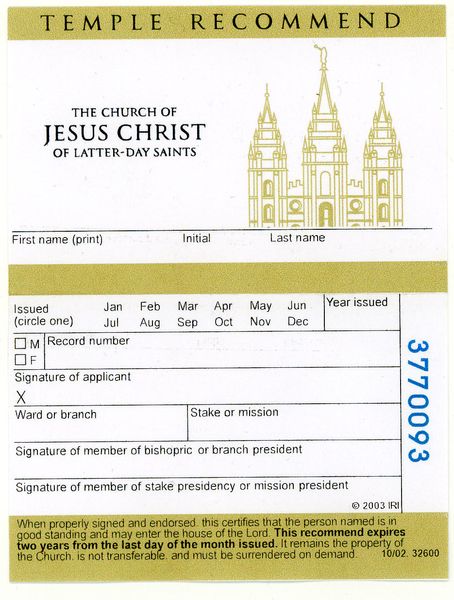
In step with this development, the LDS+ membership card (an LDS temple recommend) has become not merely a card for admission to LDS temples but a gatekeeper for many callings and a shorthand indicator to local leaders that you’re “all in” with the Church. Recent changes to the BYU ecclesiastical endorsement system makes holding an LDS temple recommend mandatory for attending or working at BYU, in practice if not formally. Also, I suspect local and upper leadership really like the idea of bringing LDS adults into the bishop’s office for a worthiness interview every year or two to renew a recommend. In LDS Basic, that doesn’t happen. Think of it as an expansion of LDS surveillance technology, if you like, just like surveillance technologies have expanded across every government and private institution in recent years. It won’t be long before they put face recognition cameras in LDS foyers to track your attendance.
Other Tiers?
Okay, you get the idea. I’ll quickly hit an upper and lower tier, less defined than the LDS Basic versus LDS+ divide. First, moving up, there is LDS+ Premium, local leadership (bishops and SPs) and above. Yes, you hold a TR, but stepping up to LDS+ Premium means you are 110% in. You didn’t just drink the kool aid, you drank the whole pitcher. Or at least you have learned to fake it fairly convincingly. Zealot is too strong a term, but not by much. You are a judge in Israel, with the institutional mandate to judge your neighbor (one of the reasons bishops don’t have much of a social life). In most cases, LDS+ Premium is a lifelong tier, even when that man (it’s a male-only tier) is released. We often still refer to released bishops as “Bishop So-and-So,” even decades after they are released. This can be very confusing to converts. I’d love to hear from a few LDS+ Premium readers about their experience when upgrading to this membership tier. Notably, you don’t volunteer. You get promoted and it’s hard to say no to the promotion.
On the flip side, you can go inactive, sort of a step below LDS Basic. The line here is a little blurry, but I’m sure you have gone through your ward list a time or two and seen probably a hundred or more names that just mean nothing to you. Haven’t been to church for years. Maybe a long-time member in the ward knows who they are, or they might be entirely unknown to any active ward member. We might call this an LDS Inactive tier of LDS membership. It’s probably more accurate to think of it as a lapsed membership, like Sling does when you try to unsubscribe. Just stop paying and we’ll suspend your access to content, but you are still in our system. You can “reactivate” at any time by just clicking the “reactivate my membership” button. But for the Church to acknowledge that totally inactive people are truly lapsed members would drop LDS membership stats by half or two-thirds. That won’t happen.
Conclusion
Have you always noticed there are different LDS membership tiers, or is this a new concept? It’s one of those things that is never explicitly addressed in church and that some leaders would expressly deny if queried. Nevertheless, it’s a thing.
I invite you to stand and deliver. What kind of Mormon are you? You can be LDS+ Premium, LDS+, LDS Basic, or lapsed membership — call that last membership tier LDS Inactive if it makes a big difference to you. It’s possible a reader or two is still in trial membership status, having joined within the last year but not yet upgraded to LDS+. I’m LDS+ and it’s working for me, but (and I imagine you’re not surprised by this admission) I’m not really your average LDS+ member. Maybe you aren’t either. And there might be a reader or two who has never had an LDS membership. Kind of like saying, “Nope, Max is not for me, thank you but I’m happy with my current streaming service.”
Are you happy with your current LDS membership tier?


I’m in the “Inactive Member” Tier with my suspicious agnostic teenager.
My husband is in the “Inactive Member” Tier that he has branded as “Health Condition Member” Tier (i.e. “if he wasn’t allergic to the cleaning supplies used, he’d be at church”).
NOTE: This personal perspective of his is without regard to not using Zoom to attend during COVID, and minimal awareness of General Conference scheduling. It also includes not recognizing how few community relationships he has to other church members.
Next year, our youngest qualifies for the “LDS Basic” Tier as a child baptism. This will be interesting, because I am not interested in completing the executive functioning to get the child baptized, nor am I interested in dealing with the self-righteousness towards family members that is a developmental trait of 8 year old children. So either he does the executive functioning to get the child baptized and engaged in church community, deals with some family fallout that it doesn’t happen, or admits what is going on (no church) and lets me deal with the family fallout.
The irony that “it’s my fault” (as the “mother leading her child away”) even though my husband’s attendance and commitment levels are pretty static pre-my faith transition is not lost on me.
I’ll add another category – “Revoked Member”. I voluntarily revoked my membership after four years of “Inactive Member” status.
I definitely noticed the tiers when active, though I didn’t have these awesome titles. Because of my previous part-member marriage status, I was never able to attain LDS+. LDS basic is the worst – you know you’re always less-than and too many lessons and talks leave you feeling hurt, sad, angry, and lonely. You are not enough if you are only LDS basic. That shouldn’t be the “message” anyone receives when they’re doing everything they can to be a faithful disciple of Christ.
I wasn’t around 150 years ago to really know what it was like, but was polygamy the original LDS+ tier? It was available earlier, and more accessible to everyone, as it didn’t require any certain physical location.
I would define the LDS+ Premium level more broadly to include bishoprics, HC and a significant number (but not all) of EQPs and RSPs, though probably not their counselors. Certainly women who are general church officers must be in that tier, right? So it may be predominantly men, but not exclusively. It’s clearly possible to get out of that tier; I’ve met inactive former bishops, and know some who have clearly stepped back to regular LDS+ as well.
Hypothetically I’m eligible for an upgrade to the LDS+ Premium membership. I’m a 40-something guy with no obvious disqualifiers (active spouse, no tattoos, etc.) but I think I’m fairly safe from any salesmen pressuring me into that upgrade. I’m currently in a situation that anyone trying to sell me on that upgrade, would be proof that the upgrade isn’t worth having. (I currently manage to coexist with elements of the church that I disagree with. I could not, however, promulgate and enforce some of those. So putting me in certain leadership positions would require either me or the church to change significantly, or I’d get released pretty quickly.)
I’ve certainly seen the tiers at work in the church. Members who aren’t LDS+ aren’t eligible for certain callings, even when it seems like they should be. (I’ve literally heard my former bishop agonize over the one YW leader who didn’t have an active temple recommend (and from what I understood didn’t want one).)
Another tier between LDS Basic and LDS+: endowed, sealed, no current TR. Far from temples (in this case, three hours), in small wards, this tier allows full socialization with the ward, callings as youth/primary presidency members (and the male equivalent), Sunday school teacher, seminary teacher, activity days leader, etc. Basically any position that isn’t the auxiliary head/bishopric, because they are desperate for bodies. It’s a pretty great tier. The LDS+ mostly focus on the LDS Basic and let you in the middle do whatever you want.
Back when I was TBM, we (LDS +) actually abstained from coffee and dressed with LDS garments year round, including very hot summers. Now I see many “active” LDS members who apparently think these items are optional to the point that they do not affect their temple worthiness. So what is LDS+ really at this point
You really need to add the very last tier of once was an LDS premium+ but now a “no account”. Haha no pun intended.
Sent from my iPhone
<
div dir=”ltr”>
<
blockquote type=”cite”>
My membership tier is -5. Casual parishioner. But hey I go to sacrament meeting about every week, that has to count for something. I also communicate with the bishop about his refugee project and am trying to work with him on helping find resources for migrants coming here. That I’m down with. But the bishop knows that I don’t believe that Jesus was resurrected or that Jesus is a god (I believe in Spinoza’s god (god is synonymous with nature) and that’s about it). And from there it can be deduced that I reject all other major teachings of the Mormonism.
The deeper you wade into the church, the more tiers you find. I agree with your tiers and might add a couple.
-There’s the “covenant path” tiers of “LDS Basic” and “LDS+”
-There’s definitely the local leadership “LDS+ Premium” tier.
-There’s the “LDS+ Platinum” tier for the seventies, general relief society, YW, YM, presidencies, presiding bishopric, etc….this is currently the highest possible tier for women in the church (and there’s only about 9 women in this tier vs literally hundreds of men).
-There’s what I’d call “LDS+ Max” for the Q15. There are probably a handful of billionaires with de facto LDS+ Max status as well.
Then there are layers and layers of sub-tiers in virtually every corner of the church. When you stop to try to draw lines around the hierarchies it can quickly get overwhelming. At some point the bureaucracy overshadows almost everything else and it can easily get conflated with righteousness.
Would it be fair to say that LDS Platinum is for that class of members that have received their second annointing?
I’m very happy with my current status, which is invisible.
The real line between LDS+ and LDS+ Premium is ordination as a high priest. The earlier one gains that achievement, the more likely that one moves to the Platinum level.
2nd anointing would be LDS Platinum ++++++++++++++++++++++
I’m a middle aged guy who goes to church every week, and I don’t understand the oft-repeated idea that there is some great divide between elders and high priests. I’m currently the EQ secretary, and I have no idea who is and isn’t a high priest. Until a few minutes ago I wasn’t even sure if I could see who is and isn’t a HP. (Turns out I can, so I guess I can make a list for my ward if I want.) Am I the minority opinion here? It’s been about 6 years since the HP group was disbanded; are we still holding on to that distinction?
To be clear, I do see distinctions made about other things. Current callings (some of which are obvious indicators of being a HP), covenant path language, family situations, political ideology, clothing choices, and many other things are used at times to group members into categories and tiers. I just don’t see the Elder/HP distinction as one that is ever explicitly used, though it may correlate reasonably well with some of the other methods.
The second anointing actually grants entry into a super secret tier called “LDS Club 33.” Most people don’t know that Disney’s uber exclusive “Club 33” is actually named after it. (See https://en.m.wikipedia.org/wiki/Club_33)
In the 90s it was given the nickname of “LDS Fight Club” because “The first rule of LDS Club 33 is don’t talk about LDS Club 33”. As such, the fact that nobody talks about it is evidence of its existence.
If you think this lie isn’t true, then go ask the blind man; he saw it, too.
@DaveW: I really don’t think there’s much distinction…and even less now than before. Even the church manual on the topic just says this:
In other words “all the stuff an elder does, but was/is in a leadership position.”
Ten or so years ago, our stake president was pressuring the bishops in our stake to try to get members who had lapsed from LDS+ to LDS Basic (because their temple recommends had expired) to upgrade back to LDS+ again. Apparently, the strategy dictacted from the stake was to have the bishopric personally visit each member with a lapsed temple recommend in their home and encourage them to get it renewed.
For convenience, my wife and I are on the same temple recommend schedule–we renew our recommends at the same time. Whoever generated the list of people with lapsed temple recommends for our ward didn’t take into consideration the fact that some people’s recommends were just about to expire and that they fully intended to renew them soon. That’s exactly what happened to my wife and me. Our recommends had just barely expired when the ward clerk made the list, but we had already renewed them a few weeks later by the time a member of the bishopric, who obviously didn’t check to see if our recommends had been renewed, called to set up one of those fun we’re-not-going-to-tell-you-why-we-want-to-meet-with-you-ahead-of-time meetings that Mormon leadership is so fond of.
My wife and I have known the two bishopric counselors who came to visit us for a long time, and we quite like them. They are good people. After 5-10 minutes of small talk, one of the bishopric counselors obviously started speaking with a purpose, so my ears perked up to finally learn what the purpose of this visit was. However, this bishopric counselor just kind of rambled on and on for what must have been at least 30 minutes–it just felt like he was kind of jumping from one Church topic to another to try to emphasize the importance of the Church/gospel in our lives. After this apparent long winded attempt to “bring the Spirit” into the discussion, he then started to fidget and kind of stumbled over his words as he started talking about how important temple attendance is. Within less than a minute of him starting down this path, it finally dawned on me what was happening. I immediately cut the bishopric member off mid-sentence, told him that our recommends had just barely expired, and that we had already already fully renewed them (we had met with the bishop himself for the renewal, so they didn’t know this). Upon hearing this, the poor bishopric member and his partner both noticably relaxed, took a deep breath, and had the color once again return to their faces. From their reaction, I got the sense that some LDS Basic members in our ward didn’t really appreciate their efforts to come into their homes to try to convince them to upgrade to LDS+ again. They laughed the abnormally loud and fast laughter of men who had been miraculously saved from certain peril and quickly left our home.
I have used my LDS+ membership to attend the temple in the last year more times than I have in many years past. Yes, I have actually endured two full endowment sessions in the last 6 months. I was curious to see if I might find value in the endowment after largely stepping away from it for a number of years, and I went into it trying to being as open minded as possible. Unfortunately, I felt the same way about my endowment experiences as I did when I participated more regularly in the past. I really found nothing spiritually uplifting about it at all. The best two parts for me were waiting in the temple chapel for the endowment to start and sitting in the celestial room when it was over. Even then, I have much more profound spiritual experiences roaming through the hills and mountains near my home than I do in the celestial room. If this is all my LDS+ membership gets me, I might consider letting it lapse. After all, I can access the mountain trails free of charge as an LDS Basic member.
We had a 5th sunday lesson last month where they told us that “It isn’t enough to just attend church, you need to be volunteering at the temple”. So, clearly a push to go from LDS Basic to LDS+.
I’m currently LDS+, but pretty sure I’m not going to renew my LDS+ membership. I don’t particularly enjoy the movie shown on the LDS+ streaming service, and I don’t particularly enjoy being pressured to see that movie again and again.
Here’s another aspect to the tier (if we’re seeing it as a business relationship): what are your notification settings? Do you unsubscribe to all the promotional messages? Do you hide your contact info or ignore attempts to reach out? What rating would you give it on Yelp or Google?
I have also observed these changes over time, and I would personally tie it to the tithing push of the 1970s. The church was insolvent! Ward budgets were set based on separate local donations at the ward level agreed upon by the active LDS families. A whole lot of people didn’t pay tithing, and had no current TR, even if they were endowed & sealed because there was no reason to do so. I think your framing that the temples came first, then the tithing, makes me wonder if it wasn’t the other way around. But it could have been more that both things raised the expectations as well as the commitment level. I would think the temples “sweetened the pot” for paying tithing (meaning, that was my assumption–the coffers were empty, and they needed to make it feel like members were getting something for their tithing dollars).
The problem I see at this point, if we are comparing it to a streaming service, is that the content is rubbish. It’s not entertaining (the sense of community is completely gone), and the target audience isn’t me. It’s like when I’m in a hotel lobby and they’ve got Fox News on. If we’re talking about the temple, even if it weren’t sexist with hints of polygamy, it’s boring AF. Let’s be honest. When people talk about how great it is, I honestly don’t know what they are talking about. If it’s relaxing to be without your cell phone for two hours, great. I get that when I go for a massage which is infinitely more enjoyable and only costs $65, not 10% of my income. To second CosmoTheCat, if I’m going to see a movie over and over, this isn’t the one.
My observation is the church policies push people out of LDS Basic. It seems like they would almost prefer inactive to basic. I would have kept my lack of belief completely to myself, and perhaps stayed in LDS basic for longer, but the policies that don’t allow me to ordain my son an elder or go to the temple for his endowment mean that now my whole family knows that I don’t believe. Which is actually kind of a relief for me, really, but it’s annoying that it was forced on me.
@Rockwell has hit on the main reason I’ve been maintaining my LDS+ membership. I don’t really care about the daily temple access included with LDS+. The main reason I maintain LDS+ is so that I can participate as a “normal” member of my ward. In other words, I can keep my activity days calling, attend my children’s sealings and endowments, and I’m not singled out for special attention.
And @Rockwell, I should add that I’m very sorry that you weren’t able to ordain your son or attend his endowment and that your lack of participation in these events forced you into uncomfortable conversations about your faith with your family.
Is this the actual size? I’m gonna print one out and sneak in.
As Rockwell points out, it is in some ways preferable to be LDS lapsed than LDS regular and deal with the pressure to move up to LDS+. It is little wonder to me that members were reacting badly to the home visit sales pitch. After a while being nagged and pressured into something you really don’t want to do, you start getting angry. For many years I had an issue with wearing the required uniform of LDS+ but was a plus member in every other way. The pressure to get with the program, wear the stupid uniform, and upgrade my membership back to plus status was unbearable. I am much happier now with plus membership antenna attached to the house (my husband pays tithing on both our incomes) but just never stay in the room if he watches and I don’t wear the uniform or attend weekly club meetings.
I am LDS+ but I am considering going LDS basic. I am very uncomfortable with the bright line that is being drawn between between different tiers of members. I don’t feel good about having an involuntary class of 2nd class citizens in our midst (LGBTQ people). If they are going to only have the opportunity to have LDS Basic, I don’t want to be at a higher level than they can have. Plus we just don’t have the time (or money) for the temple anyway. My kids with special are grown, but they still require time and money that we don’t have. Meanwhile other people with kids in their 20s are now empty nesters. Our situation is unique and difficult and we see that the church still wants to pressure us to conform. It doesn’t feel right.
Special needs
Well as someone who has stepped away from my LDS+ subscription I have found that I get all the benefits and less hassle by sharing my husband’s current LDS basic password.
I second CosmoTheCat too. I can’t go to the temple now, but it is an experience that I do not miss at all. The movie is incredibly boring and I think most people fall asleep during it for at least a little bit. The Salt Lake live ceremony is weird. Sometimes people try to be actors and it just comes off as very off-putting. Plus I’ve heard many active members complain that there is a shortage of names to do ordinances for, consequently some of the same names are done over and over. That just seems like an absolute waste of time. Believers often refer to the temple as “service.” Serving what purpose, exactly? God isn’t omnipotent enough to just save whomever God wants? Someone has to either go through some arbitrary set of rituals in a lavish, opulent building or you have to be lucky enough to have had your name and birthday recorded on a census and to have someone do the ritual for you by proxy in order to be saved? And if you got baptized and your hair was sticking out or the proxy baptizee had a piece of their hair sticking up above the water, well it doesn’t count. If someone wasn’t wearing the robe on the correct shoulder, well it doesn’t count. The culture in the temple is also a bit insufferable. The workers tend to nitpick over the tiniest of flaws. If you put the sash on the wrong way, temple workers will get on your case about that and stall the ceremony until you get it right. If you don’t get dressed fast enough during the ceremony or incorrectly you feel judged by the other temple-goers for not going frequently enough to know how to dress quickly into the weird clothes. You have to get all the words exactly right at the altar. A lot of the endowment ritual is just a little bizarre and creepy. The prayer circle is unnerving. The separation of the women and men into two different sides is strange. My wife used to say she missed going to the temple with me. Why? I asked. So you and I can sit somewhere and not interact at all, except at the very end in the celestial room very very quietly and sparsely? A lot of people go to the temple simply because they think that God will help them out of a hard situation for so doing. A lot of spouses go to the temple because they feel some sort of reassurance that their other spouse is still a believer and they will make it to the celestial kingdom. Sorry, but never again.
Lastly, I remember a story I heard on reddit of a man collapsing while in the temple. 911 was called and paramedics rushed to save his life. No one in the temple was strong enough to lift the man, nor did they have the equipment to do so. So the paramedics had to enter the temple to put the man’s body onto a gurney to wheel him to the ambulance. But what happened when the paramedics arrived? Well, they were asked for their temple recommends. And when they could not produce any such recommends, the temple workers in all their wisdom refused them entry. It was only after excessive pleading on the part of the paramedics and calling in to get special permission that the paramedics were finally allowed entry with special accompaniment to save the life of a man who had collapsed. Yeah, never again.
The church has provided a way for all–who will–to get on the high road that leads to eternal life. Some folks may believe that this somehow produces a tiered membership–but the reality is that there is only one set of requirements for getting on that road. All are required to live by the same standard–there are no exceptions. If there are any jealousies between those who have recommends and those who don’t (and vice versa) then shame on us.
The apostles sorrowed when the Savior told them that he was going away. And how did he console them? He told them that they should rejoice for him–because he was going to the Father who was *greater* than him. And then he further consoled the apostles by telling them that he would come back for them that they might dwell with him in the presence of the Father.
I think that’s a good pattern for all of us to follow with respect to the perceived inequality regarding access to the temple. We should rejoice in each other’s growth and progress and do all we can to bring each other along.
LDS+ and Basic both used to provide quality programming like Road Shows and General Conference talks with ear waggling. Now all we get is a rotating assignment to clean the chapel and bigoted Family Proclamation talks
Jack,
I think you mean well. But the church admits in it’s information that same sex attraction and gender dysphoria and gender incongruence are genuine problems that people cannot choose to change. There’s no high road to heaven for people with gender incongruence. The temple is carefully divided into one sex or the other. People who suffer gender incongruence can become suicidal without transitioning. Yet if they do transition, even if they remain chaste there’s no room for them in the temple and little room in our wards.
People with same sex attraction also are excluded from exaltation since they cannot be sealed to a same sex partner to achieve exaltation. They can remain chaste and remain 2nd class citizens among us, but no path to exaltation has been revealed.
So I wonder why our leaders don’t pray and ask for a pathway to exaltation for these people? I think they don’t mind that they are 2nd class citizens with no revealed pathway to exaltation. I cannot help but feel sad about it. I am grieving.
I’m surprised no one has mentioned how the tiered membership status relates directly to tiered heaven status for the rest of eternity. RMN and DHO have certainly put major emphasis on reaching the celestial tier. To them, that’s the only tier that really counts, the only tier where a “loving” Father won’t banish us from his presence, shun us, and keep us from being with our spouses and family members for eternity. It’s the super exclusive tier where not just Mormons reside (0.2% of world population) but LDS+ Mormons, probably less than 0.1% of the world population.
But given how DHO talks and thinks, he’s not really selling me on it. I’m just not interested in living in LDS+ heaven with him and people like him – not to mention with the god they believe in who, the way they perceive him, is an abusive and unfit parent. I’d much prefer the terrestrial tier with the “honorable” people of the earth thank you very much. My gay kids can’t even qualify for top tier status anyway, no matter how Christlike and morally upstanding they are, so why bother? We’ll all have a good ole time together in the TK.
“The church has provided a way for all–who will–to get on the high road that leads to eternal life.”
You can take the high road. I prefer the low road. Less nosebleeds.
lws329,
Thanks for the response. These things are difficult to talk about–I don’t want to hurt anyone. Even so, let me just say that I believe there’s a path to exaltation for all of God’s children. And by the time any one of us reaches that station of existence we will have grown into a personage of such glory that our former selves will seem like an acorn compared to the mighty oak that we’ve become. And so, even though some problems may seem intractable during mortality the Savior will help us manage those difficulties and open the way for us in eternity. And our part is simply to be grateful and to do our best to keep the commandments.
Jack,
Well Bryce got there first, but I was going to point out that while you may not believe in tiered church membership you probably do believe in tiered Heaven.
For myself I don’t really want access to the temple. What I really lament is a sad-heaven culture that simultaneously makes it difficult to be honest about doubts or different beliefs with family while forcing people to put their status as non recommend holder on display.
But whatevs. Like I said, in the end it has been a relief for me.
I wonder if LDS+ would be a more appealing option if, like with the streaming services, the ads were dropped when you upgraded. For example, if an LDS+ member watched General Conference, then the stream should have blanked out (or switched over to football) when Neil L. Andersen gave his haranguing tithing talk.
Most streamers operate on a business model of maintaining subscribers on autopay, regardless of whether or not they are actually using it. Gyms and fitness centers also thrive on this model, and to some extent financially depend on a certain percentage of members who continue to pay reliably but never actually show up (or who quit coming a few weeks into the new year when their resolutions fall apart). This is also why streamers are beginning to crack down on account sharing. How many streaming services are you still paying for but not watching?
In some ways, the COJCOLDS operates this way, in that they get to boast 17+million members even though the majority of that number haven’t seen the inside of a meetinghouse in years, and a certain percentage of those are likely dead but presumed alive until they reach 115. And if you want to cancel your subscription, they make you jump through shameful hoops, in stark contrast to how easy it was to join in the first place.
Brad D
No kidding on the nitpicking temple workers! When I followed the instructions exactly-leaving on my shoes until the very end, then taking them off and putting them right back on-I was told I did it wrong.
I’ve been at weddings and sealings in different states where we were instructed that patting the couple on their back was too loud.
And the weird clothes-you don’t know the half of it-when I was a Beehive, the ladies at the at the baptismal font gave us home sewn bras made from double layer dounleknit polyester with long strings to tie them on. They were huge-probably wrapped around most scrawny Beehives’ bodies twice. Maybe that’s what we get to wear in the CK.
OMG, yes! Some of the temple workers literally act like they are on commission, getting a reward for finding any nit-picky error just to make themselves feel useful, and in some cases, these are temple-specific rules they’ve made up that don’t apply elsewhere. I pointed this out to a relative who was a temple worker in Atlanta, that I had been taken to task quite harshly by someone in the locker room for not pinning my sash to the rental packet before returning it to the laundry, a procedure I have never heard of in another other temple. My relative’s response was “What?? You HAVE to pin the sash! What are you thinking? Otherwise, things get separated in the laundry room!” So much for that.
@Angela – I’ve been thinking about your comment about your tithing comment and wondering if temples “sweetened the pot” for paying tithing. IIRC “Full tithe payer” wasn’t really even a hard TR requirement until 1964. It wasn’t until 1970 when the church specifically said that tithing should be based on income…then in 1980 the FP made a big push to ensure bishops were conducting formal annual tithing settlement with every ward member. So first we get the carrot of “pay your tithing, get the temple.” Second there’s this entitled sense of, “we know you all make more money than this.” Lastly, we get the stick of an annual sit down with God’s (supposed) local accountant and sign a paper swearing the amount paid represents 10% of your income.
This carrot+stick approach has been hugely effective in the last 60 years and bringing in loads of cash. I often wonder what earlier leaders would think of the idea that the current church withholds saving ordinances from anyone who doesn’t fork over enough money. In the early days when temples were scarce, the people who helped donate would get priority use of the temple…they didn’t just exclude everyone who wouldn’t/couldn’t pay. Very much a paid subscription approach to salvation these days.
Years ago when I was doing some professional work with the church, I learned that you can just send your tithing directly to HQ and that the bishop would not receive any reports on what you had donated that year. The intention was usually for members (often wealthy ones) who wanted to pay tithing, but didn’t want local leaders calculating their annual income from tithing donations…I tried it out, and it’s a real thing. It may be defunct with the onset of paying online, but you’d fill out a little form email to HQ and some accountant would set up your account, then give you the green light to start sending donations directly to HQ without local leaders in the loop.
The temple-specific rules reminds me of the push that Cynthia L. of BCC and a bunch of folks from Feminist Mormon Housewives made maybe a decade ago to get temples to stop banning YW from doing baptisms for the dead while they were having their periods. If I recall right, they found huge variability between temples in how they handled this. (And sorry if I’m misremembering the group who did this.) But on the bright side, I think they eventually got a Church-wide ruling saying to leave the YW to decide for themselves if they’re comfortable.
I am currently subscribed to LDS Basic, but I pay a little extra each month for what I might call the Free-thinker Package or the Humanist-Pluralist Add-On. I don’t plan on cancelling my Basic subscription any time but now I have access to a much more expanded worldview/theology rather than limiting myself to much of the tired dogmatic, correlated content provided by LDS basic that no longer works. At the same time, if my friends, family or faith community wants to talk about a rerun they’re watching on LDS basic that’s meaningful for the, I’m up for that too.
“The intention was usually for members (often wealthy ones) who wanted to pay tithing, but didn’t want local leaders calculating their annual income from tithing donations…”
Also so you can avoid paying capital gains taxes on your appreciated securities,
@Bill: Shhhhh…the SEC might hear you.
I am astounded that this comment collection has gone this far without mentioning the Basic Minus tier. This is the tier I’ve been on for most of my 7 decades; I am female. Besides the obvious limitations I will add:
– When I married a non-RM I was not allowed to even consider a Basic Plus membership unless hubby was willing to also jump through all the hoops.
– Eventually the only callings that were open were RS, Primary or SS teacher or librarian. Two of these callings I’d held as a 16-yr-old, so I was obviously not seen as making much spiritual progress.
– After my divorce I did try a trial membership in Basic Plus. I didn’t find it much of a Plus so I’ve let it lapse.
– Now as an aging, unmarried woman, without a TR, I may be considered officially superfluous to the organization. I make a real effort not to also be a burden.
An economist named McBride at UC Irvine wrote a paper about 15 years ago called Club Mormon. It argues similar points. You can access it here: https://cpb-us-e2.wpmucdn.com/faculty.sites.uci.edu/dist/a/379/files/2014/08/ClubMormon_RatSoc_2007.pdf
It’s bothered me for a long time that these tiers exist in the church – I don’t see it as being Christ like. Add to that the concept of how we behaved or progressed as spirits in a pre mortal life determined some of our mortal experience. Just NO.
I’m a fake basic+ because I fudged somewhat on my last TR interview. I mean – doesn’t everyone somewhat? I hate those questions with a passion and only went along with it to attend a grandson’s wedding sealing. The ‘worthiness’ type questions, WoW etc weren’t even the hard ones for me. I’d been saying to myself these past few TR cycles that each one would be my last. This one will be so make me a basic-
I just attended the Restore conference by the Faith Matters organization – it feels like the 3000 attendees are clamoring for a new subscription tier.
You forgot the LDS+Platinum level for those who have received their second anointing!
And then there’s the LDS+Platinum level for those who have received their second anointing!