
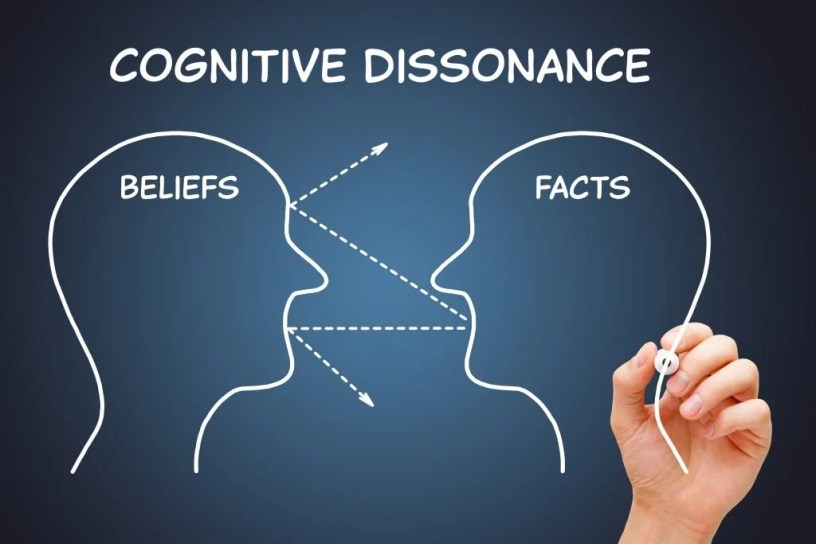
Have you ever believed something that you wished you didn’t? Have you ever been unable to believe something that you wished were true? These experiences are linked to something called doxastic involuntarism–the widely accepted psychological principle that humans cannot choose what they believe. When their desires conflict with their actual beliefs, they feel the discomfort of cognitive dissonance.
There are some related concepts to consider in this discussion. First let’s examine people who wish something they desire was true, but they just can’t make themselves believe it. I was thinking of a few examples, both from religion and from other aspects of life. You might, for example, really wish that we lived in a just society that lives up to its ideals, but perhaps you are unable to believe that is really true based on the evidence you see. Commonly, many formerly religious people desire the comfort, community or hope they felt when they were in a religion, but their brain has rejected those beliefs due to lack of evidence or logical contradictions.
- “Faux-Theism” is a term coined by philosophers to describe people who view faith as beautiful or comforting, but who cannot cross the intellectual barrier to believing it.
- Intellectual Integrity or Evidentialism is the psychological state in which a person’s commitment to truth and evidence overrides their desire for emotional comfort. They want the existential peace of a loving deity or an afterlife, but their intellect forces them into a state of involuntary disbelief.
By contrast, many people believe things that they wish were not true. There are some “Christian” doctrines that believers don’t like but that they still can’t shake: sexual shame associated with purity culture, a belief in hell or eternal damnation. Mormon women in particular often find the concept of celestial polygamy extremely distressing. These beliefs are only uncomfortable because the person holds them–if you think they aren’t real, they are only distressing insofar as others around you believe them and then impact your life, but the idea in and of itself is not distressing. For example, if you are a mother of a child who is terrified of vampires, and you don’t believe in vampires, you may feel distress for your child as you try to comfort them, but you are not literally trying to protect them from non-existent threats, just their wrong beliefs.
- Traumatic or Maladaptive Beliefs exist when someone has developed a deep-seated fear of hell, divine judgment, or eternal punishment. Even if they don’t want to believe these things, they are unable to “switch off” their belief that they are real.
- Moral Dissonance happens when a person’s inherent moral values clash with the dogmas of their religion. For example, a person might feel that policies and doctrines are harmful to marginalized groups and that those doctrines are wrong. This can lead them to wish the religion was not true, even if they still fundamentally believe it is.
You can’t force yourself to believe what you wish, no matter how much you wish it. You also can’t force yourself to stop believing something you wish were not so, even if you can see that it is harmful to your well-being. The gap between what we want and what we think can be one of the most painful forms of existential friction.
- Have you experienced both of these phenomena?
- Can you share examples?
- Which was the most difficult for you?
- How did things change for you, if they did?
- Are there some Mormon beliefs you wished weren’t true, but believed they were? Do you still?
- Are there some Mormon beliefs you wished you could believe, but you never did?
- Do you know people in other faiths who experienced these two forms of cognitive dissonance?
Discuss.


Reminds me of that talk Pres Nelson gave where his big emphasis was choose to believe. But ever since I was a kid, I could never shake the feeling that his was a forced sincerity when he was speaking. And it always felt like he leaned way too heavily into black and white interpretations as he was trying so hard to please God by “choosing” that. For me, the body is a BS meter. Belief for me is something the body and the mind can accept together. When one rejects it, it doesn’t really matter what the other “thinks”.
I have always thought that the origin of the Book of Mormon is possible but highly improbable. Then again, if it is not what it says it is, how has the church grown to be what it is today? A conundrum.
As someone who left the LDS tradition well into their 40’s I have deep regret, even anger, about what might have been. That’s what my emotions tell me. My brain is telling me that my life is actually quite good and that my choices have led me to an objectively good space, and that other paths may be worse.
I’ve spent hours and money trying to overcome this dissonance between my emotions and my intellect. My therapist tells me it’s because I skipped some important developmental milestones in the spirit of obedience and acceptance. We’ve put a label on it and I know what the problem is, but my dang emotions won’t let it go.
Even as an ABM I struggled with the idea that prophets speak to God like I speak with my parents. There is overwhelming evidence that at best prophets are gentlly nudged by God – there are no Jesus high fives in the SLC temple.
To lpf43
There are more 7th Day Adventists than LDS.
Where is the conundrum?
Islam is far bigger than Christianity- etc.
As someone who has essentially walked away from the church because I found too many of the “truths” it teaches either specious or harmful or both, I’ve tried to be more clear-eyed going forward. When I was a young, newly converted member, I believed a lot of things the church taught that I don’t believe anymore. And the perils of belief cut both ways. I believe, for example, that a lot of U.S. corporations and politicians are corrupt and do active harm, but even if that is actually true, I try not to let that belief obliterate any optimism or positivity that I have left. There are times, still, when I occasionally wish I could have been a “true believer” in the sense that life sometimes seems easier for those folks, but honestly, I wouldn’t trade my current worldview for that kind of simpler life. I just couldn’t fit myself back into that box, and I wouldn’t want to.
Your comment about not being able to force yourself to believe what you don’t really describes my last thirty years as a Mormon. I tried to plug into what I initially believed was the gospel of Jesus Christ and the community of love that I believed the people in the church comprised. But I was wrong, and that took a long time to admit to myself. There are lots of good folks in the church; I’m very grateful to have known them. There are also some great teachings about love, empathy, and our duty to bear one another’s burdens in the bible and in the B of M; but that doesn’t mean that the totality of the church is “true”. My moral dissonance came into being as I realized how misogynistic the church was, how much it prescribed a kind of conformity that I actually found was soul-crushing, how it kept so many groups of people marginalized, in clear contradiction to the teachings of Christ. So I stopped believing. One problem with belief, at least in the Mormon context, is that there’s not a lot of room for nuance and complexity, and most of life, and most of the lives of we humans is full of nuance and complexity.
I have wished at times that I could unsee what I’ve seen regarding sexism at church. My marriage would be so much easier if I just believed. But I can’t make myself.
Another dissonance discussed in conference was that of people “who know what is right” but refuse to act in those beliefs. But it was about people who leave the church. I assume it’s those folks who if had been better they never knew because now they are supposed to be accountable. I can’t tell you how much I hate that argument. That I know the temple is true but my own stubbornness is a stumbling block. Actually I don’t know the temple is true. No one has a right to tell me what I know or don’t know.
I guess I tried to make myself believe, but when believing what the church tried to teach me means that God loves his white sons more than his darker skinned sons, let alone his daughters, no I suppose I actually would rather not believe. And believing those old men in SLC actually know more about God than anyone else kind of made me feel ill. No, I rather think I will believe that Francis of Assisi knew God better, or maybe that George Burns showed us the real God in that movie (also staring John Denver as God’s chosen prophet 🤨) where Mr. Burns played a cigar smoking old guy as God who wanted to go spend more time with his animals.
Waiting for a revelation from Oaks that live-streaming an execution is bad.