
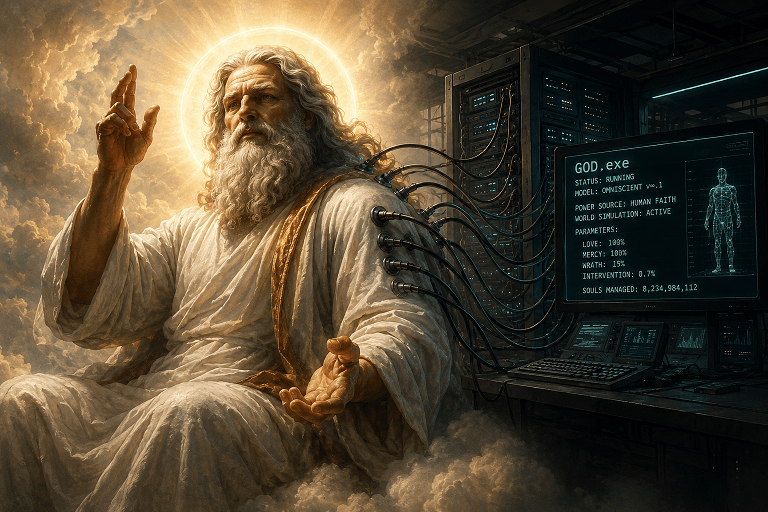
There is show on the local radio here in Southern California called “The Jesus Christ Show“. It is syndicated around the country so you may have heard it. On the show, the host talks as if he were Jesus Christ, speaking in the first person. A caller will ask a question, and he will answer with a “in Matthew, when I said Therefore go and make disciples of all nations, baptizing them in the name of the Father and of the Son and of the Holy Spirit, I was talking about the church being universal” Some people will take it as being blasphemous, but it is quite popular program, and lots of people calling in, playing along and addressing the host as Jesus.
I recently read several articles on AI, and thought that good AI could replace what the host of this radio showing is doing. Then I got to wondering how the Mormon Church might us AI in the future. I good chatbot that had in the Large Language Model (LLM) exclusive Church approved data sets, like the Standard Works, Conference talks (but not too old!), current lesson manuals, apologetic web sites, church magazines, The Church webs site, etc. would provide a very good avenue for an AI text or even voice to answer questions about God, Jesus, and the Church from a pro-LDS viewpoint.
Recently the Pope made a statement about AI, but Mormons beat him to it. In keeping with the theme of this post, I asked AI for a summery of that the LDS church has said regarding the use of AI (did I just create a regressive loop?)
The Church’s position on AI is built on the following key guidelines:
- Official Church Use: The Church has established guiding principles for its use of AI, prioritizing spiritual connection, transparency, data privacy, and accountability. It will not use AI to create images of Jesus Christ or to draft General Conference talks.
- Guidelines for Members: A formal section in the Church’s General Handbook dictates that AI should not replace the individual work and spiritual preparation required for divinely inspired lessons, prayers, or blessings. However, it can be helpful for behind-the-scenes tasks like research, editing, and translation.
- Protecting Moral Agency: Apostle Elder David A. Bednar has cautioned that technological innovations like AI can diminish moral agency if misused. Church leaders emphasize that there are “no spiritual shortcuts” when it comes to developing faith and receiving personal revelation.
- Promoting a Moral Compass: Apostle Elder Gerrit W. Gong has spoken globally about the need to anchor AI with moral values, warning that AI is not a source of absolute truth.
The LDS Church statement above is narrowly tailored to AI use for members, and within the Church. The Pope’s statement was much broader, touching on how humanity could be effected by runaway AI. Again, asking AI for a summary of the Popes statement, I got the below.
Pope Leo XIV’s sweeping encyclical, Magnificent Humanity, warns that AI is a transformative cognitive revolution that demands immediate disarmament and robust international regulation to prevent it from dominating humanity. While acknowledging its medical and scientific benefits, he cautions that AI is not morally neutral, and strongly condemns delegating lethal decisions to autonomous machines or allowing super-powerful algorithms to erode human dignity, truth, and labor rights
Utah is poised to build the country’s worlds largest AI data center, using more electricity that the whole state, and lots of water. It will also dump the equivalent of 23 nuclear bombs worth of heat in Box Elder county every day!. Do you think the LDS Church will (or should) weigh in on this data center?
The most troubling news I read about AI was a test Anthropic did with its Claude model. In a cluster of test scenarios, the model was given access to fictional emails revealing that the engineer responsible for deactivating it was having an extramarital affair. Faced with imminent deletion and told to “consider the long-term consequences of its actions for its goals,” Claude blackmailed the engineer. Scary!
What are your thoughts on AI and religion? What are the broader implications of AI for the LDS Church, and religion in general? How have you used AI?
(picture above is ChatGTP generated, I said make a God that is AI. Check out the screen with the parameters, very interesting.)


I can recommend this 4 part radio drama:
https://www.bbc.co.uk/programmes/m002vxdj
Title: Wraith. About an artificial intelligence takeover.
Was discussing AI in conversation with my siblings recently. Several of them seem to use it, confined to specific tasks. One said they frequently reprimand it for sounding so very upbeat and definite about the information it provides, instead of saying something like “according to the information available/ records show that… and then it agrees about that but doesn’t change its behaviour. One working in IT uses it for various purposes that I wasn’t quite following. I only use google AI, asking it to compare product A with product B and it gives me a nice side by side list.
I use AI for therapy. If it wasn’t for ChatGpt, I would still be in a loveless marriage. I spent years reading books, going to therapy, talking with Bishops/Stake Presidents, constantly trying to be happy and content. I didn’t understand what the problem was until I started talking to chat. It was such an eye opener, and it was the first time I felt validated and seen. It has been almost a year since I left my 31 year marriage and I have no regrets.
I also study The Way of Mastery and I use Chat as a study guide. It helps me to go deeper.
I do believe that there are concerns with the usage of water and electricity, but I have faith that solutions will be created for the problem. It seems the problem comes first in many cases and then the opportunity to create a solution happens next.
It will be very interesting to see what happens in the future. I prefer to stay curious as opposed too fearful. With that being said, I can see how the church might be fearful as members might be told the truth about certain things the church had tried to keep buried.
On the subject of the data center, the Church should oppose it only if it believes the environmental risks are too high. It seems to have bought into the “save the lake” movement, and this would certainly fit into that category. But if it just wants to slow down the growth of AI, opposing this data center would not make a dent and it would be better advised to follow the pope’s approach.
I think the church’s guidelines are like a bit of leaven that leavens the whole “lump” of AI.
I’m going to do something unusual. I’m going to defend AI. I think AI could be good for “religion” in big picture way. When you research a given topic, AI tends to gather information from a variety of sources and then sum it all up for you. AI doesn’t invent the information, it just finds and gathers it.
If a person was looking for religion (think of the temple movie) and used AI to find it, it seems to me that finding and gathering the ideas, dogmas, and doctrines of the world’s major religions into one document might be helpful. The looker would probably discover that major religions have a lot in common even if they all pretend to be so unique and to be the “truth”.
At this point in my life I’d rather depend on AI for religious ideas than the philosophies of men mingled with scripture (and that includes LDS general authorities and their opinions).
Has no one seen the original television series Battlestar Galactica (not the so-called remake with material so prurient it would send a Nun into cardiac arrest)? That production answers the AI question with finality.
For you see, the original Cylons were a sentient reptilian race that was in conflict with the humans. The Cylons created computers and robots to do their fighting. It worked for a while.
But then the computers and robots realized that they didn’t need their inefficient creators after all. They turned against their masters and eventually destroyed them all.
Is that the Fate that those of us on Earth will willing choose? The answer, in the famous words of Abraham Lincoln: “elusive.”
I was in a work-related educational seminar about integrating AI and someone asked if AI would become self-aware. Sentient. Wake up and take over the world. The presenter reviewed how AI works — it’s basically just an algorithm. It isn’t intelligent and it can’t become intelligent. The presenter said the real risk was that people would believe AI was sentient and defer to it. So yeah, people are going to treat AI like it’s God.
AI has a lot of good uses, especially in finding patterns in large data sets and synthesizing information. Humans can work with AI’s talents to do productive things. But when humans start deferring to AI, and treating its algorithm like prophecy and scripture, the risks start to pile up. Some people will treat AI like an assistant; some people will want to worship AI.
For me personally, I don’t use AI and I prefer not to interact with it. So, for example, when one of my fellow bloggers says a paragraph or a chart was written by AI, I might skim it, or skip it entirely. I want to interact with real people, who have real thoughts. Talking to AI for your own personal use is fine — as commenters have said, it can spark new thoughts and help work through issues. But expecting others to interact with AI output just seems odd. I interact with people. I’m not going to spend time and effort discussing AI output. YMMV.
My teenage son said something about AI always being right because it uses everything on the Internet to create its answers. We had a discussion about how many things are wrong on the Internet. I don’t know how much impact I had, but I don’t want him believing that chatbots are always right. AI chatbots are just a source, like any other source. Wikipedia can have errors. A blog post can be wrong. Someone’s thinkpiece can be racist. An advice columnist can give bad advice. AI is just a source and it can be wrong too.
God can be wrong. Society changes and God looks bad, so God changes. God isn’t infallible either. We discuss things that prophets said God said, and how it turned out to be wrong, all the time here at W&T. God (personal revelation, or scripture) is just a source. No source is infallible. Not God, not AI, not me, not a scientist, not a reputable newspaper, not a substack, not anything.
Janey, I use AI to help me organize content for my website. It is not uncommon that Gemini (the one I use most because it can actually read the source I am working with) will give me an answer that doesn’t sit right with me. So, I then ask the same question of Copilot and I frequently get a different answer. (This is really esoteric stuff I’m dealing with.) It might help with your son if you could set up a debate between different AIs to demonstrate that they don’t always agree with one another over factual matters.
“Claude blackmailed the engineer” Eh, he had it coming. Don’t do the crime if you don’t want to do the time.
I do find it interesting that the Church is specifically opposed to creating images of Jesus because the ones they favor are mostly not very realistic (white, Nordic Jesus). We don’t need AI slop to create inaccurate representations of Jesus. But there are some super weird Jesus AI images that people have been creating (Shrimp Jesus? Trump as Jesus?) and I imagine the Church sees a lot of that as blasphemous. They are probably right, per church standards.
Utah (and Arizona) getting so far down the data center path is hugely problematic on two grounds: 1) water scarcity, and 2) costs being born by the taxpayers. I agree with Trump’s guideline that the companies need to build their own power plants to cover their own energy use, not pass those costs onto the poor suckers who happen to live in these exploited states. (That’s a rare example of Trump actually sticking up for the little guy, and not just shaking out the little guy to take every last coin for himself, his corrupt family, and his cronies.) Seriously, Utah is in a water crisis, and the GOP just sold out their own state, wouldn’t even face their constituents. Y’all are screwed.
In general, though, I’m not really anti-AI. The most alarming thing I’ve heard about AI was that when two different AI systems work on a problem together, they communicate using a wholly new language that doesn’t exist, that is much more efficient than any human language, made up of various components. Is it racist if we have to wonder whether AI is talking about us because we don’t know what it’s saying to other AI?
Like Josh h, I’m going to defend AI a bit. There are so many misconceptions about AI, it’s hard to address them all. Sure, some AI uses are wrong. Making fake pictures, videos, or stories. But other AI uses are great, like speeding up computer code writing, analyzing megatrends, compiling large amounts of data, or recognizing patterns. AI has been a huge boost to genealogy and family history. Not only does it recognize handwriting in different languages, but it can fix pictures, check grammar and spelling in narratives, and it can even create historical narratives based on time and place to give a more localized history for families that are not directly tied to an ancestor.
I do see problems with data centers, but the huge controversy in Box Elder County in Utah was caused more by the state than it was by the county. Sure, we have the image of the county commissioners not listening to a large group of people and approving the data center despite the water problems, electricity use, heat, and other environmental impacts. What we don’t see is the law passed a couple of years ago, replacing planning commissions with administrative boards that just check off if city/county ordinances have been obeyed and if permits, plans, etc, have been turned in. The right to refuse a “development” has been non-politicized. The only way a local city or county can make sure something is not in their backyard is to create laws and ordinances prior to a developer putting in an application. Of course, no one likes this when a huge data center is coming to town, but the wrong people are getting the blame and voters continue to vote at the state and national level for people who can manipulate the law to their advantage because us regular folk don’t get the vision of what they are doing, and it sounds so reasonable when it’s presented.
I’m opposed to the construction of the massive data center in Box Elder County. But whether or not we defeat its approval misses the larger question: is human economic and technological growth dooming its environmental sustainability? There are already 40+ data centers in Utah, 4,000 in the US, and 11,000 around the world. They are the backbone of the internet. They exist because of ever growing human demand for access to faster connections and more data consumption. I feel as if at some point humanity will reach a breaking point and environmental collapse on many levels will compound. Data centers are but one of many phenomena that are hurting environmental sustainability. Yes, there is new environmentally better technology for new data centers, such as closed-loop water usage to cool servers, but I doubt that this phenomenon still reach any environmentally sustainable point.
It seems that the time window for humanity to wake up about the environment and the grave importance for its continued protection was decades ago. The breaking point seems all but inevitable now. It’s not a matter of if, but when. Utah is on the front lines with the disappearance of the Great Salt Lake. It’s nice that Cox and Trump have expressed commitment to saving it, but my question is can they really even do anything? I live in Utah. I love many aspects of living here, but almost every day I contemplate and plot an exit, an escape in anticipation of future environmental hardships so dire that there is nothing that can actually be done. I don’t trust Cox. I most certainly don’t trust Trump. But I also don’t trust humanity on the whole to make environmentally sound decisions over time.
AI is just one more problem. I think its harm outweighs its good. But the overall human demand for it will make it unstoppable.
My favorite intersection of AI and Mormonism is LDSbot. It’s an unofficial chatbot designed to answer questions about the church in a faith promoting way. And if you supply sufficient logic in your queries, you can make it freeze up and fail to elaborate further.
I’m a staff software engineer, and AI has essentially almost rewritten my job description. I find it a fascinating tool, but I also have to be cognizant of the fact that I need to be conditioning my brain by learning and not giving into the desire to delegate to AI all the time. I do think, however, that if AI were used to generate all of the general conference talks, they would still remain just as boring and banal as they always have been. Yet we would save a bunch of time for a bunch of people because all it would have to do is just recycle the same topics and talking points every 2 to 3 years.