
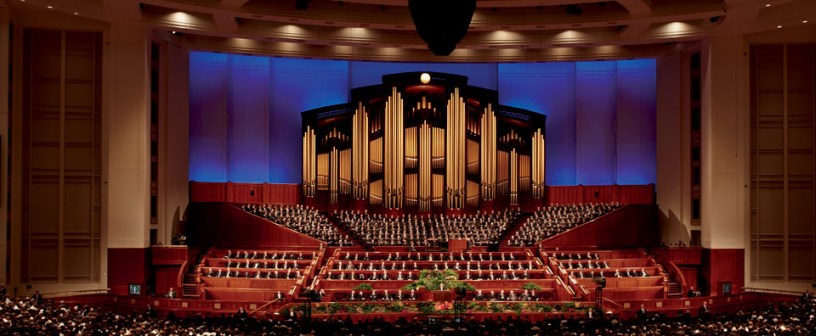
I watched Conference so you don’t have to. Short and relatively unbiased summaries of each speaker. My comments, if any, are in italics and sometimes [in brackets].
Saturday Morning Session
President Christofferson conducting, MoTab Choir singing.
President Oaks — He walks to the podium unassisted. He states this session is a solemn assembly — which is the case only at the first Conference session after the calling of a new President of the Church. [Did these happen in earlier leadership transitions and I just didn’t notice?]
President D. Todd Christofferson — Conducts the business of the solemn assembly, doing a lengthy set of sustainings of the newly constituted senior leadership of the Church, performed separately by each quorum or group, as follows: First Presidency; Quorum of the Twelve; Seventies in all their varieties plus the Presiding Bishopric; local patriarchs, high priests, and elders (i.e., almost all the men); the Relief Society (all the women); the Aaronic Priesthood; Young Women; and finally all the membership (including the few attending or watching who didn’t fall into one of the earlier categories).
Elder Kearon — On callings. He was baptized LDS in his twenties. All about getting and accepting callings. We’re all giving it out best shot, whether we are confident or if we are uncertain. If you just can’t accept a calling, well that’s okay for awhile. It’s not where you serve but how you serve in a calling that matters.
Sister Kristin M. Yee, 2C in RS Presidency — On ministering. Recounts her father’s positive experience attending the temple regularly (as encouraged by a couple of supportive brethren) and then serving as a temple worker.
Elder Clark G. Gilbert, the newest apostle — His first words were teasing Elder Kearon for being short. He’s now “a witness to the name of Jesus Christ,” the particular formulation apostles now use. Stories about people who found their way back, who don’t feel they don’t “measure up,” or who feel an obligation to other traditions rather than to the Gospel tradition or culture.
Elder Bednar — On enduring to the end. He’s a runner and has learned to endure to the end of a long race. Spend your life diligently coming closer to Christ, being born again, seeking spiritual gifts, and aligning your life and character with God’s will. Don’t be a natural man: become new creatures in Christ. Charity is a spiritual gift.
Michael John U. Teh of the Seventy — Follow the Prophet. Some traditions fit with “Gospel culture” and some don’t. “Gospel culture” just means keeping your covenants.
Jorge T. Becerra of the Seventy — Don’t be like Zarahemla (double-minded men with split loyalties). Put God and tithing first.
President Eyring — Offers encouraging words. He notes wars and rumors of war, and economic hardships that are now afflicting entire continents. People are praying more in these difficult times. [Kudos to Pres. Eyring for acknowledging present difficulties in the world and offering some specific words of encouragement and counsel. This was the only oblique mention in either session of Trump’s Iran War.]
Elder Kearon gets Best of Session Award, although Elder Bednar gave a pleasantly uplifting talk. Themes of this session: Oaks, ministering, Gospel culture.
Saturday Afternoon Session
Elder Rasband conducting, with a BYU choir providing music.
Pres. Christofferson presents senior leaders for sustaining, followed by the riveting presentation of the annual audit report (sic). [If there are no financial statements presented and no footnotes explaining accounting policies and practices as well as additional details on particular transactions and balances, then it’s not really an audit report. The fact that the auditors missed the substantial LDS financial misconduct that gave rise to the recent SEC action and subsequent fines paid by the Church for financial misconduct — at least it was never publicly reported by the auditors to my knowledge — suggests the audit process does not meet professional standards and, consequently, the audit report, such as it is, confers little assurance of anything.]
Elder Stevenson — On lost luggage. There is an airport in Japan (Kansai International Airport, about twenty miles south of Kyoto) that, after thirty years of operation, has not lost or misplaced any passenger luggage. Not a single piece! You can guess what the gospel analogy will be. [Except that this sounds like Satan’s luggage plan, not losing a single piece. But I’m so impressed with the Kansai Airport that I don’t care.]
Eduardo F. Ortega of the Seventy — Family traditions are nice, but not enough.
Wan-Liang Wu of the Seventy — His story: Born in Taiwan, family moved to Bolivia when he was ten years old, where the family met the missionaries and joined the Church. [I like this guy.]
David J. Wunderli, 1C in the YM Presidency — Put Jesus in your backpack.
Elder Causse — On Christlike love. Love each person individually: pay attention to the one. Each soul has something to love.
Brian J. Holmes of the Seventy — Another runner. He and the wife ran the Jungfrau Marathon high in the Swiss Alps. Apostles, prophets, Jesus. [I took the tram high in the Swiss Alps. And yes, the views are magnificent. So is the chocolate.]
Clement M. M. of the Seventy — Jesus knows us by name. Tomorrow will be better than today. [A refreshingly energetic delivery.]
Elder Soares — On Jesus. He is the True Vine and the source of our spiritual nourishment.
I’ll give the Best of Session Award to Elder Causse. My summary is a little sparse, but the talk was very good. Themes of this session: Running, Jesus loves you. Very nice there is no Evening Session anymore.
.


Solemn assemblies have been done for each new Prophet, including Joseph Smith. FAIR had an excellent 2-part series on the history and procedure of solemn assemblies.
Part 1: https://www.fairlatterdaysaints.org/blog/2026/04/01/the-solemn-assembly
Part 2: https://www.fairlatterdaysaints.org/blog/2026/04/02/procedural-developments-in-the-solemn-assembly
Thankyou, Dave, for watching so that I don’t have to!
Now could someone explain to me what being a witness to the NAME of Jesus Christ means?
I really appreciate your summary. I cannot watch conference but I like to know what’s up. I couldn’t find anyone else so soon and I looked. Thank you!
President Eyring’s talk reminded me of those immortal words of Lincoln.
Abraham Lincoln famously stated “Whenever the vicious portion of the population shall be permitted to gather in bands of hundreds and thousands, and burn churches, ravage and rob provision stores, throw printing presses into rivers, shoot editors, and hang and burn obnoxious persons at pleasure, and with impunity; depend on it, this government cannot last.”
Nice summary. I’m not sure why they did the regular sustaining in the afternoon session after they did the solemn assembly sustaining thingy in the morning. Seemed redundant. I didn’t take Elder Gilbert’s clark/clerk comment as a short joke. I thought he was calling himself a “small Clark.” Could be wrong, though. It was awkward. I personally enjoyed the talk though. It had “everyone belongs” vibes, even if that’s rarely true on the ground in practice.
I enjoyed Elder Causse’s talk as well. Was confused by Elder Bednar’s talk. Apparently enduring to the end and having charity are exactly the same thing now? He even copy and pasted different scripure passages into the same verse to make his point. It seemed like there a lot of “humble brag” anecdotes to set up gospel parallels, like “I travel so much that sometimes my luggage gets lost,” or “I get so tired sometimes crushing it in all these marathons.” I tend to tune out right away when I here that stuff. I’ve also noticed the apostles have started using “special witness of the NAME of Christ,” rather than “special witness of Christ.” I imagine this is part of the larger project to normalize Mormonisn. We can’t let the evangelicals think our apostles are talking to Jesus in person on the daily…right?
Anyway. That’s just my two cents. Also, the music was great as expected.
Is it just me, or does it seem to others that all of the GA’s now just give the same talk. Does no one ever say anything new or interesting?
One reason to drop the Saturday night session was to reduce the redundancy.
If conference is going to simply be the speaking of future Sunday school lessons how much “conference” do we actually need? Why not pre-record the talks and post them to the church library and have one live session on Sunday morning?
The joke passed me by, Patrick Kearon is quite a bit taller than me, I have never met Clark Gilbert, and I wasn’t paying attention to their relative heights when they stood up… also when Clark Gilbert began, my brain just went that doesn’t work with an American accent. So now I am wondering if he misunderstood the opening of Patrick’s opening remarks and thought they were referring to him as the newest called apostle.. the British pronunciation of clerk is clark however, and I understood Patrick’s remark that way. And maybe Patrick was referring to Clark Gilbert and all the jokes went over my head. They frequently do. And perhaps Gilbert is exceptionally tall, because that photo with the American football player he was the tallest in the picture. Are American football players tall, or is that just basketball? (In a similar aside to Patrick’s small clerk’s office, that would be “American football” player not American “football player”.)
Anyway, I liked Patrick’s talk for the explicit acknowledgment that sustaining doesn’t mean we have to like or agree with the person in a calling, and that they sometimes get things wrong and make mistakes. So that was refreshing. He specifically made mention of fallibility. So part of me felt he’d been given the task of addressing sustaining those in callings immediately after the solemn assembly, and it was very well played.
mat, I will be watching Saturday afternoon this morning, so I am glad they will be doing the usual sustaining. The solemn assembly was literally just about sustaining the first presidency. We need the opportunity to at least sustain the rest of the Q12, Qs70 and general officers. I was rather perturbed when it wasn’t done during the Saturday morning session.
Pres Eyring’s remarks on current world problems grated a little for me, outside the US. When he mentioned problems with economies globally I turned to my husband and commented that the current crises are a direct result of Trump’s actions. Yes he mentioned the problems, but he certainly wasn’t pointing any fingers.
From my observation of this and the last GC, Pres Oaks does seem to like to make some explanatory introductory remarks at the start of the first session before handing over to the guy conducting. That feels new to me. It remains to be seen whether it continues once GC is back to normal.
My apologies for all these comments in a row, must be a time zone thing. Just finished the Saturday afternoon session. I was impressed by how Christ centred it was. If I’m going to be picky Elder Caussé’s talk was spoiled by the inclusion of Beauty and the Beast Belle as a woman’s patience heals the Beast thing. It kind of illustrated his point, but there’s just too much baggage attached to that trope. Otherwise it was a great talk.
The music was fantastic. It looked like the combined choirs (BYUI this time) got to borrow from the Tab Choir wardrobe. It’s the first time they’ve been dressed identically, right down to the women’s jewellery (definitely a Tab Choir thing) rather than simply colour coordinated in my memory.
Good morning. I did not watch conference. However when conversing with a 30 y/o TBM last night, I commented on the “greater love” cross statue in front of the SLC temple and across from said conference center. We in this blog know different, but the younger generation believes that anti-cross teachings were never a thing. I was given the “shush” signal by my wife.
However, what good are any of these conference teachings if they are just going to change with the next generation and gaslight the prior? The main teaching of Christ is true LOVE, and that people are more important than programs or bank accounts. The LDS conference is a feel good, pat the decision makers on the back and put the populace back in their place with guilt and feelings of inadequacy. I would like to understand how the LDS church provides the greater love of Christ? We used to do some service projects, social events as a community, based in the ward. The church mostly is now, look who is the the velvet chairs, and now we have a African Woman serving a the Primary president, aren’t we special?
Thanks for doing this. The talks seem a bit anodyne and blase, honestly. The tithing talk, I heard, included a story of a man who sold his car, on which he relied extensively to run his business, to pay tithing. I find this story problematic. The scriptures say pray on your increase. Come on, people shouldn’t have to make extreme sacrifices and go into debt in order to pay tithing. Near in mind that Hinckley cautioned believers many times to avoid debt.
Dave B
Thanks for these summaries. It’s always good to know what my LDS family and friends are being told.
I write this on Easter morning having just finished the Easter Service at my local UMC congregation which follows a 2 h Good Friday service of seven UMC congregation where the scriptures and elements of that biblical day were used to address the very real concerns and fears of our present moment. No pablum, real meaning.
Christ is Risen.
Christ is Risen Indeed.
What a joyful and uplifting service today’s Easter service was, focused on the joy of the Resurrection. Finishing off with Handel’s Hallelujah chorus.
It makes me sad that for all the years that I was LDS, when Easter fell on GC weekend, I got 4 hours of LDS conference talks instead of a beautiful celebration of the Jesus story. Hope each of you get to experience that kind of hope in a time of darkness moment today in some way.
I must have not paid close attention to any “Solemn Assembly”, but I found it odd that during the sustaining, when general leadership stood, they were only asked to sustain but not given the opportunity to oppose. Elder Christopherson, and I’m sure its been this way for a while, did not include, are there any opposed until he got to the “regular” members. Is this an assumption they make about leadership, or another way to protect?
Dave B,
The dissonance of the LDS church is magnified for those who had Stake Conference on Palm Sunday. These church members did not have a single worship service during “Holy Week”. It would be a bold but simple decision for the Leadership to move the April General Conference so it falls outside of “Holy Week”. Making that change would show they value members having the opportunity to worship Christ in a way that fellow Christians are worshiping Christ.