

This post was inspired by Hawgrrl’s post “Interregnum.”
Somewhere on the Internet, I read the sentence “Most people have never been 20.” Throughout most of history, about half of everyone died before they finished puberty. Infants, children, teens. As a group, people born before the 1900s had a roughly 50% chance of dying before they reached adulthood.
This graph, from ourworldindata.org shows how that 48% chance of living to be an adult held steady in every country in the world until modern medicine arrived.
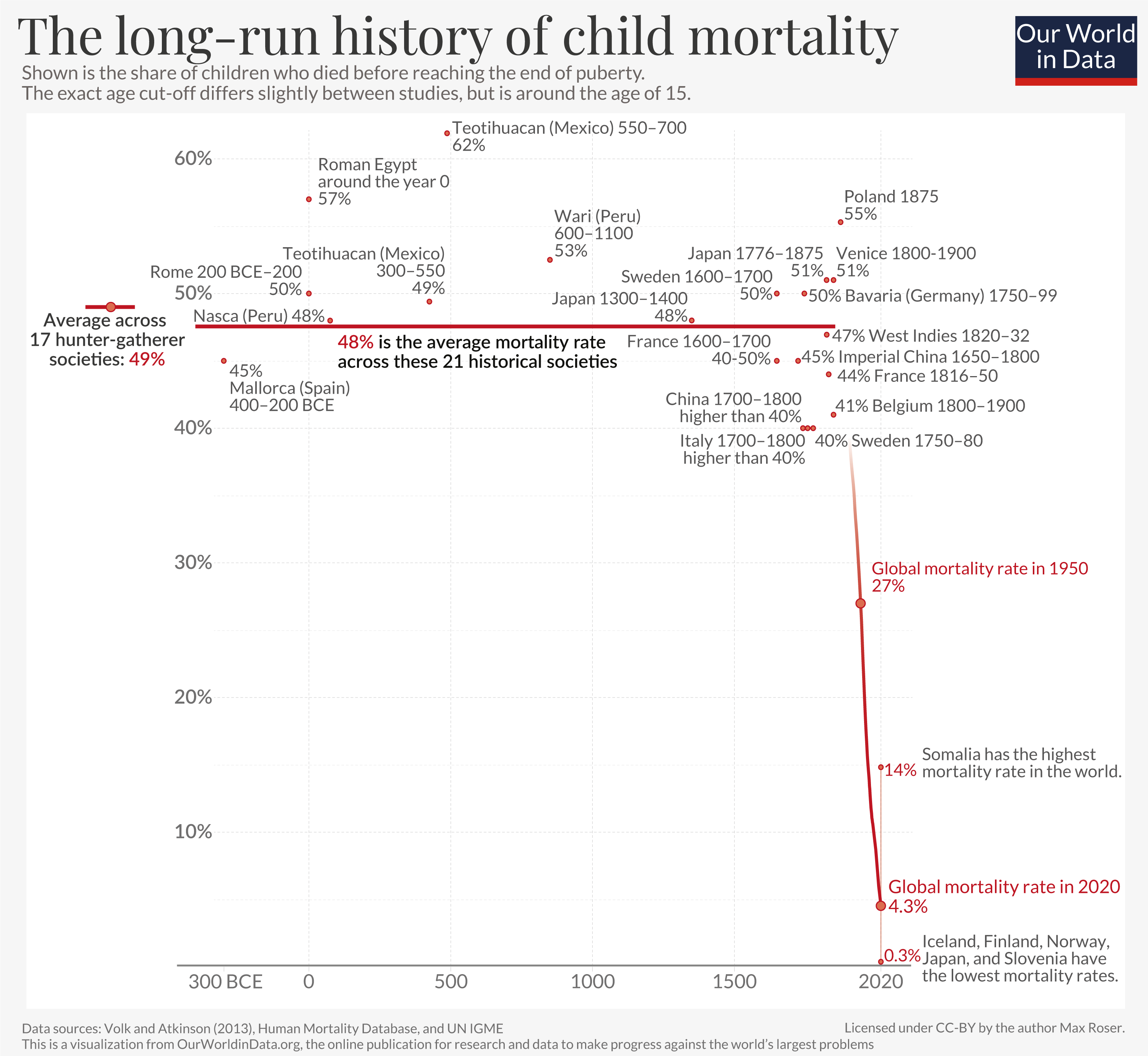
Science started saving babies. Not just vaccines, but hygiene, clean water, better nutrition, access to doctors, educating people who care for babies about healthy practices. Nowadays, a baby has a 96% chance of living to adulthood, up from about 48% in the pre-science era.
Pre-1900, even the half of the population that lived past 20 would not commonly expect to live to be elderly. “This was the case for all world regions: in 1800, no region had a life expectancy higher than 40 years.” [source] Sure, there were outliers. But large groups of elderly people with the health and energy to be active appears to be a product of our modern world.
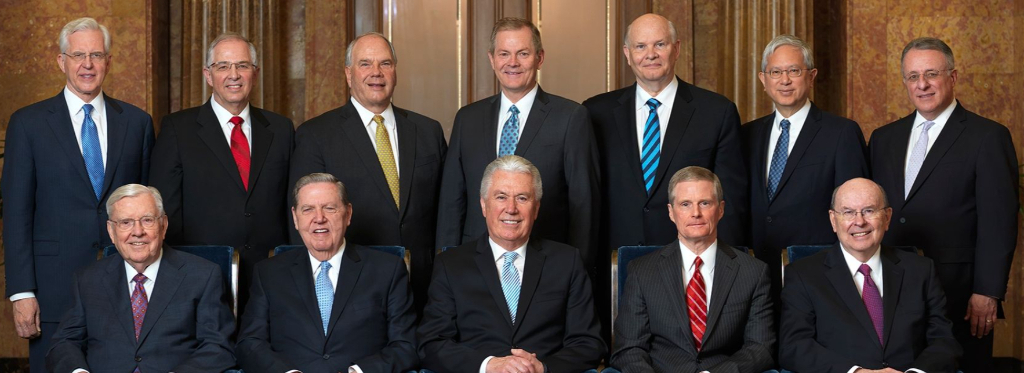
Only within the last 100 years has it become possible for the average age of a group of 100 people, say the U.S. Senate, to have more than 50 of its members be old. I’m not going to go research the average age of an apostle, but the fact that in our current group of apostles, ten out of twelve are 70 or older is something that simply wasn’t possible before modern medicine and modern sanitation changed the world’s demographics. Even as recently as 1950, the average life expectancy in the Americas was 56.5 years. [source]
I named this post a “social experiment” on purpose. I’ve heard an argument against normalizing gay relationships that calls it a social experiment. Heterosexuality is the norm, and allowing different family structures to be normalized is a social experiment. It’s new, unfamiliar, and probably dangerous! But having most/all of your children live to grow up is a relatively new social experiment. So is having a group of active, busy men over age 70 running a multi-billion dollar and multi-million member Church.
It’s an unprecedented social experiment to allow so many elderly people to have so much political power. Sure, our second president John Adams lived to be 90, but he finished being president of the U.S. when he was in his 60s. While some individuals lived to a ripe old age before 1900, it was unlikely they would be surrounded by a relatively health and active group of people who were close to their same age. An elderly leader would necessarily have younger advisors. The prophet may have been elderly, but at least several members of the Twelve would have been decades younger. Modern medicine and science-driven hygiene and sanitation have created a society that has never existed before in human history — one in which the elderly are the ruling class.
- Do you think there would be any support for enforcing a retirement age?
- What are the advantages and disadvantages of letting people retain power for three, four, or even five decades?
- Do you think that powerful men and women tend to hang on to power for too long? Church leaders, Senators, Supreme Court Justices, CEOs.
- What are your thoughts about ‘social experiments’? Science and technology have radically changed society over the past 150 years. As society changes, many situations may seem experimental. How fast should we embrace new societal structures? Why wouldn’t we change with the changing times?


We have Bishops called to lead who are in their 20s. Stake presidents are regularly called in their 40s. Unless there is a drastic change, the LDS church will never have a church president who isn’t 80 years old or older.
This makes zero ecclesiastical sense.
There’s lots of value in the wisdom and experience that can only come from living a long life. And it’s a very positive thing for society to have people with so much experience continuing to contribute well into old age. But I think it is probably time to make some adjustments to help control for some of the inevitable challenges that can also accompany old age.
I think the solutions needed for government are much different than those needed for an organization like the LDS church. In government I would be fine with trying things like stronger term limits on all public offices and/or independent strict cognitive evaluations that are mandatory above a certain age. As much as possible we want to maximize the upsides of vast experience while mitigating the risks of aggregating massive amounts of power into someone cognitively unfit.
We’ve had two US presidents in a row showing visible signs of cognitive decline and the voting public needs a better way to deal with it. This should be as apolitical as possible. Nobody thinks it’s a good idea for their angry, senile grandpa to make major life decisions for the rest of the family that will impact everyone long after they’re dead.
In a church setting, I’d love to at least see voluntary emeritus status for the Q15. There’s no reason we can’t have a Q18 or Q20 (Q15+n emeritus members) will only 15 of them with active decision-making power while those who retire can remain in spiritual or advisory roles. I’m also not necessarily opposed to enforcing an age limit somehow. Even the Tabernacle Choir has hardline limits on age and tenure – it’s not unreasonable to put similar limits on those in more important leadership roles.
It’s completely unsurprising that old powerful people want to maintain their power and stay relevant. While some leaders will acknowledge their limits, it’s unrealistic to expect/trust everyone to step down at an appropriate time.
My first thought was back to Pres. Hinckley who responded to Mike Wallace’s question about this that it was nice to be led be men of experience who aren’t blown about by every wind of doctrine (to borrow from St. Paul). My second thought was the statement of “Planck’s principle” that progress in science occurs one funeral at a time. The overall idea seems to be that old people are stereotyped as being conservative, set in their ways, and unable to change from what they learned when they were younger.
I’ve long felt that the perpetuation of the priesthood and temple ban until ’78 is more problematic than its implementation in the 19th century. I find it troubling precisely because it demonstrates that something about our church structure and culture grants us significant institutional inertia so that change comes only with great difficulty. It appears to me that we are so afraid of being tossed about by every wind of doctrine that we will cling (sometimes desperately) to false traditions.
It’s just a stereotype, so it need not be seen as universally true, but I think this is the challenge with a church being exclusively led by “old” men. How can the church demonstrate that its leaders are not slaves to the beliefs and practices that were prevalently taught as “good” by society during their younger years? How can the church demonstrate that its leaders are able to weigh new and changing information and mores against tradition and discern when tradition is better and when change is better? IMO, this is the big challenge the church currently faces.
The pride, entitlement, and inflated self importance that’s comes with decades of adulation that’s the problem. If we had a 80 year old leader surrounded by younger advisors who treated him/her as an equal instead of putting them on a pedestal and very nearly worshiping them, I’d feel better about it. The number of people who could tell Nelson his temple building was out of control was probably exactly zero.
Years ago I heard the CEO of a bank who was in his 80s speak to senior managers. Someone asked a question and the CEO gave a really terrible response. I personally heard one of the EVPs tell the CEO – his boss – “that was completely tone deaf.” That kind of feedback mechanism is missing in the church at all levels but especially the Q15. It’s probably missing at the Supreme Court too. At least in theory the senate and POTUS have to face the general population every few years (although I’m not so sure about that any more).
In the political arena, yes, people absolutely hang onto power too long. If Supreme Court justices and Senators are dying in office (and there are some of both in the recent past), they are staying too long. We now have a 92 year old Senator who says he’s running for re-election next year. Not a good idea. It’s great to love your job and keep working in old age, if you are able. It’s not great when you can’t notice that you’re starting to decline, or you start to believe you’re indespensable, which I think has happened in some cases. I am ready to have age limits for Congress and the presidency and term limits for the Supreme Court.
In the LDS church it’s a little different. I don’t think of them as holding onto power, because they are just operating within a system that they inherited which they believe is of divine origin. I think their living longer is exposing the cracks in the system, and I hope at some point someone recognizes that and is willing to make changes. The first step would be voluntary emeritus status.