
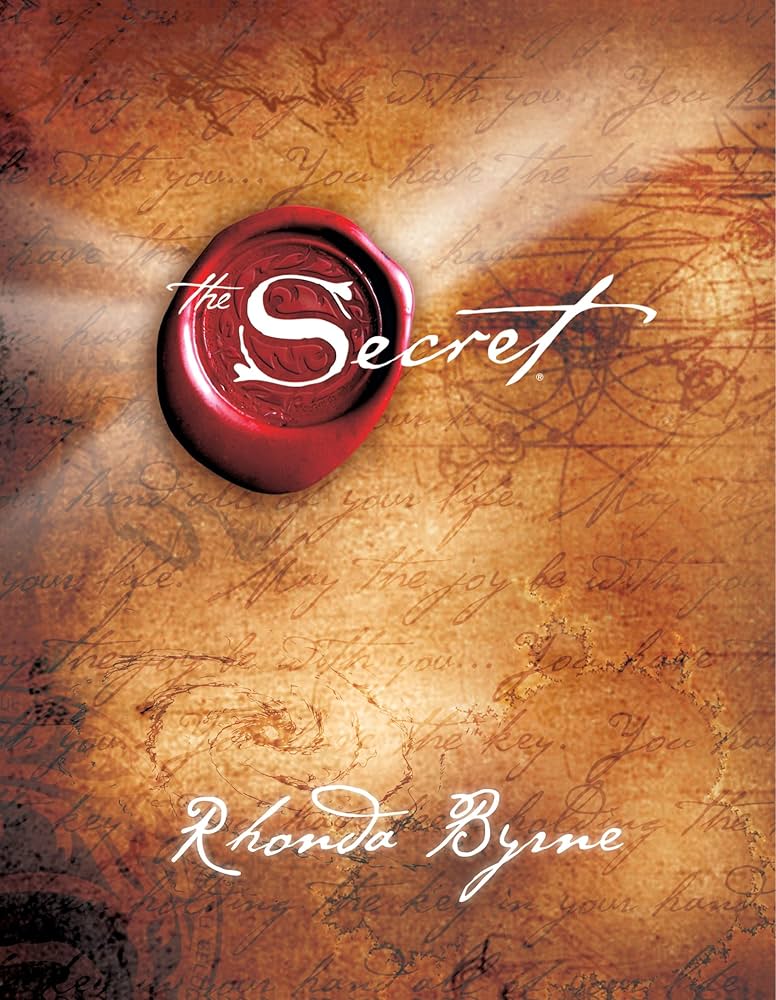
I recently did a post about the Love Languages in which I mentioned I’d do a future post on another self-help book that has been pretty popular in LDS circles, Rhonda Byrne’s 2006 book about what she calls the “Law of Attraction,” her best seller The Secret. You couldn’t board a flight between 2006 and 2010 without seeing someone reading this book, I swear. The premise behind her book is that your dominant thoughts are emotional state will broadcast a frequency to the universe which will then mirror those same energies back to you. Have you heard the youths say things like “Manifest!” when things go well, or use it as a verb: “I’m going to manifest that trip/job interview/promotion/relationship into being.” According to Byrne, the anthropomorphized universe doesn’t process negatives like “no” or “don’t” (in which case the universe is exactly like my kids were–if you said “don’t do that,” all they heard was “do that”), and your emotional state dictates whether you will get positive outcomes or negative ones.
The process she outlines in the book is:
Ask: Clearly define what you want and sent that desire to the universe.
Believe: Act, speak and feel as though your wish is already granted.
Receive: Open yourself up to accept the outcome with joy and gratitude.
When this book was all the rage, I remember sitting next to a woman in Relief Society who was talking about it. She said, “Well, it’s nothing new really. It’s just the same as the gospel, right?” and given my opinion of the book’s wishful thinking approach, it gave me a moment of pause about just what we were meant to believe as church members.
I had a very weird experience related to this book at the time. Like everyone else, of course I had read it. There were some interesting ideas: positive thinking being contagious, being clear about your objectives and goals, and so forth. But then the book really steered heavily into some magical thinking, assuming it had the same gravitas and legitimacy as the preceding ideas about goal setting. My job at this time included doing site visits of the different offices that reported to me, and often one of the mid-level employees would drive me to and from the airport, so they got some “face time” with a leader. As we approached the drop-off at the airport, the manager who was selected to drive me to the airport in one of our B cities (a location that the employees didn’t know was slated for closure within a few months) started enthusiastically repeating the words to her steering wheel: “I will be the next site director. I will be the next site director. I WILL be the next site director.” I was honestly starting to think I was about to be kidnapped. While I agree that having clearly stated goals is good, that doesn’t mean you can chant your way into it, particularly not when you are unaware that you and everyone are about to be laid off due to forces outside of your control.
You might think that she was just being a weirdo (I never thought she was before this incident), but the book literally describes “wishing” checks into your mailbox. That’s purely magical thinking. Of course it’s true that our attention, expectations, and attitudes influence our behavior and our lives, but it’s not also true that you can literally control everything that happens to you using your emotions and vibes. That’s not self-help. That’s self-delusion.
Here is a quick rundown of the main criticisms of Byrne’s theories in the book:
- There is no scientific backing to the idea of the “law of attraction” as mentioned. None whatsoever. Sorry, folks, but the premise is just made up. She literally wished it into being. So, wait. . .maybe it is real!
- This theory turns correlation into causation. “I visualized success, and then I succeeded” doesn’t mean that the act of visualization was what led to the success. For example, when the employee in my story above visualized her success, it was never going to happen (due to the impending layoff), but her actions in that car would have adversely affected her success if such a position were to become available. She seemed unhinged, not like a trustworthy, stable person ready for leadership.
- The theory results in victim blaming. If you aren’t succeeding, well it’s YOUR fault for not having the right energy and vibes. The theory implies otherwise, but face facts: people with positive attitudes still get cancer or laid off or divorced or suffer tragedies. They didn’t cause those things with negative attitudes. What if their positive attitude helped the cancer grow instead of their immuno-defense system? (Are we all seeing the medieval-level magical thinking here?)
- Structural problems are treated as individual problems. If you are underprivileged, marginalized, or mistreated, that’s your fault and not due to systemic limitations or multi-generational setbacks.
- It turns optimism into magical thinking. Sure, a positive attitude and cheerful demeanor will improve your results and relationships. But it won’t actually make physical checks appear in your mailbox.
- It discourages realistic thinking. Sometimes you do need to be aware of negative potential outcomes. Rather than wasting her time telling her steering wheel she wanted to be the next site director, this employee could have asked more questions about how the site was performing or about the future plans for the business. She could have become better prepared if she had wondered more and daydreamed less.
- It can be very dangerous when applied to money matters. The book talks a LOT about the path to wealth being attainable through good thoughts rather than the more realistic path of skills + opportunity + hard work + relationships and networks + capital + luck + market factors + persistence + health = possible success. There are many things that can prevent success, and many that contribute to it, but you can’t get there solely through wishing it so.
- It reinforces its own premise. The crazy thing is that the author is basically just bullshitting here, and in so doing has amassed wealth and riches. She’s selling what she did, which is both ironic and insidious. The more you follow her advice, the more you want to follow her advice. Sound familiar?
- It’s fertile ground for confirmation bias. If something good happens, you immediately believe “I manifested that,” and if something bad happens you must have had negative thoughts. If nothing happens, you just didn’t believe strongly enough. Every possible outcome is a confirmation that the system works as she described it.
And you know what, I think my friend in Relief Society was onto something. There’s a whole lot about The Secret that is very much how the gospel is supposed to work. What is praying for things other than visualizing what you want? And if you get the thing you prayed for, prayer worked. If you don’t, that was your fault. Or you weren’t ready for it. Or you had to have faith to be denied what you wanted. That’s just confirmation bias.
Studies also show that prayer for others (aka intercessory prayer) does not work beyond some vague placebo affects. In fact, even when people knew they were being prayed for, 59% of them had more complications, not fewer. Perhaps all that extra pressure to get well to prove that prayer works isn’t ideal for health.
- Did you read this book? Did you see gospel / church parallels?
- Do you think this is how the gospel is taught to members?
- Do you find the advice useful or not?
Discuss.


“[I]f you get the thing you prayed for, prayer worked. If you don’t, that was your fault. Or you weren’t ready for it.” So is magical thinking part of “the Gospel,” part of Mormon culture, or both?
Oh man, “The Secret,” now that brings back some cringeworthy memories! I was a senior at BYUI at the height of that hoopla, which might have been the most impressionable age *and* most impressionable place to be impressed by that book. Rexburg, like Provo, fairly swarmed with Summer Sales recruiters who engaged in the exact same magical thinking and promises of quick-and-easy wealth as that book (with that same insidious insinuation that if you don’t get rich doing it, you have only yourself to blame), so everyone was already familiar its vocabulary.
I will totally cop to having believed that ridiculous book for a hot minute. Cause like the OP mentions, some of its early advice is genuinely useful: make clear goals! Be ambitious! Have a positive attitude! Now, that’s what pretty much every self-help book suggests, but that didn’t make it any less true.
But the problem is when it gets into that insipid and victim-blaming law of attraction. Because it’s also true that just because you want something to happen, doesn’t *make* it happen, which is something most of us learned as children (“learning loving someone don’t make them love you” was even a line from a Jack Johnson song popular with Rexburg students during this exact same era). And when I graduated college only to find my ex-girlfriend got engaged to someone else, and my job-lead fell through at the dawn of the Great Recession, and I didn’t get into my first choice for grad school—despite all my positive affirmations—I very quickly recalled what I should’ve known all along, that wanting something badly enough doesn’t make it happen, and I was embarrassed that I’d ever taken that ridiculous book seriously even briefly.
This was especially cringe, because I was an RM for Pete’s sake! I had met on my mission sexual assault survivors, and impoverished immigrants, and folks who had lost loved ones to car accidents, or to freak brain aneurisms, or who had been killed in combat in Iraq overseas, and I would’ve blushed to think that these peoples’ problem is that they had failed to harness the power of positive thinking! Hell, my own mother had died of cancer shortly after my mission homecoming, despite all my earnest prayers for her life, so I for sure should’ve known better! Somehow I was more emotionally mature as a fresh-faced returned missionary than I was as a senior at BYUI. Whether “The Secret” was a cause or a symptom of that backsliding is up for debate.
The popularity of “The Secret” among Latter-day Saints was especially irritating, because The Book of Mormon, the purported keystone of our religion, is the narrative of a people who regularly pursued a “wealth-mindset” and blamed the poor for their own poverty (cf Mosiah 4:16-20), and were destroyed from off the face of the earth because of it. We even teach this to our Primary children as “the Pride cycle,” so you’d think we’d be the least susceptible to seductive thinking like this, but instead it’s the opposite.
Heck, our Church is named for Jesus Christ, who prayed that this cup might pass from him, but still allowed himself to be tortured to death because “not my will, but thine, be done”, so you’d think that not just our church but all of Christianity in general would be immune to magical thinking that promises easy wealth from God the vending machine, but that demographic is where “The Secret” sold the most.
IIRC, the Set-a-Date Program preceded The Secret by a few years. Remember Set-a-Date? Church leaders taught us to prayerfully select a date by which we would have someone ready to meet the missionaries. Heavenly Father would answer our faithful prayers. Converts galore! I tried, I really did. But my prayerful attempts to set a date were never answered the way I wanted them to be. (Cue a platitude: Of course HF answered! He said ‘not yet’!)
And if Set-a-Date was supposed to work to attract potential converts, then why not potential husbands? My friend group of late 20s, early 30s faithful LDS women joked about setting a date to start dating a husband, buuuuut I wasn’t really joking and I suspect some of my friends weren’t either. I mean, I didn’t advertise the effort, but I totally set a date to meet my future spouse. It failed.
So yeah, the Church absolutely teaches this. And then if you’re wrong, it’s because you either didn’t have enough faith, or misunderstood Heavenly Father, or he said, “I have something better in mind.” There wasn’t any acknowledgment that maybe HF didn’t want you to prepare someone to meet the missionaries. Or meet your future spouse. Righteous goals are always right!
I did not read The Secret because, by the time it came out, I was already thoroughly disillusioned with this sort of thinking.
Hawkgrrl —
This post reminds me of a story I heard a few months ago about a husband and wife attending a church service where the sermon was about having the faith to move mountains: if you have faith the size of a mustard seed, the sermon went, unbelievable things can happen.
When they got home, the wife told her husband that she thought that if she had sufficient faith, the small mound outside their back porch would be gone in the morning. She said her prayer and went to sleep. When she woke up, she excitedly pulled back the curtains, looked outside, and said, “I knew it wouldn’t work. Oh well.” And, of course, there are two perfectly acceptable explanations for why it didn’t work: she lacked sufficient faith, or it wasn’t God’s will. Either way, the proposition becomes almost impossible to test. If the mountain moves, faith worked. If it doesn’t, either you didn’t have enough faith or God had something else in mind. Yawn.
There is something about that story that gets at my discomfort with this kind of “magical thinking.” It took billions of years of geological processes—water, wind, erosion, tectonic activity—to carve something like the Grand Canyon, and yet we continue to teach and sometimes internalize ideas in which belief itself is treated as though it has a direct creative power over reality. As you point out, The Secret essentially makes thought the primary creative force: think it, believe it, feel it, and the universe will somehow respond. But thought is only one variable in an enormously complicated process. Nothing comes into existence simply because someone thought about it. I would actually suggest that nothing has ever been created that wasn’t first thought about, but an enormous number of things have been thought about that were never created.
That distinction also makes me think about the way we sometimes talk about “using the Atonement,” as though the Atonement were a spiritual tool we can deploy to produce a desired outcome. I’m not sure I think about the Atonement any differently than I think about Creation in this respect. Both are words we use to summarize the result of a much longer and more complicated process. The word can be useful, but it can also obscure the process behind the outcome. We don’t “use” Creation to make something exist. Creation is the word we give to the process by which something comes into existence. Likewise, I’m not sure “using the Atonement” tells us very much about the actual processes of repentance, forgiveness, reconciliation, transformation, suffering, grace, and relationship that the word is intended to encompass. Turning either one into a kind of spiritual mechanism that we activate when we want a particular result seems to me to get the cart before the horse.
I do think there is something worth salvaging from the basic intuition behind The Secret, though. Thoughts are also a form of attention. If I begin thinking seriously about running a marathon, I am more likely to notice opportunities to train, learn about nutrition, rearrange my schedule, develop the necessary skills, and eventually actually run one. If I start directing my attention toward building wealth, I am more likely to notice the skills, opportunities, relationships, and disciplines that might make that possible.
But that isn’t really manifestation in the sense Byrne describes it. It is something much more ordinary—and, to me, much more interesting. Beliefs shape our attention. Attention shapes our choices. Choices become actions, actions become habits, and habits develop skills and produce consequences. Along the way there are other variables we don’t control: other people, circumstances, opportunity, timing, and plain old luck.
Thought may be where the process begins, but it isn’t where the process ends. And confusing the two seems to me to be the difference between faith that motivates us to act and magical thinking that assumes reality will respond to what we believe.
The foundational basis of common Mormon belief is this:
1) If good things happen to you and you were adhering to traditional Mormon belief and practice, that is because you are “righteous” and God is blessing you. You keep it up and more blessings.
2) If bad things happen to you and you were adhering to traditional Mormon belief and practice, that is because God is testing your faith. Keep it up and the blessings will come, even if it is in the afterlife.
3) If bad things happen to you and you weren’t adhering to traditional Mormon belief and practice, that is because you are a covenant breaker and God is punishing you.
4) If good things happen you and you weren’t adhering to traditional Mormon belief and practice, just you wait, your punishment is coming, even if it is in the afterlife.
There is no such thing as coincidence. The most mundane and minor good thing to happen is a tender mercy.
Todd’s story reminds me of a story about how prayer really works. It wasn’t a pile of dirt, but a big rock that the couple wanted moved so they could put in a shed. The rock was the size of an overstuffed chair. They just didn’t have the money to have someone with the big equipment to come move it. So after a church lesson on “if you have faith….blah blah blah” he decided to try it. He prayed hard, he even visualized the rock magically picking itself up and landing in this open rocky area off highway 89 that was about a mile down the road. But after a month of praying the rock was still in the way. So, forget prayer. He called up a buddy and asked if he knew anyone who could remove the rock in exchange for any favor or job he could do in exchange. In fact he talked to everyone he knew asking for a work exchange to remove the rock. I don’t remember his occupation, but something like electrician or plumber. So, eventually he found someone who had heavy equipment and needed say, a sink put in. After all the work was done, he asked the guy who moved it where he had taken it. “Oh, I just dumped it about a mile away in that vacant yard off 89 with all those other big rocks.” Which was the exact spot he had been visualizing the rock moved to in all those prayers. God answered his prayer exactly as asked—after he did six months of asking around, planning and leg work.
We Mormons are supposed to believe in a God subject to natural laws, who works with the laws of the universe to make things happen. Just wishing for it can’t work because of all those natural laws in the way. Maybe God helped him find the guy with the heavy equipment who needed plumbing. Maybe God told the guy with the big truck where to take the rock. But even God can’t just pick up a huge boulder and magically move it a mile down the road because of natural laws.
If you have enough faith, God can move mountains. Erosion takes about 100 million years to wear a mountain down and have tectonic plates push up a mountain in another spot. But yeah, I have the faith that God can move mountains. I just don’t have the patience to wait a hundred million years. “If the mountain will not come to Mohammed, then Mohammed must go to the mountain” I have no idea where that quote came from, but my mother used to say it. She also liked, “God helps those who help themselves.” And “Pray as if everything depends on the Lord and then work as if everything depends on you. And most of the time, you can skip the praying.” Sometimes it helps to be raised by heretics.
The house always wins.
And occasionally leads you to lost keys. Or a silver dollar on the ground to buy fried chicken.
Inviting Grant von Harrison to the chat. This book took a hard mission and made it worse.
One of the
One of the insidious ideas from books like The Secret is that a person is the center of the universe. If you put it out in the universe, it will come back to you. It doesn’t require any thought about how the desire will affect other humans in that same universe. In addition to victim-blaming, the secret makes one think they are the main character in everyone’s story.
SRH – agreed, The Secret legitimizes what my kids call “main character syndrome”, where the reader is enticed to view themselves as the center of the universe. Such ideas are appealing, and are not far off from the tenets of Scientology (minus the high-control institutional framework) but gives some insight why it resonates with large numbers of people, at least initially.
I had no idea The Secret had lots of traction among LDS readers when it came out. Back then I first heard of it from some non-LDS coworkers who were into self-help/business-bro type books, and perhaps I should have noticed that these were the same people reading Covey’s 7 Habits earnestly. Once a colleague briefly explained the premise of The Secret to me, I couldn’t be less interested in reading it myself, even as a full-throttle TBM at the time. It just felt too new-agey woo-woo, which as a child of the Satanic Panic era, I had always been taught such things were an invitation for Satan himself to enter your mind and heart (along with ouija boards, tarot cards and D&D). Now in a more nuanced, enlightened era of my life, I still think The Secret is BS but for different reasons (most of which have been eloquently stated in the OP).
The Secret is toxic positivity on steroids. Just don’t think negative thoughts and constantly inhale confirmation bias and Voila! Dreams come true. Just keep listening to those anecdotes and stories and you could be like those extreme outlier exceptions to the rule as well.
My brother used to promote Amway/Quixtar MLM Pyramid scheme. It was all the same sort of thinking. Don’t read anything negative. Just keep listening to positive stories, and eventually you’ll con others into being part of your downline. Church thinking is very similar to MLM Pyramid scheme thinking. Which explains in part why there have been so many MLM scams in Utah.
I’m all for positive thinking, but one that is tempered with realism and one that recognizes and readily dismisses scammery.
I just finished reading Kristin Kobes Du Mez’s new book, “Live Laugh Love” (highly recommend!) and she absolutely ties this whole concept of wishful thinking to religion, more specifically American evangelical Christianity, with a healthy contribution from Mormonism! As an historian, she traces the history of womens’ contributions to Christian Nationalism and boy oh boy is the Mormon faith tied up in it. The Secret is very much in the vein of the implied vending machine gospel we are so invested in, much like the Nephites in the Book of Mormon. As Brad D mentioned, Amway, Avon, Mary Kay, and a lot of other MLM pyramid schemes with their downlines seem to be just another variation of modern American Christianity, including us.
I love the title of your series: BS Book Club LOL
I read this one. I was persuaded that it was kinda magical….and I wish I could write a book that millions of people would buy and fawn over. That’s the magic.