
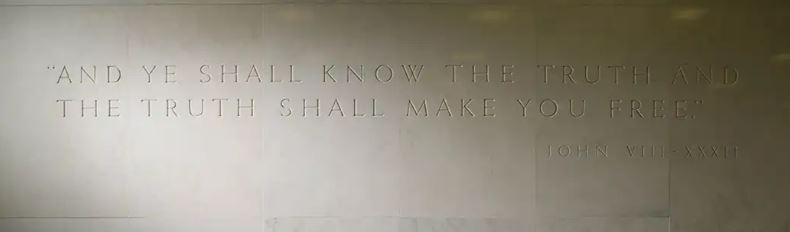
In the lobby of the CIA headquarters is a Bible verse carved into the wall. “And ye shall know the truth, and the truth shall make you free” (John 8:32). I have had the opportunity, in the course of my work, to see this carving for myself. Having the truth shall make you free? How did that work for Galileo? He had the truth, that the sun was the center of the solar system, and it cost him his freedom.
I recently heard somebody say that there are two kinds of people: those who pursue truth at the expense of happiness, and those who seek happiness at the expense of truth. Was Galileo happy while he spent the last nine years of his life under house arrest for heresy? Maybe.
There are lots of religious examples (like Galileo) that show people losing happiness by pursuing truth. How many marriages have ended when one spouse has found what they believe is the truth, which contradicts the religious dogma that they once both believed?
How many families do not celebrate holidays together because some have found a truth that is not the same as what the others believe? Does it take a certain type of personality to pursue that truth even though they could be sacrificing happiness?
On the other side of the coin is the person who cherishes their happiness over what the truth may be. I’ve shared this story before on my writings here. While I was Bishop, I read the book “Joseph Smith: Rough Stone Rolling” by Richard Bushman, which had just been published. I wanted to talk to my Stake President about it, so asked if he had read it during one of my monthly meetings with him. He said his wife had bought him the book, but he was not going to read it because he did not want to know those things about Joseph Smith. My SP valued the happiness that the Church gave him over the truth about Joseph Smith.
I believe that Galileo was happy even while under house arrest. In a book he wrote during this time, he said:
This and other facts, not few in number or less worth knowing, I have succeeded in proving; and what I consider more important, there have been opened up to this vast and most excellent science, of which my work is merely the beginning, ways and means by which other minds more acute than mine will explore its remote corners.
Galileo Galilei, Two New Sciences
He was still learning, still discovering new truths, and that is what made him happy. I believe that this applies to readers of this blog who may have discovered some truth about the LDS Church that caused them to step away. Some may have lost relationships with family and friends, but the pursuit of truth has brought them joy.
Have any of you readers given up happiness for truth?
Do you have examples of people who gave up truth to keep happiness?
Can you have the truth and still be happy?


Jennifer Finlayson Fife often says something to the effect of “The truth shall make you free but it will make you miserable first.”
A bishop once told me he wouldn’t read the LDS essays because he was afraid he’d leave if he read them. I left the LDS tradition a few years ago and my wife stayed. It’s caused significant friction and she’s said things to the effect that she’s happy where she is – implying that perhaps deep down she knows there’s more to the story. In the other hand my leaving caused an uncomfortable existential crisis – I often hover somewhere around absurdism. If I’m honest with myself I was happier when I was a true believer.
I often think of the movie The Matrix – I’d probably take the red pill but I legitimately understand why people would choose the blue pill.
There’s that interesting question we’ve heard some x-Mormons ask current members: “If the Church was not true would you want to know?”
I simply gave up on believing in true or false, black or white and all or nothing. Really the world is all in between those states. You might think you know something is true or false, but you would be wrong about both. We can each only see how things look from where we are sitting, and that is the only information we have to act on. Choosing not to even consider or research other perspectives can leave us locked in our own. That wasn’t what Joseph or Christ taught or set an example for, by the way.
Going to church isn’t necessarily linked to whether you see something as true or false either. That is a narrative developed and reinforced at church but, for me it’s irrelevant. I attend because I enjoy seeing my long time community. It isn’t about anything being true for me, and if I stop going it won’t be because anything was false. There will be another reason.
I think for me one of the difficult parts of a faith transition/faith expansion is that it can be destabilizing for people we care deeply about.
It can get messy and miserable before it starts to come back together, but sometimes there’s collateral damage that can be permanent.
There could be greater efforts to guide members in a way where people would not feel so betrayed and hurt when difficult truths begin to emerge.
I don’t love that segments of the ex-Mormon community celebrate the first alcoholic drink or certain illicit substances as a rite of passage. The effects of these substances can be damaging, something recognized by people both inside of the church and by people who have never affiliated with the church.
And it is frustrating to me that the church is doubling down on coffee and tea (especially green tea). Members end up effectively equating coffee and tea with alcohol and drugs. The all-or-nothing thinking too often encouraged in church settings sets people up for greater destabilization if they end up choosing a different journey.
I think your mileage varies on this. I have a buddy that went through a dark night of the soul, studied happiness, dug in on some health issues, left the church–end result: happiest he’s ever been in his life because things are really aligned for him now. I personally go back and forth between misery and happiness. I think sometimes it is also a perspective shift that has yet to complete. Britt Hartley had a recent video where she discussed the first few years after dropping church and all of religion. She describes not putting up any Christmas decorations and just having this overwhelming sense of revulsion towards that stuff that she and her family did nothing during those holidays. And she mentions that comes from the trauma of deconstruction. Now she does participate in those “human rituals” for a variety of reasons, one being that they really do create healthy human community. She posits that for people who are stuck in that early revulsion stage that they are probably still letting the religion control them, even though they are out of it.
I think the other thing that Britt mentions often that I think I agree with is that people like the idea of freedom, but they don’t actually like freedom once they have it. Controlling, high demand systems might seem terrible sometimes, but they are also predictable, give you meaning, you know where you fit and what you’re supposed to do. When all that goes away, it is now on you to figure all that same stuff out. And taking ownership of your life after coming out of a high demand system is pretty difficult because you’ve never had to use those muscles before.
Bliss in ignorance is a real thing and it is addictive. But, honestly I don’t think I’d go back. Even though it is a roller coaster, I can connect with people so much better. It is so much easier to stick with things because I choose to do them rather than someone else choosing for me. I let go of all the stupid theology that caused a lot of anxiety. But that anger, anxiety and other strong emotions still surface, especially as I watch the church double down on stupid positions. I don’t know, I think happiness is still very possible and I think it just a matter of finding alignment again. I don’t think we should believe it is a trade-off. That kind of black and white thinking is why we supposedly let of leaving our previous beliefs behind right?
I’m happier in my current state. If I were to return to full activity in the church, I wouldn’t be happy. I would have an anxiety attack. I just can’t see the church in any other way at this point.
That said, I think truth is hard to understand. Obviously there are many intelligent individuals in the church who believe and make long drawn-out arguments as to who they believe. If they can believe, in spite of all the counter-evidence, them what does that say about the human brain and truth? What does say about you and truth? Is it possible that you could be deceived on any given matter? I’ve known people whose opinions I had respected go down the rabbit hole and accept conspiracy theories that they dig their heels into.
I believe happiness and truth don’t have to be two opposite ends of the coin. Instead, a lot of happiness can be found in truth and trying to discover it.
Everyone’s experiences are uniquely their own. I tried so hard to be 100% for over 50 years, as I had been programmed my entire life that true happiness was only found in the church. The harder I tried, the less happy I was.
When I finally left, I was angry at the lies I was taught and how the control of the church had affected my life in so many ways (in reality, there is still some deep seated anger). I’ll admit it’s sometimes difficult to see the positives, but I did make a few real friends and it provided a limited female social circle. I’m so much happier now, outside of the church. I’m less judgemental, more tolerant (of myself and others), kinder, and at peace.
“When religion and science disagree, science always wins.”
I came across that statement years ago and it stopped me in my tracks.
Galileo was under house arrest for nine years; yet ultimately, the church decided that he was correct. Some acceptance of scientific facts will take generations before religious groups embrace those facts — but science still wins the round in the end.
Observing the history of all churches, so often they make a firm stand on some point and ultimately back down from it. The LDS church is no different in that.
In this particular time in history, it is interesting to watch people look fully at scientific proof of something, walk away and watch them choose tribal affiliation over facts. We see that in politics and we see that in religious groups.
Me? I find myself picking truth and honesty over social connections. In the end, for me it feels like I am in an ethically and morally cleaner position. That alignment makes me happy. Did I leave the LDS faith? Yes. Did my spouse stay? Yes. Is our marriage still based on mutual love, respect and honesty? Absolutely yes. I can be supportive and happy for someone else’s choices while still being true to my own. Absolutely.
I think it’s interesting that there are probably people in the church who think of this the other way around; “sure, you may be enjoying your hedonistic lifestyle of rock and roll, premarital sex, and boozy tonic water, but wouldn’t you rather know the truths of the everlasting covenant path, even if it means a sober, motab, missionary style life?”
Ultimately, I left the church more because of the church’s insistence that they have the ‘truth’. I saw a mention of Britt Hartley earlier (she’s really great) another thing she says often that I relate to is “I know I don’t know anything about ultimate reality, but I know you don’t either.”
Well, maybe Galileo knew more about ultimate reality than the church did at the time, but maybe their real sin wasnt in having an outdated worldview, but in forcing other people to conform to it despite what was right on front of their eyes.
One of the things that helps me remain active in the LDS church is the happiness that comes from living the principles it teaches and the truths that it teaches. Through regular study I find more and more truths that reaffirm that the church is God’s True and Living church.
Galileo was sentenced to house arrest. He lived out his life at his own villa and continued his work.
” I recently heard somebody say that there are two kinds of people: those who pursue truth at the expense of happiness, and those who seek happiness at the expense of truth.” Perhaps many of us have some of both, depending on the situation. I am at core the type who pursues truth at the expense of happiness. It is in my spiritual DNA. For me, the expense of happiness tends to be temporary and is ultimately replaced with a greater happiness. A happiness maintained at the expense of truth is a precarious happiness at best.
I like to follow Hugh B. Brown’s perspective of finding truth wherever I can find it, not limit it to sanctioned sources by or of the Church.
jader3rd,
Your approach just seems like confirmation bias and closed-circuit thinking. It doesn’t seem to accommodate an evidence-based approach where we have a proposition and then the evidence to back said proposition. Why is the church true, what does true mean, and where is the evidence of the truth of its claims? “Because in living the truth of the gospel it makes me happy.” That doesn’t answer anything. It’s just empty platitudes. “It is just something I feel/I’ve had experiences too sacred to share.” Again, doesn’t answer anything. If anything this sort of reasoning seems to be a pattern in other religions. Someone witnessed Ganesha or the Virgin Mary and that therefore it affirms the truthfulness of Hinduism or Catholicism.
That said, this appears to be how most believers see it. My wife certainly sees it this way. You don’t actually see your “knowledge” of the “gospel” as propositions that can be tested against real-world evidence. You just ignore that. Almost turn off your brain and seek out only confirmation. Avoid cognitive dissonance as much as possible. Only express your beliefs on your ground and in the framework of your special narrative with your special jargon. “Living the principles,” “truths that it teaches,” “regular study,” “true and living church” are jargony expressions I have heard throughout my life and hear many times a month at church. But what do these even mean? Yes, a certain sense of their meaning can be derived from believers, but there seems to a collective unwillingness among leaders and members to unpack this in any significant way, to tether it to real-world evidence. If anything these are just soft ways of conveying some unpleasant ideas whose meaning can be inferred but you don’t want to say outright because it would come off harsh and unreasonable. “Living the principles” = blindly obeying and going through ritualistic motions. “Truths that it teaches” = its body of doctrine which is beyond question. “Regular study” – going through the motions to read the scriptures and seek confirmation bias, not actually subject the scriptures to serious textual criticism. “True and living church” = the only real truth, all other religions, Christian denominations, and ways of thinking are false.
Great post. I’m someone for whom planning and working to achieve my vision for my own life and coming to my own truths has made me quite happy, so I don’t see much of a tension between them. But I think there are different magnitudes of truth; personal truths and larger, truths about humanity, the world, the universe, etc. are quite different from one another. When it comes to truths that are larger than my personally arrived at ones (social injustice, corporate greed, economic inequality, the specious truth claims of various religions that have done more harm than good, etc.), I’m certainly appalled by them, but I don’t think they make me truly unhappy. They do make me despair for and grieve for humanity, and I don’t feel great optimism about humanity’s future, but I don’t know if that equates to a personal sense of unhappiness. The church’s truth claims are obviously specious, for example, and I feel bad for people who buy into them wholesale, but that’s their choice; I don’t have to (and I don’t want to) have that kind of faith, which often thinks that slavish obedience and happiness are the same thing (they are not).
Despite the harsh truths of the world, however, I’m also kind of with Keats, that lots of things about this world are both true and beautiful (the entirety of Meat Loaf’s Bat out of Hell album being the most profound one), and certain truths don’t have to make us unhappy. I’m also thinking of the end of Milton’s Paradise Lost, when Adam and Eve, having been expelled from Eden, look back towards the garden and weep, but in the next moment, they turn towards the harsh, fallen world and realize that, despite its harshness, they have the opportunity to build a life in that world and to improve their lot in it. I try to think about that when I get bogged down in the brutalities of a lot of larger truths. Despite those truths, there are almost always spaces, I think, within which we can work to make the world a slightly better place. Maybe that’s naive, but I’ve worked hard to not surrender to complete and total cynicism, and part of that work has been to try to see where I can make small, positive differences.
“The True and Living Church”..,..
“Blessed be the Fruit”
“May the Lord Open”
“Under His Eye”
(One as valid as the other)
Interesting discussion, very relatable, especially familywomen!
Between truth or happiness, it’s not all of one or all of the other. If you assume these are competing goods (in the sense that having more of one means less of the other), then there is a whole arc-shaped frontier composed of the various combinations of lots of truth, not much happiness; some truth and some happiness; lots of happiness and not much truth. The two corner solutions (all happiness, no truth; all truth, no happiness) are possible, but not likely. Life doesn’t produce many corner solutions. In economic terms, where along the choice frontier is the optimal mix of truth and happiness? The utility-maximizing choice along the truth/happiness curve? This is the “guns or butter” problem you learned about in Econ 101.
Furthermore, the “solution” you pick along the truth-happiness curve is not objective. It depends on the preferences of each person. Different folks will choose different utility-maximizing points along the curve. Your stereotypical TBM neighbor might choose a lot of happiness, truth be damned; where you might select a lot of truth while moping around about the depressing consequences of a world composed of atoms and the void. But you can’t say your neighbor is “wrong.”
But hey — who says truth and happiness are competing goods? More truth about the human body and modern medicine produces more happiness. More truth about investing produces less risk and more stable returns, making individual investors happier. The only reason a “truth vs happiness” set up is appealing is because we (some of us) think there is a false belief system or worldview (in religion) that needs to be debunked. It’s an assumption that’s baked into the model. Given how many conflicting religious and denominations there are in the modern world, much less human history, a lot of them are likely false in the strict truth sense. But it’s just too facile to think most people are better off by shattering their worldview. Just the opposite, I’d think. And who stands on the ground of “ultimate objective truth” to make these judgements? We need a different perspective on this problem (the religious problem, which is a human problem, as pretty much all societies, past and present, embrace a set of religious beliefs about the world).
I still struggle to define truth at times. I’ve come to the conclusion there are very, very few things in life, if any, that we can know with 100% certainty. But we can become confident enough in some things to say “I know” rather comfortably and with a clear conscience. I can do that with the majority of the Restored Gospel.
I have also slowly come to the conclusion over time that fruits can indeed be a very reasonable metric in which to measure the overall viability of certain truth claims. I do think scientific studies, Gallup polls, Pew research, and many observers have found quantifiable qualities and personality traits in Latter-day Saint that set them apart from others that likely cannot readily be reduced to culture when studied at the individual level. I honestly probably find The Lord of Rings, Harry Potter, science fiction, and any number of history books a more exhilarating read than the Book of Mormon, but I simply cannot deny the change the latter has had on my soul. Linking the fruits of that with the truth claims of the Church strikes me as reasonable.
I realize others have experienced many of the same things (or some not so good things) and come to very different conclusions, but I sometimes feel there is a baby/bathwater scenario playing out at times.
I’m sure I’ll be pegged as totally biased, and I’m sure that’s true to an extent, but as someone who tries hard to take people at their word (almost to a fault I’ve been told by some), the success rate of people who have truly convinced me they are happier without the Church and its truth claims is 100% when it comes to the bloggernacle and elsewhere online. In person, I’d say it’s about 30-40%. Maybe the happy ones are more willing to share online. Maybe something isn’t adding up. Or again, maybe I’m just plain biased.
That the CIA would proclaim a motto of truth is the funniest thing I’ve read in a while.
What is the meaning of truth? There is factual truth backed up by observable reality. Closely related to factual truth is advice based on factual observation. “Look both ways before crossing the road” is a well known phrase and good advice!
What about moral truth? The Ten Commandments are moral truths and they are very valid! But moral truths have gray. Keeping the Sabbath Day holy being perhaps the grayest of all Ten Commandments in the LDS church and other Christian churches. A high trust society relies on people being honest and morally true. But even within a high trust society, people are not 100% honest. In fact, I would offer that healthy relationships rely more on trust than on complete truthfulness. I really don’t want my wife telling me EVERYTHING she thinks of me or where she sees error in my ways and I grant her the same privilege.
So what do we mean when we say we value Truth?
Soviet dissident Aleksandr Solzhenitsyn wrote a famous 1974 essay “Live Not By Lies” where he called on people under Soviet power to resist tyranny by refusing to participate in lies. A literal application of this rule would be hard for any of us to live. But the concept is important. The way for a people to resist oppression is to never knowingly participate in lies. Solzhenitsyn gives examples that apply to Americans today. The general thesis is that each can choose not to repeat information we know to be false, or support media we know is deceptive.
Imagine if we lived this way! Just in the church, imagine if a speaker told an LDS myth with the implication it was literal history. Maybe the majority would walk out of the room. Or maybe someone would stand and call out that the story was not factual. If enough members did this, the message would be received by the correlation committee to stop presenting mythical church stories as literal history.
As for our nation and its politics? I believe the only way to change the status quo is for a significant portion of the citizenry to refuse to support the lie of the two-party system. I’ve made that choice. If 30 million more American adults did similar then real political change would happen. But as long as the fight persists as a binary choice between “The Crooks” and “The Thieves” then we lose.
God’s promise is that by His Spirit we can each know the Truth. Jacob in the Book of Mormon explains: “The Spirit speaketh the truth and lieth not. Wherefore, it speaketh of things as they really are, and of things as they really will be.” One way I view the grand idea of divine truth is with the physical model of light. Light is both a particle and a wave. So in divine truth, individual photons are “true” or otherwise accurate and the wave is “true” or otherwise consistent with the character of God. The more one aligns his/her thinking and actions with divine truth, the brighter and more focused the light becomes.
Just speaking for myself, I vote in favor of empirical facts over being a satiated pig. Now if the option was a happy dog snoozing on the couch, I might reconsider.
Hows that quote go???– We have as much chance as understanding the universe as a ant understanding calculus. (Please not be Lovecraft)
So what the heck is gravity. eh?
As for truth and happiness, since I believe in biblical inerrancy, “For in much wisdom is much grief: and he that increaseth knowledge increaseth sorrow”
A Disciple,
Here in lies the rub on the science of light–we can observe and falsify both the wave behavior and the particle behavior. In science these are not contradictions, they just are described attributes of what we call light. And this is the fundamental problem with bringing science analogies into conversations of religious truth. We can’t observe divine truth. We can’t test it. We have no idea what it is. Religion just attaches “divine truth” to anything it believes brings happiness. That is exactly how we treat “fruits of the spirit”–they have to feel good to be from the spirit. And this is why people reject contradiction that truth brings because it doesn’t feel good. No one likes being wrong because it feels icky–especially in a high demand religion whose core claim is that of truth. So while I understand and once believed what you’re saying about aligning thinking with divine truth, neither you nor I nor anyone else remotely has a handle on what that is other than “doing this makes me feel good, happy, filled with purpose”–that’s a pretty low bar. Neil DeGrasse Tyson has a name for this kind of truth: “personal truth.” And it’s amazing how widely that varies and how often conceptions of God, who and what he is, go right along with it.
As some have commented, the original question seems to set up a false dichotomy – “two kinds of people: those who pursue truth at the expense of happiness, and those who seek happiness at the expense of truth.” And life is way too messy for that simple framing. And I think that people on both extremes are unhappy, because they are taking an absolutist position in a non-absolute world. An SP that didn’t read rough stone rolling? That’s not seeking happiness at the expense of truth; that’s seeking to avoid dealing with difficult questions instead of adding complexity to what was a simplistic worldview. I’ve read all of the LDS essays, rough stone rolling, and that newer one from this year or last by whomever it was (I believe it was advertised in a blog post here, actually).
To me, the real problem is making knee-jerk reactions when moderation is more advisable. That stem from black-and-white thinking to begin with. Like someone who was CONVINCED that they were preaching to the Lamanites’ descendants on their mission, only to learn later about genetic studies that have occurred. To some, that would warrant a “hey, looks like we don’t have all the facts here; let’s tone down on the one, and explore the other”; to others, like the former missionary, the knee-jerk reaction is to switch from one side of the black-and-white divide to the other – “whoa, that fact contracts what I taught; ergo, everything was a lie”.
But perhaps I digress. We are all of us likely keen on gaining truth, even at the expense of happiness, in some areas of our lives yet lazy about not wanting to impact other aspects of our lives. That’s just life! But at least to me, it is important to at least consume more information than not – with the recognition that all information was created equal, and it is on me to seek to independently confirm that information or not. (stupid example: Steve Martin joining the church is information, but whether it is true or not … that is something to explore more about). In other words, instead of knee-jerk swinging from “I want to be happy, so I don’t want to know” to “I want to know, ergo I won’t be happy), perhaps we could all try to be more open to information and yet slower to reach conclusions.
Yes, I think that is what I’m getting at – such a false dichotomy would push us to faster conclusions, while the whole premise of science is to be much slower to conclusions so that the information can be adequately vetted and experienced.
My OCD will always be with me but it was a smart move six years ago to fully and finally deconstruct from high-demand Mormonism. Did anyone have a mother who gave them a pamphlet copy of Packer’s “To Young Men Only?” Asking for a friend…
I think I agree with Adam F that this dichotomy isn’t really about truth or happiness but mostly about whether people refuse to look at disconfirming evidence in order to preserve a false sense of security for beliefs that don’t pass muster. But also, happiness is more elusive and really not related to evidenciary truth. But I also agree with Brother Sky that Meatloaf’s Bat Out of Hell is a profound experience.
There was a short story I read when I was about twelve years old in which a young girl, roughly my age, first comes to realize that her parents aren’t perfect, that they are in fact kind of a mess. They don’t have all the answers, and their love is imperfect. They aren’t always good people. It rocks her world a little bit because she is accustomed to relying on them so much, and because her sense of identity is based on her role as their daughter, but she realizes that she has to learn how to differentiate from them, how or whether to accept them, and what knowing this about them means in her (increasingly independent) life. That’s a tale as old as time, and it’s called growing up. That’s something that everyone goes through with their parents. The situation is different for everyone, though. Do you want to maintain ties with them if you were abused? Do you accept them but find that you disagree with their values? Do you remain in the same role you’ve always held or do you expect to be treated with respect as an adult?
These are all relevant questions to how we interact with any group that we associate with–the stronger that association (family, marriage, church, etc.) the harder these questions will be. When you find out that someone’s lied to you (or conversely, if they are simply not what you thought they were), what you do about that depends on many, many factors: how important is the lie, what were the motives, did they know it was a lie, what did you do because of the lie, are you unable to trust them anymore and what does that mean if so, how can you create boundaries that protect you from this in the future?
We can live with complexity. We decide if we want to, though.
There must be some kind of way out of here,’ said the joker to the thief.
Bob Dylan
Adam F,
“to switch from one side of the black-and-white divide to the other”
I’m all for nuanced thinking. But I think there are a number of questions that are either-or in relation to Mormonism. For instance, either the Book of Mormon contains the words of ancient Americans about Jesus or it doesn’t at all. There is no room for in-between. Either Joseph Smith saw God or he didn’t. No in-between. No happy medium. On questions on whether Mormon teachings are good and true, well we have a lot more possibility for nuance there. I have been called a black-and-white thinker for saying that the Book of Mormon isn’t historical. Traditional Mormon thinking is very black-and-white and either-or. It only makes sense that the counterresponse to it is similarly either-or.
“perhaps we could all try to be more open to information and yet slower to reach conclusions”
Again, I appreciate long drawn-out processes that carefully examine evidence before reaching conclusions. But when it comes to highly controversial positions that don’t seem to based on conventional evidence, I think it is fine to dismiss them without much counterevidence. To put things another way: I’ve had many conversations with 9/11 conspiracy theorists, QAnoners, and most recently Charlie Kirk assassination conspiracy theorists. The very premises of their narratives are problematic from the beginning. Instead of asking who perpetrated the crime and then building cases around a suspect, they instead seize on a select few seeming anomalies and inconsistencies in the official story, and then proceed to throw the baby out with the bathwater and reason that the only logical alternative given these seeming anomalies is that there is a mass conspiracy afoot. They demand that those who engage with them not necessarily draw a conclusion as to who is behind the crime, but at least not draw a conclusion that the official story pans out. Their anomalies, they insist, must be given an insane amount of weight in spite of the massive body of evidence in the official stories that clearly show who the perpetrators are. And so it is with the Book of Mormon. The apologists and believers demand that we give serious consideration to all of the Joseph-Smith-couldn’t-have-known-about-isms, never bothering to produce a shred of evidence that the Book of Mormon could have possibly emerged from the ancient Americas. Details of stories should be ignored when the premise on which they are built is faulty.
Brad D,
You know the old refrain: absence of evidence is not evidence of absence. In the case of the Book of Mormon we have to look at the evidence that we do have and go from there regardless of what may be lacking. That being said, it won’t be enough to prove that the book is what it says it is. But even so, the evidence that’s been collected over the last forty years or so has become rather sizable–it’s not trivial. And so we have to be careful that we don’t pass over an entire library of good work done by good scholars because we believe them to be working from a false premise–especially when it could be that we’re the ones who’ve got the wrong premise in mind. It’s kinda like Copernicus’ model of the solar system changing our thinking from a geocentric view to a heliocentric view. Nothing changed in the sidereal heavens–and yet we could “see” how things worked together in a way that made better sense of the elements involved.
Brad D, I believe I understand what you are saying, I just struggle with the comparison to recent events because it presumes that “history” has “facts” that are as easy (relatively) to discern as recent events. The history is just too far back, and I wouldn’t be surprised that we are as wrong about certain “facts” about history looking back, as someone one to two millennia from now might get completely wrong what an iPod was for. Or pick your implement/tangible thing for which records and/or context have eroded and possibly disappeared. And that dovetails to my overall thinking: say there is evidence that the gene pool of south americans suggests no semitic contributions. Does that mean that we have irrefutable evidence that the story cannot have happened? Or is it possible that the genetic pool was already so large that the semitic influence was merely a drop in the ocean and unable to be adequately traced? I’m not genetics expert so I can’t immediately rule either option out. And, again, I must stress that I don’t know either way!
Did Joseph Smith do things that look completely shady/sexual sin in nature? Absolutely! I struggle to this day to parse out how God could use someone like that for such tremendous revelatory experiences, while they do other such loathsome things. A family member by marriage was really quite terrible in how he treated his wife, and yet from time to time would talk about God speaking to him. How could that be? I still don’t know – perhaps he was literally just hearing voices, not messages from God. But, perhaps he was actually hearing God speak to him, despite his many flaws.
It’s hard at times to say what I “know” – but inasmuch as we’re now talking about truth claims of the church, the best I can say is that I believe that the Book of Mormon is the word of God, companion to the Bible. I say that because of my lived experience reading it and having the stories and teachings in it become very meaningful and, at times, beautiful to me in both their phrasing and their import. Does that mean I believe that it was from a particular tribe that landed in South America at a particular time pre-Christ? I have no idea. All I know is that the teachings and stories have been meaningful to me in helping me form a life I believe gives me purpose and direction.
I get the desire to draw conclusions quickly, so that I don’t have to use up bandwidth for that anymore. But in a world where only imperfect people have been presumed conduits of God (and believe me, I wonder why a perfect being would/must allow for imperfect interpretation of Godly knowledge – perhaps yet more for our learning and growth?), how can we ever be absolutely certain about anything? Like when the “evidence” is really a lack of any positive evidence from a millennia ago, or documented misdeeds of a self-proclaimed prophet that must be weighed together with his other actions, on and on …
I agree that traditional Mormon thinking has been either-or; which is why I mentioned the example of the old friend who was so disillusioned. But even then, I believe that we have layered on additional/second-order conclusions from the baseline either-ors (as lay members and often by leaders). If the claim that the Book of Mormon is the most correct book is true, does that NECESSARILY MEAN that it HAD to have been historically exactly happening in some exact place in South America? Or could it mean something else that we don’t perhaps have language to describe? I don’t know. But you have got me there on whether Joseph Smith saw God or not – I believe he did, but refer back to my prior paragraph about why God would have chosen such an imperfect person and yet have all this scripture about how good we should be. I haven’t committed adultery and yet I haven’t seen God – what’s up with that? Again, I don’t know yet….
Jack,
“absence of evidence is not evidence of absence” –every apologist’s escape hatch, when there is no shred of evidence
I think you’ve been challenged on this before in regards to the BoM. And the lists you have heretofore provided have also not been evidence either. And at the risk of sounding like a broken record, there is no body of evidence that has been collected as you oft repeat. We don’t even have a place and time for the BoM that works. So in terms of good work done, there hasn’t been any, despite what people like Dan Peterson would like everyone to believe. You keep repeating this same thing and I’m not sure who you’re directing it to other than yourself to keep yourself convinced–I don’t know. You’ve brought up the Copernicus model before to–it wasn’t just a shift in thinking, it completely replaced what we knew because we could observe and measure it in new ways. There was no reason for these people to hope for a different model to be true, which is what apologetics and dogmas do. Observation necessitated change in views. Science is just not helping your analogy. Science doesn’t hope for something to be true, it relentlessly attempts to prove things false and the things that make it past that process become the theories and models we base our understanding on. You could say it is engrained into the “theology” or “ideology” of science to constantly be skeptical and prove things wrong so that we might never get stuck in incorrect ways of understanding. Good science expects understanding to radically shift. As such, from a scientific perspective, the BoM is not historical because it can’t even remotely pass basic evidentiary tests that even some of the Bible passes. From a scientific perspective, the BoM will always be assumed ahistorical until evidences radically shift. But that is not religion and apologetics, where frankly evidences only matter when they buttress faith–it’s the “start with the conclusion and work backwards” approach which doesn’t really help with truth seeking that much.
That’s not to say that people can’t find the book inspiring, meaningful, spiritual, helpful, revelatory, from God, etc–it’s just not historical in any sense of the word. And frankly the BoM scholars are losing ground on this one the more that we understand the ancient near east. And the desperation has been showing for quite a while. And I’d rather we just come out and just admit that we have no evidence for historicity, yet still find the book revelatory so we can move on.
And sometimes there’s plenty of evidence, but it doesn’t support what you claim.
To put in terms I understand, Somebody claims that Wiley E, Coyote murdered Roadrunner by a research station on Baffin Island in the arctic. But when examining the supposed crime scene, there is no body, no blood, no feathers. There are no tracks. Footage from the research station shows no coyotes or roadrunners. Furthermore Acme shipping records show not only did they not ship any products to coyote on Baffin Island, they have never shipped any items to Baffin Island and that includes the Research Station.
Examining the evidence clearly shows no murder, and that no coyote has ever even seen a roadrunner on Baffin Island since they don’t live there. The cold Arctic is a long way from the hot deserts of the American Southwest..
And in response, Somebody says absence of evidence is not evidence of absence. And besides Baffin Island has wolves and snow goose, so there.
All I can say, in truth it would make me happy if Wiley E Coyote wins his lawsuit against Acme. Now I’m off to the Movies.
Adam F,
” it presumes that “history” has “facts” that are as easy (relatively) to discern as recent events”
Of course there is a lot unknown about history, but ancient history most certainly has ascertainable facts that archaeologists have uncovered. Ancients left lots of traces of their religious and material cultures that we’ve been able to piece together. Consider everything we’ve learned about ancient Egypt since 1800. Those aren’t facts? Of course they are. Similarly, we’ve learned a considerable amount about the ancient Americas, their religions and their material cultures. None of what has been found remotely resembles the religious practices described in the Book of Mormon.
“All I know is that the teachings and stories have been meaningful to me in helping me form a life I believe gives me purpose and direction.”
Which doesn’t make it historically true. People derive deep inspiration and even life meaning from the Lord of the Rings. But I’m not arguing that you shouldn’t find inspiration from the Book of Mormon. That’s fine if you do.
“draw conclusions quickly”
Scientific and historical thinking demands that we at some point draw tentative conclusions. These are of course subject to change as new evidence emerges or much better line of reasoning with available evidence. Isaac Newton was one of the most brilliant minds of his time. He’s been proven wrong on many fronts. Doesn’t mean he wasn’t amazing. So why can’t we regard Joseph Smith as amazing and wrong at the same time? Well Joseph Smith simply declared things to be true that couldn’t be verified. Newton came my his conclusions through logic, reasoning, and evidence and showed how he arrived at his positions. Everything he wrote could be tested. Joseph Smith made unfalsifiable claims.
“If the claim that the Book of Mormon is the most correct book is true, does that NECESSARILY MEAN that it HAD to have been historically exactly happening in some exact place in South America?”
The Book of Mormon clearly makes the claim that pre-Columbian Americans practiced Christianity, wrote prose engraved on metal plates, and saw and visited with Jesus. It has long been interpreted this way by believers. I suppose I could compromise and say that I don’t absolutely know that the Book of Mormon isn’t true or historical. But it appears to make bold claims without evidence. Therefore I don’t have much reason to attach a belief in, let alone root my identity in, the Book of Mormon as a historical text.
Jack,
“absence of evidence is not evidence of absence.”
I’ve heard that my entire life, largely from religionists, conspiracy theorists, Bigfoot and UFO enthusiasts, and the like. What it’s really saying is that we should take unfalsifiable claims seriously. I believe that we shouldn’t. The burden of proof isn’t upon the skeptic, it’s upon the persons making the propositions. I’ve adopted a different aphorism from the late Christopher Hitchens: that which can be asserted without evidence, can be dismissed without evidence. There is zero evidence that the Book of Mormon is historical. Why then should I need counterevidence to say that it isn’t historical?
“we have to look at the evidence that we do have”
Let me ask you this. Is there any so-called “evidence” of the Book of Mormon that isn’t a Joseph-Smith-couldn’t-have-known-about-ism or an extremely loose parallel between the BoM and the ancient world? Because everything seems to be. And some of them are really bad. I’ve heard that Joseph Smith couldn’t have possibly known about guerilla warfare. And yet the Patriots practiced it, as did the Native American groups in his vicinity. Real evidence comes in the form of corroborative artefacts, such as an ancient American inscription with Mosiah’s name on it, or, I don’t know, perhaps the golden plates themselves. You would think that such a massive object would be found somewhere.
chrisdrobison,
I don’t think the issue is so much hoping for something to be true as it is being unaware of what’s right in front of us. The observable heavens didn’t change after Copernicus’ introduced his model but boy what a different “spin” it put on the *way* we see it. And so, with respect to Book of Mormon geography, even though I don’t believe that there’ll ever be enough objective proof to prove the BoM true–at least not during my lifetime–it’s a very clear and straightforward exercise for me to utilize Sorenson’s map as a geographical backdrop for the text.
That said, I think we have to define what we mean by “evidence” because based upon my own understanding of what it means there is a mountain of evidence–not just flimsy threads, mind you, but solid stuff — especially textual evidence — that is difficult to discount. Of course, there’s not enough to coerce belief–which is what we don’t want. But it ought to be enough to keep us from closing the door completely on the book’s claims about itself.
All of that said, I think you already know how I feel about the BoM as scripture. As I’m fond of saying: it all could have happened on Mars and the book would still be just as true.
suzanne neilsen,
As a fan of Wile E. Coyote I appreciate the analogy. But also as a fan of John Sorensen I’m not sure that the analogy is apropos. In his book Mormon’s Codex he outlines over 400 correspondences to the area that he maps as Book of Mormon lands–and so far as I can tell they are generally irrefutable.
Jack,
Then I take it you haven’t digested that book then because Mormon’s Codex is a book of conjecture, not evidence or peer reviewed scholarship.
Brad D,
Having read the Book of Mormon fairly consistently for almost 50 years now I can say that I believe the Book of Mormon to be way beyond the abilities of a young Joseph Smith to produce–that’s my personal take. But beyond that I’ve also read a lot of work done by topnotch Latter-day Saint scholars who have dissected the BoM’s text in fields ranging from Hebraisms to Maya culture; from geographical markers to chiastic structures; from wisdom literature to ancient cosmology; from archaeological correspondences to volcanism; and above all the most profound Christology to be found in writing.
And so while it’s certainly possible that this veritable library of work that’s been produced over the last few decades might be overly influenced by a religious bias of sorts and therefore wholly unreliable–we have to keep in mind that the vast majority of those who have those who have done the work are experts in their respective fields. And not only that–they are people of good report who have done a large amount of professional work outside of their religious studies. They are the experts in the field of Book of Mormon Studies. To who shall we go if not to them–that is, if we are looking for scholarly work on the BoM?
The “absence of evidence is not evidence of absence” seems to be an excuse to lie or make up your own truth regardless of the facts.
The world is full of examples of two people seeing the same thing and coming away with completely different versions of what they saw.
chrisdrobison,
Who is qualified to review Sorenson’s book?
Come now, brother, there may be some Latter-say Saint scholars who might be up to the task. But I don’t think anyone outside that circle would know what to do with it.
“Neil DeGrasse Tyson has a name for this kind of truth: ‘personal truth.’ ”
I mean, that’s actually part of what makes it so special and convincing, isn’t it? I’ve grown increasingly convinced in recent years that an angel could come down into the sky and make rounds around the earth, or a deep voice could boom from the clouds and reach every human ear, with either offering daily advice for solving the world’s problems and revealing the secrets of eternity, but after just a few days–maybe a couple of weeks at most– humanity would largely just resume life as is. In fact, many would probably chalk it up to aliens or government conspiracy, and even start claiming compulsion on the part of the angel or voice.
Luke 16:31 “And he said unto him, If they hear not Moses and the prophets, neither will they be persuaded, though one rose from the dead.”
The fact that divinity took the time to communicate with my soul directly, singling me out, honoring my agency (and by default everyone else’s) and mortal experience, yields all sorts of wonderful and interesting ramifications.
I get that these experiences vary widely. They’re certainly not limited to members of the Church either. Not even to Christianity. I’ve encountered very few experiences, however, that didn’t put a person one step closer to the Restored Gospel than they were before. God works with everyone, and it would be a sorry Atonement if it was limited to members of the Church.
“That is exactly how we treat ‘fruits of the spirit’–they have to feel good to be from the spirit.”
There’s always been a trend on this blog to equate or reduce the Spirit to emotions. I’m sure I sound like a broken record, but my greatest experiences with the Spirit, infrequent as they may be, were more like a software upload directly to the mind, information being transmitted by sunlight, or intelligence entering the mind as if it was a substance that could be exchanged between beakers. One of those experiences involved the Book of Mormon. I realize one could chalk this up to physics, physiology, psychology/self-hypnosis, and any other number of things. Logic and time has told me that the most reasonable explanation is a divine being allowing me to take part in a divine experience, for a divine purpose. I realize others may see it differently. Emotions may have accompanied those experiences or were the aftermath. They were not the main event (in fact, in a couple of those experiences, it was like emotion was “muted” to make room for what I needed to experience).
I don’t necessarily think they have to feel good to be true. I’ve encountered Gospel Truths that did not immediately sit well with me, but with more time was given more light on the subject. I don’t think the “ick” feeling necessarily means we’ve learned a truth that doesn’t jive. The difference between the Spirit leaving to say “I can’t testify of this” and the cognitive dissonance that comes from learning what we thought we knew might not be can be subtle, but it’s there.
@Jack,
Do you not see the irony in using Copernicus as your analogy here? Copernicus proposed a heliocentric model, and Galileo later provided observational evidence for such a model. These men forwarded new theories–and scientific evidence for their theories–that conflicted with the Catholic (and Protestant) interpretation of the Bible. Because of Galileo’s refusal to accept Church dogma regarding the heavens, Galileo was subjected to Church discipline and lived under house arrest for over 8 years until he died.
LDS scholars trying to prove the historicity of the BoM are nothing like Copernicus and Galileo. Copernicus and Galileo applied the scientific method and accepted the results–even though they conflicted with Church dogma. LDS scholars, such as John Sorensen, start with Church dogma and grasp at the tiniest things that they claim validates BoM historicity. These are completely different ways of doing scholarly work, and quite frankly, it’s offensive to compare LDS scholars/apologists to scientists who actually followed the scientific method like Copernicus and Galileo.
Another interesting exercise would be to imagine that you lived in Florence at the same time that Galileo was there. I guess we’d call you by your Italian name, Giacomo, instead of Jack. Given your religious tendencies, you likely would have been a very orthodox Catholic. How would you have reacted to Galileo promoting heliocentrism? Again, given your religious tendencies, you almost certainly would have agreed with the Church. After all, you do stridently believe in the infallibilty of your Church leaders. Heliocentrism conflicted with your Church leaders’ interpretation of scripture, so you almost certainly would have rejected Galileo’s ideas. You praise Copernicus and Galileo today, but had you lived in their day, you would have rejected their ideas because your priesthood leaders told you they were wrong, and you believe that your priesthood leaders infallibly spoke for God.
Please stop comparing the work of LDS apologists to Copernicus, Galileo, or any other great scientists. It’s a really, really bad analogy. Great scientists have been willing to change their view of the world, including their religious beliefs, when the empirical evidence led them that way. Apologists, on the other hand, cling to their religious beliefs and only accept the evidence that aligns with their favored dogma, no matter how overwhelming the conflicting evidence may be. That is certainly the case for BoM apologists, including John Sorensen.
Jack,
“Who is qualified to review Sorenson’s book?”
That book is about Mesoamerica and correlations of the BoM therein. Any credentialed scholar of Mesoamerica would be more than qualified to review that work and assess the evidences. You don’t need to be a Latter-day Saint to qualify. This is exactly how critical Biblical scholarship works, you don’t need to be a Christian to read the Bible and become a credentialed scholar of the Bible and religion. Jack, nothing said by LDS scholars should ever be beyond scrutiny. And these LDS scholars you speak so highly of didn’t become credentialed and experts in their fields at LDS institutions, they received that at the hand of scholars and teachers and institutions outside the faith, which means, at the very least, their work should pass muster with their peers. Producing lots of work is not the same thing as producing peer reviewed scholarship and none of this Book of mormon scholarship has ever been put to the test academically because they know there is no evidence–none. The only “reviews” are by other LDS scholars that are already part of the cartel so to speak. It’s pretty self-aggrandizing.
I want to bring this point home so as to be clear: LDS scholarship on BoM historicity in Mesoamerica has been rejected by experts outside the faith because there is nothing there. All we have are correlations, we do not have evidences. Historicity is not a faith proposition. And until we find something in the real world to clearly tie the Book of Mormon to these ancient people, all the Book of Mormon really is historical erasure of people and cultures which is not fair to them.
mountainclimber479,
When I invoke Copernicus I’m talking about a way of thinking–a way of viewing the world. Before the emergence of the heliocentric theory folks didn’t have a good reason to see the cosmos differently than they had for thousands of years before–which was geocentric.
Your analogy about Giacomo is fun but flawed. You have to factor in the influence of a living Deity. And adding that one significant detail (IMO) would make all the difference.
chrisdrobison,
I agree that Latter-day Saint scholarship is not beyond scrutiny. The question is–if we’re talking about research that hinges on an in depth knowledge of the Book of Mormon then who but Latter-day Saint Scholars are qualified to do the “scrutinizing”? Even when we’re talking about things like geography and archaeology we have to know the BoM really well in order to understand what it is we should be look for. It’s not enough to be an expert in mesoamerican archaeology with only a cursory understanding of the BoM text. You have to be an expert in both.
***
Folks, thanks for engaging with me. After all I’ve said–I just want to be clear that my personal witness of the Book of Mormon is not based upon apologetic arguments. I know that it’s true because of the witness of the spirit–and (IMO) that’s the only way to that it’s true.
@Jack,
“When I invoke Copernicus I’m talking about a way of thinking–a way of viewing the world. Before the emergence of the heliocentric theory folks didn’t have a good reason to see the cosmos differently than they had for thousands of years before–which was geocentric.”
Understood. However, it’s ironic to use Copernicus because he followed the empirical evidence even though it pointed away from his religious dogma. BoM apologists are doing the opposite–they are scrambling to find something–anything–to allow for the possibility of the historicity of the BoM while ignoring the overwhelming empirical evidence against historicity. It’s really, really not a good idea to invoke Copernicus here.
“Your analogy about Giacomo is fun but flawed. You have to factor in the influence of a living Deity. ”
Oh, I think the analogy is spot on. We all would have been Catholics if we’d been born in Tuscany in Galileo’s day. However, Giacomo would have completely and totally bought into the Catholic dogma of his day, including that of a living Deity (you do understand that Catholics very much believe in a living Deity, right?) who speaks directly to the pope whose teachings are infallible. He would have rejected Galileo’s and Copernicus’ heliocentric view of the heavens because his priesthood leaders told him it was spiritually dangerous to hold such a view. He would have readily provided the Church’s standard, incorrect answers on why the geocentric model was true whenever he encountered a heliocentric proponent. When that didn’t work, he would have annoyingly borne his testimony of the truthfulness of the Bible and the reality of a living God who speaks with the pope, which totally (in his mind) proves that the geocentric model is correct.
Let’s not forget that Latter-day Saint scholars are the minority in a very large scientific and religious community; they, like Galileo, are the ones who are going against the grain. And I don’t think they’re “scrambling” to find things so much as they’re discovering new things that speak to the Book of Mormon’s claims. It’s real scholarship.
Re: Giacomo: I think we need to place things in their proper order. I believe that the apostles are the Lord’s servants because I have a living witness of that fact. And so when I’m transported to Giacomo’s time and place we shouldn’t assume that I’d get the same living witness of the leadership in those circumstances. That’s why the influence of a Living Deity makes all the difference.
“It’s real scholarship.”
Starting with the only “correct” result and then only accepting evidence that backs that result is not real scholarship. That’s exactly what Sorenson and many other Mormon scholars trying to prove BoM historicity do.
“I believe that the apostles are the Lord’s servants because I have a living witness of that fact.”
Giacomo would have likely said exactly the same thing about the Catholic Church and its leaders in Galileo’s day. Same thing if he’d been born a Muslim or Buddhist in some other time. You do realize that devout Catholics, Muslims, Buddhists, etc. in the past as well as in modern times will give just as strident a testimony and sincerely believe they belong to the only “real” church that Deity actually cares about (or cares about the most) like you do, don’t you? You think Giacomo would have reacted differently to his Catholic environment in the Italian Renaissance than Jack did to his modern Mormon environment. I doubt that.
Most people, including you and me, belong to a religion because they were born into that religion. Many of those people, including yourself, end up being very orthodox believers in the religion of their birth. It’s highly likely that that is what would have happened to Giacomo as well. I know you think you’re special because you have the Restored Gospel and “real apostles” while Giacomo only had access to some lesser religion that lacked a “Living Deity” (not really sure why you keep saying this since Catholics believe in a living Deity and Mormons even believe that Catholics had “some” truth). In reality, though, I think Giacomo would have been a very devout Catholic that rejected the teachings of Copernicus because his infallible priesthood leaders told them they were evil.
“Starting with the only “correct” result and then only accepting evidence that backs that result is not real scholarship.”
I agree that this unfortunate approach happens in some cases–and I say “unfortunate” only if it is the primary driving force. Because all scientific inquiry depends upon some degree of creativity wherein an expert’s bias cannot help but come into play. But to tag the entire world of Latter-day Saint scholarship as such a lamentable enterprise is way too reductionist for my tastes. They understand the what they’re doing–they know to be careful vis-a-vis cherry-picking evidence and all of that. The thing to do is to check out their work–give it a fair shake–instead of lumping it all into an undesirable category and then summarily dismissing it–especially when they’re dealing with elements that are peculiar to their own faith and culture. It’s folly to turn away the only real work that’s being done in these areas because it hasn’t yet made the proper inroads into the larger world of science and research.
Re: Giacomo: I understand that you’re trying to draw a parallel between how you view my inclinations in the present to who and what I would be in those circumstances–and there’s some truth in that kind of analogizing. And I’m just saying there are more things in heaven and earth than we’re aware of–things that might influence us in unexpected ways. And the greatest of these is, of course, a Living God. And let’s not forget that because many folks may say they’ve had a spiritual encounter with God that that somehow lessens the reality of a Living Deity. It doesn’t matter if people as looney as Charles Manson say that they’ve had a spiritual encounter–that truth in and of itself is worth investigating. Indeed it is the pearl in the Savior’s parables that is worth more than everything we have.
By the way, mountainclimber, I do enjoy our bouts of repartee. I hope I didn’t come across too harsh in my last comment.
Jack,
“if we’re talking about research that hinges on an in depth knowledge of the Book of Mormon then who but Latter-day Saint Scholars are qualified to do the “scrutinizing””
I don’t understand why you think the BoM is so special that only a LDS scholar could possibly scrutinize it. What knowledge about the BoM could be so in-depth that only an LDS scholar could have it? The qualification for scrutinization is that you just read it–that’s it. It’s no different than what any other critical scholar would do. The story line is quite simple, the text mimics KJV english, it’s not complicated. We do not have the plates so there is nothing really to become an expert in, in regards to the BoM other than reading the English. And also having a familiarity with all the edits and changes JS made post release, which are interesting and informative in and of themselves. I would say the only other thing that informs the text would be and understanding of time period in which it was produced in the 1800s. You’re straining to keep “expertise” in the family and it’s not working.
“They understand the what they’re doing–they know to be careful vis-a-vis cherry-picking evidence and all of that. The thing to do is to check out their work–give it a fair shake”
No one is saying LDS scholars aren’t smart, but I’m not sure you know the history of scholarship in the church–it has never had academic freedom. We are only just now seeing the church allow church historians to tell more honest history of the church. But we are still producing very whitewashed histories like Saints and not actively telling people about the GTEs. They have to cherry-pick to keep their jobs when it comes to the BoM, anything else would be apostasy. It’s tow the line or risk firing and excommunication–which is how church employed scholarship has happened for a long time. There is only one published academic work for aimed at public consumption related to scrutinizing something in church history that has come out recently (that I’m aware of) that got approval to skip correlation and that was Vengeance Is Mine by Turley and Brown on the MMM. And they only had that freedom because the current church leadership no longer feel the need to defend or hide that sore. Sorry, but until they are allowed to follow all lines of inquiry unencumbered by threat, there is no fair shake to give. And people have checked their work Jack. There is a reason other academics reject it and it’s not because they’re Mormon. It’s because it’s shoddy work that shoehorns BoM historicity into other cultures where it has no business being–all of it so one American religion can justify its existence to the world. That’s the most irritating part. We do this to justify our own existence, not to learn about other ancient cultures on there own terms. They are just meant to be a vehicle for our authority, nothing more.
On a slightly different yet related note to LDS scholars, we supposedly have a world expert Egyptologist and even he won’t speak the truth about the book of Abraham–instead he approaches the text assuming the church is true (his words). In my mind, this disqualifies any “scholarly” thing he has to say about because he won’t let evidence speak for itself.
“It’s folly to turn away the only real work that’s being done in these areas because it hasn’t yet made the proper inroads into the larger world of science and research.”
I would say it’s equally folly to not recognize why it hasn’t–and it’s not for lack of trying repeatedly to do so. It is solely because we have yet to present the evidence that demands respect and attention. Evidence like gold plates with reformed Egyptian on them (or frankly any scrap of writing with reformed egyptian on it would even do). Or ancient inscriptions in places that date back to BoM times that contain verses from the BoM or names of people in there. Or any artifact that shows these ancient people knew the name Jesus Christ (as the BoM claims) before Christianity was even a thing. Or anything that an outside scholar could look at and see without squinting and looking sideways that, yeah, this is the correct time and place for this to have happened and things are lining up literarily and historically with all the other context of the culture. That is how this works Jack–real, observable, tangible evidence, not correlation and conjecture.
Bringing this back to the OP. I’m happy for you that the BoM makes you happy and provides meaning for you and comes across as something divine. I’m happy that some people have special experiences with it or that it is instrumental in some people leading better lives than they were before. But, I’m sad that you can’t engage honestly in the conversation about evidences and historicity.
Eli
“I mean, that’s actually part of what makes it so special and convincing, isn’t it?”
Yes, lived experience is all we really have to go on. Where you were born, what you’re parents taught you, the church you were raised in–all those things you marinaded in that shaped you inform how to see and feel and make sense of things. So it is easy to for me to see why you’d believe scripture accounts about people not believing things even if someone was raised from the dead–both you and I have had that pounded into our thinking since a young age. I have yet to see or hear of God attempting to go down that route, but it sure does feel good as an explanation for the devout to explain away why God doesn’t really act or show up much. It also makes sense why you’d feel everyone gets closer to the restored gospel, that is also your entire world and context. But it’s also the bias that makes it devilishly hard to see things from completely different angles or from alternating points of view. Neil DeGrasse Tyson, in that same thing describing “personal truth” talks about how he purposefully and consistently reads content he absolutely disagrees with–he includes the Bible in that. He does that so that he can learn how and why other people think the way they do.
In my current state, I’m convinced most Christians (and I lump all LDS in that) would hate Jesus if he were alive today. He’d be this weak, woke poor guy. I’m convinced that most Christians (including LDS) are only in it for the power/meaning/purpose/control now and the reward later. I think if you take away the power, control and rewards, most people would leave–at least in the western world where capitalism reigns supreme. Very few are into the gospel for the gospel’s sake. Most are in it for the rewards we get later: celestial kindgom, eternal families, heaven, godhood, or whatever flavor of reward your version of christianity offers. Maybe I’m a bit cynical, but being good for good’s sake is not in vogue right now in Christianity.
“There’s always been a trend on this blog to equate or reduce the Spirit to emotions.”
This is how the church has mostly always taught the Spirit–good feelings. At least, that has been my experience in the church. Which is how the church has steered people away from “anti-Mormon” stuff because humans generate bad feelings all the time when they feel threatened by things that disagree with them. And it is so much easier to get people to act based on emotion rather than rationality or reason.
I’m happy you’ve had those spiritual encounters. I guess I can count on one hand the number of times something has happened for me. Not for lack of trying to pursue them. But, now I’ve stopped calling so to speak and have left the ball in God’s court if he’s so inclined to reach out. I’m a lot more careful now about what I’d classify as a “spiritual experience” or God experience. I sing in a choir that focuses mostly on sacred music which is some of the most beautiful music ever composed. We’re singing one called Even When He is Silent. The text was taken from the basement of a house in Germany used to hide Jews during WWII. The text is 3 lines:
I believe in the sun even when it’s not shining.
I believe in love when I feel it not
I believe in God even when he is silent.
I can help but feel a wide range of emotions from awe to intense anger when I read this. Awe that a Jew could pen this in such horrible times and intense anger towards God for continuing patterns of abandonment and disengagement and expecting believers to make excuses for his absence. I don’t know if God is in any of the meaning I feel from music but regardless, I will continue to participate in it solely because I do find personal meaning and fulfillment by it despite God’s involvement.
Brad D.,
“Of course there is a lot unknown about history, but ancient history most certainly has ascertainable facts that archaeologists have uncovered. Ancients left lots of traces of their religious and material cultures that we’ve been able to piece together. Consider everything we’ve learned about ancient Egypt since 1800. Those aren’t facts? Of course they are. Similarly, we’ve learned a considerable amount about the ancient Americas, their religions and their material cultures. None of what has been found remotely resembles the religious practices described in the Book of Mormon.”
I think we might be slightly talking past each other about facts – I was trying to note that we may be ascribing more to “fact” from very ancient things than is warranted. Not always, but possibly not when we think. I wonder at what times we look at something from ancient history and proclaim with as much certainty as Scuttle in the Little Mermaid about what a dinglehopper is and what it was used for.
Or if you would prefer another analogy, the skullfeet conclusion about dinosaur bones from Rick and Morty. I’m just trying to flag that we are probably more often than not getting ahead of our skis when proclaiming “fact” from things that happened thousands of years ago in cultures that did not keep records well, or when they did, in ways that our current culture is able to easily parse.
Jack,
“I believe the Book of Mormon to be way beyond the abilities of a young Joseph Smith to produce”
This line of reasoning is akin to conspiratorial logic. For instance, the twin towers couldn’t have possibly been brought down because of planes hitting them. Therefore, by default it has to have been the result of a complex plot involving controlled demolition. OK then, can we identify who planted the explosives, what time, where, who saw this happening, etc.? When pushed for details of who is behind the complex plot, they have no answers. Same thing with the Charlie Kirk murder. The bullet hole in his neck was an exit would, no possible way it was an entrance wound. Therefore it was a complex plot where someone shot him from behind, not from atop the building. Yes but what about all the video tape we have of Tyler Robinson jumping off a roof, his fingerprints on a screwdriver at the scene, and text messages with his roommate confessing that he did it? That’s all irrelevant because there is no way that that bullet hole in his neck was an entrance wound.
And such it is with the Book of Mormon. A hyper fixation on how there was no way a farm not could have written it, in spite of the fact that it lifts heavily from the KJV, fixates on 19th-century religious debates raging in upstate New York, and was dictated entirely by Joseph Smith to scribes. When pressed for details on the evidence of who exactly is the alternative, believers have nothing to show.
Bottom line: reality is full of coincidences, full of anomalies, and full of extraordinary occurrences that sometimes seem to defy our understandings. When we seriously investigate any occurrence, interesting things are bound to show up. But when we have a massive amount evidence as to how things took place, we should never just casually discard all that evidence because of a hang-up, an anomaly, a minor coincidence, a small inconsistency, etc. Apologetic Book of Mormon historicity reasoning is nothing more than a massive baby-bathwater fallacy, as is all conspiratorial logic.
Adam F,
“I was trying to note that we may be ascribing more to “fact” from very ancient things than is warranted”
“getting ahead of our skis when proclaiming “fact” from things that happened thousands of years ago in cultures that did not keep records well”
Indeed. But if anything you seem to making a very strong argument against Joseph Smith’s claims about the ancient Americas. For Joseph Smith made a wide array of claims about the Americas including the names of dozens and dozens of kings and religious leaders and the idea that they kept written records. But given the fact that these ancient American cultures didn’t keep records well, as you mention, it seems a bit odd that Joseph Smith would just up and find a massive book of prose engraved on golden plates left by Native Americans in upstate New York, a place where native inhabitants left extremely few traces of their material and religious cultures, especially when compared with Mesoamerica and the Andes. And that this prose just happens to address the religious debates raging in 19th-century upstate New York makes it even more odd.
Brad D & chrisdrobison,
I agree with your twin towers analogy–so long as we understand that the pendulum swings both ways. There are times when the credentialed get it wrong–and that’s why I brought up Copernicus. Ptolemy’s geocentric theory was remarkably powerful in terms of predicting the position of planets and so forth–and it certainly seemed like the real McCoy because ostensibly everything revolved around the earth. But the reality is that there was a whole lot more going on–and it was hiding in plain sight.
Jack,
“There are times when the credentialed get it wrong”
Ok, but so what? I think we’ve established that the “ideology” of the sciences includes fundamental provision for being wrong and changing views when new data and observation is available. You bring up Copernicus a lot. This same thing happened with Newton’s laws. Turns out they don’t account very well for really, really large masses like planets and Einstein’s theory of relativity over come those limitations. All these people provided valuable stepping stones toward getting us a clearer picture of how the natural world behaves around us. This is what science is at its core. It is non-dogmatic, otherwise it would be useless. It acknowledges the past contributions, builds on them, and reshapes understanding as we go. It doesn’t take certainty as a position nor does it assume it has all the answers or that how it currently views things is the absolute truth. Yes, human ego has caused some slow down at various times in this pursuit. But I think we can show by abundant evidence that science has enabled more human progress and improvements to human health and quality of life in the last 400 years than anything else in the history of the world. The problem I have with your “pendulum swings both ways” comment is that I’m not sure what it’s swinging back to that is equally useful for truth discovery. Brad’s example of conspiratorial thinking fundamentally isn’t about truth seeking but instead, bringing some preconceived notion of the world to the table that is incontrovertible and then doing all the gymnastics required to keep that notion intact when something doesn’t fit that model. Sure, a broken clock is right twice a day, but that is hardly useful to anyone. Sure, there is a whole lot more going on, but the sciences didn’t get to where they are by denying what they could plainly see in front of them.
@Jack,
“And I don’t think they’re ‘scrambling’ to find things so much as they’re discovering new things that speak to the Book of Mormon’s claims. It’s real scholarship.”
No, sorry, but it isn’t real scholarship. The main academic objection to BoM historicity “scholarship” is that scholarship follows evidence while apologetics defends a conclusion fixed in advance. Almost without exception, BoM historicity researchers are defending a conclusion fixed in advance. Yes, some are experts in their field who are applying their expertise to their study of BoM historicity. However, they are all, almost without exception, defending a conclusion fixed in advance–namely, that the BoM is historical. When you operate that way, most academics would say you aren’t doing real scholarship. Real scholarship requires one to be open to all conclusions. BoM historicity people are absolutely *not* open to the idea that the BoM isn’t historical. Some of them absolutely do real scholarship outside of their BoM historicity work, but I’m sorry, when they work under the assumption that the BoM is historical, and only publish findings that align with that bias, that’s not “real scholarship”, and most academics would agree with me.
I’ve previously mentioned that I took an archaeology class at BYU years ago from Ray Matheny, who is considered by Mormon and non-Mormon experts to be a real expert in ancient Mesoamerica, someone who really contributed to the field. I’ve mentioned how one day in class a student asked him a question about how all we’d been learning about ancient Mesoamerica relates to the Book of Mormon. He answered by stopping the class and giving us a very serious lecture on how, “There is no archaeological evidence for the Book of Mormon in Mesoamerica.” (I don’t have the exact quote, but this is very close–he definitely said the “There is no evidence for the Book of Mormon” in that sentence.) Matheny was a contemporary of Sorenson at BYU. He also was a man of faith. I didn’t hear him speak about Sorenson’s work in particular, but given his other statements, it seems almost certain that he found Sorenson’s work to be unconvincing at best.
I won’t get the quote exactly right, but Matheny said that as a professional he wanted to “let the dirt speak for itself.” When you let the dirt speak for itself, you learn many interesting insights about the peoples of ancient America. However, you find nothing, and I mean nothing, to support BoM historicity. Matheny chose to do real scholarship for his entire career. As a result, most serious Mesoamerican researchers around the world know and respect Matheny’s work.
Sorenson, on the other hand, chose a different path. He was undoubtedly quite intelligent and well educated. Instead of lettng the dirt speak for itself, he decided to devote much of his career to rearrage the dirt in various ways to make it support BoM historicity. Mormons know the Sorenson name, but Mesoamerican scholars generally don’t have any idea who he is. Did he apply his scholarly knowledge and methods to his work? Sure. Does that make his efforts “real scholarship”? Nope–because he fixed his conclusions regarding BoM historicity in advance rather than letting the dirt speak for itself.
You’re the guy who makes the bold claim that the BoM “demands” that it be an ancient record from the Americas. OK, if that’s the case, let’s think about some specific demands that it makes:
1. The BoM demands large, literate, urban civilizations with temples, highways, metal weapons, and wars killing about 230,000 Nephites at the final battle and “nearly two million” of Jaredites. We have no evidence for such civilizations or battles.
2. The BoM demands advanced steel metallurgy in the New World. We have no evidence for this.
3. The BoM demands the names of large cities and important people be found in the New World. We can find no inscriptions in the New World with the names of these cities or people.
4. The BoM demands Hebrew/Old World DNA in the Americas. None has been found, so BoM “scholars” offer up the conclusion that the Old World immigrants were so small in number that their DNA was lost. The do this despite the fact that the BoM offers no mention of any other people in the New World.
5. The BoM demands the existence of horses, cattle, sheep, goats, swine, asses, and elephants as living animals, along with wheat, silk, steel swords and bows, and chariots be found in the New World. None have been found in the correct timeframe.
6. The BoM demands that ancient Americans were almost identical to 19th century Protestants in religious beliefs and concerns. The sermons given sound like the sermons given in Joseph Smith’s day. We have people talking and practicing Christianity in the New World centuries before Christ’s birth, who knew the name of Christ and Christ’s future mother, when the Old World that they came from had no such thing. Infant baptism just happens to have been a major concern of the Nephites as it was in Joseph Smith’s time. Add to that the BoM’s concern with free will versus predestination, Universalism, anti-Catholic imagery, and “secret combinations” in the aftermath of the anti-Masonic uproar just before the BoM was published. Even Richard Bushman has said, “The Book of Mormon has a lot of nineteenth-century Protestant material in it, both in terms of theology and of wording. I am looking for an explanation of how and why it is there.” If it’s there, as Bushman says it is, it isn’t historical.
7. The BoM demands that we believe Joseph can translate ancient documents when it turns out he didn’t actually translate the Book of Abraham. The BoA is now just an inspired work (catalyst theory), despite Joseph being very clear that it was a translation. Why would we believe Joseph translated the BoM as he claimed to do when he didn’t translate the BoA as he claimed to do?
8. The BoM demands that the plates weren’t even needed for a translation. If the plates weren’t needed, then why are we insisting on historicity here instead of going with the catalyst/inspired work theory as we’ve done with the BoA?
9. The BoM demands that we treat the Tower of Babel as historical with the sudden creation of many world languages. Decades of linguistics research demonstates this to be false.
10. The BoM demands that people buried valuable things that became “slippery” and could not be dug up again. This doesn’t actually happen in real life and closely parallels the beliefs in the treasure digging of Joseph’s day.
11. The BoM demands that the long ending of Mark was known in the Ancient Americas despite the fact that Mark, much less the long ending of Mark which was added much later than the rest of Mark, was obviously not written before Lehi departed for the New World. See Mormon 9.
12. The BoM demands that Mormon sometime around AD 400 had access to 1 Corithians 13 because his idescription of charity is almost verbatim copied from the NT. See Moroni 7. This is impossible.
13. The BoM demands that 2nd Isaiah was in the brass plates despite biblican scholar consensus that it wasn’t written until decades later during the Babylonian exile. This is impossible.
14. The BoM demands that engraving records on large collections of metal plates in BoM times. This is not case in either the Old or the New Worlds.
I could make this list a lot longer, but I’ll stop here. Mormon scholars do not have good answers for any of these questions. Yes, I am well aware of some of the *lousy* answers they have for some of these questions, but remember I said *good* answers. The BoM provides a very large surface area that can be subjected to empirical study. When subjected to these kinds of tests, the BoM fails badly, really badly. The “real scholarship” you refer to doesn’t even come close to competing with this evidence against BoM historicity.
Because of the failure of scholars to produce good evidence for BoM historicity, many LDS apologists are now pointing to BoM textual analysis as the best evidence for BoM historicity. The problem with this is that it doesn’t address the issues I’ve raised above in any way. Textual analysis is also a very squishy subject. Sorry, but I really don’t care how many Hebraisms and chaismus are claimed to have been “discovered” in the BoM, of which we only have the English–not the Hebrew–text, if none of these other, more easily testable, claims can’t be verifed.
Finally, Jack, I don’t really see why you think you’d behave much differently if you’d been raised in a Catholic environment that was as similar as possible to the Mormon environment you were actually raised in. I also don’t understand your “Living Deity” argument. The God and Christ that Catholics believe in are so, so similar to Mormon God and Christ. It seems like you believe that Catholics don’t have access to “Living Deity”, so you wouldn’t have been fooled into becoming a TBC (True, Believing Catholic). I maintain that a person with your tendencies would have received what they believed to be spiritual confirmation of the truthfulness of the Catholic Church. After all, the Catholic Church is full of people who will bear this type of testimony. Why are you better at perceiving truth than they are?
Jack,
“There are times when the credentialed get it wrong”
Of course, because those who use true critical thinking and the scientific method to produce knowledge arrive at tentative and falsifiable conclusions. Let me ask you this. Did Joseph Smith ever get anytime wrong? If so, what are some examples and how do you know that he was wrong? Even more importantly did Joseph Smith’s revelations ever turn out to be wrong? Joseph Smith put forward a very large number of unfalsifiable ideas and made conclusions about the truth that were beyond question.
Chris,
It’s obviously impossible to grow up entirely unbiased, and religion will always be more subjective than most things. If religious truth is currently found on the earth, there will be people who are born into it. I have looked elsewhere, and while I find a lot of it beautiful, with some equally beautiful adherents and truths, I’ve found it lacking overall. I realize bias is unavoidable. I realize it’s statistically unlikely that I grew up in exactly that truth. It doesn’t make the conclusion feel any less valid.
I understand your cynicism. I disagree wholeheartedly. I don’t think God is purely one of transaction. I don’t think it’s about power or just getting the Celestial Kingdom. In fact, as an adult, the idea of Zion is equally or more appealing. I do believe the Gospel of Jesus Christ, as aided by the Church that claims it, does hold the answer to every economic, social, and political problem the world over. I look at the overrepresentation of Latter-day Saints in science, politics, and other influential areas, and see a people making a small difference to improve the world around them, with further potential to punch a bit above their weight. I’ve lived in wards that have come pretty darn close to what I have heard Zion defined as (though those definitions vary somewhat) . I think it can be replicated, and I’m optimistic in those regards.
“This is how the church has mostly always taught the Spirit–good feelings. At least, that has been my experience in the church.”
I guess I count myself lucky then. The mind and heart were pretty much given equal treatment in my upbringing, perhaps even with the mind more emphasized at times. I can probably also count those “pure intelligence” moments on one hand as well. But as of now, they’re enough.
I admire your desire to still participate. Thanks for sharing.
Dear mountainclimber479,
“1. The BoM demands large, literate, urban civilizations with temples, highways, metal weapons, and wars killing about 230,000 Nephites at the final battle and “nearly two million” of Jaredites. We have no evidence for such civilizations or battles.”
Oh, yes, we do.
“2. The BoM demands advanced steel metallurgy in the New World. We have no evidence for this.”
Oh there’s evidence–it’s just in the wrong timeframe. So we’ll have to wait and see what turns up as we keep digging–and it’s possible that we may never find any evidence in the right timeframe. Even so, Mexico is very rich in raw metals and minerals–so I won’t be surprised if the right evidence is found at some point in the future.
“3. The BoM demands the names of large cities and important people be found in the New World. We can find no inscriptions in the New World with the names of these cities or people.”
Even the earlier people who named the cities that we’re aware of today didn’t know what the original names were. That’s a general conundrum that affects the entire field of study–at least that’s my understanding of the problem.
“4. The BoM demands Hebrew/Old World DNA in the Americas. None has been found, so BoM “scholars” offer up the conclusion that the Old World immigrants were so small in number that their DNA was lost. The do this despite the fact that the BoM offers no mention of any other people in the New World.”
And they’re right–the group was just too small. Plus, we really don’t know very much about the genetic makeup of the group–that is, what their DNA really looked like. We can only assume that they were primarily of semitic origin–but as I say, that’s pure assumption. And the Book of Mormon does imply that there were other people in the region when Lehi arrived. Even if we were to consider only the Jaredites–and there were more, IMO–that was a very large group that overlapped timewise with the people of Lehi when they arrived.
“5. The BoM demands the existence of horses, cattle, sheep, goats, swine, asses, and elephants as living animals, along with wheat, silk, steel swords and bows, and chariots be found in the New World. None have been found in the correct timeframe.”
Sure, some of them have been found–but not all, of course–not yet, at any rate. But as I’ve already stated–some of them may never be found. And that’s the way it goes with archaeology at times. That said, we have to be open to how these particular elements might translate across time and culture. Is the word “cattle” general or specific? It has more than one meaning. Would they have consider peccaries to be “swine”? Does the fact that “elephants” appears only in the Book of Ether have any relevance to its timeframe? There was definitely a “silk” of sorts in pre Columbian America–is it just a matter of finding traces of it at the right time? And so on.
“6. (a) The BoM demands that ancient Americans were almost identical to 19th century Protestants in religious beliefs and concerns. The sermons given sound like the sermons given in Joseph Smith’s day. We have people talking and practicing Christianity in the New World centuries before Christ’s birth, who knew the name of Christ and Christ’s future mother, when the Old World that they came from had no such thing.”
Let me ask you–what should an inspired translation look like? And why would it be a problem for there to be similar concerns among peoples from different times and climes? And if the translation is inspired–why would it be wrong for it to speak both in terms of vernacular and theme in a way that resonates with the recipients?
That said, we also have to look at the differences as well as the similarities. What about the church being led by high priests? And priests and teachers who were called by high priests? What about the many mentions of the Law of Moses? What about the mention of temples and synagogues? What about the strictness vis-a-vis receiving the ordinances of baptism and receiving the Holy Ghost–and that they are always performed by high priests? And then there’re the anti Calvinist doctrines and the perfect blend of faith and works and so forth. And perhaps the most compelling of all–a God who’s described in a way that identifies Christ as Jehovah.
Re: the name of the Savior: IMO, relying on what the Bible says or doesn’t say is too fundamentalist for my tastes. One of the purposes of the Book of Mormon is to establish the Bible–and that includes stabilizing some of its “shaky” elements.
“6. (b) Infant baptism just happens to have been a major concern of the Nephites as it was in Joseph Smith’s time. Add to that the BoM’s concern with free will versus predestination, Universalism, anti-Catholic imagery, and “secret combinations” in the aftermath of the anti-Masonic uproar just before the BoM was published.”
Those connections can certainly be made—but we have to look at the totality of the text. What about everything that *doesn’t* connect up well with Joseph’s time and environment? When we look at the whole thing what we get is a range of things that fit, things that overlap in some measure, or things that don’t fit at all.
“7. The BoM demands that we believe Joseph can translate ancient documents when it turns out he didn’t actually translate the Book of Abraham. The BoA is now just an inspired work (catalyst theory), despite Joseph being very clear that it was a translation. Why would we believe Joseph translated the BoM as he claimed to do when he didn’t translate the BoA as he claimed to do?”
That has not been established as a fact. Yes, the catalyst theory is possible—but it is only conjecture at this time.
“8. The BoM demands that the plates weren’t even needed for a translation. If the plates weren’t needed, then why are we insisting on historicity here instead of going with the catalyst/inspired work theory as we’ve done with the BoA?”
Oh, I believe the plates were very necessary–for a couple of reasons. First to help Joseph understand what he was dealing with—the task was very specific. It served to focus his energies on getting a translation from that specific artifact. And second, to help the reader to stay open to the idea that the BoM is more than a dreamed up fantasy from Joseph’s mind.
“9. The BoM demands that we treat the Tower of Babel as historical with the sudden creation of many world languages. Decades of linguistics research demonstates this to be false.”
There are lots of different theories (I’m sure) about how the languages may have been confounded. I like Hugh Nibley’s ideas on the subject. As I remember he says that it was a catastrophic scattering of the people and subsequent syncretic influences that caused them to lose their mother language.
“10. The BoM demands that people buried valuable things that became “slippery” and could not be dug up again. This doesn’t actually happen in real life and closely parallels the beliefs in the treasure digging of Joseph’s day.”
My understanding is that burying treasure was a common practice among ancient cultures. And I’m of the opinion that God is able to curse the treasure so that it can’t be found—but that’s a matter faith, of course.
Re: Joseph digging for Josiah Stowell: I agree there’s a (loose) parallel there. But as I stated above we have to look at the whole picture. There are a lot of things in the BoM that have no parallel to Joseph’s life—like people trying to hit him with their stones and arrows while he’s preaching.
“11. The BoM demands that the long ending of Mark was known in the Ancient Americas despite the fact that Mark, much less the long ending of Mark which was added much later than the rest of Mark, was obviously not written before Lehi departed for the New World. See Mormon 9.”
There’s still a lot of debate over the long ending. Even so, I think the fact that the Savior came to the Nephites and taught them everything (and more) that he taught his disciples in Jerusalem would be a good reason as to why Moroni would have known those particular words.
“12. The BoM demands that Mormon sometime around AD 400 had access to 1 Corithians 13 because his idescription of charity is almost verbatim copied from the NT. See Moroni 7. This is impossible.”
Sure it’s possible. For my own part, I’m comfortable with the notion that the passage isn’t original with Paul—that he’s quoting someone else. And if so, Mormon could’ve gotten it from an author on the brass plates.
But even if that isn’t the case, I’m open to the idea of Joseph channeling that language from the KJV because it was a close enough translation of Mormon’s words. Again, we’re talking about an inspired translation—not a scholarly translation.
“13. The BoM demands that 2nd Isaiah was in the brass plates despite biblican scholar consensus that it wasn’t written until decades later during the Babylonian exile. This is impossible.”
I think there’s still lot’s of disagreement on Isaiah—and there are some topnotch Latter-day Saint scholars who have made some really good arguments about what’s happening with Isaiah in the Book of Mormon. Blake Ostler and Dan Ellsworth have spoken on the subject recently.
“14. The BoM demands that engraving records on large collections of metal plates in BoM times. This is not case in either the Old or the New Worlds.”
I guess it depends on how picky we want to get. I don’t know that there was any knowledge of ancient records being written on metal plates at the time the BoM was translated. But now we have a number of examples of that very thing happening. And so, while there may not be any findings that are as heavy and have as many pages as the BoM–there is strong evidence that ancient people did do something similar to what the writers of the Book of Mormon did. And that’s a win in my book—not a loss.
All of that said, the answers I’ve given may not be the best that are available. But coming from a layman I think most of them are satisfactory.
So to finish up here let me answer some of your final thoughts–
Latter-day Saint scholars aren’t merely pivoting to textual evidence because that’s the only place left to go to find good evidence. They’re working like mad on the text because it’s a veritable gold mine. The Book of Mormon gives, and gives, and gives.
Re: Matheny: what about John Clark, John Sorenson, Brant Gardner, and the like–all of whom could give better answers than I’ve given to most of your objections? They’re all well trained and brilliant (though, sadly, Sorenson has left us).
Re: the Giacomo analogy: I think we’ll have to agree to disagree.
Brad D,
“Joseph Smith put forward a very large number of unfalsifiable ideas and made conclusions about the truth that were beyond question.”
Yes–but this is where we get into different ways of knowing. The scientific method is powerful–but only as far as it goes. And it seems (to me) that most good scientists know the limits of that instrumentality–a good thing.
That said, if we want to know whether or not Joseph Smith was telling the truth then we’ve got to learn it through revelation. That’s the only way to know–at least for now. There may come a day when Joseph Smith will be vindicated by science–but I don’t think that’ll happen in my lifetime.
@Jack,
I’m afraid that those are either inaccurate or implausible answers across the board. You didn’t provide anything approaching a good answer to a single one of the 14 issues I raised. I don’t blame you, though, because there aren’t good answers to those and many other issues.
You are wrong about the recent focus on textual evidence. The BoM has numerous easily testable claims that fail miserably. BoM historicity people have worked on those issues for decades and simply hit a brick wall. If those testable claims actually checked out, apologists would be jumping up and down and telling people to look at all this great evidence they had. The textual evidence would be a side show–because, well, textual analysis is squishy, much harder to explain, and there aren’t any slam dunks to be had there. It is precisely since the BoM has failed empirical testing in every other academic field that the focus has now been put on textual analysis.
Another sign that your BoM historicity people aren’t doing real scholarship is that most of their journals will not publish papers against BoM historicity or any other form of Mormon dogma, even if the research is top notch. The Interpreter would never publish a paper with serious academic research that argued against BoM historicity. Journals that deal with real scholarship publish papers that take the field in any direction. The Interpreter rejects any scholarship that doesn’t align with Mormon dogma. That’s not real scholarship. That’s starting with the answer already known and only accepting evidence that supports the “correct” answer.
When you say the BoM has a lot of great scholarly work backing up its historicity, you are a proxy for the orthodox members in my ward who choose to make similar claims in talks and lessons. I want so much to speak up and push back on them and point out the weakness of their arguments, but I can’t because while it’s somehow perfectly acceptable to go beyond the Church’s official positions (which most of this BoM historicity evidence is, by the way) if it’s “faith promoting”, it’s absolutely not OK to poke holes in supposed BoM historicity evidence because that would potentially be faith destroying–at least, I can’t do that in my local ward without instantly becoming an outcast. It’s really very frustrating.
A dispassionate observer, when presented with all the arguments for and against BoM historicity, would very quickly conclude that the BoM is not an historic record. It’s not even close. This is why it bothers me when you repeatedly make the claim that there is a lot of good scholarly evidence in favor of BoM historicity. It’s simply not true.
mountainclimber479,
Well we both have our own persuasions. Of course, as you know, I’m open to people accepting the Book of Mormon for the best reason they can come up with. Yes–I believe it’s historical–but I won’t hold anyone else to that claim.
Even so, I think one of the sticking points in our arguments is how we (respectively) view the quality of work being done by Latter-day Saint scholars. My suggestion is to look at the lists books that have been written by believing scholars on the Book of Mormon and published through F.A.R.M.S., The Maxwell Institute, The Interpreter Foundation, and Oxford University Press and then ask yourself if there’s anything out there of that caliber that can refute it.
Latter-day Saint scholars are the experts on all things “Latter-day Saint” in the world of academia–and it doesn’t matter if some of the work seems apologetic, it is still topnotch. So let’s not be too quick to through it all into the “apologia” bin of our assumptions about how we think scholarly work should or should not be done. These guys are *really* smart–and the know the difference between good and bad apologetic work.
At any rate, the one thing I can say unapologetically is that the gospel is true. So however you come at it–hang on to it, brother.
That sentence in the middle of the third paragraph should read:
So let’s not be too quick to [throw] it all into the “apologia” bin [because] of our assumptions about how we think scholarly work should or should not be done.
I’m getting old in my old age.
Jack, Jack,Jack
Did you hear the one about the psychiatrist who had 3 clients who thought they were Jesus. He put them all in the same room to see what would happen. They all still thought they were Jesus.
People here have given you one but dozens of things that don’t fit. And the wrong time period (or region) is still the wrong time period. And yep, wolves and snow geese.
But when it comes genetics, thought I would mention social selection. Some people are just winners in the descendant numbers. It’s some dude having sociopolitical dominance and a libido. Examples possibly include Giocangga who could be the guy who is ancestor to 1.5 million guys in northeastern china. In Ireland,Niall of the Nine Hostages is thought to be the ancestor of 1 in 12 Irishmen and over 21% in Northwest Ireland. And several dudes whose names are lost to history, but are recorded in the DNA. (Also, how many Jeffs in the intermountain west?)
Regardless of the numbers of Lehi family founding members, they held a dominant sociopolitical position for generations. And somewhere in all those samples of ancient american dna samples, there should, at least, be some trace of something that is not indigenous.
Jack:
In this comments section you have said that the Book of Mormon could have taken place on Mars and it would still have value for you (or something to that effect). You just said that you believe that the Book of Mormon is historical, but won’t hold anyone else to that claim. If you truly believe both those statements that you made, why do you keep hijacking comment sections arguing that the Book of Mormon is historical? Regular readers of the site know you believe it to be historical, you don’t have to keep telling us. There is a several-hundred billion dollar church organization that exists to defend the Book of Mormon. This site can have discussions that are nuanced and less than perfectly faithful and the church won’t fall apart. You don’t have to stop believing in the Book of Mormon because someone else says they don’t.
To tie back into the original post, the truth the church taught never made me happy. And I tried. For 45 years or so I tried so hard to live the gospel perfectly. And I was unhappy. So unhappy I figured that I was broken somehow; that the fault was mine, I wasn’t good enough. But the church and the gospel were a big part of my life for a long time, so as I figure out who I am and what does make me happy, I enjoy coming to Wheat and Tares to read others’ nuanced takes on the truth claims of the church. It helps me figure things out for myself. And maybe that’s why I find Jack’s comments so personally harmful; his repeated claims of TRUTH exemplify the exact attitudes that ultimately led me to feel that the church wasn’t for me anymore. It’s hard to hold space for myself with so much TRUTH bearing down on me.
I like it here. I enjoy the thought-provoking posts. I enjoy most of the comments, even if I don’t agree with them. I’ve been trying to follow a personal policy of not rewarding attention-seeking behavior by addressing them, but I thought I’d make a final appeal to Jack before going back to developing a way to avoid wading through the comment section blockages he causes.
Big thanks to all those who have unknowingly helped me navigate my past to better understand myself.
Eli,
Thanks for the reply. There certainly are some good LDS people punching above their weight. I guess I see lots of people doing that from all walks of life. I think if the church wants Zion to be a real thing, it would have to fundamentally shift its focus away from the dead and completely towards the living, the present, the here and now. Zion is a here and now thing, not an other side thing—at least, that is how I view it. It would have to stop worrying about the covenant checklist and more about transformation. I think that would start with them opening the coffers wide to solve real problems for living people. But I don’t see that happening any time soon. They are just too afraid to say or do anything right now.
I admire the hope you seem to have. I wish I shared that.
Jack,
“If we want to know whether or not Joseph Smith was telling the truth then we’ve got to learn it through revelation”
What can we not claim on revelation? It was revealed to me that I am the reincarnation of Hyrum Smith and God has communicated to me the sealed portion of the Book of Mormon. Prove me wrong. There is an invisible Flying Spaghetti Monster in the sky. I know through revelation. Prove me wrong. The Quran was revealed by God to Muhammad, so it is claimed. In it, it claims that Jesus is not the son of God and that it is blasphemy to believe so. Prove that wrong. I witnessed the Virgin Mary appear to me. I’ll bear my testimony about this sacred experience in church next week and make the symbol of the cross while so doing. I wonder how people will react. Prove me wrong.
These are all unfalsifiable beliefs. And these kinds of beliefs are the basis of all sorts of shenanigans and chicanery throughout the world. We should have no business holding any unfalsifiable beliefs.
Thanks for the reply, Brad D.
I love this little quip by Neal A. Maxwell:
“The Holy Ghost not only helps us to recognize plain truth but also plain nonsense!”
Let me add: some things in the temporal are unfalsifiable–things that we live with and take for granted every day. I’ve used this example before: how do we falsify the love that my wife has for me? It’s a common enough sentiment that most folks don’t question it. But how do we look at it under a microscope or in a lab or on a graph?
Our experience with the supernatural is similar–in that individuals may be sincere in their convictions about spiritual things even though there’s no way to objectively verify them in the natural world. And what’s more, there’s a lot of influences out there that don’t come from above–nor do some of them come from below. Human beings have a lot of creative power–and some of it is virtuous and some of it isn’t. And some of it is downright silly–and that’s why we need the detecting power of the Holy Ghost. It can cut right through the “nonsense” and reveal to us the truth: “things as the really are and as they really will be.”
Jack,
I debated on responding, but I will one more time and then bow out.
Falsifiable beliefs just require observation and measurement. Observation is not limited to the ability to plot things on a graph or view in a microscope. The social sciences are precisely the field that “measure” love. To falsify the love your wife has for you we can survey her, survey you, observe her actions and the things she says about you, etc. All of that together allows us to determine within reasonable thresholds if she loves you or not—and if we wanted to get fancy, we could put it on a scale. In fact, humans do these kinds of measurements all the time internally in the relationships we have. These are the kinds of measurements that strengthen relationships or signal the need to end one. These measurements certainly aren’t as precise as something like mass or volume, but they are still measurements and they still allow for falsification. There maybe areas of the temporal/nature we are unable to observe right now, but that improves with time. And once we do, lots of wonder things happen. I challenge you to really dig in on something you think we can’t observe temporally and then go see if you can observe it. I bet most of the time, unless you’re talking about extremes like quantum mechanics, we can observe it in some way.
As such, our experience with the supernatural is nothing at all like measuring the love (a natural thing) your wife has for you. By definition, the supernatural is outside the natural which fundamentally means it is not observable. If it cannot be observed, it cannot be measured, it cannot be tested, it cannot be falsified. And I think you are making a false equivalence here. Yes, while love is not a tangible thing we can see or touch, it is much closer to the strong forces like gravity—because love (in the case of your wife), like gravity, is generated by something that is tangible that we can observe, measure and test. So while we don’t really understand gravity that well, we don’t know it is generated in proportion to the mass of something. And we can observe and measure for that.
We have no such luck with the supernatural—not even close. There is nothing tangible at all in the chain of things to observe. We can’t observe or test God. We can’t observe or test the HG, ghosts, JS’s visions, the boogeyman, big foot, the list goes on. So all you really have when it comes to these things is whatever is going on your own head and the life experiences you’ve had to weight these unfalsifiable beliefs. The HG is just as likely to tell a Catholic their church is the only true and living church as the HG is to tell you the same thing about the LDS church. And in either case, it is solely personal experience, emotions, etc that make that call. And I know you’re itching to say, “no it was the HG that told me”—sure, but only according to your personal experience and belief system, and nothing else. Now, you might then be tempted to say that “well, we can observe the effects God or the HG has us and that is the measure” and you would be incorrect. That is again presupposition of a cause that can be explained in other much more simple ways than the supernatural.
The HG is just not a good nonsense cutter as the HG it is most often just you assigning divine significance to your own thinking. I kid you not, there is a group in Provo that believes that JS has been resurrected, is secretly translating the sealed portion of the BoM and that he will recruit this group of men to help him as the first laborers in the last field before the second coming. The leader of the group has had a personal visitation of Jesus and shepherds people towards having their own baptism of fire and the Holy Ghost and 2nd comforter experiences. They believe the LDS church is fallen and no longer holds high priesthood power and authority. The leader is charismatic and the narrative is quite convincing. Is this nonsense? I’m guessing you would say yes and they would say no. I’m also guessing they would think they have the higher ground because their living leader has seen Jesus and been given this mission by him personally to do this. Turns out, you both claim to the Holy Ghost and yet no nonsense has been cut as we can’t objectively observe the divine trimmers in action in hands of the Holy Ghost.
Now, I wouldn’t go so far as Brad to say that you shouldn’t hold nonfalsifiable beliefs. I think those can serve a purpose. Nonfalsifiable belief has allowed many a people to get through some really hard things. I won’t begrudge them that belief because I think it is nonsense. But just because that belief system got them through something exceedingly difficult, does not say anything about the objective truth, existence, historicity, etc of the object of that belief. History demonstrates that humans can be quite a resilient bunch when handed the proper story and belief system from which to make meaning and draw purpose in life. I do think these systems can foster identity enmeshment if we aren’t careful, which isn’t a good thing, because it hardens the heart and blinds the mind to other possibility. And then we just end up as cheap imitations of the group without original thought or personal identity of our own. And reality gets reduced to only that which the group dictates is real with everything outside that being lies spread the group’s enemies. At which point we’ve completely surrendered all our agency to something else while retaining the belief we still have it.