
One of my favorite podcasts is If Books Could Kill with journalist Michael Hobbes and lawyer Peter Shamshiri. They analyze and critique popular non-fiction and “airport” books that contain misleading or flawed ideas. This includes a lot of self-help books, most of which I’ve read over the years. Weirdly enough, I encountered people talking about Gary Chapman’s relationship book The Five Love Languages in multiple places within the course of a week, even though it was first published in 1992.
This is a book that has been quite popular among Mormons (maybe not quite on par with Fascinating Womanhood in the 1970s, LOL, and fortunately it’s not the train wreck that horror is). It’s written by a pastor who does not have any actual training in psychology; the book is based on his decades of counseling couples. He is also pretty committed to gender roles and stereotypes. He says that when couples experience friction, feeling unappreciated or that their needs are not being met, it’s because they have different “love languages,” and that everyone finds it easier to recognize their partner’s loving acts if they are in the language that they speak. The five “languages” he lists are:
- Acts of Service
- Words of Affirmation
- Physical Touch
- Receiving Gifts
- Quality Time
According to Chapman, if a husband gives his wife a necklace, but she really wants more date nights, her needs are not being met. Referring to these preferences as languages helps couples open the conversation about their preferences and needs they have that are not being met. While it’s not based in anything scientific, it’s a conversation starter which is sufficient for many couples’ needs.
I remember when this book was making the rounds. My mother-in-law gave us a copy, and I had a hard time figuring out what my supposed love language was. Definitely not receiving gifts which often make me feel awkward. I probably liked words of affirmation the best, but I could see all of them being good in context.
So what’s bad about this theory? Well, quite a bit actually.
It’s BS. There’s no scientific backing to the theory, and while it’s maybe a conversation starter, the framework is not really psychologically sound.
People don’t really have a “primary” love language. We don’t really have just one way to experience love, and everything is contextual. For example, you might say that you love quality time, but when you need help you don’t want your partner talking about a special trip or date night–you want someone to unload the dishwasher for crying out loud! And, like me, you may not be big on gifts, but that doesn’t mean that a surprising, thoughtful gift wouldn’t blow you away if it was the right thing at the right time.
Preferences are not needs. Just because you appreciate someone’s help or spending time together, that doesn’t mean that if those things don’t happen you will immediately feel unloved and put the relationship in jeopardy. Additionally, once you disclose your “love language” to your partner, it can turn into a relationship test for future behavior. Consider a husband saying “I’ve told you my love language is physical touch, but you don’t want sex as much as I do!” Which brings us to…
This steers into gender stereotypes. A whole lot of men report that their primary love language is physical touch, and a whole lot of women say acts of service. That’s funny because the gender norms would say that 1) men typically want sex more than women (physical touch), and 2) men don’t do nearly as much housework as women do (acts of service). So, are we just trading sex for chores now, Pastor Chapman? Methinks you’ve just written the same book patriarchy always writes. As comedian Danitra Vance used to say “Whores do it for money. Wives do it for refrigerators.”
Entitlement and one-way accommodation. Partners can wield their “need” (which is really a preference) as a cudgel against a partner who doesn’t deliver it once that preference is disclosed. Any time the person isn’t getting their preference, it’s now (mis)identified with the partner not valuing the relationship enough to give them what they want. Instead of opening a discussion, negotiating, and considering context, each person can stake out the thing they most want (sex, help, praise, whatever) as their god-given right whenever they are not getting enough of it. Rather than smoothing over conflict through communication, it hands each partner a trump card they can play to get their way.
It romanticizes normal human behavior. Doing the dishes is not inherently romantic (didn’t both people use the dishes?), nor is fixing your tire. Some behavior is just treating others well and not being selfish; it’s not inherently romantic. Things like giving gifts, leaving romantic notes, cuddling or planning dates are things we consider romantic, and a partner may be great at those things while being completely manipulative, dismissive, unreliable, irresponsible, or even abusive. They shouldn’t get a pass for being a horrible partner because they are good at romantic gestures.
The emotional labor gap. If you claim your language is “acts of service,” what exactly do you mean? Taking care of things or anticipating my needs, managing the household, remembering everyone’s appointments and birthdays, planning vacations, etc.? Someone can wedge a whole lot of stuff into those three little words, which can be used to defend unequal division of work that grinds people down over time. That’s not romantic or sustainable.
Physical touch me! Likewise, physical touch is a minefield. Pressuring your partner into sex on demand 24×7 isn’t going to lead to a great, sustainable relationship for both partners. Refusing sex doesn’t always mean they are failing to show that they love their partner. There are many reasons someone may not want to be touched at a given time.
Communication problems. If you reduce your discussion of problems to the five love language framework, you are still going to experience the same problems you had before because they are so vague. Sometimes the real problem isn’t “acts of service” or “physical touch” but feeling unappreciated, lonely, or taken for granted. Instead of identifying and dealing with your real needs, you may be seduced into a superficial discussion that’s largely irrelevant. What if the real issue is that you lack emotional intimacy, that one or both of you feel resentment, that there is an unequal power dynamic, that there are chronic issue of irresponsibility, that there are unresolved conflicts or incompatible values? These are the types of things people go to actual marriage counselors for, and they are very common problems.
Scorekeeping. This one seems obvious but merits pointing out. Once you tell your partner the “love language” you speak, there is an expectation that every time they do that thing, they get credit for it. “I gave you a gift and you didn’t appreciate it!” becomes a whole new argument, when maybe the gift wasn’t thoughtful or was unwanted, or the person didn’t even see it as a gift. The framework can turn intimacy into a kind of relationship accounting system. Real love doesn’t work that way. We all go through different times in which we have more to give or need more from our partner.
I mentioned the If Books Could Kill episode that deals with this book, and I always find these guys entertaining, so here it is if you are interested.
Just a few questions for readers:
- Did this book make the rounds in your ward or family when it came out? Do you think Mormons are drawn to these types of books?
- If you’ve read it, did you find it helpful? Problematic?
- Are there other relationship or self-help books that were popular in Mormon circles that you can think of? How did they stack up? (I’m planning another post on The Secret, so put a pin in that one). Any special requests?
Discuss.


I have a very embarrassing story regarding the book Fascinating womanhood. My husband and I were living in married student housing at BYU, and had just gotten to know another couple and we all decided to go to lunch together. And while visiting I mentioned the book Fascinating Womanhood that I had just finished reading and said how stupid and insulting it was to both women and men and that it was pretty much garbage. The other couple were just staring at me and after a few seconds of silence, the man says, “my mom wrote that book”.
Well, this is going to be an interesting discussion. There may be little or no academic support for the “love languages” framework, but as a list of five suggestions for how to make a spouse happy (or feel loved and appreciated), one could do a lot worse.
Maybe there’s a place in the world for some gender roles. As a guy who, over the last month or so, bought and installed a new dryer, rebuilt a leaking toilet, and fixed the baseboard heater that would never shut off — I never thought of it as my love language, but it definitely scored some points with the wife.
On communication: Does LDS culture and teaching hurt marital communication? There is so much emphasis on following the script and giving the right answers and modeling the ideal Mormon couple, I think candid communication between spouses gets disfavored if not totally repressed on many topics. I’m sure LDS-focused therapists could weigh in on this.
I became aware of The Five Love Languages early in my marriage, about 20 years ago. I didn’t realize the book was that old. It seemed to be having another moment in the mid-2000s, possibly because that’s when I was in my 20s in Provo and everyone was getting married, or possibly because that’s when the internet discovered how much we all love internet quizzes. I haven’t read the book, but my wife and I did take the online quiz.
My feeling about this book specifically, and most of these types of things generally, is that they can be useful conversation starters, even if there’s no real wisdom under the surface. I find that 15 minutes of honest self-reflection can reach the same conclusions as any personality test I’ve ever taken. But I’m not very good about setting aside time for the self-reflection, or asking myself good questions about how I’m feeling and what I want.
I remember when first hearing about the book my wife and I were both baffled by “gifts” as a love language. Neither of us are very good at giving gifts, and thankfully, neither of us expect much in receiving them, either. My wife and I are quite similar in personality and we’ve spent a lot of time over the years wondering how some couples we know that are so different from each other function. (To be clear, we know plenty that seem to function very well; we just don’t know how they do it.)
There is a strong tendency in books of this type (Self-Help? Pop-Psychology?) to be able to read the title and have essentially read the book. Whether it’s “Five Love Languages” or “Seven Habits”, it is an exercise in condensing 2 pages of thought into a 300 page book.
I never thought the book, Five love Languages helped much in my marriage and I’ve been married 50 years. The teachings of the church about the roles we play in a marriage were way more powerful of an influencer than what the book taught, for me anyway. I was taught and I know I heard this at times from leaders, was that your husband is the bishop and you are his counselor so you can advise him but he gets the final word. That never went over well. And all the teachings about Sunday observance, word of wisdom nuances, family home evening details, pretty much the minutiae of the church caused way more trouble in my marriage. But the book, did help at times with my kids. Which kid likes presents, who likes quality time more, etc.
sacslas: I love your story. That book is trash. It’s so, so bad. It was something I was surprised to hear referenced in another book I recently finished written by an ex-Evangelical, A Well-Trained Wife. Her husband was abusive and she was encouraged by many in her community to follow Fascinating Womanhood and she’s a heckuva lot younger than I am. I can kind of see how someone in the 1950s or even 1960s can fall for that crap (literally stomping your foot like a child, calling your husband “daddy,” and so forth), but in the 2000s??? Insane.
squidloverfat: The best example of a small idea being drawn out into a book is “Let Them.” Yep, the title pretty much says it all. Another one that’s kind of like that is The 4-Hour Work Week, and even weaker sauce are the other books that Tim Feriss wrote in the same vein: The 4-Hour Body, etc. I actually liked the advice in Seven Habits, but I would also add that it’s descriptive of how good leaders operate more than it is a way for someone to learn how to be a good leader. A whole lot of people lack interpersonal skills and don’t feel particularly motivated to gain them.
Regarding whether LDS church advice leads to better or worse marriages, I have a hard time saying. I think it’s a truly mixed bag. In general, I think a gerontocracy is going to be misogynist, even if it’s “benevolent patriarchy” (gag). They might be progressive for their era, but not truly egalitarian, so their advice is often several decades out of date. But as I’ve said before, I often observed that the Mormon men I knew when our kids were young (and later) were far more equal in their parenting than the Evangelical men I’ve known and even than just the non-Mormon men I have known in general. There’s something in church culture, at least among the people my age and younger, that has led to men wanting to be parents and not assuming strict gender roles or female submission. I can’t say exactly what caused this, although maybe the fact that there’s more of an emphasis on women’s education in LDS circles than in other conservative faiths. I’m really not sure. The majority of the guys I went to high school with were more susceptible to gender roles (avoiding parenting as “women’s work”) than the LDS men I have known. But then I hear stories about some LDS men who lord it over their wives, who don’t take their input into account, or whatever, and I am forced to scratch my head. Maybe it is more related to one’s family and upbringing than to church culture and advice.
Great narrative Hawkgrrrl. My compliments. While I personally think that a great majority of what is taught by the LDS Church is just bloviating nonsense and pablum, I must admit that I’ve always liked this quote by Marjorie Pay Hinckley:
“I know it is hard for you young mothers to believe that almost before you can turn around the children will be gone and you will be alone with your husband. You had better be sure you are developing the kind of love and friendship that will be delightful and enduring. Let the children learn from your attitude that he is important. Encourage him. Be kind. It is a rough world, and he, like everyone else, is fighting to survive. Be cheerful. Don’t be a whiner.” Marjorie Pay Hinckley.
She always struck me as a realist and a pragmatist.
I had something all written up and had to answer an alarm in another app and of course lost everything I had written and I don’t feel like writing it out again.
But briefly, the idea of love languages is a conversation starter. But don’t take it too seriously or inflexibly because needs change over time. Communication and respect are far more important. Each of those sentences was a paragraph in my usual wordy style. So, pretend those sentences are book titles and expand them into a book for yourself.
Another reason not to take it too seriously is that there is another book with different things as love languages. I can’t remember what it was called, because that was clear back when I was still seeing clients.
Also, think about the people you know. There is someone in everyone’s life who feeds everyone. She is insulted and hurt if you don’t stay for dinner and just loves to feed people. Like the grandmother who always has cookies. When you visit and she doesn’t stuff you, you know she is angry and go home wondering what you did that was so bad. Her love language is food, which is different than gifts or service, but kind of similar. There is also the person who has to be told you love them, endearments. And there are people who never need to be told because they judge by how you treat them. There are also the teachers of this world. They show love by teaching you stuff. My daughter was just telling me about a guy she knows who is a retired college prof, who just loves to show people where to find fossils or have them ask him what kind of rock they found. He lives to show you his rock collection. He shows love by teaching, sharing his knowledge. What I used to do with clients of listening to them, caring about them, solving problems together— that is a love language. Best friend girl talk. If you get none of that from the person you love, you may end up feeling like they don’t care. Those are all love shown in different ways.
There are all kinds of “love languages” out there. Do not limit your life to this guy’s five. The world is much bigger and more diverse than 5 ways to show people you love them.
I like the book as a conversation starter and also as a way to describe the different ways people connect. Anyone who relies on it too much, as the post points out, makes it weird really fast.
My college roommates and I all read it and picked a love language. Then we tried to speak each others’ languages. I realized one roommate really did enjoy just sitting and watching tv together. I thought that was a complete waste of time, but after finding out that she considered it a bonding experience, I watched tv with her. Other roommates reciprocated for me. The whole thing was very BYU and joyful.
Using the book in my marriage was awful because of course he picked physical touch and I hadn’t yet accepted that I was asexual.
It’s helped with my children. I paid attention to what my kids got most excited about. One child likes gifts the most. In general, I dislike gifts because I feel pressured to reciprocate. But watching my one kiddo get so thrilled about a gift made me realize that the gift meant more to him than trying to have a conversation or go somewhere together. Since I just don’t care about gifts, recognizing his joy has made me more thoughtful about picking up something I know he’ll like, whereas another kid would rather come to the store with me and chatter the entire time.
Rereading this comment, I conclude that the Love Languages is good for every relationship except marriage. LOL!
I can see the use of the five love languages as a conversation starter and I think that is a good use. My ex-wife declared that her love language was physical touch. I never really found one of the five to fit me really well. Her declaration of needing physical touch made me aware and I tried to adapt and meet her needs, but it never seemed to be enough, which contributed heavily to my feelings of not being good enough.
We often talked about how in our relationship we didn’t really match the stereotypical gender roles. She was the primary earner, craved intimacy, and was a much stronger personality. It turns out I am, for all intents and purposes, asexual and much more of a follower. And I am definitely a people-pleaser. And while sex, or the lack of it, wasn’t the only cause, our marriage imploded several years ago. I am in a much better place now and I think she is as well. I hope she is, anyway.
Maybe it’s my resistance to being pigeon-holed, but I just don’t see how a list of five options is enough for everybody to find one that fits. I much prefer subversions of this concept. Such as, for example, Lego is my Love Language.
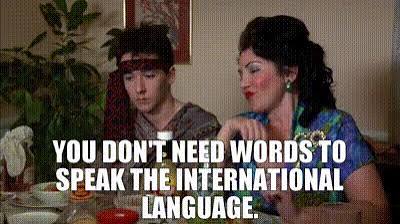
Hey LOOK AT THAT! All of the posters are getting along! 😂😜 There must be some truth to it’s only value being a convo starter. BTW Hawkgrrl, Better Off Dead is one of our favorite dumb movies to watch on an annual basis, usually around the holidays!
I’m very fortunate to have a dear wife that I’ve been married to going on 45 years. We had a rough spot, my dumbassery, but we survived it. We had many other trials that we faced together, but we have had many wonderful experiences as well. My thought is that every marriage/relationship has peaks and valleys, especially at the beginning. Couple’s need to recognize the valley and know that it will take some work to get out of it to a saddle or peak where the view is wonderful.
At this stage of our marriage, I feel like we enjoy more high elevation views, or plateaus than valleys. I know that we will need to endure the pains of old age and eventually death together, one way or another, but I can’t think of anyone I would rather navigate that storm with than my dear wife.
Cheers –
My love language is food. But that also means my wife and I have to hit the gym 3-4 times a week or we would balloon up in size pretty quickly!
17RRider: Yup…just like the “old days”; before the corrisive cancer of Politics was invited in.
Better Off Dead may be my favorite movie of all time, but it’s definitely my favorite Christmas movie. It’s only slightly marred by him playing the saxophone at her. Nobody likes that. Not even the French.
I’ve long tried to determine which of the five options was my love language. I’ve had some extra time on my hands lately and finally figured it out. It’s not one of the five options, which is why it took me so long.
My love language is romance. Gazing into each other’s eyes, soft kisses, writing poetry to each other, slow dancing. It does include elements of the five love languages but it’s more mental and emotional.
When I first came across the concept, most likely in a blogpost somewhere in the bloggernacle a good many years ago, I just rolled my eyes. Seemed a weird conceptual idea.
In our household we seem to have divided household tasks without really sitting down to discuss things, unless it is a big or expensive job like decorating or refitting things, and generally the person who sees something needs doing just does it. Although as the at home person I will do a lot on week days. I still recall when my husband and I moved into our first house and he vanished whilst I was bringing in boxes assisted by my parents who had driven down to help. When I tracked him down he was busy cleaning the toilet. Something we all appreciated.
Adam L. Absolutely. I’d go for Lego as a love language if I had to pick one. Along with, having my music endeavours supported, which translates as pick me up from my community orchestra rehearsals (I don’t drive) and attend all our concerts.