
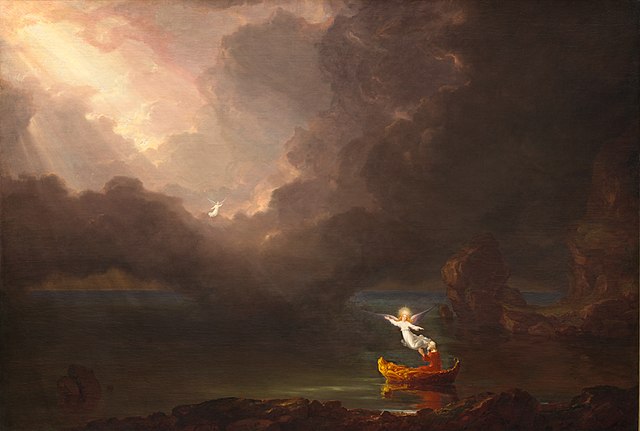
The hardest part about letting go isn’t always losing the person, the job, or the dream. It is losing the identity, security, and hope we built around it. A dream job may have validated my worth. A relationship may have reinforced my belief that I was lovable. A long-held goal may have given my life direction and purpose. When these things disappear, we don’t simply lose the thing itself. We lose the story we told ourselves about what the thing meant. And so we grieve—not only what is gone, but the person we thought we were because of it.
Perhaps this is one of the treasures buried beneath the surface of the story of the rich young ruler. Are we brave enough to dig for it? Or are we content to leave it buried beneath another lesson about obedience?
Revelation is not necessarily what is said, but what is discovered by digging beneath what is obvious.
These ancient stories we have canonized are made of words and ink. We often read them as though revelation were contained in the words themselves, waiting for us to uncover the correct interpretation. But perhaps revelation is less like receiving a message and more like a mining project. The text is the earth. The familiar interpretations are the layers of material already removed by generations before us. Beneath them may be something precious, but finding it requires a fearless willingness to dig—to disturb what has become settled, to question what seems obvious, and to enter the darkness without knowing exactly what we will find.
Revelation, then, is not merely hearing what the text says. It is the precious metal discovered in the excavation.
The character we specify as the rich, young, ruler who approaches Jesus is not plagued by the problem of insubordination. He has, by his own account, kept the commandments all his days. Perhaps there is some self-assurance in his answer, but obedience is not the precious resource in short supply. When we read this story primarily as a moral problem, we hear his question—“What one more thing must I do to get eternal life?”—as though he were simply asking for the final requirement on a list.
But listen more closely. There is something revealing in the question itself. He has apparently done everything right, and yet he is still asking what he lacks. He is already wealthy, youthful, powerful, and apparently righteous. And still he approaches Jesus as though life were a transaction: Tell me what I am missing. Tell me what I must acquire. Tell me what I must accomplish next.
His question is not merely about obedience. It is about acquisition. He wants eternal life to become one more possession.
In this sense, the rich young ruler begins to resemble the preacher in Ecclesiastes. The preacher has pursued the very things we are so often told will make a life meaningful. He has accumulated wealth, experienced pleasure, acquired wisdom, accomplished great things, built, planted, possessed, and achieved. And then he looks back over it all and asks what it was for.
There is something haunting about speaking from the other side of the fantasy. Most of us live on this side of it. When I get this, then I’ll be happy. When I have that, then I’ll finally be secure. When the right person comes along, when the business succeeds, when the money is sufficient, when the body looks different, when the children are okay, when the spiritual life finally falls into place—then I will have arrived. Joy is always somewhere just beyond the next acquisition.
But the preacher and the rich young ruler seem to have wandered farther into the fantasy than most of us ever do. They have, in different ways, discovered what happens when the things we imagine will complete us actually become ours. And still there is hunger.
“Everything is meaningless.”
“There is nothing new under the sun.”
All is vanity. Vapor. Smoke.
But perhaps we need to be careful about what we mean by “meaningless.” It isn’t necessarily that there is something inherently wrong with wealth, status, pleasure, achievement, relationships, or any of the other good things we spend our lives pursuing. The problem may be our relationship to things that are, by definition, impermanent.
We ask temporary things to carry permanent weight.
We ask a career to tell us who we are.
We ask a relationship to guarantee that we are lovable.
We ask wealth to provide security against an uncertain future.
We ask achievement to prove that our lives mattered.
We take something that is inherently passing and attach our identity to it as though it could make us permanent. And then we are surprised when it cannot.
This is what I mean by attachment. The story of the rich young ruler is often reduced, particularly in LDS discussions, to an act of defiance: Jesus gave him a commandment, and he was unwilling to obey it. But perhaps that reading leaves the deeper treasure buried.
Perhaps this is a story about attachment. The man’s problem may not simply be that he has possessions. It may be that his possessions have become part of the story he tells about himself. He cannot imagine himself apart from them.
And perhaps that is why Jesus’ invitation is so difficult. Jesus isn’t merely asking him to give something away. He is inviting him to discover who he is when the things he has used to construct his identity are no longer available to him. That is a much more frightening proposition.
And it brings us to the question of meaning.
Jim Palmer writes:
“The opposite of nihilism is not certainty. It is participation.”
I think there is something profound in that. Perhaps the opposite of nihilism is not possessing an explanation that makes everything make sense. Perhaps it is becoming fully involved in the life that is actually here.
There is a difference between asking for the meaning of life and discovering meaning in life.
The meaning of life sounds like a question demanding an answer. What is the purpose of all this? Why are we here? What is the final explanation? What is the destination?
And perhaps those questions aren’t wrong. But I wonder if we sometimes mistake an explanation for an experience. We want to stand outside of life long enough to understand it completely, as though meaning were an object hidden somewhere in the universe that we might eventually uncover, possess, and carry home.
But meaning may not work that way.
Meaning in life is different.
Meaning in life emerges through participation. Through loving someone. Through being present. Through creating something. Through serving. Through suffering and discovering that suffering does not have to be meaningless. Through noticing beauty. Through friendship. Through grief. Through giving ourselves to something beyond the narrow project of constructing an impressive self.
Meaning isn’t necessarily something I find at the end of an argument. It can emerge through the way I inhabit the life I have actually been given.
This gives the rich young ruler’s question a different resonance. “What must I do to inherit eternal life?” He is asking for something he can possess. Perhaps Jesus is offering him something he cannot possess at all. A different way of being alive.
The tragedy is not simply that he has too much. It may be that he is holding too tightly.
The same things that give us security can become the things that prevent us from participating freely in life. A relationship can become an identity. A career can become a verdict. An achievement can become a demand that the future continue validating the person we think we are.
Even religion can become another possession—another system of certainty we use to reassure ourselves that we know the answers, that we are on the right path, that our lives have the meaning we desperately want them to have.
And when any of these things changes, we experience more than loss. We experience disorientation.
Who am I now?
What does my life mean now?
What happens when the story I was telling about myself can no longer be sustained?
Perhaps this is why letting go is so painful. We aren’t merely releasing the thing. We are releasing our attachment to what we believed the thing would make us.
And perhaps this is also why the invitation of Jesus can feel less like a commandment and more like an excavation.
Dig beneath the obvious.
Dig beneath obedience.
Dig beneath acquisition.
Dig beneath the identity.
What remains?
Perhaps eternal life is not the final possession added to a successful life. Perhaps it is a realization. A way of seeing. A life no longer organized around the desperate need to become someone through acquisition.
Maybe eternal life is not something I acquire but something I awaken to.
Maybe the opposite of nihilism isn’t certainty.
Maybe it is participation.
And perhaps the question Jesus leaves me with isn’t simply:
What am I willing to give away?
It is:
What am I willing to stop needing in order to know that my life is meaningful?
Maybe this is the deeper invitation hidden inside the story. Not to possess the meaning of life, but to participate in the meaning that emerges within it.
That may be the treasure buried beneath the story.
And perhaps revelation is what happens when we become willing to dig for it.
Discussion Question
- If eternal life is less about possessing the “right” answers and more about participating fully in the life we have been given, how might that change the way we understand Jesus’ invitation to the rich young ruler—and perhaps our own lives?


This was so beautiful for me! Thank you!
This is so beautiful can I share it?
sacslas – Share away
Loving these posts, Todd. I relate so well to the part about losing identity due to job loss and forced out of two career paths. You get so used to older adults constantly asking you as a young adult where you’re going and what you’re doing. I felt like I disappointing the people around me when things didn’t work out in the paths that I wanted, even though the path I chose have me more money AND more flexibility and time with family. It was if I had to choose my identity for the rest of my life while in college and move hell and high water to get there. The fact is I wear multiple skill identities. I’m still skilled in what I was trained to do, and I still wear that identity even if I don’t make money doing it.
There is much to think aboutin this post. In my own faith journey I have found myself asking many of the same questions that you have raised in this post and I am feeling encouraged because others are asking these questions as well.
THIS is why I hated the temple the first time I experienced it in 1999 (that and being touched by a 90 year old man who probably misjudged where things were under that white poncho). It made heaven feel transactional. For the first 19 years of my life, Mormonism taught me that God would just our hearts. The temple disagrees.
Brad D raises a good point. So many people in my family avoid gatherings because they don’t want an inquisition into their lives. I think the older generation means well but instead of asking about jobs and relationships, we really should just ask people what is keeping them busy currently and what interests them. More about getting to know them and less about keeping tabs on their salary and pregnancy status.
Todd S,
Thank you for this very thoughtful post. So much of what you say resonates with me on the deepest levels.
When I hit the wall of depression years ago it was as if everything in the world lost its meaning. The only thing I was certain of was that I loved my family. But I could no longer find meaning in the beauty of the earth or our existence here. I could no longer look at the sunsets or the clouds on the horizon and find a reason to hope for better things to come.
Since then I’ve gone through a very slow healing process–and I’ve regained my hope and my connection with the beauty of creation–though some of the burdens of mental illness still remain with me. And what has happened over the last while is–and this is rather personal–with the help of heavenly influence I’ve been able to adjust my view of the this world–this life–so that I see it within a larger context–more of a “cosmic” context if you will. And now, everything that is good, true, and beautiful is charged with deeper meaning than ever before–meaning that extends beyond the limits of the fallen world.
I realize that some of what I’ve said here may sound a little “out there”–but in my opinion the key to finding meaning that endures is to have a hope in Christ. I haven’t yet arrived at the “perfect day”–but even so, as my hope grows brighter so, too, does everything that is virtuous, lovely, and praiseworthy become charged with greater meaning.
In the movie Hannah and her Sisters (1986) the Woody Allen character, Mickey, has a breakdown. He’s not been a religious person, or even spiritual, and he becomes greatly concerned he needs to believe in God. He investigates Catholicism but that doesn’t work. He investigates Hinduism. Nothing satisfies him and he contemplates suicide. The suicide attempt (a gun) fails and Mickey, in a daze finds himself in a movie theater that is showing the Marx Brothers movie “Duck Soup”. Mickey narrates:
“The movie was a film that I’d seen many times in my life since I was a kid, and I always loved it. I’m watching these people up on the screen and I started getting hooked on the film. I started to feel, how can you even think of killing yourself, I mean isn’t it so stupid. Look at all the people up there on the screen, they’re real funny, and what if the worst is true. What if there is no God and you only go around once and that’s it. Well, ya know, don’t you wanna be part of the experience? You know, what the hell it’s not all a drag. And I’m thinking to myself, Jeez, I should stop ruining my life searching for answers I’m never gonna get, and just enjoy it while it lasts.”
Religion should never be oppressive. If one is in a religion and not enjoying life, then what are you doing? The same applies to any personal pursuit. If the effort is not providing fulfillment then one ought to reflect on why that is.
Beautifully written and narrated, Todd. My sincere compliments! I couldn’t agree more!