
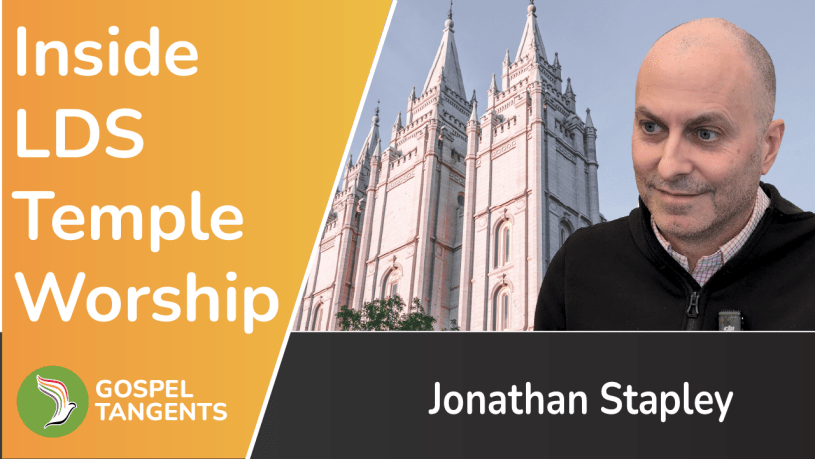
Chapter 1 is the best temple prep book ever. I sat down with Jonathan Stapley, an award-winning historian to discuss his newest book, Holiness to the Lord: Latter Day Saint Temple Worship. During the show, Stapley was even surprised he won the “Best Temple Book of 2025” award! I thi
0:00 Award Winning Author on LDS Temple Worship
3:20 Is Temple Worship Taboo?
10:14 Required Reading for Temple Prep
17:52 Kirtland Temple Period
Demystifying the Temple Experience/Temple Prep
For many, the LDS temple can feel like a secretive or taboo topic, but Stapley’s new book aims to change that. He designed his first chapter to be a transparent walkthrough for anyone preparing for the temple. It covers the practical, step-by-step process of going to the temple, from talking to a local bishop and purchasing garments to making an appointment and participating in the ceremonies.
Stapley explains that this level of openness is highly beneficial. Not only does it help outsiders understand the faith’s practices, but it also gives practicing Latter-day Saints a much-needed framework for discussing the temple constructively, helping them avoid being unhelpfully “cagey” or silent about their worship. Furthermore, Stapley pushes back against critics who use the private nature of the temple as a “dig” against the church, noting that the creation of sacred, “insider/outsider” boundary-maintaining spaces is a common practice across many world religions and ancient Christianity.
The Myth of the “OG” Endowment
When it comes to the temple’s core ceremony—the endowment—Stapley makes a striking historical observation: there is no such thing as an “OG” (original) endowment.
Before temples, bishops, or apostles were even fully established in the church, Joseph Smith taught that the saints would be “endowed with power from on high,” a concept pulled directly from the biblical books of Luke and Acts. Originally, this endowment was a charismatic experience rather than a set ritual. Over time, these biblical concepts were ritualized and performed, constantly adapting to the needs of the church.
Because the ceremony was initially transmitted orally, Stapley notes that the ritual has continually changed and adapted throughout its entire history. He directly challenges fundamentalist attempts to reconstruct a supposedly “original” 8-hour endowment, stating that such a platonic ideal never actually existed, and that procedural changes are a historical reality, not proof of apostasy as fundamentalists allege.
A “Golden Era” for Latter-day Saint History
Stapley shared that we are currently living in a “golden era” of Latter-day Saint historical research. Compared to a couple of decades ago when archive access felt like the “wild west,” there is now sustained openness and transparency, with massive resources like the Brigham Young papers available freely online.
While the church still naturally redacts specific details about the temple ceremonies from third-party historical documents, Stapley isn’t bothered by this. Instead of getting bogged down in reconstructing “ticky tack” changes to the ceremonies, he is far more interested in the bigger picture: understanding what these sacred rituals actually do in the lives, minds, and communities of the believers who participate in them.
Have you read his book? What are your impressions?


These rituals are not sacred.
williamellerychannings – Regardless your views on temple ritual, perhaps look outside yourself, and your views and recognize that they are sacred to many people that attend. It’s okay that they are not sacred for you.
“Stab and run comments” are what has gotten our country to where it is today. We should all be trying to develop empathy for viewpoints that are contrary to our own. Doing so, we all will find we are not as “correct” or “righteous” as we thought.
17RRider, sorry, but you just hit a nerve and I don’t mean to take this out on you, but you brought it up. So, you get to hear the rant.
I think there is value in recognizing that the temple rituals are not sacred. I think we should be allowed to say we do not believe they are sacred. We should be free to say what we believe just as much as people who still think they are sacred.
Yes, there are people who would get upset if I mocked. But just saying that the temple is not of God is just saying my belief. If believers get to say it is sacred, then unbelievers deserve that same respect. So, I believe the temple rituals are man made and are not sacred to whoever or whatever created the universe and us in it. We can respect that they may be held sacred to some of our fellow humans and respect that, but still know that they hold no power over us. It is that power over us that keeps us prisoner and it is false.
I had to recognize that to find peace. Those rituals are no more powerful than voodoo or birthday wishes. They do not keep me from God, or make my self righteous neighbor more favored of God, even if he is sure they do. They do not make him better or me evil.
So, I don’t need to take away from that neighbor if he finds them sacred, anymore than I need to go around telling children Santa isn’t real. But for me, *I* need to know they hold no power over me. So, just as children can be happier knowing it is their parents who love them and not some all powerful elf who lives at the North Pole, for me, *I* need to know that the temple ritual has no power to send me to hell because I just do not make a good girl Mormon. So, there is value is saying that the ritual is not sacred. But I do not need to rub anyone’s nose in that fact or try to destroy what may work for them.
For years and years I lived in hell now on earth because I was taught that this ritual that placed human men between me and God were sacred. It was life changing to discover that, no those rituals are just stuff men made up to put women lower than men. God does not hold those rituals sacred.
I can still respect people who have not learned that yet. I have no need to smash into the cake frosting the face of the kid who blows out candles to get his wish. But I need the truth.
People who know the truth also deserve respect and to be allowed to state our belief just as much as the person who holds them sacred deserves respect. I get tired of having to respect other people who tell me I am going to hell because I do not believe as they do, yet they are free to disrespect me. It should go both ways. But it doesn’t. They demand respect, while reserving the right to condemn others. That is respecting their right to disrespect me. Tired of it. Respect should go both ways. I do not need to shut up in order to respect their right to believe. I just need to leave them alone. But to them, the only way for me to respect them is to agree with them or shut up and act ashamed of what I believe. They demand a respect they are not willing to extend to others.
I won’t try to disprove to a believer or mock them and expect the same in return.
What is sacred is a subjective judgment that is personal to every individual. It is a matter of opinion rather than fact. williamellerychannings chose to phrase his opinion as a statement of fact. He might just as easily have written “I don’t regard Mormon temple ritual as sacred” had he wished to be more respectful and less condescending to others, and interested in advancing productive dialogue. I guess he wasn’t. I agree with 17RRider that this style of interaction online in search of cheap dopamine hits is a factor in the highly polarized society we have now. Anna, the difference between you and williamellerychannings, even though you clearly think similarly about the temple, is that you put in a whole lot more effort to be thoughtful and explain why expressing how you feel is important to you. That effort is worthy of respect much more than one liner cheap shot comments. It’s the thought out comments that keep me coming back to this forum.
Anna & Quentin, Spot on! Anna you explained your thinking as Quentin points out, and I know you were not railing on me because your experience was explained and valid. Quentin nailed my point home, and the primary reason I posted.
Thanks for both of your respectful replies.
17RRider. I did not stab and run. I stated my point in few words and they stand where they are. No running. I guess you wanted a longer explanation. The writer said the rituals are sacred, I said they aren’t. Why don’t you correct him from your high vantage point. The rituals are not sacred, and some people thinking they are does not change anything. I don’t think my comment got the country where it is today.