

I’m a nerd at heart, an engineer by profession, and a big kid according to my wife. I love a good graph, and even blogged about Venn diagrams a few years ago.
I found this site that has some interesting charts.
Here are some from that site that have some relavance to the Mormon church, and are possibly worrisome to the leadership in Salt Lake
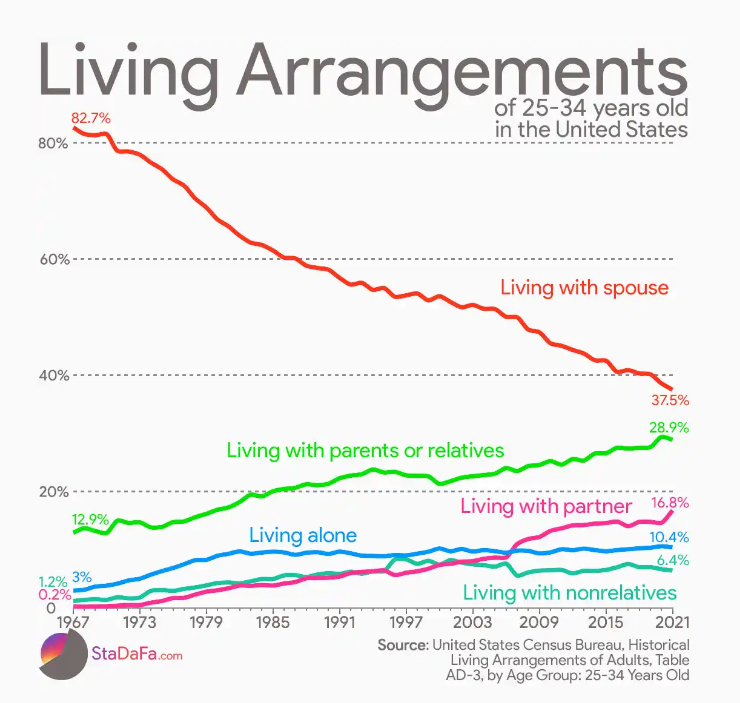
Is it any wonder that Elder Oaks urged young adults to get married in his talk last week? What are the biggest concerns the Church would have with the above tends?
Now here is one that is obviously very worrisome to the Q15
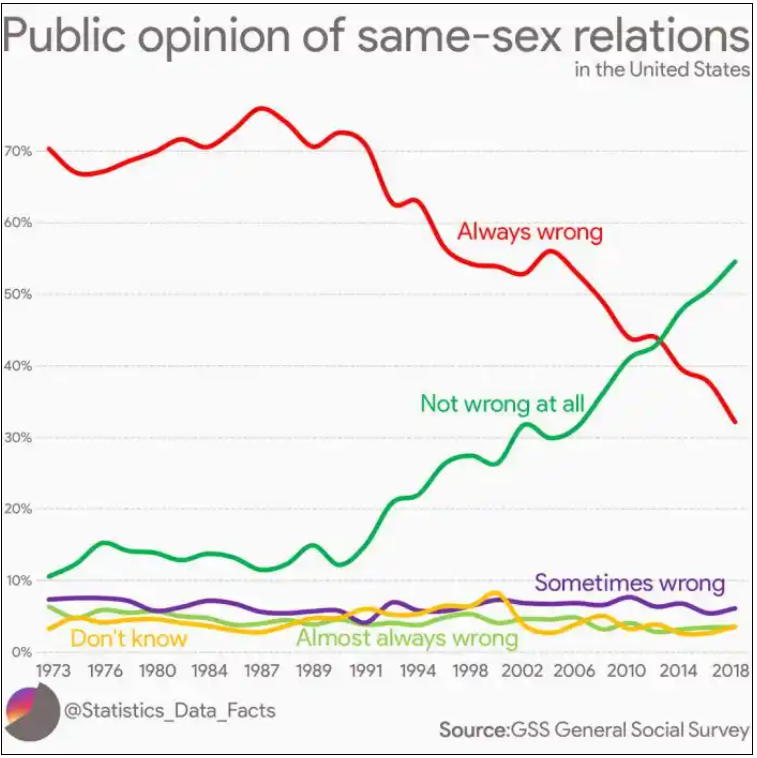
Neither the red or green line show any indication they will change their current trajectory. This will further drive away the newer generations from conservative religions in general, and the LDS church in particular.
And now a graph that is causing Pres Ezra “women come home” Benson to roll over in his grave.

The good news is the Church is slowing stepping away from it rhetoric on mothers not working outside the home. You can read an excellent review of this shift by Jana Reiss called “Mormonism’s slow shift away from demonizing working mothers”
The Church recently published some graphs in their News Room that showed the growth of the church since the beginning. Here is the main graph.

Missing from the above chart are how many members are active. The above graph was scaled so that the decline in the rate of membership growth is almost entirely obscured. If you look very carefully, you’ll see that the line dips slightly from 2013 to 2022, but nobody but nerds like me will even notice it. Below is a graph from the Wikipedia page for LDS membership history, that shows better the decline in growth in the church not evident in the Church’s graph.

What do you think of all of the above graphs? What jumps out to you? Did any of these numbers surprise you?
 Wheat & Tares
I wouldn’t be surprised if the institution that manages the Restored Church included vicarious baptism in its membership statistic. Nobody can verify any statistic the institution puts out, and I don’t think any of the statistics published by the institution are accurate or reliable. Agendas manufacture statistics…
For myself, graphs are OK. However, I am drawn to a map like a bug to the light. I can get lost for hours looking at various maps. I remember back in the 1980’s at Deseret Book they sold a map of the percentage of members per county throughout the USA. I never purchased it, just looked at it when going to the mall. Now, I can not find any reference to it online. Even similar maps produced in the 2010 era are missing. Looking for this data, is like looking for the Kamino lost planet in Star Wars. They should be available, but they have been scrubbed or not placed online.
My map memory corresponds with the graph data, back in 1980 when looking at Utah every county would be at the 75-80+% of concentration of LDS members. That is when I first learned that there were so many members in Phoenix and Idaho, and not only in Utah. Now many Utah counties, along with CA, AZ, CO, ID, WA, etc are different colors, indicating a significant loss of membership. The combination of the graph downward trend with the maps change of colors should be enough to say, “All is not well in Zion” and Daniel’s stone got stuck.
I graduated from highschool in 1985. All of these changes have been part of my life. I remember EBTs talk. I was getting my bachelor’s degree and considering a mission at the time. I felt like I had been sent to my room and told to put my face in the corner.
My mother suffered from depression as a stay at home mom. I was the oldest child. She went back to work when I was 14 and my youngest sister was 3. Everything in my home improved when my mother worked. I always intended to work.
Then I had my first child. I discovered I desperately wanted to be home with him. When he was two I came home for good. Do I regret that? Both yes and no.
It’s good the church has adjusted to women working. However they have put women through the ringer doing it and contributed to conflicts between them.
There isn’t just one way to have a family. The church has tried to define and control the concept of family but in the end, it will have to adjust to the changes in society that are inevitably occurring.
The purpose of a church is to support children of God in whatever their journey is. To be a world wide church is to understand this. This process is continuing. Our elderly leaders need to accept it more fully
A few thoughts:
1. LGBTQ graph. The church will eventually have to fully accept LGBTQ It’s a matter of time, but will it be too late.
2. Living arrangements. This comment is a tangent but very much related. I read a Deseret News article recently that said (buried) that the number of sexually active LDS teenagers is much higher than generally thought, almost approaching numbers of the general public. Once people realize that God won’t in fact smite you for premarital sex, I think church participation will drop off even more.
3. College and post grad degrees going to women. I have two daughters and two sons. Both of my daughters have masters degrees and I’m highly supportive of equality. That said I wish the numbers were 50/50. I don’t think it’s healthy for humanity to have either sex being more highly educated than the other. But from a church perspective this must – eventually- mean more access to decision making for women. Again, will it be too late.
4. Church growth. Both graphs tell a portion of the story. Would like to see a graph like: church growth counting converts active after a year. Growth counting only active members. Growth rate of Melchizedek priesthood holders leaving the church (not to imply that adult men are more important, but rather that is the metric the church uses for almost everything – M Priesthood holders available for leadership callings.) I’m sure those numbers are available to the Q15 but not many others.
5. Snarky remark. How about a uniquely American metric like school shootings per Bald Eagle? I was in Utah for the last 8 days and omg there are a lot of gun stores. Or maybe a metric of gun stores per adult store in Utah. That might be an interesting indicator of conservatism in Utah.
Thanks for the post Bishop. I enjoy a good graph.
I noticed the only real spike in membership growth, against a strong downward trend, were the two years I served my mission. I guess my cohort was either really persuasive or there were a lot of baseball baptisms.
It also was the time when the Berlin Wall fell, so I am curious if the growth was driven by the opening of the Eastern bloc.
One of the most revealing maps I’ve ever seen is one that illustrates LDS population density as a percentage of overall population. This map clearly shows that the Mormon corridor (Az, Ut, Id) is a real thing and outside of that corridor Mormons are barely a rounding error.
I wonder what the Brethren think of this map. We’ve sent hundreds of thousands of full-time missionaries (including me in the 80s) around the world and yet we can’t event get on the map east of the Mississippi, not to mention in foreign countries. Why is that? Is the world that evil? Is the message of the Gospel that weak?
I’m a transplant to Utah having lived back East most of my life and in other places. It’s so easy to see the bubble when you’ve lived in and out of it. Some of us (speaking of maps) have travelled a bit around the country and world. Why are we so few in number virtually everywhere on the map (2/1000 of the population) if we are the Lord’s one true Church? To me the density map I mentioned is as powerful as any anti-LDS literature.
The most alarming line on any graph is that showing just how many young adults are living in their parents’ basements. This will cause far more harm than any other thing measured by any of the charts or graphs.
Whether someone is a member or nonmember, active or inactive, they should not be wasting their live away living in a parent’s basement. Playing violent video games and watching hot dog eating contests on television does nothing productive for society.
All other negative trends follow that one. Broken families, drug addiction, and disease always increase in any society in which young people shun work and seek idleness.
Any organization worth its salt should preach that happiness comes from working hard to be productive, not from sitting around in windowless rooms clad in sweatpants and crocs. It is time to focus on priorities.
@John Charity Spring
Adults are living in their parent’s basement because they can’t afford basic costs of living such as rent or mortgages.
So I guess you could say that, I too, find the increasing rate of living with parents problematic.
Stop blaming the victims. Most young adults living with their parents likely have jobs and ambitions- it’s the economy duuude.
Same with the decreasing fertility rate. Having and raising kids are more expensive today. Housing. Medical care. Diminishing social safety net. Family planning is tied to economic security.
Just when you lose hope in humanity John Charity Spring re-appears on W&T and gives you a reason to wake up in the morning. 🙂
I have sometimes wondered if JCS is as horrified with my adult child living in an upstairs bedroom as he is with those that live in basements. They do wear Crocs when they are not at their full-time job providing care for the elderly in assisted living.
Plz put the jcs bot back in the box whoever you are, it’s regurgitating the same old tropes. Crocs? Still? Enough!
The issue often ignored by some is that how much one earns has little to do with the critical importance of that job to society. For example those who work harvesting the food we eat, plus those who teach and care for our children vs those who catch and throw footballs etc.
Money doesn’t “trickle down,” as much as it trickles up.
I have a 45 year old daughter who lives at home. Australian houses don’t have basements, but our house is built into the side of a hill and the bedrooms are underground so close. She is a federal police officer (like fbi) and works shifts so on day shift she leaves home at 4.00 am and returns 12 hours later. She owns 4 investment properties. In her spare time she is a volunteer rural fire officer which requires part of one day a week to keep fit (have to be able to carry 50 pounds 5 miles in 43 minutes) and 2 days burning off and training. She is one of 20 from our state population 5 million, asked to go to Canada where she is presently fighting fires working 14 hour shifts, in the tundra. The ground is peat which burns on top of perma frost then pine forest. So the ground is burning while the forest fire is crowning through the forest overhead, and they are trying to put it out.
I have a granddaughter who at 22 had a masters in law and environmental science, who is today being admitted to the bar in Queensland and then flying 1200k to Canberra for a work meeting. She works for the federal department of environment.
I wonder how many of the singles are like mine v JCS offensive caricature?
Whenever my wife gets emotional about the prospect of our teens leaving home and being adults in just a few years, I point out to her that there are reasonable odds they’ll be living with us well into their 20s. I assume from the chart that someone married and living with their parents would be in the “living with parents” category?
The numbers nerd inside of me says that the huge spike in church growth rate in 1989 must be attributable to other sources and not a one year dramatic increase in the effectiveness of missionaries. It looks like the data has large variation from year to year in the 1980s, which shrinks by half in the 1990s, and then settles down even more after 2000. Perhaps this represents shifts in record keeping from paper forms mailed around the world to early electronic records to instant internet access for everyone?
I don’t believe the accuracy of the Church’s published membership numbers. I think that the real total for 2022 are closer to 10M. With TR members closer to 5M.
That church growth graph is interesting, but like others here I’m quite skeptical about the self-reporting here. Did we change how we report things? Was there a surge in baseball baptisms during my mission time (I could certainly believe it)? But the one thing I thought was interesting is that Church membership decline may be outpacing population decrease, but not by much. It’s not way off.
I think it’s important to distinguish between growth rate and growth in absolute terms. Church membership as a count of members didn’t decline, but the RATE did decline. So instead of growing at ~3-4%, it grew at 1%…not the same as saying membership count went down. Not saying the OP missed this, but it’s a common misconception when looking at that kind of data that is worth pointing out.
It’s worth noting that there have been several dips close to 1% growth in church history – notably during The American Religious Depression of 1925-1935. There was a large decline in overall religious activity in the US, and unsurprisingly the LDS church was impacted by it. We are currently in a similar dip in overall religious interest in the US…so unsurprisingly the LDS church is impacted now as well. This is a largely macro thing and not isolated to a Mormon context.
There were only a handful of years where the church actually had an absolute decline in membership (i.e. a negative growth rate): 1839, and 1856-1857. There are another ten-ish years where growth was between to 0% and 1%. Otherwise, the church membership has increased every year.
The church-published graph of membership count (the second to last chart with the green lines) doesn’t have any of the common markers of an intentionally misleading graph. Both the X and Y axis increment their scales normally without gaps. The specific callouts are for pretty common milestones and/or important years in church history. It also doesn’t try to play with visual perspective (many 3d charts are displayed to make a certain part of the chart look much larger/smaller even if there’s nothing fishy going on with the actual X/Y scales).
It’s kind of a wide, squatty chart, but it’s also trying to cover a long timeline and growth from 0-20M people…they were trying to fit several charts into one article and give them a uniform size/format, so this was likely just a design choice – not really misleading though.
If I were a suit at N Temple st, I would be very concerned about the sharply divergent red and green lines in the second graph and I think many probably are. It’s only a matter of time ( and not very much time) before the vast majority of Christians believe that same-sex relations are no big deal. I think we’re more than halfway there, even among tbm’s. They just feel they can’t admit it publicly. I truly believe RMN is certain that the Second Coming (also known as my student debt repayment plan) will get here before that happens, and he won’t have to deal with the collective cognitive dissonance hysterics that will set in throughout the church once that red line completely disappears. btw, did anyone else notice that JCS suddenly reappeared in the comments as soon as Jack seemingly dropped off the face of the earth? … Things that make you go “hmmm.”
mat, the thing that is certain is that RMN will be dead before the Church has to “deal with the collective dissonance hysterics”. It won’t be RMN’s problem anymore.
I was serving a mission in 1989. I can testify that this graph is true ! I know of the tactics the LDS church was teaching its’ missionaries and how those numbers are true! . I promise that this church has graphs better than any other church !
John Dehlin was also in Guatemala in 1989 and my story mirrors his. Any one who served a LDS mission in 1989, in Central America (along with many other locations), and does not currently have questions about the whole LDS culture and system; I really wonder. Again, it was probably my fault (since the church likes to blame us, instead of taking responsibility) for believing as a 19-year old every thing that was told to me and having “Faith”, and the other missionaries must have already been PIMO. 1989 was the first time I ever questioned the church and its’ system. It took me another 25 years to put the whole puzzle together and open my eyes
The Pirate Priest
I am bad at math ( while facts are fun, math is not) and statistics are beyond me. If my memory still works, in both Brazil and Mexico there is over a million member discrepancy between census and church claims. That’s over 2 million in just 2 countries (Yea, I can do still do simple arithmetic)
So may question is– What is the growth rate when using accurate data?
Back in the Romney for president era, Pew did a thing for US? Is there anything current? I am curious what the figure is.
In Australia the gay marriage approval is 90% . There is no viable political party questioning gay marriage.
The church site says there are 155586 members.
But the census has 57868 self identifying as members
If 66% of these are active thats 38192 about 25% what the church claims.
But on the east coast of the country most wards are 50% pacific islander and increasing.
In other parts of the country the active members have reduced by 11 to 15%. If we assume the east coast of the country the original members have also left at say 12.5% that’s 4774 of the 38192 have also left but been replaced (so 33418) by islanders. So Australian members active is likley just over 20% of what the church claims, and falling each year.
Fact: There are probably 40,000 active members in Australia
Alternative fact; there are 155,586 active LDS in Australia.
Extrapolating Australian figures; If the Church claims 17 million reality is probably closer to 5 million active, tithing paying, TR holding members.