

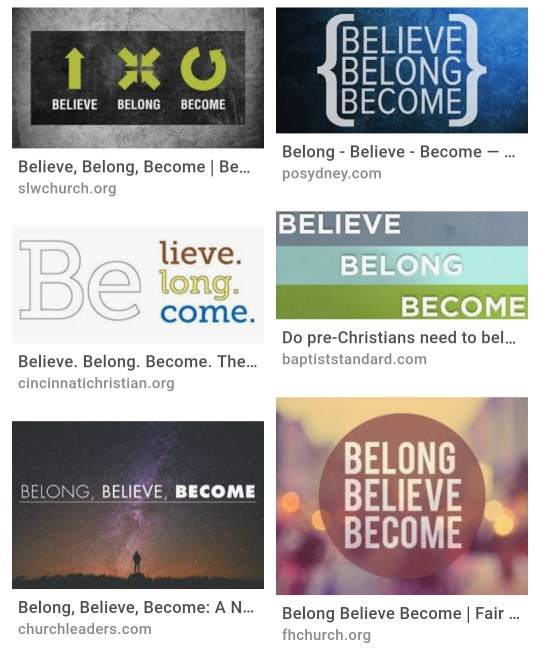
Recently there’s been gossip about a possible new Mormon.org replacement: Become.org. Jana Reiss wrote about it today in her “Top 5” General Conference rumors post. While I’m skeptical of the Church getting rid of their most recognizable website, the word “become” has already made its way on to Mormon.org as a three-part way to understand the Church, “Believe, Belong, Become” (or “Believe, Become, Belong” depending on which version of Mormon.org you’re looking at!). If the Church is trying to look more like other Christian denominations, this is definitely a way to do it. Variations of a believe-belong-become formula have been floating around for awhile.
Background
Some scholars have look at religious traditions through a lens of three factors: behavior, belief, and belonging. For example, one sociologist in 2002 posited that ritualistic behavior fosters belief in certain doctrines and belonging in the community. But it isn’t just scholars using this three-part model. Leaders of Christian denominations themselves have worked for many years with variations on this equation when talking about conversion to the faith. As one Baptist pastor put it,
The church I first learned about God from and from whom I received my beginning theology had an equation they followed. It was an equation that went without challenge because we weren’t living in challenging times. It was an equation that drove everything about how we functioned as a church and no one questioned it…. Here’s the old equation: Belief leads to behavior; and behavior leads to belonging.
Of course, that pastor was arguing that times were changing, and he proposed a different solution, “if we’ll find a way to allow people to belong, if they feel a sense of connection and welcome, they’ll find their way to believing.” Notably, a 2017 Catholic post also declared belonging as the critical first step, followed by belief and behavior.[1] At some point, people started replacing the word “behave” with the more ambitious “become.” The new process of evangelism (converting others to the gospel of Jesus Christ) thus became belonging, belief, and becoming.
Mormon.org
When I first heard the Become.org rumor, I figured (if true) it would have something to do with President Oaks’ October 2000 general conference address, “The Challenge to Become.” Oaks talked about the conversion to the gospel of Jesus Christ requiring us to become something greater than ourselves.
To testify is to know and to declare. The gospel challenges us to be “converted,” which requires us to do and to become.
So Oaks covered belief and becoming, but no belonging (he does mention exaltation as a family affair, but he doesn’t mention the wider church community). So Oaks’ talk doesn’t have anything to do with the verbiage on Mormon.org, right? Well…
On one version of Mormon.org, this is what’s under the “Believe, Belong, Become” headings:
Believe
Welcome to a living faith, where truths influence our everyday lives.
Belong
Welcome to a family. Learn about our worship services – even join us this Sunday!
Become
Welcome to a support group, where we try to help each other become better every day.

On another version of Mormon.org, this is what’s under the “Believe, Become, Belong” headings:
Believe
Welcome to a source of divine help.
As a companion to the Holy Bible, the Book of Mormon teaches us about Jesus Christ and His immeasurable love for us. We invite you to learn more about this amazing book of scripture, as well as other beliefs that help us feel closer to God.
Become
Welcome to a living faith.
What we preach on Sunday, we try to practice every day. Living the values taught by Jesus Christ leads to a sense of purpose and happiness, as well as provide strength to face the difficulties of life.
Belong
Welcome to a community.
Here, we think of each other as family – and act like we actually are. Learn about our workshop services, community projects and age-based activity programs – you’re welcome to come join us this Sunday at a meetinghouse near you.

Overall, the Mormon.org use of believe and belong matches up well with the traditional Christian usage of the terms. Click on “Believe” and it takes you to one of several variations of a website describing some of our beliefs. Click on “Belong” on one version of Mormon.org and there’s a cute website describing our church community. The other version links to website describing what it’s like to specifically worship in our community.
The interesting one is the “Become” section. On both versions of Mormon.org, the “Become” section takes you to a website describing our beliefs on the meaning of life. One line states, “God’s plan is not random. It is carefully designed to give you the experiences you need to return to Him again as a better person.” The only time the word “become” is used on the entire page is in dealing with life’s challenges: “You can choose to make the best of the most trying circumstances, and you can become better because of them.” In looking deeper, that section on challenges echoes Oaks’ “The Challenge to Become” talk.
Most of us experience some measure of what the scriptures call “the furnace of affliction” (Isa. 48:10; 1 Ne. 20:10)…. Through the justice and mercy of a loving Father in Heaven, the refinement and sanctification possible through such experiences can help us achieve what God desires us to become.
Not to say that the meaning of life site only focuses on afflictions (although, there is a featured video of a mom talking about her son’s autism). The three major sections of the website talk about the significance of your life to God (meaning, Heavenly Father), others (mainly your family), and your eternal happiness (primarily finding joy amidst affliction, though it does mention baptism and repentance).
What’s missing from that website is the concept of becoming a disciple of Christ that you find in more traditional Christian denominational uses. Even Oaks took time to mention the pure love of Christ as a hallmark of conversion in his conference address.
We are challenged to move through a process of conversion toward that status and condition called eternal life. This is achieved not just by doing what is right, but by doing it for the right reason—for the pure love of Christ. The Apostle Paul illustrated this in his famous teaching about the importance of charity (see 1 Cor. 13). The reason charity never fails and the reason charity is greater than even the most significant acts of goodness he cited is that charity, “the pure love of Christ” (Moroni 7:47), is not an act but a condition or state of being. Charity is attained through a succession of acts that result in a conversion. Charity is something one becomes.
See, that’s more what I expected to see with “Become.”
Takeaway
It does seem that there is something to the “Become” rumor, though right now the evidence is on Mormon.org, not Become.org. Currently, the Become.org site is a duplicate of one of the Church’s beliefs websites, but that could change anytime. (Heck, the Mormon.org site has been driving me nuts with their variations just in the last week.) Regardless, like dropping our unique “Mormon” moniker, using a “Believe, Belong, Become” (or “Believe, Become, Belong”) motto helps us look more like mainstream Christian denominations. Maybe that’s the point?
Questions:
- What do you think about Mormon.org using “Believe, Become, Belong”? Is this new or do you remember the Church using the phrase before?
- What do you think about the way Mormon.org uses “Become”?
[1] There has been some deserved pushback on any sort of universal linear model for conversion like belong–>belief–>behave. One Lutheran bishop argued in 2013,
Belonging, Behaving and Believing are all significant aspects of a fully embodied disciple of Jesus Christ, but we may need to be flexible in our ordering. For some people, there is an intellectual connection to the faith, for others it will be the attractiveness of belonging to a community, and others it’s the behaviors. In other words, there is no one path. We are wise to see that there are multiple ways into the faith.
W&T blogger Andrew S approached Mormonism with a similar three-part structure in a 2016 blog post, noting that individual members appreciate different aspects of the religion more than others. One group’s primary satisfaction is behavior, the doing (Word of Wisdom, church attendance, prayer, etc.). Another group is drawn more towards the unique doctrines and beliefs, the intellectual satisfaction. A third group cherishes belonging, the strong sense of community in Mormonism.
 Wheat & Tares
As women transition to the workforce the pool of free labor for community building has dried up.
LDS chapels have gone from community centers with sports, drama and music leagues to three hours on Sunday and bleary eyed seminary students—in many stakes attending in their pajamas and free to sleep the entire time.
Speaking of Believe, Belong, Become —there needs to be something to belong to that is a community.
The move to a two hour block would reduce the sense of community even more unless something else is done.
A good something else would be 30 minute sacrament. 30 minute social period with food. Then perhaps an hour of discussion groups on a gospel lesson.
This would make a good start as a text for study next year: https://www.amazon.com/Five-Books-Moses-Translation-Commentary-ebook/dp/B0028T8T40
The change would renew the missing community. It would provide some substance to gospel study. Following the injunction “out of the best books.”
It would provide nourishment for the soul.
When I did Early Church History at Tabor College my teacher explained it as believe , belong, behave.
Otherwise I like it, though I would like more of Oaks style becoming, I understand what they are doing.
The problem is they need four parts, not three and modem science says you can only make a three part message succeed.
I agree that behavior should really stay separate from become. That’s why I like that Lutheran bishop’s take – believing, belonging, and behavior are all different elements in *becoming* a disciple of Christ.
I second Stephen R Marsh’s proposal that we use Alter’s Five Books of Moses as our course of study. I used it when I taught this past year and we barely had time to scratch the surface. It is better than anything the correlation committee has (or likely will) come up with
This is a pretty silly idea. Oh well. Nothing is perfect.
This is new to me. Thanks for posting. I immediately thought of Oaks’ talk on becoming. I like it much better than a focus too be more obedient, or lenghten your stride or more more more…..because there is an emphasis on doing what you can and prioritize to become better…and I like that.
It is fascinating to me it is so copied from other religions and sociology studies. Makes me just think we are not so different from other humans on this spiritual journey.
When Nelson said they had work to do to move away from referring to ourselves as Mormon or LDS…I wondered how they could do that. But this makes sense to me. This is one way to have a purpose in changing the names we use by emphasizing the purpose we are after.
It’s plausible to me.
However, one unintended consequence may be we lose our brand name and distinction from other religions. Maybe that is both good and bad.
Last conference there seemed to be more about loving God, and our fellow men/ women. This is a positive, and taken to its conclusion doesn’t allow for discrimination against women and gays.
I like the emphasis on becoming too. I see it as replacing “obedience is the first law of heaven”. Obedience does not lead to becoming whatever we want, as part of becoming a diciple of Christ.
Notice my favorite scripture “Be ye therefore perfect, even as your father in heaven is perfect” is about becoming, not about doing. In context it is about becoming a person who loves our fellows, as perfectly as our heavenly father does.
This all seems good, a little surprising, but good.
Some time ago Hawkgirl did a blog on personality types. The first type valued obedience, loyalty , the second group, love, integrity, etc. millenials are more likely to favour the second group so it is good to see the change in emphasis.
I like Andrew’s idea, which might give us this angle: “Are you a behaving Mormon, a believing Mormon, or a belonging Mormon? What aspect of the Three B’s keeps you active in the Church?”
I also noticed that the term “Mormon community” pops up a lot in the belonging discussion. There is going to be whole new minefield of when the word “Mormon” can and can’t be used on LDS websites and in LDS manuals. So I’m guessing they can use the term “Mormon community” (it’s an adjective) but “community of Mormons” would not be allowed (it’s a noun). Instead they’d have to use “community of members of the Church of Jesus Christ of Latter-day Saints.” Or maybe: “community of Mormons who are really uptight about using the word ‘Mormon’.”
I’d say I’m a “behaving” Mormon but I’m less of a “believing” Mormon which makes me feel as though I’m not a “belonging” Mormon.
I don’t know that I’ll ever feel like I belong. The overall culture places too much emphasis on literal belief and on the authority that derives from those literal beliefs.
Steve–I *LOVE* the idea of a mid-meeting community meal/snack. We have potlucks now, but as a fourth hour of church they can be extremely difficult for people with various challenges (small children, health conditions, transportation issues, etc.). A shared repast on time that is part of the Sunday worship schedule would be really easily integrated and I think it could be a lot of fun. Only way we’d get it done in 30 min is if we issued special callings for people to make it happen. (Though perhaps if we started alternating priesthood/RS and Sunday School, then whichever group of leaders is “off” on a particular Sunday could assist with the meal cleanup.)
We meet in a Stake building that was build in decades past as a suburban faith center near a major Eastern US city. It’s dilapidated and empty-feeling now that we’re surrounded by updated buildings in the wards around us, including the ones in the urban core. Could definitely be making better use of the space. (And don’t get me started on the other wards who use our space on off-days and then leave it a mess.)
“Belief leads to behavior; and behavior leads to belonging”
Works the other way as well; belonging encourages behavior which encourages belief (and discourages disbelief and bad behavior).
It is why, in my opinion, very few people (or blogs) can straddle the fence for any significant length of time.
Love this post. I have not visited the Mormon.org site, and I appreciated your observation of the lack of emphasis or mention of “becoming” a disciple of Christ.
For many LDS, this is what is missing in our Sunday worship. If you talk to your average LDS, they are incredulous when it is suggested that we don’t emphasize Christ in our sacrament mtgs and lessons.
I wish that we LDS were encouraged to attend worship services of other Christian denominations at least once per quarter. I think it would be shocking for many LDS to see and hear what it looks like to “talk of Christ, rejoice in Christ, preach of Christ, prophesy of Christ” in ways that we just…don’t. They would see worship of Christ, prayer to Christ, singing to Christ, stories of Christ, conversion to Christ, surrender to Christ, passion…, love…, teaching…, etc.
I would be willing to bet that not a few LDS would feel genuinely uneasy, uncomfortable with the focus and emphasis on Jesus Christ. I’m seeing signs of improvement from church leadership, and it has been slow in adoption at the local level. But some progress.
A local non-denim Christian church near me in Draper emphasizes to visitors that they are welcome to belong before they believe. It is a powerful invitation. Makes me think of my mission, and the baptismal interviews we gave, pressuring belief and behavior before they were welcome to belong.
These 3 word/phrase mottos remind of some interesting past efforts. Of course, there is Timothy Leary”s 1966 “turn on, tune in, drop out.” Luckily this one has not survived as a useful life plan. And Leary has been discredited. Then there is the more recent “eat, pray, love.” This one involved a popular book and movie. The latter starring Julia Roberts. The “eat” motto received a lot of criticism from Christian clerics. But I think Oprah liked it.
I’m not a big fan of this type of sloganeering, so the 3 b’s don’t do it for me. But if I was a fan, I would have a couple of suggestions. I think one of the words/phrases should include something related to “service.” Also, instead of a static word like “become,” I would prefer using something more dynamic like “becoming.” But becoming has too many definitions. So how about progressing (think eternal progression)?
So how about: believing, sharing (servicing doesn’t work), progressing? It doesn’t have the alliteration of the 3 b’s, but maybe a Church PR person could work on that.