
I’ve been thinking about what I’ve learned from reading the Old Testament about whether or not being called to a position makes someone infallible or if those called can be expected to be human.
 In earlier blog posts I’ve discussed Aaron and the golden calf he built for the Children of Israel to worship. He was not unique. It was not just Aaron and Baalim who went off track.
Look at the story of Eli in the Bible. Followed by the story of Samuel in the Bible. Followed by the story of Saul. Followed by the story of David. Followed by the story of Solomon. Followed by many other stories.
Eli’s sons were disrespectful and worse. To quote from the Bible:
12 Eli’s sons were scoundrels; they had no regard for the Lord. 13 Now it was the practice of the priests that, whenever any of the people offered a sacrifice, the priest’s servant would come with a three-pronged fork in his hand while the meat was being boiled 14 and would plunge the fork into the pan or kettle or caldron or pot. Whatever the fork brought up the priest would take for himself. This is how they treated all the Israelites who came to Shiloh. 15 But even before the fat was burned, the priest’s servant would come and say to the person who was sacrificing, “Give the priest some meat to roast; he won’t accept boiled meat from you, but only raw.”
16 If the person said to him, “Let the fat be burned first, and then take whatever you want,” the servant would answer, “No, hand it over now; if you don’t, I’ll take it by force.”
17 This sin of the young men was very great in the Lord’s sight, for they[a] were treating the Lord’s offering with contempt.
…
22 Now Eli, who was very old, heard about everything his sons were doing to all Israel and how they slept with the women who served at the entrance to the tent of meeting.
Eli’s kids corrupted the priesthood and the temple. His successor Samuel’s kids took bribes and perverted justice.
1In his old age Samuel appointed his sons as judges over Israel. 2The name of his firstborn son was Joel, and the name of his second son was Abijah. They were judges in Beer Sheba. 3But his sons did not follow his ways. Instead, they made money dishonestly, accepted bribes, and perverted justice.
So then Saul was called as King.
A man who lived there answered, “And who is their father?” So it became a saying: “Is Saul also among the prophets?
… and he too prophesied in Samuel’s presence
 Saul went pretty sour in the end after a start that had him regarded as king and prophet. So we get David.
David’s story gets rocky (Bathsheba was the daughter of an important general, the wife of a hero in the army, the granddaughter of another military leader).
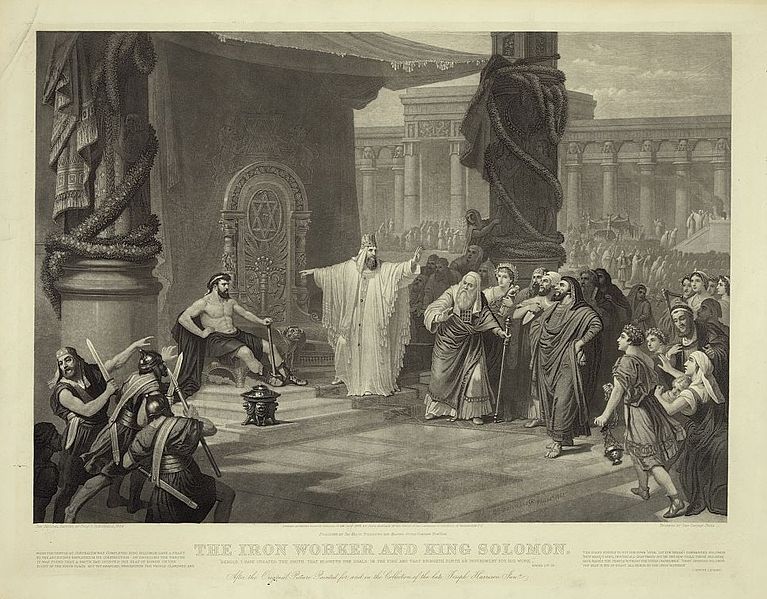
After David we get Solomon, blessed with wisdom from God. He seems to have a good start.
Then Solomon loses a war with a Pharaoh, marries his daughter and eventually builds temples to other gods and worships them.
The Old Testament is a string of stories of those called and failing to thrive.
There are a few bright spots. Deborah thrived and her administration did not fall into corruption. So not all the judges, prophets and kings went sour or had mixed results. Many did. Often their guidance was not as clear as it could have been either.
“Pay attention to what I have to say! When there is a prophet among you, won’t I, the LORD, reveal myself to him in a vision? Won’t I speak with him in a dream? 7But that’s not how it is with my servant Moses, since he has been entrusted with my entire household! 8I speak to him audibly and in visions, not in mysteries. If he can gaze at the image of the LORD, why aren’t you afraid to speak against my servant Moses?”
It is easy to read that as praising Moses, but it also discusses the reality that Moses was unique, that unlike most prophets whose guidance is not as clear and who are communicated with in mysteries. Moses was not the baseline or the expectation, the other was (and is).
I think we need that kind of perspective to temper our expectations. I’m hoping the new curriculum shares that. That God sends us prophets for guidance and to help bridge the gap between God and man, but that they are humans too, still “one of us.” At the same time, it is important to remember that God expects us to not reject them in spite of their frailties. After all, when the people of Israel decided that Eli’s sons followed by Samuel’s sons were too much, God said:
And the Lord told him: “Listen to all that the people are saying to you; it is not you they have rejected, but they have rejected me as their king.
Perhaps they could have lessons with a variant of the song “What if God was one of us” added to the song book [What if a prophet was one of us?]
What do you think:
- How do we honor our parents or honor prophets without sliding into idolatry?
- How do we have reasonable expectations combined with faith?
- How do we avoid having our faith damaged when prophets act as they did in the Old Testament?
- How do we learn to have the benefit of God’s reaching towards us through prophets in spite of their humanity?
- What do you think?
 Wheat & Tares
Thanks for the post. To answer your first study question, I believe having a willingness (and ability) to teach and learn about our leaders’ flaws helps us to avoid leader worship. For example, I read an article many years ago in Dialogue about Joseph F. Smith’s mission to Hawaii and the tragic events preceding that time. It gave me much more empathy and admiration for President Smith than did the hagiography that often passes for Church history. When we’re willing to teach warts and all history, leaders stop becoming demigods and start becoming faithful and flawed people called by God to see through a glass darkly who attempt to understand what they see and then try lead their brothers and sisters accordingly. It’s not easy, and they have failed many, many times, just like me.
To be human for prophets today means they prefer Pepsi to Coke. Generally, much of the membership of the Church has strayed into believing leaders are infallible. In priesthood meeting or Sunday School, I’m unable to voice any disagreement or concern with a teaching or authority that isn’t met with some sort of admonishment that I might be speaking ill of the Lord’s anointed. That includes when I state I’m not willing to sacrifice my own kid or take on a second wife. Seems a week doesn’t go by without me hearing somewhere “the Lord will never allow the prophet to lead the church astray”. I once was leading the discussion in a Group meeting when Wilford Woodruff’s quote was repeated and I mentioned to the class that I didn’t really believe that to be the case. I got open mouths and huge deer in the headlight stares from the group. Believing leaders are infallible is a dangerous attitude and will probably cause the church some great harm, if it hasn’t already.
D&C 121:36:37 and 41 apply to everyone. Amen to the priesthood or the authority of that man when they are exercised in any degree of unrighteousness. So I’m not on board with the statement “God expects us to not reject them in spite of their frailties”, if those frailties include exercising dominion in unrighteousness.
President James E. Faust once wrote “The responsibility for determining the divine validity of that which one of the oracles of God may state does not rest solely upon him.” President J. Reuben Clark stated, “We can tell when the speakers are ‘moved upon by the Holy Ghost’ only when we, ourselves, are ‘moved upon by the Holy Ghost’’.
In practice, however, Holy Ghost confirmation seems to only run one way. When there is a disconnect between the oracle and “we, ourselves” the assumption is “we, ourselves” need to try harder to receive the HG confirmation, but as Stephen R. Marsh points out, that streak of leader perfection would seem to be an aberration.
In my view the larger question is who is a prophet. In Hebrew Nabi prophet means a spokesman for God. That means someone to whom God has spoken and who relays the message to the people. Please correct me if I am wtong but I am not aware of anyone in the hierarchy in the last 50 years or so making that claim publicly. I know of people who make that claim for others but none who make it for themselves.. Is anyone else anywhere of such a claim? Do we even have a prophet who claims to be the recepiant of revelations or publicly announced an act of seership. No one will be happier than I if I am mistaken
I highly recommend Robert Alter’s The Story of David. It opened my eyes to how subpar Samuel was. I came away realizing that Samuel’s attempt to install Saul as a puppet king was partly to blame for Israel’s ultimate divisions.