
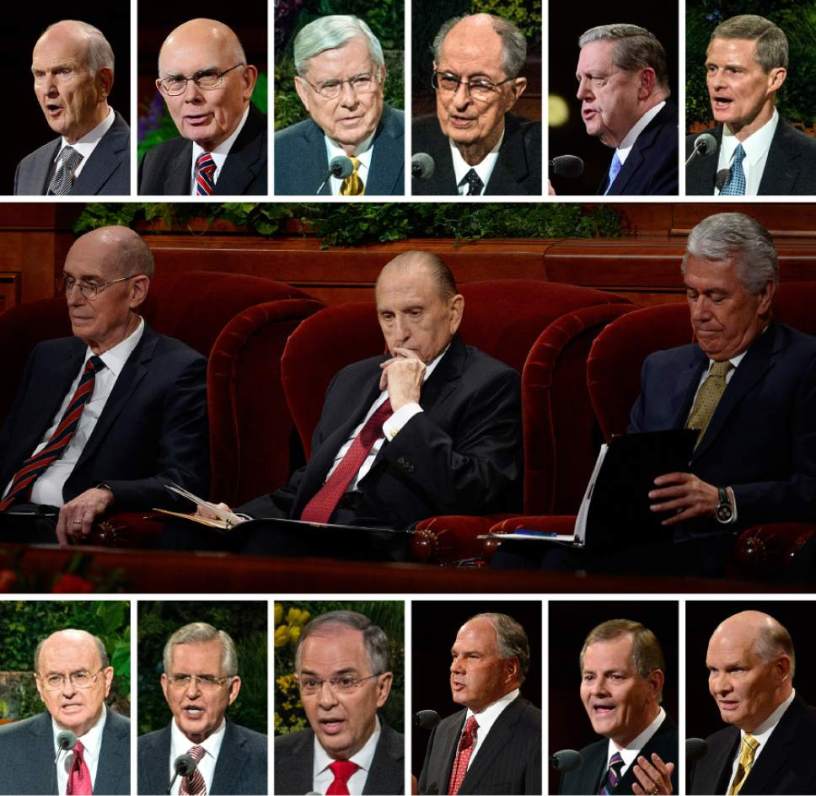

As we await the funeral of President Thomas S. Monson and the installation of President Russell M. Nelson as the Next President of the Church of Jesus Christ of Latter Day Saints, the issue of age is being discussed once again.
While it is true President Nelson is 93 years of age, he appears healthy and hardy at this point. The issues of age brought up are not specifically related to their physical age, though that is a sub-issue, it is their ability to relate to all members of the Church, particularly young people. Today’s young people, those under 30 for example, live a very different experience than President Nelson did when he was in that same age group (around the 1940’s, early 50’s).
As many remember, President Hinckley stanchly defended the ages of the senior leadership of the Church when he stated to Mike Wallace on the show “60 Minutes,”
“Isn’t it wonderful, a man of maturity at the head. A man of judgement who isn’t blown about by every wind of doctrine.”
I suppose there is some credence in that statement, but on the other side, can they relate to the real problems of today?
My own opinion is that I’ve been surprised at how much the Leaders seem to know and understand the problems being faced by Church members of all ages. Sure, there are decisions, like the exclusion policy that seem a throwback to an earlier time, but yet, addresses a real problem for the Church that is happening today—the issue of Same sex marriage. No matter what side you come down on, it is a modern issue that Church will have to deal with at some point.
But , as I pondered this issue, I wondered where else do we see older people in charge of large organizations.
Here are the ages of the Quorum of Twelve Apostles ( currently 14):
| Name | Ordained | Age |
| Russell M. Nelson | 4/12/1984 | 93.3 |
| Dallin H. Oaks | 5/3/1984 | 85.3 |
| M. Russell Ballard | 10/10/1985 | 89.3 |
| Jeffrey R. Holland | 6/23/1994 | 77.1 |
| Henry B. Eyring | 4/6/1995 | 84.6 |
| Dieter F. Uchtdorf | 10/7/2004 | 77.2 |
| David A. Bednar | 10/7/2004 | 65.5 |
| Quentin L. Cook | 10/11/2007 | 77.3 |
| D. Todd Christofferson | 4/10/2008 | 72.9 |
| Neil L. Andersen | 4/9/2009 | 66.4 |
| Ronald A. Rasband | 10/8/2015 | 66.9 |
| Gary E. Stevenson | 10/8/2015 | 62.4 |
| Dale G. Renlund | 10/8/2015 | 65.1 |
The average age is 75.64 years. The oldest is President Nelson at 93.3 years, the youngest is Elder Stevenson at 62.4.
US Government
I also looked at two US Governmental bodies, The US Congress (House and Senate) and US Supreme Court. The Supreme Court is interesting in that the members are appointed for life, but some resign before death.
| Senate | ||
| Name | Title | Age |
| Mike Pence | President | 58 |
| Orrin Hatch (R) | President pro tempore | 83 |
| Patrick Leahy (D) | President pro tempore emeritus: | 77 |
| Republican Leadership | ||
| Mitch McConnell | Majority Leader: | 75 |
| John Cornyn | Majority Whip: | 65 |
| John Thune | Conference Chairman: | 57 |
| Roy Blunt | Conference Vice Chair: | 67 |
| Cory Gardner | Campaign Committee Chair: | 43 |
| John Barrasso | Policy Committee Chairman: | 65 |
| Democratic Leadership | ||
| Chuck Schumer | Minority Leader | 67 |
| Dick Durbin | Minority Whip | 73 |
| Patty Murray | Assistant Minority Leader | 67 |
| Jeff Merkley | Chief Deputy Whip | 61 |
| Debbie Stabenow | Policy Committee Chair | 67 |
| Mark Warner | Caucus Vice Chairs | 63 |
| Elizabeth Warren | 68 | |
| Tammy Baldwin | Caucus Secretary | 55 |
| Chris Van Hollen | Campaign Committee Chair | 58 |
| Joe Manchin | Policy Committee Vice Chair | 70 |
| Amy Klobuchar | Steering Committee Chair | 57 |
| Bernie Sanders | Outreach Chair | 76 |
| Average Age | 65.33 | |
| House of Representatives | ||
| Paul Ryan (R) | Speaker | 47 |
| Majority (Republican) leadership | ||
| Kevin McCarthy | Majority Leader | 52 |
| Steve Scalise | Majority Whip | 52 |
| Cathy McMorris Rodgers | Conference Chair | 48 |
| Doug Collins | Conference Vice-Chair | 51 |
| Jason T. Smith | Conference Secretary | 37 |
| Steve Stivers | Campaign Committee Chairman | 52 |
| Luke Messer | Policy Committee Chairman | 48 |
| Minority (Democratic) leadership | ||
| Nancy Pelosi | Minority Leader | 77 |
| Steny Hoyer | Minority Whip | 78 |
| Jim Clyburn | Assistant Minority Leader | 77 |
| Joseph Crowley | Caucus Chairman | 55 |
| Linda Sánchez | Caucus Vice-Chairwoman | 48 |
| Ben Ray Luján | Campaign Committee Chairman | 45 |
| Rosa DeLauro | Steering and Policy Committee Co-Chairs | 74 |
| Eric Swalwell | 37 | |
| Cheri Bustos | Policy and Communications Chairmen | 56 |
| David Cicilline | 56 | |
| Hakeem Jeffries | 47 | |
| Average Age | 54.58 |
If we look at the average age of the entire US Congress, it continues to trend toward older Americans. The average age for the US House of Representatives is 57.0 years, while the US Senate is 62 years. (Congressional Research Service) Even though you are eligible to run for the House at age 25 and the Senate at 30.
The closer parallel to Church Leadership is the US Supreme Court:
US Supreme Court
| Name | Title | Age |
| John Roberts | Chief Justice | 62 |
| Anthony Kennedy | Associate Justice | 81 |
| Clarence Thomas | Associate Justice | 69 |
| Ruth Bader Ginsburg | Associate Justice | 84 |
| Stephen Breyer | Associate Justice | 79 |
| Samuel Alito | Associate Justice | 67 |
| Sonya Sotomayer | Associate Justice | 63 |
| Elena Kagen | Associate Justice | 57 |
| Neil Gorsuch | Associate Justice | 50 |
| Average Age | 68 |
This is interesting that we as a country do favor age and experience somewhat even though the median age in the US as of 2015 is 37.8 years. (Wikipedia)
Retirement
The retirement age in US is nominally around 66,67 years old as far as the Social Security Administration is concerned. However, retirement, as we know it was invented in Germany in the late 1800’s.
“In 1881 Otto von Bismarck, the conservative minister president of Prussia, presented a radical idea to the Reichstag: government-run financial support for older members of society. In other words, retirement. The idea was radical because back then, people simply did not retire. If you were alive, you worked—probably on a farm—or, if you were wealthier, managed a farm or larger estate.
This was a big “if,” at the time. That retirement age just about aligned with life expectancy in Germany then. Even with retirement, most people still worked until they died.” (The Atlantic).
The secondary benefit of retirement was giving younger people the jobs held by those older people.
What’s the Precedent?
In the early Church, it appears the first Apostles of the Church were young men. And they did serve until they died. The problem is they were mostly martyred (killed) and did not die of natural causes at a ripe old age. This was true in the early days of the LDS Church. Joseph Smith was only 38 when he was killed. But after that, the senior leaders tended to serve until they died. Brigham Young was 76, John Taylor was 78, Wilford Woodruff was 91, etc.
In October Conference in September 1978, General Authorities, except for First Presidency and The Quorum Of the Twelve, were granted Emeritus status and retired from full time Church service. (LDS Facts)
In some cases, these men continued to serve in the Church in some capacity, including Elder Jacob De Jager, who became a Ward Bishop a month after his emeritus status was announced. (Deseret News)
As far as lifetime appointments for the 1st Presidency and Q12, I cannot find any scriptural injunction that points to lifetime appointments. Maybe someone can set me straight on that.
But it seems, that if nothing else, compassion would say that we give these men a break in their waning years, especially if they become disabled in some way. Most have served the Church their entire life, leaving the family to travel abroad and meet with Church members. They follow a rigorous schedule for many, many years in most cases. There is no reason, in this information age, to try to hide the fact of whether a Church leader can truly function in their calling. Perhaps, he should be thanked for his longtime service and released from full time service.
What do you think? Should be have a set retirement age for the Senior Church Leadership? Is it compassion, common sense or both?
BTW, I tried to find out the ages of the Auxiliary General Leadership of the Church, the nine women, and was not able because in keeping with a long held tradition, the Church does not publish the ages of the Women Leaders, be they General Leadership, Temple Matrons, of Mission President’s wives. Seems a bit old fashion.
 Wheat & Tares
I didn’t question the ability of these older men to relate to current times until the release of the Exclusion Policy. They were clearly unprepared for both the leak of the policy and the backlash. Had they really been in touch with modern times, they would’ve known the policy would be leaked, they would have known it would receive serious backlash including from inside of the church, and they would have made preparations ahead of time to deal with it.
Instead of mandatory retirement, it might be better to make voluntary retirement more culturally acceptable, so an aging apostle can leave office with dignity, and on his own terms. Supreme Court justices, even with lifetime appointments, are more likely to retire than die on the bench. Pope Benedict broke from tradition and retired when the effects of age became too much of a burden. We put 70s out to pasture when they get too old. Sometimes I wonder if some of the older apostles actually want to step down, but believe they can’t because it’s never been done before–“unwritten order of things” and all that.
This problem is mostly centered on the President of the Church. If the Q12 is a couple of members short because of incapacity of some members, it still can function fairly well. They can push down many responsibilities onto the 70s and keep on working. In the past, President Romney was the president of the Q12 for several years and was not seen publicly. President Hunter was the acting president and then-Elder Packer would be available to help also. Of course some people may not have wanted Elder Packer stepping up so soon.
For the church president, there are 2 counselors who can take up the work. If we are in a time like the early 90s with President Hinckley as the 1st councilor and also likely to be President in the near future, then there is likely to be smooth functioning. Our most recent episode was somewhat different. President Eyring was not likely to be the church president any time soon and the 2 senior members of the Q12 were. There was some room for disfunction or misdirection in leadership.
On the whole, I think that the old apostles are in touch with almost every issue impacting many church members. There are major drug addiction issues and other crime problems in Utah. Only a few of the worst 1st world problems are not right there for them to observe. With the frequent overseas travel schedules, I am sure that they are in tune with 3rd world issue better than the vast majority of US members (except perhaps missionaries in those locales).
Jack,
I like the voluntary retirement idea and think that it could work. One big problem is that several apostles are called at or near retirement age. Half the Q12 was over 60 when called. Even President Nelson turned 60 later in the year that he was called. I am sure that this puts them into the mindset that they are called to serve for the rest of their life. In the past this was less of an issue because most of the senior leaders had been in full time church callings at much younger ages. President Hunter was the first church president who was over 50 when called to full-time church service.
A couple years ago, we had one of those canned multi-regional stake conference broadcasts from SLC, and the closing speaker was Elder Hales. He was clearly unwell. Right before his talk began, the camera focused on the other seated speakers for an awkwardly long time, presumably so Elder Hales could be wheeled into position before the camera switched to him. When it did, it focused tightly on his face to keep any part of his wheelchair out of the shot, but you could tell he was in a seated position, and his oxygen glasses were fairly obvious. His speech was halting, and it was hard to watch. It was sad that this elderly man, clearly suffering, was trotted out and expected to provide valuable leadership and guidance to thousands of people. But it was even more sad that they went to extraordinary lengths to hide or downplay his health problems. It would be better if we could just let each apostle bow out gracefully when he feels it’s time.
The human brain deteriorates in old age. It’s a matter of science. I think we can make some small, conservative changes that would make a lot of sense and be reasonably easy for the general body to accept. Determine an age maximum for apostles. Maybe about 85. That wouldn’t apply to prophet. But maybe there could also be a contingency that if the Q15 all voted in favor, the prophet could be released. This would only be in rare cases of Alzheimers, etc.
I’m with Jack Hughes on this. I understand that individuals, whether through genetics, the will of God, whatever, can defy stereotypes regarding aging and so I can see an 80 year old being pretty spry and alert and whatnot. My grandmother died at the age of 99 and was lucid till the end. My concern is less with aging/diminished capacity and more with respecting the basic human dignity of the leader. If we truly love/revere our prophets, why are we trotting out clearly ill, confused or otherwise incapacitated men to give a short talk that they clearly labor through? I was really sad for President Monson when it became clear he was really struggling just to stay focused on anything and was clearly exhibiting signs of dementia or some other cognitive impairment. Are we so desperate to hear our leader speak and have a chance to revere him that we compromise his personhood by propping him up in front of a teleprompter for five minutes? What kind of people would rather have that happen than let the man rest and enjoy his last days on earth peacefully and calmly? I was really disturbed by this and I think the solution, as Jack points out, is to let them bow out gracefully.
El Oso– I disagree, I think age puts our apostles out of touch with many pressing issues facing church members today. Being successful white hetero mostly-American elderly men puts them in a privileged position to begin with. You can see it every time Elder Oaks gives one of his trademark firesides to single adults, haranguing his audience to not delay marriage or put off starting families, when he has probably never experienced the pressures of crushing student debt, a depressed/changing job market, unemployment/underemployment, dim career prospects or a lack of job security. Our current apostles started their professional careers in unusually good economic circumstances, which allowed them to raise families on a single income, then eventually retire with generous pensions–neither of which are realistic expectations for rising generations. Whenever an apostle tells us to “just pull yourself up by the bootstraps” or “it will all work out in the end” or something to that effect, it rings hollow, as lived experience has taught me and many others of my generation that life is a lot more complicated than that. The church leaders have also repeatedly demonstrated that on social issues, they are far behind, and more reactive than proactive. Even the most junior apostles were serving full-time missions in an era when the church had racial restrictions in place.
Jack Hughes has a point about changing the culture to accept a graceful retirement. Most orthodox members I know believe that this system of choosing church presidents is God’s way. I’ve heard people say that God orders new apostles in a way such that He essentially chooses the next prophet – knowing when each will die.
I see no way around it until a particularly brave LDS version of Pope Benedict retires himself, thereby setting precedent. Not unlike George Washington who set precedent after retiring as two terms as US President (he was probably considered fairly old when he retired – for that era). Until FDR came along, proving that such a tradition may not work, but I don’t see the Q15 reaching consensus that all future presidents have to retire at some given age. They are trained to respect age and seniority. I’ve heard that they leave their Q15 meetings with the most senior leaving first while the young ones wait until last, even though they have to wait patiently a long time.
Ideally we’d have a broader mixture of church leadership. If I’ve learned anything as a professional it’s that diversity works. Women, minorities, different ages, different geographies. Right now we have Q70 and Q15 almost entirely made up of wealthy, white, American men. This church reflects their collective prejudices over the past 150 years.
I’m fascinated by the oldest on the US Supreme Court being the more liberal.
Stephen, I suspect that’s explained by the vastly different selection procedures between the Q15 and the Supreme Court. The Q15 themselves select new members of their ranks, leading to a perpetuation of the ideology of the older members (obviously there are some shifts, but the members being selected by members leads to a great deal of ideological stability, for better or worse). Members of the Supreme Court are selected by an interplay of the President and Senate, which means that changes in ideology of the members reflect changes in ideology in other branches of government (with some lag and some room for Justices to surprise us), not any kind of generational or age-driven shifts in temperament.
I am old enough to be a contemporary apostle. That said I am speaking from personal experience of knowing my father who died last year at age 90 about as sharp as they come and many other people my age and in between.
First, anyone over 80 is barely making it..
Second, anyone over 60 is over the hill and their best years are behind them, with rare exception.
It is in our DNA. At puberty certain genes / enzyme systems are activated and development proceeds in a new direction. As we age gradually other genes/ enzyme systems are turned on that start shutting things down. Aging is an active process. It is much more than wear and tear that explains why I can’t run even 1/2 mile at 10 mph while my young adult son can run 10 miles at 10 mph and he is packing about 40 pounds more muscle than I ever had. The physical results are obvious, but take it to other levels that involve cognition or social skills and he beats me every time, except maybe where years of experience might help. Those with capable adult children know what I am trying to say. Elderly people function best as advisors not as executives.
This church is in trouble. The once good(?) ship Mormon is sinking. What we are doing isn’t working anymore. Putting any one of the 14 people on that list in charge is not going to be enough. It doesn’t matter how healthy or infirm any of them might be, the leadership slips onto other similar stooped shoulders and nothing substantially different is done. Small compromises will not fix a problem this big. Diversity of octogenarians is not the answer either.
Arrange their rocking chairs as you wish. It might be past time for decisive and creative leadership to save us. If the entire geriatric GA group doesn’t recognize the need for younger, vigorous, creative, honest and decisive leadership, then we will continue to dwindle to irrelevance. They are probably collectively incapable of making the tough decisions to even allow for this to happen. They might sincerely believe that this is the way God wants his only especially true church to go. We are marching on the illusionary path to the top of the mountain while we are simultaneously rolling down the mountain with increasing velocity into a deeper chasm.
It will take a long time for the hundred billion dollars ( a complete wild ass guess) to be squandered and the physical properties of the church may stand for centuries. I don’t see the LDS church slipping into complete oblivion for a long time. I don’t know religious history well enough to think of a parallel example of a religion that was this wealthy, about this size, and had the same devotion to such a bone-headed leadership succession model. But it doesn’t matter, it would convince no one.
The current pope is 81. The current Supreme Court justices that liberal leaning individuals favor as “more in tune” are older as well.
Bednar is usually seen as the most conservative.
I think that there is something besides age going on.
So J. I agree that it is not age that makes the difference. And Mike, it is not creativity that most critics complain about —it is positions they disagree with. They would be fine with old people they agree with —most like the current pope.
I was too terse. And I don’t disagree that we are at a major inflection point. I’m just not certain that we need to take the path of “Logan’s Run” (to cite an example of a complete rejection of any value to experience).
On the other hand, there were good reasons to embrace emeritus status for 70s. How to otherwise move towards those sorts of governance changes is an interesting question but one that is often driven by factors other than age analysis.
“You can see it every time Elder Oaks gives one of his trademark firesides to single adults, haranguing his audience to not delay marriage or put off starting families, when he has probably never experienced the pressures of crushing student debt, a depressed/changing job market, unemployment/underemployment, dim career prospects or a lack of job security. ”
E. Oaks was born during the great depression, was the oldest child when his father died of TB and worked to support his mother and his younger brothers. No, I think it is fair to say he has some experience with hardship, poverty, depressed/changing job markets, etc.
Stephen R Marsh – glad I wasn’t the only one getting echoes of “Logan’s Run” from the comments.
At the end of the day, nothing we say or think on this really matters. The only people who can make the change are the apostles themselves, and I don’t know that they see any problems with the model.
I think that an age limit for the first presidency and the quorum of the 12 would be useful in avoiding long periods where the church is lead by people who are incapacitated. The change would need to happen gradually based on a pre-announced schedule to avoid the leadership rejecting the change based on its effect on their length of service.
The church could announce that all leaders would transition to emeritus status at 100 and that the emeritus age would drop by one year every other year until it reached 85 in 30 years. None of the senior leaders of the quorum would be significantly impacted by the change, but it would bring the ages of the church leadership back in line with the ages of Supreme Court justices.
Age is a very real problem. It goes to the credibility of the Prophets. I read we have had incapacitated leaders for half of the last 50 years. One of our points of differenttion is that we are lead by a Prophet. Our missionaries say that a lot, then come home and find he’s incapacitated by diamentia. What does that do to their faith?
In Aust the average age of federal politicians has always been between 48 and 52, there are a couple over 65. So it appears we are more inclined to retire, we do have a reasonable pension.
I think there should be a retirement age, but with a culture that you can voluntarily retire before that. The compulsory retirement age could start at 80 and be reduced to 70 over time.
To justify very old Prophets we claim they learn a lot over the years, not justified.
The time of bringing in the retirement age would be a good time to get some diversity.
I have been a member since 1958, and I think the only Apostle I have ever met is Mark E Petersen. None since then have any idea of me. They are protected from reality.
It would be a good idea in this computer age to ask for feedback. For example they could put a question up each month eg. how do you feel about the pox ranging from -5 to +5. It may be that those who oppose are all -5 and those who support are +1.
Do you think it would be good to allow the 15 to retire at 80?
I think there must be change soon if we want more than 20% activity from the rising generation.
ReTx, Obviously you are correct but if there is discussion, and they realise there is a problem, they may eventually respond.
The feedback idea, could also allow members to pose the questions.
If the church doesn’t initiate it could one of you tech savvy people do it for them?
I have two rather lengthy things to say about this. I can’t figure out how to combine them into a coherent comment, so here they are, somewhat separated.
First, El Oso mentions that the president of the church has 2 councilors who can take up the work when he is unable. I think it is worth examining what happens when the councilors are also incapacitated.
Under David McKay the first presidency extended to include up to five councilors. First Hugh Brown was called as a third counselor. After Reuben Clark died the presidency shrunk down to two councilors, but grew again to include (eventually) Thorpe Isaacson, Joseph Fielding Smith, and Alvin Dyer.
Under Spencer Kimball a third counselor was also called: Gordon Hinkley.
When this is done, a new apostle is called to the Q12, so including the first presidency you have a Q16, Q17, or Q18. At least, that was what was done when Hinkley became a counselor. I don’t know what happened under McKay.
It’s interesting to me that although new counselors are called, the disabled or incapacitated counselors are not released. It appears there is no rest for the weary.
——-
Okay, the other thing I had to say:
There was recently a lesson in priesthood discussing the succession. Everyone else seemed to agree that the succession policy will never change (which is weird to me because this is the church that preaches modern day revelation), and that the status quo is good because there is no politicking. This strikes me as post-hoc reasoning.
If 100 years ago the leaders had decided to have a big old debate and vote for the next prophet, we would pat ourselves on the back every time the smoke announcing the imminent decision came out of the chimney of the [church office building / Salt Lake Temple / What have you]. Instead we have rule by seniority and everyone says it’s grand because no one has to make the hard decision.
I lean toward some type of emeritus status not to “move them out of the way”, but to let them enjoy their families. And remember, “It doesn’t matter where you serve, but how”. Right?
And one statement you made Jeff, “the issue of Same sex marriage. No matter what side you come down on, it is a modern issue that Church will have to deal with at some point.” Either “deal with it” or deal with the consequences – which I think the church is already feeling the consequences.